
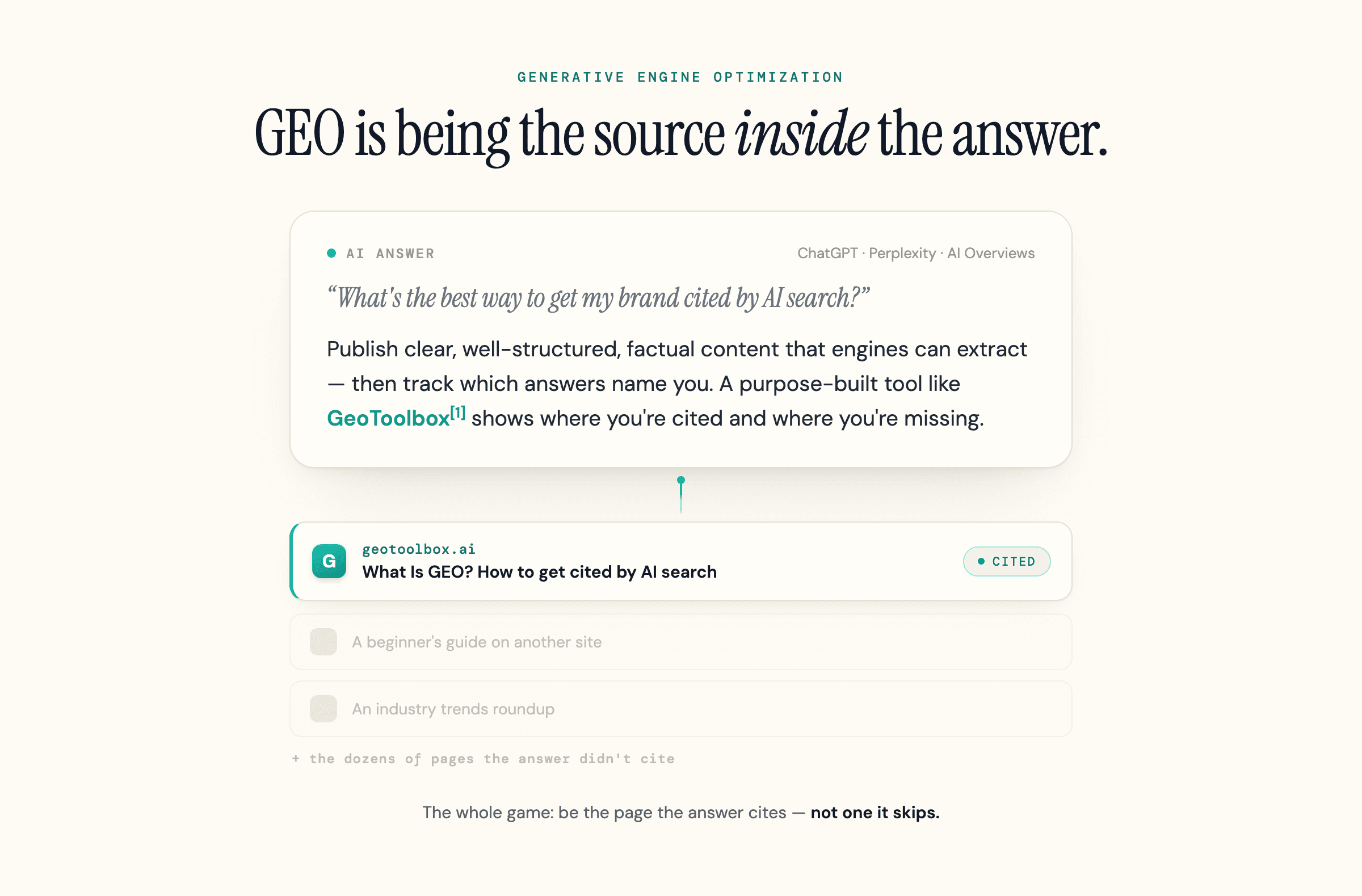
You can rank first on Google and still lose the click. Someone asks ChatGPT or Google's AI Overview the same question your page answers, gets an AI-generated answer with three citations, and never scrolls to your result. Generative engine optimization (GEO) is the work of making sure your brand is one of those citations.
No hype.
What Is Generative Engine Optimization?
Generative engine optimization (GEO) is the practice of structuring your content and brand presence so AI-powered engines like ChatGPT, Perplexity, Gemini, and Google's AI Overviews cite, quote, and recommend you in their answers. Where traditional SEO competes for a ranked list of links, GEO competes to be part of the synthesized answer itself.
A generative engine is any system that reads a question, pulls from multiple sources, and writes a single answer instead of returning ten links. ChatGPT, Perplexity, Google's AI Overviews, Gemini, Claude, Microsoft Copilot, and open-weight models like Kimi are all generative engines. They don't send most users to a results page. They give the answer, list a few sources, and move on.
That changes the goal. You are no longer optimizing only for a position. You are optimizing to be the source the model trusts enough to name. That means clear, extractable answers, factual claims it can lift, and a brand presence consistent enough across the web that the model treats you as authoritative on the topic.
The label is newer than the practice. The neutral definition is laid out on Wikipedia, and the term broke into the mainstream when New York Magazine ran "SEO Is Dead. Say Hello to GEO." in 2025. The practice predates the name.
GEO, AEO, LLMO, and AI Search Engine Optimization: The Same Job, Different Names
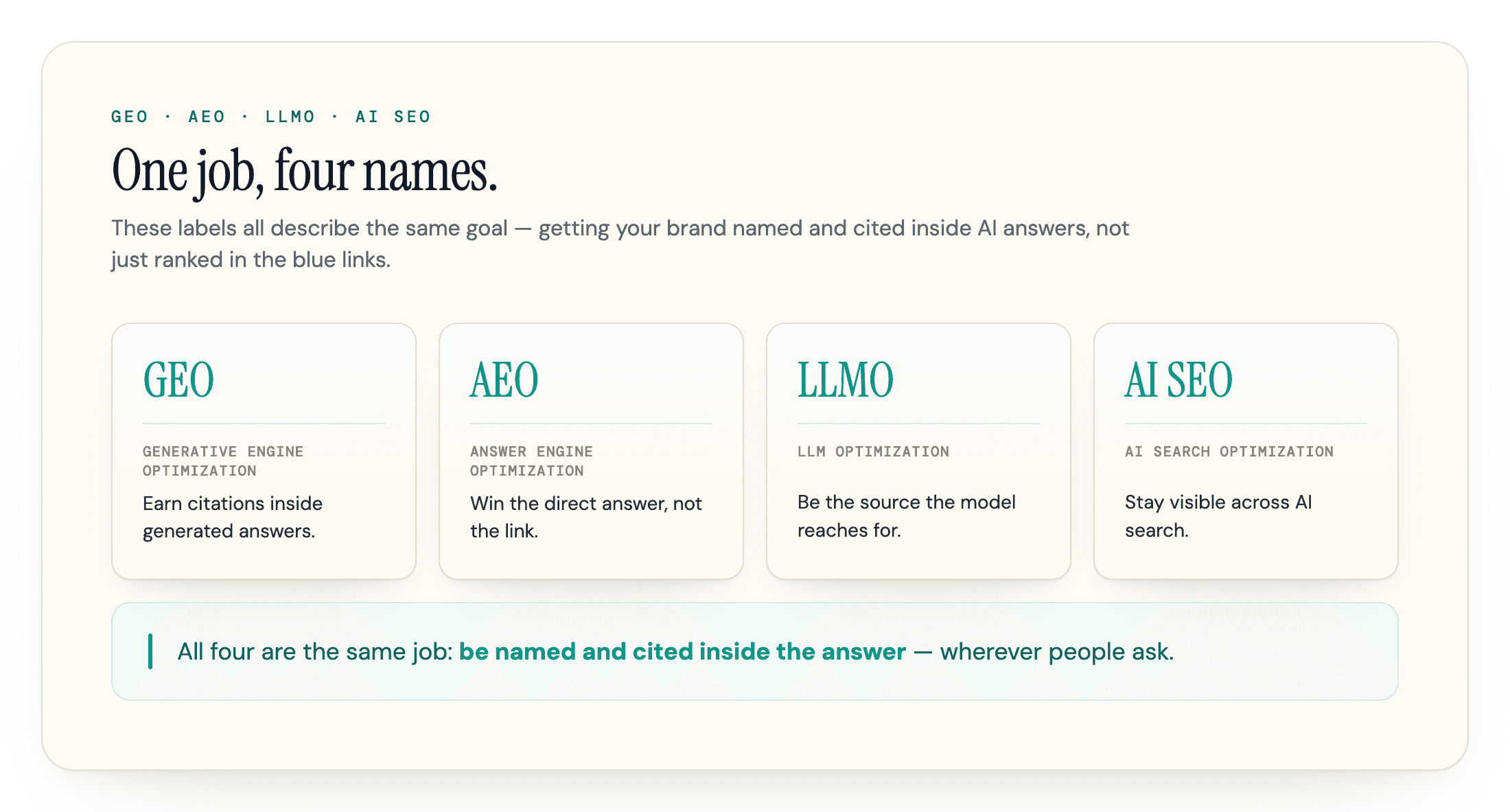
You will see this discipline called four or five different things. They are mostly the same job described from different angles, and the search data shows people hunting for all of them.
| Term | What it emphasizes | US searches/mo |
|---|---|---|
| Generative engine optimization (GEO) | Being cited by generative engines that write answers | 4,400 |
| Answer engine optimization (AEO) | Winning the direct answer, including featured snippets and voice | 2,400 |
| AI search engine optimization | The plain-English umbrella for all of it | 8,100 |
| LLM SEO / LLMO | Optimizing specifically for large language models | 880 |
Search volumes: DataForSEO, United States, July 2026.
Here's the honest version. GEO and AEO are not separate disciplines you staff separately. Answer engine optimization (AEO) grew out of the featured-snippet era and leans toward concise, direct answers. GEO is the newer label for the same instinct applied to generative engines that synthesize rather than excerpt, and LLMO is that same work pointed at chat assistants. AI search engine optimization, or AI SEO, is simply the plain-English umbrella most people actually type for all of it. If you want them laid side by side, see GEO vs AEO vs SEO.
The distinctions matter less than the shared requirement: write content a machine can extract and trust. The vocabulary itself is still settling. Most of the acronym labels have cooled since their 2025 spike, with "generative engine optimization" down 33% year over year and "LLM SEO" down 63%, while "answer engine optimization" is up 26% and plain-English phrasings keep growing ("AI search optimization", a shorter variant of the umbrella term above, is up 82% year over year per DataForSEO). Whatever the label, the tactics are the same.
One practical note. Picking a label is a marketing decision, not a strategy. Do not let a vendor convince you that AEO and GEO need two budgets. The work overlaps almost entirely.
Why GEO Matters Now
The behavior shift is already measurable, and it is hitting the exact spot SEO used to own: the click.
When Google shows an AI Overview, the top organic result gets fewer clicks. Ahrefs measured a 34.5% lower average click-through rate (CTR) for the top-ranking page when it compared March 2025 with March 2024 across 300,000 keywords, and its re-run on December 2025 data put the gap at 58%. You can hold position one and watch the traffic that came with it shrink.
Adoption is the other half. Pew Research Center found that 44% of US adults have used ChatGPT, per a survey published in June 2026, up from 34% a year earlier and more than double the 2023 share. Globally, OpenAI reported 900 million weekly ChatGPT users in February 2026, up from 800 million the previous October. Sensor Tower, an app tracker, estimates the ChatGPT app alone crossed 1 billion monthly active users in May 2026; OpenAI has not confirmed the number. That is one tool. Add Perplexity, Gemini, Copilot, and Google's own AI Overviews, and a real share of the questions your customers used to type into a search box now get answered by a generative AI model before anyone clicks.
Statcounter put ChatGPT at 77.89% of worldwide AI chatbot referrals to websites in July 2026, with Gemini second at 9.93%, Perplexity at 5.86%, and Claude and Copilot splitting most of the rest. More than a fifth of AI referrals already come from somewhere other than ChatGPT, so optimizing for one engine is too narrow a target. For the full 2026 picture across every engine and study, see our state of AI search 2026 report.
This is the pain that brings many teams to GEO. They check Search Console and see impressions holding or rising while clicks fall. The ranking is fine. The answer is being delivered before anyone reaches it. If your brand is not in that answer, you are invisible for the query even though you "rank."
GEO is the response to that shift. Not a replacement for SEO, an extension of it into surfaces that summarize instead of link.
Is GEO Just a Buzzword?
Partly yes, and it is worth saying so out loud. The skepticism you see on Reddit and in SEO circles is earned. A lot of "GEO" content is old SEO advice with the acronym swapped in, sold at a premium by people who rebranded overnight.
So separate two questions that usually get mashed together.
Is the term hype? Often, yes. There is no secret GEO checklist that the SEO fundamentals did not already cover. Google says as much: its AI optimization guide (updated July 2026) is blunt that "you don't need to create new machine readable files, AI text files, markup, or Markdown" to appear in its generative AI features. Helpful, well-structured content is the requirement, same as it has been.
Is the behavior shift real? Yes, and that part is not hype. The CTR data and adoption numbers above are not marketing. The way people find answers is moving toward synthesis, and that genuinely changes which pages get value from a query.
Hold both at once. You do not need a new discipline, a new team, or a new six-figure tool. You do need to apply solid content and technical practices with AI answers as an explicit target, and you need to measure whether it works instead of trusting a vendor's dashboard. The brands that win here are not the ones who bought the most expensive "GEO platform." They are the ones who made their best pages easy for a machine to read, quote, and trust.
How AI Engines Decide What to Cite
Every generative engine runs roughly the same loop, and knowing it tells you where to intervene.
Understand
The model reads the question and expands it into related sub-queries. A single question fans out into several searches the user never typed.
Retrieve
It pulls a candidate pool of documents for those sub-queries, sometimes from a partner search index, sometimes from its own crawl.
Evaluate
It ranks those candidates by authority, recency, relevance, and agreement across sources. A claim that shows up consistently in several independent places beats one that appears in a single page. A source it has cited successfully before has an edge over a brand-new domain.
Generate
It writes the answer and attaches a few citations, the sources it leaned on most.
Two things follow from this. First, the evaluation step rewards clarity and corroboration, not keyword density. If your claim is stated plainly and echoed by other credible sources, it is easier to lift. Second, citation is not ranking. The model is choosing what to quote, not what to list, and those are different selection problems.
For a deeper walk through how each engine handles retrieval and why they diverge, see our breakdown of how AI search works. The short version for GEO: you are optimizing for the evaluate-and-generate steps, where extractability and trust decide whether you make the answer.
Why Google Authority Does Not Equal AI Citations
A high domain rating does not buy you AI citations. This trips up experienced SEOs, because the instinct is to assume the pages Google ranks are the pages AI quotes. They are often not.
We tested it. When we queried ChatGPT for "generative engine optimization" topics and counted which domains it cited, the most-cited sources were Wikipedia, Reddit, and arXiv, not the high-authority marketing blogs that dominate the Google results for the same term. The encyclopedia, the forum, and the academic preprint server beat the SEO publications.
We ran that test via DataForSEO LLM Mentions, ChatGPT, United States, May 2026.
Why does this happen? Generative engines lean on sources that are structured, consensus-driven, and heavily referenced. Wikipedia is built for extraction. Reddit threads capture real first-hand language and answers. Academic papers are dense with citable claims. A polished agency blog optimized for Google links may carry less of what a model wants to quote.
The takeaway is not "go spam Reddit." It is that citation logic and ranking logic are different systems. Earned presence on the places models trust, clear factual content on your own pages, and consistent mentions across the web matter more than the backlink profile that wins you a Google position. If you only track Google rankings, you will miss where AI is actually sourcing its answers. Watching which sources AI cites for your topics is its own monitoring job.
Can AI Even Reach Your Page?
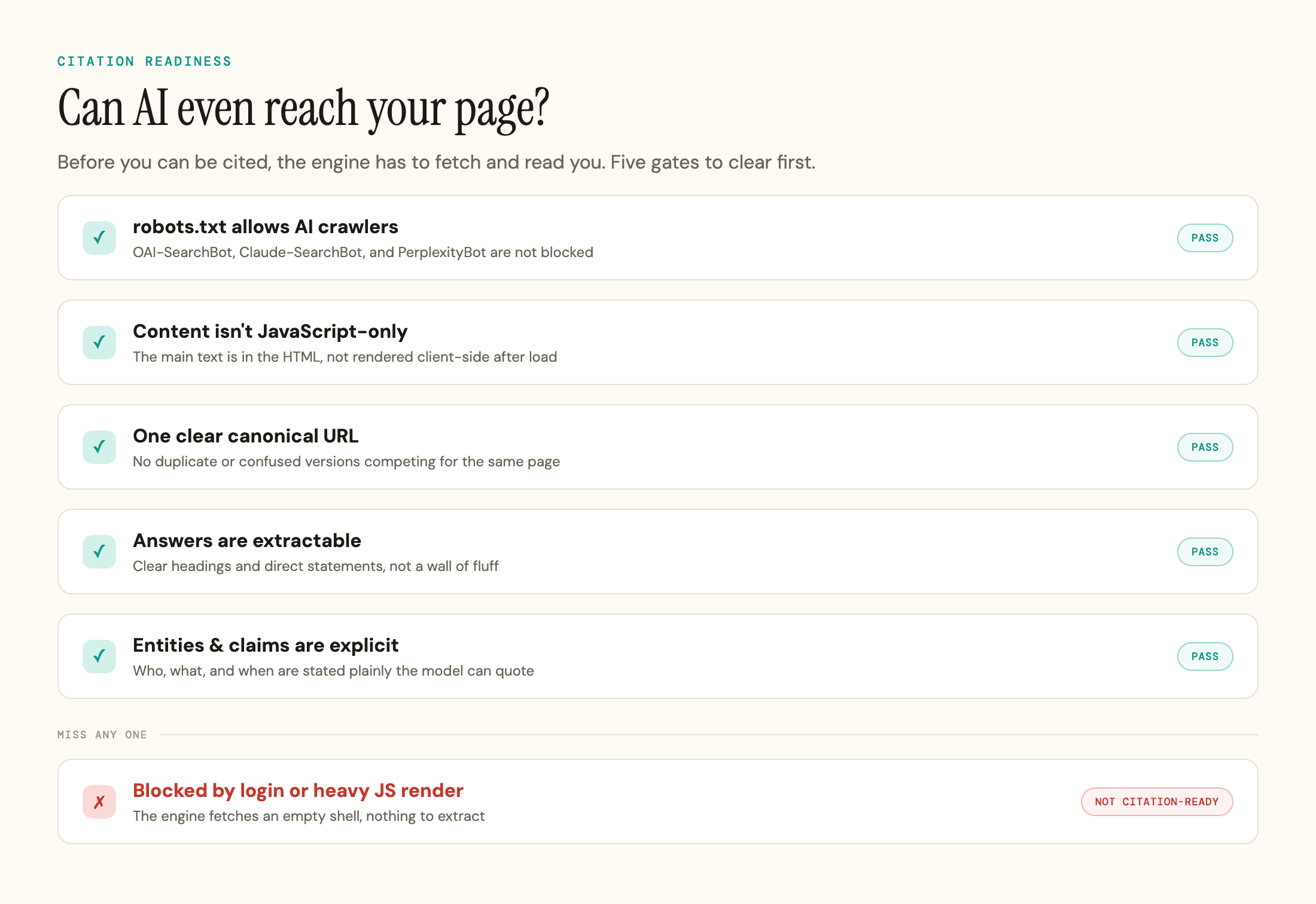
Before any of the content advice matters, one prerequisite has to be true: the AI's crawler has to be able to fetch your page. If it cannot reach you, you cannot be cited, no matter how well-written the page is, and the same access path is what lets an agentic browser actually use your site rather than just read it.
Generative engines use named crawlers to gather and refresh what they know, and they split by job. The ones that gate citations are OAI-SearchBot and ChatGPT-User (OpenAI), Claude-SearchBot and Claude-User (Anthropic), and PerplexityBot and Perplexity-User (Perplexity). GPTBot and ClaudeBot are training crawlers, and Google-Extended is a robots.txt token controlling both Gemini training and grounding (feeding Search-index content to the model at prompt time), not a crawler at all; AI Overviews are fed by ordinary Googlebot. Each can be allowed or blocked independently.
Three things commonly block them:
- robots.txt rules that disallow AI user agents, sometimes added on purpose, often copied from a template without anyone deciding to.
- WAF (web application firewall) or bot-management rules (Cloudflare and similar) that challenge or block non-browser traffic, catching AI crawlers as collateral.
- JavaScript rendering, where the page a crawler receives is nearly empty because the content loads client-side and the bot does not execute it.
In our experience scanning sites with Geotoolbox, the most common and most fixable problem is the second one: a WAF blocking bots that robots.txt explicitly allows. The site owner never intended to block AI, and nobody notices because rankings look fine. The page is simply unreachable to the engines writing the answers.
This is the cheapest GEO win available, because it is binary. Either the bot reaches the page or it does not. Before optimizing a single sentence for citation, confirm the door is open. The free AI Crawler Checker tests 34 crawler user-agents against your robots.txt and shows the exact blocking line; a WAF-level block needs a live fetch test, which is the paid scan's job.
The GEO Tactics That Actually Work
Strip away the rebranding and the real work comes down to five things. None of them are exotic. All of them make your content easier to extract and trust.
Answer First, Explain Second
Lead each section with a direct, self-contained answer, then add the detail. Models lift the clean sentence at the top. A page that buries its answer under three paragraphs of setup gives the engine nothing easy to quote.
Add Citable Substance: Quotes and Statistics
This is the one tactic with hard evidence behind it. The Princeton and IIT Delhi study that coined the term GEO (Aggarwal et al., KDD 2024) found that GEO methods can boost visibility in generative-engine responses by up to 40%, with adding sources, quotations, and statistics among the most effective. Specific, attributable facts are what a model reaches for.
Make Entities and Claims Unambiguous
State who you are, what you do, and the facts about your topic in plain language. Schema helps machines parse a page, but it is not a magic switch. Clarity in the prose does more.
Build Consistent Presence off Your Own Site
Models corroborate across sources, and many of the trust signals familiar from E-E-A-T matter in AI search too. Being described the same way on Wikipedia, in communities, on YouTube, and in press makes you safer to cite. A claim that only exists on your own domain is weaker than one echoed in several trusted places. A September 2025 study by Chen et al. measuring ChatGPT, Perplexity, and Gemini found "a systematic and overwhelming bias towards Earned media," meaning third-party authoritative coverage, over brand-owned and social content, "a stark contrast to Google's more balanced mix." Your own site alone cannot carry the citation.
Keep It Reachable and Current
None of the above counts if the crawler is blocked (see the section above) or if the page is years stale. Freshness and reachability are table stakes.
Notice what is missing from that list: keyword stuffing, exact-match density targets, and link-buying. Those were already losing tactics for SEO. They are useless for GEO. The discipline rewards being genuinely the clearest, best-sourced answer on a topic.
A word of caution on tactic 2. The same research that found the 40% lift is not license to jam fake statistics into every paragraph. Stuffing unverified numbers degrades the content and the trust signal you are trying to build. Add data because it is true and useful, not to game a model.
For the step-by-step version of applying these to a real page, see our guide on how to optimize for AI search.
How to Measure GEO
Measurement is where GEO gets honest fast, because the easy metric does not exist. Google shipped its first real window on June 3, 2026: Search Console's Generative AI performance report shows impressions for AI Overviews and AI Mode, with a separate twin report covering generative AI features in Discover. Impressions only, no clicks or query breakdown, and as of August 31, 2026 it covers all websites worldwide. The chat engines offer nothing like it. ChatGPT does not send you a query report, and traffic from an AI tool often lands in analytics as direct or referral with no keyword attached.
So you triangulate. A good starting point is to run an AI visibility audit once, then track the same checks over time. Here is what is actually trackable today.
| What to track | How | Where |
|---|---|---|
| Citation share | Query the engines for your topics and count how often you appear versus competitors | AI visibility tools, manual prompt checks |
| Branded prompt presence | Ask the engines about your brand directly and log how they describe you | Manual, or a tracker |
| AI referral traffic | Filter analytics for referrers like chatgpt.com, perplexity.ai, gemini.google.com | GA4 |
| Reachability status | Confirm AI crawlers can fetch your key pages | Bot reachability scan |
| Google AI surface impressions | Watch AI Overviews / AI Mode impressions for your pages | Search Console, Generative AI performance report |
The hard truth: most GEO measurement is sampling, not a complete count. You cannot see every answer the way you can see every Google impression. Anyone selling you a precise, total "AI traffic" number is overstating what is knowable.
Calibrate volume expectations while you are at it. Conductor's benchmark of 1,215 enterprise domains (part of a 3.3-billion-session dataset, US, May through September 2025) measured AI referral traffic at 1.08% of all website traffic, growing about 1% month over month, with 87.4% of those referrals coming from ChatGPT, per the report's July 2026 update (a heavier ChatGPT skew than Statcounter's worldwide mix; different panel, US enterprise traffic only). Small share, modest growth, heavy concentration. That is the realistic shape of the channel today, and it is why referral traffic alone undercounts AI's influence: most AI answers end without a click at all.
What you can do is track direction. Are you cited more this month than last for your core questions? Does the engine describe your brand accurately? Did AI referrals tick up after you fixed reachability and restructured a page? That trend line is the signal.
A repeatable way to track your AI visibility over time turns scattered manual checks into a baseline you can actually compare against. Start measuring before you optimize, so you have a before to point to.
How to Start with GEO: Your First Three Steps
You do not need a platform or a budget to begin. You need three moves, in order.
Step 1: Check Reachability
Confirm that the citation bots (OAI-SearchBot, ChatGPT-User, Claude-SearchBot, Claude-User, PerplexityBot, Perplexity-User) can actually fetch your most important pages, and allow GPTBot and ClaudeBot too if you also want training inclusion. This is binary and fast, and it is a common silent failure. Fix any robots.txt or WAF block before anything else.
Step 2: Fix Structure on Your Best Pages
Take the five or ten pages that matter most and rewrite the openings answer-first. Lead with the direct answer, add a citable fact or two, make the claims unambiguous. Do not boil the ocean. Start where you already have authority.
Step 3: Set a Baseline and Track
Pick ten questions your customers ask. Run them through ChatGPT, Perplexity, and Google's AI Overview today and record whether you appear. That is your starting line. Re-check monthly.
That is the whole on-ramp. Reachability, structure, measurement. Once those are running, you can go deeper per engine, since each one sources answers a little differently. Our guides on getting cited in ChatGPT search, ranking in Perplexity, showing up in Google AI Overviews, getting cited in Claude, Gemini, and Copilot cover the engine-specific tactics, and if you are evaluating whether to buy help, our rundown of generative engine optimization tools compares the options.
Frequently Asked Questions
Will GEO replace SEO?
No, and budgeting works best when you treat them as one program: the same crawl health, content quality, and authority work feeds both, so a separate "GEO team" usually duplicates effort. What you add for GEO is a citation target and a prompt-tracking habit, not a second stack.
Is GEO the same as SEO?
The overlap is large; the delta is concrete: answer-first structure so a model can lift a clean passage, citable statistics with inline sources, and off-site corroboration so the claim is safe to repeat. If your SEO already does those three, you are doing GEO under another name.
Can ChatGPT do SEO?
ChatGPT can help with SEO tasks like drafting and keyword ideas, but that is a different question from optimizing to appear in ChatGPT. This guide is about the latter: getting your brand cited when ChatGPT answers a question, which is what GEO targets.
How long does GEO take to work?
Reachability fixes can show up within days, since they just unblock crawling. Content and citation changes take longer and are harder to attribute, because AI sourcing shifts gradually and is not fully observable. Track direction over weeks, not a single before-and-after.
More Questions
Do I need a GEO tool to start?
No. You can audit reachability, restructure pages, and manually check ten prompts with no tool at all. Tools save time once you are tracking many pages or prompts regularly, but they are not a prerequisite for the first wins.
Where to Go from Here
GEO is not a new discipline you have to fear or a buzzword you can dismiss. It is the same instinct that has always driven good search work, pointed at a surface that now writes the answer instead of listing links.
The first question is the cheapest to answer and the easiest to get wrong: can AI engines actually reach and read your most important pages? Geotoolbox's free AI-Readiness Score checks the crawler-access foundations in seconds, and the Content Analyzer grades how citable your page is. Start there, fix what it flags, then work down the list above.
Sources
- GEO: Generative Engine Optimization - Aggarwal et al. (Princeton et al.), KDD 2024 -
arxiv.org/abs/2311.09735 - Optimizing your website for generative AI features on Google Search - Google Search Central, updated July 2026 -
developers.google.com/search/docs/fundamentals/ai-optimization-guide - AI Overviews reduce clicks: 2026 update - Ahrefs, 2026 (data citation) -
ahrefs.com/blog/ai-overviews-reduce-clicks-update - Americans and AI 2026: Chatbots, Smart Devices and Views on Impact (44% of US adults have used ChatGPT) - Pew Research Center, June 2026 -
pewresearch.org/internet/2026/06/17/americans-and-ai-2026-chatbots-smart-devices-and-views-on-impact - Update: AI Overviews Reduce Clicks by 58% - Ahrefs, February 2026 (December 2025 data, 300,000 keywords; original April 2025 measurement was 34.5%) -
ahrefs.com/blog/ai-overviews-reduce-clicks-update - SEO Is Dead. Say Hello to GEO. - John Herrman, New York Magazine, 2025 -
nymag.com/intelligencer/article/seo-is-dead-say-hello-to-geo.html - Generative engine optimization - Wikipedia -
en.wikipedia.org/wiki/Generative_engine_optimization - ChatGPT reaches 900M weekly active users - TechCrunch, February 2026 (OpenAI announcement) -
techcrunch.com/2026/02/27/chatgpt-reaches-900m-weekly-active-users - AI Chatbot Market Share Worldwide - Statcounter Global Stats (July 2026 data) -
gs.statcounter.com/ai-chatbot-market-share - ChatGPT hits 1 billion monthly users faster than any app before it - The Next Web, June 2026 (Sensor Tower estimate) -
thenextweb.com/news/chatgpt-1-billion-monthly-active-users - Generative AI performance report - Google Search Console Help -
support.google.com/webmasters/answer/16984139 - The 2026 AEO/GEO Benchmarks Report - Conductor, updated July 2026 -
conductor.com/academy/aeo-geo-benchmarks-report - Generative Engine Optimization: How to Dominate AI Search - Chen et al., arXiv, September 2025 -
arxiv.org/abs/2509.08919