G
GEO Toolbox

Made by an SEO agency, for SEO teams

AI visibility tracking7-day free trial

Get your brand cited by AI — ChatGPT, Gemini, Perplexity, Claude, Google AI Overviews, AI Mode, Bing Copilot, and Grok

See where AI cites you, learn why it doesn't, and win the citations your competitors are taking.

14 tools · 8 engines · from the first scan to the published fix

or start a 7-day free trial

First scan in under two minutes · plans cover ChatGPT, Perplexity, Google AI Overviews and more

Works with
  • ChatGPT
  • Gemini
  • Perplexity
  • Claude
  • AI Overviews
  • AI Mode
  • Bing Copilot
  • Grok

The problem

AI search is your biggest blind spot.

Millions of brand queries answered by AI every day. None of it shows up in the tools you use today. Brand monitoring watches social. Rank trackers watch the ten blue links. Neither one opens ChatGPT and asks the question your buyer just asked, which is where the decision is now being made — often without a single click reaching your site. The gap is not that the data is bad; it is that nobody is collecting it, because the surface it lives on did not exist when the tooling was built.

What you miss·8· 0 visibility today
  • ChatGPT recommendations
  • Perplexity citations
  • Gemini answers
  • Claude mentions
  • Google AI Overviews
  • Google AI Mode answers
  • Bing Copilot responses
  • Grok answers

The fastest-growing search channel is the one you don't measure. AI visibility is already the metric your competitors track. What about you?

The answer

One prompt. Every AI. Every citation.

A single prompt runs through eight AI engines in parallel. Green means you were cited. Amber means you were mentioned without a link. Red means you were left out entirely. The engines disagree far more often than people expect, and that disagreement is the useful part: it tells you whether you have a content problem on every engine or an access problem on one of them.

Demo shown with sample queries and responses. Production scans run against your real domain and return real engine responses in under two minutes.

How it works

From URL to insights in minutes.

No integrations, no tagging, no waiting. The scan runs in parallel and returns an AI visibility score you can defend to your CMO. One run powers your ChatGPT rank tracker, AI Overviews check, and Perplexity citation monitor. You give it a domain; it returns the prompts your market actually asks, which engines answered with your name, which URLs they cited instead, and the most likely reason each uncited page was passed over. Nothing is installed on your site and no tracking code is added — every signal is read the same way an AI crawler reads it, from the public page.

  1. 01Enter

    Your domain

    Paste a URL. Add competitors if you want a side-by-side.

    geotoolbox.ai + 2 competitors

  2. 02Scan

    Eight AI engines in parallel

    Same scan you saw above, on your domain. One prompt hits ChatGPT, Perplexity, Gemini, Claude, Google AI Overviews, Google AI Mode, Bing Copilot, and Grok at the same time.

    847 responses analyzed

  3. 03Read

    Your visibility report

    Score, engine-by-engine breakdown, citability analysis, competitor deltas.

    72/100 · +8 this week

The workflow

See it. Fix it. Own it.

14 tools across one workflow — from the first scan to the published fix that wins the citation. They share one credit pool and one dataset, so a citation you find in a scan carries straight into the brief that fixes it and the report that proves it moved. Nothing has to be exported and re-imported to get from a finding to a published change. Start anywhere in that chain — a one-off scan to see where you stand, or the full loop from prompt set to published fix to the report that shows the citation arrived.

Scan

See where AI cites you — and where it doesn't

GEO Scan runs one prompt across all eight engines; Query Fan-Out captures the dozens of sub-questions they really ask. Your domain, your competitors, every citation.

Track

One score, week over week

Domain Overview rolls every scan into a single 0–100 visibility score, with GSC + GA4 attribution — so you catch drift before it costs you traffic.

Analyze & act

Find why a page isn't cited — then fix it

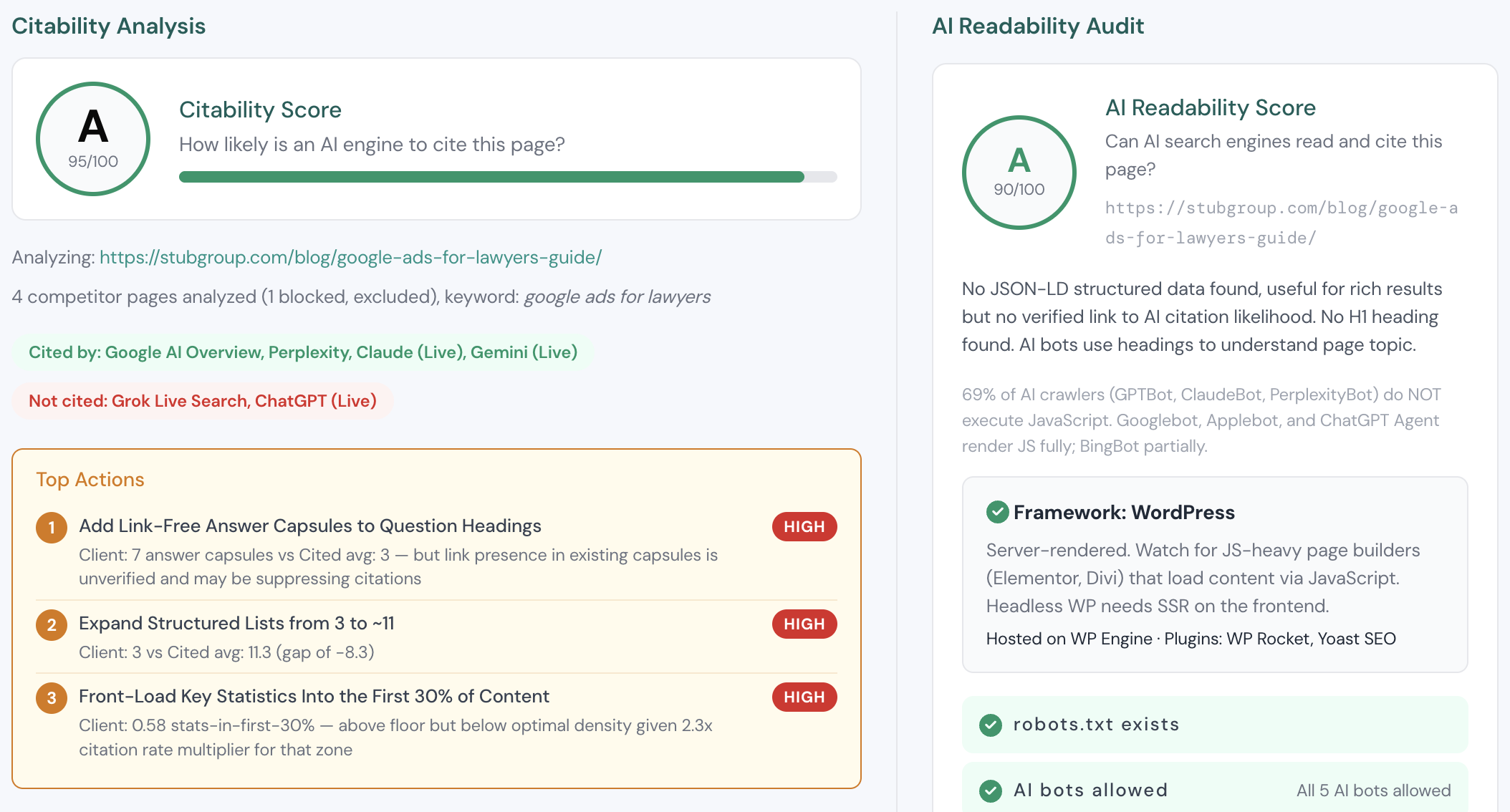
Content Analyzer grades any URL across 21 citability signals; Content Studio briefs and writes the fix. Turn a Not-found into a citation.

Own the gap

Win the prompts competitors are taking

Competitor Intel tracks who's cited instead of you; Citation Interceptor and Community surface the offsite threads AI quotes — so you show up where the answer is formed.

14 tools across scan, analyze, act, and track. Explore all 14 →

Run your first scan

Pricing

Every price is public.

No demo call, no sales gate, no “contact us” wall. The full ladder — credits, engines, scan cadence — is on one page, and you can try it for a week before paying a cent. Every tier lists its credit allowance, how many brands and prompts it covers, which of the eight engines it unlocks, and how often scans run — so you can size a plan against your own prompt list before you talk to anyone.

Starter

from $79/mo

$99/mo

Solo SEOs going deep on one brand.

  • 3 engines
  • 12,000 credits/mo
  • Weekly scans

Plus

from $159/mo

$199/mo

A second brand, more engines, one shared pool.

  • Pick 5 of 8 engines
  • 30,000 credits/mo
  • Weekly scans

Growth

from $399/mo

$499/mo

Agencies scaling AI visibility across lots of clients.

  • Pick 5 of 8 engines
  • 80,000 credits/mo
  • Weekly scans

Annual billing brings Starter to $79/mo, Plus to $159/mo and Growth to $399/mo.

Free tools

Ten free tools. No signup.

Standalone utilities we built because we needed them — open to everyone, no email gate, no trial clock. If they help you ship better AI-ready pages, that’s the point. They run in the browser on a URL you can send to anyone: check whether AI crawlers are blocked, score a domain's AI readiness, validate a robots.txt or a sitemap, or turn a keyword into the prompts people actually ask AI. None of them ask for an account. Some are deliberately narrower than the paid scan; one, the Agent Readiness Scanner, is the full scan with no sign-up at all. They exist because the answers they give should not sit behind a signup form.

The playbook

The questions AI searchers keep asking.

Short answers to the things visitors ask about generative engine optimization, AI visibility, LLM SEO, and AI citation tracking. Tap any question to expand. They are the questions users actually ask us, the ones support sees most, and the ones the engines themselves answer when someone asks what GEO Toolbox is for.

How do I see where AI cites my brand?
Run a GEO scan and get a visibility score from 0 to 100, verbatim citation snippets, and a side-by-side competitor read-out across all eight engines. That baseline is where every answer engine optimization (AEO) program starts.
Why isn't AI citing my pages?
Grade any URL on two scores, Citability and AI Readability: 21 signals covering schema markup, AI bot access, JavaScript rendering, freshness, and answer-first formatting, each benchmarked against the pages AI actually cites. AI crawlers can't cite what they can't read. The audit maps every signal to a specific fix.
What do I change to get cited?
Brief and draft content AI will actually quote. You get a framework-aware outline (pillar, cluster, comparison, or FAQ), an entity checklist, competitor facts coverage, and dual Structure and AI Readiness scoring. Answer-first content, built to earn citations.
How do I know my changes are working?
Run a baseline scan, ship your changes, re-scan. GEO Toolbox keeps scan history so you can see the before/after visibility score, new citation snippets you picked up, and which engines moved. Schedule weekly or monthly auto-scans to watch the trend line in Domain Overview. Indexing speed varies by engine, but every scan cycle makes progress observable.
What's the difference between GEO, AEO, and LLM SEO?
Three names for the same job: being the source AI engines cite when your customer asks a question. Generative engine optimization (GEO) covers the full workflow across ChatGPT, Perplexity, Claude, Gemini, Google AI Overviews, Google AI Mode, Bing Copilot, and Grok. Answer engine optimization (AEO) focuses on earning citations in answer engines specifically. LLM SEO is the crawler-facing work: robots.txt, schema markup, entity clarity, and bot access. GEO Toolbox covers all three.
Which AI engines does GEO Toolbox track, and why separately?
ChatGPT, Perplexity, Gemini, Claude, Google AI Overviews, Google AI Mode, Bing Copilot, and Grok. They are tracked separately because they disagree: the same prompt routinely earns a citation on one engine and nothing on another, so a single blended “AI visibility” number hides the engine that is actually costing you customers. Every scan reports each engine on its own line. Plans differ in how many run at once — Starter covers three, Plus lets you pick five, Pro runs all eight.
Can I track AI visibility in other countries and languages?
Yes — scheduled tracking runs across 29 markets. Market matters more in AI search than it did in classic search, because an answer engine will happily cite a local competitor in response to a Spanish prompt while citing you in response to the English one. Running the same prompt set per market is what separates visibility that is genuinely global from visibility that stops at a border.
Does publishing an llms.txt file get my site cited?
On the evidence we have seen, no — and we say that despite shipping both an llms.txt checker and a generator ourselves. We have found no public evidence that a major answer engine uses llms.txt as a ranking or citation input. It is cheap hygiene worth having, because agent-readiness audits look for it and it costs nothing to publish, but it is not the lever people hope it is. What demonstrably matters is whether crawlers can reach and read your pages at all, and whether those pages answer the question directly.
How is this different from rank tracking — should I stop doing SEO?
No, and the two are not substitutes. A rank tracker tells you where a URL sits in a list of links. An AI answer usually names two or three sources and never shows the list, so you can hold position one and still be absent from the answer your customer actually reads. Most of classic SEO still pays — crawlability, entity clarity, genuinely useful pages — it is just measured differently. What GEO Toolbox deliberately does not do is keyword rank tracking, backlink analysis, or site-speed auditing; keep a general SEO suite for those.
How do I check whether AI crawlers can even reach my site?
Run the Agent Readiness scan, or the free AI Crawler Checker if you only want the robots.txt answer. Blocking is more common than people expect: a WAF rule or a bot-management default can refuse GPTBot, ClaudeBot, or Google-Extended without anyone deciding to, and a page a crawler cannot fetch will never be cited however good it is. The scan also catches the quieter version of the same problem — content that only exists after JavaScript has run.
Can I prove AI search is sending me traffic?
Partly, and it is worth being precise about the limits. Connect Google Search Console and GA4 and you can see referral traffic from AI surfaces next to your organic data. What no tool can honestly give you is a complete, deterministic attribution table: some engines send no referrer, many answers are read without any click at all, and prompts are not keywords. Treat citation share as the leading indicator and referral traffic as the lagging one.
What is agent readiness, and why does it matter now?
Agent readiness is whether an AI agent — not a person, not a classic crawler — can enter your site, read it, and act on it. It is the plumbing: real HTTP status codes, content that exists without JavaScript, structured data an agent can parse, machine-readable indexes, and error pages that tell an agent where to go next. It matters now because traffic that used to arrive as a click increasingly arrives as an agent fetching a page on someone’s behalf, and a site that only works in a browser is invisible to it.
What do credits mean, and what does a scan cost?
Every plan draws on one shared credit pool that all fourteen tools spend from, so a scan, a brief and a report all draw on the same allowance. A check against a heavier engine costs more credits than a lighter one, credits refill monthly, and you can top up at any time. Starter is $99/month with a 7-day free trial. Every tier, limit, and engine count is published on the pricing page rather than kept behind a sales call.
Ready when you are

Your competitors already know.
Do you?

Run your first scan in minutes. Visibility score, engine-by-engine citations, and competitor benchmarks. 7-day free trial on Starter and Growth.

Paid plans from $79/mo (annual) · cancel anytime