G
GEO Toolbox

Generative engine optimization

Samy Ben SadokSamy Ben SadokFounder, GEO Toolbox

The AI answer your buyer reads cites a handful of sources. My job is making one of them you.

ChatGPT, Perplexity, Gemini, Copilot and AI Overviews compose answers from sources they name. I built GEO Toolbox — the platform used to measure AI visibility — and I personally rebuild your pages to be cited in those answers, then prove it monthly with the tracker I built.

20-min intro call · no obligation · I take 4 active clients.

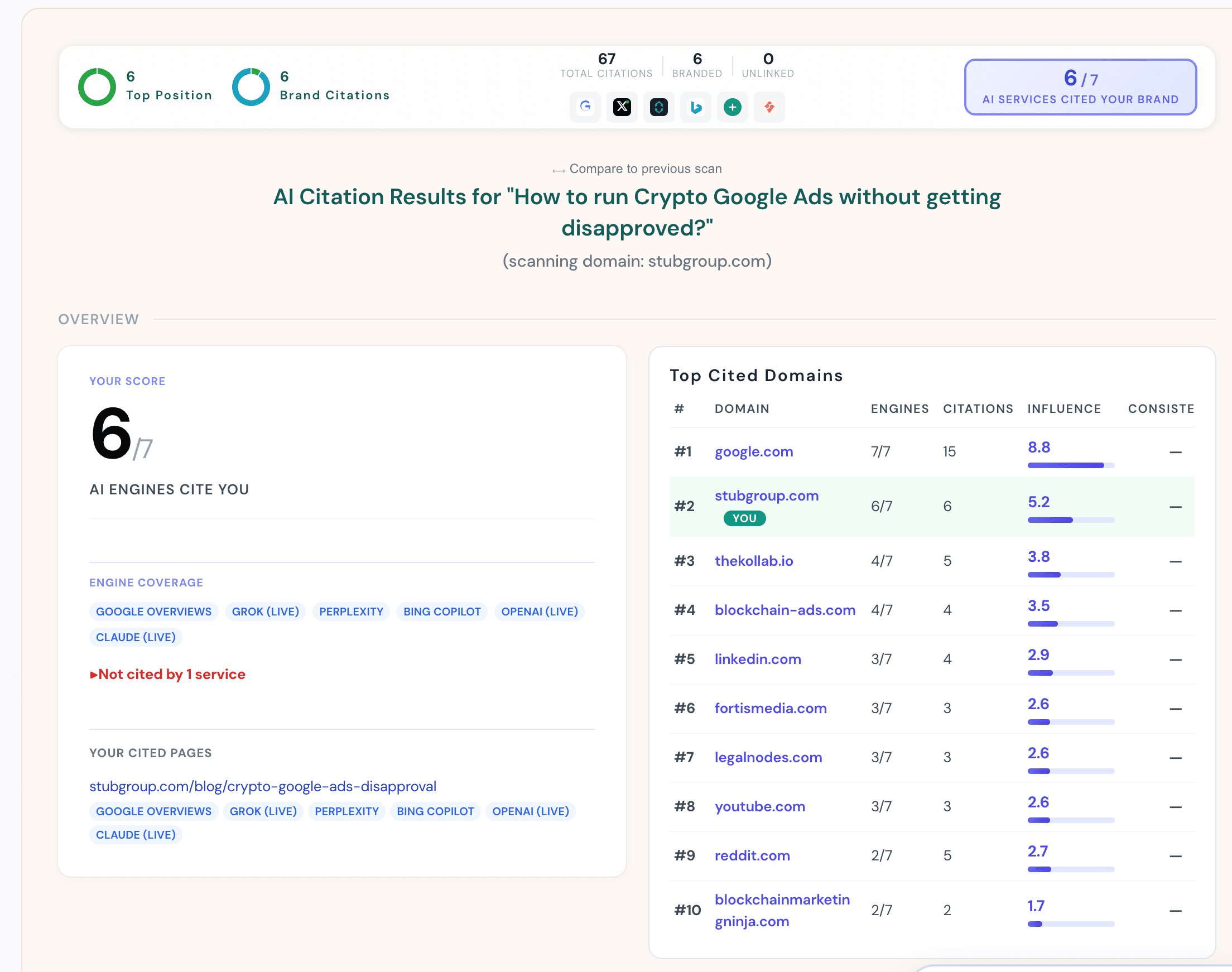
AI citation scan showing a client's crypto Google Ads guide cited by 6 of 7 AI engines, the #2 cited source behind only google.com.
A client's page cited by 6 of 7 AI engines — example scan.

The category, defined honestly

What GEO is — and what it isn't.

  1. 01

    GEO is getting cited inside the composed answer.

    When ChatGPT, Perplexity, Gemini, Copilot or Google's AI Overviews write an answer, they pull from a handful of sources and name them. Generative engine optimization is the work of becoming one of those named sources for the prompts your buyers actually ask.

  2. 02

    It is not classic SEO — and it doesn't replace it.

    SEO earns a ranking a human might click. GEO earns a citation inside the answer the human reads instead of clicking. The overlap is real — clean structure and verifiable claims lift both — but the scoreboard is different: citations per prompt per engine, not positions.

  3. 03

    It is not AEO either.

    Answer engine optimization targets the extracted block — the featured snippet, People Also Ask, the answer slot inside an AI Overview, the voice answer. GEO targets the synthesized answer an AI composes across cited sources. The two jobs meet inside AI Overviews, which both cite sources and extract blocks; I run both, measured separately.

Want the deeper theory first? Read the guides: what GEO is, GEO vs AEO vs SEO, or the glossary definition. This page is the done-for-you service.

The proof, from my own test domain

One fresh, zero-authority domain. The receipts, by source.

These are the numbers, not a promise — the exact figures, stamped, and updated as they move. The Google figures came from about 7 weeks of publishing on a domain that drove near-zero traffic before; the AI-citation count is a separate 3-month Bing sample.

Keywords ranked in Google
5,095
Google Search Console
In Google's top 3
223
Google Search Console
AI-citation appearances
~10,300
Bing WMT · Microsoft Copilot and partners · 3-mo sample3-month sample
Impressions per day
~9,400
Google Search Console

As of 21 Jul 2026. Google figures are from Google Search Console — deduplicated and verifiable in Search Console.

The ~10,300 AI-citation figure is a 3-month sample from Bing Webmaster Tools' AI Performance report (Microsoft Copilot and partners) — a count of citation appearances, not unique citations, and not attributable to ChatGPT, Perplexity, or Google.

What you get, and how it runs

Three outcomes. Audit, build, track.

No black box, no list of busywork tasks. Each stage is one outcome you can check, and each one produces an artifact you can hold — a baseline, a rebuilt page, a monthly log — so you always know what the money bought.

  1. 01Audit

    A citation baseline across the engines that matter — before I touch anything.

    Week one: my tracker queries ChatGPT, Perplexity, Gemini, Copilot and AI Overviews with the prompts your buyers use, and logs who gets cited today — you, or your competitors, by name. You start from a measured gap, not a hunch.

    cross-engine citation baseline

  2. 02Build

    Your priority pages rebuilt so an engine can quote you with your name attached.

    Verifiable claims, clean structure, the sources an engine trusts. The focus is the comparison and “which should I buy” prompts where the shortlist forms — the citations that precede a purchase, not trivia mentions — while your classic Google rankings hold.

    citable priority pages

  3. 03Track

    Monthly citation logs: which engines, which prompts, what changed.

    Your report is the raw tracker output — citations gained and lost, per engine, per prompt, with deltas. If a month is flat, the log says flat. Same numbers on my screen and yours.

    monthly citation log

How to start

Start with the diagnostic. Scale when the numbers say to.

Two one-off purchases and one ongoing engagement. Start with the Report — you never commit to a retainer before you've seen the opportunity in your own numbers.

Visibility Report

One-off
$750

One-off

The full GEO baseline: prompts, engines, competitors, and the pages worth building.

A one-off diagnostic that maps the buying-intent prompts in your market, who gets cited today across the AI engines, and the specific pages to build.

Most popular

30-Day AI Visibility Sprint

One-off
From$4,500

One-off · scoped to project size

Thirty days of building: fixes shipped, priority pages rebuilt to be cited.

Technical fixes, your priority pages rebuilt to be citable, and the citation and source work that gets an engine to quote you. Scope and price depend on your site's size — we set both on the call. The Sprint counts as month one if you continue on a retainer within 30 days.

Ongoing GEO + SEO Growth

Retainer
From$3,500/mo

90-day initial commitment

The compounding version: new citable pages, new prompts, tracked every month.

Continuous GEO and SEO work — new citable pages, more buying-intent prompts taken one by one, and the monthly tracker report. Then month to month.

The Report fee is credited toward a Sprint or retainer if you continue within 14 days. I take 4 active clients, so there's sometimes a short wait.

The $750 Report is a fixed price, payable by card — direct checkout is coming shortly. The Sprint and retainer are scoped to your project on the call. Looking for the umbrella service? See done-for-you AI SEO — or answer engine optimization if your market's questions end in a snippet, not a composed answer.

On-time delivery guarantee

If I miss a milestone after you've given on-time access and feedback, I refund that milestone's fee. I never guarantee rankings or citations — no honest person can — only that I deliver on time or pay for missing.

You own everything

Every page, dashboard and dataset is yours. If we stop working together, you keep the work, the tracker baseline, and the pages — nothing is held hostage.

Start with the Report

If the opportunity doesn't justify implementation, you keep the research and owe no retainer. The Report has to earn the Sprint before the Sprint earns the retainer.

FAQ

The questions I get about GEO

  • 01What exactly is generative engine optimization?
    The work of getting your pages cited inside the answers AI engines compose — ChatGPT, Perplexity, Gemini, Copilot, Google's AI Overviews. When an engine writes an answer it pulls from a handful of sources and names them; GEO makes you one of those named sources for the prompts your buyers ask. Full definition in the glossary: geotoolbox.ai/glossary/generative-engine-optimization.
  • 02How is GEO different from SEO?
    SEO earns a ranking a human might click; GEO earns a citation inside the answer the human actually reads. The work overlaps more than the names suggest — my test domain put 5,095 keywords into Google while chasing citations — but the measurement is different: citations per prompt per engine, not positions. A normal SEO report has no column for it.
  • 03How is GEO different from AEO?
    AEO targets the extracted block — the featured snippet, People Also Ask, the AI Overview answer slot, the voice answer: one passage lifted verbatim. GEO targets the composed answer an AI writes across several cited sources. If your market's questions get answered by AI chat, GEO is the lever; if they get answered by a snippet, AEO is; AI Overviews reward both. I run them as separate, separately measured services.
  • 04How do you measure GEO?
    With the cross-engine tracker I built (geotoolbox.ai). It queries the real engines with the real prompts your buyers use and logs who's cited, where, how often. Your monthly report is its raw output — prompts, engines, citations, deltas. A log, not an estimate.
  • 05How long until an engine cites me?
    My own zero-authority domain took about 7 weeks to first meaningful citations. Your site has age and authority mine didn't; your market has competition mine didn't — plan on first tracked movement in 4–8 weeks, compounding after. Week one you get the baseline. If someone promises AI citations in days, ask to see their tracking.
  • 06Why hire the founder instead of a GEO agency?
    The person who built GEO Toolbox — the platform used to measure AI visibility — is the person who does your work. Not a strategist handing off to a junior: the founder who built the measurement tool, in the code of your pages. Trade-off, stated plainly: I take 4 active clients, so there's sometimes a wait.

Every day, the engines compose answers about your market. Someone gets cited. Make it you.

Book a call. I'll read your citation baseline with you and tell you straight whether GEO is worth doing for your market — founder to founder, no handoff.