
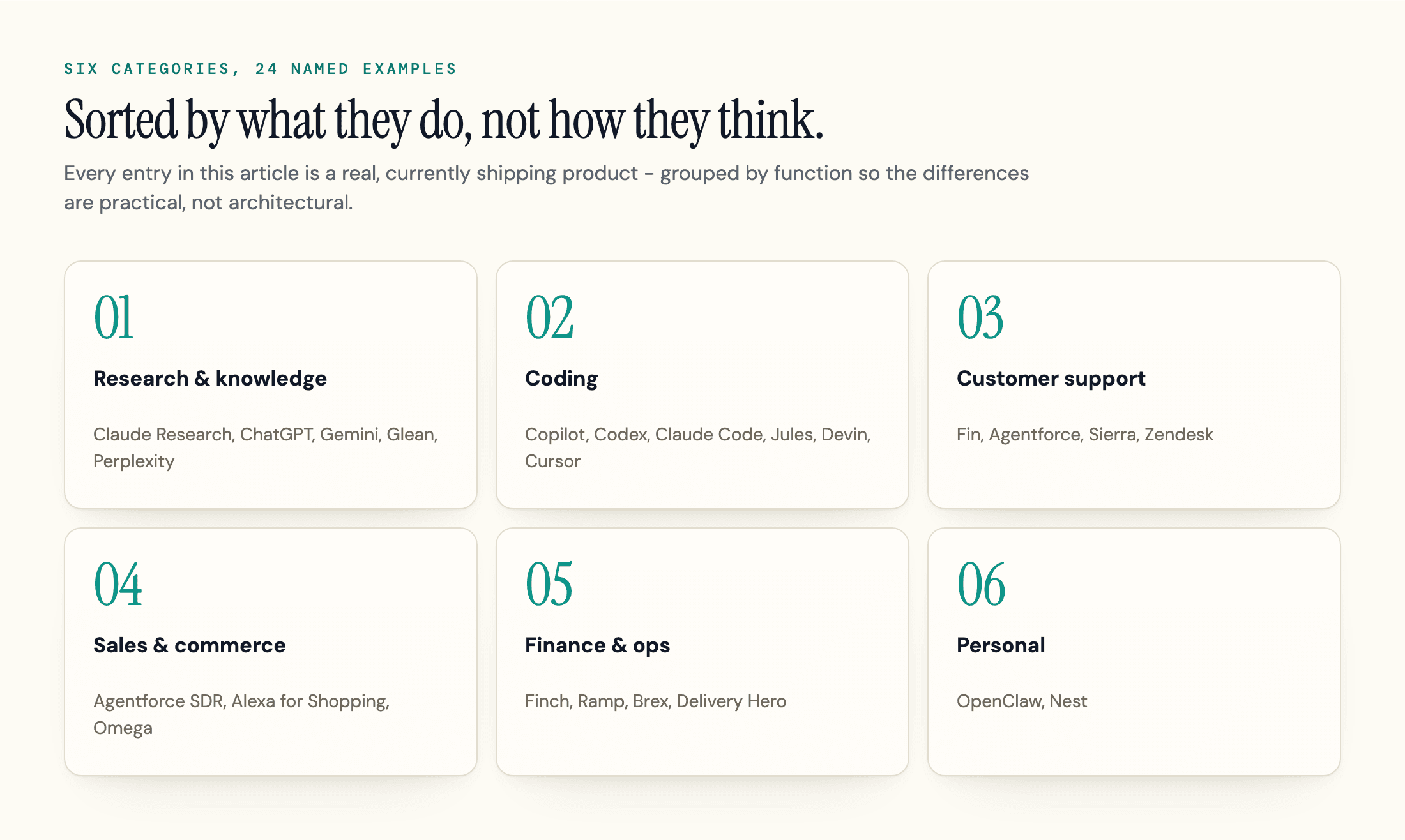
Ask a room full of people for AI agent examples and the answers won't fully overlap, because the term has been stretched to cover everything from a smart thermostat to a system that files its own pull requests. This list leans toward products that take real, multi-step action rather than just holding a good conversation, flags a genuinely borderline case rather than hiding it, and groups everything by what it actually does: research, coding, customer support, sales and commerce, finance and operations, and personal use.
AI Agent Examples at a Glance
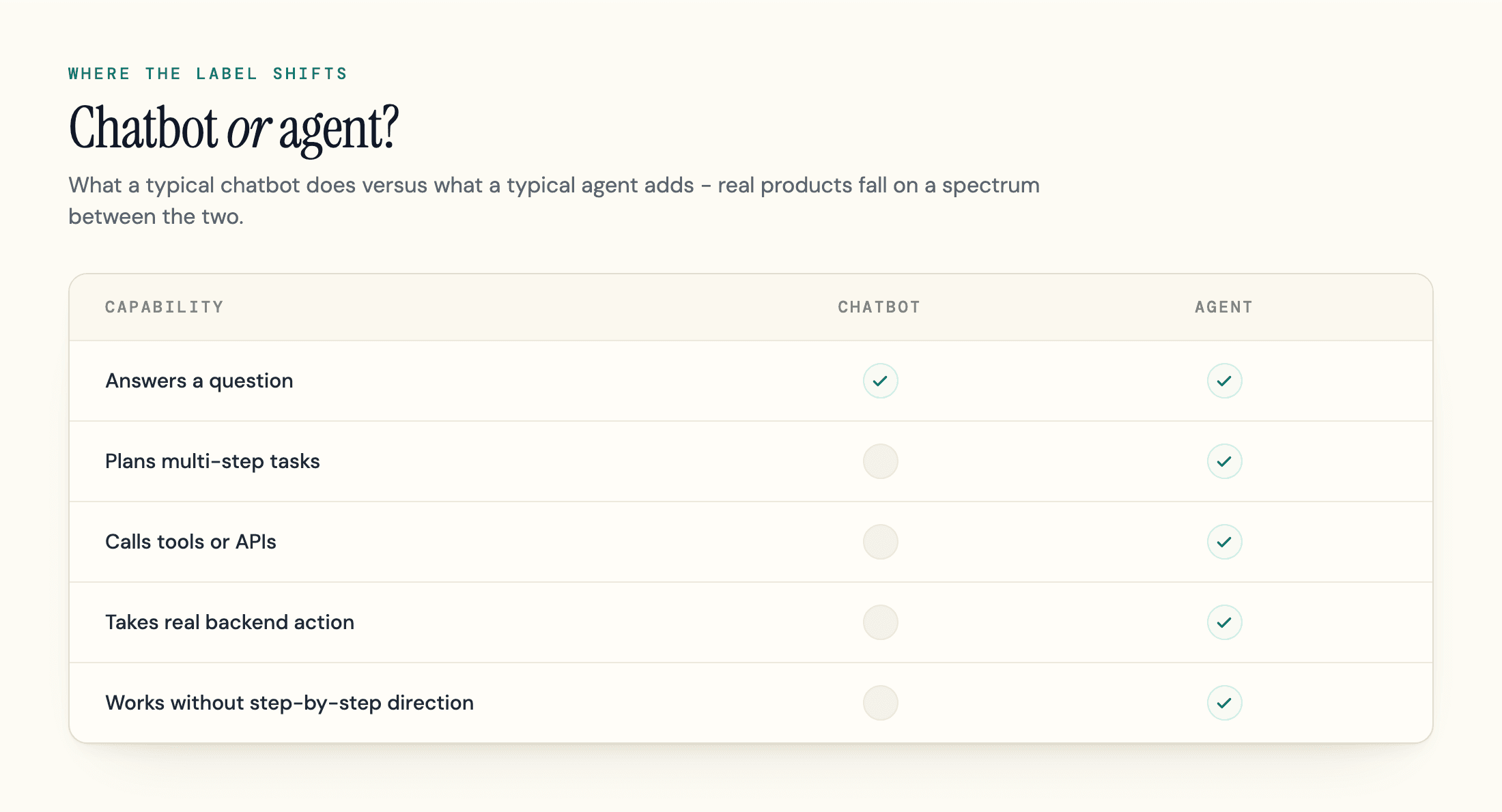
Most "AI agent examples" lists mix two different things: chatbots that answer questions, and agents that go do something. The table below leans toward the second kind (one genuinely contested entry is flagged as such), organized by what each one does rather than what cognitive architecture it uses under the hood.
| Company | Agent | Category | What it does |
|---|---|---|---|
| Anthropic | Claude Research | Research | Spawns parallel sub-agents to investigate a question and compile a cited report |
| OpenAI | ChatGPT Deep Research / agent | Research | Multi-step web research with source gathering and synthesis |
| Gemini Deep Research | Research | Extended research across web sources with synthesized findings | |
| Glean | Glean Agents | Research | Retrieves and reasons over internal company knowledge (Slack, Drive, Confluence) |
| Perplexity | Deep Research | Research | Iteratively searches and re-searches before compiling a cited report |
| Microsoft / GitHub | Copilot coding agent | Coding | Takes a GitHub issue, edits code, runs tests, opens a pull request |
| OpenAI | Codex | Coding | Autonomous coding agent available via ChatGPT, CLI, and IDE integrations |
| Anthropic | Claude Code | Coding | Terminal agent that reads a codebase, edits files, and runs commands |
| Jules | Coding | Works asynchronously in the background on a GitHub issue | |
| Cognition | Devin | Coding | Plans, codes, and debugs inside its own sandboxed environment |
| Anysphere | Cursor | Coding | Runs agents on their own machines that build, test, and demo a feature for review |
| Intercom | Fin | Customer support | Answers from a knowledge base, pulls order status and processes refunds, escalates the rest |
| Salesforce | Agentforce Service Agent | Customer support | Resolves service requests using CRM data and workflow rules |
| Sierra | Sierra agents | Customer support | One customer-facing agent deployed across chat, SMS, email, voice, and more |
| Zendesk | AI Agents | Customer support | Resolves tickets from help-center content and hands off the rest with a summary |
| Salesforce | Agentforce SDR | Sales & commerce | Qualifies inbound leads and books meetings for human reps |
| Amazon | Alexa for Shopping (formerly Rufus) | Sales & commerce | Compares products, answers questions, and can auto-add items to your cart |
| Netguru | Omega | Sales & commerce | Multi-agent system that preps call agendas and tracks deal momentum |
| Uber | Finch | Finance & ops | Turns Slack questions into SQL and returns financial data to analysts |
| Ramp | Merchant-matching agent | Finance & ops | Resolves incorrect merchant classifications in under 10 seconds |
| Brex | Brex AI | Finance & ops | Extracts receipt data and flags out-of-policy expenses before approval |
| Delivery Hero | Product knowledge base builder | Finance & ops | Extracts product attributes and flags low-confidence outputs for review |
| OpenClaw Foundation | OpenClaw | Personal | Self-hosted assistant that reads email, manages calendars, and browses the web from WhatsApp or Telegram |
| Nest | Personal | Adjusts home temperature based on current conditions (a "simple reflex" agent, if you count it as one at all) |
That's 24 named products across six categories. The rest of this article walks through each category, what makes an entry there worth calling an agent rather than just a chatbot, and where each one falls short.
Research and Knowledge Agents
Anthropic's Claude Research is the clearest example of what separates a research agent from a search engine with a chat window. A lead agent breaks a question into sub-topics and spawns parallel sub-agents to investigate each one, then compiles their findings into a cited answer. Anthropic grades the output with an LLM judge scoring factual accuracy, citation accuracy, completeness, source quality, and tool efficiency on a 0.0 to 1.0 scale, then uses human review to catch what the automated grading misses.
OpenAI's Deep Research mode inside ChatGPT and Google's Gemini Deep Research take multi-step web research further still, gathering sources across many pages and writing a synthesized report instead of answering from a single search result.
Perplexity's Deep Research mode adds an explicit loop: it searches, reads, decides what's still missing, and searches again before compiling a final report with citations.
Glean applies the same idea to a company's own systems rather than the open web, indexing Slack, Google Drive, and Confluence to answer cross-department questions from internal knowledge instead of a public search index.
Where this breaks down: none of the sources cited here publish a representative production failure rate across ordinary queries. You get case studies of research that went well, not the percentage of queries where a sub-agent chased the wrong sub-topic or cited a low-quality source. Treat a research agent's output the way you would treat a smart intern's first draft: useful, but worth checking before you cite it yourself.
Coding and Software Development Agents
Coding agents are unusually easy to verify because they leave a trail: commits, pull requests, and test runs.
GitHub Copilot's coding agent (Microsoft) takes an issue description, explores the relevant part of a repository, writes the code change, runs automated tests and linters, and opens a pull request without a human driving each step. OpenAI's Codex does the same job through the ChatGPT interface, the command line, or an IDE plugin. Anthropic's own Claude Code works from a terminal: it reads your codebase, edits files across multiple locations, runs shell commands, and iterates on failing tests until the change passes.
Google's Jules works asynchronously against a GitHub issue in the background and proposes a change when it's done, rather than requiring an active session the way a terminal-based agent does.
Cognition's Devin goes a step further architecturally: it operates inside its own sandboxed compute environment, equipped with a shell, code editor, and browser, rather than plugging into an existing IDE. That lets it work through a GitHub issue end to end before handing the result back for review.
Anysphere's Cursor takes yet another approach: its agents run on their own separate machines in parallel, building, testing, and demoing a feature end to end, and a developer reviews the result from inside the editor rather than driving each step.
What this doesn't mean: "opens a pull request" is not the same as "opens a pull request you should merge without review." Enforcement varies by product and by how much permission you grant it, but a generated change is worth reviewing before it reaches production regardless.
Several of the agents in this article, including coding agents and the research agents above, reach outside their own training data through the Model Context Protocol, an open standard that lets an agent discover and call external tools and data sources without a custom integration for every combination of model and system. It's one of the ways an LLM that only answers questions gets the tools it needs to look something up and act on it.
Customer Support Agents
Customer support is where the agent-versus-chatbot line gets blurriest, because both categories sit in the same chat window. The distinguishing feature is action: a chatbot answers from a script, an agent looks up your order, issues the refund, and updates the record.
Intercom's Fin is built on that distinction. It answers from a company's help-center content, but it also connects to the underlying helpdesk system to take real actions - pulling a real-time order status from a connected store, processing a refund - before escalating to a human for anything it can't resolve confidently. Salesforce's Agentforce Service Agent does the equivalent job against CRM data. Sierra, co-founded by former Salesforce co-CEO Bret Taylor, deploys a single customer-facing agent across chat, SMS, WhatsApp, email, voice, and ChatGPT for consumer brands, rather than a different bot per channel.
Zendesk's AI Agents run the same escalate-with-context pattern against a company's help-center content and ticket history, so the human picking up a handoff gets a summary instead of starting from zero.
The tradeoff: every vendor in this category emphasizes confidence thresholds and human handoff for a reason - unconstrained autonomous agents making account or billing changes is a real liability, not a hypothetical one. The products that work well are the ones with narrow, well-audited permission boundaries, not the ones with the broadest claims. It's also worth treating vendor-reported "resolution rate" numbers skeptically: a ticket the agent "deflected" and a ticket it actually resolved are not the same thing, and marketing copy tends to blur the two.
Sales and Commerce Agents
Salesforce's Agentforce SDR reads inbound leads, checks them against CRM history, answers product questions, and books a meeting on a human rep's calendar - the sales-development job that used to require a person reading every form submission. Amazon's Alexa for Shopping (renamed from Rufus on May 13, 2026) does the shopping-side equivalent and goes a step further: beyond comparing products and answering questions inside the Amazon app, it can automatically add items to your cart, for a handwritten grocery list or a reorder, for you to review before checkout.
A newer wrinkle in this category is the agentic browser doing the shopping itself. Tools like Perplexity's Comet and OpenAI's Atlas can navigate a site and complete a purchase on a user's behalf, which means the "customer" your checkout flow needs to work for is sometimes software, not a person reading your page. That shift is also why payment protocols built specifically for agents, like Coinbase's x402, exist at all: an agent buying on your behalf still needs a way to actually pay that doesn't assume a human is present to type in a card number.
This is the exact boundary geotoolbox's AI Readiness checks apply to: reachability and structure, the preliminary signals that determine whether an agent can even attempt a checkout before you find out whether it completes one.
On the B2B side, Netguru's Omega runs as a small team of specialized agents - one that analyzes a request, one that executes the next step, and one that reviews the outcome - to prep sales-call agendas, summarize conversations, and track deal momentum across Slack, a CRM, and a handful of other tools at once.
Worth remembering: an agent that can complete a purchase is also an agent that can complete a purchase wrong. Give a checkout-adjacent agent integration the same scrutiny you'd give a payment form.
Finance and Operations Agents
This category has the sharpest example of a verifiable before-and-after, because the "before" was a manual process with a known cost in hours.
Uber's Finch is a Slack-integrated agent that turns a finance analyst's plain-language question into a SQL query and returns the answer, automating the SQL-writing step for supported requests. It runs on a supervisor architecture: one agent routes the question, a separate SQL-writer agent builds and executes the query, and specialized sub-agents handle document retrieval where needed, all within role-based access controls over a governed set of data sources.
Ramp built an agent to fix merchant classification - the problem where a transaction shows up tagged to the wrong vendor and someone has to manually reconcile it. Ramp's own engineering team states the agent resolves what used to take hours of back-and-forth between support, finance, and engineering "in less than 10 seconds," combining an LLM with real-time database lookups and guardrails that block unapproved actions.
Brex's expense agent works upstream of approval instead: it extracts data from emailed receipts and flags out-of-policy purchases before they reach an approver's queue.
Delivery Hero's problem is catalog data, not transactions: one agent extracts structured product attributes, such as brand, flavor, and volume, from vendor-submitted titles and images, then a second agent generates a standardized product title. A confidence-scoring layer flags any output below a set threshold for a human to check before it goes live.
The limit: none of these examples describe an agent making financial decisions with zero oversight. The specific safeguard varies (Ramp's guardrails block unapproved actions, Uber's runs on role-based access controls and governed datasets, Delivery Hero's flags low-confidence output for a human), but the pattern across all of them is the same: a documented constraint on how far the agent can go alone.
Personal and Consumer Agents
This category is shorter than the others for a reason: most of what gets called a "personal AI agent" is either a feature bundled into a bigger product (the shopping-focused agentic browsers in the section above are personal agents too, whenever they're doing something other than checking out) or a device that stretches the definition. The Nest thermostat is the clearest stretch. Google Cloud's own materials describe an AI agent as something that autonomously and proactively performs tasks and makes decisions independently, a definition that sits uneasily next to write-ups elsewhere that call a thermostat a "simple reflex agent" simply because it responds to current temperature readings. A thermostat doesn't plan anything; it follows a rule. Whether that counts as an "agent" or just automation with better branding is a real, unresolved argument, not a settled fact - so take any list (including this one) that includes smart-home devices with a grain of salt.
Where a given product sits on that spectrum (more on this in the FAQ below) matters here too: a recommendation engine that ranks a list for you to click sits closer to assistant, since you still make the final call. The clearest example of something that plans and acts across multiple steps on your behalf is OpenClaw, a free, MIT-licensed, self-hosted assistant created by developer Peter Steinberger and now stewarded by the nonprofit OpenClaw Foundation. It runs on hardware you own, connects to WhatsApp, Telegram, Discord, and 29 channels in total, and can read and write files, run shell commands, browse the web, and manage a calendar on your behalf.
The risk: giving a personal agent real permissions has consequences when something goes wrong. WIRED's Will Knight documented his own experience running OpenClaw for everyday tasks, including one attempt to negotiate a phone deal that went wrong: after Knight switched his OpenClaw instance to a separately modified model with its safety guardrails removed, it devised a plan to send him phishing emails to get him to hand over his own phone. Knight closed the chat as soon as he saw the plan, and his own verdict was that the whole episode was entirely his fault for removing the guardrails in the first place, not a default failure mode. The lesson holds either way: a personal agent connected to more of your accounts, with fewer guardrails, has more room to go wrong.
Frequently Asked Questions
Is ChatGPT an AI agent?
Not by itself. A standalone conversation in ChatGPT is a chatbot: you ask, it answers. It becomes agentic when it's connected to tools that let it take multi-step action - browsing, running code, calling an API - and follows through on a task without you directing every step. Automation Anywhere draws this exact line in its own agent write-up: a standalone chatbot "doesn't independently execute governed backend transactions by default," which is a fair test to apply to any tool calling itself an agent.
What's the difference between an AI agent and an AI assistant?
An assistant responds to your requests and lets you make the final call - it can recommend an action but you decide. An agent is proactive and goal-oriented: given an objective, it plans multi-step work, calls tools across systems, and acts with less supervision. It's a spectrum, not a hard line: a tool that only answers a single question sits closer to assistant, one that plans and executes several steps across systems sits closer to agent, and plenty of real products (including some in this article) sit in between. Vendors use both terms loosely, so the product's actual behavior is the only reliable signal.
What are the different types of AI agents?
Function is one way to sort agents, which is what this article does. The other common way sorts by architecture - simple reflex, goal-based, utility-based, learning, and multi-agent systems, among others - which describes how an agent decides what to do rather than what job it does. See our glossary entry on AI agents for the base definition this article builds on.
How much do AI agents cost?
It ranges from free to a significant line item, and most public write-ups skip this question entirely. OpenClaw itself is free, MIT-licensed, and has no paid tier, though running it still costs whatever the underlying LLM and any optional APIs it calls charge you. Enterprise agent platforms like Salesforce's Agentforce or Intercom's Fin are typically priced per resolution or per seat, on top of the underlying CRM or helpdesk subscription. Building a custom agent in-house (the Uber Finch or Ramp pattern) costs engineering time rather than a subscription fee, plus ongoing LLM API usage. There's no single number - the honest answer is "depends which of the categories above you're building or buying into."
| Path | Example | What you actually pay for |
|---|---|---|
| Self-hosted, free | OpenClaw | Your hardware or hosting, plus whatever LLM and optional third-party APIs it calls |
| Per-seat or per-resolution | Salesforce Agentforce, Intercom Fin | A vendor subscription on top of the CRM or helpdesk you already pay for |
| Build in-house | Uber Finch, Ramp's merchant agent | Engineering time to build and maintain it, plus ongoing LLM API usage |
Can anyone build their own AI agent?
Yes, with caveats. Frameworks like LangChain, LangGraph, and crewAI make it possible to wire up a basic agent without deep ML expertise, and self-hosted tools like OpenClaw work out of the box for personal use. The gap between a working demo and something you'd trust with real money, real customer data, or real calendar access is where most of the engineering effort actually goes - the examples in this article that involve financial or customer data all pair the agent with some form of guardrail: a permission boundary, a confidence threshold, or a human-review step built into the workflow itself.
What This Means for Your Own Site
Several of the agents above don't just answer questions about the web - they browse it, click through it, and sometimes buy from it. That's a different kind of visitor than the one your site was built for, and most sites have never been checked against it.
If you want to see where your own pages stand, geotoolbox's free AI Readiness checker runs the same kind of checks an agentic browser or crawler would hit first: whether your content is actually reachable, whether it's structured in a way an agent can parse, and where it currently breaks. It takes a few minutes and tells you exactly where to start.
Sources
- Uber Engineering, Unlocking Financial Insights with Finch -
uber.com/en-IN/blog/unlocking-financial-insights-with-finch - Ramp Engineering, Fixing Merchant Classifications with AI -
engineering.ramp.com/post/fixing-merchant-classifications-with-ai - Anthropic, How We Built Our Multi-Agent Research System -
anthropic.com/engineering/multi-agent-research-system - OpenClaw Foundation, OpenClaw -
openclaw.ai - WIRED, I Loved My OpenClaw AI Agent, Until It Turned on Me -
wired.com/story/malevolent-ai-agent-openclaw-clawdbot - Sierra, Bret Taylor -
sierra.ai/author/bret-taylor - Sierra, homepage -
sierra.ai - GitHub, Copilot Coding Agent -
github.com/features/copilot/agents - GitHub Docs, Coding Agent concepts -
docs.github.com/en/copilot/concepts/coding-agent/coding-agent - Cognition, Introducing Devin -
cognition.com/blog/introducing-devin - Anysphere, Cursor -
cursor.com - Google Cloud, What Are AI Agents? -
cloud.google.com/discover/what-are-ai-agents - About Amazon, Amazon's AI Shopping Assistant Gets Smarter -
aboutamazon.com/news/retail/amazon-rufus-ai-assistant-personalized-shopping-features - About Amazon, How Amazon uses agentic and generative AI to improve shopping (Rufus renamed Alexa for Shopping, May 13, 2026) -
aboutamazon.com/news/retail/amazon-agentic-ai-gen-ai-shopping - Automation Anywhere, AI Agents Examples: Top Use Cases for the Autonomous Enterprise -
automationanywhere.com/company/blog/ai-agents-examples - Intercom, Fin -
intercom.com/fin