
"Agentic AI" is the most-hyped and most-confused term in artificial intelligence right now. People use it to mean three different things, vendors promise it as magic, and most of what gets written quietly oversells it.
This guide cuts through that. In plain English: how agentic AI differs from generative AI and from an AI agent, how agents actually work under the hood, and the part almost nobody explains, what it means for whether AI finds and recommends your brand.
The short version up front: agentic AI is real, it is genuinely useful on the right tasks, and it is much further from "set it and forget it" than the headlines suggest.
Agentic AI vs Generative AI vs AI Agents
Three terms get used as if they mean the same thing, and they do not. Sorting them out is the fastest way to understand the whole topic.
The cleanest way to hold it in your head is a chain. Generative AI creates. An AI agent acts. Agentic AI orchestrates.
Generative AI is the engine. It produces text, images, code, or audio in response to a prompt. It is reactive: you ask, it answers, and it does not do anything else. ChatGPT writing an email or Midjourney making an image is generative AI at work.
An AI agent is that engine put to work with a body. Take a generative model, give it tools (a web browser, an API, an MCP server, access to your CRM) and a task, and it can take actions, not just produce words. An agent can look up a price, file a ticket, or send a draft. An agent is usually focused on one job.
Agentic AI is the system around the agents. It is the goal-driven setup that plans across many steps and often coordinates several agents toward one objective. IBM frames it neatly: agentic AI is the framework, and AI agents are the building blocks inside it. Think of a smart home where one system manages your energy use by directing separate agents for the thermostat, the lights, and the appliances.
| Generative AI | AI agent | Agentic AI | |
|---|---|---|---|
| What it does | Creates content from a prompt | Takes actions using tools | Pursues a goal across many steps |
| Posture | Reactive (waits to be asked) | Task-focused (does one job) | Proactive (works toward an objective) |
| Needs a human to | Prompt every output | Set the task and guardrails | Supervise and approve key actions |
| Marketing example | Draft a landing page | Publish the page and post the link | Test variants, track results, shift budget |
So is ChatGPT an agentic AI? On its own, no. The base model is generative AI. Switch on ChatGPT Work, OpenAI's agentic mode (launched in July 2026, gradually replacing the original "agent mode" since the following month), and connect it to tools, and the same model starts to behave agentically. The label depends on what the system can do, not on the brand name. The mechanics are broken down further down this article.
What Is Agentic AI?
Agentic AI is artificial intelligence that can pursue a goal on its own, breaking it into steps, using tools, taking actions, and adjusting along the way, with limited human supervision. Instead of answering one prompt at a time, an agentic system is handed an objective and works toward it.
The word that matters is agency: the capacity to act independently and on purpose. A regular chatbot waits for you to ask. An agentic system decides what to do next.
Take a simple example. Ask a normal AI assistant to "write five ad headlines" and you get five headlines. Give an agentic system the goal "improve this campaign's conversion rate this month" and it can pull the performance data, find the weak ad groups, draft variants, launch the approved ones, watch the results, and flag what it cannot decide on its own.
That shift, from a tool you operate to a system that operates toward a goal, is the whole idea. It is also a question a lot of people are suddenly asking. The capability is new enough that the words are still settling, and in everyday use people often say "AI agent" and "agentic AI" loosely.
A working definition that holds up across the serious sources: agentic AI is a goal-directed system that combines reasoning, planning, memory, tool use, and action, with a varying amount of autonomy and human oversight.
One thing to fix in your head before the hype takes over: autonomy here is a dial, not a switch. Most agentic systems worth running today operate with a human watching, not hands-off, and why that matters comes later.
How Do AI Agents Actually Work?
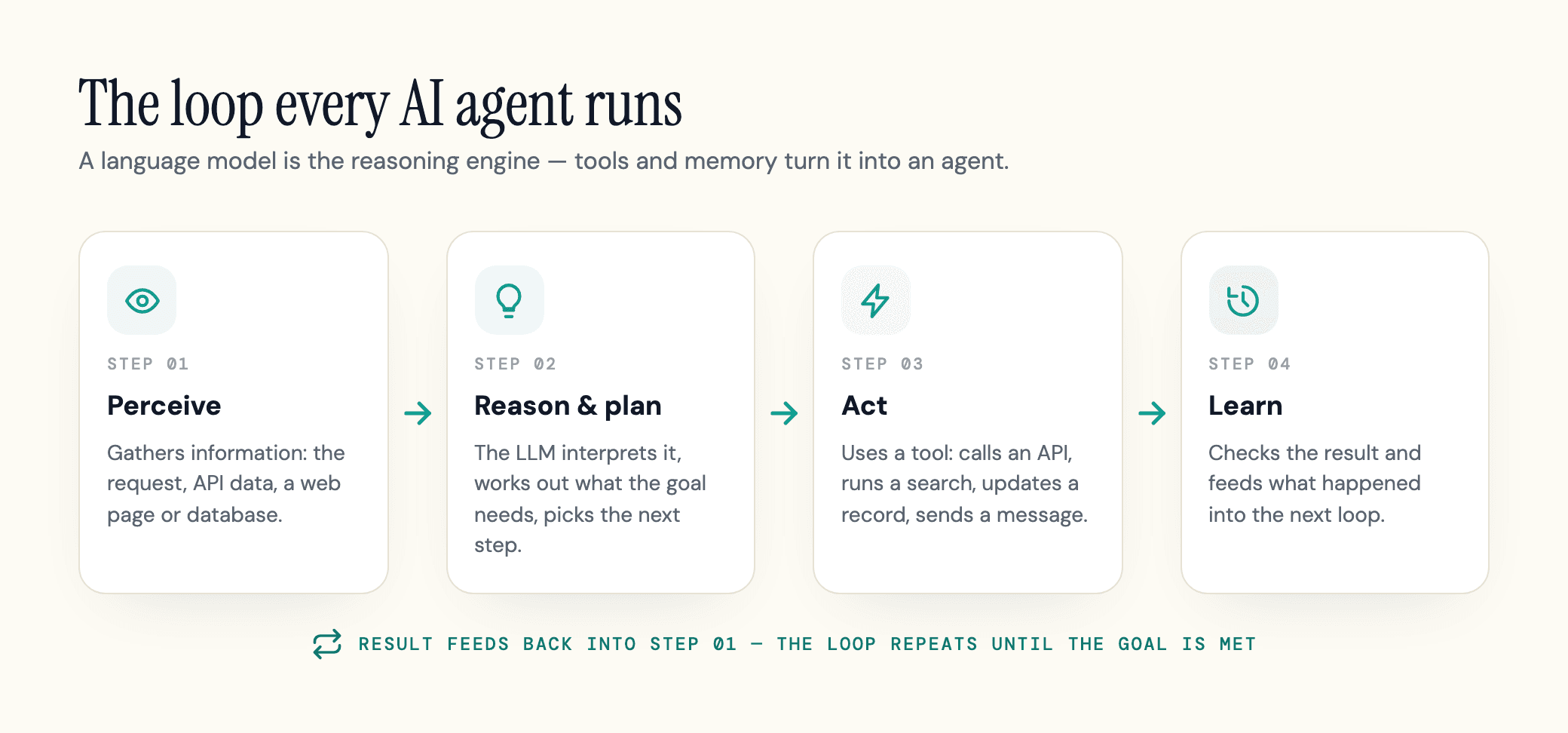
Under the hood, an agent runs a loop. It is simpler than the marketing makes it sound.
- Perceive. The agent gathers information from its environment: a user's request, data from an API, the contents of a web page or a database.
- Reason and plan. A large language model interprets that information, works out what the goal needs, and decides on the next step.
- Act. The agent uses a tool to do something in the real world: call an API, run a search, update a record, send a message.
- Learn. It checks the result, and feeds what happened back into the next loop.
The language model is the reasoning engine, but a model alone is not an agent. What turns it into one is the tools and the memory. Anthropic draws the line between a workflow, where developers hard-code the steps in advance, and an agent, where models "dynamically direct their own processes and tool usage." The more the system decides for itself, the more agentic it is.
Some tasks need only one agent. Bigger ones use several, coordinated by an orchestrator, sometimes called a conductor model, that hands subtasks to specialist agents and stitches the results together. You will also see older textbook categories, such as simple reflex agents and goal-based agents, but for a brand audience the loop above is the part that matters.
In our own work, the loop is not theoretical. We run agents in parallel to research a topic, one reading competitor pages while another pulls keyword data, then bring the findings back together. The pattern is genuinely faster than doing it by hand. It is also where the limits show up, which is the next thing worth being honest about.
What Agentic AI Looks Like in the Real World
The clearest way to grasp agentic AI is to see what it actually does today, not what a vendor promises for next year. See named AI agent examples by category for specific products, not just the categories below.
The consumer examples are the ones most people have already met. A research agent books a trip by comparing options and reserving the flight and hotel. A coding agent writes, runs, and fixes its own code. A shopping agent compares products across sites and adds the winner to a cart. A customer-service agent reads a ticket, checks an order, and issues a small refund within set limits.
The major AI products now include agent modes. Google Gemini has one that browses and acts, and OpenAI's ChatGPT Work does the same for ChatGPT. Anthropic's Claude can operate a computer and write code across a project. Microsoft Copilot, Salesforce Agentforce, and Perplexity all run task-doing agents, and platforms like Microsoft Copilot Studio let companies build their own. Even Apple has moved this way: at WWDC 2026 it announced an assistant that takes action across apps on a user's behalf, and a Passwords app that navigates websites to sign in and upgrade accounts for you.
So is Siri agentic AI? Increasingly, yes. As soon as an assistant stops answering questions and starts completing multi-step tasks for you, it has crossed the line from generative to agentic.
The impressive demos are real, but they are demos. The same agent that books a flight flawlessly on stage can stumble on a messy real-world account. The gap between a demo and a dependable production system is the source of most disappointment with agentic AI, and it is worth understanding before you buy.
The Hype Problem: Agent-Washing and Why Projects Fail
Agentic AI is real and it is also oversold. Both things are true, and a brand owner needs to hold them at once.
Adoption is genuinely wide. A PwC survey of US executives found 79% said their companies were already using AI agents, and two-thirds of adopters reported measurable value. Andrew Ng helped popularize the word "agentic," and in 2024 he wrote that seeing it in an article made him more likely to read on, because it was "less likely to be marketing fluff." Two years later the label is on almost everything, which is how a useful word stops being useful.
That is where "agent washing" comes in: rebranding ordinary chatbots, scripts, and automation as "agents" to ride the trend. Gartner has flagged it directly and estimates that only a small fraction of the thousands of self-described agentic vendors are the real thing. The same firm predicts that more than 40% of agentic AI projects will be cancelled by the end of 2027, citing rising costs, unclear value, and weak controls. A 2025 MIT report found that 95% of enterprise generative AI pilots delivered little to no measurable return on the bottom line.
Here is the part the failure stats usually hide: projects rarely die because the models are bad. They die on the unglamorous parts. The data is messy, the systems do not connect, nobody owns the governance, and the agent gets handed a job too broad to do reliably.
For a non-technical buyer, one quick test separates a real agent from a repainted chatbot. Ask whether the system can take a goal, choose its own steps, and use tools to act across several of them. If it only follows a fixed script and answers what it is asked, it is automation with a new label, not agentic AI. That single question will save you a lot of money.
Why Agents Aren't Magic: Reliability and Cost
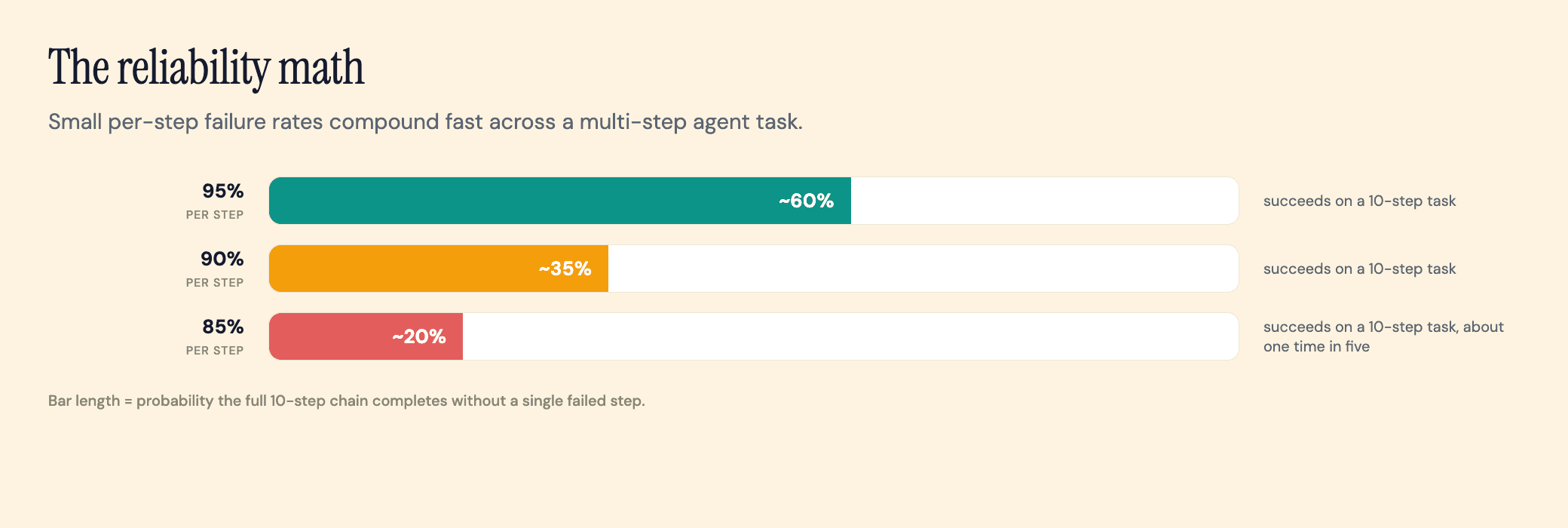
The single most useful thing to understand about agentic AI is that errors compound. A generative model only has to get one answer right. An agent has to get every step in a chain right, and small failure rates stack up fast.
The math is blunt. An agent that is 95% reliable on a single step is only about 60% reliable across a ten-step task, because you multiply the odds at each step. Drop to 85% per step and a ten-step job succeeds about one time in five.
| Accuracy per step | Success on a 10-step task |
|---|---|
| 95% | about 60% |
| 90% | about 35% |
| 85% | about 20% |
This is why "just wait for a better model" is not the fix people hope for. A sharper model raises the per-step number, but a long chain still leaks. The fixes that actually work live in the design, not the model: break the job into smaller steps, let the agent verify and retry its own work, and route anything that cannot be undone to a human. Adding a check at each stage recovers much of the lost reliability, which is exactly why the systems that hold up are built around verification rather than raw model power.
The practical rule: controlled autonomy
Let an agent run freely on cheap, reversible steps, and put a human checkpoint in front of anything it cannot take back: a payment, a deletion, an email to a customer. Full autonomy is for low-stakes tasks. Everything that touches money or your brand keeps a person in the loop.
Cost behaves the same way: it grows with every step. An agent re-reads its accumulating context before each action, so a long task can burn far more tokens than a single chat, and the bill is hard to predict. The practical rule is to set hard usage caps and point agents at narrow, repeatable, high-value jobs rather than turning one loose on everything.
Then there is accountability, which is not a hypothetical. When Air Canada's chatbot gave a customer wrong information about its bereavement fares, a tribunal held the airline responsible for what its bot said and rejected the argument that the chatbot was a separate entity. "The agent decided" is not a legal defense. Whatever your agent says or does is your company speaking. A newer risk is prompt injection, which OWASP ranks as the number-one security threat for these systems: hidden instructions buried in a web page or document the agent reads can quietly redirect what it does.
This shapes how we use agents in our own work, and the lesson generalizes. The checking is never left to the agent that did the job, because models are bad at catching their own mistakes: asked to review their own output, they tend to wave it through or repeat the error with more confidence. So a separate agent, with fresh context and no stake in the first answer, does the review, and we run the work past different models, including OpenAI's Codex and a few cheaper open-weight models, because each has different blind spots.
We treat those open-weight models as adversarial second opinions, never as the source of truth. They are cheaper but hallucinate more than the frontier models, and their training is often months out of date, so they will confidently "correct" a true, current fact into a wrong one. Every flag gets checked against a primary source, and agreement between models is a weak signal rather than proof, since models trained on similar data can share the same blind spot.
The part that actually compounds is what happens after a task. Agents do not quietly get better on their own. The improvement comes from a deliberate habit of capturing what went wrong on each run and folding it back into the rules the next run follows. That review loop, run by people, is what sharpens over time, not the model. It is the same lesson the failure stats keep pointing to: reliability is a matter of system design and discipline, not of waiting for something smarter.
What Agentic AI Means for Your Brand's AI Visibility
Here is the part the vendor explainers skip, and the part that should matter most to a brand. Agents are not just a tool you might use. They are increasingly the customer.
When someone asks an assistant to "find the best CRM under $100 a month and start a trial," a research agent does the searching, reads the options, and recommends one, often without the person ever visiting a website. Discovery, comparison, and sometimes the purchase itself happen inside the assistant. The brand that gets named wins. The others are invisible. This is not hypothetical: engines like Perplexity answer buying questions by naming specific products, and ChatGPT now drives product discovery and comparison (it pulled its in-chat Instant Checkout in early 2026, so the purchase itself completes on the merchant's site).
This is already reshaping web traffic. Cloudflare reported in June 2026 that bots now make up about 57.5% of web requests, passing human traffic for the first time, a crossover Cloudflare attributes to the surge in AI agents browsing on behalf of assistants like ChatGPT and Gemini. Those agents are a new audience hitting your site, and a separate one from Google's crawler. Our own list of AI crawlers shows how many are already knocking.
The uncomfortable twist for anyone who has invested in traditional SEO: ranking first on Google does not mean an agent will find or cite you. We see the gap in our own analytics. Some of our pages get picked up and cited by AI assistants while barely registering in Google's rankings for the same terms. The measurement of AI referrals is still rough, but the direction is clear: being cited by the model and ranking in search are two different games.
Agents also do not browse the way people do. They favor clean, machine-readable information: clear titles, structured product attributes, specifications, and consistent facts repeated across the web. A thin description like "medium roast, caramel" gives an agent almost nothing to match against a query. Worse, many agents weigh how consistent your facts are across the web, so if your pricing or claims differ from page to page, the agent may quietly pick a competitor it trusts more. In practice that comes down to three things you control: publish clear, structured details a machine can parse; keep your facts, pricing, and claims consistent everywhere they appear; and make sure AI crawlers are not blocked from reaching you in the first place.
This is the job we built geotoolbox for. Being chosen by an agent starts with two things you can actually check: whether AI crawlers and agents can reach your site at all, and whether the engines actually cite your brand when they answer questions in your space. That is the discipline behind generative engine optimization, and it is closely tied to the rise of agentic commerce, where an agent, not a person, does much of the choosing.
How to Start Without Getting Burned
You do not need to be technical, or buy a platform, to start with agentic AI. You can begin inside a tool you already use, since both ChatGPT and Claude now run simple agents directly.
The approach that works is narrow on purpose. Pick one repeatable task you understand well: routing inbound leads, drafting first replies to a common type of inquiry, turning a campaign report into a plain-language summary, or generating first-draft variants to test. Keep it small enough that you can check the output, and make sure a person approves anything the agent cannot take back, such as a send, a payment, or a deletion. Measure whether it actually saves time before you scale it to anything bigger.
That is the same lesson our own agent work keeps teaching us. Start narrow, keep a human on the steps that matter, verify the output, and only widen the scope once the agent has earned it. The teams that get value from agentic AI are not the ones that hand it the most freedom. They are the ones that aim it carefully.
The Bottom Line for Brands
Agentic AI is the step from AI that answers to AI that acts. The hype is loud and the failures are real, but the direction is steady: more of what your customers do, including how they find and choose brands, will run through agents that search, compare, and decide for them.
That makes one question worth asking now. When an AI agent goes looking in your category, does it find you, trust you, and recommend you, or does it quietly pick a competitor? The brands that win the agentic shift are the reachable, consistent, and citable ones.
If you want to see where you stand, you can run a quick AI readiness check to find out whether AI agents and crawlers can actually reach and read your site, then check whether the engines cite your brand when they answer questions in your space. Together they are the difference between being recommended by the agent and being invisible to it.
Frequently Asked Questions
Is ChatGPT an agentic AI?
Not by default. The base ChatGPT model is generative AI, which means it creates content in response to a prompt. When you turn on ChatGPT Work (OpenAI's agentic mode, launched in July 2026, gradually replacing the original "agent mode" since August 2026) and connect it to tools, the same model can plan and act across steps, which makes that setup agentic. Whether something is agentic depends on what it can do, not on the brand name.
What is the difference between AI agents and agentic AI?
An AI agent is a single building block: a model with tools that can do a task. Agentic AI is the wider system that pursues a goal and often coordinates several agents to get there. In short, AI agents are the parts, and agentic AI is the framework that puts them to work.
Is Siri an agentic AI?
Increasingly, yes. At WWDC 2026 Apple announced a Siri that completes multi-step tasks across apps on your behalf, alongside features that navigate websites to sign in for you. Once an assistant starts completing multi-step jobs rather than only answering questions, it has crossed from generative into agentic territory.
Is agentic AI just hype?
It is both real and oversold. Adoption is genuine, but Gartner expects more than 40% of agentic projects to be cancelled by 2027, and many "agents" are rebranded chatbots, a pattern called agent washing. The technology works best on narrow, repeatable tasks with a human checking the important steps.
What does agentic AI mean for SEO?
It adds a new visibility game on top of search rankings. Agents read and recommend from structured, machine-readable information and look for consistency across the web, so ranking on Google no longer guarantees that an AI agent will find or cite you. The goal shifts from being indexed to being chosen.
Do I need to know how to code to use agentic AI?
No. You can start with simple agents directly inside tools like ChatGPT or Claude, and many no-code platforms let you assemble agents by connecting steps together. Begin with one small, reversible task before you scale up.
Sources
- Anthropic, Building Effective Agents -
anthropic.com/engineering/building-effective-agents - PwC, AI Agent Survey -
pwc.com/us/en/tech-effect/ai-analytics/ai-agent-survey.html - Gartner, Predicts Over 40% of Agentic AI Projects Will Be Canceled by End of 2027 -
gartner.com/en/newsroom/press-releases/2025-06-25-gartner-predicts-over-40-percent-of-agentic-ai-projects-will-be-canceled-by-end-of-2027 - MIT NANDA via Fortune, 95% of generative AI pilots at companies are failing -
fortune.com/2025/08/18/mit-report-95-percent-generative-ai-pilots-at-companies-failing-cfo - McCarthy Tétrault, Moffatt v. Air Canada: A Misrepresentation by an AI Chatbot -
mccarthy.ca/en/insights/blogs/techlex/moffatt-v-air-canada-misrepresentation-ai-chatbot - OWASP, GenAI Top 10: Prompt Injection (LLM01) -
genai.owasp.org/llmrisk/llm01-prompt-injection - Cloudflare via Tom's Hardware, Bots Have Now Passed Human Traffic Online -
tomshardware.com/tech-industry/artificial-intelligence/bots-have-now-passed-human-traffic-online-cloudflare-boss-laments-says-agentic-traffic-wasnt-expected-to-eclipse-real-people-until-next-year