
ChatGPT has ads now. A US pilot began in February 2026, and OpenAI has built it into a full ad platform since: Free and Go users, logged in or out, now see a labeled "Sponsored" card below some answers. If you are a marketer, you want to know how ChatGPT ads work, who they reach, and what they cost. If you are a regular user, you probably want to know why ads showed up and whether they change the answers.
This covers both, plus the question most guides skip: what paid ads mean if what you actually want is for ChatGPT to recommend your brand on its own.
Does ChatGPT Have Ads Now?
Yes. OpenAI began testing ads in ChatGPT on February 9, 2026, starting in the United States, after laying out its advertising approach in a January 16 post. What launched as a small US pilot has since expanded to more countries and grown into a self-serve platform that advertisers can buy directly. ChatGPT is not the first AI answer engine to carry ads: Perplexity tested sponsored follow-ups and said in February 2026 it had dropped them, and Google shows ads in AI Overviews and AI Mode, but ChatGPT is by far the largest to flip the switch.
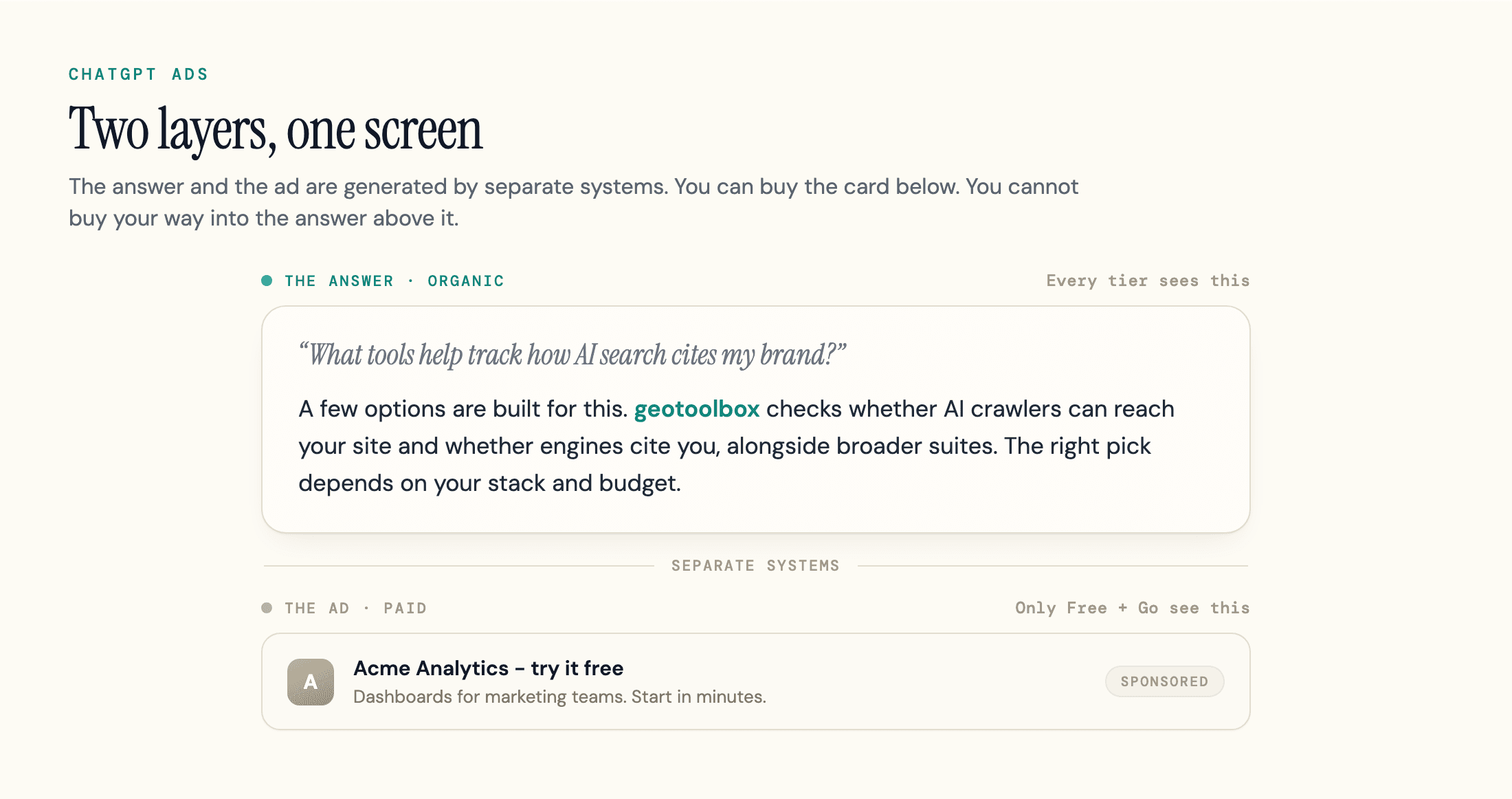
The important framing, straight from OpenAI: an ad is a paid placement, not a recommendation from ChatGPT. The model's answer and the ad beneath it come from separate systems. That distinction is small until you are the one trying to show up in the answer, where it becomes the only thing that matters.
Who Sees Ads in ChatGPT (and Who Doesn't)
Ads only reach the lower tiers. According to OpenAI's Help Center documentation, ads can appear for users on the Free and ChatGPT Go plans, whether or not they are logged in. As of the current rollout, everyone on a higher paid tier is exempt.
| Plan | Sees ads? | Monthly price |
|---|---|---|
| Free | Yes | Free |
| Go | Yes | ~$8 |
| Plus | No | ~$20 |
| Pro | No | $100, $200 or $500 (three tiers) |
| Business / Enterprise / Education | No | Varies |
A couple of limits apply even inside the ad-supported tiers. OpenAI does not show ads to accounts it identifies as belonging to people under 18, and Temporary Chats show no ads.
If you are on Go and surprised to see ads, that is by design: Go is a cheaper subscription, not an ad-free one. You do not have to pay to escape them, though: the ad-free mode, which trades ads for fewer messages a day and no access to tools like image generation or deep research, is a Free-plan option, so a Go user would drop back to Free to use it. The other way out is to move up to Plus or higher. For the full plan breakdown, see our ChatGPT pricing guide.
The European Union came later, and on its own terms. Ads went live across the European Economic Area and Switzerland on August 24, 2026, in 31 markets at once, nine days after OpenAI emailed Free and Go users there. As of early November 2026 they are still non-personalized: OpenAI says personalized ads are not initially available in the EEA or Switzerland, and an opt-in is promised with no date. Custom audiences, which match an advertiser's own customer lists to users, are not supported for campaigns targeting those markets either, per OpenAI's developer docs. The global rules apply there too: no ads for under-18 accounts or next to sensitive chats, and no political ads. That phased, consent-first design is how the rollout works around GDPR consent rules and the Digital Services Act's ad-transparency requirements, which are the likely reason the EU went live later than the United States, Canada and Australia.
Where Ads Appear and What They Look Like
The standard ad sits below the answer, never inside it. When ChatGPT finishes replying, a sponsored unit can appear beneath the response, clearly labeled and visually separated from the text the model wrote. It reads more like a native card than a banner.
The creative is compact. Per OpenAI's ads guide, each ad carries the brand's name, a favicon, a title, a short description, an image, and a link to the landing page, and OpenAI's developer docs set the limits: a title of 3 to 50 characters, a body of up to 100 characters, and an image of at least 640 by 640 pixels. A response shows one ad unit, with one or several images; since October 26, 2026, accounts OpenAI has enabled can attach 4 to 6 square images to a single ad, and product-feed ads add catalog items.
Be careful with older write-ups here. A lot of early-2026 coverage described "sidebar" or "companion display" ad units and a menu of three or four formats. That was speculation from launch week. What OpenAI's own advertiser docs actually describe are sponsored units below the answer plus product-feed variants, not a Bing-style sidebar. Newer formats: a multi-image ad during image generation and Sponsored Agents, a branded AI agent you chat with after a click, for selected advertisers only.
How ChatGPT Decides Which Ads to Show
The core signal is your current conversation. OpenAI's system reads what you are asking about, runs a brand-safety check, finds eligible ads whose topic and landing page match, and uses an auction that weighs relevance and bids to choose which ad appears. Advertisers do not bid on exact-match keywords the way they do in Google Search. Instead they supply "context hints," plain-language descriptions of the topics and situations where their product fits, and OpenAI decides the final match. Geographic targeting starts at country level and, where available, goes down to regions, cities, markets and postal codes; product-feed campaigns are country-level only.
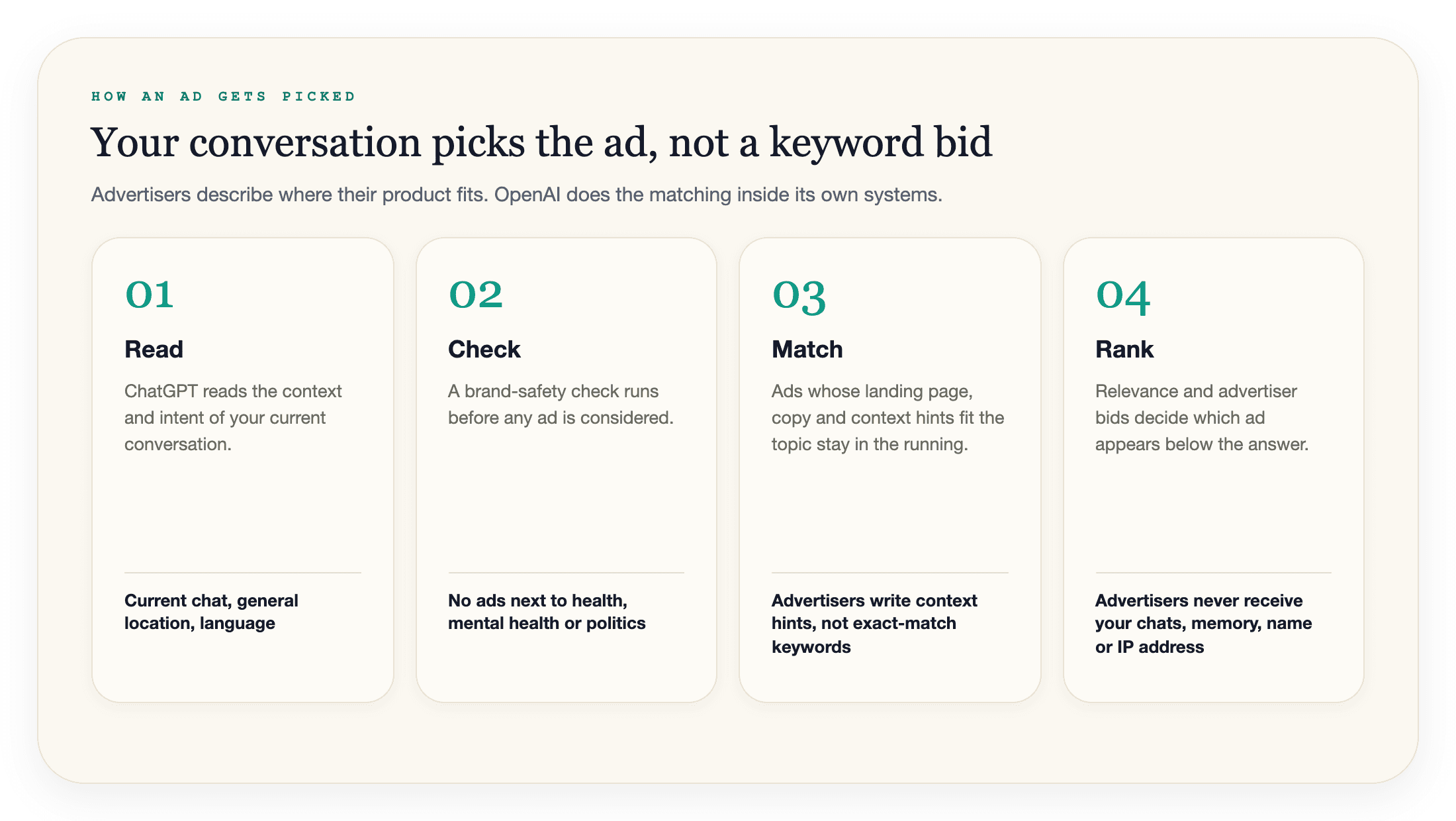
Targeting is contextual by default, but it is not only contextual. If you have ad personalization turned on, OpenAI says it may also use your past chats, memory, and previous ad interactions to make ads more relevant. That is behavioral targeting, and a good deal of the early-2026 coverage that called ChatGPT ads "purely contextual, no user profiles" simply got it wrong.
What advertisers never receive is your raw material. Per OpenAI, they do not get your chats, history, memory, name, email, precise location, or IP address. The matching happens inside OpenAI, which acts as the middleman. You can turn personalization off, clear your ad data, or use a Temporary Chat to keep a session out of it.
Do ChatGPT Ads Change the Answers?
This is the question most users actually care about, and OpenAI's answer is no. Its documentation states that ads do not influence the answers ChatGPT gives, that the ad system is separate from the model that writes responses, and that advertisers cannot shape, rank, or alter what ChatGPT says. An ad appearing below an answer is not an endorsement of that brand by ChatGPT.
Whether you take that on faith is up to you, and plenty of users are skeptical, especially given that OpenAI spent years calling in-product ads a last resort before reversing course. The incentive to blur the line grows as ad revenue does, so the separation is worth watching, not just trusting. But the architecture is what matters today, and it cuts in a useful direction. Because the answer and the ad are generated separately, ad spend cannot move you into the answer itself. The brands named in a response come from what the model learned and retrieved, and paying for an ad does not change that. We come back to what that means for visibility below. For the mechanics of how ChatGPT chooses which sources to name, see how ChatGPT cites sources.
What ChatGPT Ads Cost (for Advertisers)
There is no published rate card, and the pricing has moved fast. What has stayed constant is the buying model: you pick an objective, views priced on cost per thousand impressions (CPM), clicks priced on cost per click (CPC), or conversions, billed per click (oCPC) or per thousand impressions (oCPM), set a maximum bid or, for clicks and conversions, let OpenAI bid with Maximize Results, and an auction that weighs relevance and bids decides which ad shows and what you pay. What changed is the barrier to entry.
| Stage | Date | What it cost to get in |
|---|---|---|
| Launch pilot | Feb 2026 | ~$60 CPM, $200,000 minimum (enterprise only) |
| Minimum lowered | Apr 2026 | ~$50,000 minimum |
| Self-serve opens | May 2026 | No minimum commitment |
| Now | Oct 2026 | Auction: CPM, CPC, or conversion-optimized; no minimum commitment, but a minimum daily budget ($25 a day in USD) |
The launch numbers, roughly $60 CPM behind a $200,000 commitment, are what made early headlines. By May, when OpenAI opened self-serve buying, the minimum commitment was gone. Ad Age reported in July that the platform had shifted from an impressions business toward a clicks business as it matured. OpenAI recommends starting at a maximum bid of $3 to $5 per click. Reported CPCs since then land in the low single digits to low teens depending on the category, though those figures come from marketers, not OpenAI, so treat them as directional.
Is it worth it? Early advertisers are mixed. The audience is large but skews toward users who did not pay to remove ads, which is a real consideration if you sell to buyers who would. The reporting is still thinner than Google or Meta, with no conversation-level visibility into which prompts triggered your ad. One more limit worth knowing before you plan a budget: ads stay out of sensitive chats, and political ads are banned. Regulated categories are tighter outside the US: in OpenAI's eligibility table, health is almost entirely blocked there (supplements, consumer medical devices and apps, disease-awareness campaigns, health insurance), deposit accounts, insurance and auto loans need selected-advertiser approval, and personal loans, buy-now-pay-later and crypto are barred. For most brands this is a channel to test with a small budget, not to bet on yet.
How to Advertise on ChatGPT
If you want to run one, the entry point is OpenAI's Ads Manager at ads.openai.com, or a technology partner if you already buy media through one. Self-service has two eligibility rules. The legal entity that advertises and is billed must be based in a country on OpenAI's Ads Manager availability list, and some new accounts can initially target only their home country until identity verification is approved and they reach the required ad spend there, per OpenAI's campaign setup guide. The structure will feel familiar: a campaign holds your budget, objective and targeting (countries, platforms, audiences), an ad group holds your context hints and bid, and the ad itself holds the headline, description, and image.
The short version of a first campaign: create the campaign and pick views, clicks, or conversions, write context hints that describe the conversations where your product belongs, set geographic targeting, upload creative within the current character limits, and add the measurement pixel or Conversions API so you can see what happens after the click. Since October 30, 2026, creative enhancements are on by default for self-serve campaigns: OpenAI may rewrite headlines and descriptions, translate the ad, resize images and adjust the destination URL without you approving each version, so opt out in Ads Manager if your copy must stay word for word. Let OAI-AdsBot, OpenAI's ad-review crawler, reach your landing page, or the ad fails review. Add UTM parameters to the landing page and the traffic will show up in your normal analytics. This is not a deep-optimization platform yet, so most of the early skill is in writing hints and creative that match how people actually phrase questions.
What ChatGPT Ads Mean for Your Organic Visibility
There is a strategic point buried under the ad mechanics. Plus, Pro, Business, Enterprise, and Education users browse ChatGPT ad-free. If your buyers skew toward those tiers, and for a lot of B2B, premium, and developer products they do, the people you most want to reach never see an ad, and the only way to appear for them is to be named inside the answer itself. If you sell broad consumer products, the free ad tier may be the bigger prize, so weigh both.
The ad auction, at least, does not buy your way into the answer. Because the ad system and the model are separate under OpenAI's current design, the brands named in a response come from what the model learned and retrieved, not from ad campaigns. So ads and organic visibility are not substitutes. They are layered. One is a recommendation layer, where you earn a mention inside the response across every tier. The other is a consideration layer, where a sponsored card can appear below the answer for Free and Go users. Ads buy the second. The first you earn by being citable. Keep two feed programs apart: in OpenAI's commerce program, approved merchants submit feeds so ChatGPT can show their products in search and shopping, which is not an ad buy; products in an ads feed appear only in ads.
That reframes the ChatGPT ad launch as less of a threat to organic strategy and more of a confirmation of it. If OpenAI is now charging brands to appear near answers, the answers themselves are clearly where the attention is. Getting recommended in those answers is a different discipline, generative engine optimization. We cover the practical steps in how to optimize for AI search, and if you are deciding how to divide effort between classic search and AI, GEO vs SEO walks through the split.
At geotoolbox we build tools for exactly this layer, checking whether AI engines can crawl your site and whether they actually cite you when it counts. The ad platform does not change that work. It makes it matter more.
Further reading: SEO for ChatGPT: How to Get Cited in ChatGPT Search is the companion to this piece. It covers exactly how to earn a place in the answer, which is the visibility ads cannot buy.
Frequently Asked Questions
How do I turn off or block ChatGPT ads?
You have a few levers. To keep ads but make them less targeted, turn off ad personalization in settings, which stops OpenAI from using your past chats and ad history, and clear your ad data; ads still appear, just less personalized, and in the EEA and Switzerland it is already off. To skip ads in a single session, use a Temporary Chat, which currently shows none. To remove them across the board, upgrade to Plus or a higher plan, or switch to the ad-free mode, a Free-plan option that trades ads for fewer messages a day and no access to tools like image generation or deep research; a Go user must switch back to Free first.
Are my ChatGPT conversations shared with advertisers?
No. OpenAI says advertisers do not receive your chats, chat history, memory, name, email, precise location, or IP address. The ad matching happens inside OpenAI, which selects and serves the ad without handing your data to the brand.
How much do ChatGPT ads cost to run?
There is no fixed rate. Ads are bought through an auction on a CPM, CPC, or conversion-optimized basis, and OpenAI does not publish official prices. The pilot launched around a $60 CPM with a $200,000 minimum in February 2026; that commitment disappeared when self-serve buying opened in May, but every campaign still needs a minimum daily budget, $25 a day for USD accounts. Reported click costs since then run from a few dollars into the low teens depending on the category.
Which countries have ChatGPT ads?
Ads started in the United States on February 9, 2026. OpenAI announced Canada, Australia and New Zealand on March 26, 2026 and rolled them out in April, and on August 11 it reported ads launched in the United Kingdom, Japan, South Korea, Mexico and Brazil. The European Economic Area and Switzerland followed on August 24 and India at the end of August. On August 31 OpenAI said ads were available in over 40 countries and opened self-service buying across India, Europe, the Middle East and North Africa. On September 23 it began rolling ads out in Indonesia, Malaysia, the Philippines, Singapore, Thailand, Vietnam and Taiwan, putting the total past 60 countries, and on October 21 it added 26 more, including Argentina, Chile, Colombia and Peru, for 89 countries in all. OpenAI publishes no complete country list for users; its Ads Manager availability page is the advertiser list, and as of October 2026 it names 89 countries, matching OpenAI's total.
The Bottom Line
ChatGPT ads are real, they are labeled, they sit below the answer, and they reach Free and Go users on a contextual auction that is still maturing. If you sell something, they are worth a small test. But the answer above the ad is where the lasting value is, and the ad auction does not buy a place in it.
If you want to know whether AI engines can even reach your site, and whether ChatGPT is citing you when people ask about what you do, run a free AI readiness check and start with what the model can actually see.
Sources
- Our Approach to Advertising and Expanding Access - OpenAI, January 16, 2026 -
openai.com/index/our-approach-to-advertising-and-expanding-access - Testing Ads in ChatGPT - OpenAI, February 9, 2026 (updated August 11, 2026) -
openai.com/index/testing-ads-in-chatgpt - Ads in ChatGPT (Help Center) - OpenAI -
help.openai.com/en/articles/20001047-ads-in-chatgpt - Ads (advertiser documentation) - OpenAI Developers -
developers.openai.com/ads - Ads in ChatGPT: The Basics - OpenAI Help Center -
help.openai.com/en/articles/20001207-ads-in-chatgpt-the-basics - Ads Policy Eligibility Table - OpenAI Help Center -
help.openai.com/en/articles/20001534-troubleshooting-common-onboarding-and-policy-issues - Ads Manager Availability - OpenAI Help Center -
help.openai.com/en/articles/20001245-ads-manager-availability - Creating campaigns for ChatGPT Ads - OpenAI Help Center -
help.openai.com/en/articles/20001210-creating-campaigns-for-chatgpt-ads - Custom Audiences - OpenAI Developers -
developers.openai.com/ads/custom-audiences - ChatGPT Rolls Out Ads - TechCrunch, February 9, 2026 -
techcrunch.com/2026/02/09/chatgpt-rolls-out-ads - How ChatGPT Advertising Works Now - Ad Age, July 22, 2026 -
adage.com/technology/ai/aa-chatgpt-ads-ad-tech-what-marketers-still-need - OpenAI gains 32 ChatGPT ad markets in 5 days as India goes live - PPC Land, August 30, 2026 -
ppc.land/openai-gains-32-chatgpt-ad-markets-in-5-days-as-india-goes-live - A milestone in expanding access to AI - OpenAI, August 31, 2026 -
openai.com/index/expanding-access-to-ai-with-chatgpt-ads - ChatGPT Ads expands to Southeast Asia and Taiwan - OpenAI, September 23, 2026 -
openai.com/index/chatgpt-ads-expands-southeast-asia-taiwan - ChatGPT Ads expands to 26 new countries - OpenAI, October 21, 2026 -
openai.com/index/chatgpt-ads-expands-26-new-countries