
The real question behind GEO vs SEO is not which one to pick. It is how to divide a fixed budget now that AI answers sit between your pages and your audience. The two are not rivals; they are two surfaces built on one foundation, and the money you already spend on search is what makes AI citations possible in the first place.
Most of this piece is about where the incremental dollar goes. One thing to clear up first, since the acronym is overloaded: GEO here means generative engine optimization, not geo-targeting or local search.
The Core Difference Between GEO and SEO
SEO buys a ranked position you can hold; GEO buys a mention inside an answer that gets rewritten every prompt, and the two pay off in different currencies. SEO's return is a click from a spot you defend. GEO's return is a citation in a probabilistic answer with no position to hold, so you fund a share of many answers rather than one rank.
That is why this is a budget question, not a swap. Rankings and citations come apart in practice: a page can sit outside Google's top 10 and still get quoted by ChatGPT, and a page at position 1 can be left out of the answer entirely.
If you want the wider acronym picture, including where answer engine optimization (AEO) fits, our GEO vs AEO vs SEO breakdown is the triage page. This one stays on the two disciplines most budgets actually trade off: search and AI, where GEO means generative engine optimization, the work of getting cited by AI answer engines.
Why GEO and SEO Share a Foundation
Here is the part that decides how you should spend: most AI answer engines do not run their own web-scale crawl. They lean on a search index to find candidate pages, then fetch those specific pages to read and quote them. Ask ChatGPT or Google's AI features a question and the system rewrites it into several queries, pulls candidates through search-style retrieval (Bing plus OpenAI's own index for ChatGPT, Google's own for AI Overviews), and writes an answer from what comes back. Perplexity runs more of its own retrieval, but the pattern holds: to be quoted, you first have to be findable. That retrieval step is query fan-out, and it means the SEO foundation, being crawlable, indexable, and credible, is the layer GEO is built on. How AI search works walks the full loop.
The data backs the dependency. A Writesonic study of over a million AI Overviews found 40.58% of AI citations came from pages in Google's top 10 for the query. The top 10 is still the single biggest door into an AI answer, even though the majority of citations now come from beyond it, often from a page that won a fan-out sub-query no rank tracker shows you. Note what that implies: you do not need to rank first for the head term to be cited, you need to rank for one of the sub-questions the answer is built from.
Google says the same thing from the other side: its AI features run on core Search ranking and indexing, with no special markup that turns them on. So the foundation is shared. What differs is the slice on top, and that slice is where the budget question lives.
GEO vs SEO, Side by Side
The deltas that matter day to day are narrow but real. SEO optimizes for a crawler that ranks; GEO optimizes for a model that retrieves and rewrites. That changes what you measure, who you compete with, and which content actually wins.
| Dimension | SEO | GEO |
|---|---|---|
| Unit of success | A ranked position and its click | A citation inside an AI answer |
| What gets picked | Pages, ranked by relevance and authority | Passages, selected by extractability and trust |
| Where you appear | The results list | Inside a written, sourced answer |
| How it is measured | Rankings, clicks, sessions | Share of voice, mention rate, citation rate |
| Content that wins | Depth, links, keyword coverage | Clear claims, quotes, stats, consistent entity |
| Visibility pattern | A position you hold | A share that shifts prompt to prompt |
The last two rows are where the money splits. Rankings still reward links and depth; citations reward being a clearly defined entity, named and described the same way across the web, so entity SEO and digital PR earn more of the GEO budget than another link-building push. Because the answer reshuffles every run, you fund a share of voice rather than a rank you hold.
When SEO Still Wins
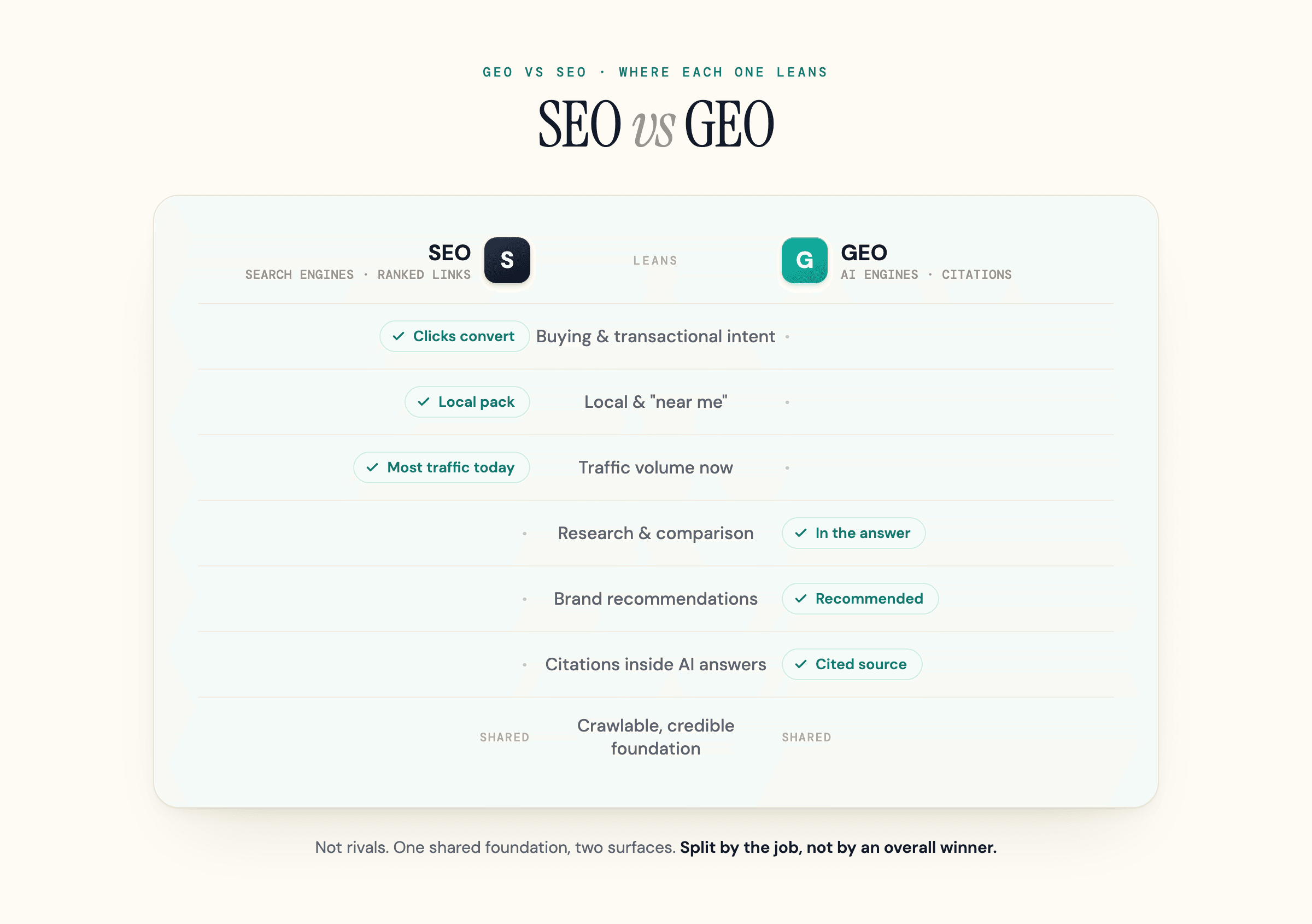
GEO is additive, not a replacement, and for whole classes of query and business SEO is still the better place to spend.
Most searches still have no AI answer to be cited in. Per Pew Research's July 2025 study of 68,879 searches, an AI summary appeared on about 18% of them. Where one does fire it suppresses the click hard, with Pew putting the click rate at 8% with a summary versus 15% without, but that cuts both ways: in Pew's March 2025 measurement window most searches carried no summary to be cited in. Coverage has grown since (the Semrush figures further down track it), yet plain results still cover the majority of queries, and on them the ranked link is the whole game.
High-intent and YMYL queries still click. When someone is ready to buy, book, or reach a specific site, they act on a result rather than ask a chatbot to do it for them. It also holds for high-stakes medical, legal, and financial decisions, where people click through to verify an accountable source rather than take a summary at its word. These reward a strong ranked page and a fast path to act, not a citation in someone else's answer.
AI tends to get the research question, search gets the buying one. People reach for an assistant to explore and compare, then return to search to transact. a16z, citing Semrush, puts AI prompts at about 23 words versus 4 for a traditional search; treat the exact number as directional, since Semrush's own clickstream reports shorter prompts, but the direction fits the behavior, longer exploratory questions upstream and decisive clicks downstream. The bottom of the funnel still lives in search.
Being findable comes before being cited. Because engines retrieve from a search index, a page that is not crawlable or indexable rarely gets quoted. A low-authority site can still win a narrow sub-query it answers well, but it cannot skip the groundwork. If you are early, the fastest route to AI visibility is the SEO foundation: crawlable, credible, findable first.
How to Split Your Budget Between SEO and GEO
There is no universal percentage. SEO and GEO are interdependent: the same work that lifts a ranking often lifts a citation, so a clean "X% to GEO" split misrepresents how the money actually works. The vendor guidance that circulates varies widely, from an even split to the large majority of effort on SEO depending on who you ask, which tells you it is a judgment call rather than a formula.
Start from your business, not a slider. This is where the lean sits by model:
| If you are | Lean | Why | First GEO dollar |
|---|---|---|---|
| Local service | SEO | Buyers want one nearby result and a click to act | Reachability + a clean profile |
| Ecommerce | SEO-lean | Checkout stays on-site, but product discovery is moving into AI, so feed it too | Structured product data |
| B2B or SaaS | Toward GEO | Long research cycles run through AI comparisons; the win is being the recommended brand | Third-party citations and entity trust |
| Publisher or media | SEO | Ad models need the visits, but publishers are the most exposed to summarizing | Track citation leakage first |
| New or low-authority | SEO foundation | Citations follow discoverability you have not built yet | Nothing until you can be found |
If you need a place to start, most programs sit somewhere between 85/15 and 70/30 in favor of SEO, tilting toward 60/40 for high-consideration B2B where buyers lean on AI to build a shortlist. Treat that as a dial, not a rule: begin near 80/20 and let your own exposure move it.
Then size the GEO slice to that exposure, not a benchmark. Two numbers set it: how many of your money queries actually trigger an AI summary (Pew's 18% US average runs higher in some categories), and how much of your visibility already leaks to zero-click answers in Search Console. Coverage has moved fast and unevenly since early 2025: Semrush's AI Overviews study, refreshed in December 2025 across more than 10 million keywords, tracked AI Overviews on 6.49% of queries in January 2025, 24.61% in July 2025, and 15.69% by November 2025 - a peak and a partial retreat, settling around 16%. So revisit the split as your category's coverage moves, in either direction.
In practice, hold your total search-and-content budget steady and fund GEO by redirecting part of your existing content, PR, and link spend rather than adding a new line, letting measurement justify every shift after that. You also do not need to buy a separate service to do it. Most of the work is your own SEO and PR redirected, a point we make in GEO services vs software.
How to Migrate an SEO Program to GEO
Most guides hand you a GEO checklist. What an existing SEO team actually needs is a sequence: how to evolve the program you already run into one that earns citations too. Four phases, in order.
-
Fix reachability first. The crawlers that fetch pages for live answers, OAI-SearchBot and ChatGPT-User (OpenAI), Claude-SearchBot and Claude-User (Anthropic), and PerplexityBot and Perplexity-User (Perplexity), mostly read raw HTML and do not run JavaScript. A robots.txt rule, a bot-management block, or client-side rendering can quietly lock them out even when Googlebot gets in. (Blocking the training-only crawlers like GPTBot keeps you out of model training but does not stop you being cited, so leave the retrieval ones in.) This is the cheapest win and usually a same-day change. Confirm the retrieval crawlers can reach your pages with our AI crawler checker before anything else. Nothing downstream matters until this passes.
-
Redesign the content for extraction. Shift from pages that rank to passages a model can lift. Lead each section with a direct 40-to-60-word answer, phrase headings as the questions people ask, and put evidence in the body. The GEO research paper that coined the term found that its optimization methods raised a page's visibility in generated answers by up to 40%, with adding citations, quotations, and statistics among the highest-impact tactics. That is not a new skill, it is AI content optimization applied to a new reader.
-
Build off-site entity trust. Rankings reward links; citations reward a consistent, well-described entity. Move some link budget into digital PR and getting named accurately across the sources models lean on, from Wikipedia and Wikidata to Crunchbase, LinkedIn, and the main directories in your category. The goal is that your brand is described the same way wherever a model looks.
-
Evolve your KPIs. Add citation rate, share of voice, and mention rate alongside rankings and sessions, and expect engines to disagree with each other. The full AI-search playbook covers the tactics under each phase; the shift here is what you hold yourself accountable to.
The Measurement Problem Nobody Warns You About
Budgets stall on GEO for a plain reason: you cannot manage what you cannot see, and AI visibility is genuinely harder to measure than a ranking. Three things make it slippery.
Answers are probabilistic. SparkToro ran the same prompts thousands of times and found AI engines returned an identical list of recommended brands under 1% of the time, and the same order closer to 1 in 1,000. Any score you get samples that noise, so treat it as a trend line, not a census.
Citations do not always name you. Semrush's Ghost Citations study found 62% of AI citations reference a source without naming the brand, so a mention-only tracker undercounts your real influence. And the visits that do come through often arrive with no referrer and land in analytics as direct traffic, which undercounts again.
Attribution will not be clean, but you can close some of the gap. Watch branded-search and direct-traffic lift in the weeks after you gain citations, add a "how did you hear about us" prompt at signup, and treat share of voice as the leading indicator while conversions catch up. Set expectations while you are at it: most AI citations behave like an impression, not a click. GEO's near-term return is upper-funnel, being the brand the answer names, so budget it as brand influence rather than direct traffic.
The fix is to track the right things: share of voice across engines, mention rate, citation rate, and where you land inside an answer. In the sites we scan, a page is often invisible in AI answers for a reason a visibility check surfaces quickly, so measure before you optimize. Our guides to AI share of voice and tracking AI visibility cover the metrics in depth.
Is GEO Just SEO With a New Name?
Partly, and that is worth conceding. Ask working SEOs and many will say most GEO advice is plain good SEO with a fresh label, and threads full of that skepticism are not wrong: reachable pages, clear answers, real authority, and consistent branding earn both rankings and citations. If a "GEO package" is reselling you those fundamentals at a new price point, you are paying twice for one program.
The sharper objection is about efficacy, not price. In several practitioner write-ups, the accounts where GEO "worked" were the ones already ranking well, which suggests the citations were reflecting existing SEO rather than adding to it. It is a fair challenge. The incremental layer, extractable formatting and entity trust, is worth doing, but its standalone return is still thinly evidenced. Which is exactly why you measure before you scale it.
But the rebrand framing also hides a genuinely new layer. Retrieval changes which pages get surfaced, citation changes how credit is assigned, and measurement changes what you can even see, none of which existed when the job was purely ranking. The practical takeaway is not "GEO is fake" or "SEO is dead." It is that the fundamentals now serve two surfaces, and the new work is the thin slice on top plus the tracking to prove it moved. Spend on that slice, not on a second invoice for the base.
Frequently Asked Questions
Is GEO replacing SEO?
No. GEO adds a surface, it does not remove one. Most searches still return no AI answer to be cited in, and AI engines mostly retrieve candidates through search-style discovery, so the authority that makes you findable is what makes citations possible. Treat GEO as an extension of SEO, not a successor.
Is SEO dead in 2026?
No, though the click is under pressure. AI answers resolve more queries without a visit, so some sites see organic traffic slide. The response is to extend SEO toward citations and answers, not abandon it, because the fundamentals that earn a ranking are the same ones that earn a citation. We walk through the data behind that in is SEO dead?.
Is GEO the same as geo-targeting or local SEO?
No, and the name collision causes real confusion. GEO here means generative engine optimization, getting cited by AI answer engines like ChatGPT and Perplexity. It has nothing to do with geographic targeting, geolocation, or local search.
How much of my budget should go to GEO?
There is no universal number. Hold your total budget steady and fund GEO by redirecting part of your existing content, PR, and link spend, sized to how many of your money queries trigger AI answers and how much visibility you already lose to zero-click. Let tracking justify each shift rather than committing to a fixed split up front.
Can I do GEO without doing SEO first?
Rarely well. Because AI engines mostly find candidates through search-style discovery, a page that cannot be found or indexed usually cannot be cited. New or low-authority sites get the fastest AI-visibility gains by building the crawlable, credible SEO foundation first.
Can optimizing for GEO hurt my SEO?
Rarely, and mostly they pull the same way. The one real tension is over-trimming a page into extractable snippets at the expense of the depth that earns rankings. Keep the substance, add the answer-first structure on top, and the two reinforce each other.
Is GEO the same as AEO?
They overlap but are not identical. Answer engine optimization targets the answer slot on search surfaces, while GEO targets citations inside generated, conversational answers. Our 3-way breakdown untangles all three.
Where to Start
For most businesses the verdict is the same: keep SEO as the foundation and layer GEO on top, sized to your actual AI exposure. Do not defund the work that still brings the traffic to chase a surface that, for now, sends a fraction of it: AI referrals were about 0.32% of all website traffic in SE Ranking's June 2026 study, growing fast but still tiny next to search. The two share a base, so the smart move is to run the fundamentals once and spend the incremental effort where your own data says you are losing visibility.
That last part is the catch. You cannot split a budget you cannot measure, and AI visibility does not show up in a rank tracker. Before you move a dollar toward GEO, get a read on where you actually stand across the AI answers your buyers see. geotoolbox tracks your share of voice and citations across ChatGPT, Perplexity, Google AI Overviews, and more, so the split is a decision backed by numbers rather than a guess. Start with a look at your AI visibility, then let what it shows decide how much of the budget shifts.
Sources
- AI Citations From SERP Results Study - Writesonic -
writesonic.com/blog/ai-citations-from-serp-results-study - Google Users Are Less Likely to Click When an AI Summary Appears - Pew Research Center, July 2025 -
pewresearch.org/short-reads/2025/07/22/google-users-are-less-likely-to-click-on-links-when-an-ai-summary-appears-in-the-results - GEO: Generative Engine Optimization (paper) - Aggarwal et al., arXiv 2311.09735 -
arxiv.org/abs/2311.09735 - AIs Are Highly Inconsistent With Their Recommendations - SparkToro -
sparktoro.com/blog/new-research-ais-are-highly-inconsistent-when-recommending-brands-or-products-marketers-should-take-care-when-tracking-ai-visibility - Semrush AI Overviews Study - Semrush, originally March 2025, refreshed December 2025 -
semrush.com/blog/semrush-ai-overviews-study - The Ghost Citations Study - Semrush -
semrush.com/blog/the-ghost-citations-study - GEO Over SEO - Andreessen Horowitz (a16z) -
a16z.com/geo-over-seo - AI Features and Your Website - Google Search Central -
developers.google.com/search/docs/appearance/ai-features - What's the Real Difference Between SEO and GEO (discussion) - r/SEO -
reddit.com/r/SEO/comments/1o0ta17 - AI Traffic Research Study - SE Ranking, June 2026 -
seranking.com/blog/ai-traffic-research-study