
First, a disambiguation. This guide is about getting your brand cited when someone asks ChatGPT a question, not about using ChatGPT to write SEO content. Those are different jobs, and much "ChatGPT SEO" advice quietly mixes them: using ChatGPT to brainstorm keywords or draft posts is a productivity tactic that does nothing on its own to get you cited, and can hurt if it produces generic content. SEO for ChatGPT, in the sense that matters here, means appearing in ChatGPT's search answers.
Why bother? Because the audience is now mainstream. Pew Research found that 44% of US adults had used ChatGPT, per a survey published June 2026, up from 34% a year earlier and 18% in 2023. The usage numbers behind that trend are just as large: OpenAI announced 900 million weekly active users in February 2026, and the search side specifically had already passed 1 billion web searches in a single week by April 2025, per OpenAI's own announcement. When nearly half the country is asking a chatbot questions, being absent from its answers is a real gap in coverage.
The good news: OpenAI has documented enough that you do not have to guess.
ChatGPT Search vs ChatGPT's Training Knowledge
The single most important distinction: ChatGPT answers from two different places, and only one of them is something you can realistically influence on a useful timeline.
When ChatGPT answers from its training knowledge, it is drawing on what the model learned during training, which is frozen until the next training run. You cannot influence that quickly. When ChatGPT searches the web, it fetches live results and cites sources in a sidebar, the same way a search engine would. That layer updates continuously.
| ChatGPT model knowledge | ChatGPT search | |
|---|---|---|
| Source | Frozen training data | Live web fetch |
| Shows citations? | No | Yes, in a Sources panel |
| How to influence | Wait for retraining (slow, indirect) | Be reachable, structured, and current (fast) |
This is why the common advice to "wait until ChatGPT retrains on your content" is mostly wrong. For search answers, you are not waiting on a training cycle. You are competing to be retrieved and cited right now, which is a far more tractable problem.
How ChatGPT Search Actually Finds Sources
Here is where most articles overstate something. The common claim is that ChatGPT search runs entirely on the Bing index. OpenAI's own announcement of ChatGPT search says only that it draws on "third-party search providers, as well as content provided directly by our partners," and OpenAI's help docs confirm that search queries may be shared with the Bing search engine as one of those providers. What OpenAI has never said is that ChatGPT runs entirely on Bing; it blends providers with its own crawl. So Bing matters, but do not build a strategy that depends on a single named index.
What OpenAI does state plainly is more useful: any website or publisher can choose to appear in ChatGPT search, and ChatGPT shows a Sources panel listing the references behind an answer (for the anatomy of those citations and why they are often wrong, see how ChatGPT cites sources). There are also direct publisher partnerships. OpenAI's announcement named publisher partners including the Associated Press, Reuters, Axel Springer, Le Monde, Condé Nast, and the Financial Times. But you do not need a partnership to be eligible. Eligibility comes down to being crawlable and useful.
A practical way to think about ChatGPT Search is a retrieve-and-cite loop: it gathers candidate sources from search partners, OpenAI crawling/indexing, and partner content, then applies proprietary ranking and citation systems. Your job is to be in that candidate pool and to be the cleanest answer in it.
Is the Publisher-Partner Path a Signal Worth Chasing?
For most brands, no. The named partnerships are deals struck with large news organizations, not a ranking lever you can pull. They matter as context, because partner content is one of the two source types OpenAI explicitly says it draws on, so a partner's pages may carry weight that an unaffiliated site does not. But the actionable takeaway is the opposite of "go get a partnership." It is that the second source type, ordinary crawlable web pages surfaced through third-party search providers, is the path open to everyone. Optimize for that path. The partner roster is a reminder that ChatGPT blends licensed and open sources, not an invitation to negotiate a license.
The Three OpenAI Crawlers You Must Get Right
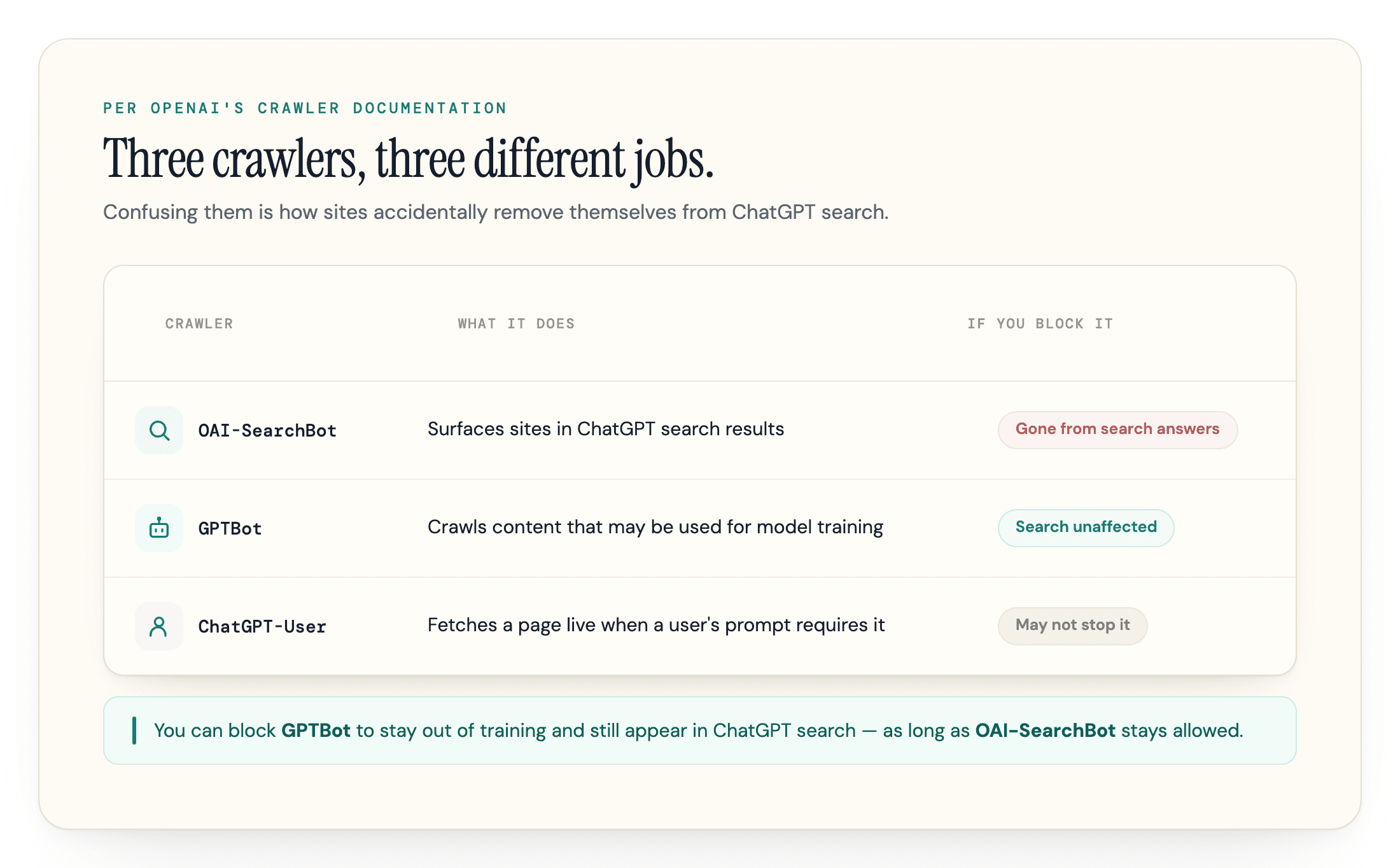
OpenAI runs three crawlers that matter for your visibility (a fourth, OAI-AdsBot, only validates ad landing pages), and they do different jobs. Confusing them is how sites accidentally remove themselves from ChatGPT search. The details are in OpenAI's crawler documentation.
| Crawler | What it does | If you block it |
|---|---|---|
| OAI-SearchBot | Surfaces sites in ChatGPT search results | You will not appear in ChatGPT search answers |
| GPTBot | Crawls content that may be used for model training | You opt out of training, but search is unaffected |
| ChatGPT-User | Fetches a page live when a user's prompt requires it | robots.txt may not stop it; OpenAI says rules may not apply to user-initiated fetches |
The one that matters most for visibility is OAI-SearchBot. Per OpenAI, sites opted out of OAI-SearchBot will not be shown in ChatGPT search answers, though they can still appear as plain navigational links. Many sites block GPTBot to keep their content out of training, which is a legitimate choice, then assume they have also blocked themselves from ChatGPT search. They have not, and the reverse trap is worse: a broad bot-block that catches OAI-SearchBot quietly removes you from the answers entirely.
The robots.txt rule you want is explicit about which bot you are allowing. To keep ChatGPT search reachable while opting out of training, name each crawler separately:
User-agent: OAI-SearchBot
Allow: /

User-agent: GPTBot
Disallow: /
That allows the search crawler, blocks the training crawler, and leaves no ambiguity for either. If you instead rely on a catch-all User-agent: * block to stop scrapers, double check it does not also catch OAI-SearchBot. You can confirm a request really came from OpenAI by matching its source address against the published IP ranges in OpenAI's OAI-SearchBot IP list, which is the same method you would use to verify Googlebot.
In our experience scanning sites with Geotoolbox, this crawler confusion is one of the most common reasons a brand is missing from ChatGPT search, and it is invisible until you check.
What Gets a Brand Cited in ChatGPT
Once OAI-SearchBot can reach you, citation comes down to the same signals that define generative engine optimization generally, applied to ChatGPT:
- Answer-first, extractable content. Lead each section with the direct answer. ChatGPT lifts the clean statement, not the buried one. Our guide to writing content LLMs cite covers the passage-level craft, and the content optimization tools that score it.
- Citable substance. Aggarwal et al.'s GEO study (KDD 2024) found that optimization tactics including adding sources, quotations, and statistics improved visibility in their benchmark by up to 40% — a study-scoped result on their test engines, not a guaranteed ChatGPT lift. Specific, sourced facts get quoted. See the GEO paper.
- Freshness. For time-sensitive queries, freshness likely helps, and visible substantive update dates are good hygiene; OpenAI has not published a ChatGPT freshness weighting formula.
- Off-site corroboration. ChatGPT leans on sources that agree. Being mentioned consistently across reviews, listicles, and reputable sites makes you safer to cite than a claim that lives only on your own domain.
One more reason for optimism if you are not a household name: the citation pool has a long tail. When Profound analyzed roughly 730,000 US ChatGPT conversations with web citations from late 2025 (study published February 2026), the ten most-cited domains captured only about 12% of all citations, with Wikipedia first at just 5%. The Profound sample suggests citations are distributed across a long tail rather than captured entirely by the biggest domains; it does not prove why each cited page was selected.
The step-by-step version, with the per-page checklist, lives in this how to optimize for AI search playbook. The ChatGPT-specific point is that extractable, corroborated content is what wins a citation once you are eligible. One honest caveat: none of it guarantees a citation. OpenAI has not published how the search layer picks among eligible sources, so these signals raise your odds; they do not buy a slot.
How Fast Can You Appear in ChatGPT?
Faster than a training cycle, because you are not waiting on a model retrain. Since ChatGPT search fetches live results, the constraint on a newly reachable, well-structured page is recrawl speed. OpenAI documents roughly 24 hours for robots.txt changes to register; actual surfacing after that depends on crawl, indexing, ranking, and query demand, and OpenAI publishes no timeline.
That reframes the whole effort. If you are blocked from OAI-SearchBot today and fix it, you are not waiting for the next GPT version. You are waiting for a recrawl. Confirm the crawler can reach your key pages, make those pages the clearest answer to the questions you want to win, and the search layer can pick you up quickly.
How to Tell If ChatGPT Is Citing You
You cannot improve what you are not watching, and ChatGPT gives you no dashboard. So you check directly. Three methods, in order of effort:
- Prompt it yourself. Take the ten questions your customers ask and run them through ChatGPT with search on. Note whether you appear and which sources it cites instead. Open the Sources panel; it lists the exact references behind the answer, which tells you who you are competing with.
- Watch referral traffic. Filter analytics for referrers like chatgpt.com. It will not capture every appearance, since many answers do not produce a click, but a rising trend after you fix reachability is a real signal.
- Track over time. A single check is a snapshot. Re-run the same prompts monthly so you can see direction. A monitoring view that tracks your AI visibility turns those manual checks into a baseline.
Here is what that looks like in practice. Say you sell project-management software and one of your ten questions is "best project management tool for small agencies." You open ChatGPT, turn search on, and ask it. The answer names three competitors and shows a Sources panel citing two listicles and one competitor's comparison page. You are absent. Now you have something specific to act on, not a vague worry.
You open each cited source and read why it earned the slot: the listicles name you nowhere, and the comparison page answers the exact question in its first paragraph while your own page buries the answer under a feature tour. That single prompt has surfaced two fixes: off-site corroboration on the listicles you are missing from, and an answer-first rewrite of your own page. It has also shown you which competitors are setting the bar. Repeat that for all ten questions and you have a punch list, not a feeling.
Set the expectation early: this is sampling, not a complete count. Judge progress by whether you show up more often for your core questions, not by a single perfect number.
Common Reasons You're Not Cited in ChatGPT
When a brand is missing from ChatGPT search, it is usually one of these, starting with the ones we see most in our scans:
- OAI-SearchBot is blocked. A robots.txt rule or WAF (web application firewall) setting keeps the crawler out. Fix this first; nothing else matters until it is fixed.
- The page renders empty without JavaScript. If the content loads client-side and the crawler does not execute it, there is nothing to cite.
- The answer is buried. The page may rank on Google but bury its answer under setup, leaving nothing clean to extract.
- No corroboration. The claim exists only on your own site, with no third-party mentions to make ChatGPT confident repeating it.
- Stale content. An old page with no recent update loses to a fresher competitor in a search answer.
Work that list top to bottom. The first two are technical and binary; the last three are content and authority. In our scans, number one is the most common sticking point, and the owner almost never knows.
The order matters because the failures are not independent. A blocked crawler makes every other improvement invisible, which is why reachability sits at the top: it is the precondition for the rest paying off.
The JavaScript problem is the quiet runner-up, because it passes a casual eyeball test. The page looks complete in your browser, where JavaScript runs, so the gap may only show up when a crawler or retrieval system receives raw HTML without the client-rendered content; verify what OAI-SearchBot receives with logs or fetch tests. Server-side rendering or static generation closes it.
Once those two technical gates are open, the remaining three are the ones you iterate on over weeks. None of this is exotic. It is the same hygiene that helps in ordinary search, applied with the knowledge that the retrieval step is now the whole game.
Frequently Asked Questions
How do I rank in ChatGPT search?
Allow OAI-SearchBot to crawl your site, structure pages answer-first, keep them current, and earn consistent mentions on reputable third-party sites. ChatGPT retrieves and cites the clearest, best-corroborated sources for a query.
How fast can I appear in ChatGPT?
There is no published timeline. Search answers use live web fetches rather than training data, so the constraint is recrawl speed. OpenAI documents roughly 24 hours for robots.txt changes to register; actual surfacing after that depends on crawl, indexing, ranking, and query demand.
Is ChatGPT search powered by Bing?
Partly. OpenAI's help docs confirm queries may be shared with Bing as one of its "third-party search providers," but OpenAI has never said search runs entirely on Bing, and it blends in its own crawl. Cover Bing (via Bing Webmaster Tools) without building a strategy around one named index.
If I block GPTBot, will I disappear from ChatGPT?
No. GPTBot controls training data, not search. The crawler that governs search visibility is OAI-SearchBot. You can block GPTBot to stay out of training and still appear in ChatGPT search, as long as OAI-SearchBot is allowed.
Do I need a publisher partnership with OpenAI?
No. OpenAI states any site can choose to appear in ChatGPT search. Partnerships exist for major publishers, but eligibility comes from being crawlable and useful, not from a deal.
What is SEO for AI engines actually called?
Most people call it generative engine optimization (GEO) or answer engine optimization (AEO). For how the engines pick sources in general, and Perplexity specifically, see how to get cited in Perplexity or how to get cited in Gemini, or ChatGPT vs Perplexity for how the two engines retrieve and cite differently. The cross-engine fundamentals live in how to get cited by AI.
Start by Checking the Gate
Everything here depends on one thing being true: OAI-SearchBot can reach your most important pages. That is the gate, and it is the easiest part to get silently wrong with a stray robots.txt or WAF rule.
Geotoolbox's free AI Crawler Checker shows whether your robots.txt allows the major AI crawlers, OAI-SearchBot included (a WAF block needs a server-side check, which the Content Analyzer covers along with grading how citable your page is). Confirm the gate is open, then make the page the cleanest answer to the question you want ChatGPT to cite you for.
Sources
- Overview of OpenAI Crawlers - OpenAI -
developers.openai.com/api/docs/bots - OAI-SearchBot IP ranges - OpenAI -
openai.com/searchbot.json - Introducing ChatGPT search - OpenAI -
openai.com/index/introducing-chatgpt-search - GEO: Generative Engine Optimization - Aggarwal et al., KDD 2024 -
arxiv.org/abs/2311.09735 - Americans and AI 2026: Chatbots, Smart Devices and Views on Impact (44% of US adults have used ChatGPT) - Pew Research Center, June 2026 -
pewresearch.org/internet/2026/06/17/americans-and-ai-2026-chatbots-smart-devices-and-views-on-impact - How ChatGPT sources the web - Profound, February 2026 -
tryprofound.com/blog/chatgpt-citation-sources - ChatGPT reaches 900M weekly active users - TechCrunch, February 2026 -
techcrunch.com/2026/02/27/chatgpt-reaches-900m-weekly-active-users - Over 1 billion web searches in a week - OpenAI on X, April 2025 -
x.com/OpenAI/status/1916947241086095434