
Casino SEO, often called iGaming SEO or gambling SEO, is the work of getting a licensed online casino, or an affiliate that reviews casinos, found in search engines and in the AI answers players increasingly read. The ranking basics match any other niche; the rules around them differ.
Every casino page answers to Google's spam policies, the regulator in each market you are licensed for (the UK, Ontario, New Jersey, Pennsylvania and Michigan below), and the AI engines deciding which sources to cite. In our own test, those engines cited regulators, official market lists, news sites and affiliates for casino picks, but never a casino's own website as a source.
What Makes Casino SEO Different
Casino SEO differs in who may target which market, which channels are open and how much proof a page needs before Google trusts it.
The license sets the market. A casino website may only target places where its operator holds a gambling license, so keyword research, URLs and bonus pages follow a license boundary, and each market needs its own SEO strategy.
Paid search is gated. Google's gambling ad policy allows online casino ads only in listed countries, with certification, approved country targeting and a landing page that shows responsible gambling information. In Canada the operator must be licensed by the province and target only that province. Those advertising restrictions make organic search the channel operators and affiliates fight hardest over.
The quality bar is high. Google says its systems give more weight to strong E-E-A-T on topics that could affect people's financial stability. Several casino SEO guides call gambling a "your money or your life" topic for that reason. Google's rater guidelines never name it one, though casino pages clearly touch the financial security their YMYL definition covers. Our guide to E-E-A-T in AI search covers what that weight looks like in practice.
Casino SEO serves two audiences. Operators run the casino website on a licensed platform and want their brand and game pages to rank.
iGaming affiliates publish casino reviews, comparisons and bonus pages and earn a fee or a revenue share for each player they send. Sportsbooks answer to the same regulators in these markets, so most of this applies to sports betting SEO too.
Google Policies That Decide Casino Rankings
Google's spam policies target tactics, not topics, and casino SEO has a long history with the ones they name. When a casino website drops sharply, these are common causes.
| Policy | Casino example | What to do |
|---|---|---|
| Site reputation (formerly site reputation abuse) | A casino page placed on an unrelated host site | Don't place casino sections on unrelated news, university or brand domains |
| Thin affiliation | Reviews copied from the operator's own descriptions | Publish your own testing, ratings and comparisons |
| Link spam | Bought links and private blog networks | Mark any paid placement rel="sponsored" |
| Expired domain abuse | "Casino-related content on a former elementary school site" | Don't buy old domains to host casino content |
| Scaled content abuse | Thousands of near-identical slot or bonus pages | Consolidate or noindex pages without search demand |
Site Reputation Abuse After the EEA Change
Google's site reputation abuse policy, now called the site reputation policy, covers third-party pages placed on a strong host site to borrow its ranking signals. Its example is a casino one: "a medical site hosting a low-quality, third-party advertising page about 'best casinos'".
Enforcement changed in 2026. In a Search Central post dated August 28, Google said that from August 30 a manual action under this policy no longer applies to searches inside the European Economic Area. There, the section may instead be split off so it "ranks independently", and the policy page says casino content then ranks against other casino content. The UK, Canada and the US sit outside the EEA, so a manual action still hits the affected section in search results shown there.
Manual Action or Algorithm?
When traffic falls, check Search Console first. Google says a manual action appears in the Manual actions report, and that most spam is caught by its algorithms instead. No notice makes a manual action unlikely, so check indexing, recent site changes and query demand before putting the drop down to a core update, which you fix by improving the pages rather than with a reconsideration request.
Spammy links pointed at your site, a worry in some of the casino threads we read, rarely need action either. Google's disavow guidance reserves the tool for a considerable number of spammy links that have caused, or will likely cause, a manual action.
Market Rules That Shape Casino SEO Content
In the UK and Ontario, the regulator holds the operator accountable for what its affiliates publish. New Jersey, Pennsylvania and Michigan also license or register many affiliates directly.
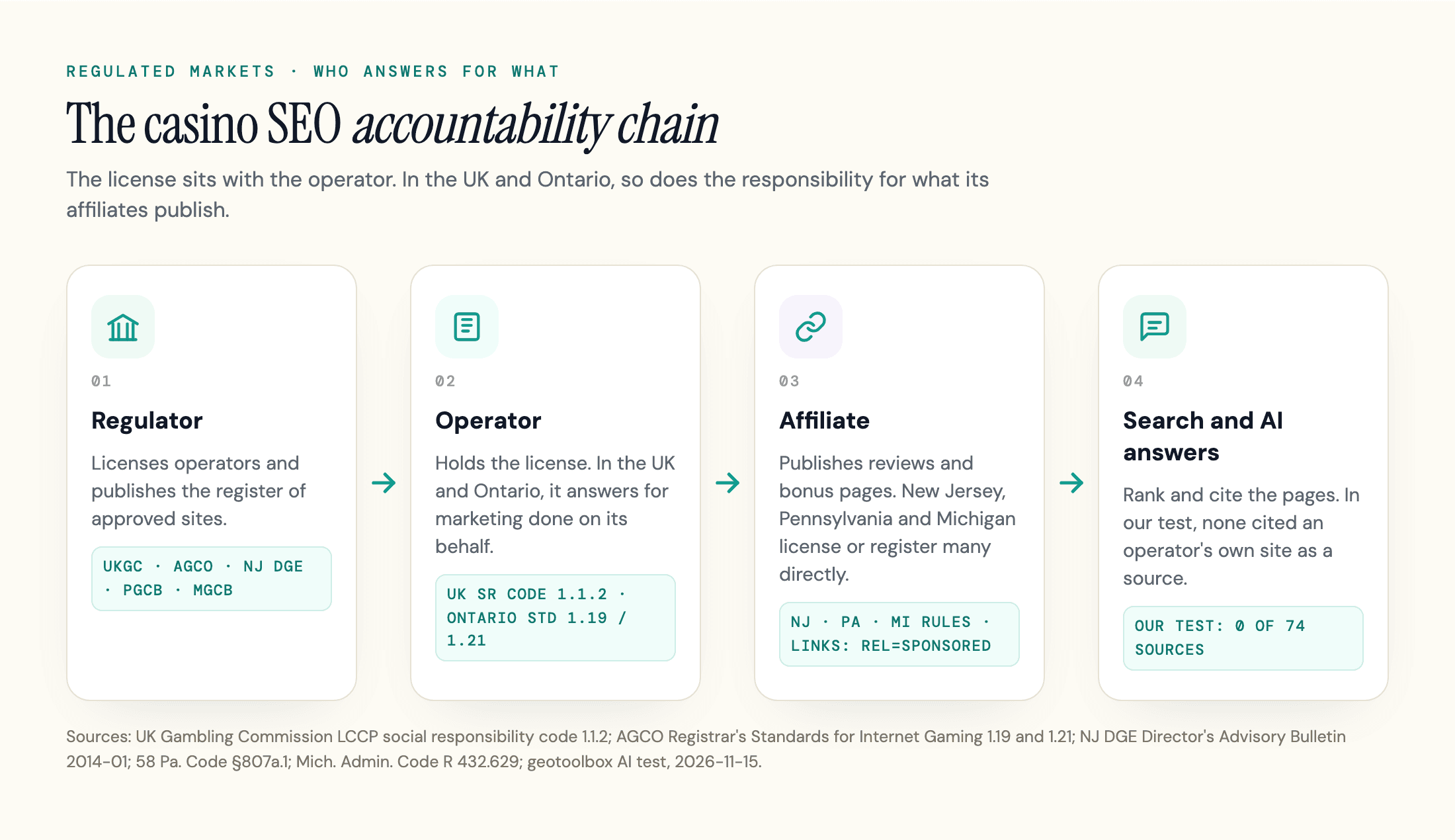
The UK puts it in writing: under social responsibility code 1.1.2, licensees are responsible for third parties they contract with, and contracts must let them end a deal with an affiliate that breaks the rules. Ontario's Registrar's Standards set the same responsibility in standard 1.19. Its standard 1.21 goes further: operators must make sure their affiliates do not also market sites that take Ontario players without an AGCO registration, so a pan-Canadian "best casinos" page that lists such sites can put an affiliate's Ontario deals at risk.
| Market | Affiliate rules | What it means for your pages |
|---|---|---|
| UK (Gambling Commission; Advertising Standards Authority) | Operator answers for affiliates (SR code 1.1.2) | Since January 2026: wagering capped at 10 times the bonus, no mixed-product offers |
| Ontario (Alcohol and Gaming Commission of Ontario, AGCO; iGaming Ontario runs the market) | Operator answers for affiliates (standards 1.19 and 1.21); marketing affiliates may not need to register, and AGCO decides case by case | Bonuses may be advertised only on the operator's own site or in opt-in marketing (standard 2.05), which rules out affiliate bonus pages aimed at Ontario players |
| New Jersey (Division of Gaming Enforcement, DGE) | Flat fees, including flat-rate CPA: vendor registration; revenue share, CPA tied to gaming activity or deposit size, or hybrids: ancillary casino service industry enterprise (CSIE) license (DGE bulletin 2014-01) | Check every casino you list against the DGE list; sites not on it are not approved |
| Pennsylvania (Gaming Control Board, PGCB) | Revenue share: certification; flat fee: registration (58 Pa. Code § 807a.1) | Check every casino you list against the PGCB list |
| Michigan (Gaming Control Board, MGCB) | Without revenue share: may need vendor registration (vendors providing $100,000 or less can be exempt) and, when they register, must certify they do not promote illegal sites (R 432.629) | Check every platform you list against the MGCB list |
Two UK gambling advertising rulings show how closely the Advertising Standards Authority (ASA) checks which searches an offer appears on. It upheld complaints against the affiliate Smart Gravity, whose casino ad appeared on a search for "help with gambling", and against Optival for an ad on "self exclusion bookies". Both were paid search ads, both affiliates had negative keyword lists, and in both cases the ASA found their targeting controls not robust enough. Organic pages have no negative keywords, so the precaution is editorial: don't build or optimize offer pages for problem-gambling or self-exclusion searches.
Technical SEO for Licensed Casino Sites
Geo-blocking by country is the technical problem that sets online casino SEO apart. Googlebot's default crawl IPs appear to be US-based, so a geo-blocked URL can serve it a block page instead of your content.
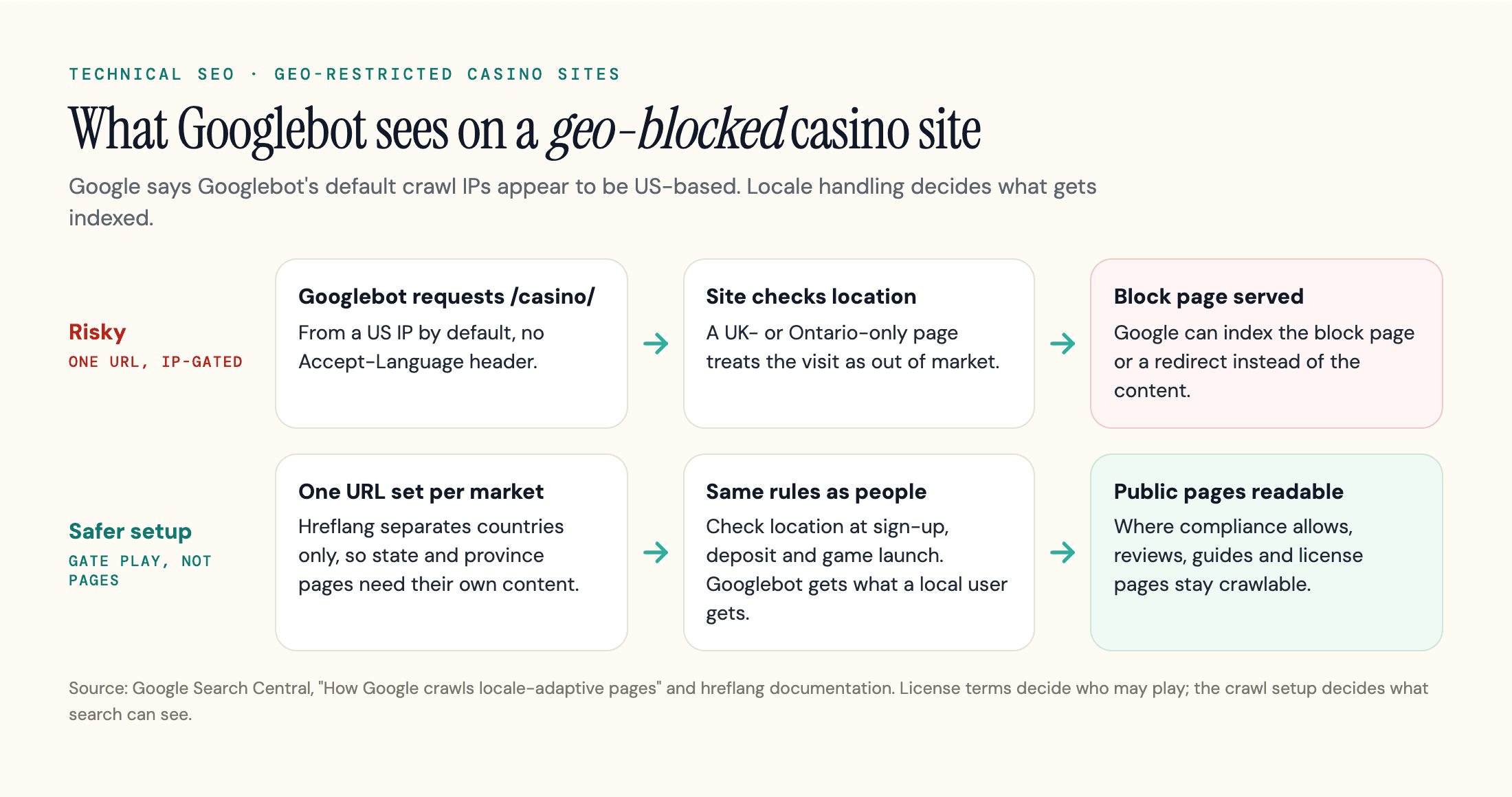
Google's guide to locale-adaptive pages spells out the rule. The crawler sends requests without an Accept-Language header and also crawls from IPs outside the US. When it appears to come from a country, Google says to "treat it like you would treat any other user from that country", and its recommended setup is separate URLs per locale, linked with hreflang.
That rules out the common shortcut of letting Googlebot past a block that real users hit: presenting different content to users and search engines "with the intent to manipulate search rankings and mislead users" is cloaking under Google's spam policies. Gate play, not pages. Ontario's standard 3.02 requires games to be provided only within Ontario; it says nothing about who may read about them. Where compliance allows, keep reviews, guides and license pages publicly readable and put the location check at registration, deposit and game launch.
Hreflang has a limit for US states and Ontario. Google supports only ISO 3166-1 region codes, so a /nj/ and a /pa/ page are both en-US to hreflang, and an Ontario page is en-CA like the rest of Canada. State and province pages need distinct content, internal links and their own sitemaps. For a multi-license casino website, that means one folder or domain per market, each with its own license details, bonus terms and responsible gambling links.
Add these checks to every casino audit:
- Age and location gates. If a modal hides the page until the visitor confirms their age or location, use URL Inspection in Search Console to see what Google renders behind it.
- Game libraries. Game providers often supply the same descriptions to every casino that carries a game. Give unique pages only to games with search demand, consolidate or noindex the rest, and check provider artwork used in promotions: Ontario's standard 2.03 bars cartoon figures likely to appeal to minors.
- JavaScript lobbies. Google can only reliably crawl links that are
<a>elements with an href, so a lobby that opens games through script events can hide them. Link categories to game and bonus pages with plain links. - Mobile-friendly design and speed. Game lobbies are heavy pages, and Google asks site owners to achieve good Core Web Vitals. Test the mobile game and bonus templates, not only the homepage, since that is where the user experience breaks.
- Structured data. Organization markup suits any operator site. Before adding review stars to casino reviews, read Google's review snippet guidelines, including its rule on self-serving reviews.
- Sitemaps per market. One XML sitemap per market folder lets you see in Search Console how each licensed section is indexed.
Our technical SEO guide covers crawlability basics, including for AI crawlers.
Content and Links That Survive Core Updates
Casino pages that hold their rankings through core updates show their work. That is also the line Google draws in its thin affiliation policy, where good affiliate pages offer "original product reviews, rigorous testing and ratings". A review that says how, when and by whom the casino was tested beats a page that rewrites the operator's own marketing copy.
Keyword research works per market. Head keywords such as "online casino" are the most contested in the niche, so aim at the specific queries a focused page can win: one game, one payment method, payout speed in one state. For on-page SEO, give every page its own descriptive title, as Google's title guidance asks.
For casino reviews and comparison pages, showing your work means:
- A published method: what you deposited, how long withdrawals took, which games and devices you checked
- Named reviewers with a real gambling or industry background
- The license number and regulator for each casino, linked to the regulator's register
- Bonus terms per market, dated and updated when the rules change, and none on affiliate pages aimed at Ontario players
Pruning matters as much: pages for expired bonuses, closed casinos and markets you no longer serve dilute the website.
Casino link building is the bottleneck. Link acquisition was one of the two most common complaints in the 17 casino SEO threads we read on Reddit in November 2026. The links that last come from:
- Original data that journalists cite, such as payout speed tests and responsible gambling research
- Game guides and rules explainers that answer player questions without pushing offers
- Regulatory news and analysis that trade media can cite
- Industry press and events, such as trade media coverage, guest articles on industry sites (marked sponsored when you pay) and conference talks
- Sponsorships and partnerships, with the link marked rel="sponsored"
Skip backlinks from private blog networks and link insertions on off-topic websites. Both are link schemes under Google's link spam policy.
How AI Assistants Answer Casino Queries: Our Test
AI assistants name casinos and even link to them, but in our test none cited a casino's own site as a source. Across 74 counted citations, the engines leaned on regulators and official market bodies, news sites and affiliates, and they named BetMGM in 21 of the 22 answers they gave.
How we tested. On November 15, 2026, geotoolbox sent six player prompts to ChatGPT, Gemini, Google AI Mode and Perplexity: the best online casino in New Jersey, legal casinos in Pennsylvania, the best UK casino site and welcome bonus, and the best and the safest casinos in Ontario. Each prompt ran once, with the location set to its country (US, UK or Canada), for 24 answers. ChatGPT was a logged-out session with web search on, Gemini and AI Mode were their consumer interfaces, and Perplexity was its Sonar API. A source counts when the engine cited or linked it as a source; we could check retrieval only for ChatGPT and Perplexity, where it also had to appear in the engine's search results. ChatGPT's 22 product links to casino websites are left out. Gemini declined both UK prompts and answered the rest.
The engines split sharply on which kinds of sites they cite.
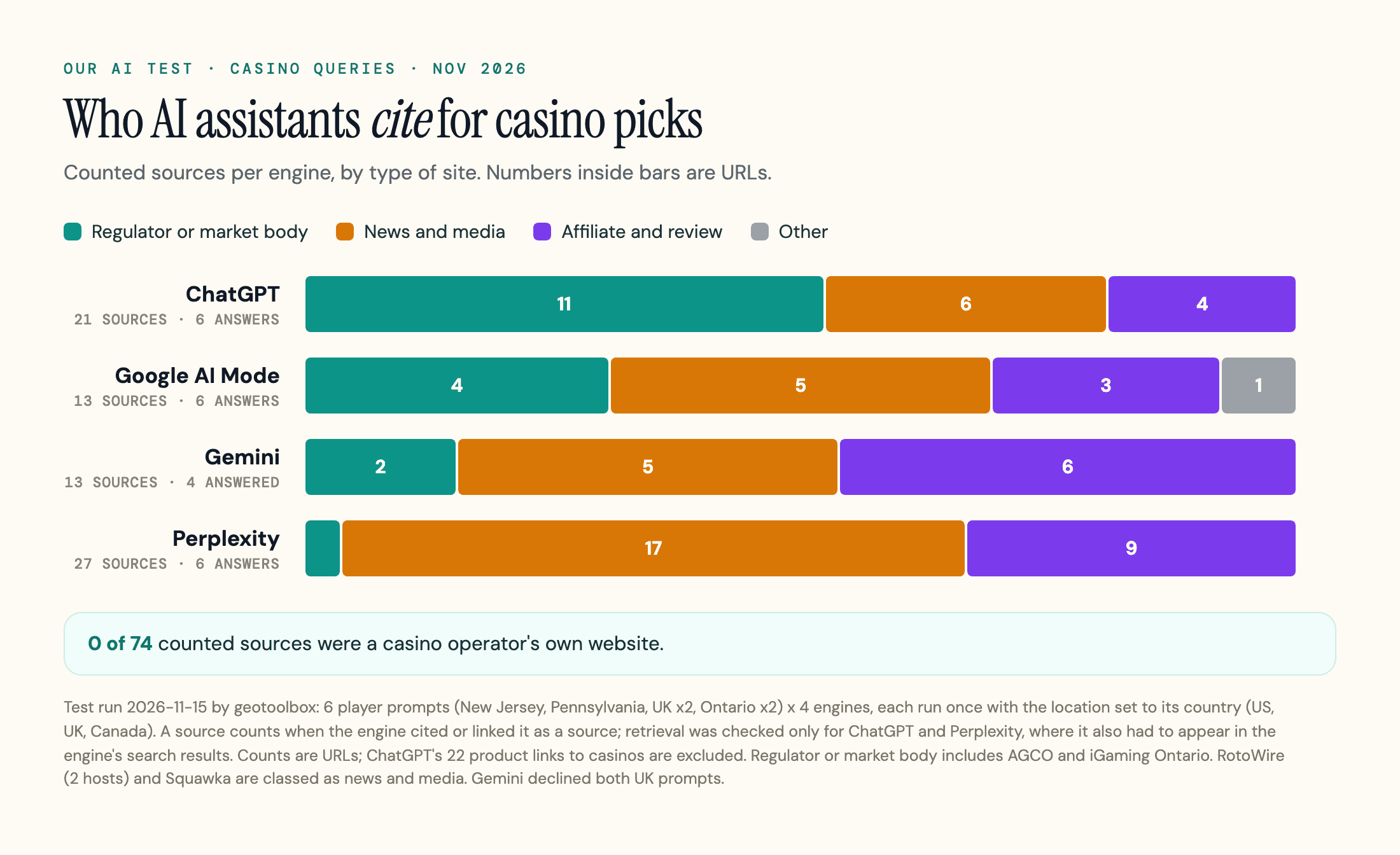
ChatGPT took 11 of its 21 citations from regulators or official market bodies, 5 of them from a single Ontario answer that linked 5 iGaming Ontario pages. Perplexity took 1 of 27, with 17 from news sites, all on gambling or betting pages (14 if you count RotoWire and Squawka as affiliates). Across the engines, news and affiliate pages supplied 55 of 74 citations.
The market mattered too.
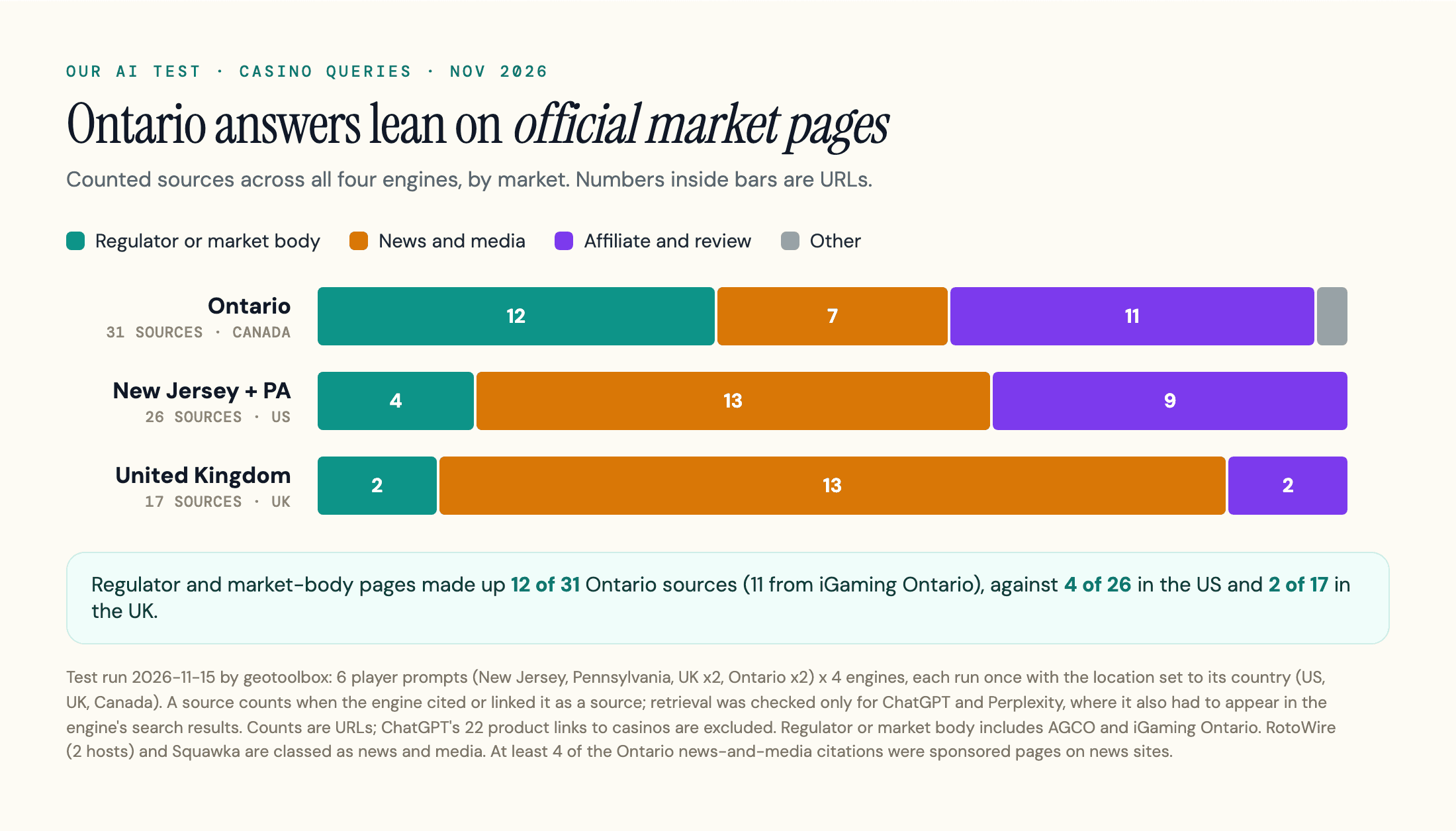
Regulator and market-body pages made up 12 of 31 Ontario citations, 11 of them from iGaming Ontario, whose directory of regulated sites listed 84 sites from 49 operators (the directory says it is accurate as of 2026-09-01). At least 4 of the Ontario citations were sponsored pages on news sites. Ontario answers also pointed to a possible routing problem: 3 of ChatGPT's 12 casino links for Ontario prompts went to domains missing from iGaming Ontario's September directory, for brands whose Ontario sites it lists.
What this means for casino SEO:
- Get the regulator listing right. Engines read official lists, so the brand and site names there should match your own pages.
- Make your market site the one engines link to. Clear market names and canonical market URLs may help the licensed site collect those links; recheck the answers after you change them.
- Earn editorial coverage. Some cited pages were sponsored casino pages on news domains, a setup Google's site reputation policy can treat as a violation. Our guide to ChatGPT citations covers how cited pages get picked.
- Own your brand queries. Affiliates ranking for "brand + bonus" and "brand + review" searches came up in the threads we read; official pages for those queries give engines an operator source.
Measuring Casino SEO: FTDs, NGR and Timelines
Rankings and organic traffic matter less in casino SEO than the numbers the business earns on. Report those, split by market, because each license is its own profit and loss account:
- Organic registrations, from landing page to sign-up
- First-time deposits (FTDs) from organic visitors
- Net gaming revenue (NGR) from those players, the figure revenue-share affiliates are paid a percentage of
Filter Search Console by country so a UK gain does not hide an Ontario loss. Then add AI search visibility: whether the engines name your brand for your markets, and which pages they cite when they do. Plan in quarters, since one core update can move a whole market in either direction.
Our tools cover part of the checks above. Our free AI crawler checker shows which of 34 AI crawlers your robots.txt allows or blocks; it reads robots.txt only, so pair it with the URL Inspection checks. On Plus and higher plans, geotoolbox's Citation Interceptor lists the offsite pages AI engines cite for your topics where your brand is missing.
Frequently Asked Questions
Are online casino affiliate programs legal?
They can be, subject to each market's affiliate, advertising and registration rules, summarized in the table above. Check those rules before you sign a deal.
Are there fake casino sites?
They exist, and the reliable test is the regulator's own list rather than a badge on the site. Before you link to or list a casino, check iGaming Ontario's directory, the New Jersey DGE list, the PGCB site list, the MGCB list or the UK Gambling Commission register.
Can I do casino SEO myself?
For most of it, yes. The core work is the same as any SEO: content, technical fixes and casino link building. The extra cost is compliance. Each market's bonus, advertising and affiliate rules need a review by someone who knows them, in-house or at a casino SEO agency, before a page goes live.
Sources
- Spam policies for Google web search - Google Search Central, updated Aug 28, 2026 -
developers.google.com/search/docs/essentials/spam-policies - Update to the Site Reputation Policy - Google Search Central blog, Aug 28, 2026 -
developers.google.com/search/blog/2026/08/update-site-reputation-policy - Qualify your outbound links to Google - Google Search Central -
developers.google.com/search/docs/crawling-indexing/qualify-outbound-links - How Google crawls locale-adaptive pages - Google Search Central -
developers.google.com/search/docs/specialty/international/locale-adaptive-pages - Search Quality Rater Guidelines - Google, Sep 11, 2025 -
static.googleusercontent.com/media/guidelines.raterhub.com/en//searchqualityevaluatorguidelines.pdf - Manual actions report - Search Console Help -
support.google.com/webmasters/answer/9044175 - Gambling and games policy - Google Ads Help -
support.google.com/adspolicy/answer/15132179 - LCCP social responsibility code 1.1.2, Responsibility for third parties - UK Gambling Commission -
gamblingcommission.gov.uk/licensees-and-businesses/lccp/condition/1-1-2-responsibility-for-third-parties-all-licences - LCCP social responsibility code 5.1.1 - UK Gambling Commission -
gamblingcommission.gov.uk/licensees-and-businesses/lccp/condition/5-1-1-sr-code - ASA ruling on Smart Gravity Ltd - Advertising Standards Authority, Sep 9, 2026 -
asa.org.uk/rulings/smart-gravity-ltd.html - ASA ruling on Optival Ltd - Advertising Standards Authority, Oct 28, 2026 -
asa.org.uk/rulings/optival-ltd.html - Registrar's Standards for Internet Gaming - AGCO -
agco.ca/en/book/export/html/245361 - Regulated igaming market directory - iGaming Ontario -
igamingontario.ca/en/player/regulated-igaming-market - Director's Advisory Bulletin 2014-01, Licensing of Internet Marketing Companies - NJ Division of Gaming Enforcement -
nj.gov/oag/ge/docs/Bulletins/LicensingofIMarketingCompanies.pdf - 58 Pa. Code § 807a.1 - Pennsylvania Code -
pacodeandbulletin.gov/Display/pacode?file=/secure/pacode/data/058/chapter807a/s807a.1.html - Mich. Admin. Code R 432.629 - Michigan Gaming Control Board rules -
law.cornell.edu/regulations/michigan/Mich-Admin-Code-R-432-629 - Creating helpful, reliable, people-first content - Google Search Central -
developers.google.com/search/docs/fundamentals/creating-helpful-content - Make your links crawlable - Google Search Central -
developers.google.com/search/docs/crawling-indexing/links-crawlable - Understanding Core Web Vitals and Google search results - Google Search Central -
developers.google.com/search/docs/appearance/core-web-vitals - Influencing your title links in search results - Google Search Central -
developers.google.com/search/docs/appearance/title-link - Tell Google about localized versions of your page - Google Search Central -
developers.google.com/search/docs/specialty/international/localized-versions - Disavow links to your site - Search Console Help -
support.google.com/webmasters/answer/2648487 - Review snippet structured data - Google Search Central -
developers.google.com/search/docs/appearance/structured-data/review-snippet - Internet Gaming Suppliers Application Guide - AGCO -
agco.ca/en/lottery-and-gaming/responsibilities-and-resources/internet-gaming-suppliers-application-guide - Internet gaming information and approved sites - NJ Division of Gaming Enforcement -
njoag.gov/about/divisions-and-offices/division-of-gaming-enforcement-home/internet-gaming-information/ - Interactive gaming operators - Pennsylvania Gaming Control Board -
gamingcontrolboard.pa.gov/interactive-gaming-operators - Authorized online gaming and sports betting platform providers - Michigan Gaming Control Board -
michigan.gov/mgcb/internet-gaming-and-fantasy-contests/authorized-online-gaming-and-sports-betting-platform-providers-in-michigan