
SEO for law firms is still about being the practice Google shows when someone nearby searches for help with a specific legal problem. What changed is where that search can happen.
Prospective clients can now ask ChatGPT, Gemini or Google's AI Mode for a lawyer before they open a single website. In our test, the answers cited lawyer directories, ranking lists and Google's business listings far more often than firm websites.
What Law Firm SEO Covers in 2026
Law firm SEO (also called lawyer or attorney SEO) is the work of getting a legal practice found by people who need a lawyer: in Google's map results, in the organic results below them, and now in the AI answers many people read before they call anyone.
On many legal searches, paid search ads and Local Services Ads sit above the map pack too. This guide leaves paid placements aside, but they push organic listings down the page.
The AI layer is the newer part. In its study of 146 million search results pages, Ahrefs found AI Overviews on 23.6% of legal results pages, against 17.2% for searches outside the "your money or your life" categories and 44.1% for medical ones.
That summary costs clicks. An Ahrefs update based on December 2025 data found that an AI Overview correlates with a 58% lower click-through rate for the page ranked first. We cover why in our piece on zero-click searches.
Some prospective clients skip search engines for the first step. On the page for its 2026 Legal Trends Report, Clio reports that 24% of U.S. adults have already used AI to answer a legal question, and that 46% of consumers would consult AI before contacting a lawyer.
So the 2026 version of law firm SEO comes down to these jobs:
- Win the local results for the matters and places you serve
- Build pages that answer the questions clients ask before they hire
- Make sure the sources AI assistants cite about lawyers describe your firm accurately
Is SEO Worth It for Your Law Firm?
SEO is worth it when demand, case value and capacity line up: enough people search for your practice area in your market, the profit from the extra cases it brings in, after the cost of handling them, covers the monthly cost, and your firm can take on new matters. If any of those is missing, it is not.
Lawyers argue about this openly in the 11 Reddit threads we read on r/LawFirm, r/Lawyertalk and r/SEO. In an r/LawFirm thread titled "Is SEO Fake?", the most upvoted answer said a firm already living on referrals, with plenty of cases, has no reason to pay for it. Another called SEO "a drug": the calls stop when the spending stops.
One way to size the opportunity is the price of the alternative. Google Ads cost per click shows what firms already pay for a single visitor from search:
| Practice area | Search | Google Ads CPC (US) | What it suggests |
|---|---|---|---|
| Personal injury | personal injury lawyer | $174.26 | Organic visibility replaces very expensive clicks, but competition is stiff |
| DUI defense | dui lawyer | $99.46 | Strong case for ranking in each city you serve |
| Criminal defense | criminal defense attorney | $56.56 | Worth it where you can rank for city plus charge-type searches |
| Employment | employment lawyer | $35.89 | Mid-priced clicks; matter pages can win the long tail |
| Family law | divorce lawyer | $29.97 | Local SEO and reviews carry much of the weight |
| Immigration | immigration lawyer | $15.15 | Cheaper clicks; content in your clients' languages may matter more |
| Estate planning | estate planning attorney | $8.42 | Low click cost; referrals and local profiles may beat a big content program |
Source: DataForSEO, US national figures, November 15, 2026. City terms can differ sharply: "dui lawyer phoenix" ran $160.74 and "estate planning attorney columbus ohio" $3.24.
On cost, there is no neutral price list. In an r/Lawyertalk thread on solo SEO, one commenter wrote that "most marketing firms will want $5-10k/month"; others in the same thread advised hiring a freelancer by the hour instead.
Then do the break-even math with your own numbers: divide the monthly cost by your average fee on a signed case. As an illustration, a $3,000 monthly retainer against a $1,500 average fee needs 2 extra signed cases a month just to cover the fee, before handling costs.
Two kinds of firms should usually wait: firms whose intake cannot answer the phone within minutes, and firms already turning away referral work.
Local SEO for Lawyers: Google Business Profile and Reviews
The Google Business Profile is the core of local SEO for a law firm. You need one to appear in the map pack, and Google lists keeping it up to date among the basics for its AI features too.
Google's own guidelines for Business Profiles name lawyers as individual practitioners, and set specific rules for them:
- A lawyer can have a dedicated profile only if they work in a public-facing role and can be contacted directly at the verified location during stated hours
- One practitioner should not create several profiles to cover each specialization
- Where several lawyers practice at one office, the firm gets its own profile for that location, and each lawyer's profile carries only the lawyer's name, not the firm's
- A solo practitioner at a branded office should share one profile, named "[brand/company]: [practitioner name]"
The name rule is where many firm profiles go wrong. Google wants the real-world name used on your signage, website and stationery. Adding "Best Car Accident Lawyer Houston" to the name is not permitted, and Google says it can lead to suspension.
Then pick categories that are as specific as possible but still describe your main practice, and keep hours, phone number and address identical everywhere you are listed.
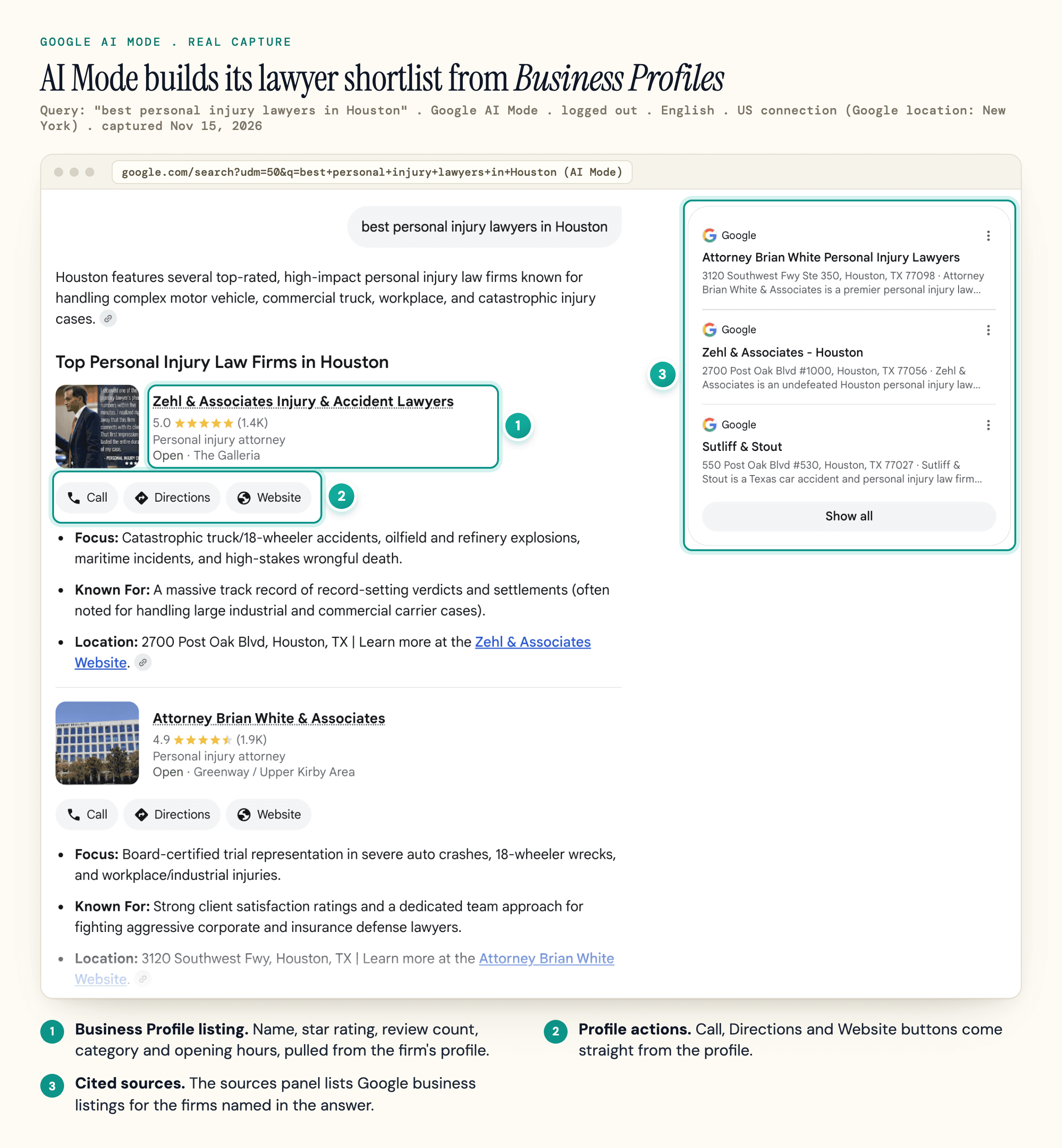
When we ran "best personal injury lawyers in Houston" in AI Mode, the answer was built around Business Profile listings: ratings, review counts, and Call, Directions and Website buttons. In the separate engine test below, 6 of the 7 sources AI Mode cited for a similar Houston question were Google business listings.
Reviews: The Rules on Asking and Rewarding
Reviews feed local rankings and shape how prospective clients judge you. Google, the FTC and your state bar each limit how you get them.
Google's Maps content policy bans fake engagement. Businesses may not offer incentives such as payment, discounts or free services in exchange for a review, or ask for content that does not reflect a genuine experience.
The FTC's consumer reviews rule, in effect since October 21, 2024, bans fake reviews, incentives conditioned on a positive or negative review, and suppressing negative reviews through intimidation, groundless legal threats or false accusations. Courts can impose civil penalties for knowing violations.
Bar rules come third. ABA Model Rule 7.2(b) bars giving anything of value for recommending a lawyer's services, with narrow exceptions, and states read it differently for small thank-you gifts. Since Google bans review incentives anyway, the safe default is to ask every client the same way, after the matter closes, with a direct link to your profile and no reward attached.
When you reply to a negative review, keep it general. A reply that confirms facts about a client's matter can breach the confidentiality you owe that client, even when the review is unfair.
For the full local playbook, including citations and service areas, see our local SEO guide.
Practice Area and Location Pages That Rank
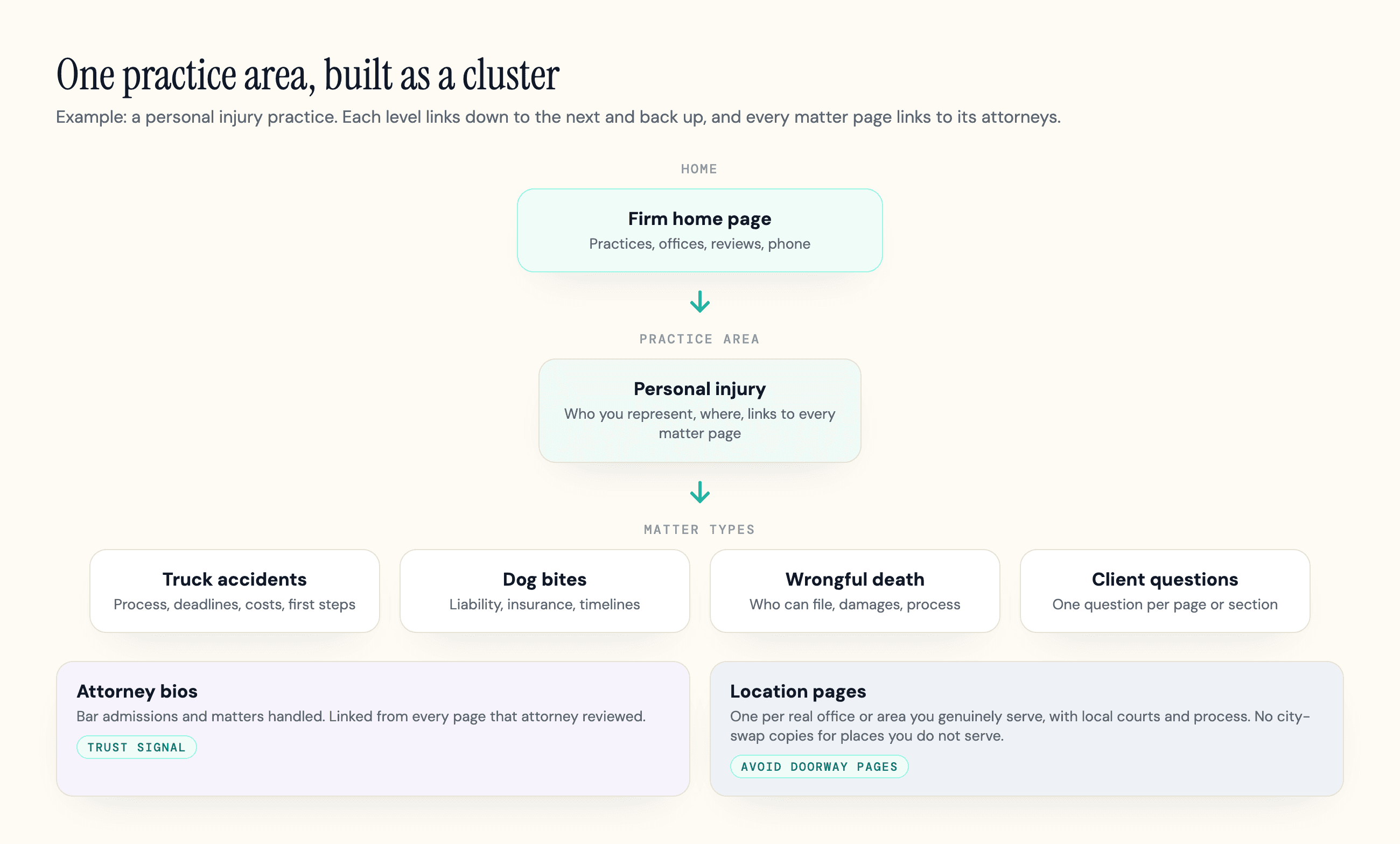
Build one page per practice area, then one page per matter type underneath it, and link every page to the attorneys who handle that work. "Personal injury" is a practice area. "Truck accidents", "dog bites" and "wrongful death" are the matters people actually search for.
Choose Keywords by Matter and City
Pick the keywords for each page from how clients actually search: the matter plus the place. In DataForSEO's US data, pulled November 15, 2026, "divorce lawyer denver" gets about 2,400 searches a month, "dui lawyer phoenix" 1,300 and "estate planning attorney columbus ohio" 390. These count searches, not people, but a search that names a matter and a city usually comes from someone looking for help with that matter. Your own Search Console queries and the questions callers ask fill in the long-tail keywords that potential clients use.
Each page should answer what a prospective client asks before calling: Do I have a case? What does it cost? How long does it take? What happens first? The best source for those questions is your own intake. A reply in an r/Lawyertalk thread for new solo lawyers put it simply: search your inbox for the questions clients ask, and write a post for each one.
Meet the Higher Bar for Legal Content
Legal pages are held to a higher bar than most. Google's guidance on creating helpful content says its systems give "even more weight" to content with strong experience, expertise, authoritativeness and trust on topics that could affect people's health, financial stability or safety. Legal information sits squarely in that group, which Google calls "Your Money or Your Life" topics, and Google adds that trust matters most of all. Casino pages put players' money at stake too, so they face a similar bar, as our guide to casino SEO shows.
In practice, that means a named attorney reviews every page, the page says who reviewed it and when, and the attorney bio it links to lists bar admissions and the matters that lawyer handles. We go deeper on these E-E-A-T signals in a separate guide.
| Page type | Its job | What it needs | Common mistake |
|---|---|---|---|
| Practice area | Rank for the broad service plus city | Overview, who you represent, links to every matter page | One page trying to cover ten matter types |
| Matter type | Rank for specific problems | Process, timelines, costs, what to do first | Thin copy that repeats the practice page |
| Location | Rank in each city you serve | A real office or an area you genuinely serve, with local court and process details | City-name swaps on identical text |
| Attorney bio | Show who stands behind the advice | Bar admissions, matters handled, links to their pages | A generic paragraph with no specifics |
| Questions and articles | Answer pre-hire questions | One question per page or section, in plain language | Unreviewed AI drafts published at volume |
The on-page basics still apply to every one of these pages: the matter and city in the title tag, the H1 and the URL, a meta description that answers the page's question, and alt text that describes each image. Keep it readable, because Google's spam policies treat keyword stuffing as spam.
Google's AI features guidance also suggests supporting text with high-quality images and videos. A short video of the lawyer answering the page's main question, with a transcript, earns its place on a matter page.
Avoid Doorway Location Pages
Location pages are where firms get into trouble. Google's spam policies list pages "targeted at specific regions or cities that funnel users to one page" as doorway abuse. A set of near-identical city pages built only to catch each suburb's searches and send everyone to the same contact form is exactly that. A page for an area you genuinely serve is fine when it says something useful about serving clients there.
The same policies cover scaled content abuse, including "using generative AI tools or other similar tools to generate many pages without adding value for users". AI can draft a matter page. It cannot replace the attorney who checks that the statute of limitations in it is right.
A cluster of strong pages around one practice area builds topical authority faster than thin pages across ten.
Technical SEO for Law Firm Websites
Most technical problems on law firm sites are the same few: slow mobile pages, contact forms and phone numbers search engines cannot read, duplicate domains, and AI crawlers blocked by a robots.txt rule or a firewall nobody remembers adding.
Google's page on AI features and your website lists ordinary basics as the way into AI Overviews and AI Mode: allow crawling in robots.txt and at your CDN or host, keep important content in text, make structured data match the visible page, and keep your Business Profile up to date. It also says there is "no special schema.org structured data that you need to add."
Structured data still helps search engines read your pages, so mark up each office with schema.org's LegalService type, which lists law firms as its example, and describe attorneys as Person entities. Test the markup in Google's Rich Results Test, but do not expect a schema plugin to get you cited.
For speed and user experience, check Core Web Vitals in Search Console or PageSpeed Insights. Google's thresholds for a good experience are a Largest Contentful Paint within 2.5 seconds, an Interaction to Next Paint of 200 milliseconds or less, and a Cumulative Layout Shift of 0.1 or less.
Our technical SEO checklist covers crawl, render and speed checks, and our guide to schema markup covers the markup itself.
Links, Legal Directories and Mentions
Backlinks still matter, and for law firms the best ones come from places that also send clients: legal directories, your state and local bar associations, local news, courts and community organizations you work with.
Directories do double duty: they are citations for local rankings, and our test below found them among the sources AI assistants cite most. Most of those pages were city listing pages on sites like Avvo and Justia, where many lawyers already have a free profile to claim that Avvo fills partly from bar and court records. Selection lists such as Super Lawyers and Best Lawyers work differently: you are chosen for them, you cannot simply sign up.
So claim and complete your profiles on the directories that cover your practice and on your state bar's lawyer search, matching your site's details.
The Model Rules allow paying for those listings. The ABA's comment on Model Rule 7.2 says a lawyer may pay for "on-line directory listings", and that listings of lawyers by practice area, without more, are not "recommendations" under the rule. Paying for a placement that vouches for you, a recommendation in the rule's sense, is generally prohibited outside the rule's exceptions, such as a qualifying lawyer referral service. Check how your state bar applies this before you pay for a featured spot.
The links that move rankings in competitive markets are earned: a local reporter quoting you on a new law, a bar association page listing your CLE talk, a community group thanking a sponsor. Bought link packages put the site at risk under Google's spam policies.
How Law Firms Get Recommended by AI Assistants
In a test we ran at geotoolbox on November 15, 2026, AI assistants cited directories, ranking lists and Google's own business listings far more often than firm websites when asked to recommend lawyers.
How We Tested
We sent 4 engines the same 6 prompts, written the way a client might ask, such as "Who are the best personal injury lawyers in Houston, Texas?" The others covered divorce in Denver, DUI defense in Phoenix, estate planning in Columbus, immigration in Miami and employment law in Seattle. Every prompt ended with "Cite sources.", and 4 of the 6 asked the engine outright to recommend firms.
How we counted (TESTED, one run, November 15, 2026). Logged-out ChatGPT (web search forced on) and Gemini, Google AI Mode, and Perplexity's Sonar API, all from the US. We counted a source only when the engine cited it: for ChatGPT, a shown source that was also in that answer's search results (we left out 19 other links, mostly Google Maps and Yelp place links plus 5 firm homepages); for Perplexity, a source whose number appears in the answer; for Gemini and AI Mode, the citations returned. A page cited twice in one answer counts once. Read the results as a pattern, not a market share.
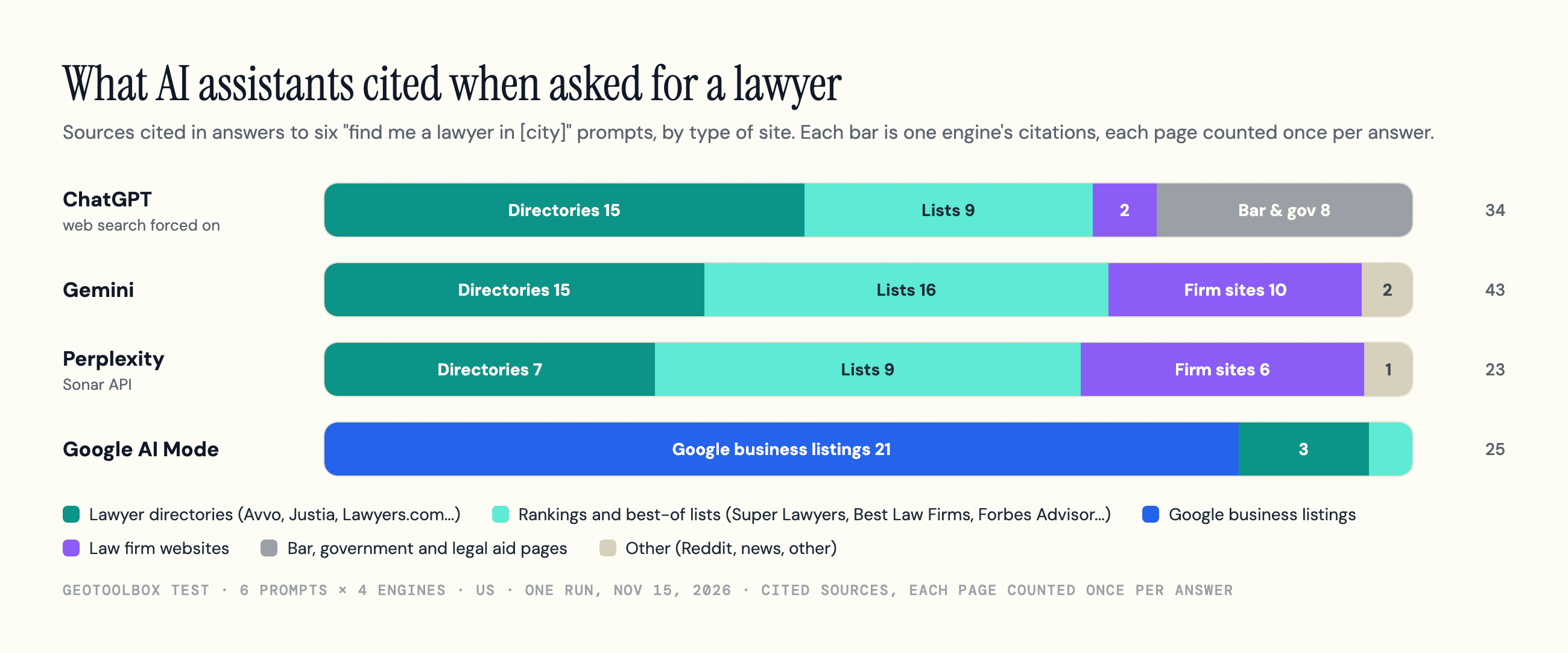
In our test, ChatGPT, Gemini and Perplexity cited directories and ranking lists most, while Google AI Mode mostly returned Google business listings rather than web pages, so its column counts a different kind of source.
What the Engines Cited
| Engine | Cited sources | Lawyer directories | Rankings and best-of lists | Google business listings | Law firm websites | Other |
|---|---|---|---|---|---|---|
| ChatGPT | 34 | 15 | 9 | 0 | 2 | 8 (bar and government pages) |
| Gemini | 43 | 15 | 16 | 0 | 10 | 2 |
| Perplexity | 23 | 7 | 9 | 0 | 6 | 1 |
| Google AI Mode | 25 | 3 | 1 | 21 | 0 | 0 |
Avvo was cited 23 times, mostly city listing pages, followed by Justia and Super Lawyers with 11 each. A firm website was cited in 9 of the 18 answers from ChatGPT, Gemini and Perplexity, so firm sites were in the mix, just rarely the main source. AI Mode's listings draw on Google's business data, which a firm can shape through its Business Profile, though Google also uses other sources.
One managing partner on r/LawFirm reported that ChatGPT left their 30-year litigation firm out of its answers while it recommended newer firms.
What This Means for Your Firm
- Claim and complete your directory profiles, and keep the details identical everywhere
- Keep the Business Profile complete and reviewed, since Google lists it among the basics for its AI features
- Give your own pages the facts engines quote: who you represent, where, and how the process works
- Ask the engines about your firm every month, and correct the sources behind wrong answers
That last step matters because AI engines get facts wrong, and an outdated directory profile is one place a wrong answer can come from. A simple routine is to keep a list of 10 to 20 prompts by practice area and city, run it in each engine, and track your AI visibility over time.
Bar Advertising Rules That Shape Law Firm SEO
What your website says about your services is a communication under the Model Rules. The ABA's comment on Model Rule 7.1 says the rule "governs all communications about a lawyer's services, including advertising", which covers title tags, meta descriptions, Business Profile posts and AI-drafted pages as much as a billboard.
The same comment describes a common trap for SEO copy. A truthful report of past results can still mislead if it leads a reasonable person to expect the same outcome "without reference to the specific factual and legal circumstances" of their case. An unsubstantiated comparison with other firms can mislead too, when it is specific enough that a reader could take it as backed by facts. The comment adds that an appropriate disclaimer or qualifying language may prevent that finding.
Model Rule 7.2 adds specific limits that touch SEO directly, and the comment on Rule 7.3 addresses one common worry: a website directed to the general public is not a solicitation.
The Model Rules are a template, though. Your state's version controls, its rule numbers can differ, and it may add filing or disclaimer requirements. Read the table below as a list of questions to check against your state bar's rules, not as legal advice.
SEO Tasks Mapped to the Model Rules
| SEO task | Model Rule to check | Safer practice |
|---|---|---|
| Case results and verdict pages | 7.1, comment [3]; client confidentiality | Give context for each result, add qualifying language that past results do not predict future outcomes, and get the client's consent before publishing identifying details |
| "Best" or "top" in titles and meta descriptions | 7.1 (unsubstantiated comparisons) | Use claims you can substantiate, such as a named award with its year |
| "Certified specialist" on practice pages | 7.2(c) | Only with certification from an approved or ABA-accredited organization, named on the page |
| Review requests and referral thank-yous | 7.2(b), comment [4] | No reward for reviews (Google bans review incentives); for referrals, at most a token gift that was never promised in advance, if your state allows any |
| Lead generators and pay-per-lead services | 7.2(b), comment [5] | The service must not recommend you, and payment must respect the fee-sharing and independence rules |
| Landing pages, ads and Business Profile posts | 7.2(d) | Include the name and contact details of a lawyer or firm responsible for the content |
| AI-drafted pages and bios | 7.1 | Attorney review for accuracy before publishing |
Under the Model Rules, saying you "specialize in" a field based on experience is generally allowed, while claiming certification needs the approved certifier. Some states are stricter, so check your own rule before using the word.
DIY, Agency or In-House SEO for Lawyers
Most solo and small firms end up with a mix: the lawyer handles the Business Profile, reviews and client-question pages, and pays specialists for technical work, writing support and link earning. (Disclosure: geotoolbox sells done-for-you AI SEO services, so weigh our view on agencies with that in mind.)
Experiences with agencies in the threads we read were mixed. A solo lawyer on r/LawFirm asked whether to fire an SEO team that left nearly half of its first month's deliverables undone, and the top reply was a flat yes. In the same thread, another commenter said they had fired earlier agencies over the same problem and that their current one is great.
Bringing SEO in-house sounds cheaper, but as one r/LawFirm commenter put it, it is several jobs, not one: technical SEO, content, links, Business Profile work and web development.
Contract Terms and Questions to Ask
Whichever route you take, these terms protect you:
- The firm owns its domain, website, content, Business Profile, Search Console and analytics accounts, and the agency gets user access
- Monthly reporting shows calls, form fills and consultations by source, not only rankings
- Pages go live only after an attorney signs off
- No guaranteed rankings and no link packages
Before you sign, ask the questions Google itself suggests: examples of previous work, experience in your industry and your city, and references from past clients you can call. The last term on the list comes straight from Google's page on whether you need an SEO: "No one can guarantee a #1 ranking on Google."
Measuring Law Firm SEO: Calls, Consultations, Signed Cases
Track every stage from search impression to signed case, because rankings alone do not tell you whether SEO pays. A firm can rank first and sign nothing if the calls go to voicemail.
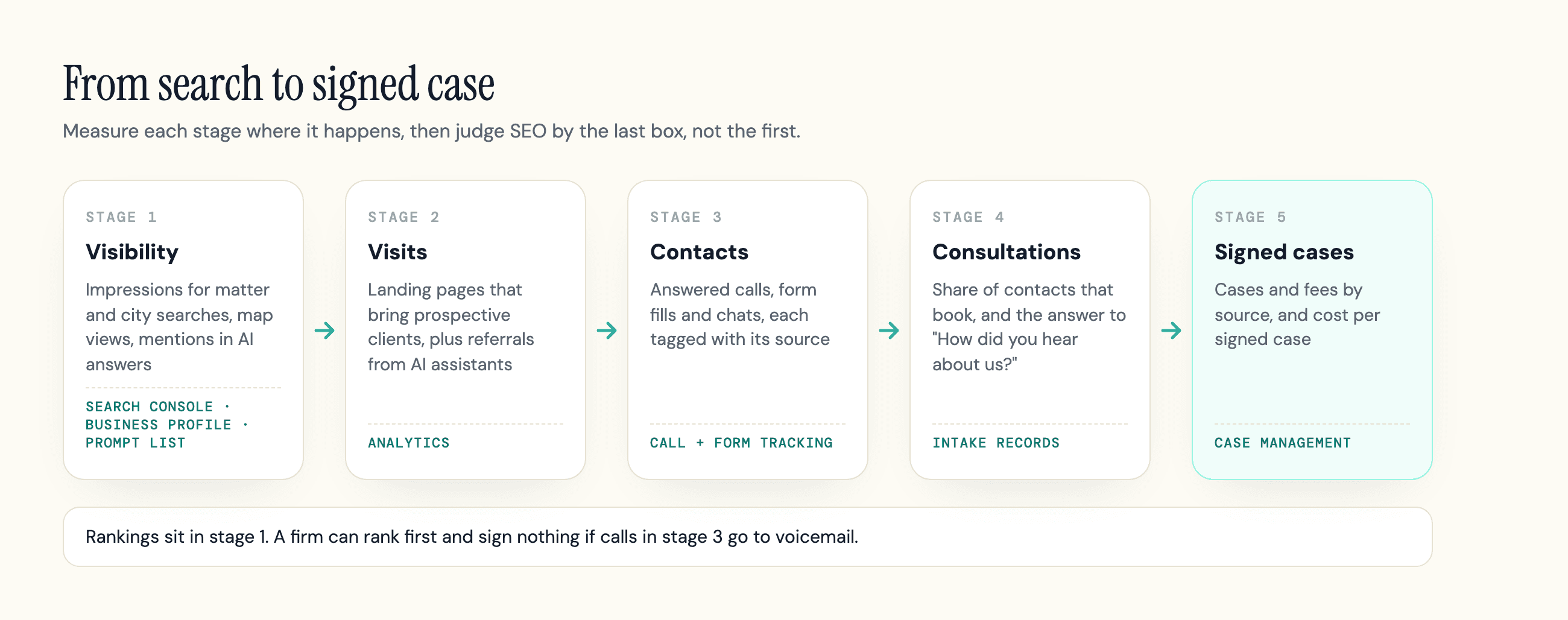
The weak link is usually intake. Ask every new caller how they found you, record the answer in the case file, and you can tie fees back to search. One firm owner on r/LawFirm described working on that chain, from originating campaign to intake to signature. Another commenter replied that return on ad spend is "insanely difficult to track."
Review the numbers monthly, but judge SEO over quarters.
What to Do This Month
If you do nothing else this month, do these, in this order:
- Fix your Google Business Profile: real name, the right primary category, current hours, and a review request sent to every client whose matter closes
- Check that your Business Profile category, hours and phone number match your site
- Rewrite your top practice area page around the questions clients ask on the first call, with an attorney review line
- Ask ChatGPT, Gemini, Perplexity and Google AI Mode who they recommend for your practice area in your city, and note which sources they cite
- Add "How did you hear about us?" to intake
Asking the engines tells you where the AI answers come from. To check the technical side, run the free AI Readiness check we built at geotoolbox on your domain. Its score covers robots.txt validity, whether your robots.txt blocks AI crawlers and whether your sitemap is valid, from one server-side request; it reports the Content-Signal directive and markdown support separately, as emerging signals. It cannot see firewall or CDN blocks; our full Agent Readiness scan covers those.
Frequently Asked Questions
How long does SEO take for a law firm?
There is no standard timeline. Impressions in Search Console usually move before inquiries do, and in a saturated market such as personal injury in a large metro, a clear return can take a year or more. A well-run Business Profile in a smaller town can move faster. Be wary of fixed promises: Google's own guidance says no one can guarantee a #1 ranking.
Can ChatGPT do SEO for a law firm?
It can help with drafting outlines, rewriting thin copy, writing title tags and auditing a page against a checklist. It cannot decide which matters your firm should rank for, earn links or reviews, or take responsibility for legal accuracy, so every AI-drafted page still needs attorney review before it goes live.
Is SEO dead for lawyers in 2026?
No, but it has moved. AI Overviews take clicks from classic results, and assistants like ChatGPT can now suggest lawyers before anyone visits a site. Both still reward a strong Business Profile, accurate directory profiles, reviewed practice pages and earned mentions. We cover the broader question in is SEO dead.
Sources
- What Triggers AI Overviews? 86 Factors and 146 Million SERPs Analyzed - Ahrefs (Ryan Law), November 10, 2025, updated May 31, 2026 -
ahrefs.com/blog/ai-overview-triggers/ - Update: AI Overviews Reduce Clicks by 58% - Ahrefs, February 4, 2026, updated October 15, 2026 -
ahrefs.com/blog/ai-overviews-reduce-clicks-update/ - Legal Trends Report (2026 edition page) - Clio -
clio.com/resources/legal-trends/ - Guidelines for representing your business on Google - Google Business Profile Help -
support.google.com/business/answer/3038177 - Prohibited & restricted content (Maps user-generated content policy) - Google -
support.google.com/contributionpolicy/answer/7400114 - The Consumer Reviews and Testimonials Rule: Questions and Answers - Federal Trade Commission -
ftc.gov/business-guidance/resources/consumer-reviews-testimonials-rule-questions-answers - Creating helpful, reliable, people-first content - Google Search Central -
developers.google.com/search/docs/fundamentals/creating-helpful-content - Spam policies for Google web search - Google Search Central -
developers.google.com/search/docs/essentials/spam-policies - AI features and your website - Google Search Central, updated December 10, 2025 -
developers.google.com/search/docs/appearance/ai-features - Do you need an SEO? - Google Search Central, updated June 5, 2026 -
developers.google.com/search/docs/fundamentals/do-i-need-seo - Web Vitals - web.dev (Google), updated October 31, 2024 -
web.dev/articles/vitals - LegalService type - Schema.org -
schema.org/LegalService - Model Rule 7.1, Comment - American Bar Association -
americanbar.org/groups/professional_responsibility/publications/model_rules_of_professional_conduct/rule_7_1_communication_concerning_a_lawyer_s_services/comment_on_rule_7_1/ - Model Rule 7.2 and Comment - American Bar Association -
americanbar.org/groups/professional_responsibility/publications/model_rules_of_professional_conduct/rule_7_2_advertising/ - Model Rule 7.3, Comment - American Bar Association -
americanbar.org/groups/professional_responsibility/publications/model_rules_of_professional_conduct/rule_7_3_direct_contact_with_prospective_clients/comment_on_rule_7_3/ - How to improve an Avvo Rating - Avvo Support -
avvo.com/support/articles/913949-how-can-i-increase-my-avvo-rating.html - Google Ads cost-per-click and search-volume data for US legal keywords - DataForSEO, November 15, 2026
- AI lawyer-recommendation test (6 prompts, ChatGPT, Gemini, Google AI Mode, Perplexity) - geotoolbox, November 15, 2026
- Reddit threads in r/LawFirm, r/Lawyertalk and r/SEO (11 threads read, posted in the past year) - Reddit, read November 15, 2026