
You added the author bio. You earned the rankings. And ChatGPT, Perplexity, and Google's AI Overviews still never mention you. If E-E-A-T is supposed to be your ticket into AI search, why does doing it by the book change nothing?
E-E-A-T for AI search is widely misunderstood. It is not a score you raise or a ranking factor you switch on. It is a label for the trust signals AI engines reach for when they decide whose content to cite. This is about which signals move that decision, which ones are theater, and what to do when you are doing everything right and still going uncited.
What E-E-A-T Actually Is
E-E-A-T stands for Experience, Expertise, Authoritativeness, and Trustworthiness. It is the language Google's Search Quality Rater Guidelines use to describe credible content. Google added the second E, for Experience, in December 2022, to value first-hand knowledge alongside formal expertise.
One detail matters more than the acronym: the four are not equal. Google states plainly that "trust is most important," and that the other three exist to support it. A page that is not trustworthy has low E-E-A-T no matter how experienced or expert it looks. The framework gets extra weight on Your Money or Your Life (YMYL) topics, where bad information can cause real harm.
None of these are things an engine reads directly, and that is the part most guides skip. They are human-rater concepts, and both Google's ranking systems and AI answer engines have to infer them from signals they can observe. That gap, between the idea and the observable signal, is where most E-E-A-T advice goes wrong.
| Pillar | What Google means by it | What an AI engine can observe |
|---|---|---|
| Experience | First-hand, real-world use of the topic | Original photos, data, dated results, and first-person detail it can extract |
| Expertise | Knowledge, skill, or credentials | A named author with a machine-readable identity and matching profiles elsewhere |
| Authoritativeness | Reputation as a go-to source | Other credible sites citing, linking to, and mentioning you |
| Trustworthiness | Accuracy, transparency, and safety | Consistent facts across the web, clear sourcing, HTTPS, real contact details |
Read the right-hand column again. Most of those signals, especially authority and trust, are things other people say about you, not things you can declare on your own page. Hold onto that, because it explains most of how AI citation works.
Is E-E-A-T a Ranking Factor? No, and That Matters More for AI
There is no E-E-A-T score, and it is not a ranking factor. This is Google's own position: "While E-E-A-T itself isn't a specific ranking factor, using a mix of factors that can identify content with good E-E-A-T is useful." Quality raters score sample results to check whether the ranking systems are working. Their ratings do not flow back as a number attached to your page.
So when a tool offers to grade your "E-E-A-T score," it is inventing a metric Google says does not exist. The same goes for the checklist version of the idea, the one where you bolt on an author box and a "reviewed by" line and expect rankings to move.
That is a costly myth. Google's Danny Sullivan has been blunt that author bios are not a ranking signal: having an expert write something does not magically make it rank, and adding a credentials line does not flip a switch. The bio still matters, but not as a lever you pull on your own page. It matters as evidence an engine can connect to a real, recognized person.
AI answers raise the stakes. The engines are even further from your page than Google's crawler is: they cannot see your intentions or your effort, only signals. So the same correlated signals that nudge search rankings weigh even heavier when an engine decides what to cite. A page it cannot place or trust rarely surfaces in an answer at all.
Does E-E-A-T Apply to ChatGPT, Perplexity, and AI Overviews?
Strictly, no. E-E-A-T is Google's vocabulary for its human raters. ChatGPT, Claude, and Perplexity do not run a function called E-E-A-T, and anyone who tells you they do is guessing.
The better question is whether the same underlying signals decide who gets cited. There, the answer is yes. Many AI answers are built with retrieval: the engine runs a search, pulls a set of pages, and writes from them. How AI search works under the hood is a retrieval step feeding a generation step. That retrieval step leans on the same web that search engines have already sorted by quality, so the trust signals you would build for E-E-A-T are largely the ones that get you into the retrieved set.
Google's AI Overviews lean on pages Google's core systems already rank, though less tightly than they used to. Ahrefs put the share of AI Overview citations coming from the top 10 at 76% in July 2025, then at 38% in a larger March 2026 study. Ranking still gets you considered; it no longer guarantees the citation.
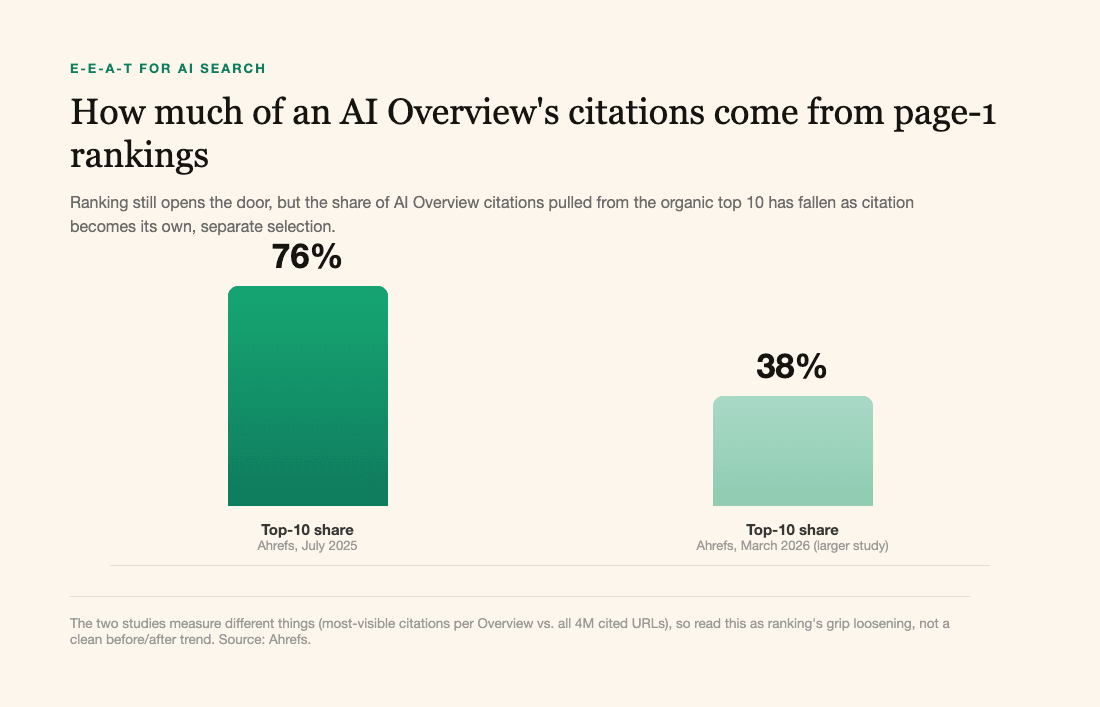
They are not, however, the same thing. A strong rank gets you considered, not chosen. Plenty of pages rank well and never get named in an answer, and plenty of cited sources sit far outside page one. So treat ranking as the price of entry and citation as a second selection on top of it, one that weighs trust and corroboration even harder. The next section is about why that second selection so often goes against the page that "did everything right."
Why You Rank #1 and Still Do Not Get Cited
The single most common frustration we hear: "I rank first on Google, my page has an author bio and schema, and ChatGPT still never names me." The reason is that AI engines lean heavily on trust at the level of the entity, not just the page.
A page can be excellent in isolation. But an engine deciding whether to cite a claim wants corroboration, and corroboration lives off your site. It is looking at whether other credible sources talk about you, link to you, and agree with you. The shorthand: AI does not pull its read of you from what your homepage says, it pulls from what the rest of the web says about you.
That is why a thin Reddit thread can beat your detailed guide. Reddit is a recognized entity that thousands of independent voices reinforce, and one the engines have struck content deals with, so it is an easy thing to quote. Your better page, from a domain the engine has barely seen mentioned anywhere, is a riskier bet. It is not fair, but it is legible.
The data points the same way. Ahrefs found that the off-site signals correlating most strongly with AI Overview mentions were branded web mentions, at 0.664 correlation, ahead of branded anchors and branded search volume. And a large share of what AI cites is structurally out of your hands: Ahrefs also found that roughly two-thirds of ChatGPT's most-cited sources are off-limits to marketers, dominated by Wikipedia, reference sites, and other pages you cannot easily influence through outreach.
So the work that moves AI citation is not another on-page tweak. It is becoming an entity the engines recognize: consistently named, consistently described, and corroborated across the sources an AI engine already trusts. Your page is where you convert that trust into an answer, not where you create it.
The Signals AI Reads, and the Theater It Ignores
Once you accept that engines infer trust from observable signals, the to-do list sorts itself into two piles. One pile changes whether you get cited. The other is busywork that feels like E-E-A-T because it uses the vocabulary.
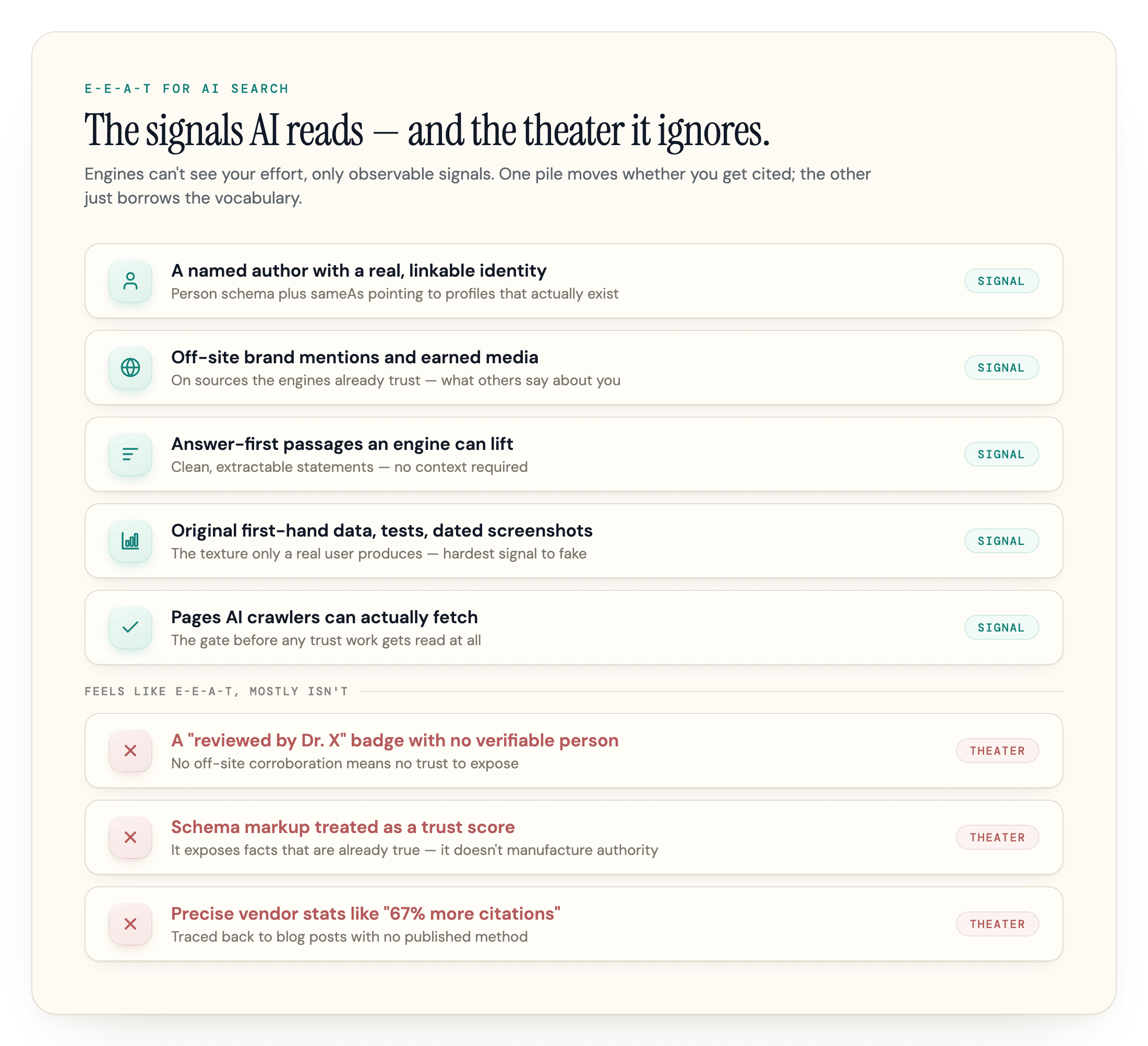
| Moves the needle | Theater (feels like E-E-A-T, mostly is not) |
|---|---|
| A named author with a real, linkable identity (Person schema plus a sameAs to profiles that exist) | A "reviewed by Dr. X" badge with no verifiable person behind it |
| Off-site brand mentions and earned media on sources engines already trust | Schema markup treated as a trust score on its own |
| Answer-first passages an engine can lift without context | An llms.txt file expected to boost citations on its own |
| Original first-hand data, tests, and dated screenshots | Precise vendor stats like "answer-first earns 67% more citations" |
| Pages AI crawlers can fetch | Stacking author boxes on pages no one off-site corroborates |
Two items on the theater side surprise people. Schema is one. It makes your author and organization machine-readable, which genuinely helps an engine connect the dots, but it is a signal-exposer, not a trust score. When Ahrefs tracked 1,885 already-cited pages that added schema, it found no meaningful citation lift. Use schema to expose facts that are already true, not to manufacture authority.
The other is the genre of precise citation statistics. The "answer-first gets cited 67% more" numbers trace back to vendor blog posts with no published method. The durable findings are blunter: be trustworthy, be original, be extractable, be corroborated. When the craft of writing pages LLMs cite is done well, the citations follow without a magic percentage attached.
Experience vs Expertise: the "E" Most Content Fakes
The two front E's are not synonyms, and the difference is the part most content gets wrong. Expertise is theoretical knowledge: a doctor who can list the symptoms of the flu. Experience is lived: a patient describing what the flu felt like. Google added Experience because for a lot of queries, readers want the second kind, and a credentialed summary of what everyone already knows is not it.
This is also the hardest signal to fake, which is exactly why it is worth investing in. You cannot bolt on first-hand experience with a byline. It shows up as the texture only a real user produces: the specific number, the screenshot with your own data in it, the thing that went wrong that no summary would mention, the dated before-and-after. Engines and readers both reward that detail because it cannot be cheaply synthesized.
In our experience auditing pages that get cited versus pages that do not, the citable ones almost always contain something the writer could only know by doing the thing. The uncited ones read like a competent rewrite of the top ten results, which is precisely what a model can already generate, so it has no reason to send anyone there.
Can engines tell the difference between real experience and credential cosplay? Not perfectly, but they lean on corroboration to approximate it, and content that mimics expertise without any external validation tends to be treated as exactly that. The reliable move is not to perform experience. It is to have some, then make it extractable.
Reachability: the Gate Before Any of This Matters
There is one signal that sits in front of all the others, and it is the one teams forget. An engine that retrieves the web cannot cite a page it cannot fetch. If your robots.txt blocks the AI crawlers that feed those answers, the trust work never gets read, because the page never enters the retrieval set.
It is a common silent failure in AI visibility, and one of the easiest to fix. OpenAI, Anthropic, and Perplexity each run named crawlers (OAI-SearchBot, Claude-SearchBot, PerplexityBot) you can allow independently, and it is easy to find one quietly disallowed by a default rule or a security plugin nobody revisited. Google's AI Overviews are the exception: they ride on ordinary Googlebot, so there it is your normal crawl and index settings that decide inclusion, not a separate AI crawler.
Check reachability before anything else
The free AI Crawler Checker shows which AI crawlers your robots.txt allows or blocks, with the exact line to fix. Run it before you invest in any of the trust work above.
Reachability does not earn you a citation. It just makes you eligible for one. Treat it as the gate it is: confirm it first, then go build the trust that gets you through.
How to Measure E-E-A-T for AI Without a Paid Tool
Since there is no E-E-A-T score, you cannot check a number. But you can check the thing the score is a proxy for: what the web, and the engines reading it, currently believe about you. Most advice here points straight at a paid toolkit. You do not need one to get started.
The free version takes ten minutes. Search your brand and your key topics while excluding your own domain (a your brand -site:yourdomain.com query), so you only see what other sources say. Then ask the engines directly: pose the questions your customers ask to ChatGPT, Perplexity, and Google's AI Overviews, and watch who gets named. You are looking for three things: whether you appear at all, who describes you when you do, and whether the description is accurate. Silence usually means you have not cleared the entity bar yet, though it can also be query variance or a topic that does not trigger an AI answer. A wrong description means the corroboration exists but points the wrong way.
Google hands you a self-check for this without naming it E-E-A-T. Its helpful-content guidance asks Who created the content (is there a real, identifiable author), How it was made (is any automation disclosed), and Why it exists (to help a reader, or just to rank). Those three questions map onto what an AI engine can verify: a named author it can resolve, content whose provenance is clear, and a purpose that is not obviously manipulation. If your pages cannot answer Who, How, and Why, an engine cannot either.
That manual pass tells you where you stand. The structured version is what our AI Readiness check automates, and tracking it over time is how you turn a one-off look into a way to measure AI visibility as you build. Either way, the point is the same: stop trying to grade a page, and start watching whether engines can find, trust, and correctly describe you.
How the Engines Differ
No single playbook performs identically everywhere, because the engines retrieve and weigh sources differently. None of them publish a trust formula, so read the table below as observed tendencies, not settled factors.
| Engine | Where it pulls answers from | What it appears to over-index on |
|---|---|---|
| Google AI Overviews | Pages Google already ranks (ordinary Googlebot) | The same authority signals that drive Google rankings |
| ChatGPT (search) | Its own search index plus the model's training memory | Established, widely-referenced sources and familiar brands |
| Perplexity | Its own crawl plus live fetches | Recent pages and several independent sources agreeing |
| Gemini | Google's index and grounding | Recognized entities Google already connects in its Knowledge Graph |
One caveat the table hides: an engine can name a well-known brand straight from training memory, with no retrieval at all. That is the long game of being an entity. You become part of what the model already knows, not just what it can look up.
A Realistic On-Ramp for New or Small Sites
If your site is new and has no link history, "build authority" can sound like "already be famous." You cannot conjure years of brand mentions overnight, but you can pick the moves that compound fastest, including a focused plan for earning links from relevant sites through the right link building platforms.
Lead with depth, not breadth. One subject covered thoroughly, as a connected cluster rather than a single page, builds topical authority an engine can recognize faster than scattered posts across ten topics. Pair that with the one thing a bigger competitor cannot copy: your own first-hand data, your own tests, your own numbers. Originality is the cheapest entity signal a small site can create, because it is real.
Then get named where your audience already talks, in communities, on podcasts, in roundups, anywhere an independent source can mention you. A handful of credible mentions does more for AI citation than another self-published page.
If you work in a Your Money or Your Life field, health, finance, or legal, the bar is higher. Engines lean harder on named, credentialed authors and on outside corroboration, and they filter fringe claims more aggressively, so first-hand proof and recognized sourcing matter even more. The full sequence for optimizing for AI search walks through the order. The short version: reachable first, original and extractable second, corroborated third.
Frequently Asked Questions
Is E-E-A-T a ranking factor?
No. Google states that E-E-A-T is not a specific ranking factor and that there is no E-E-A-T score. It is a framework its human quality raters use to judge content, and the rater feedback helps Google tune its ranking systems over time. You optimize for the signals that correlate with it, not for a number.
Does E-E-A-T matter for ChatGPT and Perplexity?
Those engines do not run Google's E-E-A-T framework, so not literally. But they retrieve sources from a web already filtered by search and reach for the same underlying trust signals, so the work you do for E-E-A-T is also what makes you eligible to be cited in AI answers.
Why does AI cite Reddit over my detailed expert content?
Because AI engines weigh trust at the entity level and prefer corroboration. Reddit is a recognized source that thousands of independent voices reinforce, which makes it an easy thing to quote. A stronger single page from a domain the engine rarely sees mentioned elsewhere is one it has less reason to trust, even when it is better.
Does schema markup improve AI citations?
Schema makes your author and organization machine-readable, which helps an engine connect your content to a known entity. But it is not a trust score on its own. Ahrefs tracked 1,885 already-cited pages that added schema and found no meaningful citation lift, so use schema to expose facts that are already true, not to manufacture authority.
Does using AI to write hurt E-E-A-T?
Not by itself. Google says it judges content on quality, not on whether a human or AI produced it, and only treats AI made mainly to manipulate rankings as spam. The real risk is subtler: AI is very good at the generic rewrite of the top results, and that is exactly the content an engine has least reason to cite. Use it to draft and edit, then add the first-hand experience and original data it cannot invent.
Can you fake E-E-A-T, and will AI catch it?
You can add the surface markers (an author box, a "reviewed by" line, a credentials list), but without off-site corroboration they do little. Engines approximate genuine experience and authority through external validation, and content that mimics expertise with nothing backing it up tends to be treated as exactly that.
Stop Grading the Page
E-E-A-T for AI search is not a checklist you complete or a score you raise. It is whether the engines can reach your content, trust the entity behind it, and find your claim corroborated somewhere they already believe. Get those three right and you stack the odds for citation. Stack author boxes on an unreachable, uncorroborated page and you will not, no matter how the page scores in some tool.
If you are not sure which of the three is holding you back, start by measuring instead of guessing. Our free AI Readiness check shows where you stand on reachability and the trust signals AI engines actually read, which is the difference between optimizing a page and earning a citation. geotoolbox is the AI bot debugger we built for exactly this: seeing your site the way an answer engine does, before you spend a month on signals it never gets to use.
Sources
- Google Search Central, Creating Helpful, Reliable, People-First Content -
developers.google.com/search/docs/fundamentals/creating-helpful-content - Google Search Central Blog, Our latest update to the quality rater guidelines: E-A-T gets an extra E for Experience -
developers.google.com/search/blog/2022/12/google-raters-guidelines-e-e-a-t - Search Engine Land, Debunking common Google E-E-A-T misconceptions -
searchengineland.com/google-eeat-misconceptions-437445 - Ahrefs, E-E-A-T: How to Build Trust and Boost Web & AI Visibility -
ahrefs.com/blog/eeat-seo - Ahrefs, What Are ChatGPT's Most Cited Pages? -
ahrefs.com/blog/chatgpts-most-cited-pages - Ahrefs, We Tracked 1,885 Pages That Added Schema Markup -
ahrefs.com/blog/schema-ai-citations