
LLMO, or large language model optimization, is the work of getting your brand named when ChatGPT, Claude, or Gemini answers a question, rather than just ranked in a list of links. You will also see it called LLM SEO, the same discipline from the search side; for the hands-on playbook and the mistakes to avoid, see our LLM SEO guide. This page is the plain definition and what is genuinely new about it.
What Is LLMO?
LLMO, short for large language model optimization, is the practice of structuring your content and brand presence so large language models like ChatGPT, Claude, and Gemini cite and recommend you in their answers. It is also called LLM SEO. Either way the goal is the same: be the source the model pulls from, not just a link it ranks.
That settles the most common mix-up. LLM SEO means optimizing to appear in LLMs, not using an LLM to do your SEO. Across the guides ranking for this term the distinction is unanimous.
A language model answers from two places: what it absorbed during training, and what it retrieves from the live web at the moment you ask. How AI search works walks through that loop. LLMO is the work of being present in both.
LLMO, GEO, AEO: Same Job, Different Letters
You will collect a small pile of acronyms here: LLMO, GEO, AEO, LLM SEO. Vendors will tell you they are distinct disciplines. One popular framing splits them neatly: AEO for Google's AI Overviews and snippets, GEO for live-web answer engines like Perplexity, LLMO for conversational chat like ChatGPT and Claude.
It is a tidy story, and in practice it does not change what you do. The underlying work, reachable content with clear answers and real authority behind it, is the same whether the reply comes from a chat box or an AI Overview. We map the wider set of terms in what generative engine optimization is and the answer engine optimization guide; read either for the full breakdown.
There is now usage data on which label is winning. A Fractl and Search Engine Land study published in November 2025, combining a survey of 342 practitioners with Google Trends, Indeed, and social-media data, found that 84% of respondents recognized GEO and 42% chose it as their working term, while LLMO sat among the acronyms fewer than half of respondents even recognized. So if you are picking one word for a deck, GEO travels furthest; LLMO remains the specialist's term.
The split is still useful as vocabulary, so treat LLMO as the label aimed at the chat assistants specifically, and do not let anyone sell you separate budgets for one job. Where LLMO earns its own page is the part of that task list that is genuinely specific to how a language model works.
What Is Actually Different about Optimizing for an LLM
Most "LLM SEO" advice is solid SEO with a new label. A few things, though, are genuinely specific to how a language model works, and they are the part worth understanding.
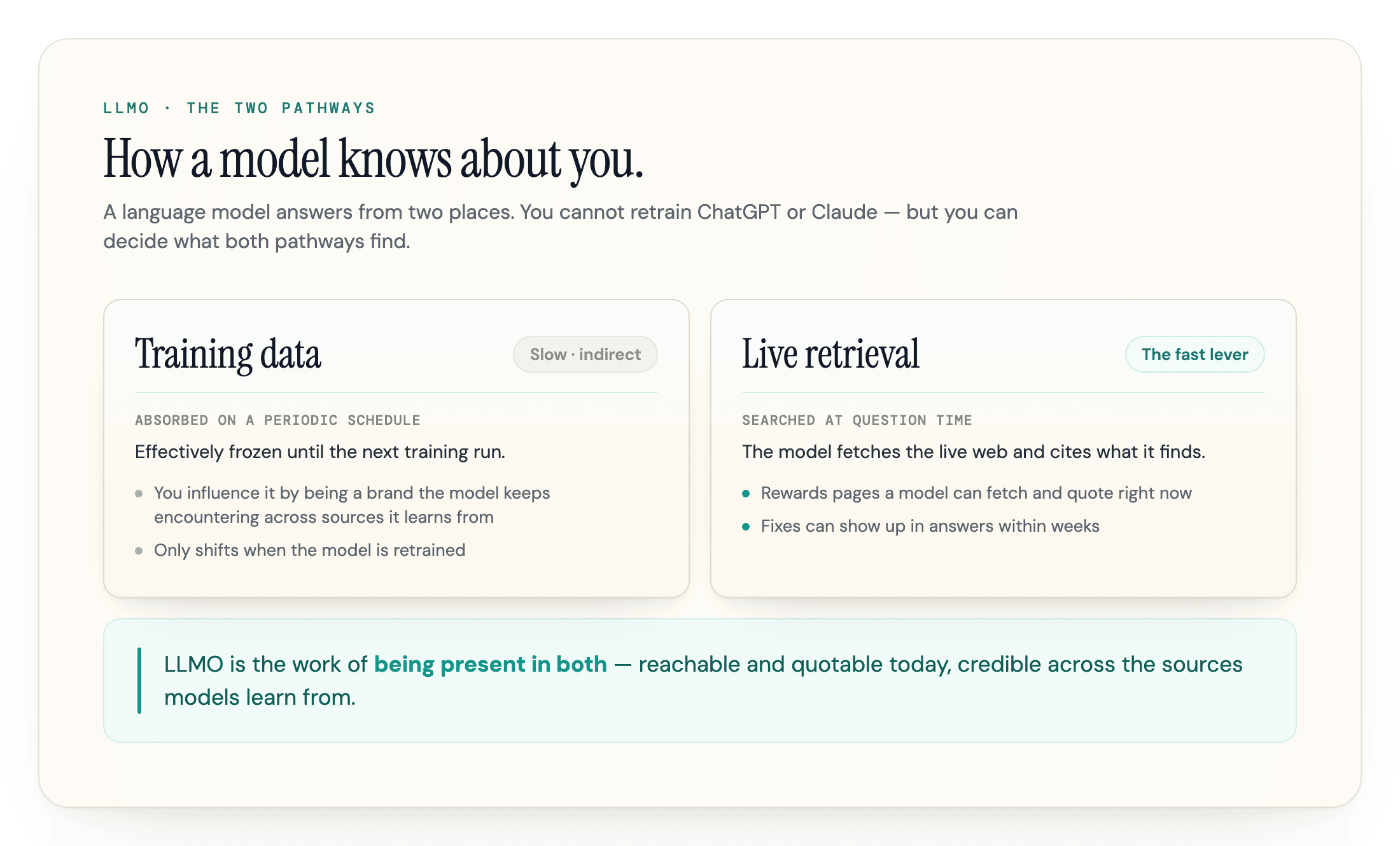
Start with the two pathways. A model knows about you through training data, absorbed once on a periodic schedule and effectively frozen until the next training run, and through live retrieval, where it searches the web at question time and cites what it finds. You cannot retrain the model behind ChatGPT or Claude, so the training pathway is slow and indirect: you influence it by becoming a brand the model keeps encountering across the sources it learns from. The retrieval pathway is the fast lever, and it rewards pages a model can fetch and quote right now.
The second difference is that visibility is probabilistic, not ranked. In search you are position three or you are not. Ask an LLM the same question twice and you can get different sources each time. There is no number one to hold. Success is measured as how often you are mentioned across many prompts, a share of voice, rather than a fixed rank.
The third is that your Google ranking does not transfer cleanly. Strong organic performance helps, but it is not the same currency. A page can own the SERP and never get cited, because the model selects for extractable, trustworthy passages, not for backlink counts. A study of 55,936 queries across six LLM-based search engines, published in December 2025, found they cite a more diverse set of domains than traditional search engines: of all the domains seen across both, only 38% appeared in both systems, while 37% were cited only by the LLM engines.
Here is the practical translation:
| Standard SEO lever | What changes for LLMs |
|---|---|
| Backlinks and domain authority | Unlinked brand mentions on sources the model trusts (Reddit, Wikipedia, news) carry weight that raw link equity does not |
| Keyword matching | Semantic relevance: the model matches meaning, not exact strings, so cover the concept fully rather than repeating a phrase |
| Heading structure | Headings double as extractable labels; a question heading with a self-contained answer underneath is a citation-ready block |
| Content freshness | Recency bias is stronger, and cited pages skew toward original, not already-synthesized, information |
Everything else in the typical LLMO checklist (schema, clean structure, fast pages) is good SEO you should already be doing.
Can AI Models Even Reach Your Content?
None of the optimization matters if a model cannot fetch your page in the first place, and in the readiness scans we run, this is the LLMO step most often skipped.
Bots now generate more than half of HTML requests, Cloudflare reported in its 2025 Year in Review, with AI crawlers among the fastest-growing of them. They are also pickier than Googlebot in one important way: most read raw, static HTML and do not run JavaScript. If your content is injected client-side, a crawler like GPTBot, OAI-SearchBot, ClaudeBot, or PerplexityBot can fetch the URL and still see almost nothing.
Two more blocks are common. A robots.txt rule may disallow the AI crawlers by name, often added by a plugin or a default nobody revisited. A firewall or bot-management rule (Cloudflare and similar) may challenge non-browser traffic and quietly turn the crawlers away even when robots.txt allows them.
Each of these is invisible in a normal content review and cheap to fix, usually in a day. Confirm reachability before you spend a week rewriting copy a model was never going to see. Our AI search playbook walks the checks in order.
How to Do LLM Optimization
With the page reachable, the work is making each answer easy for a model to lift and trust. Five moves do most of it (for the full practitioner walkthrough, our LLM SEO guide and step-by-step AI search playbook go deeper).
-
Answer first. Open a section with a direct, self-contained answer in the first 30 to 60 words, then expand. Models extract that opening block and often quote it nearly verbatim. A Kevin Indig analysis of 1.2 million AI answers, published February 2026, found 44.2% of the 18,012 verified ChatGPT citations pointed to the first 30% of the content. This is also the part of content chunking advice that survives scrutiny.
-
Structure for extraction. Use question-shaped headings, short paragraphs, lists, and tables. The format is not cosmetic: an AirOps analysis of 12,000+ pages comparing ChatGPT-cited pages with Google's top results found the cited pages were about three times as likely to include a list, and far more likely to follow a clean heading hierarchy, because those structures hand a model clean blocks to pull.
-
Lead with original substance. Models reward information they have not already seen synthesized everywhere else: proprietary data, first-hand experience, specific numbers, a clear point of view. A study from IIT Delhi and Princeton researchers found that adding citations, quotations, and statistics raised a source's visibility in generative answers by up to 40%. Recycled, AI-written filler does the opposite.
-
Add structured data. Article, FAQ, and Organization schema help a model interpret what your page is and how its parts relate. Treat it as clarity, not a cheat code. Google states there is no special markup required to appear in AI features, so schema supports good content; it does not replace it.
-
Build off-site authority and entity clarity. This is the biggest divergence from on-page SEO. Models weigh how often and how credibly you are mentioned across sources they trust, especially Reddit, Wikipedia, and established news and reference sites. Branded search matters too: rising searches for your name track with how readily models bring you up, though that is correlation, not a documented mechanism. The clearer the web is that your brand is one distinct, well-described entity, the more confidently a model attaches your name to your topics. Our guide to entity SEO goes deeper there.
The through-line: be reachable, be extractable, be the most credible original source on your topic. That is the whole game.
Does LLMO Actually Work?
Worth doing, and worth a clear head. The honest answer has three parts.
The behavior shift is real. OpenAI announced ChatGPT had reached 900 million weekly active users in February 2026, and Google's Gemini app passed 750 million monthly active users per Alphabet's Q4 2025 earnings. People genuinely ask these assistants the questions they used to type into Google, and a brand absent from those answers is invisible for them. That part is not vendor hype.
The conversion claims are softer than they sound. You will see that AI-referred visitors convert several times better than organic, often the same Semrush figure of 4.4x repeated across articles. Treat it as a single-source claim, not settled fact, especially since AI assistants frequently pass no referrer, so the "AI traffic" most teams can measure is a small, self-selected slice.
And the results are volatile. The same prompt can name different brands on different days, and citation sets churn from week to week. Researchers who repeat the same prompt rarely get an identical set of sources back. That is not a reason to skip LLMO. It is a reason to track direction over weeks and ignore any single snapshot, and to be wary of a vendor promising a stable "rank" in a system that does not have one.
Net: do it, because the shift is real and the fundamentals are cheap. Just buy it for visibility and qualified demand, measured honestly over time, not because a dashboard promised a tidy multiple.
How to Measure LLMO
Drop the idea of a single ranking. LLMO is measured as a spread of imperfect signals tracked over time.
- Prompt tracking. List the questions your customers actually ask, run them through ChatGPT, Perplexity, and Gemini on a schedule, and record whether and how you appear. Run each a few times, since answers vary. This is the most direct read, and you can start by hand.
- Share of voice. Across that prompt set, track how often you are named versus competitors, by hand or with an AI rank tracker. This is the closest thing LLMO has to a rank, and it is the signal AI visibility tools like geotoolbox roll into a 0-to-100 score.
- AI-referred traffic. In GA4, segment the visits that arrive from AI assistants. The number undercounts reality, because many referrals are stripped or lumped into direct traffic, but the trend is still useful.
- Branded search. Rising searches for your name, especially alongside flat non-branded clicks, is a fingerprint of AI mentions sending people to look you up.
Watch one more thing while you measure: whether the models describe you correctly. A confident, wrong answer about your brand is worse than no mention, and it is common. Our guide to AI hallucinations about your brand covers finding and correcting them.
Frequently Asked Questions
What does LLMO stand for?
LLMO stands for large language model optimization. Of the competing acronyms, it is the one that names the model rather than the engine or the answer, which is why it tends to be used for chat assistants like ChatGPT and Claude specifically.
Is LLM SEO the same as GEO and AEO?
For practical purposes, yes. The split you will see, AEO for AI Overviews, GEO for answer engines, LLMO for chat assistants, is vocabulary rather than strategy. The only real divergence is which surface you track, since the optimization work is shared.
Does "LLM SEO" mean using ChatGPT to write content?
No, and that is the common mix-up. LLM SEO means optimizing so that AI models cite you, not using AI to produce your content. AI-assisted drafting is fine when a human adds original data and a point of view; what hurts is publishing recycled filler that adds nothing new.
Can you optimize for ChatGPT if you cannot change its training?
Yes, indirectly. You cannot retrain the model, but you can influence what it retrieves live and what it encounters across the web. Consistent mentions on trusted sources and a clear brand entity shape how the model represents you over time.
How long does LLMO take to show results?
Weeks to months, depending on the pathway. Retrieval-side fixes like crawler access and answer-first structure can show up in live-search answers within a few weeks. Authority and entity work moves slower, and anything tied to training data only shifts when the model is retrained.
Where to Start
LLMO is good search work plus a handful of habits that fit how a language model actually reads, not a separate discipline to master from scratch.
Start where it is cheapest and most often broken: can the AI crawlers reach and read your key pages? geotoolbox's free AI-Readiness Score checks the crawler-access foundations in seconds, and the Content Analyzer grades how citable a page is. Fix what it flags, make your best pages answer-first and genuinely original, then track your share of voice over time.
Sources
- GEO: Generative Engine Optimization - Aggarwal et al. (IIT Delhi + Princeton), KDD 2024 -
arxiv.org/abs/2311.09735 - AI features and your website - Google Search Central -
developers.google.com/search/docs/appearance/ai-features - What Is Answer Engine Optimization? And How to Do It - Semrush (conversion figure, cited with caveat) -
semrush.com/blog/answer-engine-optimization - Structuring Content for LLMs - AirOps, 2025 (citation-structure study) -
airops.com/report/structuring-content-for-llms - Cloudflare Radar 2025 Year in Review - Cloudflare, 2025 (data citation) -
blog.cloudflare.com/radar-2025-year-in-review - SEO, GEO, or ASO? What to call the new era of brand visibility in AI - Fractl / Search Engine Land, November 2025 (terminology recognition study) -
searchengineland.com/seo-geo-aso-new-era-brand-visibility-ai-research-464936 - ChatGPT reaches 900M weekly active users - TechCrunch, February 2026 -
techcrunch.com/2026/02/27/chatgpt-reaches-900m-weekly-active-users - Google's Gemini app has surpassed 750M monthly active users - TechCrunch, February 2026 -
techcrunch.com/2026/02/04/googles-gemini-app-has-surpassed-750m-monthly-active-users - Source Coverage and Citation Bias in LLM-based vs. Traditional Search Engines - Zhang et al., arXiv, December 2025 -
arxiv.org/abs/2512.09483 - 44% of ChatGPT citations come from the first third of content - Search Engine Land / Kevin Indig, February 2026 -
searchengineland.com/chatgpt-citations-content-study-469483