
Ask ChatGPT or Google about your company and you get an answer built from a model the engine already holds, not a fresh read of your homepage. When that model is thin or tangled with a similarly named business, the answer comes out wrong, and tuning keywords on the page does nothing to fix it.
Entity SEO is the work of fixing that model: making search and AI engines resolve your brand to one clear, well-defined entity and attach the correct facts to it.
No magic schema trick. Just the parts that actually move recognition.
What Is Entity SEO? (Things, Not Strings)
Entity SEO is the work of getting search and AI engines to recognize your brand as a clear, well-defined thing, and to attach the right facts to it. Instead of optimizing a page to match a string of words, you are making sure the engine knows who you are, what you do, and how you relate to other things it already understands.
The shorthand is "things, not strings." A keyword is a string of characters a system matches against your page. An entity is a thing that exists independently of any particular wording: a company, a person, a product, a place. "Nintendo" is the same entity whether the page is in English or Japanese, because the engine has resolved the word to a thing, not just indexed the letters.
Google describes an entity in its own patent language as something "singular, unique, well-defined and distinguishable." That last word does the heavy lifting. The engine's job is to tell your brand apart from every other thing with a similar name, and your job in entity SEO is to make that easy.
This matters more now than it did five years ago, because semantic search and AI answers both run on entities, not strings. An engine answers from the model of your brand it has already built, so the quality of that model, not the keywords on any single page, is what decides whether the answer about you comes out right.
| Dimension | Keyword SEO | Entity SEO |
|---|---|---|
| Unit of optimization | A string of words | A thing and its relationships |
| What you win | A ranked position | Recognition and citation |
| Main signals | Keywords, content, backlinks | Schema, sameAs, consistency, corroboration |
| Where it shows up | Ten blue links | Knowledge panels and AI answers |
| How you measure | Rank tracking | Citations, panel presence, brand queries |
Entity SEO does not replace keyword work. It sits underneath it. The clearer your entity, the more of your keyword and content effort actually lands, because the engine knows which brand to credit. It is one half of semantic SEO, the same instinct behind generative engine optimization, applied to the question of identity.
The Knowledge Graph: How Google (and AI) Build a Model of Your Brand
The knowledge graph is where engines store what they know about entities and how those entities connect. Google launched its version in 2012 with a post literally titled "things, not strings," describing a starting set of about 500 million objects and 3.5 billion facts. By Google's last public figure, from May 2020, that had grown to over 500 billion facts about five billion entities. The graph is also actively pruned, not just grown: in June 2025, Kalicube's long-running tracker recorded Google deleting more than 3 billion entities in a single week, a 6.26 percent contraction by its count, which implies the graph had grown to roughly ten times Google's 2020 entity figure before the cull. Kalicube, writing in Search Engine Land, read the cleanup as Google trading raw volume for entity clarity in the dataset that feeds its AI features.
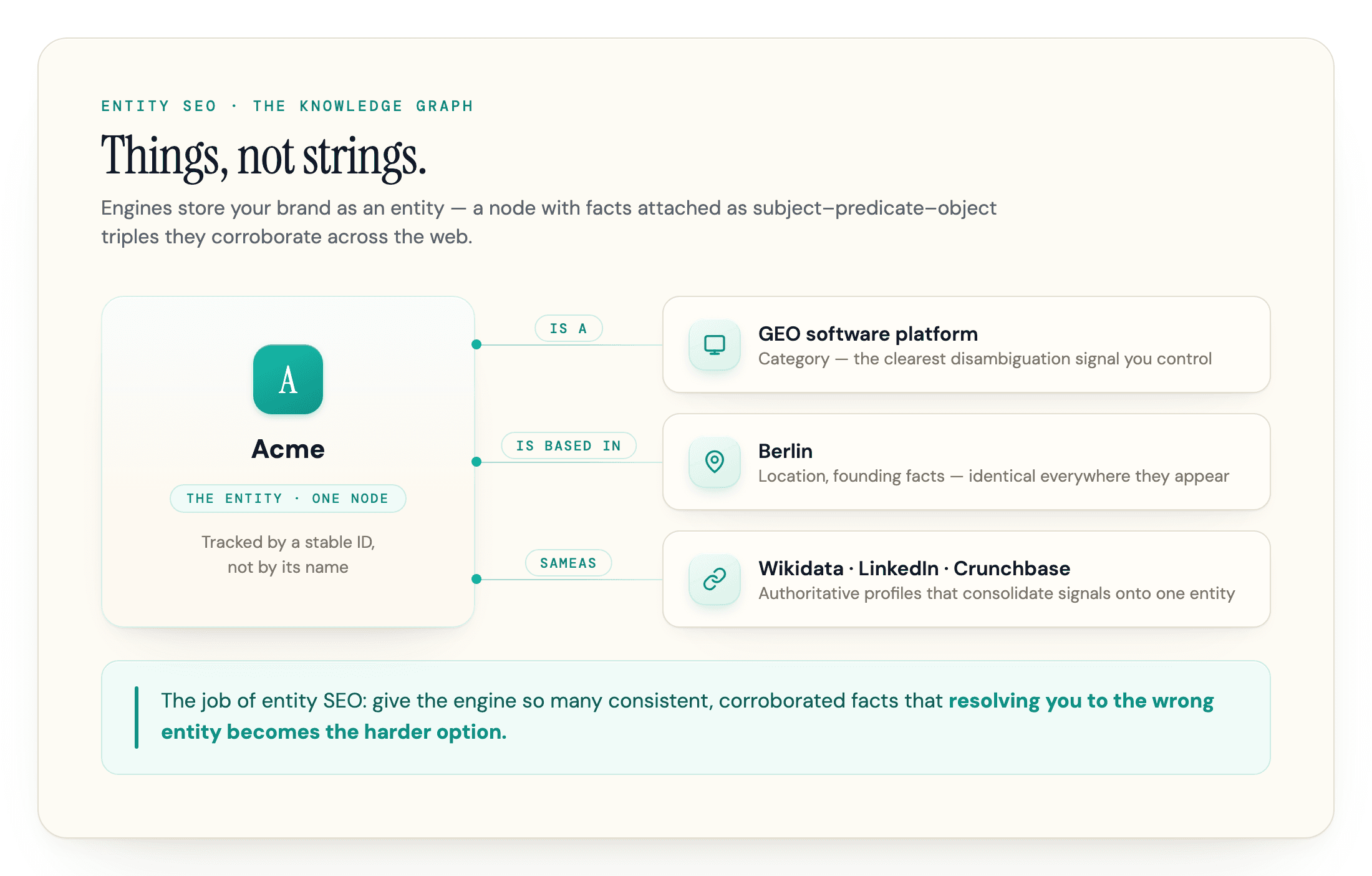
The structure underneath is simple to picture. Facts are stored as triples: a subject, a predicate, and an object. "Acme (subject) is a (predicate) software company (object)." "Acme (subject) is based in (predicate) Berlin (object)." String enough of those together and you get a graph: your brand as a node, connected by labeled edges to the people, products, and places it relates to.
Each entity gets a stable identifier so the graph can refer to it without ambiguity. Google's knowledge-graph machine IDs look like /g/... or the older Freebase-style /m/...; the same entity usually has a Wikidata QID (like Q95) and, in your own structured data, a JSON-LD @id. You do not need to memorize these. The point is that engines track entities by ID, not by name, which is exactly why two brands sharing a name can still be told apart.
Where do the facts come from? A lot of the early graph was seeded from Freebase, a community knowledge base Google acquired and then shut down in 2016, migrating its data into Wikidata. Google has also published research like the Knowledge Vault project, which explored automatically extracting facts from across the web with a confidence score attached. That was a research effort, not a live product, but it tells you the direction: engines want to corroborate facts from many places, not trust a single page.
This is the model your brand has to land in cleanly. The rest of this guide is about the signals that put it there.
How AI Engines Use Entities to Understand and Cite Your Brand
Most entity SEO advice predates the AI era and talks only about Google. That misses where this matters most now. AI engines lean on entities even harder than Google does, because they have to decide which brand to talk about before they write a single word.
Search engines have been moving this way for a decade. Google's Hummingbird update in 2013 shifted ranking toward meaning over exact keywords, and RankBrain extended that to interpreting queries it had never seen. Large language models took the idea further: they learn entities and their relationships from training data, so your brand name is not just a string they match but a concept they may already hold some knowledge of.
When you ask ChatGPT, Perplexity, Gemini, or a Google AI Overview about a brand, a rough version of this happens. The engine identifies the entity in your question, a step called named entity recognition. It represents that entity and your query as vector embeddings, numerical fingerprints of meaning. Then it resolves the mention to a specific entity by cross-referencing what it knows, often the same trusted reference points: Wikipedia, Wikidata, Crunchbase, official profiles. The clearer and more corroborated your entity is across those, the more confidently it lands on the right one. For the engine-by-engine detail of how this retrieval works, see our breakdown of how AI search works.
Each engine sources and weighs entities a little differently, which is why the per-engine playbooks diverge in the details. Our guides on getting cited in ChatGPT, ranking in Perplexity, and appearing in Google AI Overviews cover those differences. The entity fundamentals below carry across all of them.
There is an important nuance here about timing. An engine's parametric memory (the facts baked into its training) updates on a slow training cycle you cannot see. But most modern AI answers also retrieve live sources at query time and ground the response in them. That means fixing your structured data and your public facts can influence the grounded, cited part of an answer well before any model retraining catches up. You are not stuck waiting years for a fix.
Two things follow for your brand. First, a strong entity is what earns an AI citation in the first place; the engine cites sources it can attribute confidently to a known thing. Second, a weak or ambiguous entity is behind many of the AI hallucinations about a brand we see in audits, where the model blends your facts with a namesake's or invents a detail to fill a gap. Entity clarity is one lever that improves citation and reduces hallucination at the same time.
Entity Disambiguation: Making Sure AI Knows Which Brand You Are
Disambiguation is the engine's process of picking the right entity when a name could mean several things, and it is where most brand confusion starts. "Apple" is a fruit and a computer company. "Jaguar" is a cat, a car, and an NFL team. The engine resolves these constantly, using context and the strength of each candidate entity.
The trouble comes when your brand shares a name with something better established. We see it again and again when auditing how AI describes a company: the engine has the right name but the wrong facts, because it merged your brand with a larger or older namesake. A small software firm gets described with a manufacturer's founding date. A consultancy inherits a same-named law firm's location. The model is not malfunctioning; it resolved the name to the entity it had more signals for, and that was not you.
You fix this by making your entity unmistakable. State your category plainly and early on your main pages, because category is one of the clearest disambiguation signals you control ("Acme is a GEO and AI-visibility software platform," not just "Acme helps brands grow"). That plain, self-contained phrasing is the same instinct behind writing pages AI engines cite. Keep your founding details, location, and leadership consistent everywhere they appear. And link your brand to the authoritative profiles that already disambiguate it, which is the schema and sameAs work covered next. The goal is to give the engine so many consistent, distinguishing facts that resolving you to the wrong entity becomes the harder option.
Building Your Brand's Entity Home: Schema, sameAs, and Structured Data
Your entity home is the one page engines should treat as the canonical source of truth about your brand, usually your homepage or an About page. Everything else points back to it. Getting that page right is the most direct thing you control in entity SEO.
Start with Organization schema markup. Structured data states your brand's facts in a format machines parse without guessing: legal name, logo, founding date, founders, location, contact points. Use the most specific type that fits, so a software company should reach for a more precise subtype rather than the bare Organization if one applies. This is the machine-readable version of the plain-language facts you already publish. The implementation mechanics, which types to ship, the code patterns, and how to verify the markup actually reaches AI crawlers, are covered in our guide to schema markup for AI search.
The field that does the most work is sameAs. The schema.org sameAs property takes URLs that point to your brand's authoritative profiles: your Wikipedia or Wikidata page, your LinkedIn company page, your Crunchbase listing, your verified social accounts. Each link is you telling the engine, in its own language, "these all refer to the same entity as this page." It is the connective tissue that ties your entity home to the wider web of corroboration engines already trust.
Now the honest part, because this is where entity SEO gets oversold. Schema is necessary, not sufficient. It helps machines parse and disambiguate your brand, which is real and worth doing; Microsoft's Fabrice Canel confirmed in March 2025 that schema markup helps Bing's LLMs understand content. It is not a switch that turns on citations, though. Google's own guidance on AI features is blunt that there is no special structured data you add to appear in AI answers. An Ahrefs study from May 2026 put numbers on it: across 1,885 already-cited pages that added JSON-LD between August 2025 and March 2026, measured against 4,000 control pages, citations moved within statistical noise on ChatGPT and Google AI Mode and dipped a small but statistically significant 4.6 percent in AI Overviews, a decline Ahrefs itself cautions against reading as schema doing harm. The same study explains why the myth survives: in a separate crawl of 6 million URLs, AI-cited pages were almost three times more likely to carry JSON-LD, a correlation the study attributes to overall site quality, not to the markup itself. Anyone selling schema as a growth hack for AI visibility is selling the wrong thing.
Treat structured data as housekeeping you do once and maintain: accurate, specific, consistent with your prose, and wired to your real off-site profiles. It removes ambiguity. The authority that earns citations comes from the corroboration those sameAs links point to. For where schema fits in the full optimization sequence, see step five of our guide to optimizing for AI search.
Build Topical Authority Around Your Entity
Recognition is the start; authority is what makes an engine trust you on a subject, the E-E-A-T signals that decide AI citation. You build it by surrounding your entity with content that proves depth on the topics you want to be known for, and by linking that content so the relationships are obvious.
Think in clusters, not isolated pages. A pillar page defines your core topic, and supporting pages cover the sub-questions around it, each linked back to the pillar and to each other. That internal linking does two jobs: it passes relevance between related pages, and it tells the engine these pieces belong to the same entity and topic. A scattered set of unconnected posts reads as noise; a connected cluster reads as expertise, which is exactly how topical authority gets built.
Anchor every cluster to your entity. When supporting pages consistently reference your brand and link into a clear hub, you are reinforcing that your entity owns a subject, not just ranking pages one at a time. That is the difference between an engine knowing you exist and reaching for you when someone asks about your space.
Off-Page Entity Signals: Wikipedia, Wikidata, and Consistency
Engines do not take your word for who you are. They corroborate. A fact that appears only on your own domain is weaker than the same fact echoed across independent, trusted sources. Off-page entity signals are how you build that corroboration.
The most damaging mistake here is inconsistency. If your founding year is 2019 on LinkedIn, 2020 on Crunchbase, and unstated on your site, you have handed the engine three versions to reconcile and a reason to trust none of them. The same goes for your name, your category, and your location. Consistency is not a polish item; it is the signal. Pick one canonical version of every core fact and make every profile match it.
Two reference bases carry outsized weight because engines lean on them directly: Wikidata and Wikipedia. They are not the same, and the difference matters for most brands. A Wikipedia article has a high notability bar and is editorially contested, which is why so many companies cannot get or keep one.
Wikidata is more reachable. It maintains its own notability rules that are separate from Wikipedia's, and one path simply requires that an item can be described by serious, publicly available references. In practice that means you can often have a properly sourced Wikidata entity without any Wikipedia article at all, and that Wikidata item still feeds the knowledge graph.
So do you need a Wikipedia article? It helps a great deal, but it is not a strict prerequisite for being a recognized entity. Plenty of brands establish a clear entity through a well-structured entity home, a sourced Wikidata item, a complete Google Business Profile, and consistent listings on the profiles their industry actually uses. Earn the Wikipedia article if you can clear the notability bar honestly. Do not treat its absence as a dead end.
How to Earn a Google Knowledge Panel
A knowledge panel is the box of facts about an entity that appears beside or above search results. It is the most visible proof that Google recognizes your brand as an entity, and you cannot buy or directly request one.
Two conditions drive it. The first is notability: there has to be enough public interest and independent coverage for Google to consider your brand a distinct, search-worthy thing. The second is verifiability: the facts about you have to be consistent and corroborated across the sources Google trusts. Panels are generated algorithmically, and Google does not accept a request to create one. You earn it by being a clear, well-corroborated entity.
Once a panel exists, you can claim it. Google lets a verified representative of the entity claim its panel and suggest changes, but suggested edits are reviewed, not applied on demand, and they need to be backed by the same public, verifiable sources. Claiming gives you a voice, not an edit button.
That review process is also why a wrong panel is so frustrating. When a panel shows the wrong logo, an incorrect founder, or a parent company you have no relation to, it is usually pulling from a confused or better-established entity. The fix is not to fight the panel directly. It is to correct the underlying signals: make your entity home unambiguous, align your sameAs profiles, get the correct facts onto the trusted sources, and give Google time to recrawl and reconcile. The panel reflects the graph; change the graph and the panel follows.
Auditing and Measuring Your Brand's Entity Presence
Before you change anything, find out what the engines currently think you are. There are two questions worth answering.
The first is reachability: can AI crawlers fetch your entity home at all? A page blocked by a robots rule or a bot-management rule is invisible to the engines building the graph, no matter how clean your schema is. In our experience auditing sites with Geotoolbox, a blocked or thinly rendered entity home is one of the most common and most fixable reasons a brand is missing from AI answers. You can run a free AI crawler check that tests 34 crawler user-agents against your robots.txt and shows the exact blocking line; seeing what crawlers actually receive past a WAF (web application firewall) takes a live fetch, which is the paid scan's job.
The second question is harder and more honest: how do the engines describe you, and how often do they pick you? This is where entity SEO measurement parts ways with rank tracking, because there is no position number to watch.
So you track different things. Ask the engines directly about your brand and log whether the description is accurate. Count your share of voice on your core topics, meaning how often you are cited versus competitors. Watch whether a knowledge panel appears and whether its facts are right. And in Search Console, watch your branded-query trend as a proxy for recognition.
None of these is a complete count. AI answers are sampled, not fully observable, and anyone promising a precise total is overstating what is knowable, a point we make in detail in the what is GEO guide. Track direction over time, not a single number. If you are weighing whether to buy help with this, our rundown of GEO tools compares what the platforms actually measure.
Common Entity SEO Mistakes to Avoid
A few patterns waste the most effort:
- Treating schema as a magic switch. Markup is parsing help; the authority lives in what your profiles corroborate. Add it, then move on.
- Inconsistent core facts. Different founding dates, names, or locations across your profiles is the fastest way to weaken an entity.
- Chasing debunked shortcuts. Ideas like "LSI keywords" (latent semantic indexing) keep getting sold as entity tactics. There is no such lever. Clear facts and real corroboration are the work.
- Ignoring off-site signals. A brand that only describes itself on its own domain gives engines nothing to corroborate against.
- Stuffing entity names. Repeating your brand or topic terms unnaturally is keyword stuffing in a new costume. Engines reward clarity, not density.
Where to Start
The work sequences cleanly:
- Fix your entity home. Make one page the unambiguous source of truth, with accurate Organization schema and a plain statement of who you are.
- Wire up
sameAs. Link that page to your authoritative profiles so engines consolidate them into one entity. - Enforce consistency. Make your name, category, founding facts, and location identical everywhere they appear.
- Corroborate off-site. Get the same facts onto the trusted sources engines lean on, starting with a sourced Wikidata item.
- Measure direction. Track how the engines describe you and how often they cite you, then re-check over time.
The cheapest first move is also the easiest to skip: confirm the engines can actually reach and read you, and check whether they describe you correctly today. Geotoolbox's free AI-Readiness Score checks the crawler-access foundations on your entity home, and the Content Analyzer grades how citable the page itself is: answer structure, sourced facts, and whether AI crawlers can read it. Start there, fix what it flags, then work down the list.
Frequently Asked Questions
What is an entity in SEO?
An entity is a distinct thing an engine can recognize and store facts about: a company, person, product, or place. The practical test: if an engine can confuse you with something else that shares your name, you have an entity problem, and no amount of keyword work on the page will solve it.
What is the difference between keyword SEO and entity SEO?
Keyword SEO optimizes a page to match the words people type. Entity SEO optimizes your brand to be recognized as a thing and connected to the right facts and relationships. Keyword work wins rankings; entity work wins recognition and citation in knowledge panels and AI answers. They complement each other rather than competing.
Why does ChatGPT or Google get my company info wrong, and how long does it take to fix?
Usually your entity is thin or it got blended with a similarly named brand the engine had more signals for. Fix the source facts: an unambiguous entity home, consistent sameAs profiles, and corroboration on trusted sources like Wikidata. Grounded, retrieved answers can update within days to weeks after a recrawl; facts baked into a model's training shift more slowly.
Why doesn't my brand have a Google Knowledge Panel?
Most often the trigger threshold is independent coverage: press, directories, and reference sites describing you consistently. There is no application form and no timeline Google publishes; brands typically see panels appear after their Wikidata item, profiles, and a few independent write-ups have existed and agreed with each other for a while.
Can I add my business to Wikidata without a Wikipedia article?
Often yes. In practice "serious, publicly available references" means things like a company registry entry, substantive press coverage, or an industry database listing; cite at least one when you create the item, because unsourced brand items are the ones editors delete.
Do Organization schema and sameAs actually help the knowledge graph?
Yes, with a precise job: they tell engines which off-site profiles are really you, so signals consolidate onto one entity instead of fragmenting across lookalikes. The win shows up most for brands with common names or several near-duplicate profiles floating around.
Sources
- Introducing the Knowledge Graph: things, not strings - Google, 2012 -
blog.google/products/search/introducing-knowledge-graph-things-not - A reintroduction to Google's Knowledge Graph and knowledge panels - Google, May 2020 (500B facts / 5B entities figure) -
blog.google/products-and-platforms/products/search/about-knowledge-graph-and-knowledge-panels - Google's great clarity cleanup: 3 shifts redefining the Knowledge Graph and its AI future - Search Engine Land / Kalicube, August 2025 -
searchengineland.com/google-great-clarity-cleanup-knowledge-graph-ai-future-460836 - We Tracked 1,885 Pages Adding Schema. AI Citations Barely Moved. - Ahrefs, May 2026 -
ahrefs.com/blog/schema-ai-citations - Microsoft: Bing/Copilot use schema for its LLMs - Search Engine Land, March 2025 -
searchengineland.com/microsoft-bing-copilot-use-schema-for-its-llms-453455 - AI features and your website - Google Search Central -
developers.google.com/search/docs/appearance/ai-features - sameAs property - Schema.org -
schema.org/sameAs - Wikidata:Notability - Wikidata -
wikidata.org/wiki/Wikidata:Notability - Get a knowledge panel for your entity - Google Knowledge Panel Help -
support.google.com/knowledgepanel/answer/9163198 - Knowledge Vault - Dong et al., KDD 2014 -
cs.ubc.ca/~murphyk/Papers/kv-kdd14.pdf - Question answering using entity references (US9477759B2) - Google LLC patent (entity definition) -
patents.google.com/patent/US9477759B2