
Ask ChatGPT, Perplexity, or Google's AI Overview a question your page answers, and more and more people read the AI's summary instead of clicking a single result. Answer engine optimization (AEO) is the work of getting your brand named in that answer.
It is the same job as generative engine optimization, described from the answer-engine angle.
What Is Answer Engine Optimization?
Answer engine optimization (AEO) is the practice of structuring your content so AI-powered answer engines can find it, trust it, and cite it as the direct answer to a user's question. Where traditional SEO competes for a ranked link, AEO competes to be the answer itself.
An answer engine is any system that takes a question and returns a written answer instead of a list of links: ChatGPT, Perplexity, Google AI Overviews, Gemini, Microsoft Copilot, and Claude. The idea predates the chatbots. Featured snippets and voice assistants were the first answer engines, and how AI search works walks through the retrieve-and-synthesize loop the newer ones run.
The shift is from ranking to being referenced. You are no longer optimizing only for position three on a results page. You are optimizing to be the source the model quotes, so that when the answer appears with two or three citations, one of them is yours. That rewards clear, extractable answers, factual claims a model can lift cleanly, and a brand mentioned consistently enough across the web that engines treat you as credible on the topic.
What Does AEO Stand For?
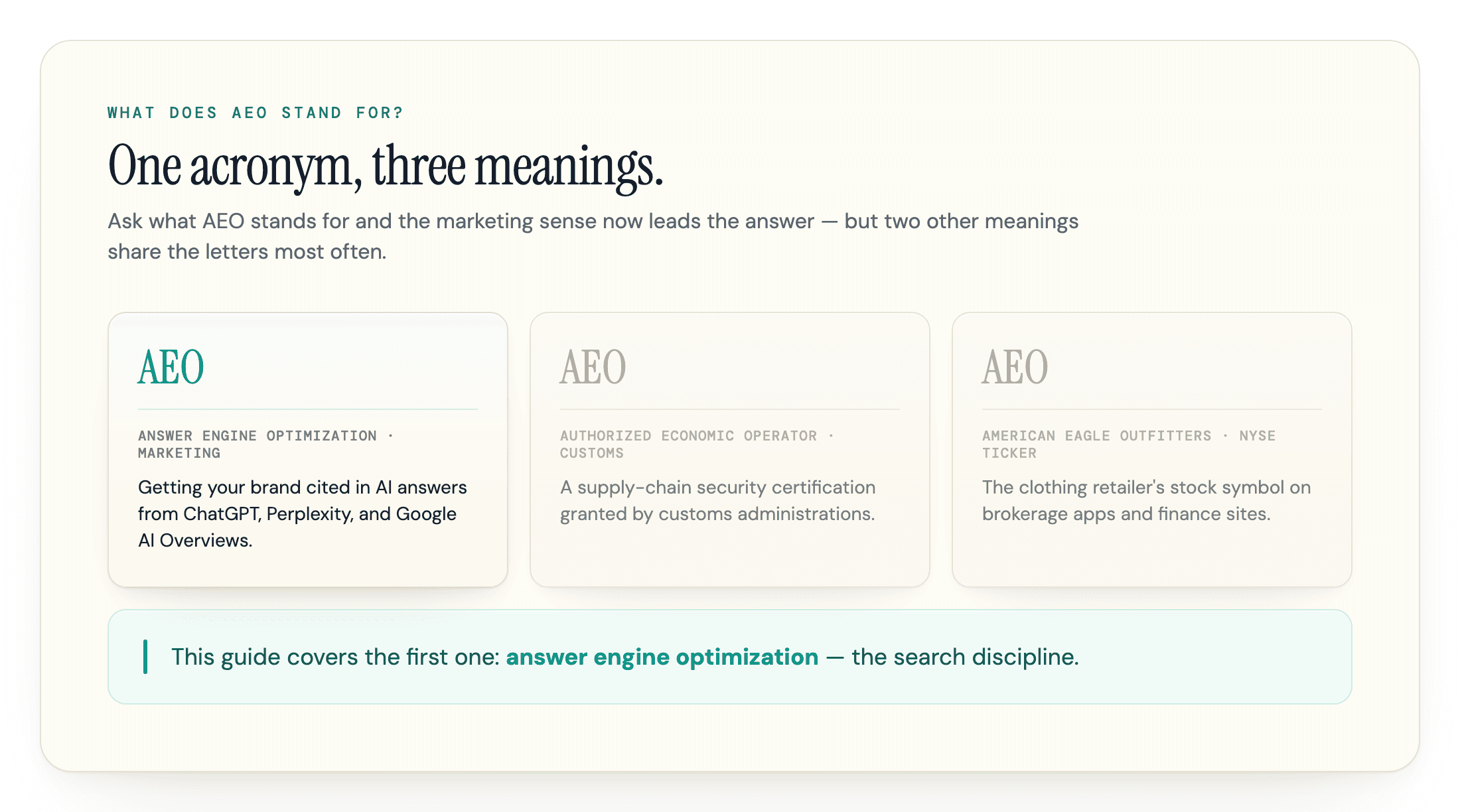
In marketing, AEO stands for answer engine optimization: the work of earning citations in AI-generated answers. When people ask what the acronym stands for, that is the sense Google's own AI answer now leads with.
Two other meanings share the letters most often, so a quick disambiguation saves confusion. In international trade, AEO is an Authorized Economic Operator, a customs certification for supply-chain businesses. On a stock ticker, AEO is American Eagle Outfitters. If you arrived here from a customs form or a brokerage app, this is the wrong AEO.
AEO vs SEO: What Actually Changes
SEO and AEO share most of their foundation. What changes is what counts as a win.
Traditional SEO earns a ranked position and the click that follows it. AEO earns a citation inside the answer, whether or not anyone clicks. In a zero-click search, the user reads the synthesized answer and stops. That is now the majority case: 68% of US Google searches in the first four months of 2026 ended without a click, per Similarweb panel data published by SparkToro in June 2026, up from the 60.45% SparkToro reported for 2024 using a different panel (Datos).
The pull is measurable: AI Overviews are associated with a 58% lower click-through rate for the top-ranking page, per Ahrefs' 2026 re-run of its study (the early-2025 version measured 34.5%; the gap widened). Real-user behavior agrees: Pew Research Center's analysis of 68,879 searches by 900 US adults (March 2025) found people clicked a traditional result on 8% of visits when an AI summary appeared, versus 15% without one. If your brand is named in the answer, you kept a claim on the value of the query. If it is not, you are invisible for it, even when you rank first in the links below.
| Dimension | Traditional SEO | Answer Engine Optimization (AEO) |
|---|---|---|
| What you optimize for | A ranked position in the link list | A citation inside the AI-written answer |
| Unit of success | The click | The mention, click or not |
| Content focus | Keywords, backlinks, metadata | Direct answers, factual claims, machine-readable structure |
| Main surfaces | Google and Bing results pages | ChatGPT, Perplexity, Google AI Overviews, Gemini, Copilot |
| How you measure | Rankings, organic traffic, click-through rate | Citations, AI-referred visits, branded search lift |
Two things follow from that split. First, AEO does not replace SEO; it extends it. Many cited pages still come from sites with real search authority, even as engines pull citations from a wider pool than the top 10. The authority and crawlability you built for Google are the raw material AEO works from.
Second, the scoreboard changes. Rankings and click-through still matter, but you add a new question: when an AI answers this, am I in the answer?
AEO vs GEO: Are They Different?
Short answer: not really. AEO, GEO, "AI SEO," and LLM SEO mostly name the same job from different angles. AEO grew out of the featured-snippet and voice-search era and leans toward concise, direct answers. Generative engine optimization (GEO) is the newer label for the same instinct aimed at engines that synthesize a fresh answer instead of excerpting one. The full breakdown of the four labels, with search volumes, lives in our GEO guide.
Here is the honest version. Do not let a vendor sell you AEO and GEO as two separate budgets. The underlying work is shared across all of them: reachable, clearly answered content backed by real authority. Pick whichever label your team already uses and move on.
The skepticism is fair, too. Spend time in SEO communities and you will find practitioners calling AEO a rebranded-SEO buzzword sold at a markup. They have a point about the term.
They are wrong about the behavior change underneath it. Google said at I/O in May 2026 that AI Overviews passed 2.5 billion monthly users and AI Mode passed 1 billion within a year of launch. The way people get answers is genuinely shifting toward synthesis, and that changes which pages earn value from a query, whatever you decide to call the response. Our state of AI search report tracks that shift surface by surface.
First, Can AI Engines Even Reach Your Page?
Most AEO advice jumps straight to formatting. It skips the step that decides whether any of that formatting will ever be seen: can the AI crawlers actually fetch your page?
An answer engine can only cite a page it can read. Three common problems quietly block that:
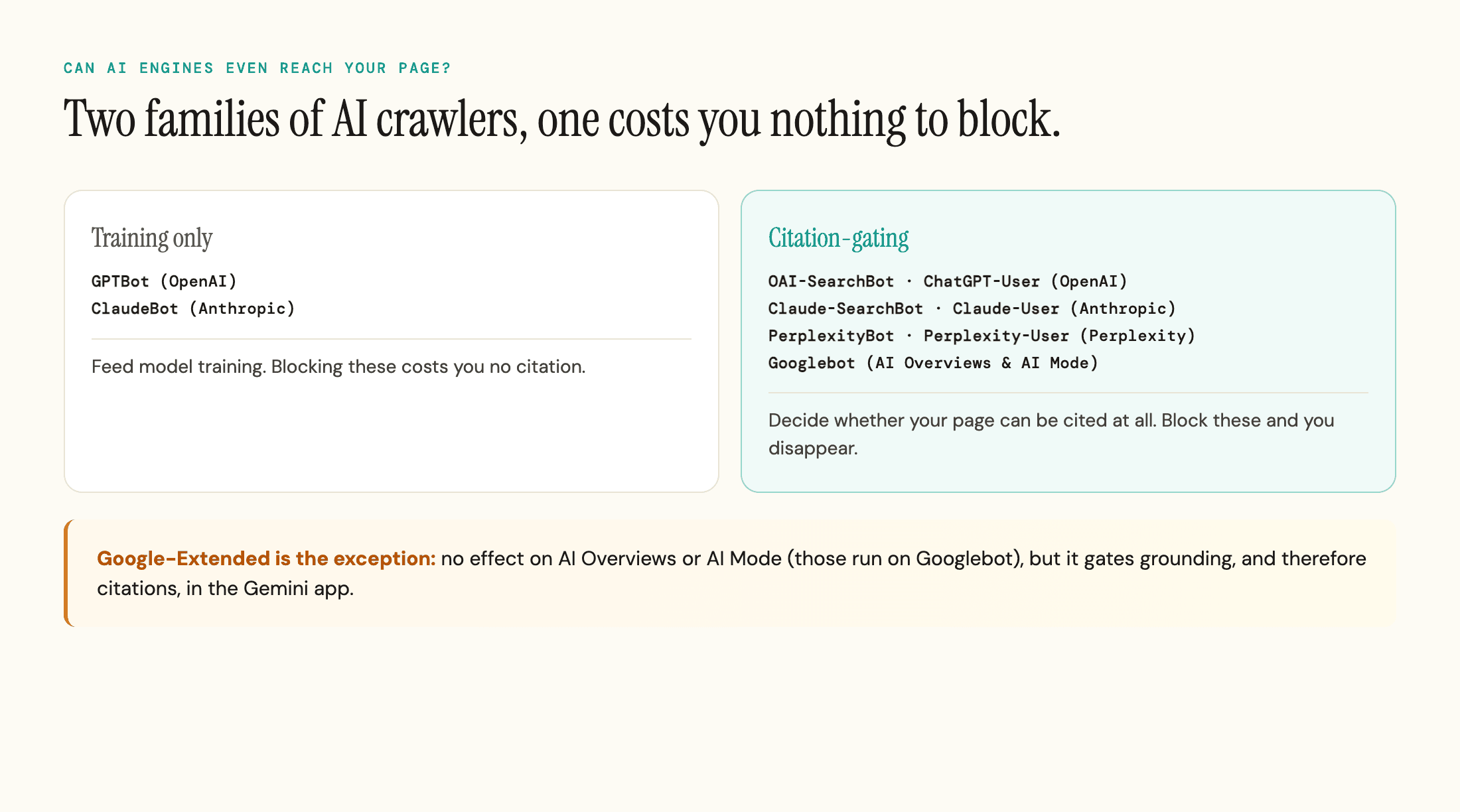
- robots.txt rules that disallow the crawlers that actually gate citations — OAI-SearchBot and ChatGPT-User (OpenAI), Claude-SearchBot and Claude-User (Anthropic), PerplexityBot and Perplexity-User (Perplexity), and Googlebot (AI Overviews and AI Mode) — often added by default or by a plugin nobody revisited. Blocking GPTBot or ClaudeBot does not cost you a citation: those two only feed model training, not the citation index. Google-Extended is the one to read carefully: it does not affect AI Overviews or AI Mode, which run on Googlebot, but Google states it also governs grounding in the Gemini app, so blocking it does cost you Gemini citations
- Bot-management and firewall rules (Cloudflare and similar) that challenge or block non-browser traffic, which can stop AI crawlers even when robots.txt allows them. We see this regularly in crawler scans: marketing blogs publishing AEO advice that are themselves unreachable to the crawlers they tell you to court
- JavaScript-only rendering, where the answer lives in client-side script and a crawler that does not execute JavaScript sees a nearly empty page
None of these surface in a normal content audit. You can write the best answer-first page on the web, and if PerplexityBot gets a 403, you will never be cited. This is the cheapest AEO win and the most overlooked, because clearing a robots rule or a firewall block can restore reachability in a day, before you change a word of copy. Our step-by-step AI search playbook runs the reachability checks in order.
How to Do AEO: What Gets You Cited
Once a page is reachable, AEO comes down to making it easy for a model to extract a trustworthy answer. Five practices do most of the work, and our AEO best practices checklist turns them into a page-by-page audit.
-
Answer first, then expand. Put a direct, self-contained answer in the first 30 to 60 words of the page or section, then add the supporting detail. Models lift that lead block almost verbatim. Bury the answer under three paragraphs of preamble and it gets skipped.
-
Write in questions. Use the actual question as an H2 or H3 and answer it immediately underneath. Question-shaped headings match how people prompt an AI, and they map cleanly onto the sub-questions an engine breaks a query into.
-
Make it machine-readable. Short paragraphs, clear subheadings, lists, and comparison tables give an engine clean blocks to pull from. A wall of text forces it to guess where the answer is. One caveat: structure helps extraction more than selection. A May 2026 study of 252,000 controlled citation trials across six models found formatting-only changes barely shifted which of two retrieved pages got cited, while topical relevance, fresh timestamps, and explicit price information did.
-
Add structured data. FAQ and HowTo schema label your questions and steps so engines parse them with less ambiguity. Treat it as helpful clarity, not a magic switch. Google states plainly there is no special markup required to appear in AI features, so schema supports good content; it does not substitute for it.
-
Build off-site authority. This is where AEO diverges most from traditional on-page SEO. Engines weigh how often and how credibly you are mentioned across sources they trust, especially Reddit, Wikipedia, YouTube, and established news and reference sites. A high Google domain rating does not guarantee citations; consistent, corroborated mentions are the stronger signal. A study from IIT Delhi and Princeton researchers found that adding citations, quotations, and statistics raised a source's visibility in generative answers by up to 40%. Recency matters too, so a visible "last updated" date and current facts help.
This is also where entity SEO earns its keep. The clearer the web is that your brand is a distinct, well-described entity, the more confidently an engine attaches your name to the topics you cover.
Does AEO Really Convert Better?
You will see one claim repeated across AEO content with great confidence: traffic from AI answers converts several times better than organic search. Treat it carefully, because the sourcing is thinner than the confidence suggests.
The numbers trace back to a handful of vendor reports, each citing itself or a single study:
- Semrush puts AI search visitors at 4.4x more valuable than organic, based on its own data
- A widely shared Forbes piece popularized a "9x better conversion" figure that traces to the author's own Cornell master's students' analysis, not a published study
- A third figure, a 4-to-5x premium from a 2026 Opollo benchmark of 312 IT-services firms, is again the vendor's own data rather than an independent study
The pattern is a single-source multiplier repeated until it sounds settled. And there is a real reason for caution beyond sourcing: most teams cannot measure this cleanly yet. AI assistants often pass no referrer, so "AI traffic" in your analytics is a small, identifiable slice rather than the full picture, and an unusually high conversion rate may just reflect that biased subset.
The realistic read: AI-referred visitors plausibly do convert well, because someone who clicks through after an AI recommends you arrives pre-qualified. But the exact multiplier is marketing, not measurement, and for most sites the volume is still small today. Build AEO for visibility and qualified demand, not because a "9x" number promises easy revenue.
How to Measure AEO
Because clicks are no longer the whole story, AEO measurement combines a few imperfect signals instead of one clean number.
- Prompt tracking. Pick the questions your customers actually ask, run them through ChatGPT, Perplexity, and Google's AI Overview on a schedule, and record whether you are mentioned and how. This is the most direct read on AEO, and you can start by hand before buying any tool.
- AI-referred traffic. In analytics, segment the visits that arrive from AI assistants. The volume undercounts reality because many assistants strip the referrer, but the trend over time is still useful.
- Branded search lift. When an AI names your brand, a share of those people search for you directly afterward. Rising branded queries in Search Console alongside flat or falling non-branded clicks is a fingerprint of AI-driven demand.
- Citation share. For a set of target questions, track how often you appear versus competitors with an AI rank tracker. This is the signal AI visibility tools like geotoolbox roll into a 0-to-100 score. Any tracker's number, ours included, samples a probabilistic system, so weight the trend over the point score.
- The platforms' own reports. Two arrived in 2026, both free and both partial. Search Console's generative AI performance report (June 2026, rolled out to all websites worldwide as of August 31, 2026) counts your impressions in AI Overviews and AI Mode, nothing more yet. Microsoft's Clarity Citations (generally available May 2026) shows which pages Copilot and Bing's AI answers cite and the grounding queries that retrieved them. Each covers only its own engine, so treat them as windows, not the scoreboard.
One thing to watch while you measure: whether the engines describe you correctly. AI models will confidently state wrong facts about a brand, and a citation that misrepresents you is worse than none. Our guide to AI hallucinations about your brand covers how to find and correct them.
Frequently Asked Questions
Is AEO the same as SEO?
No, but the same team can run both. The genuinely new work is small: answer-first formatting, crawler-access checks for AI bots, and prompt-level tracking. What an SEO-only program misses is the scoreboard, because nothing in a rankings report tells you whether AI engines mention you at all.
Is AEO better than SEO?
Neither is better; they target different surfaces. SEO still drives the bulk of measurable traffic for most sites today, while AEO captures visibility in AI answers that SEO alone misses.
What is the difference between AEO and GEO?
Mostly the audience for the word. If your stakeholders talk about featured snippets and voice search, say AEO; if they talk about ChatGPT and AI search, say GEO. The task list and the budget should be one program either way.
Do I need AEO if I already do SEO?
Run a quick test: ask ChatGPT, Perplexity, and Google's AI Overview the five questions that drive your revenue. If AI answers come back and you are not named in them, you need AEO now. If those queries still return plain link lists, you have runway, but recheck quarterly because coverage expands without notice.
How much does AEO cost?
For most teams, AEO is reallocated effort rather than new budget. The work is restructuring pages you already have, fixing crawler access, and earning mentions, which is SEO-team labor. Baseline measurement is free where you have access: Search Console's generative AI performance report (available to all sites worldwide since August 31, 2026), Microsoft Clarity Citations, and manual prompt checks cost nothing but time. Paid trackers only earn their fee once you have enough pages competing for citations to need scheduled monitoring. Be skeptical of agencies quoting AEO as a separate retainer on top of SEO; the deliverables overlap almost entirely.
What is an example of answer engine optimization?
A page that opens a section with a direct 40-word answer to "what is answer engine optimization," uses the question itself as the heading, backs the answer with a cited statistic, and stays reachable to OAI-SearchBot and PerplexityBot. When someone asks an AI that question, the page is easy to quote, so it gets cited. This article is built that way on purpose.
Where to Start
AEO is not a new discipline to fear or a buzzword to dismiss. It is search work pointed at a surface that now writes the answer instead of listing links. Most teams have not started it either: in an Acquia-commissioned Researchscape survey of 500-plus US and UK marketers (September 2025), 62% had watched search clicks decline, yet only 20% had begun implementing an AEO strategy. The brands that get cited are the reachable, clear, well-sourced ones, not the ones with the biggest tool budget. When you do reach for software, our rundown of the best AEO tools by job sorts them by the task each one actually does.
Work in that order. Confirm AI crawlers can reach your key pages, restructure those pages to answer first, earn honest mentions on the sources engines trust, then track whether the citations actually show up. The first step is the cheapest and the easiest to get wrong: geotoolbox's free AI-Readiness Score checks whether the crawler-access foundations are in place, and the Content Analyzer grades how citable the page is. Fix what it flags, then work down the list.
Sources
- GEO: Generative Engine Optimization - Aggarwal et al. (IIT Delhi + Princeton), KDD 2024 -
arxiv.org/abs/2311.09735 - AI features and your website - Google Search Central -
developers.google.com/search/docs/appearance/ai-features - What Is Answer Engine Optimization? And How to Do It - Semrush (data citation) -
semrush.com/blog/answer-engine-optimization - AI Overviews reduce clicks: 2026 update - Ahrefs, 2026 (data citation) -
ahrefs.com/blog/ai-overviews-reduce-clicks-update - Answer Engine Optimization, What Brands Need To Know - Lutz Finger, Forbes, 2025 -
forbes.com/sites/lutzfinger/2025/06/19/answer-engine-optimization-aeo--what-brands-need-to-know - Google users are less likely to click on links when an AI summary appears in the results - Pew Research Center, July 2025 (March 2025 data) -
pewresearch.org/short-reads/2025/07/22/google-users-are-less-likely-to-click-on-links-when-an-ai-summary-appears-in-the-results - In 2026, Less than One Third of Google Searches Still Send a Click - SparkToro / Similarweb panel, June 2026 -
sparktoro.com/blog/in-2026-less-than-one-third-of-google-searches-still-send-a-click - Google I/O 2026 keynote - Google, May 2026 (AI Overviews and AI Mode user counts) -
blog.google/innovation-and-ai/sundar-pichai-io-2026 - What Gets Cited: Competitive GEO in AI Answer Engines - Vishwakarma et al., arXiv, May 2026 -
arxiv.org/abs/2605.25517 - AEO vs SEO: Transforming Digital Strategy for AI Answers - Acquia / Researchscape survey, September 2025 -
acquia.com/blog/why-answer-engine-optimization-aeo-next-big-thing-digital-strategy-and-why-most-brands-arent - The 2026 AI Search Benchmark Report - Opollo, February 2026 (vendor data) -
opollo.com/blog/the-2026-ai-search-benchmark-report