
AI search isn't one thing. ChatGPT, Perplexity, Gemini, Claude, and Google AI Overviews each handle your query differently. But the core process they share is the same: read the question, search the web, pick the good sources, write a grounded answer with citations. For where all of this stands in 2026, across every engine, see our state of AI search field report.
AI Search vs. Traditional Search: The Real Difference
Traditional Google ranks ten links and you click. AI search reads your question, pulls from many sources at once, and writes one answer with a few cited URLs underneath.
The behavior shift on the user side is just as big. AI search queries run several times longer than the three-or-four-word phrases people type into classic Google. People type to AI the way they'd ask a colleague. Full sentences, context, follow-ups. That single change reshapes what the engine has to do under the hood.
One quick disambiguation. If you searched "how does AI search work" and landed on Microsoft or Cloudflare documentation, you saw something different. Those pages describe Azure AI Search or Cloudflare AI Search, which are vector database products that companies use to add semantic search inside their own apps. Important tech, totally different topic. Here we mean the consumer-facing AI search engines that answer questions for end users: ChatGPT search, Perplexity, Google AI Overviews, Gemini, Claude, and Microsoft Copilot. If you are deciding which of them to actually use, we rank and compare the best AI search engines by use case.
The 4 Steps Every AI Search Engine Runs
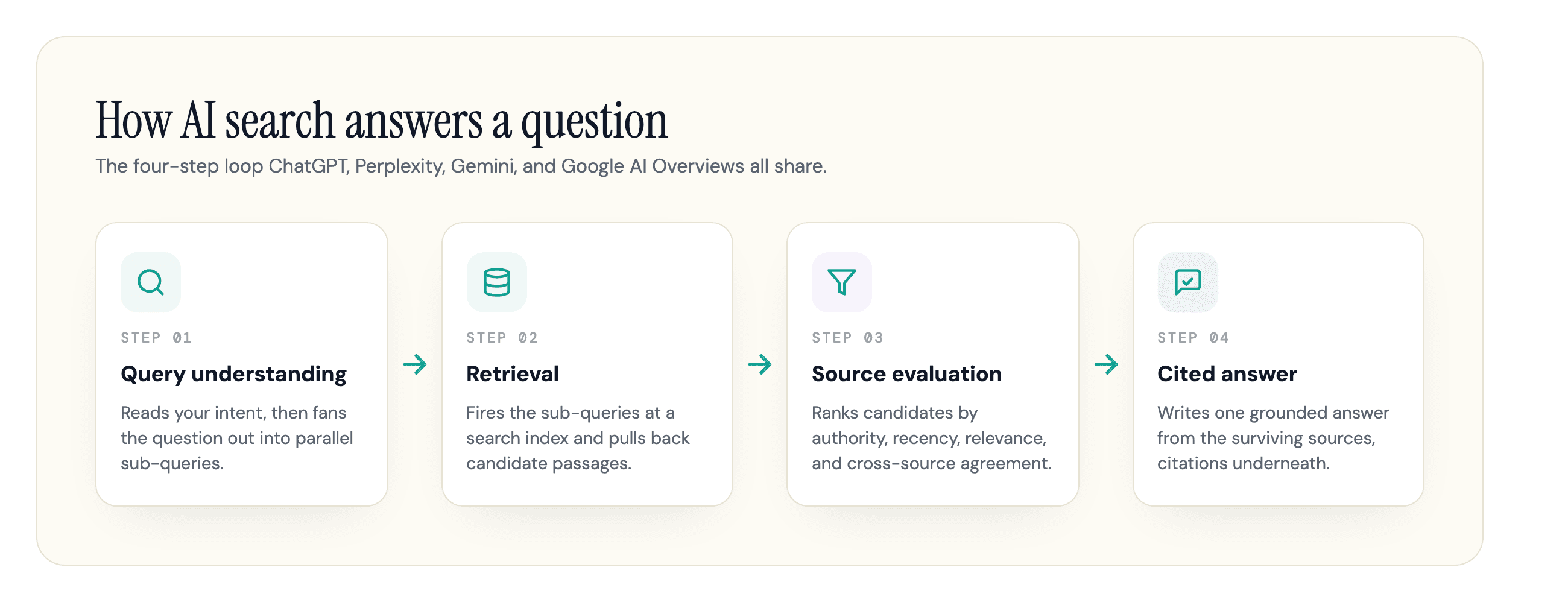
Almost every engine in this space runs the same four-step loop. The implementations vary. The shape doesn't.
-
Query understanding. The model reads your question and figures out intent, then expands it. Synonyms, related concepts, and what Google calls query fan-out: breaking a complex question into smaller parallel sub-queries. Ask for "a 5-day trip to Japan" and the engine simultaneously searches for hotels in Tokyo, weather in Kyoto, train passes, and a dozen other angles you didn't type.
-
Retrieval. The engine fires those sub-queries against a search index, matching them against chunked passages of indexed pages rather than whole documents. Sometimes that's a partner index like Bing (in ChatGPT's case). Sometimes it's a SERP API. Sometimes it's a proprietary cached crawl. The output is a candidate pool of documents per sub-query, typically a few dozen.
-
Source evaluation. This is the step most explainers gloss over. The system ranks candidates by authority, recency, relevance, and cross-source agreement. A claim that shows up in three independent sources beats one that appears in one. The engines don't publish how they score this, but observed citation behavior suggests a domain they have cited before beats a brand-new domain on the same topic.
-
Generation with citation. The model takes the surviving sources, fills its context window with their text, and generates an answer grounded in that text. The links it shows below the answer are visible citations, though not a perfect provenance trace. This whole pattern has a name: Retrieval-Augmented Generation, or RAG, and it is worth understanding what RAG is and how to be the page it retrieves.
How ChatGPT Search Works (Bing-Rooted)
ChatGPT's web search was built on Bing's index and still leans on it, with OpenAI increasingly blending its own crawl and ranking on top. That blend is shifting fast: OpenAI's crawl of the web roughly tripled between August 2025 and March 2026, per a Botify analysis of about 7 billion server log files published in April 2026. When you trigger a search inside ChatGPT, the model issues queries against that blended index, pulls back results, evaluates them, and writes an answer (for what it then cites, and why it cites only some of it, see how ChatGPT cites sources). We break that retrieval loop down in how ChatGPT search works.
OpenAI now documents four crawlers, and the three that matter for search visibility have separate jobs. OAI-SearchBot builds the index behind ChatGPT search. ChatGPT-User fetches a specific page in real time when a user's question points to it. GPTBot collects training data, a separate use case (newer ChatGPT models will know what was on your site at training time, but live answers run through the search and fetch bots). The fourth, OAI-AdsBot, checks pages submitted as ChatGPT ads and has nothing to do with organic visibility. The bot user agents matter because if your site blocks the search or fetch bots in robots.txt or via a WAF (web application firewall) rule, you're invisible to that engine.
The practical implication: covering Bing helps, since ChatGPT search uses Bing as one of its third-party providers — submit your sitemap to Bing Webmaster Tools and resolve coverage issues there — but ChatGPT search also blends OpenAI's own crawl, so don't treat Bing as the whole index.
How Perplexity Works (Sonar and Context-Window Saturation)
Perplexity calls itself an answer engine, not a search engine, and the architecture reflects that distinction. Its in-house answer model is named Sonar, built on Meta's Llama 3.3, per Perplexity's own announcement. Retrieval runs on Perplexity's own index, crawled by PerplexityBot. Perplexity Pro lets users swap in backend models from OpenAI, Anthropic, and Google.
Perplexity appears to ground answers aggressively in retrieved text, but the exact candidate pool, ranking, and context assembly are proprietary. That contrasts with ChatGPT's broader assistant experience, where web retrieval is one product layer among others — a distinction ChatGPT vs Perplexity breaks down for visibility.
Perplexity also leans hard on Reddit. Citation tracking from Profound, an AI-visibility vendor, has shown Reddit as the #1 most-cited domain in Perplexity answers in their 2025 analysis, ahead of every other source in that dataset. One caveat on that pipeline: Reddit sued Perplexity in October 2025 over scraped data, and unlike Google and OpenAI, Perplexity holds no Reddit licensing deal, so Reddit's weight in Perplexity answers may shift while the case plays out. Either way, if your category has active Reddit discussions and your brand isn't in them, you're handing competitors a free lane.
How Google AI Overviews Work
AI Overviews are the boxed answers that appear at the top of Google search results for a growing share of queries. They run on Gemini and pull from Google's main index, not from a separate AI-specific crawl.
That last detail is what makes them different from every other engine in this list. AI Overviews draw citations from pages Google's systems already trust, but the overlap with classic rankings is loosening fast: Ahrefs measured only 38% of AI Overview citations ranking in the organic top 10 for the same query in March 2026, down from about 76% in July 2025, a shift Ahrefs ties partly to Google pulling sources from related fan-out queries. Classic SEO fundamentals (helpful content, sound technical setup, real authority signals) still carry real weight, just not through a simple rank-first-get-cited pipeline.
Google's separate AI Mode (the standalone conversational interface) behaves more like ChatGPT and Perplexity. One SEO analysis of AI Mode citations (SE Ranking, June 2025, 10,000 keywords) found only about 14% of cited URLs ranked in the visible Google top 10, so the citation pool is wider than what classic SERPs reveal (see Google AI Mode SEO for how to optimize for it).
The token to know here is Google-Extended. It's not a crawler; it's a robots.txt control that governs whether your content can be used to train and ground Google's Gemini models. AI Overviews are a Search feature fed by regular Googlebot, so blocking Google-Extended does not opt you out of them. The only exit from AI Overviews is the standard Search controls, with the Search-visibility cost those carry.
How Claude, Gemini, and Copilot Handle Search
Claude added live web search a few months after ChatGPT, and the implementation is closer to ChatGPT's pattern: pull from a search backend, evaluate, generate with citations. That backend is Brave Search: Anthropic has never announced the partnership, but its own subprocessor list names Brave for web search, and in a March 2025 spot check Profound measured an 86.7 percent overlap (13 of 15 test results) between Claude's cited results and Brave's top non-sponsored results. The crawlers to know are Claude-SearchBot, which indexes pages for Claude's web search, and Claude-User, which fetches a page when a user's question points to it. ClaudeBot is the training crawler. (Older guides mention anthropic-ai or Claude-Web; those are legacy names Anthropic no longer uses.) The same training, search, and user-fetch split OpenAI runs.
Gemini grounds answers through Google Search when the model decides external data is needed. Inside the Gemini chat app, that grounding is what powers the "Show sources" feature. If you're optimizing for Gemini, you're effectively optimizing for the Google index it grounds against.
Microsoft Copilot is the simplest of the bunch. It's a thin layer on top of Bing's regular search results, with answer generation by OpenAI models plus Microsoft's own MAI models, which Microsoft announced in August 2025 it was rolling into certain Copilot text use cases. If you're indexed and ranking in Bing, you're a candidate for citation in Copilot.
Here's the whole field in one view:
| Engine | Draws from | Search / fetch bots | Training opt-out |
|---|---|---|---|
| ChatGPT search | Bing index + OpenAI's own crawl | OAI-SearchBot, ChatGPT-User | GPTBot |
| Perplexity | Perplexity's own index | PerplexityBot, Perplexity-User | Not used for model training |
| Google AI Overviews / AI Mode | Google's main index | Googlebot | Google-Extended (Gemini training only) |
| Gemini | Google Search grounding | Googlebot | Google-Extended |
| Claude | Brave Search + Anthropic's own crawl | Claude-SearchBot, Claude-User | ClaudeBot |
| Microsoft Copilot | Bing index | Bingbot | n/a |
What This Means If You Want to Get Cited
Three things matter, and they're all downstream of the four-step loop above.
Be reachable. Most "we're not showing up in AI" problems are simpler than people think. The bot can't reach the page. A robots.txt rule blocks GPTBot. A Cloudflare or DataDome rule rate-limits OAI-SearchBot. A JS-only render delivers a blank shell to a crawler that doesn't execute JavaScript. That last one is measured, not theoretical: a Vercel and MERJ crawler study from December 2024 found that none of the major AI crawlers rendered JavaScript, in a month of traffic on Vercel's own network that included 569 million GPTBot fetches. The main exception is Google: Gemini and AI Overviews ride Googlebot, which does render JavaScript. If the bots can't fetch your pages, every other tactic is wasted effort. This is the gap GEO Toolbox's free AI Crawler Checker was built to surface: it reads your robots.txt and shows which of 34 documented AI crawlers you allow or block, down to the exact line doing the blocking. One honest caveat: reachability is a floor, not a ranking lever. An unblocked bot still has to choose to cite you. A blocked one never will.
Be a clear answer to a clear question. AI search tends to favor clear, direct answers; structured data helps Google/Bing understanding and feature eligibility, but it is not publicly proven as a direct ChatGPT/Perplexity citation lever. Present claims in a format the model can lift (short paragraphs, tables, bulleted definitions). This is the craft of writing pages that LLMs cite. If your top-of-page is brand storytelling and the answer is buried in section four, you'll lose to a competitor who put the answer up top.
Build authority signals across sources. RAG evaluation rewards cross-source consistency. Cross-source agreement may help, especially in systems that compare sources, but treat it as a plausible correlative authority signal rather than a guaranteed ranking rule. A claim on your site, in a Reddit thread, in a YouTube transcript, and in a third-party listicle is better-positioned than the same claim on your site alone. Treat off-site presence (Reddit, Quora, podcast transcripts, expert directories) as part of your visibility stack, not a separate channel.
Frequently Asked Questions
Is AI search the same as Azure AI Search?
No. Azure AI Search and similar products (Cloudflare AI Search, Elasticsearch with vector extensions) are infrastructure tools that companies use to add semantic search inside their own applications. AI search engines like ChatGPT, Perplexity, and Google AI Overviews are user-facing products that answer questions from the open web. They share underlying techniques (embeddings, RAG, semantic matching) but solve different problems.
Does traditional SEO still matter for AI search?
Yes, though the tie is loosening: by Ahrefs' March 2026 measurement, only about 38% of Google AI Overview citations ranked in the organic top 10 for the same query, down from 76% in mid-2025. ChatGPT search leans on Bing's index, so being well-indexed in Bing is a direct lever. Even Perplexity (which uses its own retrieval) factors in authority signals that overlap with classic SEO: backlinks, domain credibility, content quality. SEO isn't sufficient on its own anymore, but it's still necessary.
Do AI search engines crawl pages live or rely on a cached index?
It depends on the engine and the action. Live search queries (ChatGPT search, Perplexity, Claude with web search) hit a search index or SERP API in real time when you ask a question. Training-data crawls (GPTBot, ClaudeBot, CCBot) happen on a separate schedule and feed the model weights; Google-Extended is a robots.txt control rather than a crawler, with Google's existing bots doing the fetching. If you want to manage either, robots.txt and your WAF are the levers, with one caveat: the user-triggered fetchers sit partly outside robots.txt. OpenAI says robots.txt rules "may not apply" to ChatGPT-User, and Perplexity says Perplexity-User "generally ignores" them, so a WAF rule is the firmer block. A page can be reachable to one and blocked to the other.
Why do AI engines cite Reddit so much?
Because Reddit is dense with people explaining things to each other in plain language, with cross-validation from other commenters. That format is almost ideal for RAG: short, declarative, cross-referenced, often with concrete examples. The same vendor citation data that has put Reddit first in Perplexity ranks it in the top three across ChatGPT, Grok, and Google AI Overviews. For brands, the implication is that being present in active Reddit threads (helpfully, not promotionally) is a high-value citation play.
Where to Go from Here
The reason the four-step loop matters to you is that step 2 (retrieval) can fail silently. If OAI-SearchBot or Claude-SearchBot can't reach your page, none of the rest of the loop runs.
If you're not sure your site is reachable to the bots that matter, run a free AI crawler check with GEO Toolbox and see which of 34 documented AI crawlers your robots.txt allows or blocks today. It's the cheapest part of the AI visibility stack to verify, and the easiest to get wrong without noticing.