
Your brand has a rank in Google. In AI search it has something stranger: a presence that flickers on and off depending on the engine, the prompt, and the day. An AI rank tracker is how you measure that moving target across ChatGPT, Perplexity, Gemini, and Google's AI Overviews. The hard part is knowing what a tracker can honestly tell you, because a single AI rank position is mostly a fiction, and the number that actually matters is the one most tools bury.
What an AI Rank Tracker Actually Does
An AI rank tracker monitors whether AI engines name your brand when they answer questions in your category, and how that changes over time. The word "rank" is borrowed from SEO, but the job is different: instead of a position on a results page, you are tracking presence and prominence inside generated answers across ChatGPT, Perplexity, Gemini, and Google's AI Overviews.
This matters now because the answer is increasingly where the decision happens, not the link list below it. Links inside AI summaries get clicked on just 1% of visits, per Pew Research, and the presence of a summary nearly halves clicks on the traditional results beneath it. If buyers are reading answers instead of clicking, being named in those answers is the visibility that counts, and you need a way to measure it.
A good tracker reports three things, per engine and over time: whether you are mentioned, whether you are cited as a source, and your share of voice against named competitors. The general discipline of measuring AI visibility applies across all of this. An AI rank tracker is the automated, multi-engine version: run a fixed set of prompts on a schedule, log who shows up, and watch the trend.
The catch is in the word "rank." Treat it as a position and you will chase a number that does not hold still. Treat it as a tracked distribution and it becomes one of the more useful signals you have.
Why "AI Rank" Isn't a Real Position
There is no position one through ten in an AI answer. An engine either names your brand or it does not, and which brands it names changes from one run to the next. So a tracker that hands you a single "AI rank" is reporting a snapshot of something that moves while you look at it.
This is not a tooling flaw; it is how the models work. A study testing five large language models across eight tasks and ten runs each found accuracy varying by up to 15% between runs, with a gap of up to 70% between the best and worst output, even with settings meant to make results repeatable. None of the models reliably reproduced identical output. If the answer text itself is not stable, the brand list inside it certainly is not.
The brand-level evidence is just as blunt. When SparkToro had 600 volunteers run 12 prompts 2,961 times, ChatGPT and Google's AI returned the same brand list less than 1 time in 100, and the same order closer to 1 in 1,000, with Claude only slightly steadier. Independent reporting of the study reached the same figures. What you can measure reliably is the pattern across many runs.
The Honest Metric: Share of Voice Across Many Runs
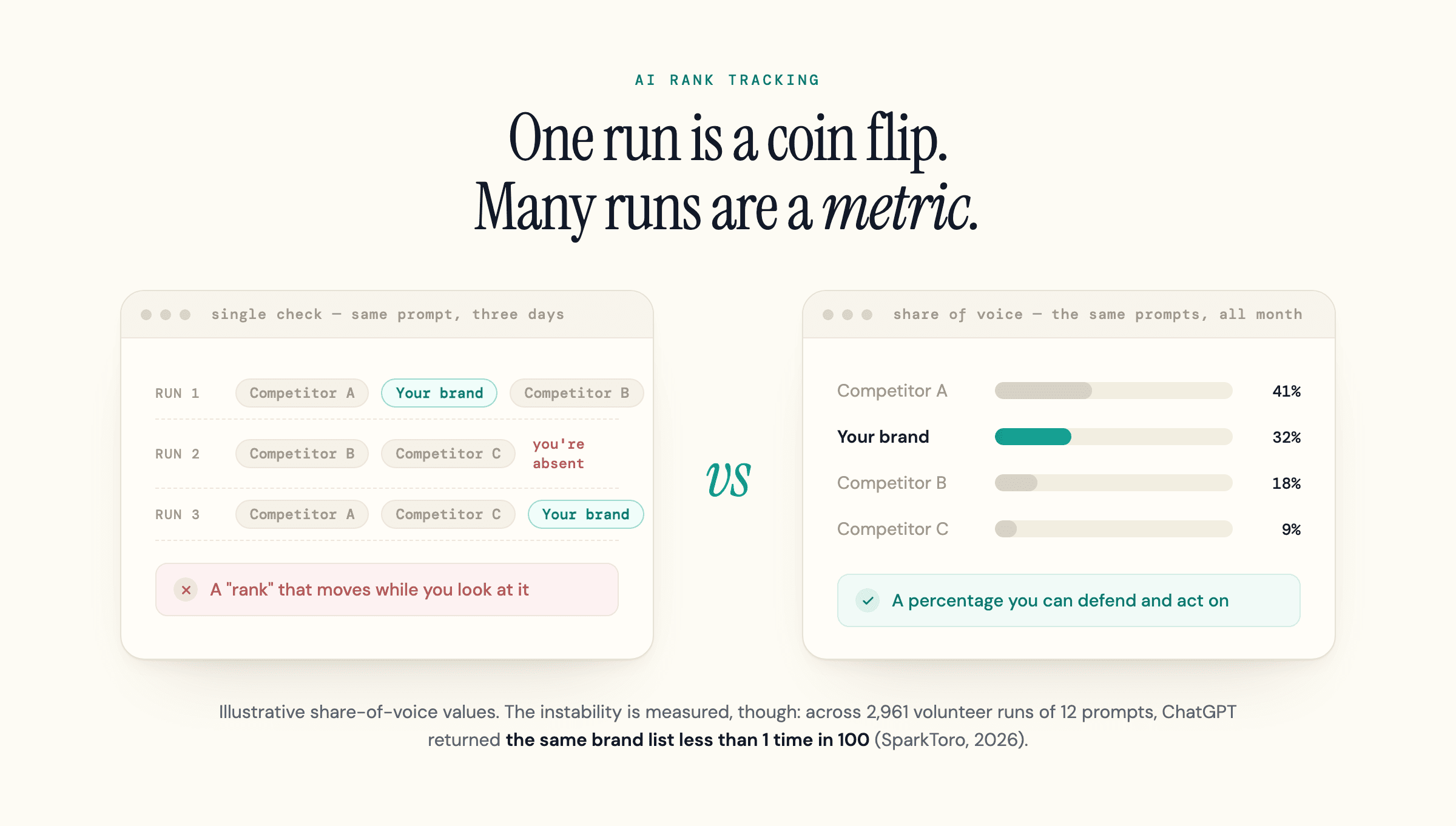
If a single rank is unreliable, the metric that survives is share of voice: across a fixed set of prompts run many times, how often does your brand appear as a fraction of all brand mentions. One run is a coin flip. A hundred runs is a stable percentage you can trend. The step-by-step version of that sampling is in our guide to tracking brand mentions in AI search.
That reframes what a tracker is for. It is not telling you "you rank third." It is telling you "you appear in 32% of answers for these prompts this month, up from 24% last month, while your top competitor sits at 41%." That is a number you can defend and act on.
Two design choices decide whether the number means anything. The first is sample size: the prompt set has to be re-run enough times to smooth out the run-to-run noise, not checked once. The second, and the one most people underestimate, is the prompt set itself. Your visibility percentage is entirely a function of which questions you test. Choose 20 prompts that flatter your brand and you will look dominant. Choose the 20 a real buyer would actually ask, grounded in your real search demand, and you get a number that reflects reality.
What counts as a "good" share of voice depends on your category and prompt set; our share of voice guide covers benchmarks. Absolute numbers across tools are not comparable.
Why Two AI Rank Trackers Disagree
Run the same brand through two AI rank trackers and you can get wildly different scores: one says 40% visibility, the next says 12%. Neither is lying. They are measuring different things and calling them the same word.
Four variables drive the gap:
- They test different prompt sets, so they are answering different questions
- They sample at different depths, so one has averaged out the noise the other is still showing
- They cover different engines and model versions, and the same brand can be strong in Perplexity and weak in Gemini
- Every one is a modeled estimate, because none of these tools sees your real users' prompts; they all run controlled questions and infer your standing
Layer that on top of run-to-run instability and the disagreement is expected, not surprising. The SparkToro data showed the same engine returns different brand lists run to run, so two tools sampling at different times and depths will naturally land on different numbers.
The practical rule that follows: pick one tracker and stay with it. Consistency of method matters more than the absolute number, because the signal you care about is the trend, and only one tool's trend is internally comparable. Switching tools resets your baseline to zero.
Track Each Engine Separately
AI search is not one channel, and a single blended "AI visibility" score hides more than it shows. ChatGPT, Perplexity, Gemini, and Google's AI Overviews each pick sources their own way and pull from sharply different parts of the web, so a brand can dominate one and be absent from another. Our ChatGPT vs Perplexity comparison breaks down that divergence for the two biggest engines. Averaging them into one number tells you nothing about where to act.
So track per engine, then read each against how that engine actually chooses sources. The mechanics differ enough that the fixes differ too: getting cited in ChatGPT leans on its search partner and crawler access, while Perplexity rewards a different source structure, xAI's Grok leans on the X firehose enough to need its own Grok rank tracker approach, Claude decides for itself whether to search the web at all and so needs its own Claude rank tracker approach, and tracking Google's AI Overviews has enough quirks to get its own AI Overview tracker guide.
Google is the one engine with a partial native option here. As of June 2026 it introduced Generative AI performance reports in Search Console, which surface impressions, pages, countries, devices, and dates for AI Overviews and AI Mode; the rollout started with a subset of properties and, as of August 31, 2026, covers all properties worldwide. It is real first-party data, but limited: it does not break out clicks or the queries that triggered those answers, and it covers only Google's own surfaces, not ChatGPT or Perplexity. Treat it as a useful sanity check on Google, not a replacement for cross-engine tracking.
A useful tracker breaks the score out by engine and lets you set the engine weighting to match your audience. If your buyers live in Perplexity, a Gemini dip should not drag your headline number around. Weight what matters, watch each engine's trend on its own, and treat a drop in one as a specific, fixable event rather than a blip in an average.
The Blind Spot No Rank Tracker Will Explain
A tracker can tell you your share of voice is near zero. It cannot tell you the reason is that the AI never managed to read your page. That is the most common cause of a flat line, and it is invisible in every citation report.
The mechanism is the same across engines. AI answers are built from web content the engine can actually fetch and parse. Google states that its AI features surface links from the web with no special requirements to appear, and the other engines depend on their own crawlers reaching your pages. If GPTBot, ClaudeBot, PerplexityBot, or Googlebot cannot get a clean copy of the page, you are not low in the rankings, you are absent from the source pool entirely.
Two failures cause most of it, and neither shows up in a rank tracker. The first is rendering: if your content only appears after JavaScript the crawler does not execute, the bot indexes an empty shell. The second is access: a firewall or bot-management rule that quietly returns a 403 or a challenge to non-browser traffic, so every human sees the page and every AI crawler is turned away. In the scans we run, reachability is the most common cause of a flat zero, and no amount of tracking or rewriting fixes a page the crawler never sees.
So before you read too much into a low score, confirm the AI can reach the page. geotoolbox's free Agent Readiness scan checks whether AI crawlers can fetch and render your pages, which is the one input a rank tracker assumes and never verifies.
AI Rank Tracker vs Traditional Rank Tracker
If you come from SEO, it helps to see exactly where the old mental model breaks. A traditional rank tracker and an AI rank tracker answer different questions, and treating the second like the first is the most common mistake. Both still have a place: if your classic tracking needs Bing as well as Google, our Bing rank tracker comparison covers which tools document Bing tracking.
| Dimension | Traditional rank tracker | AI rank tracker |
|---|---|---|
| What it measures | Your URL's position on the results page | Whether your brand is named or cited in the answer |
| The unit | A position, 1 to 100 | A presence rate and share of voice, 0 to 100% |
| Stability | Largely stable day to day | Non-deterministic; varies run to run |
| How to read it | A single position is meaningful | Only a distribution across many runs is meaningful |
| Surface | One search engine at a time, usually Google | Many engines, each tracked separately |
| Prerequisite | Page indexed | Page fetchable and renderable by AI crawlers |
The row that trips people up is stability. SEO teams are used to a rank that holds, so they read a single AI check as a real position and panic or celebrate over noise.
Choosing an AI Rank Tracker
Whether you need a paid tracker at all depends on scale. A small prompt set checked monthly can be run by hand in a spreadsheet. You cross into tool territory when you need hundreds of prompts, multiple engines, daily readings, or automated competitor share of voice, which is also the point where doing it manually costs more than the subscription. Agencies and multi-brand teams hit that line first, usually because they need a defensible number to report to clients.
When you do evaluate tools, five questions separate a real tracker from a dashboard:
- Does it cover the engines your buyers use, and report each one separately rather than as one blended score?
- How many times does it run each prompt? Once is noise. Look for repeated sampling and an average, not a single daily call.
- Does it track competitor share of voice, not just your own presence?
- Can you control the prompt set, so the number reflects real buyer questions instead of vendor defaults?
- Does anything verify reachability, or does it silently report zero when the real problem is a blocked crawler?
That last question is the one almost no tracker answers. And since geotoolbox sells one of these trackers, apply the same five questions to us: our scheduled scans run weekly on most tiers, so treat any single week's reading as one sample in the trend, not a position.
The budget spread is wide. As of July 2026, dedicated trackers start as low as $29 per month for Otterly.ai's entry plan and climb to $250 per month for Scrunch AI's Core plan or $295 per month for AthenaHQ, with enterprise tiers custom-priced above that. The category is also consolidating: Profound raised a $180 million Series D at a $1.8 billion valuation in September 2026, less than seven months after its $96 million Series C, Adobe completed its $1.9 billion acquisition of Semrush in April 2026, and Sitecore acquired Scrunch in June 2026. Expect packaging and pricing to keep shifting, which is one more reason to pick a tool and judge it by its own trend.
For a side-by-side of the actual tools, from free graders to enterprise platforms, our rundown of generative engine optimization (GEO) tools compares them by capability and price. Whichever you pick, the score is only as honest as the prompts and the sampling behind it.
Frequently Asked Questions
What is an AI rank tracker?
A monitoring tool for brand presence in AI answers. Despite the name, the better mental model is a polling operation: it samples the engines repeatedly and reports the distribution, the way a pollster reports vote share rather than a single voter's answer.
Is there a position 1 to 10 in AI search?
No, and that has a budgeting consequence: there is no "position 2 strategy" worth funding in AI search. Spend that effort widening the set of prompts where you appear at all, since appearing anywhere in the answer is the entire prize.
Can I track my AI rank for free?
Yes, for a small prompt set. Run your target questions in a clean session, log whether each engine names you, and repeat on a schedule. A month of hand-tracking also teaches you which prompts matter, which makes any tool you adopt later far better configured.
How long before a trend is trustworthy?
Give it at least four to six weekly readings before acting. Two data points cannot distinguish trend from noise in a system where the same prompt changes answers run to run; a quarter of consistent direction can.
Where to Start
Pick the questions your buyers actually ask, run them across the engines that matter to you, and log who gets named, including your competitors. Track each engine on its own, and pick one tool so your baseline stays comparable.
Then check the input every tracker takes for granted: whether the AI can read your pages at all. A zero share of voice caused by a blocked or unrendered page looks identical to weak content in a rank report, and only one of those is fixed by writing. geotoolbox's free Agent Readiness scan checks whether AI crawlers can fetch and render your pages, and the Content Analyzer grades how citable they are. Start there, then build your tracking on pages you know the engines can actually see.
Sources
- Non-Determinism of "Deterministic" LLM Settings - Atil et al., arXiv, 2024 -
arxiv.org/abs/2408.04667 - AIs are highly inconsistent when recommending brands or products - SparkToro, 2026 (12 prompts run 2,961 times) -
sparktoro.com/blog/new-research-ais-are-highly-inconsistent-when-recommending-brands-or-products-marketers-should-take-care-when-tracking-ai-visibility - AI recommendation lists repeat less than 1% of the time: Study - Search Engine Land, 2026 -
searchengineland.com/ai-recommendation-lists-rarely-repeat-study-468076 - AI features and your website - Google Search Central -
developers.google.com/search/docs/appearance/ai-features - Introducing Search Generative AI performance reports in Search Console - Google Search Central, June 2026 (impressions/pages/countries/devices/dates for AI Overviews + AI Mode; subset rollout) -
developers.google.com/search/blog/2026/06/gen-ai-performance-reports - Google's AI Overviews are hurting clicks: Pew study - Pew Research Center, reported by Search Engine Land, 2025 -
searchengineland.com/google-ai-overviews-hurting-clicks-study-459434 - Profound Raises $180M Series D at $1.8B Valuation to Build the AI Platform For Marketing Teams - Profound via GlobeNewswire, September 15, 2026 (funding announcement) -
globenewswire.com/news-release/2026/09/15/3362180/0/en/profound-raises-180m-series-d-at-1-8b-valuation-to-build-the-ai-platform-for-marketing-teams.html - Profound raises $96M Series C - Profound, February 24, 2026 (funding announcement) -
tryprofound.com/blog/profound-raises-96m-series-c - Adobe Completes Semrush Acquisition - Adobe, April 28, 2026 ($1.9 billion equity value per the November 19, 2025 announcement) -
news.adobe.com/news/2026/04/adobe-completes-semrush-acquisition-news.adobe.com/news/2025/11/adobe-to-acquire-semrush - Sitecore acquires Scrunch to help brands influence discovery and buying decisions - Sitecore, June 3, 2026 (acquisition announcement; purchase price not disclosed) -
sitecore.com/company/newsroom/press-releases/2026/06/sitecore-acquires-scrunch-to-help-brands-influence-discovery--and-buying-decisions