
Ask ChatGPT about your company and there is a real chance it will state something false with total confidence. Wrong pricing, a founder who never worked there, a product you do not sell, or a flat "is this a scam" implication. That is an AI hallucination, and when it happens to your brand it is a reputation problem, not a trivia problem. The fix is not waiting for the models to improve. It is controlling what they read about you.
What an AI Hallucination Is
An AI hallucination is when a model generates false or fabricated information and presents it as fact. The cause is structural: a large language model predicts likely text. It does not verify truth. OpenAI's own research frames it bluntly, arguing models "guess" because the way they are trained and evaluated rewards a confident answer over admitting uncertainty.
So a hallucination is not a bug that a patch will remove. It is a side effect of how the technology works, which means the job is not to wait for it to be fixed but to reduce your exposure to it. For the underlying mechanics of how AI search retrieves and generates answers, see how AI search works.
Why AI Gets Your Brand Wrong Specifically
Hallucinations cluster exactly where the training data is thin, and for most companies that is their own brand. The model has seen a huge amount of web text about "project management software" but very little about your specific product, so when asked, it fills the gap with plausible-sounding guesses drawn from competitors and category norms. This is the same half-known-entity effect explained in how Claude works, and it traces back to how AI models actually think internally: an answer is assembled from whatever concepts the model holds about you, thin or wrong ones included.
That tendency is well documented in citation studies, where models invent specifics confidently. A 2023 Cureus study found 47% of the references ChatGPT-3.5 produced were entirely fabricated and another 46% had wrong details, leaving only a small fraction fully correct. A 2024 JMIR study found GPT-4 hallucinated 28.6% of references and GPT-3.5 39.6%. Search-connected tools fare little better: when the Tow Center for Digital Journalism tested eight AI search engines in March 2025, giving each an excerpt from a real article and asking for the headline, publisher, date, and URL, the engines answered wrong in more than 60% of the sixteen hundred queries they ran, and Perplexity, the most accurate of the eight, still missed 37% of the time. Newer models hallucinate less, and OpenAI says so itself, but the failure mode persists: on the harder, longer-document version of Vectara's hallucination leaderboard introduced in November 2025, frontier models including GPT-5 and Claude Sonnet 4.5 still produced unsupported claims in more than 10% of the summaries they wrote from documents they were handed. References are just an easy thing to check; the same mechanism plausibly applies to facts about your business, since OpenAI's own explanation is that rare facts get guessed, and how ChatGPT cites sources breaks down exactly where its citations break.
The uncomfortable implication: the more niche your brand or the less that has been written about your executives, the more likely AI is to invent details, because rarity is where retrieval often fails and the system is more likely to guess.
The Most Common Brand Hallucinations
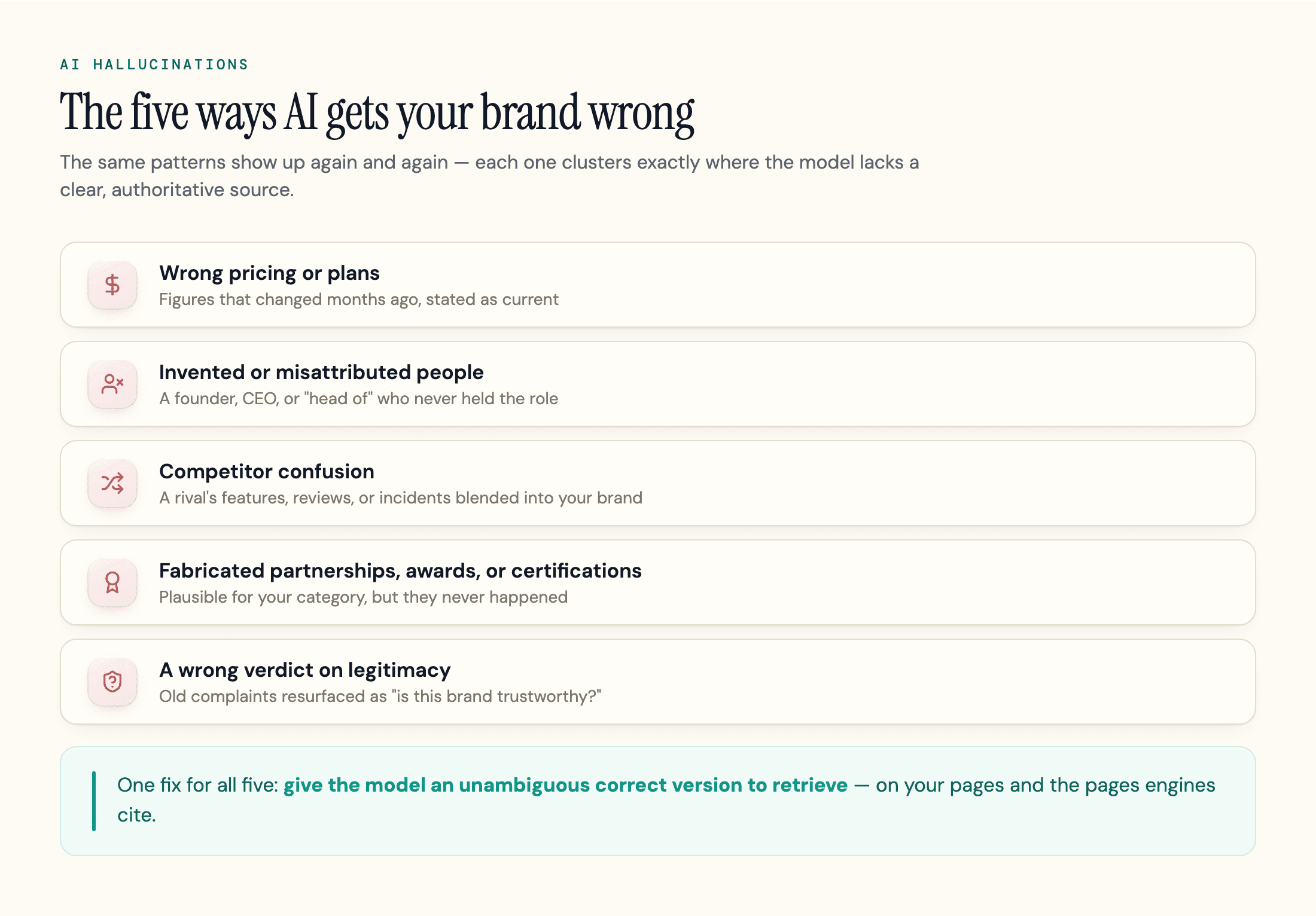
A few patterns show up again and again when AI gets a company wrong:
- Wrong pricing or plans stated as current, when the figures changed months ago.
- Invented or misattributed people such as a founder, CEO, or "head of" who never held the role.
- Competitor confusion, where the model blends a rival's features, reviews, or incidents into your brand because it cannot cleanly separate two similar companies.
- Fabricated partnerships, awards, or certifications that sound plausible for your category but never happened.
- A wrong verdict on legitimacy, where an answer leans on old complaints and implies you are not trustworthy.
The common thread is accuracy failing exactly where the model lacks a clear, authoritative source. Each type is a symptom of the same gap, and each is reduced the same way: give the model an unambiguous correct version to retrieve.
The Real Cost (This Isn't Hypothetical)
When AI invents something about your brand, the liability and reputation damage are real. In Moffatt v. Air Canada, a tribunal held Air Canada liable after its website chatbot gave a passenger an invented bereavement-fare policy. The airline argued the bot was a separate entity responsible for its own answers. The tribunal disagreed: you own what your AI says.
The pattern is widespread. Damien Charlotin's AI Hallucination Cases database had logged 1,809 court decisions involving fabricated citations and other hallucinated material as of late July 2026. More than 700 of those involve lawyers, professionals who trusted a confident answer and got burned in public; most of the rest are self-represented litigants who had even less reason to doubt it. The penalties are real too: in a published June 2026 order, the Ninth Circuit sanctioned two attorneys whose briefs contained nonexistent cases and misattributed quotations, imposing monetary sanctions and a six-month suspension from practice before the court, and noting it generally does not matter whether a fabrication came from an AI tool or from the lawyer's own "natural intelligence."
For many brands the damage is quieter but just as costly: an AI Overview that summarizes only old complaints, a chatbot that recommends a competitor, or an answer that questions your legitimacy. The customer may never see your side, because the answer arrived before they reached your site.
How We Verify This Article
Courts sanctioning AI-fabricated citations have been blunt: using AI is fine, but verifying its output is a duty you cannot hand off, and we hold our own content to that rule. A hallucination in an article about hallucinations would be its own kind of failure.
So every study, percentage, and court case in this article is logged in a per-claim evidence ledger that records the primary source and the exact line the claim rests on. An automated gate refuses to publish unless every claim is either backed by that evidence or deliberately set aside with a stated reason, and the list of claims is pulled from the finished article rather than chosen by the writer, so the writer cannot quietly narrow what gets checked. A panel of independent AI models, none of which wrote the piece, then re-checks each claim against its original source, and when that review turns up anything, two more models audit the outcome before the piece ships.
While we were updating this article, two AI assistants each confidently described a recent court sanction, complete with a case name, court, and dollar figures. We could not independently verify it in any primary source, so it is not in the version you are reading. It is the same discipline we recommend for your brand: make the correct facts easy to verify, and never let a confident-sounding claim go out unchecked.
How to Find Out What AI Says about You
You cannot fix what you cannot see, and there is no help desk for this. There is no universal correction portal from OpenAI, Google, or Anthropic; OpenAI's privacy form only covers inaccurate claims about individuals (useful if AI invents something about your founder), and engine feedback buttons report a bad answer without guaranteeing a fix. So the first job is monitoring, and the structured version of it is an AI visibility audit.
Run the questions your customers actually ask across ChatGPT, Perplexity, and Google's AI Overviews, and log what comes back:
- Direct brand prompts: "What is [brand]? Who founded it? What does it cost?"
- Category prompts: "best [your category] tools" and "is [brand] legit / worth it?"
- Comparison prompts: "[brand] vs [competitor]"
In our experience running Geotoolbox audits, the wrong fact is usually one the brand never knew was live; teams tend to discover it only when a prospect repeats it back.
Record where the answer is wrong, where you are absent, and which sources the engine cites. A single check is a snapshot; the value is tracking it over time so you catch a new hallucination before customers do. A GEO scan logs the verbatim answer each engine gives for your prompts, and that history is what turns manual checks into an ongoing baseline.
How to Reduce Hallucinations about Your Brand
You cannot edit the model, but you can change what it reads. Hallucinations about your brand come from data gaps and weak signals, so the fix is to make the truth about your brand unmissable and consistent. This is the same work that earns AI citations in the first place.
| Why AI gets it wrong | What to fix |
|---|---|
| Sparse or inconsistent brand data | Strengthen entity clarity: one consistent name, address, and description; Organization schema; sameAs links to your verified profiles |
| No authoritative source for a fact | State pricing, leadership, and product facts plainly on clear first-party pages so there is a canonical source to cite |
| The fact only lives on your site | Earn corroboration: consistent descriptions on Wikipedia/Wikidata (if you qualify), Crunchbase, LinkedIn, and reputable coverage |
| Crawlers can't reach the current truth | Make sure AI crawlers can fetch and render your updated pages, so the live facts are what gets retrieved |
This aligns with what Google states in its AI features guidance: AI answers draw from the normal Search index, and standard, helpful, well-structured content is how you influence them. There is no special override; you make the correct version of the facts the easiest one for the model to find. The full playbook is in how to optimize for AI search, and clear entity SEO is the part that matters most here.
How to Correct a Hallucination That's Already Live
There is no takedown button, so correction is indirect: fix the sources the system can retrieve, then wait for recrawl/reindexing or, for facts baked into weights, a future model refresh. Telling the chatbot "that's wrong" may affect that conversation, but it is not a reliable public correction mechanism.
The durable fix has three parts, in order:
- Update the canonical source. State the correct fact plainly on your own page.
- Address the cited third-party sources. The pages the engine actually cited often carry more weight than your own site, so the old fact has to be corrected there too.
- Wait for the recrawl. The lag depends on where the wrong fact lives: engines that retrieve live pages (AI Overviews, Perplexity, ChatGPT search) can reflect corrected, recrawled pages sooner than training-data changes, but timing varies from days to months by engine and page, while a fact baked into training data waits months for the next refresh. If the wrong fact persists, it usually means a cited third-party source still carries the old version, or your grounding signals are weaker than the source the model trusts.
Frequently Asked Questions
Why does AI get my company wrong?
A useful self-test: the harder it is to find a written, third-party answer to a question about your company, the more likely AI is to invent one. If a journalist could not verify your pricing or your founder's bio from public sources in five minutes, neither can a model, and unlike the journalist it will not call you to check.
How do I fix what ChatGPT says about my business?
Start with a 30-day pass: week one, publish canonical pages for the facts AI gets wrong (pricing, leadership, product names); week two, align your Wikidata, Crunchbase, and LinkedIn entries to match; weeks three and four, request corrections on the specific third-party pages the engines cite. Then re-run your prompts and compare.
I updated my site. Why is the AI still wrong, and how long until it's fixed?
Check which kind of lag you are in. If the engine cites a third-party page, your site update cannot fix it; the cited page has to change. If it cites your own outdated page, request a recrawl where available: Search Console for Google, Bing Webmaster Tools/IndexNow for Bing-powered surfaces, and make sure OAI-SearchBot can crawl pages you want eligible for ChatGPT Search. The fix can land sooner rather than waiting months for a training refresh.
Can I report or remove a hallucination?
For statements about a person, yes in part: OpenAI accepts correction and removal requests for inaccurate personal data through its privacy portal, which covers a hallucinated founder or executive. For statements about the company itself there is no correction channel, so the practical path is fixing the underlying sources.
Can I sue for AI defamation?
It is largely untested and hard to win so far. In Walters v. OpenAI, a US defamation claim over a fabricated ChatGPT statement was dismissed in 2025. Air Canada was held liable for its own chatbot, but that is different from suing a model's maker.
Does ranking #1 on Google fix what AI says about me?
Not directly. Ranking helps your pages get retrieved, but AI answers also pull from third-party and entity signals that can override your site. You have to fix the whole picture, not just your ranking.
Monitor First, Then Fix the Sources
You will not stop AI from occasionally getting things wrong. What you can control is your exposure: know what AI says about you, give the engines an unambiguous correct version, and repair the cited sources when something is off.
Start by seeing what the engines actually say. Geotoolbox's GEO Scan logs the verbatim answer each engine gives for your brand prompts (the entry plans open with a 7-day free trial; higher tiers add more engines), and Domain Overview keeps that history in one place on the higher plans, so a changed answer stands out before a customer quotes it back to you.
Sources
- Moffatt v. Air Canada, 2024 BCCRT 149 - BC Civil Resolution Tribunal, 2024 -
decisions.civilresolutionbc.ca/crt/crtd/en/item/525448/index.do - Hallucinations in ChatGPT references - Bhattacharyya et al., Cureus, 2023 -
cureus.com/articles/158289 - Reference hallucination rates in GPT-4/GPT-3.5 - Chelli et al., JMIR, 2024 -
jmir.org/2024/1/e53164 - AI Search Has a Citation Problem - Tow Center for Digital Journalism, Columbia Journalism Review, 2025 -
cjr.org/tow_center/we-compared-eight-ai-search-engines-theyre-all-bad-at-citing-news.php - Next generation of Vectara's hallucination leaderboard - Vectara, 2025 -
vectara.com/blog/introducing-the-next-generation-of-vectaras-hallucination-leaderboard - AI Hallucination Cases database - Damien Charlotin, 2026 -
damiencharlotin.com/hallucinations - LNU v. Blanche sanctions order, No. 24-4790 - US Court of Appeals for the Ninth Circuit, 2026 -
cdn.ca9.uscourts.gov/datastore/opinions/2026/06/03/24-4790.pdf - Why language models hallucinate - OpenAI, 2025 -
openai.com/index/why-language-models-hallucinate - AI features and your website - Google Search Central -
developers.google.com/search/docs/appearance/ai-features - OpenAI defeats defamation claims (Walters v. OpenAI) - Eric Goldman, 2025 -
blog.ericgoldman.org/archives/2025/05/chatgpt-defeats-defamation-lawsuit-over-hallucination-walters-v-openai.htm