
"AI content optimization" means two different things, and most guides blur them. One is using AI tools to help you write and edit faster. The other is writing content so AI engines quote it. This guide is about the second, because that is the one that decides whether ChatGPT, Perplexity, or Google's AI Overviews ever name your page.
It is also the harder one to find honest advice on. The web is full of checklists and tool roundups, and very little on the actual craft: how to write a sentence a model can lift cleanly. That craft is what this covers. It assumes the AI crawlers can already reach your pages, which is a separate job covered in our AI search playbook.
What Actually Gets a Page Cited
Strip away the noise and the levers are unglamorous: clarity, structure, originality, and specific sourced facts. That is most of it. The reason this needs saying is that the niche has filled up with precise-sounding citation stats ("answer first and get cited 67% more," "data tables earn 4.1x more citations") that trace back to vendor blog posts with no published method. Treat those as marketing, not findings.
The claims that do hold up are narrower and better sourced. The IIT Delhi and Princeton study that defined GEO (generative engine optimization) found its methods can lift a page's visibility in AI responses by up to 40%, and that citing sources, adding quotations, and including statistics were among the most effective moves. A separate audit of 15 sites receiving 7,500 ChatGPT referral sessions found that 72.4% of the cited posts included a direct-answer capsule and 52.2% contained original or owned data, with the strongest pages combining both. A May 2026 controlled experiment backs the same split from the lab side: across 252,000 trials spanning six models in a two-document retrieval setup, formatting-only edits barely moved which document got cited; topical relevance, fresh timestamps, and explicit price information did. That is the real signal: specificity and evidence, not formatting tricks.
It is worth knowing what Google itself says does not matter, because it contradicts a lot of popular advice. Google's guide to its generative AI features states plainly that you do not need special AI text files or Markdown, you do not need to break content into tiny chunks, you do not need structured data, and you do not need to write in a special way for AI. What Google asks for instead is "non-commodity content" with a unique point of view, written clearly for people. The structured-data point now has a measured test behind it: in May 2026, Ahrefs tracked 1,885 already-cited pages that added schema markup against 4,000 controls and found no meaningful citation lift on any platform; ChatGPT and Google AI Mode moved within noise, and AI Overviews dipped slightly.
It helps to separate the popular advice that holds up from the advice that does not:
| Common claim | What actually holds up |
|---|---|
| An llms.txt file boosts citations | Server-log studies report it is almost never fetched; Google says no special AI files are required |
| FAQ or structured-data schema gets you cited | Not required for AI search; Ahrefs tracked 1,885 cited pages that added schema and found no meaningful citation lift on any platform |
| Break content into tiny chunks for AI | No chunking requirement; write passages that stand on their own instead |
| SEO keyword tactics carry straight over | The GEO research found classic tactics like keyword density add little to no lift in AI responses |
| Precise stats like "answer-first earns 67% more citations" | Unsourced vendor numbers; treat them as marketing, not findings |
Write the Answer First
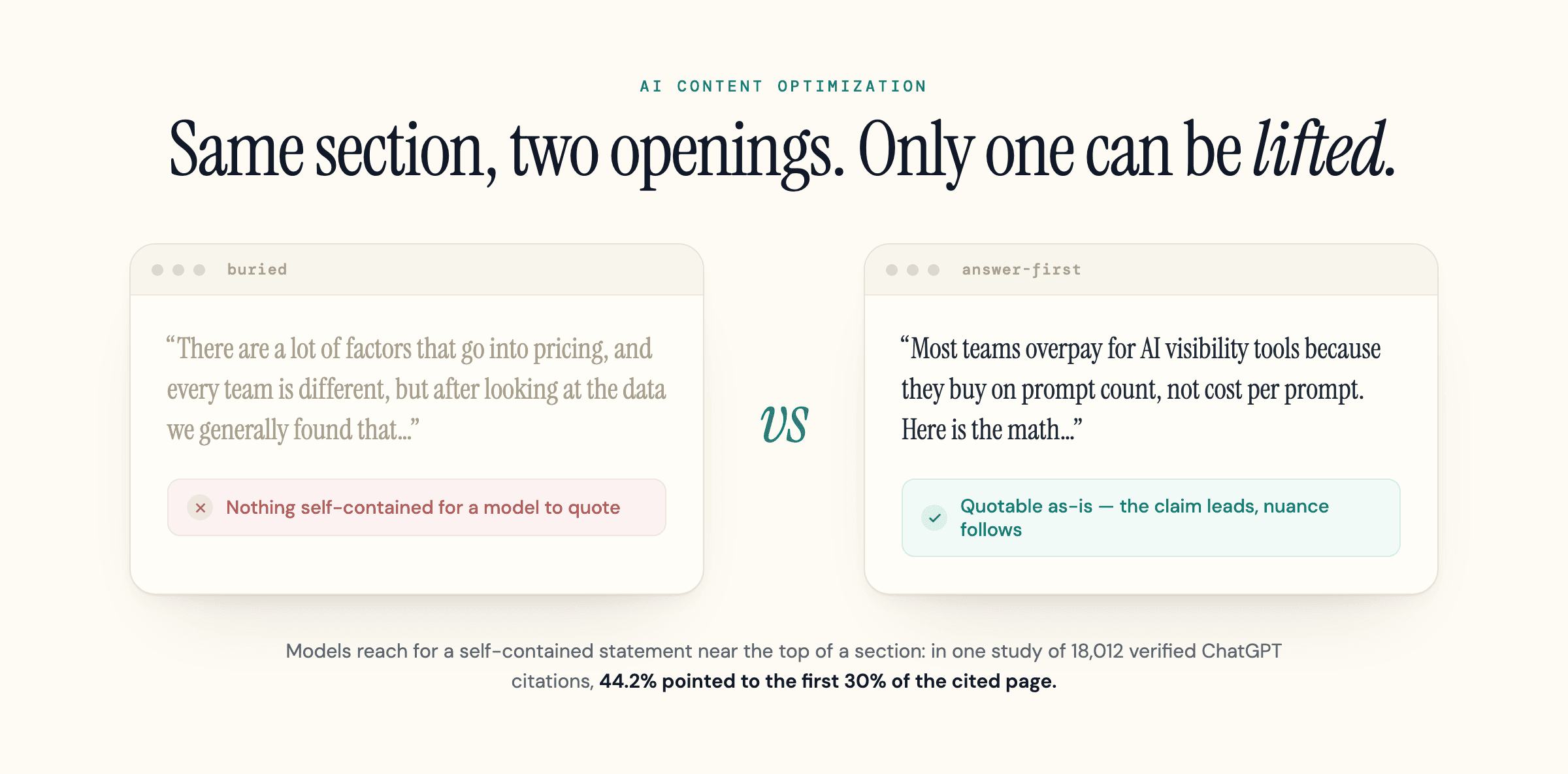
The single most valuable habit is to put the answer in the first sentence under a heading, then explain. A model pulling an answer reaches for a self-contained statement near the top of a relevant section. If your answer arrives in the fourth sentence after setup, there is nothing clean to lift. The pattern shows up at scale: a February 2026 analysis of 18,012 verified ChatGPT citations by Kevin Indig found that 44.2% of them pointed to the first 30% of the cited page's content.
Compare two openings to the same section:
Buried: "There are a lot of factors that go into pricing, and every team is different, but after looking at the data we generally found that..."
Answer-first: "Most teams overpay for AI visibility tools because they buy on prompt count, not cost per prompt. Here is the math, and the two cases where it flips."
The second (an invented example, but the shape is the point) can be quoted as-is. The first cannot. This is not theoretical. A content marketer who ranked first on Google yet went unmentioned by ChatGPT traced the gap partly to format, noting that the sites the engines did recommend answered the question in the first paragraph while their own posts buried the point behind long intros. Notice that the answer-first version did not delete the nuance; it moved it below the claim, where a human who wants context still finds it. Lead with the claim, qualify underneath.
Make Each Passage Stand on Its Own
This is where the popular advice gets muddled. You will read that you must "chunk" your content into tiny pieces because models extract in chunks. You will also read Google saying flatly that there is no requirement to chunk content, because its systems understand a long page. Both are describing the same thing badly.
Here is the resolution. You are not writing for an arbitrary word limit, you are writing so that any passage still makes sense when it is lifted away from the rest of the page. That is a property of the writing, not a layout rule. A retrieval system, which matches passages to questions using vector embeddings, grabs a slice of your page and hands it to the model with no memory of the paragraphs around it. If that slice depends on "as we mentioned above" or an "it" whose subject is three paragraphs back, the model gets an orphan.
So write passages that survive extraction:
- Restate the subject instead of leaning on pronouns. Not "it raised prices again," but "Acme Analytics raised prices again." The cost is a little repetition, the gain is that the sentence carries its own meaning.
- Kill dangling references. "As noted earlier" and "the former" are fine for a human reading top to bottom and useless to a model holding one paragraph.
- Keep one idea per passage. A section that argues three things at once cannot be cleanly lifted for any one of them.
You do not need to fragment your prose into atoms to do this. A well-written long section made of self-contained paragraphs satisfies both the retrieval step and the human reader. That is the honest middle of the chunking argument.
The correlation data fits that reading. AirOps compared more than 12,000 URLs, pages ChatGPT cited against Google page-one results for the same 900 queries, and the cited set was almost three times as likely to include at least one list section, with 68.7% keeping a clean sequential heading hierarchy versus 23.9% of the Google set. Treat that as a description of what extractable pages look like, not a trick to bolt on: the 252,000-trial experiment above found that formatting-only edits, on their own, barely moved citation selection.
Frame Your Data so the Meaning Travels
Specific, sourced data is the strongest citation magnet there is, but writers treat it as a number to drop in rather than something to frame. The craft is making sure the model extracts the meaning of the statistic, not just the digits.
A bare number is ambiguous out of context. "Conversions rose 34%" lifted alone says nothing about what changed or for whom. Frame it so the claim travels with it: "Moving the pricing table above the fold raised checkout conversions 34% in our test across 12 stores." Now the lifted sentence carries the cause, the effect, the size, and the scope.
Two habits help the significance survive extraction. First, put the number and its source in the same sentence, so the quote and the credit travel together. Second, use a short framing cue before or after the figure, a phrase like "which means" or "unlike the prior approach," so the model knows what the number proves. A statistic stranded in a sentence of its own, or marooned in a table the prose never explains, gets quoted as a naked figure or skipped.
Give the Model Something Only You Have
If clarity gets you extractable, originality gets you chosen. Engines reach for non-commodity content, and Google says as much: a unique point of view and first-hand experience (the kind of E-E-A-T signal that actually moves AI citation) influence AI presence, while common-knowledge restating does not. A page that recombines what ten other pages already say gives a model no reason to cite you over them. Practitioners describe the same pattern bluntly: in an r/SEO_LLM thread on what content gets cited, one summed it up as "ChatGPT cites specific research and numbers more than generic advice. If your post is just opinion, it loses to sources with methodology."
The practical version is to put something on the page that exists nowhere else. Your own test results, with the sample size and method. A number you measured. A counterintuitive finding from your own data. A named example with specifics. This is the work AI cannot do for you, and it is the reason "use AI to generate the article" is self-defeating for citation.
In our experience at geotoolbox, auditing pages that plateau at zero AI visibility, the most common content cause is not bad structure. It is that the page contains nothing a model could not have generated itself.
You do not need original research on every page. You need at least one thing per page that is yours: a data point, an example, a judgment, an experience. That is the difference between a page that informs the model and a page the model already knew.
Cover the Whole Question
Models favor a page that answers the question and its obvious follow-ups over one that answers a sliver. When someone asks an engine about a topic, it often pulls from a source that resolves the whole cluster of related sub-questions, because that page is the safer, more complete thing to cite.
So map the question before you write. For a buyer asking "which AI visibility tool should I use," the follow-ups are predictable: what do they cost, what is the difference between them, which is best for a small team, is there a free option. A page that answers all of those in clearly headed sections is more citable than five thin pages that each answer one. This is the same instinct behind building topical depth: cover the subject well enough that a model can resolve a reader's real question from your page alone.
The discipline is to write the sub-questions out as headings, then answer each one answer-first. You are not padding for length, you are closing the gaps that would send a model to someone else's page for the part you skipped.
AI Content Optimization Tools: Where They Help, and Where They Hurt
Back to the other meaning of the phrase, because it is a real part of the work. Using AI to optimize content is fine, even useful, in a specific lane: auditing an existing page for gaps, checking readability, drafting headline options, comparing your coverage against the top results. As an editing and analysis assistant, it saves real time. The content optimization tools built for that lane are worth knowing, and we compare them, and where they stop, separately.
It hurts when you ask it to manufacture the substance. A model generating your "insight" produces commodity content by definition, and at scale it trips Google's scaled content abuse policy. The line is simple: use AI to sharpen and check what you wrote, not to invent what you know. The originality has to come from you, because that is the only part a model cannot supply and the only part another model has a reason to quote.
So keep a human in the loop on facts and judgment. Let the tool flag a buried answer or a passive sentence. Do not let it fill the page with the average of everything already published.
The Per-Passage Citability Checklist
Run this on each section as you draft, not after a tool scores the page. It is a writer's rubric, not an algorithm to game.
| Check | Pass condition |
|---|---|
| Answer-first | The first sentence answers the heading directly and could be quoted alone |
| Self-contained | The passage makes sense lifted away from the page; no "as above," no orphaned pronouns |
| Specific and sourced | Claims carry a real number and its source in the same sentence |
| Framed data | Each statistic has a cue that tells the reader what it proves |
| Original | The section contains at least one thing a model could not have generated itself |
| One idea | The passage argues a single point, cleanly extractable for it |
If a section fails the first or last row, fix it before anything else. Those two, a buried answer and a passage trying to do too much, are the most common reasons a model passes your page over.
How to Tell If It Is Working
Set expectations honestly: optimizing a page improves its odds of being cited, it does not guarantee it, and the engines cite only a fraction of eligible pages. Skeptics in the same Reddit threads cited above have a fair point: no one can see exactly why a model cites one page over another, and a single check is close to meaningless. Judge the trend, not a single check. Run your target questions through ChatGPT, Perplexity, and Google's AI Overviews, record whether you appear, and re-check on a schedule. Our guide to tracking AI visibility covers how to do that without fooling yourself with a one-off result.
Two cautions. AI referral traffic is hard to attribute, since a large share of it lands in analytics as direct with no referrer, so do not expect a clean before-and-after in your traffic numbers. And give it time: content changes take weeks to surface, because AI sourcing shifts gradually. The honest signal is whether your share of citations trends up across many runs, not whether a single answer named you today.
Frequently Asked Questions
What is AI content optimization?
Most tools sold under this name serve the first meaning: AI-assisted drafting and on-page scoring for rankings. The citation-side craft this guide covers has almost no dedicated tooling yet, which is why it is mostly editorial discipline rather than a software purchase.
Does AI-written content get cited by AI engines?
AI-assisted content can be, when a human supplies the substance: real numbers, first-hand experience, a position. What reliably fails is fully generated content with no human input, because it averages what already exists. Disclosure is not the issue; the source of the substance is.
Do I need to break my content into chunks for AI?
No, and there is no magic passage length either. A 300-word section and an 80-word section both get cited when each stands alone. A working rule: any paragraph that would make sense read aloud to someone who has not seen the rest of the page is extraction-ready.
How is this different from regular SEO?
They overlap, but ranking and citation are different selection systems. Classic tactics like keyword density transfer poorly: the research that defined GEO found such methods offer little to no improvement in AI responses. Extractability and originality matter more for citation than they do for a blue-link ranking.
What kind of content does ChatGPT cite most?
By content type: original studies and benchmarks, pricing and comparison pages with concrete numbers, and documentation-style pages that resolve a specific question. Thin roundups and opinion posts are cited least, because they are the easiest content for a model to reproduce without you.
Start by Checking What You Have
Before you rewrite anything, see where a page actually stands. Most pages that fail to get cited fail on one of two things: a model cannot read them, or a model has no reason to choose them. The first is reachability, the second is the craft above.
geotoolbox's free AI-Readiness Score flags whether the AI crawlers can fetch your page in the first place, and the content analyzer grades how extractable and citable it is. Run it on your best page, fix what it flags, then work down the per-passage checklist. The writing is where citations are won, but only on a page the model can actually see.
Sources
- Optimizing your website for generative AI features - Google Search Central (what is and is not required for AI search) -
developers.google.com/search/docs/fundamentals/ai-optimization-guide - GEO: Generative Engine Optimization - Aggarwal et al. (IIT Delhi + Princeton), KDD 2024 (sources, quotations, and statistics among the most effective methods; up to 40% visibility lift) -
arxiv.org/abs/2311.09735 - What Gets Cited: Competitive GEO in AI Answer Engines - arXiv, May 2026 (252,000 controlled trials across six models; formatting-only edits have little effect on citation selection, while topical relevance, fresh timestamps, and explicit prices do) -
arxiv.org/abs/2605.25517 - Spam policies for Google web search (scaled content abuse) - Google Search Central (limits on mass-generated content) -
developers.google.com/search/docs/essentials/spam-policies - How to get cited by ChatGPT: the content traits LLMs quote most - Adam Gnuse, Search Engine Land, 2025 (answer-capsule and original-data audit of 15 sites with 7,500 ChatGPT referral sessions) -
searchengineland.com/how-to-get-cited-by-chatgpt-the-content-traits-llms-quote-most-464868 - 44% of ChatGPT citations come from the first third of content: Study - Kevin Indig via Search Engine Land, February 2026 (18,012 verified ChatGPT citations; 44.2% point to the first 30% of the content) -
searchengineland.com/chatgpt-citations-content-study-469483 - We Tracked 1,885 Pages Adding Schema. AI Citations Barely Moved. - Louise Linehan, Ahrefs, May 2026 (1,885 already-cited pages that added schema vs 4,000 controls; no meaningful citation lift on any platform) -
ahrefs.com/blog/schema-ai-citations - Why Ranking on Page One Isn't Enough - AirOps, July 2025 (structural comparison of 12,000+ URLs: ChatGPT-cited pages vs Google page-one results for the same 900 queries) -
airops.com/report/structuring-content-for-llms - My site ranks #1 on Google but ChatGPT ignores us - r/content_marketing (practitioner account of the format gap) -
reddit.com/r/content_marketing/comments/1smzffv/my_site_ranks_number_1_on_google_but_chatgpt - What type of content gets cited most often in ChatGPT? - r/SEO_LLM (practitioner views on data vs opinion and measurability) -
reddit.com/r/SEO_LLM/comments/1twhmw1/what_type_of_content_gets_cited_most_often_in