
You cannot improve an AI visibility problem you cannot see. If ChatGPT, Perplexity, and Google's AI Overviews answer questions in your category, the first job is to track whether they mention you, how often, and against which competitors. Most of that you can measure for free.
What "AI Visibility" Means
AI visibility is how often, and how prominently, AI engines mention or cite your brand when they answer questions in your space. It is the AI-era version of a ranking: instead of where you sit on a results page, it is whether you appear in the synthesized answer at all, and whether you are named alongside or ahead of competitors.
Two signals sit underneath it, and they are not the same. A mention is the model naming your brand in its text. A citation is the model linking to your page as a source. The balance differs by engine: in our tracking, ChatGPT tends to mention brands more often than it cites them, while Google's AI Overviews lean the other way. Either way, track both, because they tell you different things: mentions measure awareness, citations measure whether your content is doing the work.
If the underlying idea is new to you, our guide to generative engine optimization covers how engines decide what to mention.
The Metrics That Matter
Five metrics cover the job. You do not need all five to start, but you should know what each one tells you.
| Metric | What it tells you | How to get it | The catch |
|---|---|---|---|
| Share of voice | How often you appear versus competitors across a set of prompts | Run prompts, divide your mentions by the total, or use an AI rank tracker | The prompts you choose decide the number |
| Mentions vs citations | Awareness versus whether your page is the cited source | Log both for each answer | A mention with no citation sends no traffic |
| Sentiment | Whether you are described positively, neutrally, or wrong | Read the answer, not just the name | A wrong mention is worse than none |
| AI referral traffic | Visits that actually arrive from AI tools | GA4's AI Assistants channel plus referrer rules | Heavily undercounted (see below) |
| Branded search lift | People searching your name after seeing you in AI | Branded queries in Search Console | Indirect, but the most defensible |
That is the scoreboard. The numbers are shakier than they look, and you can populate most of them without paying anyone. For the full set with a formula, a worked example, and a vanity-vs-credible verdict on each metric, see our reference on AI search visibility metrics and KPIs.
A Reality Check: Why AI Visibility Is Hard to Measure
Before you trust any number, understand why the numbers wobble. Two facts make AI visibility genuinely harder to measure than rankings.
First, the answers are non-deterministic. Ask the same model the same question twice and you can get a different set of brands. SparkToro had 600 volunteers run 12 prompts 2,961 times across ChatGPT, Claude, and Google's AI Overviews: for ChatGPT and Google's AI there was less than a 1-in-100 chance of getting the same list of brands in any two responses, and closer to 1-in-1,000 for the same order. Claude repeated the same list slightly more often, but was even less consistent about the order.
The consequence is blunt: a one-off check tells you almost nothing, and any tool selling you an "AI ranking position" is selling a number that does not really exist. Measure a distribution across many runs, not a single snapshot.
Second, the traffic is hard to attribute. Influence rarely shows up as a tracked visit: SparkToro's June 2026 read of Similarweb clickstream data found 68% of US Google searches ended without a single click in the first four months of 2026, up from the roughly 60% SparkToro reported for 2024 using a different panel, and even when someone does visit after seeing you in an answer, the analytics trail is patchy (more on that below).
Neither problem makes measurement pointless. It means you measure the right way: track direction over weeks and report ranges instead of false-precision decimals. That measurement gap, most teams still cannot see where they stand, is one of the defining findings of the 2026 state of AI search.
Before You Measure: Can AI Even See Your Pages?
There is a prerequisite that sits above every metric: an engine cannot mention or cite a page it cannot reach. If your most important pages are blocked to AI crawlers, your visibility is not low, it is unmeasurable, and no tracker will tell you that is the reason.
The usual culprits are a robots.txt rule that disallows AI crawlers (training bots like GPTBot and ClaudeBot, or retrieval bots like PerplexityBot and OAI-SearchBot), a firewall that challenges non-browser traffic, or content that only renders with JavaScript the crawler does not run. Google's own guidance is that appearing in AI features takes no special markup, just helpful content engines can reach, and "can reach" is exactly what most sites get wrong for AI bots. Check reachability before you read too much into a poor citation rate, because a blocked crawler makes every other measurement misleading. Our AI search playbook covers the checks, and geotoolbox's free AI-Readiness Score runs the robots.txt and crawler-access checks in seconds (rendering and firewall behavior take a deeper scan).
The Free Way to Track It
You can build a usable AI visibility picture with a spreadsheet and an hour a month. The trick is consistency, not volume. For the mention-specific version of this workflow, with the run counts that make a rate trustworthy, see how to track brand mentions in AI search.
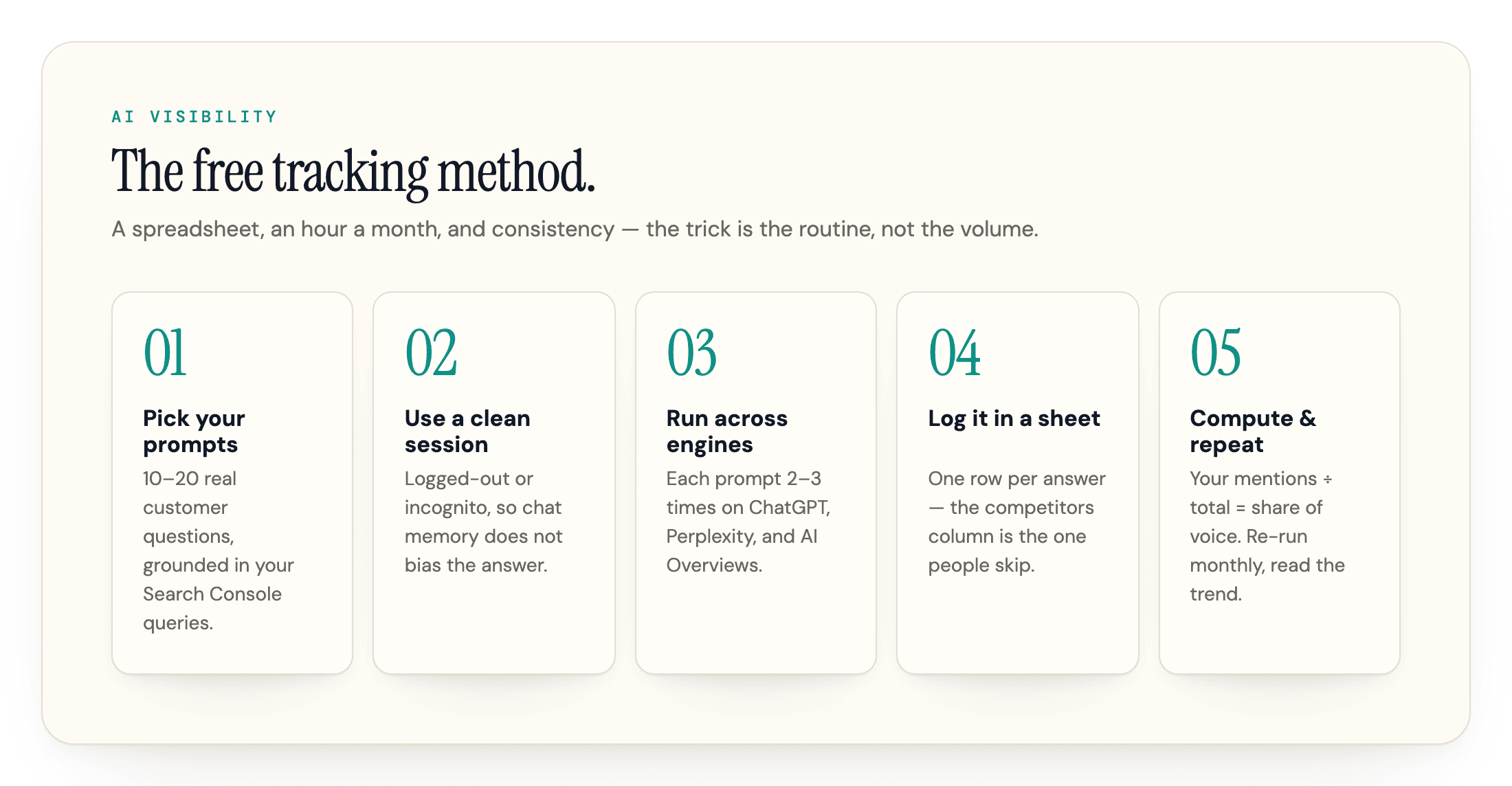
- Pick your prompts. Choose 10 to 20 questions a real customer would ask, the kind that should surface your brand. Ground them in your actual Search Console queries rather than guessing, so you track demand that exists.
- Use a clean session. Run each prompt in a logged-out or incognito window. If you are signed in, the model's memory of your past chats biases the answer toward your own brand and ruins the reading.
- Run each prompt across engines, more than once. Put every prompt through ChatGPT, Perplexity, and Google's AI Overview, two or three times each, because a single run is noise. If Perplexity is your priority, our best Perplexity rank trackers guide compares the tools that automate this for one engine, for Microsoft Copilot see the best Copilot rank trackers comparison, and for Claude the best Claude rank trackers guide.
- Log it in a sheet. One row per answer, with columns for prompt, engine, mentioned (yes/no), position (first, second, third or lower; meaningful only averaged across runs), citation link (yes/no), sentiment, and which competitors appeared. That last column is the one most people skip and the most useful.
- Compute share of voice and repeat. Divide your mentions by the total across all brands for a rough share of voice, then re-run the whole set on a fixed schedule. Monthly is plenty to start; the direction over three months is the signal.
That is the entire method. It will not scale to thousands of prompts, but for most brands the first real insights come from exactly this.
Tracking AI Referral Traffic and Branded Search
Prompts tell you about mentions. Two more signals tell you about impact.
The first is AI referral traffic, and GA4 now does the base work for you. Since May 13, 2026, when the referrer matches a recognized assistant, GA4 automatically tags the visit with an "ai-assistant" medium and groups it under the AI Assistants channel in the Default Channel Group. Google's channel definitions name ChatGPT, Gemini, DeepSeek, Copilot, and Grok as examples but do not publish the full list, and the list has shifted since launch, so keep a referrer segment for domains the native channel may miss, such as perplexity.ai. Expect the number to be small as well as undercounted: Conductor's benchmark of 1,215 enterprise domains puts AI referrals at 1.08% of all website traffic across ten key industries, 87.4% of it from ChatGPT, growing about 1% month over month, measured on US traffic from May to September 2025. And when a model strips the referrer, the visit still lands silently in "Direct," so treat whatever you see as a floor, not a full count.
The second is branded search lift, and it is the most defensible signal you have. When an AI names your brand, a share of those people go search for you directly afterward. A rise in branded queries in Search Console, especially while your non-branded clicks stay flat or fall, is the fingerprint of AI-driven demand, and it is the number a finance team will accept. Watch it alongside your prompt tracking.
Search Console itself has started reporting AI visibility directly. On June 3, 2026, Google launched Search Generative AI performance reports: dedicated views of how often your URLs appear in AI Overviews and AI Mode, broken down by page, country, device, and date. Two caveats: it shows impressions only, with no clicks or query data yet, and while the rollout started with a subset of sites, Google says it now covers all websites worldwide as of August 31, 2026. It answers the visibility half of the question your prompt sheet estimates by hand, at least for Google's engines. To turn these numbers into a monthly report, our free SEO report template has an AI visibility tab with a prompt-run log.
One thing to monitor throughout: accuracy. Models routinely state confident, wrong facts about brands, and a mention that misrepresents you is worse than none. Our guide to AI hallucinations about your brand covers spotting and correcting them.
When Is a Paid Tool Worth It?
Every AI visibility score on the market, paid or free, is a modeled estimate, ours included. No tool sees the real prompts your buyers type, so all of them sample controlled questions and infer your standing. That is fine, as long as you remember you are buying scale and consistency, not access to ground truth.
The DIY method above works until it does not. Stay manual if you are tracking a small prompt set, reporting monthly, and can spare a couple of hours. Move to a paid tracker when you cross into real scale: hundreds of prompts across five or more engines, daily rather than monthly readings, automated share of voice against several named competitors, or simply the point where the staff time to do it by hand costs more than the subscription. Agencies and multi-brand teams hit that line fastest. If you are weighing software against hiring that out, GEO services vs software walks through the call.
For the actual options, from free graders to enterprise trackers, our rundown of the best AI visibility tools compares them by what they do and what they cost. Whichever you choose, the score it returns is only as good as the prompts behind it, so start by getting those right. And once tracking shows the gap, closing it usually means earning the off-site mentions and links engines trust, the job of the right link building platforms.
Frequently Asked Questions
What is AI visibility?
AI visibility is how often and how prominently AI engines mention or cite your brand when they answer questions in your category. It starts mattering the moment your buyers' questions return AI answers at all; if your category still gets plain link lists, classic rank tracking covers you for now.
How do I check if ChatGPT mentions my brand?
Ask the category question, not the brand question. Prompting "is [your brand] good" guarantees a mention and proves nothing; "what is the best [category] for [use case]" tests real visibility. Use a logged-out or incognito session so your chat history does not bias the answer.
Can I measure AI visibility for free?
Yes. A spreadsheet, a set of real customer prompts, and a monthly re-run gets you share of voice, brand sentiment, and competitor comparison at no cost. The trade-off is hours, not data: paid tools buy scale and automation, not access to numbers you fundamentally cannot get yourself.
Why do the results change every time?
Because the engines sample from many plausible sources on each run rather than reading from a fixed index. SparkToro found less than a 1-in-100 chance of ChatGPT or Google's AI returning the same brand list twice, so average several runs before reading anything into one.
Do I need a paid AI visibility tool?
Only at scale, and start manual either way: a month of hand-tracking teaches you which prompts actually matter, which makes any tool you buy later far better configured. Upgrade when you need hundreds of prompts, several engines, daily data, or automated competitor benchmarking.
Where to Start
You need a consistent method more than a budget. Pick ten real prompts, run them across the major engines in a clean session, log what you see, and repeat monthly.
Before any of that, rule out the silent failure: a page AI crawlers cannot reach scores zero for a reason no tracker will show you. The free AI-Readiness Score from geotoolbox checks whether the crawler-access foundations are in place, and the Content Analyzer grades how citable the page is once they are. Start there, then build your prompt-tracking sheet.
Sources
- AIs are highly inconsistent when recommending brands or products - SparkToro, January 28, 2026 (600 volunteers, 12 prompts, 2,961 runs) -
sparktoro.com/blog/new-research-ais-are-highly-inconsistent-when-recommending-brands-or-products-marketers-should-take-care-when-tracking-ai-visibility - In 2026, Less than One Third of Google Searches Still Send a Click - SparkToro, June 2026 (Similarweb US clickstream, Jan-Apr 2026) -
sparktoro.com/blog/in-2026-less-than-one-third-of-google-searches-still-send-a-click - New AI Assistant traffic measurement - Google Analytics What's New, May 13, 2026 -
support.google.com/analytics/answer/9164320 - Default channel group definitions (AI Assistants channel) - Google Analytics Help -
support.google.com/analytics/answer/9756891 - Introducing Search Generative AI performance reports in Search Console - Google Search Central, June 3, 2026 -
developers.google.com/search/blog/2026/06/gen-ai-performance-reports - The 2026 AEO / GEO Benchmarks Report - Conductor, updated July 6, 2026 (1,215 enterprise domains; US traffic, ten key industries, May-September 2025) -
conductor.com/academy/aeo-geo-benchmarks-report - AI features and your website - Google Search Central -
developers.google.com/search/docs/appearance/ai-features