
The best content optimization tools all do the same core thing: they score your draft against the pages already ranking and hand you a target to write toward. The hard part is not finding one. It is knowing what that score is actually worth, which tool fits your budget and workflow, and why a 95 in Surfer can still leave you invisible in the AI answers your buyers now read.
This is a tested list of the content optimization tools worth paying for in 2026: what each is best at, the real price, who should skip it, and how each one handles AI citation.
Disclosure: GEO Toolbox, the site you are reading this on, makes the Content Analyzer recommended for the citability job later in this guide. The optimizer reviews below are of other companies' products, several linked through affiliate programs as disclosed above.
Jump to a tool: Surfer SEO · Frase · Scalenut · NeuronWriter · Clearscope · MarketMuse · SE Ranking · Comparison table · FAQ
What Content Optimization Tools Actually Do
A content optimization tool takes your draft and a target keyword, pulls the pages already ranking for that keyword, and scores how well your text matches them. The output is a number, usually 0 to 100, plus a checklist: add these terms, hit this word count, use this many headings.
Under the hood they run natural language processing (NLP) over the top results and extract the terms those pages share. Surfer and Frase do this live inside a Google Docs or WordPress editor, so the score moves as you type. That real-time loop is the whole appeal. You stop guessing whether you covered the topic and get a target to write toward.
Most tools bundle three jobs that are worth separating:
- Term coverage and scoring, the core feature, comparing your draft to ranked competitors.
- Briefs and research, pulling the questions, headings, and entities to include before you write. This is where content chunking and entity coverage get decided.
- AI writing, generating the draft itself.
In practice, the scoring is the part that works, the briefs save real time, and the built-in AI writer is the part most experienced writers turn off.
This is the optimization side of the job. The writing-craft side, how to structure sentences and frame facts so a page earns a citation, is a separate skill we cover in AI content optimization. This guide is about the tools.
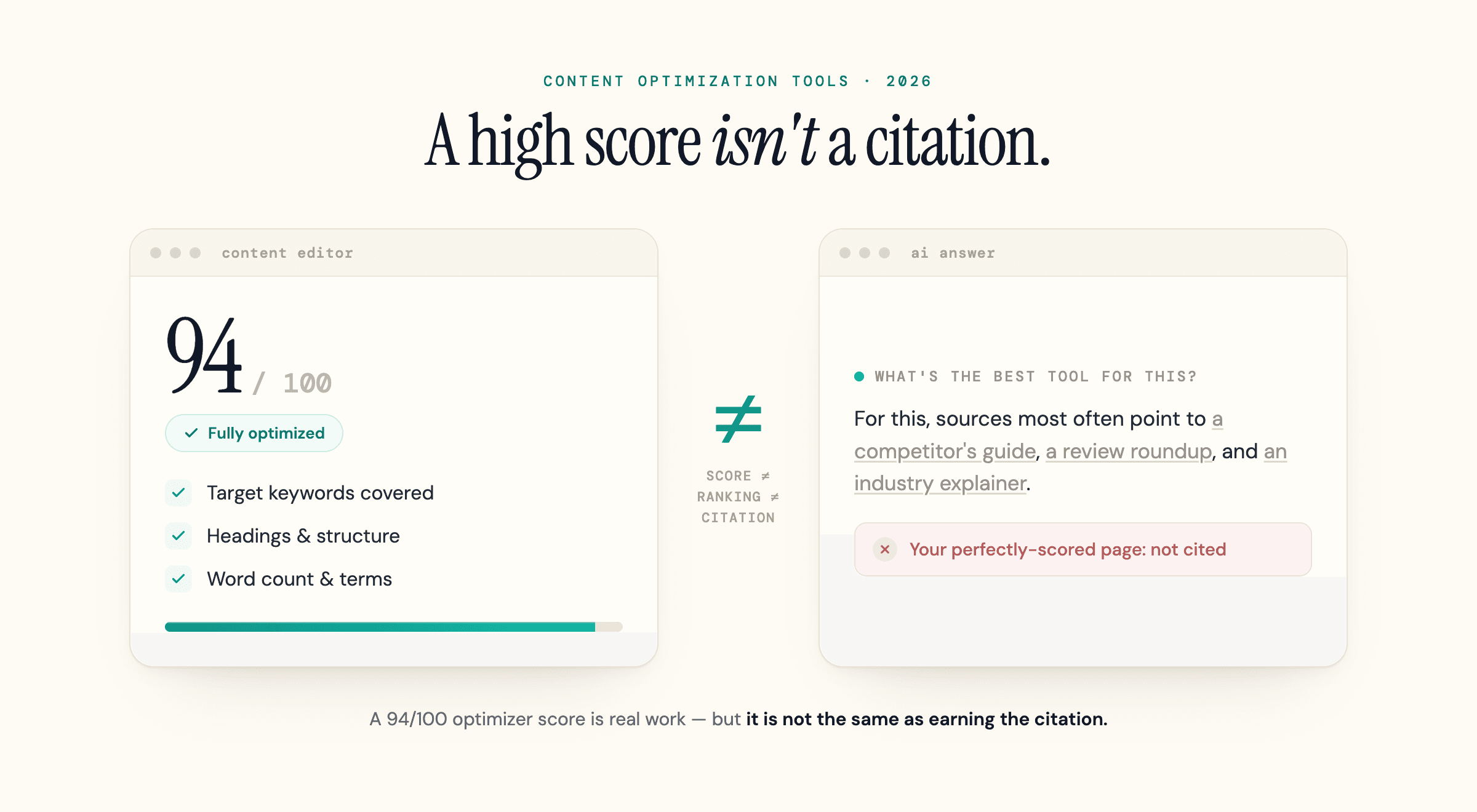
A High Score Is Not a Ranking, and Definitely Not an AI Citation
Here is what the roundups leave out. A content score measures how closely your page resembles the pages already ranking. It does not measure whether yours will rank, and the gap between those two things is wide.
Surfer's own study of over a million SERP entries put the correlation between its content score and ranking position at 0.28. That is a weak positive relationship, and Surfer publishes it honestly. An independent Ahrefs study of several optimization tools found some scores, Frase's among them, correlating closer to 0.1. Different studies, different samples, same lesson: the score clears the first gate, topical relevance, and then real ranking factors take over. Search Engine Land framed it exactly that way in content scoring works, but only for the first gate.
Chasing the number past that gate backfires. Push a draft to 100 and you start adding terms the reader does not need and headings that exist only to satisfy the tool. Most practitioners settle around 70 rather than 100, because the last 30 points are usually where natural writing goes to die. In our experience, the pages that get cited are the ones that stopped optimizing at "covered" and spent the rest of the effort on something a tool cannot score.
Which is the second blind spot, and it survived the AI gold rush. Most of these tools bolted on an AI-visibility tracker in 2025 and 2026, so they can now tell you whether your brand gets mentioned in AI answers. Useful, but separate. The content score you actually optimize toward is still built from the top-ranking Google pages. A 90-plus score tells you nothing about whether ChatGPT, Perplexity, or Google's AI Overviews will quote the page in front of you, because the signals that earn an AI citation, clear direct answers, original data, and the trust signals that make content citable, are not what the score measures.
How We Judged These Tools
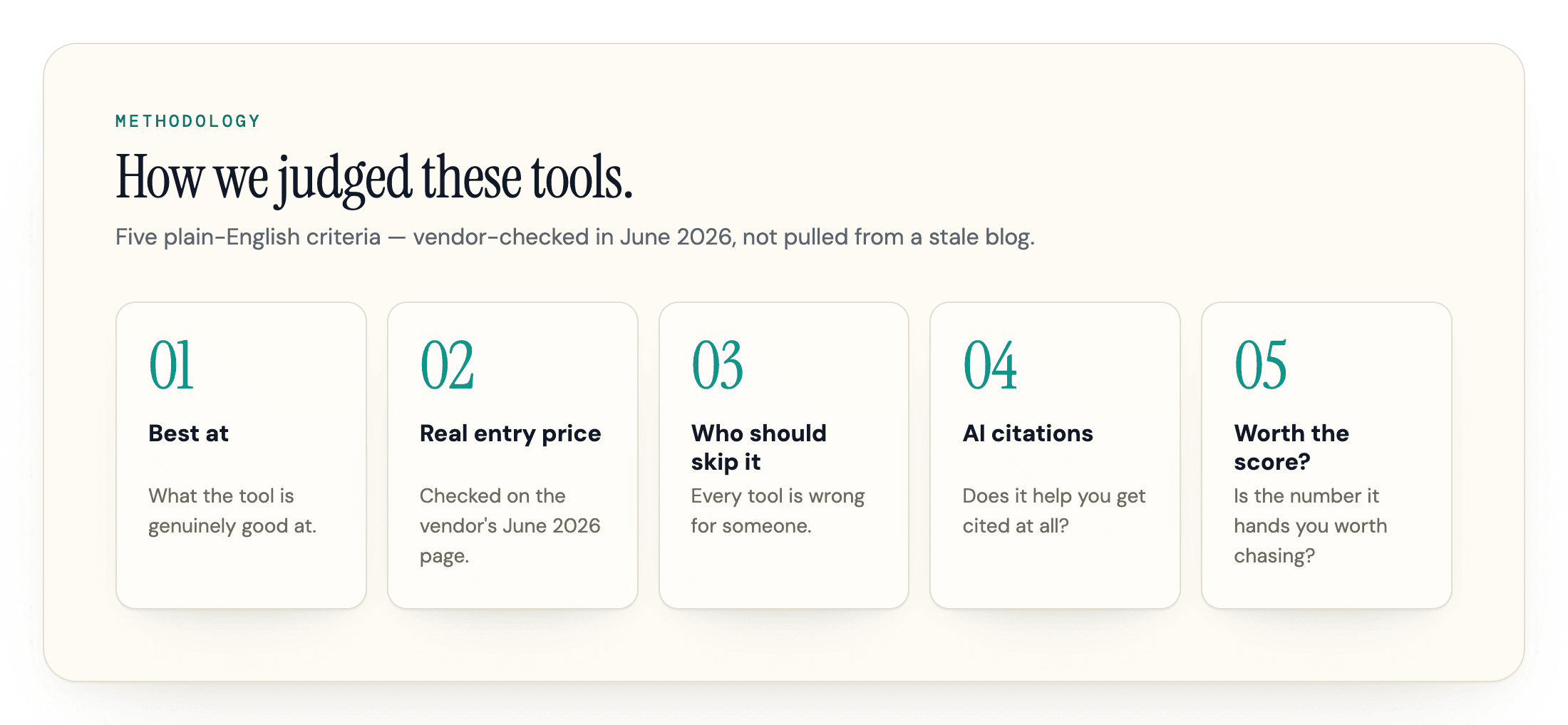
Five criteria, in plain terms. What each tool is genuinely best at. The real entry price, checked on the vendor's own pricing page (most recently re-verified live in September 2026) rather than a stale blog figure. Who should not buy it, because every tool is the wrong choice for someone. Whether it does anything for AI citations. And whether the score it hands you is worth chasing.
Prices below are monthly in USD where the vendor publishes USD; SE Ranking now prices in EUR, noted where it appears. Several of these tools restructured pricing in late 2025, so confirm the current number on the pricing page before you buy.
Content Optimization Tools at a Glance
| Tool | Best job | Entry price | AI-citation tracking | |
|---|---|---|---|---|
| Surfer SEO | Real-time on-page at scale | ~$49/moDiscovery tier | IncludedChatGPT tracking from Standard ($99); full 5-engine needs Pro ($182) | Visit Surfer SEO |
| Frase | Briefs + research-to-draft | $49/mo | IncludedGEO score on every plan; Claude+Gemini need the $299/mo Scale tier | Visit Frase |
| Scalenut | Fast all-in-one lifecycle | $59/mo | IncludedChatGPT+AIO on every tier; Perplexity needs Professional; no Gemini | Visit Scalenut |
| NeuronWriter | Budget semantic optimization | $23/mo$19 annual | Add-onAI module is an add-on | Visit NeuronWriter |
| Clearscope | Premium editorial grading | $129/mo14-day trial | IncludedPrompt tracking; grade is SEO-only | — |
| MarketMuse | Topical authority + strategy | Free planpaid is demo-gated | NoneNo AI-citation tracking | — |
| SE Ranking | Inside an all-in-one suite | ~€87-188/mobilled annually | Add-onAI Visibility Tracker is an add-on | Visit SE Ranking |
| geotoolboxOur tool | Grades a live URL for AI citations | $99/mo$79 annual | Built inNo import or paid seat needed; checks crawler access | Try geotoolbox |
Affiliate links may earn us a commission at no cost to you — it never changes the picks. Our own tool is labelled.
The fourth column is where 2026 gets interesting. Most of these tools added some form of AI tracking in the last year, so the old line "they ignore AI" is dead. What separates them now is whether that tracking is built in or a pricey add-on, and whether it actually grades your page or just watches the leaderboard. We pick the list apart below, then deal with the gap that is left.
Surfer SEO
Best for: teams and agencies optimizing a lot of content fast.
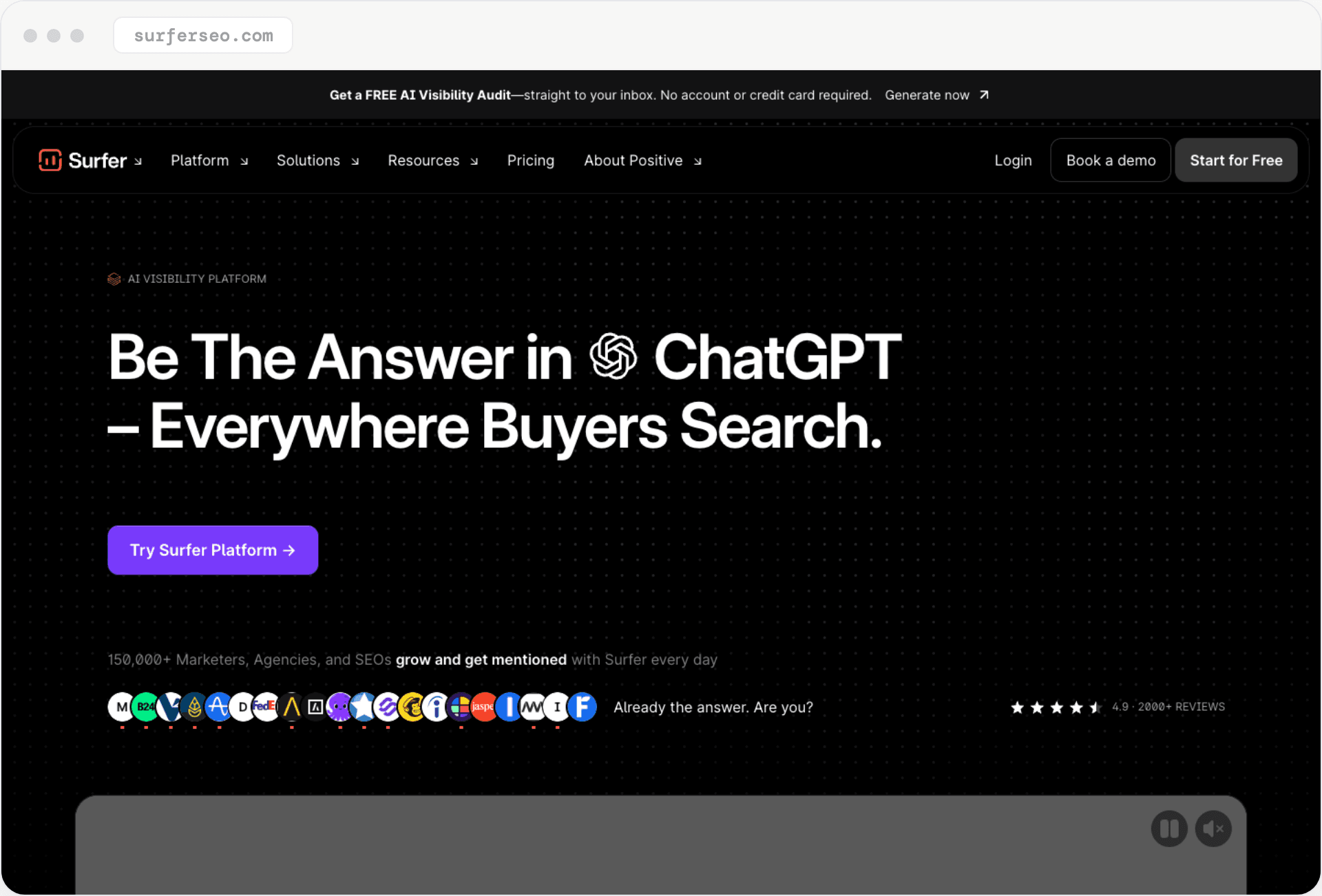
Surfer SEO is often the first tool people picture when they hear "content score," though its own homepage now markets it as an AI Visibility Platform under a parent brand called Positive. Its Content Editor pulls live SERP data, sets a word count and term list, and updates the score as you write, inside the browser or Google Docs. The learning curve is shallow, the interface is clean, and for production teams that value is real.
Pricing starts with a Discovery tier around $49 a month billed yearly, with Standard near $99, then Pro near $182, Peace of Mind near $299, and Enterprise above that. Surfer restructured its plans in late 2025 and again since, so confirm the current tier names and figures on its pricing page before you commit.
The catch is the AI writer, which is metered or gated to higher tiers, and a few AI-written articles can quietly cost more than the subscription itself. Surfer's own blog admits the generated drafts can feel like AI, which is a refreshingly honest thing for a vendor to say and a good reason to use the editor and skip the writer.
What works:
- Content Editor pulls live SERP data and updates the score as you type, inside the browser or Google Docs
- shallow learning curve and a clean interface built for production teams
- basic ChatGPT visibility tracking is included from the Standard plan up, no separate purchase
What doesn't:
- solo bloggers writing a handful of posts a month will not use enough of it to justify the price
- the AI writer is metered/gated and can cost more than the subscription itself if you lean on it
- per Surfer's cancellation policy, canceling removes your saved editors, audits, and tracked sites at the end of the billing period
Surfer's AI Tracker splits by tier. Standard ($99/mo) tracks ChatGPT mentions only. Full coverage across Perplexity, Google AI Overviews, AI Mode, and Gemini needs Pro ($182/mo) or above - it is not a flat "included from Standard" feature the way the plan-migration framing suggests. Either way it watches the leaderboard rather than grading a page: it can tell you that you are not showing up, but it will not grade the page in front of you for why, and the content score you optimize toward is still pure Google SERP.
Frase
Best for: writers wanting a brief and a draft in one place without paying enterprise prices.
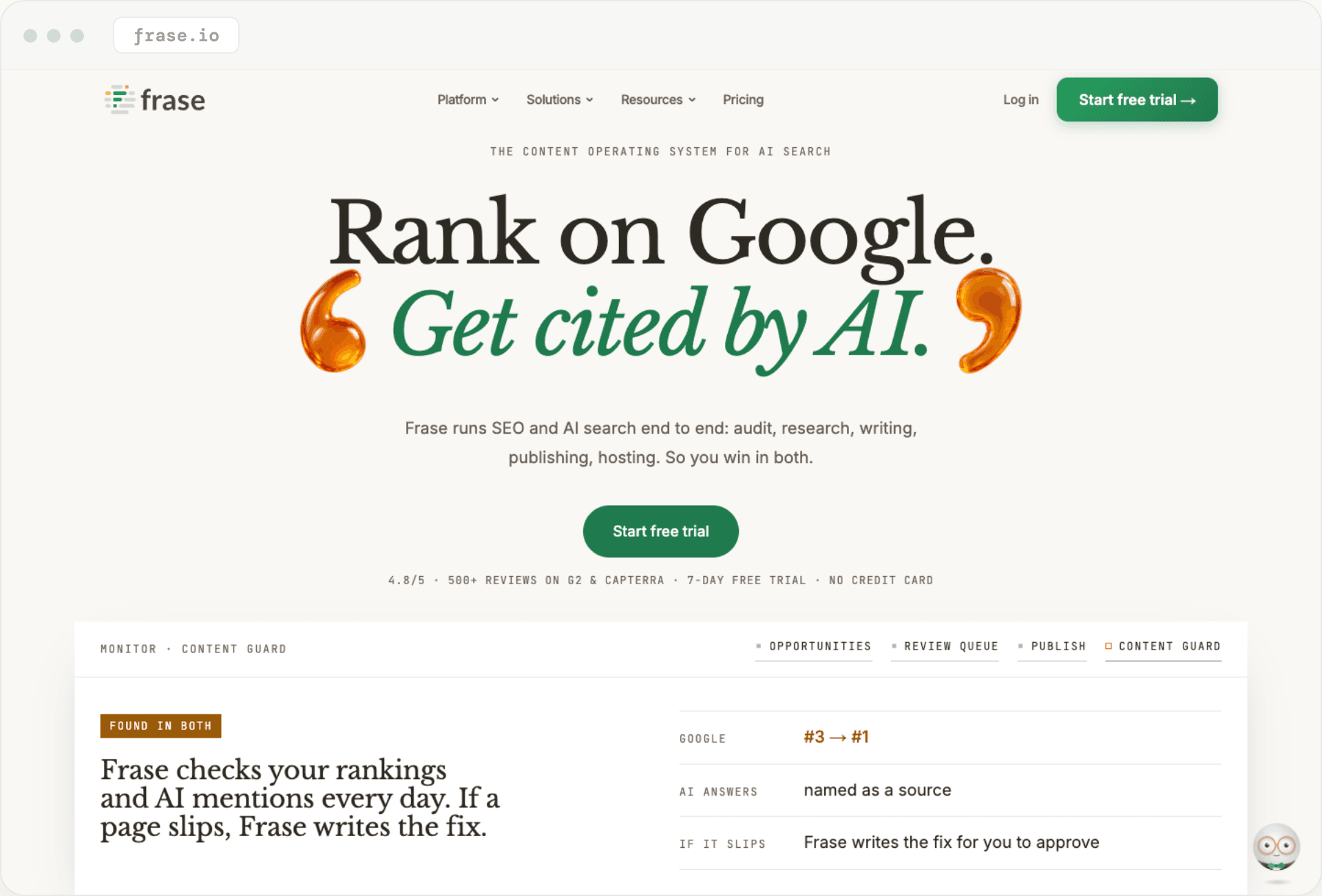
Frase starts from the SERP, builds an outline and a question list in minutes, and folds optimization scoring into the same editor. For a freelancer or small team, that research-to-draft loop is the selling point, and it is genuinely fast.
Pricing now spans three tiers. The Starter plan is $49 a month and Professional is $129, each with a 7-day trial and a discount on annual billing, per the Frase pricing page. A Scale tier now sits above them at $299 a month ($239 on annual billing) - more on what it adds below.
The real weakness is the score. The independent Ahrefs study mentioned earlier grouped Frase with Surfer and Clearscope as similarly weak correlators against actual rankings - it does not single Frase out as worse than Surfer specifically, only NeuronWriter and Ahrefs' own tool scored meaningfully better in that study. Treat Frase's number as a coverage check, not a ranking forecast. Its AI writer, like the others, produces drafts that need real editing before they publish.
What works:
- fastest research-to-draft loop of the group: SERP, outline, and question list in minutes
- cheapest entry price among the "serious" optimizers, at $49/mo for Starter
- a GEO score that grades pages and lists fixes ships on every paid tier, not gated to the top plan
What doesn't:
- content score correlates weakly with actual rankings, per independent testing, in the same range as Surfer's and Clearscope's
- full 5-engine AI tracking (adding Claude and Gemini) requires the $299/mo Scale tier
- AI writer drafts still need real editing before they publish
For AI citation, Frase has gone furthest of the optimizers, and the GEO score itself is not the part that's gated. Starter already includes the GEO score plus tracking on ChatGPT and Google AI; Professional adds Perplexity; only Scale adds Claude and Gemini for full 5-engine coverage. If you want a content editor that grades pages against what AI actually cites, Frase does that from its $49-a-month Starter plan - paying up to Scale buys you more tracked engines, not the GEO score itself.
Scalenut

Best for: teams wanting planning, writing, and optimization in one fast workflow.
Scalenut covers the whole content lifecycle, from keyword clusters to a drafted, optimized article, and its Cruise Mode can take a keyword to a full draft in a few minutes. If speed and a single interface matter more than best-in-class depth, it fits.
Pricing is mid-budget. The Starter plan is $59 a month, Plus is $89, and Professional is $199, with a 7-day trial, per the Scalenut pricing page. Promotions run often, but the list prices are what you should plan around.
What works:
- covers the whole lifecycle - keyword clusters to a drafted, optimized article - in one interface
- Cruise Mode takes a keyword to a full draft in a few minutes
- ChatGPT and Google AI Overview tracking is built into every tier, no separate add-on
What doesn't:
- Perplexity tracking is Professional-tier only, and Gemini isn't tracked on any priced plan despite broader claims on Scalenut's marketing pages
- SERP and NLP analysis is solid but lags Surfer and Clearscope on scoring precision
- some users report AI drafts needing more editing than the "minutes to a draft" pitch implies, and the app feeling slow under load
Scalenut's AI-visibility tracking covers ChatGPT and Google AI Overviews on every tier, with Perplexity added at Professional; Gemini is not part of any priced tier's feature list as of this check. It also gives some page-level AI recommendations. What it does not give you is a clean letter grade for a specific live page's citability.
NeuronWriter
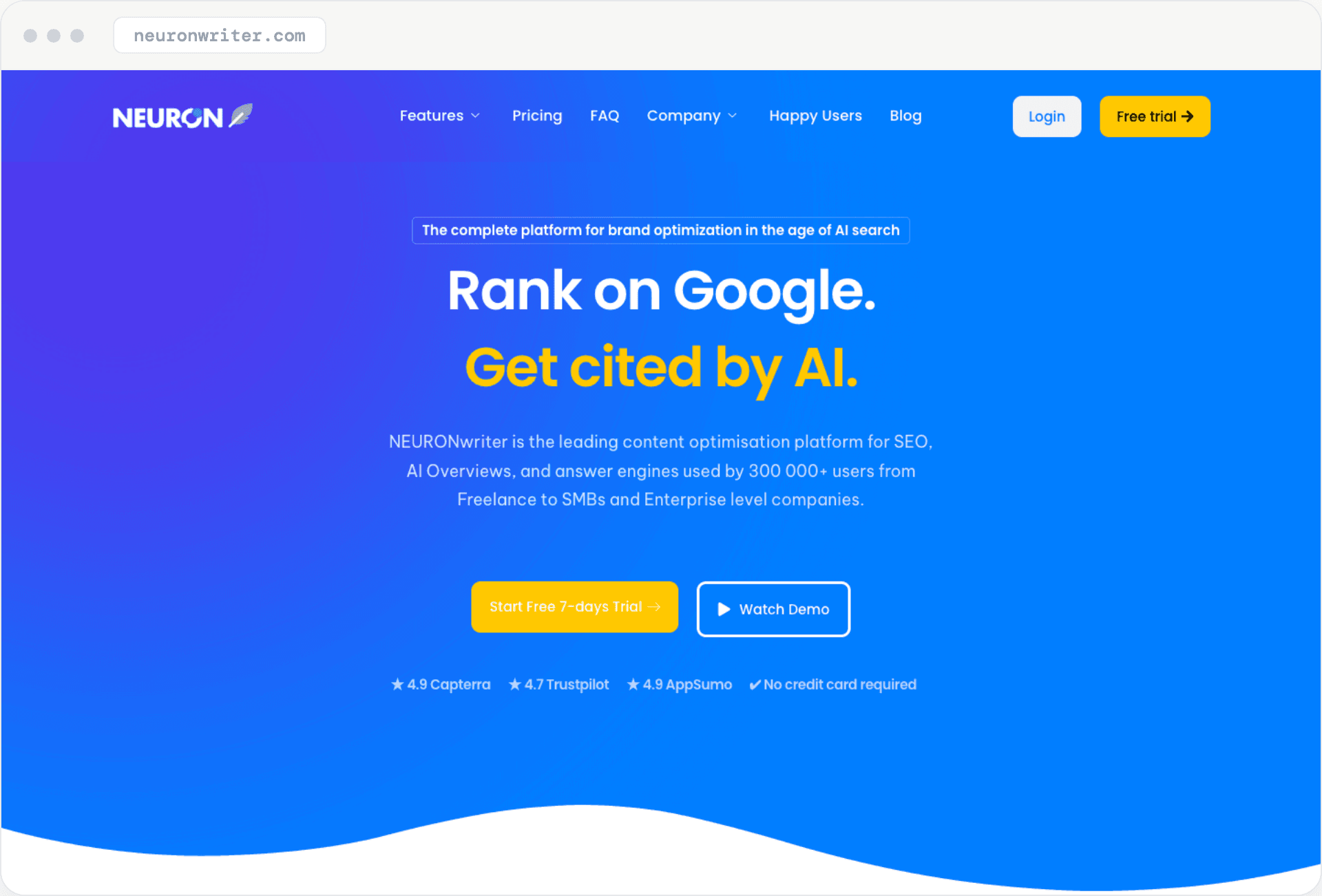
Best for: budget-conscious bloggers and SEOs wanting real semantic optimization without a big-team price tag.
NeuronWriter does the core job, SERP analysis, term suggestions, internal-link recommendations, and a content score, for the lowest entry price on this list.
That price is the headline. The Bronze plan is about $23 a month, or $19 on annual billing, with Silver and Gold tiers stepping up from there. For a writer publishing a few posts a month, NeuronWriter optimizes each article for roughly a dollar, which is why it is the value pick here.
What works:
- lowest entry price on this list at roughly $19-23 a month
- covers the core job - SERP analysis, term suggestions, internal-link recommendations, content score - without a big-team price tag
- an AI-visibility add-on tracks mentions in ChatGPT, Perplexity, and AI Overviews for a low added cost
What doesn't:
- interface is more utilitarian than Surfer's or Clearscope's, and support is lighter
- reviewers report the built-in AI writer's drafts need more cleanup than the pricier tools' output
- AI-visibility tracking is a separate add-on, not bundled into the base price
NeuronWriter's AI visibility module tracks mentions in ChatGPT, Perplexity, and AI Overviews, though it requires a separate add-on. Like the others at this price, it monitors rather than grades. As a low-cost way to make sure a draft covers its topic, it is still hard to beat.
Clearscope
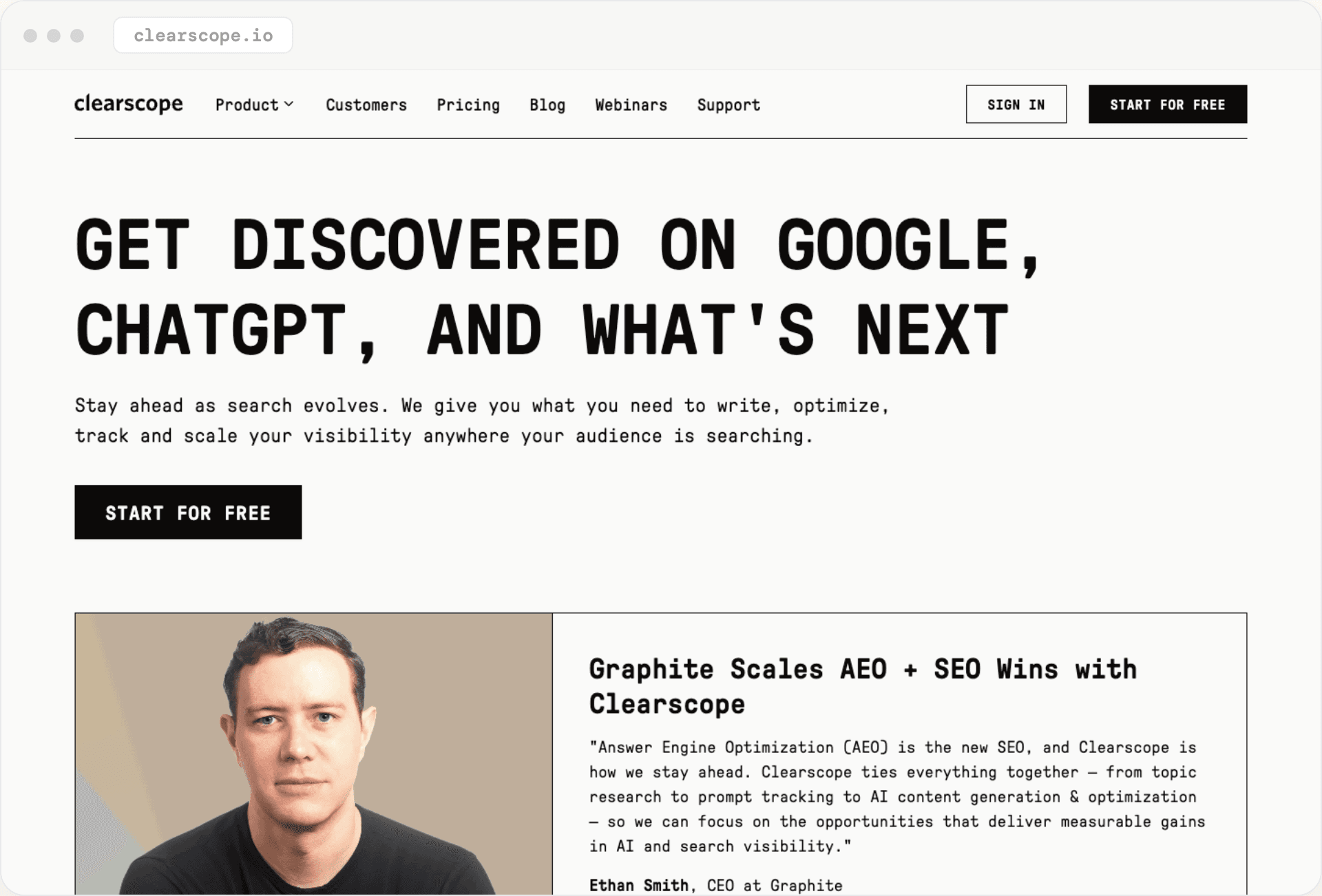
Best for: in-house editorial teams and premium publishers putting content quality first.
Clearscope built its reputation on a clean grading algorithm and tight Google Docs integration, and its term recommendations are frequently cited by reviewers as among the more trusted in the category. If your job is to make good writers slightly better and hold a house standard, it is excellent.
A note on honesty: Clearscope has no affiliate program, so the link here earns us nothing. We include it because leaving out the best premium grader would make this list less useful, which is the whole point.
Price is still the barrier. Clearscope starts at $129 a month for Essentials and jumps to $399 for Business, now with a 14-day free trial on every tier, per its pricing page. That is built for funded teams, not solo writers, and cost is still the most common complaint in reviews even with the trial.
What works:
- clean, trusted grading algorithm with tight Google Docs integration
- a 14-day free trial now runs on every tier, Essentials through Business
- prompt tracking watches whether ChatGPT and Gemini mention your brand
What doesn't:
- $129-399/mo puts it out of reach for solos and small teams
- narrow by design: it grades and recommends, but doesn't plan clusters or monitor content decay
- the well-known A-to-F grade is an SEO content grade, not an AI-citation grade
The tool is narrow by design. It grades and recommends; it does not plan clusters, audit a whole site, or monitor content decay the way MarketMuse does. You are paying a premium for one job done very well. Its prompt tracking watches whether ChatGPT and Gemini mention your brand, but the tracking tells you where you stand while the grade itself still measures resemblance to top Google results.
MarketMuse
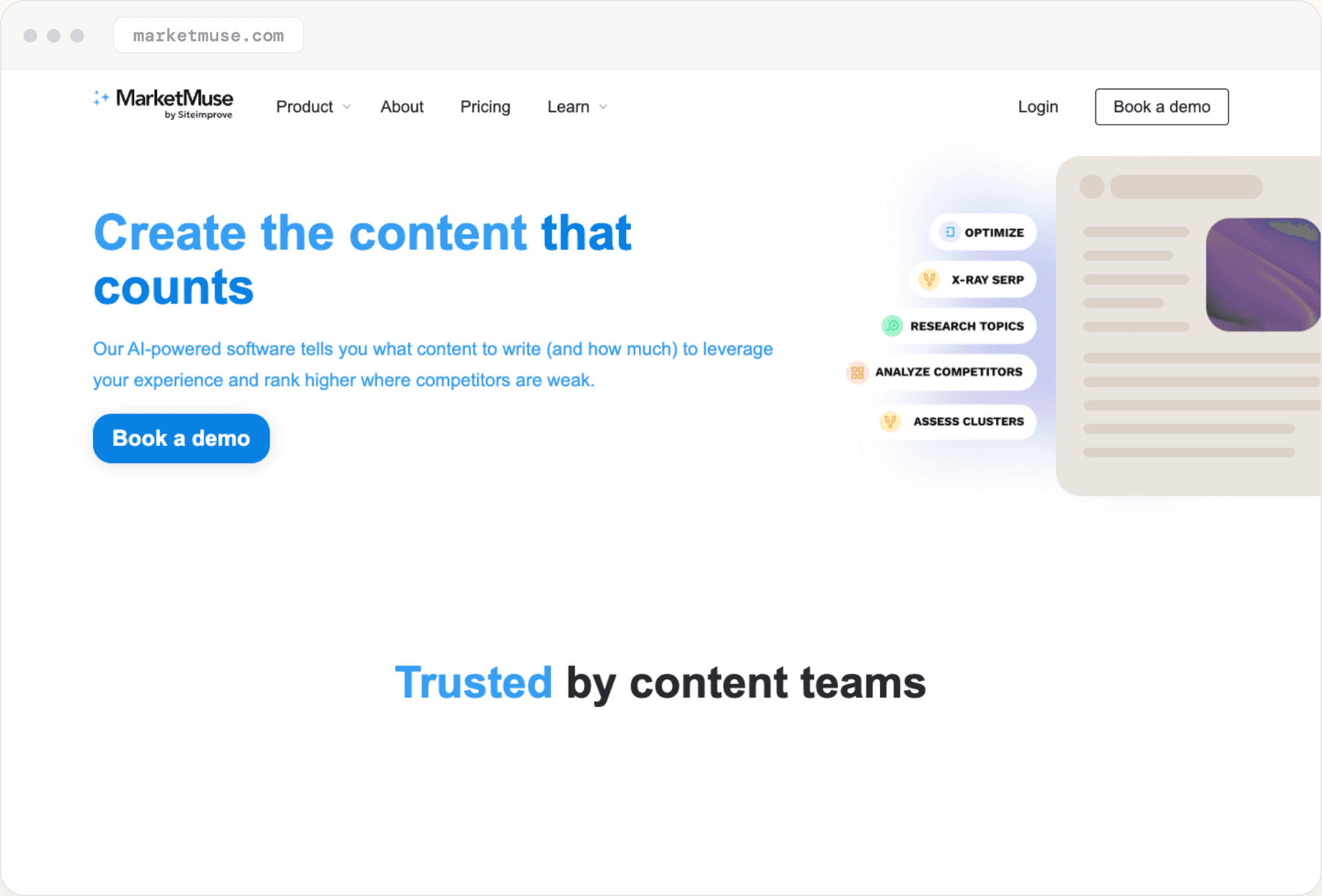
Best for: teams building topical authority across a whole site rather than optimizing one page at a time.
MarketMuse models a topic in depth, finds content gaps, plans clusters, and is one of the few tools with native content-decay monitoring, flagging pages that are slipping before you notice the traffic drop.
It runs a free plan plus paid tiers above it. MarketMuse no longer publishes its prices and routes you to a demo, so confirm the figure for your team size on the MarketMuse pricing page. It has no standard affiliate program either, so this is a straight recommendation, not a paid one.
What works:
- models a topic in depth and plans clusters across a whole site, not just one page
- one of the few tools with native content-decay monitoring
- a genuine free plan exists alongside the paid, demo-gated tiers
What doesn't:
- steep learning curve; overkill for a small site without a cluster plan
- pricing is demo-gated, so you cannot compare cost against the other six without a sales call
- no AI-visibility tracking of any kind, even after the Siteimprove acquisition
The weakness is the learning curve. MarketMuse is a strategy platform, and for a small site without a cluster plan it is overkill, with a feature set you will pay for and barely use. Its AI first drafts, like most on this list, need heavy editing. On AI citation, MarketMuse is the holdout: since the Siteimprove acquisition it has added no AI-visibility tracking, so it is the one tool here that still cannot tell you whether AI mentions you. It stays a planning brain - thorough topical coverage helps AI pick sources, but MarketMuse measures none of it.
SE Ranking

Best for: people wanting content optimization without buying a separate tool for it.
SE Ranking is a full SEO platform, rank tracking, audits, and keyword research, and it folds a content editor and optimization scoring into the same subscription. If you are already shopping for an all-in-one and want the writing-time optimizer included, it consolidates the stack.
Pricing reflects the broader scope, and now runs in EUR rather than USD. Core starts around €87 a month on annual billing (€109 month to month), and Growth around €188 a month annual (€235 month to month), after a restructure into Core, Growth, and Enterprise tiers, with a 14-day trial, per the SE Ranking pricing page. You are paying for the whole platform, not just the optimizer.
What works:
- one subscription covers rank tracking, audits, keyword research, and the content editor
- AI Visibility Tracker monitors AI Overviews, AI Mode, ChatGPT, Gemini, and Perplexity in one dashboard
- a 14-day trial with no credit card required
What doesn't:
- if all you want is a content editor, a dedicated tool like Surfer or NeuronWriter does that one job better
- AI Visibility ships as a paid add-on (+€63/mo annual) on top of Core or Growth, not bundled in
- pricing now displays in EUR, so US buyers should convert before comparing to the other six
SE Ranking's AI Visibility Tracker monitors AI Overviews, AI Mode, ChatGPT, Gemini, and Perplexity, sold as an add-on on top of the base plan. Like most here it tracks mentions rather than grading a page, but it is one of the more complete monitors if you want AI visibility inside a single SEO platform.
A Few Others Worth Naming
Four tools did not earn a full entry but belong on your radar. Semrush bundles a content optimizer, the SEO Writing Assistant, inside its larger suite; it is convenient if you already pay for Semrush, but weaker than a dedicated scorer. Dashword is a lighter, cheaper brief-and-score tool that small teams like. PageOptimizer Pro is the technical, manual option favored by SEOs who want to control the inputs. GrowthBar folds optimization into a blogging workflow. None changes the picture above, and the same caveat applies to all of them: the score is a Google-resemblance metric, not a citability grade.
What the AI Trackers Still Don't Do: Grade Your Live Page
The AI gold rush reached the optimizers, and most of them now track whether AI engines mention your brand. That closes one gap and leaves another wide open.
Tracking tells you where you stand. It does not tell you why a specific page is or is not getting cited, or what to change. Most of the AI features above are built for content you draft inside the tool's own editor. Frase is the exception that goes furthest: it can import a live URL you already published into its paid workspace and run the same GEO score and fixes against it. Getting your existing pages quoted is its own discipline, generative engine optimization, and it is real enough that researchers now build formal evaluations for it.
So the real split is not two buckets, it is three jobs.
| Job | What it answers | Tools that do it |
|---|---|---|
| Optimize for Google | Does my draft resemble the ranking pages? | All seven optimizers |
| Track AI mentions | Am I showing up in AI answers, and where? | Surfer, Frase, Clearscope, SE Ranking, Scalenut, NeuronWriter |
| Grade a live page for citability | Why is this page not cited, and what do I fix? | Frase (imports the URL into its paid editor), GEO Toolbox (any URL, no import or seat needed) |
That third job is the one the category still under-serves, and the dedicated AI-visibility platforms handle the tracking without the page-level grade either. Our Content Analyzer is built for it: paste any live URL and it returns an A-to-F citability grade, a check of which AI engines cite the page, and the specific fixes, scored against the signals shared by the pages AI actually cites, the direct answers, the structured facts, the entity coverage and trust markers, not resemblance to the top ten Google results. It works on any URL you paste with no import step and no editor seat required, and it is included on every GEO Toolbox plan, from $99 a month ($79 billed annually) with a 7-day free trial, closer to Clearscope's and SE Ranking's price band than to the budget end of the optimizers above.
Pair an optimizer with a real citability grade and you cover all three jobs: rank with Surfer or Frase, and find out whether your best-optimized page is actually citable or just well-scored.
Which Content Optimization Tool Should You Actually Buy?
The right answer depends on the job, not the leaderboard. Mapped to the most common situations:
- Solo blogger or freelancer on a budget: NeuronWriter for the cheapest real optimization, or Frase if you also want briefs and a draft in one place.
- Content team optimizing at volume: Surfer SEO. The editor is fast and the workflow scales, even though its content score correlates with rankings about as weakly as Frase's and Clearscope's, per the independent testing cited above.
- Editorial team that lives on quality: Clearscope, if the budget is there and grading is the priority.
- Site-wide content strategy: MarketMuse for clusters, gaps, and decay monitoring.
- One tool for everything: SE Ranking or Scalenut, depending on whether you want a full SEO suite or a content-first lifecycle.
- Brand that needs to show up in AI answers: any optimizer above for Google, paired with a tool that measures AI citation.
Whichever you pick, set the score target at "covered" rather than 100, and spend the time you save on original data and clear answers. That is the part that ranks past the first gate, and the part an AI engine can actually quote.
Frequently Asked Questions
What are content optimization tools?
Content optimization tools score a draft against the pages already ranking for your target keyword and tell you which terms, headings, and length to match. Most run inside a Google Docs or WordPress editor and update the score in real time as you write. The best known are Surfer, Frase, and Clearscope.
Do content optimization tools actually improve rankings?
They help with one part of ranking, topical relevance, and not much beyond it. Surfer's own study found its content score correlates with ranking position at about 0.28, a weak positive relationship, and independent tests put some tools lower. The score clears Google's first gate; links, authority, and intent decide the rest.
What is the best free content optimization tool?
There is no strong fully free option, but the cheapest paid tools cover the core job. NeuronWriter starts around $23 a month ($19 on annual billing), and MarketMuse has a limited free plan. Frase offers a 7-day trial rather than a free tier. For a genuinely free check, Mangools runs a single-page content optimizer with no account needed.
Surfer vs Frase: which should I pick?
Pick Surfer if you optimize at volume and want a fast, polished editor. Pick Frase if you want SERP research, a brief, and a draft in one cheaper interface, plus a GEO score that grades pages against what AI cites. On raw scoring correlation to rankings, independent testing rates the two roughly the same, both weak; Surfer wins on editor polish, Frase wins on workflow, price, and the page-grading piece of AI citation (both reach full 5-engine tracking breadth only on a higher tier).
Do content optimization tools help you get cited by ChatGPT?
Most of them now track it. Surfer, Frase, Clearscope, SE Ranking, Scalenut, and NeuronWriter all added some form of AI-visibility tracking in 2025 and 2026, so they can show whether ChatGPT, Perplexity, or AI Overviews mention your brand. Tracking is not the same as fixing, though. Frase comes closest: paste a live URL and it imports the page into its paid workspace, then runs its GEO score and fixes against it. What stays uncommon is a tool that grades any URL you paste with no import step and no paid seat required, separate from a Google content score with tracking bolted on.
Can you over-optimize content?
Yes. Pushing a draft to a 100 score usually means adding terms and headings the reader does not need, which reads worse and can do more harm than good. Most experienced writers stop around 70 and spend the rest of the effort on originality and clarity.
The Score Is a Means, Not the Goal
A content optimization tool is worth paying for. It turns "did I cover the topic" from a guess into a target, and on a team it keeps quality consistent. Just hold the number in perspective: it confirms you cleared topical relevance, not that you will rank, and not that any AI engine will quote you.
Pick the tool that fits your budget and workflow from the list above, optimize to "covered," and put the saved hours into original data and clear answers. Then check the part the optimizers track but do not grade: grade any live URL for AI-citability with our Content Analyzer, and find out whether your best-optimized page is citable or just well-scored.
Sources
- Surfer SEO content score study, content score to ranking-position correlation (0.28) -
surferseo.com/blog/surfer-content-score-study - Ahrefs SEO content score study, independent multi-tool score-versus-ranking analysis -
ahrefs.com/blog/seo-content-score-study - Search Engine Land: content scoring works, but only for the first gate -
searchengineland.com/content-scoring-tools-work-but-only-for-the-first-gate-in-googles-pipeline-469871 - Surfer SEO: making AI-generated content not feel like AI -
surferseo.com/blog/ai-generated-content - SAGEO Arena: evaluating generative engine optimization (arXiv) -
arxiv.org/abs/2602.12187 - Pricing pages, re-verified live September 2026: Surfer SEO, Frase, Scalenut, NeuronWriter, Clearscope, MarketMuse, SE Ranking -
surferseo.com/pricing-frase.io/pricing-scalenut.com/pricing-neuronwriter.com/pricing-clearscope.io/pricing-marketmuse.com/pricing-seranking.com/subscription.html - Surfer SEO subscription migration FAQ (AI Tracker bundling, May 2026) -
docs.surferseo.com/en/articles/12944180-subscription-migration-faq