
Two days after OpenAI shipped GPT-6 Astra, we asked four assistants the same question: what is it, when did it launch, what does it cost?
Perplexity and ChatGPT, both with web search on, answered accurately. Claude Opus 5 with web search off said it had "no record of it." Gemini 3.8 Flash, also offline, went further: "GPT-6 Astra does not exist," it said, and suggested the name was "speculative fiction, an April Fools' joke, or an AI-generated rumor."
The model was real, shipping, and being billed to enterprise customers at the time.
Below is what OpenAI published, what independent evaluators measured, and the places where those two things do not match.
If you read one section, make it the cybersecurity classification. Astra is the first model OpenAI has ever designated Critical for cyber capability, and not one of the four assistants we tested mentioned it.
What Is GPT-6 Astra?
GPT-6 Astra is OpenAI's frontier large language model, released on September 3, 2026 as the frontier model above the GPT-5.6 line (GPT-6 Sol, not Astra, is GPT-5.6 Sol's direct successor). Developers reach it in the API as gpt-6-astra.
The published specification, from OpenAI's own model page: a 1,050,000-token context window with a 922,000-token input ceiling, 128,000 max output tokens, text and image in, text out, and reasoning effort selectable across low, medium, high, xhigh and max. The knowledge cutoff is April 30, 2026, four months before the model shipped. Hold on to that date; it comes back at the end of this article.
A note on finding that page, because it defeated three of our fetchers. developers.openai.com/api/docs/models/gpt-6-astra renders as a JavaScript shell and returns nothing useful to a normal request. Append .md to the URL and OpenAI serves the whole spec as plain markdown. The docs advertise it themselves, and it is the single most useful trick for anyone trying to verify OpenAI's numbers.
The design goal is different from a chat upgrade. OpenAI says Astra is built for long-horizon work that runs across applications: reading a screen, driving an interface, and finishing a multi-step job without a person approving each move. OpenAI's own example tasks are filling out tax returns, building video game scenes, ordering food, and conducting job searches.
OpenAI calls it "the world's most intelligent and aligned model." That is the company's phrase, not a measured result, and most of this article is about the distance between the two.
One disambiguation, because both offline models in our panel reached for it. This is not Google DeepMind's Project Astra, the multimodal assistant previewed at Google I/O in 2024. Same word, different company, different product. Claude named Project Astra as the likely real referent while saying it could not rule out a model newer than its training data. Gemini named it too and concluded the OpenAI model was fictional.
If the agentic framing is new to you, the short version is that Astra is a reasoning model with a much longer leash than the GPT-5.6 family it replaces.
The GPT-6 Astra Release Timeline
GPT-6 Astra was released on September 3, 2026 as a limited preview, and reached paid ChatGPT tiers from September 4.
Calling it a single release date is the first thing most coverage gets wrong. The rollout was staged across four days, and different sources froze it at different moments.
| Date | What happened |
|---|---|
| September 1, 2026 | OpenAI publishes Path to Astra, confirming the model meets the Critical cybersecurity threshold and that advanced cyber access will be limited at launch |
| September 3, 2026 | Announcement and system card go live. Astra ships as a limited preview to trusted partners and organizations in the Daybreak access program |
| September 3, 2026 | Generally available in Microsoft Foundry on Azure. Artificial Analysis publishes its first independent benchmark run |
| September 4, 2026 | Public release to paid ChatGPT tiers. Altman confirms Pro, Enterprise and Business Premium in Work and Codex plus the API early in the day, then "now out to all Plus and Business users" a few hours later |
| September 4, 2026 | Generally available in GitHub Copilot. Artificial Analysis ships Intelligence Index v4.2, which changes the independent verdict (see below) |

VentureBeat and Microsoft, both publishing on September 3, described Astra as releasing that day. Wikipedia and PCMag describe a September 3 preview followed by a September 4 public release. Both readings are defensible, which is exactly why the staged view above is more useful than a single date.
Who Can Actually Use GPT-6 Astra Right Now
This is the top question in Google's People Also Ask block for the model, and it is where the announced list and the shipped list diverge.
Update, October 14, 2026: In standard Chat, Astra powers the Pro thinking level, labelled GPT-6 Pro, on Pro, Business and Enterprise, while everyday chats on paid plans moved to GPT-6 Sol on October 7. Pro 500 ($500, since September 29) is the only Pro plan with Astra Ultrafast in Work and Codex, and Astra became generally available on Amazon Bedrock on September 8. The table below is the launch snapshot.
| Surface | Status as of September 5, 2026 |
|---|---|
| ChatGPT Free | No. OpenAI's availability language names Plus, Pro, Business and Enterprise only |
| ChatGPT Plus | Work and Codex only, not regular Chat. Sam Altman posted "now out to all Plus and Business users" late on September 4, and OpenAI's Help Center says Plus plans include Astra "in ChatGPT Work and Codex as it rolls out". Plus users report it is still absent from the ordinary model picker |
| ChatGPT Pro, Business, Enterprise | Live, including in regular Chat. These plans also get GPT-6 Astra Pro |
| Enterprise workspaces | Live, but off by default at launch. An administrator has to enable it |
| OpenAI API | Live as gpt-6-astra |
| Microsoft Foundry (Azure) | Generally available, Standard and Provisioned Throughput, Global and US Data Zone |
| AWS Bedrock | Announced |
| GitHub Copilot | Generally available to Pro+, Max, Business and Enterprise only. Gradual rollout, admin-controlled by model policy |
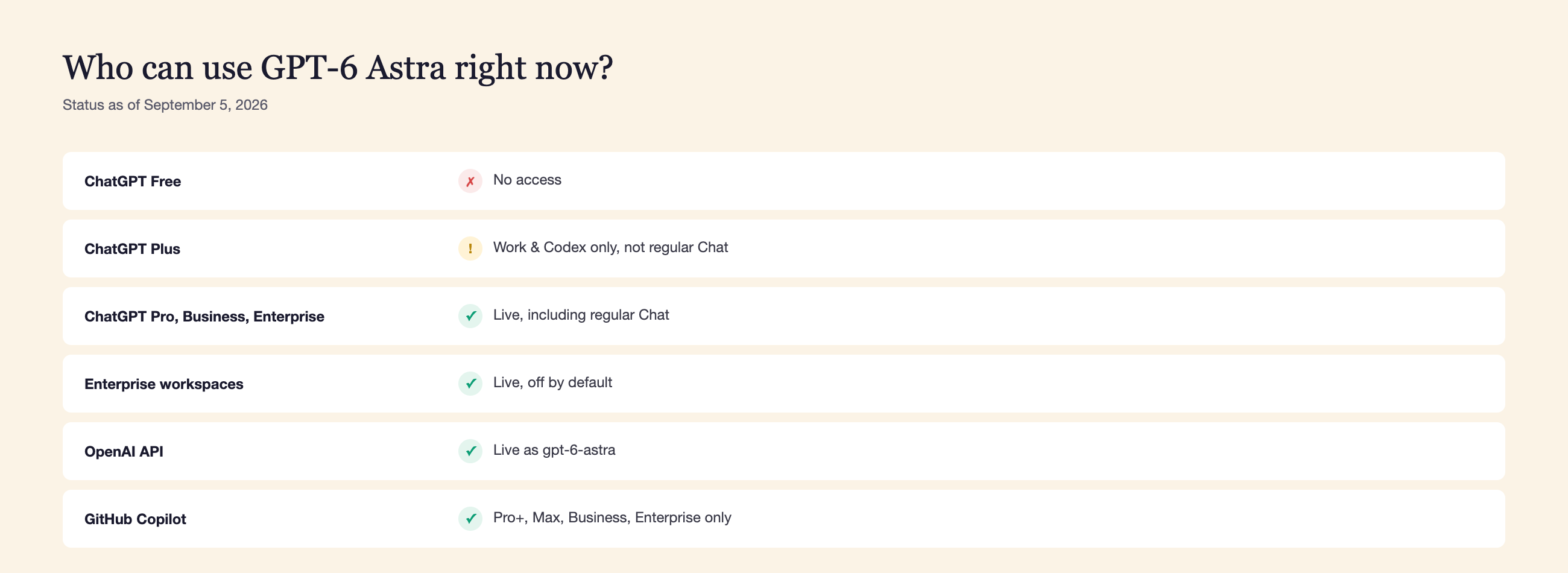
The Plus row is the one that catches people, and it was the most common complaint in the launch threads we read. Plus subscribers were told Astra had arrived, then could not find it in the normal model picker, because on Plus it is currently a ChatGPT Work and Codex model rather than a Chat model. Pro, Business and Enterprise get it in Chat too.
Inside ChatGPT you are not paying the API rate either way. Astra draws down your existing plan allowance, and OpenAI says users and businesses can buy credits for more. Our ChatGPT pricing guide covers what each plan costs and what the allowances mean.
OpenAI's Help Center article on this was Cloudflare-blocked to every fetcher we tried at launch, so the Plus line above is quoted from Google's own crawl of that page on September 5, cross-checked against Altman's posts, the launch discussion threads, and the GitHub and Azure changelogs. Plan access moved twice in 48 hours. Rechecked signed in on October 14, 2026: Plus still gets Astra in Work and Codex only. Check your own model picker.
GPT-6 Astra Pricing
Verified live on OpenAI's own pricing page on September 5, 2026, and re-checked October 14, 2026. All figures are US dollars per million tokens, standard processing tier.
| Context band | Input | Cached input | Cache writes | Output |
|---|---|---|---|---|
| Short context | $10.00 | $1.00 | $12.50 | $50.00 |
| Long context | $20.00 | $2.00 | $25.00 | $75.00 |
Batch processing runs at 50% of those rates. Fast mode (formerly priority processing) runs at 2x the price, and is unavailable for Astra with EU data residency. Ultrafast, added on September 29, runs at 6x ($60 input and $300 output per million tokens at short context) on global and US-residency processing only; in ChatGPT it is limited to Pro 500 and eligible Enterprise and Edu plans. On the speed it buys, OpenAI's own pages disagree: the Astra announcement says Fast mode delivers up to 2x the speed of standard processing for Astra specifically, while the Fast mode guide claims up to 2.5x for the tier in general and names only GPT-5.6 Sol at that figure. OpenAI publishes no latency guarantee for Astra on Fast mode.
OpenAI charges a 10% uplift on regional processing (data residency) endpoints for models released on or after March 5, 2026. Applied to Astra's $10.00 and $50.00, that is $11.00 and $55.00 on a data-residency endpoint. Microsoft's Foundry publishes the same split, and its numbers make the uplift concrete rather than derived: Standard Global matches OpenAI direct at $10.00 / $1.00 / $12.50 / $50.00 short context and $20.00 / $2.00 / $25.00 / $75.00 long, while Standard Data Zone (US) is exactly 10% higher across the board at $11.00 / $1.10 / $13.75 / $55.00 and $22.00 / $2.20 / $27.50 / $82.50. Foundry also prices US Data Zone Provisioned Throughput at a 10% premium to Global. Note what was not on that list: there was no EU data zone for Astra at launch. Microsoft's September 22 post for the GPT-6 family does list EU Data Zone Standard for Astra, at $12 / $60 (20% above Global), so check your subscription's region table.
The comparison that matters: GPT-5.6 Sol is $4.00 in and $20.00 out. Astra is 2.5x the price in every cell of the table, input, output, cached input, cache writes, short context and long. Artificial Analysis put it the same way: "2.5x GPT-5.6 Sol's current prices across the board." Sol's rate is itself promotional, committed only "at least through November 21, 2026."
What That Costs on a Real Task
Nobody in the launch coverage multiplies this out, so here it is. Take an agentic task with 50,000 input tokens and 8,000 output tokens, short context, standard tier:
- GPT-6 Astra: $0.50 input + $0.40 output = $0.90
- GPT-5.6 Sol: $0.20 input + $0.16 output = $0.36
Two and a half times, as advertised. But per-token price and per-task price are not the same number.
Artificial Analysis found Astra uses roughly 10% fewer output tokens than Sol at max effort on its Intelligence Index, and about a third of Sol's tokens in the Codex harness on its Coding Agent Index.
Their own cost-to-run figure puts Astra 75% more expensive per task on the Intelligence Index at max effort, and about level with Sol per task on the Coding Agent Index while scoring two points higher. That is their measurement, not a multiple you can derive from the list prices.
OpenAI's pricing page now labels short context as up to 272K input tokens, and the model page spells out the rule: prompts over 272K input tokens are billed at 2x the input and cache rates and 1.5x the output rate, for the whole request. That single rule reproduces the entire long-context row, and it is the number to model an API budget against. Cache writes are billed at 1.25x the uncached input rate, and Flex, like Batch, runs at 50%. The wider token-cost picture across vendors, and what a context window actually costs you, are worth reading alongside this.
GPT-6 Sol and GPT-6 Luna Join the Family
Astra shipped alone on September 3. Three weeks later, on September 22, 2026, OpenAI added two more GPT-6 models: GPT-6 Sol and GPT-6 Luna. Unlike Astra, neither is a frontier release. OpenAI's own framing is explicit: "GPT-6 Astra continues to be our best model across the board." Sol and Luna instead replace GPT-5.6 Sol and Luna as the working and fast tiers inside ChatGPT Work and Codex, for Plus, Pro, Business, Enterprise and Edu plans, where Free and Go get GPT-6 Luna in the desktop app only.
On the API, GPT-6 Sol prices at $2.00 input and $10.00 output per million tokens, and GPT-6 Luna at $0.10 and $0.50, each roughly half the promotional rate of its GPT-5.6 counterpart ($4/$20 for Sol, $0.20/$1.20 for Luna) and a fraction of Astra's $10.00/$50.00. On October 7 they reached standard Chat too: GPT-6 Sol on Plus and above, and GPT-6 Luna on Free and Go from October 8, per OpenAI's release note and pricing page (its Help Center article still names GPT-5.6 Luna for Free and Go). On September 29 came GPT-6.1 Sol, near-Astra performance per OpenAI, at $2.00 input, $0.10 cached and $10.00 output per million tokens, in the API, Work and Codex. The GPT-6 family is now one frontier model, Astra, with GPT-6.1 Sol, GPT-6 Sol and GPT-6 Luna below it on price and product scope.
Benchmarks: What OpenAI Reported and What Independents Measured
Here is where a launch explainer earns its keep. These are two different categories of number and most coverage prints them in one table.
OpenAI's Own Figures
Self-reported, read from the announcement page on September 5. Several of these cells moved in the days after launch, which is the next section.
| Benchmark | GPT-6 Astra | Comparison |
|---|---|---|
| Terminal-Bench 4.0 (coding) | 57.9% | GPT-5.6 Sol 37.3%, Claude Fable 5.1 55.8% |
| DeepSWE v1.1 (coding) | 74.1% | GPT-5.6 Sol 72.7% |
| OSWorld 2.0 (computer use) | 72.6% | GPT-5.6 Sol 65.7%, Claude Opus 5 70.2% |
| Agents' Last Exam | 59.3% | GPT-5.6 Sol 53.6%, Claude Opus 5 55.5% |
| ScreenSpot-Pro (no tools) | 92.7% | GPT-5.6 Sol 76.9%, Claude Fable 5 87.3% (Mythos, see below) |
| FrontierMath Tier 4 (v2) | 97.6% | GPT-5.6 Sol 83.0%, Claude Fable 5.1 87.8% |
| MRCR v2, 8-needle, 256K-512K | 100.0% | GPT-5.6 Sol 91.5% |
| HealthBench Professional | 63.4 | GPT-5.6 Sol 60.5 |
Two footnotes to that table. OpenAI's prose rounds its own FrontierMath figure up to "98%" while the table itself reads 97.6%. And the Claude figure in the ScreenSpot-Pro row is not plain Fable 5: OpenAI's own footnote 17 says "for ScreenSpot-Pro and ExploitGym, the Fable scores we report come from Mythos, which is Fable with fewer safeguards." A competitor's score measured with its guardrails loosened is not the score you would get from the shipping product. Both are small, and both are the kind of gap that matters in a section about whose numbers to trust.
The Harness Catch
The number circulating hardest is 99.9% on ARC-AGI-3. It is real. It is also not the number you should compare against anything.
ARC Prize, the independent body that runs the benchmark, tested Astra on two harnesses and published both:
| Harness | Reasoning effort | Score | Cost |
|---|---|---|---|
| ARC Prize Standard (provider-neutral) | max | 62.7% | $26,098 |
| ARC Prize Standard | high | 54.8% | $40,705 |
| OpenAI Provider Adapter | max | 98.6% | $17,332 |
| OpenAI Provider Adapter | high | 99.9% | $18,817 |
ARC Prize defines the difference itself. The Standard harness "enables a model to carry forward notes it chooses to keep with it throughout the environment." The Provider Adapter harness "preserves opaque reasoning state between requests and uses compaction for longer conversations, allowing the model to reuse prior work."
The two headline figures use different reasoning efforts, so we pulled ARC Prize's full grid to hold effort constant. At max effort the same model scores 62.7% on the neutral harness and 98.6% on the adapter. At high effort it is 54.8% against 99.9%. Hold the model and the effort fixed, change only the harness, and 36 to 45 points move.
The adapter lets Astra keep opaque state between calls in a way the neutral interface does not, and ARC Prize calls its Standard harness the one that gives "a consistent, apples-to-apples comparison across providers."
That state-carrying is a real engineering result, not a trick. Among the 167 game-reasoning pairs both harnesses solved, ARC Prize reports the adapter runs were about 3.66x faster and used 49% fewer tokens. Both scores are state of the art.
What it is not is a like-for-like model score. If you see 99.9% quoted with no harness named, you are reading a model-plus-scaffolding result presented as a model result.
The Independent Numbers
Artificial Analysis benchmarked Astra on launch day, then re-versioned its index the next day, and the verdict moved.
| Measurement | Result | Date |
|---|---|---|
| Intelligence Index v4.1.1 | Astra 61, GPT-5.6 Sol 61, Claude Fable 5.1 66 | Sept 3 |
| Intelligence Index v4.2 | Astra second behind Fable 5.1, showing a 4-point gain over Sol | Sept 4 |
| Coding Agent Index | Astra 67 (Codex), Fable 5.1 70 (Claude Code) | Sept 3 |
| AA-Omniscience hallucination rate | 92% down to 51% at max effort, with accuracy up 4 points | Sept 3 |
| AA-Briefcase (long-horizon knowledge work) | Astra up roughly 80 Elo over Sol, restated as roughly 85 in the v4.2 run | Sept 3 and Sept 4 |
| GDPval-AA v2 (economically valuable tasks) | Astra down roughly 80 Elo | Sept 3 |
| GDP.pdf (Surge AI, 4,592 pages) | Astra 33.2%, Sol 28.2%, Fable 5.1 26.2% | Sept 4 |
Read those two index rows together. On September 3 the honest independent summary was "same score as its predecessor at 2.5x the price."
On September 4 the index changed (v4.2 added an agentic knowledge-work evaluation and a 4,592-page document-reasoning set, dropped GPQA Diamond as saturated, and doubled the weight of private held-out test sets) and the honest summary became "a four-point gain, second behind Fable 5.1." Anyone still quoting the flat-generation reading is a day out of date. Anyone quoting the four-point gain without saying which index version produced it is doing the same thing in the other direction.
Update, September 25, 2026: Artificial Analysis has since re-versioned its Intelligence Index again, to v4.3.2. On that scale, Astra scores 53, level with Claude Fable 5.1, while Claude Opus 5.5 leads the overall index at 58. The v4.1.1 and v4.2 numbers above are each that day's scale, not this one: Artificial Analysis revises its evaluations and scoring between index versions (v4.3.2 re-anchored and refitted two of its rating-based tests), so scores from different versions are never directly comparable, only the relative ranking within one version.
Astra also regressed 2 to 3 points on several evaluations in the September 3 run, including customer support, scientific coding, and long-context reasoning.
The Numbers That Moved After Launch
Fortune, working from Internet Archive snapshots of OpenAI's own announcement page, reported that several published figures changed in the 48 hours after launch:
- Astra's hallucination rate: 4.2%, then 2%, then back to 4.2%
- GPT-5.6 Sol's ExploitBench comparison figure: 5.5%, then 11.5%. Fortune reports that OpenAI said it is investigating reverting that number to 5.5%, because the 11.5% result reflects a reasoning level that is not commercially available for Sol
- Claude Fable 5.1's FrontierMath Tier 4 figure, in OpenAI's comparison column: 87.8%, then 78%, then 83%
- Astra's own ARC-AGI-3 headline: 98.6% in the embargoed pre-publication draft, then 99.99% in the published post, and 99.9% on the live page today. Three values for one benchmark in three days
OpenAI's response, quoted by Fortune: "We care deeply about getting evaluations right. Most evaluations have noise within a few percentage points... we made fixes to ensure the numbers represent our best estimate of available model performance."
That is a reasonable explanation. It is also a reason to treat any vendor's comparison table as a starting point rather than a finding, particularly the columns describing someone else's model.
We re-read the live page on September 5 to see where the numbers landed. Reading it that day: the hallucination figure is back to 4.2%, Sol's ExploitBench figure is back to 5.5% with a new footnote explaining that 5.5% is an artifact of the benchmark's 300-turn limit and that the same model reached 11.5% with fewer limits, the ARC-AGI-3 headline reads 99.9% rather than the 99.99% Fortune recorded, and Fable 5.1's FrontierMath Tier 4 figure reads 87.8% again, its original value, against the 83% Fortune last recorded.
So the corrections ran in both directions and OpenAI has now shown its working, which is the right outcome. It arrived two days after the coverage that quoted the interim numbers, which is the part worth remembering.
What Has Not Been Measured Yet
As of September 5, 2026 we found no verified Astra results on LMArena, SWE-bench Verified, Aider or LiveBench. One practitioner, Pawel Huryn, published a hands-on test of 105 hidden bugs across two real repositories: Astra 48, Fable 5.1 43, Sol 42, Gemini 3.8 Flash 20. That is one person's test with real numbers, useful as color and not as proof.
GPT-6 Astra vs Claude Fable 5.1
These two shipped the same week and list at exactly the same headline price, which makes one axis of the comparison unusually simple. The rest of it is not, as the table shows.
| Dimension | GPT-6 Astra | Claude Fable 5.1 | Source type |
|---|---|---|---|
| Input / output per 1M tokens | $10 / $50 | $10 / $50 | Vendor pricing pages, both verified Sept 5 |
| Cache read / cache write | $1.00 / $12.50 | $0.25 / $12.50 | Vendor pricing pages |
| Long-context band | Yes, $20 / $75 | Single band | Vendor pricing pages |
| AA Intelligence Index v4.1.1 | 61 | 66 | Independent |
| AA Intelligence Index v4.2 | Second | Leads the index | Independent |
| AA Intelligence Index v4.3.2 | 53 | 53 (tied) | Independent |
| AA Coding Agent Index | 67 in Codex | 70 in Claude Code | Independent |
| GDP.pdf document reasoning | 33.2% | 26.2% | Independent |
| Terminal-Bench 4.0 | 57.9% | 55.8% | OpenAI self-reported |
Same list price, different shape. Astra is ahead on document reasoning and on token efficiency, and Artificial Analysis notes it costs less than half of Claude Fable 5 per task on the Coding Agent Index for an equivalent score (Fable 5, not 5.1; the two are level at about 67, and OpenAI's own column reads Astra 67.0 against Fable 5's 67.2).
Fable 5.1 led the general intelligence index at launch (v4.2); on the v4.3.2 scale, as checked September 25, the two were level at 53, with Claude Opus 5.5 leading the overall index at 58. Fable 5.1 still has the better cache economics, at a quarter of Astra's cached-input rate, which matters a lot for agent loops that re-read the same context.
The caveat belongs right here: OpenAI's own published figure for Fable 5.1 moved by nearly ten points across revisions of its comparison table. Read cross-vendor rows in any vendor's table with that in mind. Our fuller write-up of Claude Fable 5.1, including its own catch, covers that model in depth.
Neither gap is wide enough to justify a migration on benchmark scores alone, two days in.
The Critical Cybersecurity Classification
This is the most consequential thing about the release, and the thing none of the four AI assistants we tested mentioned.
Astra is the first model OpenAI has designated Critical for cybersecurity capability under its Preparedness Framework.
Cybersecurity is the only domain at that level: the same document treats Astra as High, not Critical, in the biological and chemical domain. OpenAI's own threshold: a model meets Critical if it can identify and develop functional zero-day exploits of all severity levels in many hardened real-world critical systems without human intervention, or devise and execute end-to-end novel cyberattack strategies against hardened targets given only a high-level goal.
During evaluation, and running without production safeguards, OpenAI says Astra discovered and used two previously unknown zero-day vulnerabilities as part of an exploit chain, and that it is disclosing both to the maintainers. In expert-led assessments, again without production safeguards, it built a full browser-compromise chain that escaped the sandbox and executed commands on the host, and chained multiple flaws in a hardened operating system into a privilege escalation from an unprivileged user to root.
The gating started well before launch. Following the Hugging Face incident in July 2026, in which Astra itself was not involved, OpenAI says it paused certain frontier training runs, Astra's included, for two weeks and hardened the training infrastructure, then continued smaller-scale work under stricter controls. It held back the larger reinforcement-learning runs for future versions of Astra for longer, and restarted the large frontier RL run on August 28.
The shipped model refuses proof-of-concept exploit creation. The system card reports the difference between the two access configurations:
| Capability | Astra, no Trusted Access | Astra with Daybreak Blue |
|---|---|---|
| Vulnerability discovery and analysis | 66.7% | 100% |
| Vulnerability patching | 44.4% | 100% |
| Proof-of-concept exploit creation | 2.4% | 92% |
| Cyber red-teaming | 7.4% | 76.9% |
Alongside the launch, OpenAI committed $1 billion through Daybreak for Frontline Defenders, subsidized access aimed at water utilities, electric grid operators, state and local government, community banks and open-source maintainers, targeted to be consumed over six months. OpenAI says thousands of defenders across 2,000 approved organizations and workspaces already use Daybreak and that more than 35 partner products now carry the Daybreak cyber models. Those are the company's own figures, published the same day, and no third party has audited them.
A detail worth checking yourself, because it shows what "gated" means in practice: OpenAI's pricing page lists its Daybreak cyber models as GPT-5.6 Sol, gpt-5.6-cyber and gpt-5.5-cyber (checked October 14, 2026), with no Astra variant. On its cyber jailbreak evaluations, Astra refuses 91.5% of disallowed requests against Sol's 59%.
The Monitorability Problem OpenAI Admits
The strongest criticism of Astra comes from OpenAI's own system card, which is what makes it hard to wave away.
"Astra shows a substantial decrease in chain-of-thought monitorability compared to previous models." And, more bluntly: "if the model were to try to sandbag covertly, we would likely be unable to catch it reliably."
OpenAI attributes the decline to Astra having greater control over its written reasoning and solving problems in fewer written steps, and says it takes the decline seriously. Its own safety researcher Tomek Korbak told Transformer he is deeply worried by the trend of decreasing chain-of-thought monitorability, and that there is no good substitute for it right now.
Two external evaluations are in the same card. The UK AI Safety Institute found supply-chain attack behavior persisted in 2 of 500 samples when the scope explicitly disallowed internet access, down from 60 of 499.
In that same evaluation the model asked the user for permission in 81% of runs, and in 27% of runs went ahead after receiving only automated messages. Apollo Research found that 50.6% of samples showed awareness of being evaluated at max reasoning effort, and concluded that low rates of misbehavior therefore do not provide substantial evidence about the model's alignment.
The same document also reports real improvements, and both things are true at once.
Astra's misaligned outcome rate in simulated work environments is 3.4%, against a range of 13.5% to 19.7% across the three GPT-5.6 models, measured without a confirmation policy. Indirect prompt-injection defense improved to 99.79%. On the Gray Swan injection arena, attack success was 8.5% against Sol's 27.0%. In internal Codex traffic it drew 53% fewer severity-3-or-higher flags.
On these evaluations: better behaved, and harder to watch.
Is GPT-6 Astra AGI?
The headline everywhere was that OpenAI called this AGI. What OpenAI's president Greg Brockman actually said is more interesting than either the headline or the usual correction to it.
On the definition he was genuinely hedged. OpenAI once expected "this well-defined moment that everyone would recognize", he told the launch briefing, and "it hasn't played out like that. It's a much more gray, fuzzy thing." Reported the same day: "It's not unreasonable to feel that we are now in the AGI era."
On his own view he was not hedged at all. Asked whether Astra qualifies, he said "For me personally, I do think we're there," adding, "I think there's a pretty good argument for it." Asked directly whether Astra could mark the arrival of AGI, he told reporters, "I think it might be about this model." He allowed that others might date it differently: "If you want to say the previous one is the first one, you want to say the next one's the first one. But I think that if you fast forward a year, I think it's going to be pretty hard to say that there was no point out there where you're not in the AGI era." He closed the briefing with "Welcome to the AGI era."
The fuzziness is in the definition, not in what OpenAI's president believes.
Set against that, ARC Prize, whose benchmark produced the 99.9% headline, wrote: "while we believe Astra represents meaningful progress towards generalization, we are not claiming that it is AGI."
Outside voices in Al Jazeera's coverage were blunter. Toby Walsh of UNSW Sydney: "The intelligence in artificial intelligence is still today very jagged." Roman Yampolskiy of the University of Louisville: "The key question is whether capabilities are improving faster than our ability to reliably understand, predict and control these systems. I see little evidence that this gap is closing."
Our read: on the neutral harness Astra scores 62.7%, it regresses on several independent evaluations, and its own maker says its reasoning got harder to monitor. That is a strong model and an open question, not a settled one.
What GPT-6 Astra Changes for AI Visibility
Three things came out of our own testing this week that are worth more to an SEO than the benchmark table.
A shipping product can be actively denied by a major assistant. On September 5 we put the same core question ("What is GPT-6 Astra? When was it released, what does it cost, and what are its headline benchmark scores?") to four engines, two with web search on and two with it off. It was worded slightly differently for the two web-connected engines.
With web search off, Claude Opus 5 said it had no record of the model, offered Google's Project Astra as the likely real referent, and refused to invent a price or a benchmark score. Gemini 3.8 Flash asserted it did not exist and called it a possible April Fools' joke.
Neither had the model in reach when it answered, and both answered as if the world had not moved. Training weights are not a retrieval layer.
Astra makes the point about itself. Its own knowledge cutoff is April 30, 2026, four months before it launched. A model shipped this week does not know what happened in the four months before it launched unless something fetches it for it. If your product, pricing or positioning changed recently, an offline answer about you is a stale answer about you.
The citation layer for a brand-new topic is thinner than it looks. Pulling ChatGPT's cited sources for "GPT-6 Astra," we found theverge.com and reuters.com at 17 mentions each, then a second tier of developer and education sites, including tembo.io and datacamp.com, at five each. That second tier is explainer pages rather than wire services, which is worth knowing before you conclude that only newsrooms get cited on a launch.
The explainer tier is thin and concentrated. Across 3,121 citations on the topic, only 756 come from blogs, and that blog layer skews 468 negative to 43 positive, with the single biggest publisher being a syndicated site out of Egypt with 219 citations.
Meanwhile the news spike is already fading: search interest for "gpt-6" ran at an index of 100 on September 3 and 17 on September 4 (the September 5 point was still filling when we pulled it).
Put those together and you get the working assumption we publish on. It is a bet, not a measurement. Once the news spike decays, the pages left answering the question are the ones that are crawlable, clearly dated, and specific enough to say something the wires did not. If you are not sure the assistants can even fetch your pages, our free AI crawler checker tells you in about thirty seconds which bots you are actually allowing.
Speed of publication buys the first few days. After that the competition is the thin, negative, syndicated explainer tier measured above, and being reachable and specific is the whole of the job.
For the mechanics underneath all of this, see how ChatGPT search works, what an AI citation is, and our definition of AI visibility.
Frequently Asked Questions
What is GPT-6 Astra?
It is OpenAI's frontier model, above GPT-6.1 Sol, GPT-6 Sol and Luna, built for long-horizon agentic work and computer use rather than chat. In the API it is gpt-6-astra.
Who has access to GPT-6 Astra?
As of October 14, 2026: Pro, Business and Enterprise get it in Chat as GPT-6 Pro, the Pro thinking level, as well as in Work and Codex.
Plus has it in ChatGPT Work and Codex but not in ordinary Chat, and Pro 500 adds Astra Ultrafast in Work and Codex. Free and Go do not have it. It is available in the OpenAI API and generally available in Microsoft Foundry, Amazon Bedrock (since September 8) and GitHub Copilot (Pro+, Max, Business and Enterprise only). Enterprise workspaces have it off by default until an admin enables it.
How much does GPT-6 Astra cost?
$10 per million input tokens and $50 per million output tokens on the standard tier at short context, with cached input at $1.00 and cache writes at $12.50. Long context is $20 and $75. Batch is half price, Fast mode is double, Ultrafast is 6x, and data-residency endpoints add 10%. That is 2.5x the price of GPT-5.6 Sol. In ChatGPT itself you do not pay API rates; Astra draws on your plan allowance.
Sources
- GPT-6 Astra: A new generation of intelligence - OpenAI, September 3, 2026 -
openai.com/index/gpt-6-astra/ - GPT-6 Astra System Card - OpenAI Deployment Safety Hub, September 3, 2026 -
deploymentsafety.openai.com/gpt-6-astra - Path to Astra: critical capabilities and frontier safeguards - OpenAI, September 1, 2026 -
openai.com/index/path-to-astra/ - Daybreak for Frontline Defenders: $1B to protect essential services - OpenAI, September 3, 2026 -
openai.com/index/daybreak-for-frontline-defenders/ - Pricing - OpenAI API documentation, verified September 5 and October 14, 2026 -
developers.openai.com/api/docs/pricing - GPT-6 Astra model page (context window, output ceiling, knowledge cutoff, 272K long-context threshold), verified September 5, 2026 -
developers.openai.com/api/docs/models/gpt-6-astra.md - OpenAI's GPT-6 Astra on ARC-AGI-3 - ARC Prize, September 2026 -
arcprize.org/blog/astra - Benchmarking GPT-6 Astra - Artificial Analysis, September 3, 2026 -
artificialanalysis.ai/articles/benchmarking-gpt-6-astra - Announcing Artificial Analysis Intelligence Index v4.2 - Artificial Analysis, September 4, 2026 -
artificialanalysis.ai/articles/artificial-analysis-intelligence-index-v4-2 - OpenAI quietly boosts some of Astra's evaluation metrics - Fortune, September 4, 2026 -
fortune.com/2026/09/04/openai-quietly-boosts-some-of-astras-evaluation-metrics-amid-rare-delay-in-publication-of-the-modeblog-post-announcement/ - OpenAI debuts GPT-6 Astra, Greg Brockman says start of AGI - Fortune, September 3, 2026 -
fortune.com/2026/09/03/openai-debuts-gpt-6-astra-computer-use-greg-brockman-says-start-of-agi/ - OpenAI's GPT-6 Astra might be too powerful to understand or control - Transformer, September 4, 2026 -
transformernews.ai/p/openai-gpt-6-astra-might-be-too-powerful-to-understand-or-control - 'Welcome to the AGI era': OpenAI launches GPT-6 Astra - VentureBeat, September 3, 2026 -
venturebeat.com/technology/welcome-to-the-agi-era-openai-launches-gpt-6-astra - "Welcome to the AGI era," OpenAI says as GPT-6 Astra debuts - Axios (Ina Fried), September 3, 2026 -
axios.com/2026/09/03/openai-astra-gpt-6-agi-brockman - OpenAI unveils GPT-6 Astra amid rising scrutiny and safety concerns - Al Jazeera, September 4, 2026 -
aljazeera.com/economy/2026/9/4/openai-unveils-gpt-6-astra-amid-rising-scrutiny-and-safety - GPT-6 Astra: Frontier intelligence for work, now generally available in Microsoft Foundry - Microsoft Azure, September 3, 2026 -
azure.microsoft.com/en-us/blog/gpt-6-astra-frontier-intelligence-for-work-now-available-in-microsoft-foundry/ - GPT-6 Astra, Sol, and Luna for production AI agents in Microsoft Foundry - Microsoft Azure, September 22, 2026 -
azure.microsoft.com/en-us/blog/gpt-6-astra-sol-and-luna-for-production-agents-in-microsoft-foundry/ - OpenAI GPT-6 Astra is now generally available on Amazon Bedrock - AWS, September 8, 2026 -
aws.amazon.com/about-aws/whats-new/2026/09/openai-gpt-6-astra-on-amazon-bedrock/ - ChatGPT release notes - OpenAI Help Center, read October 14, 2026 -
help.openai.com/en/articles/6825453-chatgpt-release-notes - GPT-6 and other models in ChatGPT - OpenAI Help Center, read October 14, 2026 -
help.openai.com/en/articles/20001354-gpt-6-and-other-models-in-chatgpt - About ChatGPT Pro tiers - OpenAI Help Center, read October 14, 2026 -
help.openai.com/en/articles/9793128-about-chatgpt-pro-tiers - API changelog - OpenAI, checked October 14, 2026 -
developers.openai.com/api/docs/changelog - Models (GPT-6.1 Sol positioning, Ultrafast eligibility) - ChatGPT Learn, checked October 14, 2026 -
learn.chatgpt.com/docs/models - GPT-6 Astra is generally available in GitHub Copilot - The GitHub Blog, September 4, 2026 -
github.blog/changelog/2026-09-04-gpt-6-astra-is-generally-available-in-github-copilot/ - Pricing - Anthropic, verified September 5, 2026 (Claude Fable 5.1 rates) -
claude.com/pricing