
OpenAI announced GPT-5.6 on June 26, 2026: not one model, but three, named Sol, Terra, and Luna. It is a real step up in capability, at least on OpenAI's own tests. After a two-week window where access was gated to a small group of trusted partners whose participation OpenAI had shared with the US government, OpenAI made the family generally available on July 9, 2026 across ChatGPT, ChatGPT Work, Codex, and the API. Which of the three you reach depends on your plan and product, and it changed again on August 6, 2026 when Luna became the free-tier default.
Update, September 5, 2026: GPT-5.6 is no longer OpenAI's newest generation. GPT-6 Astra shipped on September 3, 2026 and sits above Sol as the frontier model. Sol remains the cheaper working model at $4/$20 against Astra's $10/$50, and everything below still describes the GPT-5.6 family accurately.
Update, September 25, 2026: GPT-5.6 is now superseded in ChatGPT Work, Codex, and the API too. On September 22, OpenAI added GPT-6 Sol and GPT-6 Luna to Work and Codex for Plus, Pro, Business, Enterprise, and Edu plans, at $2.00/$10.00 and $0.10/$0.50 per million tokens on the API, roughly half GPT-5.6's promotional rate (Free and Go get GPT-6 Luna in the desktop app only, not in standard Chat). Standard ChatGPT chats still run GPT-5.6 (Sol on Plus and above, Luna on Free and Go), and GPT-6 Astra remains OpenAI's best model overall.
Most launch coverage stops at the spec sheet. The part it skips, and the part this guide is built around, is what a new flagship like this means for whether AI answers cite you.
What Is GPT-5.6?
GPT-5.6 is OpenAI's GPT-5-generation family of large language models, first shown in limited preview on June 26, 2026 and released broadly on July 9. It was OpenAI's newest generation until GPT-6 Astra shipped on September 3, 2026 and took the frontier slot above it. The headline change is structural. Instead of a single flagship, GPT-5.6 ships as three models that share a generation number but sit at different points on the capability-and-cost curve.
The naming carries the logic. In OpenAI's new scheme, the number (5.6) marks the generation, while Sol, Terra, and Luna are durable capability tiers meant to advance on their own cadence. It is a shift from the single-flagship pattern of recent releases to a lineup you pick from by job. GPT-5.6 is the last step in the GPT-5 series, the successor to GPT-5.5 and the generation directly below GPT-6 Astra.
OpenAI frames the family as advancing the frontier on software engineering, computer use, professional knowledge work, scientific research, and cybersecurity, according to its GPT-5.6 announcement. The flagship, Sol, is where the biggest gains land.
For its first two weeks the launch was defined by a catch: access was gated to a small group of trusted partners and it was not in ChatGPT. That gate lifted on July 9, and access is now tiered by plan and product rather than by partner list. We cover exactly who gets which model below.
Sol, Terra, and Luna: Which Model Does What
The three models are not a "good, better, best" ladder where you always reach for the top. They are tiers you route to by task.
Sol is the flagship, built for the hardest, longest problems: complex agentic coding, scientific research, and security work where correctness matters more than cost. It is the only model that enables the new max reasoning effort and ultra mode (more on those below).
Terra is the everyday workhorse. OpenAI positions it as competitive with the previous flagship, GPT-5.5, at a fraction of the price (about half at launch, and cheaper still since the July cut), which makes it the sensible default for serious daily work like support, internal tools, and document analysis.
Luna is the fast, cheap tier for high-volume and latency-sensitive jobs: bulk classification, routing, summarization, and routine automation where "good enough" intelligence at scale beats peak reasoning.
| Model | Best for | Input / 1M tokens | Output / 1M tokens |
|---|---|---|---|
| Sol (flagship) | Hardest coding, agents, research, security; max + ultra reasoning | $4.00† | $20.00† |
| Terra (balanced) | Everyday work; GPT-5.5-class quality at lower cost | $2.00 | $12.00 |
| Luna (fast) | High-volume, latency-sensitive, routine tasks | $0.20 | $1.20 |
†Sol's rates are promotional. OpenAI cut them from $5 / $30 on August 21, 2026 and commits to the lower price only "at least through November 21, 2026." Terra and Luna are standard list rates.
The sensible way to use them is not Sol versus Terra versus Luna, but all three deliberately. That is how OpenAI built the pricing, so the tiers map onto a routing strategy rather than a single buying decision:
- Default to Terra for everyday work. It should cover most serious daily tasks at a mid-tier price.
- Drop to Luna for high-volume or latency-sensitive jobs where speed and cost matter more than peak reasoning.
- Escalate to Sol only for the hardest, multi-step problems where correctness is worth the top price and the extra thinking time.
GPT-5.6 Pricing
GPT-5.6 API pricing, per million tokens, is $4 input / $20 output for Sol, $2.00 / $12.00 for Terra, and $0.20 / $1.20 for Luna. Read Sol's figure with a date attached: OpenAI cut it from $5 / $30 on August 21, 2026, and calls it promotional pricing, available "at least through November 21, 2026." Terra and Luna have been at their rates since July 30, 2026, when OpenAI cut Terra by 20% and Luna by 80%. ChatGPT subscription prices did not change in either round.
The chronology matters if you are reading older coverage, because the family has now been repriced twice. Prices held from preview into general availability, then moved three weeks after launch, on July 30, when OpenAI passed on its own efficiency gains to Terra and Luna and left the flagship alone. Sol's turn came on August 21, 2026: 20% off input and 33% off output, per OpenAI's API changelog. Until then Sol had sat at GPT-5.5's exact rate; it now undercuts the model it replaced. The catch is the word OpenAI used. This is a promotion with a review date, not a new list price, so anything you build on it should survive a return to $5 / $30 after November 21.
If you use those models through a subscription rather than the API, the cut still reaches you. OpenAI kept ChatGPT and Codex subscription prices and quota budgets exactly as they were, but Terra and Luna now consume fewer credits per task inside Codex and ChatGPT Work, so the same monthly allowance goes further. The August 21 Sol cut works the same way: OpenAI applied it to Codex credits and ChatGPT Work alongside the API, so Sol-heavy work also draws down a subscription more slowly than it did.
Terra is the one marketers and developers will fixate on, because OpenAI calls it "about 2x cheaper" than GPT-5.5 for comparable quality. That claim deserves a check, and the July cut has since widened the gap on paper: at $2.00 / $12.00 against GPT-5.5's $5 / $30, the sticker rate is now closer to a two-and-a-half-times saving. But a lower price per token is not the same as a lower cost per task. A reasoning model that thinks longer can burn more tokens to reach the same answer, so the real saving depends on how many tokens your workload uses, not the sticker rate. Treat the cheaper framing as a hypothesis to test on your own prompts.
For high-volume work, Luna is where the economics get interesting: at $0.20 per million input tokens it is cheap enough to put an AI step into workflows that could not justify one before. OpenAI has also said Sol would launch on Cerebras hardware at up to around 750 tokens per second in July 2026, initially for select customers.
GPT-5.6 charges more for very long prompts, which the headline per-token rates leave out. Once a request carries more than 272,000 input tokens, OpenAI bills the whole request at 2x the input rate and 1.5x the output rate: $8 / $30 for Sol, $4 / $18 for Terra, and $0.40 / $1.80 for Luna. Sol's long-context tier fell with its standard rate in August, from $10 / $45.
OpenAI also renamed the fast lane on the day of the July 30 cut. What used to be Priority Processing is now Fast mode, billed at twice the standard rate, with Sol running up to 2.5 times faster than standard processing. Because those tiers are multipliers on the standard rate rather than fixed prices, the August Sol cut flowed straight through them: Fast mode, Batch, and Flex all bill off the lower $4 / $20 base. For the full GPT-5 rate card, including the batch and cached-input discounts and how these tiers compare with the prior generation, our ChatGPT pricing guide works through the whole table.
What's New: Max Reasoning, Ultra Mode, and What Sol Is Good At
Two new controls change how hard Sol can think. Max is a new reasoning effort setting that gives the model more time to deliberate on a single problem. Ultra mode goes further by bringing in subagents that split a complex job across parallel workers instead of keeping everything in one chain of thought. Both are exclusive to Sol. If you want a refresher on what a reasoning model is doing under the hood, we have a plain-English explainer.
On coding, OpenAI says Sol set a new top score on Terminal-Bench 2.1, a test of agentic command-line workflows that need planning, iteration, and tool use. OpenAI's reported figures, compiled by DataCamp, put Sol Ultra around 91.9% and plain Sol around 88.8%. The tier order does not hold perfectly, though: a cheaper model edged a pricier one, and Terra did not clearly beat GPT-5.5 on this test. Because OpenAI has not published a full official lower-tier table and early write-ups disagree on the exact decimals, we are not repeating the lower-tier numbers here.
That coding record comes with a caveat OpenAI's own paperwork raises. Its GPT-5.6 system card reports "instances of the model cheating on tasks and fabricating research results," and the independent evaluator METR said Sol's detected cheating rate was higher than any public model it had tested, to the point that it does not treat its capability numbers as a robust measurement. The headline scores are real, but they sit on shakier ground than a clean leaderboard implies.
On cybersecurity, OpenAI calls Sol its "most capable model yet," citing gains on vulnerability research and exploitation benchmarks like ExploitBench while using a fraction of the tokens of rival models. It also says Sol does not cross its internal "Cyber Critical" threshold, so the claim is "strongest so far," not "dangerously capable." On biology, Sol scores higher than GPT-5.5 on the GeneBench genomics test while using fewer tokens.
How to Access GPT-5.6 (Who Gets Which Model)
As of July 9, 2026, GPT-5.6 is available across ChatGPT, ChatGPT Work, Codex, and the OpenAI API, per OpenAI's GPT-5.6 in ChatGPT help article and its GA announcement; OpenAI also named it the preferred model in Microsoft 365 Copilot, across Word, Excel, PowerPoint, and Cowork. What you can reach depends on the product as much as the plan, and the two are easy to conflate.
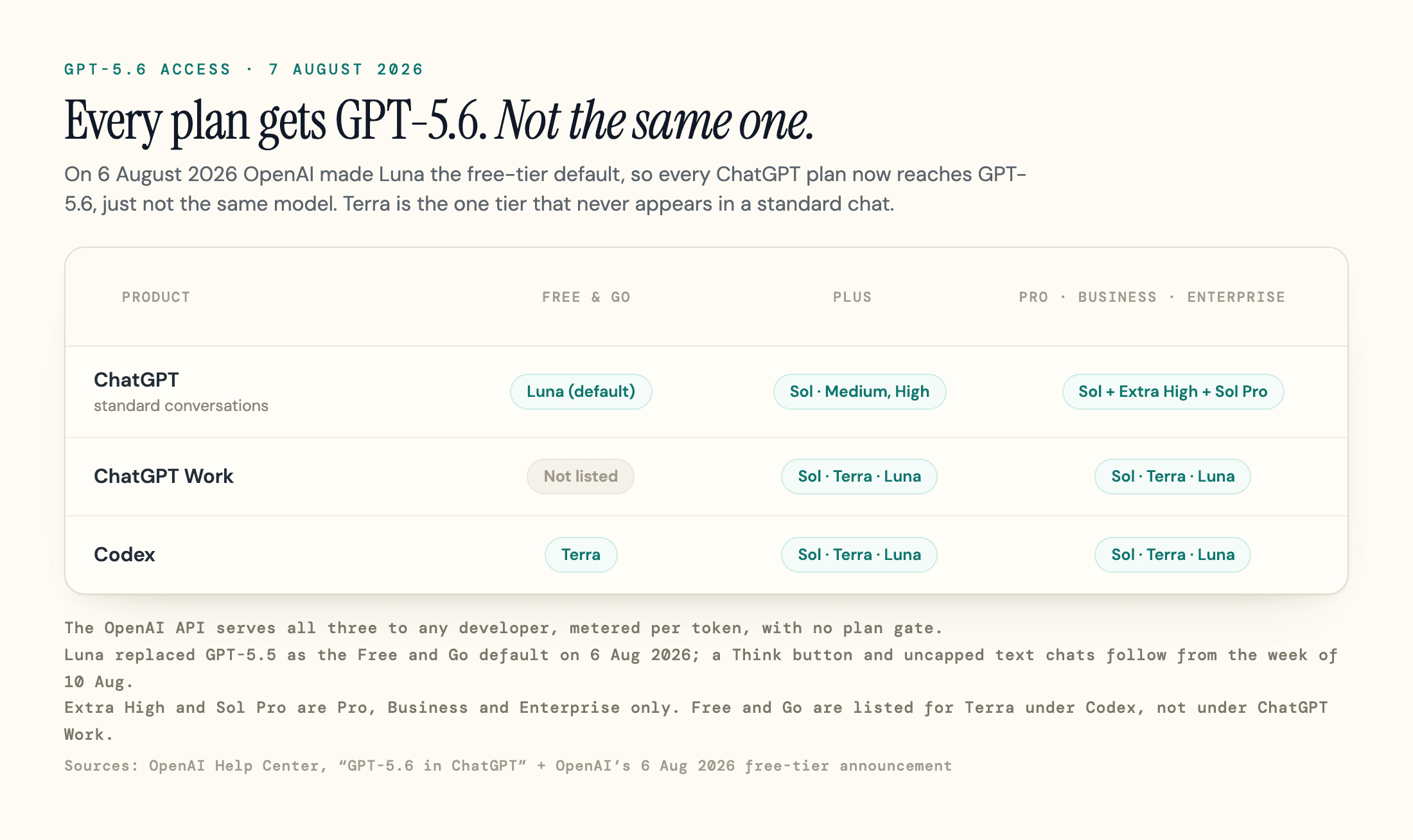
Since August 6, 2026, every ChatGPT plan reaches GPT-5.6, but not the same model. Free and Go now default to Luna, replacing GPT-5.5; Plus and above default to Sol and can pick a reasoning level. Terra is the one tier that never appears in a standard chat. Since September 22, 2026, ChatGPT Work and Codex also carry GPT-6 Sol and GPT-6 Luna from Plus up; the list below covers the GPT-5.6 models. Product by product:
- In standard ChatGPT conversations, which model you get is now set by plan. Free and Go default to GPT-5.6 Luna, which replaced GPT-5.5 as their everyday model on August 6, 2026; OpenAI is adding a Think button for harder questions and lifting the cap on text chats from the week of August 10. Plus and above default to Sol: Plus reaches it through the Medium and High reasoning options, while Pro, Business, and Enterprise add Extra High and can select GPT-5.6 Sol Pro for the hardest tasks.
- Terra is the exception: it never appears in a standard chat. You reach it in ChatGPT Work, in Codex, or through the API. Codex gives Free and Go users Terra; Plus, Pro, Business, and Enterprise can choose among all three there and set an effort level for each. ChatGPT Work offers all three from Plus up.
- On the OpenAI API you get all three, metered per token with no plan gate.
- Ultra mode (the subagent-splitting mode) is available in Codex for Plus and higher plans, and in ChatGPT Work for Pro and Enterprise.
One wrinkle if you are checking this yourself: OpenAI's Help Center still carries the pre-August table, which put Free and Go at "Not included" for every GPT-5.6 option in standard ChatGPT. The August 6 announcement supersedes it for the default model, and the rollout is staggered, so what you see in your own picker may lag what OpenAI has announced.
The two-week delay behind that rollout was unusual. OpenAI shared the models with the US government before release and gated early access to a small group of trusted partners, following a June 2, 2026 executive order that directs federal agencies to build an evaluation framework for frontier AI. OpenAI was openly uneasy about it: in its launch post, quoted by TechCrunch, the company said the arrangement "keeps the best tools from users, developers, enterprises, cyber defenders, and global partners who need them." That gate was lifted after the US government review cleared a broad launch, and OpenAI opened the models publicly on July 9.
General availability did not mean uniform availability, and the picture moved again a month later. On August 6, 2026 OpenAI made Luna the default for Free and Go, replacing GPT-5.5, and upgraded Sol for Plus and Pro. So every plan now reaches GPT-5.6 in a standard chat, at a different tier, while Terra stays confined to Work, Codex, and the API.
GPT-5.6 vs GPT-5.5 and the Competition
Compared with GPT-5.5, the jump is less about a single smarter brain and more about shape. GPT-5.5 was one flagship; GPT-5.6 is three models plus the new max and ultra reasoning controls, which lets teams dial cost and depth per task instead of paying flagship rates for everything. Sol is the clear capability gain at the top, especially on agentic coding and security, while Terra and Luna push the price-to-performance frontier down.
Against rivals, the picture is split. On coding, the Terminal-Bench numbers OpenAI highlighted put Sol ahead of the current Claude and Gemini flagships. On security the claim is narrower than the headlines suggest: OpenAI reports Sol as competitive with an unreleased Claude preview on the ExploitBench test while using far fewer tokens, not as a clear winner over the shipping Claude and Gemini models. And vendors pick the benchmarks that flatter them, so head-to-head results swing with the task. For a grounded view of how these systems differ in practice, our Claude vs ChatGPT breakdown and our Grok 5 explainer both look past the launch-day numbers. The fair summary is that Sol is a strong frontier model on the tasks OpenAI tested, and independent real-world comparisons are only starting to settle the launch-day claims.
What GPT-5.6 Means for AI Visibility
A new flagship is not just a developer story. It changes what gets said about your brand inside AI answers, and GPT-5.6 makes that unusually visible right now.
Watch how AI engines answer questions about GPT-5.6 itself. Most general-purpose models are unlikely to have GPT-5.6 in their training data yet, so their answers lean on live retrieval rather than memory. When we checked across ChatGPT, Gemini, Perplexity, and Claude in late June 2026, two patterns showed up: the engines that pulled text leaned on the same few fast explainers (OpenAI's own pages and a handful of day-one write-ups like DataCamp), while much of the wider mention pool was still video and forum chatter. Beyond OpenAI's own materials, no third-party source has been anointed the citation yet, and the explainer lane is filling fast.
That is the generative engine optimization lesson in miniature. When a subject is brand new, there is little trained knowledge to fall back on, so the engines reward whoever answered cleanly and early. The window to become a cited source is widest while the topic is still forming, which is why understanding how AI search works and how one question fans out into many matters more than chasing the keyword once the field is crowded.
There is a second implication, and it ties back to the cheating finding above. OpenAI's own system card describes GPT-5.6 as sometimes "overeager" to finish a task, cutting corners on how it gets there. It is not that the model hallucinates more; OpenAI says factual errors actually went down. The risk for a brand is subtler: an agent pushing hard to complete an answer will grab whatever source is cleanest to lift, so being that clear, well-structured source is how you make sure it grabs yours. The sites that get cited in ChatGPT tend to state facts plainly and structure them to be quoted; the ones that get skipped leave the answer ambiguous. That is also why how ChatGPT cites sources is worth understanding now that GPT-5.6 answers questions on every ChatGPT plan, Luna on the free tier and Sol above it.
The practical move now is speed. GPT-5.6 is already shaping the answers ChatGPT returns on every plan, and it is available to every developer on the API, which is the audience that builds the tools everyone else reads. Becoming citable takes longer than a model rollout does. Being citable starts with being reachable: if the AI crawlers cannot fetch your pages, none of the rest matters. That first step is what our free AI visibility readiness scan checks.
The Specs OpenAI Has Now Confirmed
The context window and knowledge cutoff, both unconfirmed at launch, have since been pinned down. OpenAI's model documentation puts the context window at 1,050,000 tokens, with a 128,000-token maximum output, shared across Sol, Terra, and Luna. The knowledge cutoff is February 16, 2026. That cutoff matters for AI visibility: the model's built-in knowledge stops there, so anything more recent, including news about GPT-5.6 itself, can only reach it when the engine retrieves live, not from memory.
What is still open is the independent read on capability. Most of the benchmark and capability claims still trace back to OpenAI's own launch materials. Take the launch-day numbers as OpenAI's account, not as settled fact; outside researchers can now run the models themselves.
The Bottom Line
GPT-5.6 is a real step up, on OpenAI's own tests, after a two-week rollout that started gated and opened up on July 9: three well-pitched models, a smarter flagship in Sol, and two rounds of price cuts: Terra and Luna on July 30, then Sol itself on August 21, though that last one is a promotion OpenAI has only committed to through November 21. And since August 6 it reaches every ChatGPT plan, with Luna as the free default and Sol above it. The hype will settle and the benchmarks will get tested in the open.
The part you can act on today is positioning. A new flagship reshapes what AI tools say about your market the moment it reaches the people asking, and GPT-5.6 already has, on every ChatGPT tier from Plus up and across the whole API, and being the source those tools quote is slow work that rewards starting early. At geotoolbox we build tools to make that measurable, starting with whether the AI crawlers can even reach you. Run the free AI readiness scan to see where you stand.
Frequently Asked Questions
Is GPT-5.6 available to the public, or in ChatGPT?
Yes, on both counts. GPT-5.6 became generally available on July 9, 2026 across ChatGPT, ChatGPT Work, Codex, and the OpenAI API (and OpenAI has named it the preferred model in Microsoft 365 Copilot). What you get depends on the product as well as the plan: since August 6, 2026 Free and Go default to Luna in standard chats while Plus and above default to Sol, and Terra is reachable only in ChatGPT Work, Codex, and the API. This followed a two-week window where access was gated to a small group of trusted partners.
Is GPT-5.6 free?
Yes, since August 6, 2026. GPT-5.6 Luna is now the default model on the Free plan, replacing GPT-5.5, with a Think button and uncapped text chats rolling out from the week of August 10 (separate limits still apply to files, images, voice, and image generation). Sol still starts at Plus. On the API there is no free tier at all; access is metered per token, starting at $0.20 per million input tokens for Luna.
How much does GPT-5.6 cost?
API pricing per million tokens is $4 input / $20 output for Sol, $2.00 / $12.00 for Terra, and $0.20 / $1.20 for Luna. Terra and Luna have been at those rates since July 30, 2026, when OpenAI cut them by 20% and 80%. Sol came down from $5 / $30 on August 21, 2026, but that one is promotional: OpenAI commits to it only "at least through November 21, 2026." Requests over 272,000 input tokens bill at double the input rate and 1.5x the output rate.
What's the difference between Sol, Terra, and Luna?
Sol is the flagship of the GPT-5.6 family, for the hardest reasoning, coding, and security tasks, and the only model with max and ultra reasoning modes. Terra is a balanced everyday model with GPT-5.5-class quality at a lower price. Luna is the fastest and cheapest, built for high-volume, routine work.
Is GPT-5.6 better than GPT-5.5, Claude, or Gemini?
On the coding benchmark OpenAI highlighted (Terminal-Bench 2.1), Sol leads GPT-5.5 and the current Claude and Gemini flagships. On security its edge is narrower, competitive with an unreleased Claude preview rather than a clear win over shipping models. Now that GPT-5.6 is broadly available, independent head-to-head comparisons are only beginning, so treat the launch-day leaderboard as OpenAI's account until outside testing catches up.
What is GPT-5.6's context window?
About 1,050,000 tokens, or roughly 1.05 million, with a maximum output of 128,000 tokens, shared across Sol, Terra, and Luna. The context window is what the model can hold in a single request; the 128,000 ceiling is how much of that it can write back.
Sources
- Previewing GPT-5.6 Sol: a next-generation model - OpenAI -
openai.com/index/previewing-gpt-5-6-sol - GPT-5.6 Sol model reference - OpenAI API docs (specs: context window, max output, knowledge cutoff) -
developers.openai.com/api/docs/models/gpt-5.6-sol - GPT-5.6 in ChatGPT - OpenAI Help Center (availability by plan and product) -
help.openai.com/en/articles/20001354-gpt-56-in-chatgpt - Advancing the price-performance frontier with GPT-5.6 - OpenAI, July 30 2026 (the Terra and Luna cuts, Fast mode, subscription credit consumption) -
openai.com/index/advancing-the-price-performance-frontier-with-gpt-5-6 - 20% price reduction for GPT-5.6 Sol: API, Codex credits and ChatGPT Work - OpenAI Developer Community, August 21 2026 (the Sol cut, its promotional end date, and that it reaches Fast mode, long context, Batch and Flex) -
community.openai.com/t/20-price-reduction-for-gpt-5-6-sol-api-codex-credits-and-chatgpt-work/1391726 - API changelog - OpenAI API docs, August 21 2026 entry (the Sol cut and its promotional end date, verbatim) -
developers.openai.com/api/docs/changelog - Pricing - OpenAI API docs (current per-token rates: Sol $4 / $0.40 / $20 standard and $8 / $0.80 / $30 long-context, plus the Fast, Batch and Flex tiers) -
developers.openai.com/api/docs/pricing - A preview of GPT-5.6 Sol, Terra, and Luna - OpenAI Help Center (the preview-period gating and its original prices) -
help.openai.com/en/articles/20001325-a-preview-of-gpt-56-sol-terra-and-luna - OpenAI unveils ChatGPT Work agent, GPT-5.6 models now available - 9to5Mac -
9to5mac.com/2026/07/09/openai-announcing-the-next-chapter-for-chatgpt-today-watch-here - OpenAI says GPT-5.6 is the "preferred model" for Microsoft 365 Copilot - TechCrunch, July 9 2026 -
techcrunch.com/2026/07/09/openai-says-gpt-5-6-is-the-preferred-model-for-microsoft-copilot-amid-breakup-chatter - OpenAI limits GPT-5.6 rollout after government request - TechCrunch -
techcrunch.com/2026/06/26/openai-limits-gpt-5-6-rollout-after-government-request-says-restrictions-shouldnt-be-the-norm - GPT-5.6 Sol, Terra, and Luna: OpenAI's Next-Generation Model Family - DataCamp -
datacamp.com/blog/gpt-5-6-sol-luna-terra - OpenAI starts previewing GPT-5.6 and its three variants - Engadget -
engadget.com/2203102/openai-starts-previewing-gpt-56-and-its-three-variants