
LLM seeding has correlational support, no independent causal test that we found, and one study where cited listicles often did not help their authors. The version worth trying places things a stranger would reference, keeps your affiliation visible, and is judged against control prompts, so a lucky week does not pass for a result.
What Is LLM Seeding?
LLM seeding is placing content on the surfaces AI systems draw from, so that when someone asks ChatGPT, Claude, Perplexity or Google's AI Mode a question in your category, your brand is named or cited in the answer. Most of those surfaces are not your site: community threads, review profiles, comparison articles, Wikipedia, YouTube and trade press.
None of that is new. Getting your name into credible third-party places is digital PR and reputation work. What changed is the scoreboard: you check whether an answer engine says your name, and the answer can change from one run to the next. That makes it closer to measuring AI visibility, or LLM visibility, than to tracking a ranking.
It sits inside generative engine optimization (GEO), the wider work of being cited by AI answers, and it borrows from SEO without replacing it. Our comparison of GEO and SEO covers where they split.
Retrieval and training get confused here. Retrieval is what an engine does at answer time: it searches the web, reads pages and cites some of them. Training is what a model absorbed before it shipped. Seeding for retrieval is something you can test within weeks. Seeding for training is a bet on a future model, with no public evidence that it can be steered on demand. Everything below is about retrieval, because that is the part you can measure.
The other half of getting cited happens on your own pages, which we cover in our guide to getting cited by AI.
Does LLM Seeding Work? What the Evidence Says
The evidence so far is association, not cause. What exists is a set of studies showing that brands present on certain surfaces get cited more, which is not the same as proving that adding yourself to those surfaces makes it happen.
| Claim | What the evidence is | Grade | Limits |
|---|---|---|---|
| Review-site profiles go with being cited alongside that site | Seer Interactive, May 2026: 804,491 responses, 1,926 brands. The median rate was 1% with no Trustpilot profile, against 53.5% for brands with a minimal one (as few as 1 to 13 reviews). | Correlation | The rate is how often a brand appeared alongside a Trustpilot citation, not its overall citation rate. Trustpilot only. |
| Reviews and social proof dominate branded answers | Omniscient Digital: 240 branded prompts, 23,387 unique sources. 57% of branded-query citations went to reviews, listicles, forums, social media and case studies. | Descriptive count | A content-form bucket that does not test who owns the page. Branded prompts only, run through one tracking tool. |
| You do not need a top Google ranking to be cited | Semrush, July 2025: pages ChatGPT search cited ranked in positions 21 or worse "almost 90% of the time". Some engines cite positions 1 to 5 more often than 6 to 20. | Descriptive count | ChatGPT search only, across 500+ digital marketing and SEO topics. Semrush says ranking well may still help. |
| Republishing a story on third-party sites gets it cited more | Stacker with Scrunch: eight stories, 944 prompt-platform combinations, five LLMs. About 8% of answers cited only the original and about 34% cited at least one version, brand or syndicated. | Vendor test | Syndication is one form of placement. The 8% is a share inside the distributed dataset, not an undistributed control. It counts citations, not mentions, Stacker sells distribution, and the study calls itself an early, directional exploration. |
| A listicle you write about your own category gets you recommended | Kenyon Digital, March 2026: 255 tracked citations of brand-authored CRM listicles in ChatGPT. The author was recommended first 24.7% of the time. | Single test | One practitioner, one software category, one engine. The author calls it strong correlation, not lab-grade causality. |
| Seeding causes more mentions | We found no independent controlled test. | Not shown | The rows above are associations, counts or one vendor's directional test. |
Engines lean on pages other people wrote about you. In Seer's analysis of ChatGPT's query fan-out, only 0.5% of Trustpilot citations came from a query that named Trustpilot. Seer reads that as Trustpilot's own SEO doing the heavy lifting, and its table labels 27.9% as training data.
The Semrush finding is evidence that the citation pool is wider than page one, and no more. Seeding is a bet with a measurable payoff.
Where LLMs Pick Up Seeded Content
The studies most often name YouTube, Wikipedia and review profiles, and none of them measures what seeding there does. Each surface also carries its own rule, and ignoring it is how seeding turns into spam.
| Surface | What the evidence shows | Rule or risk | Effort (our estimate) |
|---|---|---|---|
| Reddit and communities | Listed among the sources close behind YouTube, Wikipedia and Google.com in Surfer's Google AI Overview data (2025). ChatGPT's Reddit citations reportedly fell sharply in August 2026 while, in that data, other engines held roughly flat, per OtterlyAI's tracker data. Our Reddit SEO guide covers the rules and the numbers. | Moderators remove promotion. Disclose who you are. | High, ongoing |
| Review sites | Trustpilot profiles go with higher rates of appearing alongside Trustpilot citations (table above). | Reviews must come from real customers. | Medium |
| Third-party listicles | Reviews, listicles, forums, social media and case studies led branded-query citations in Omniscient's data. | Paid rankings can be deceptive even when disclosed (FTC guidance). | Medium, outreach |
| Wikipedia | Surfer's analysis of 36 million AI Overviews (data from March to August 2025) reports Wikipedia at about 18.4% of citations. The datasets disagree: the Search Engine Land data in our citation guide puts Wikipedia under 1% of AI Overview citations. | Conflict-of-interest and paid-editing rules apply. | Gated, often not worth it |
| YouTube | The same analysis gave YouTube about 23.3%. In Ahrefs' study of 75,000 brands with DR above 40, using Ahrefs' own Brand Radar data, YouTube mentions correlated about 0.737 with brand mentions in AI answers, the strongest factor it tested. Omniscient found video among the least-cited formats for branded queries. | Video is costly to produce, and the Ahrefs figure is a correlation. | High |
| LinkedIn, Medium, Substack | Surfer lists LinkedIn among the sources close behind the leaders. Medium and Substack are not isolated in the studies above. | Low risk, low evidence. | Low |
| Industry press and digital PR | Only syndication is tested (Stacker, above). Editorial coverage is not isolated. | Pitch something worth publishing, not a link. | High |
| Your docs and help center | The other half of the job, covered in the guide linked above. | None | Medium |
Engines do not agree with each other, so a placement that lifts one can do nothing for another. How ChatGPT picks and credits sources differs by mode, which we cover in how ChatGPT cites sources.
Before you pick surfaces, run your buyers' prompts and note which sources the engines already cite. Choose from that list, not from the table. If your category has no active subreddit, no Reddit plan will fix that.
What to Seed and Where Listicles Fall Short
Place things a stranger would reference on their own merits. That means original data with the method shown, a comparison with stated criteria, documentation with specifics, a free tool or template with a descriptive title, reviews from customers you asked, and expert commentary under a real name.
Self-published "best X" listicles appear in several of the seeding guides we read, and they carry the clearest warning. In the Kenyon Digital test, ChatGPT cited a brand-authored listicle in 68% of the responses that recommended a CRM. The listicles were read, yet the author was the top recommendation about one time in four. The author went unmentioned for 37.3% of the citations while a competitor was recommended, which Kenyon calls a backfire.
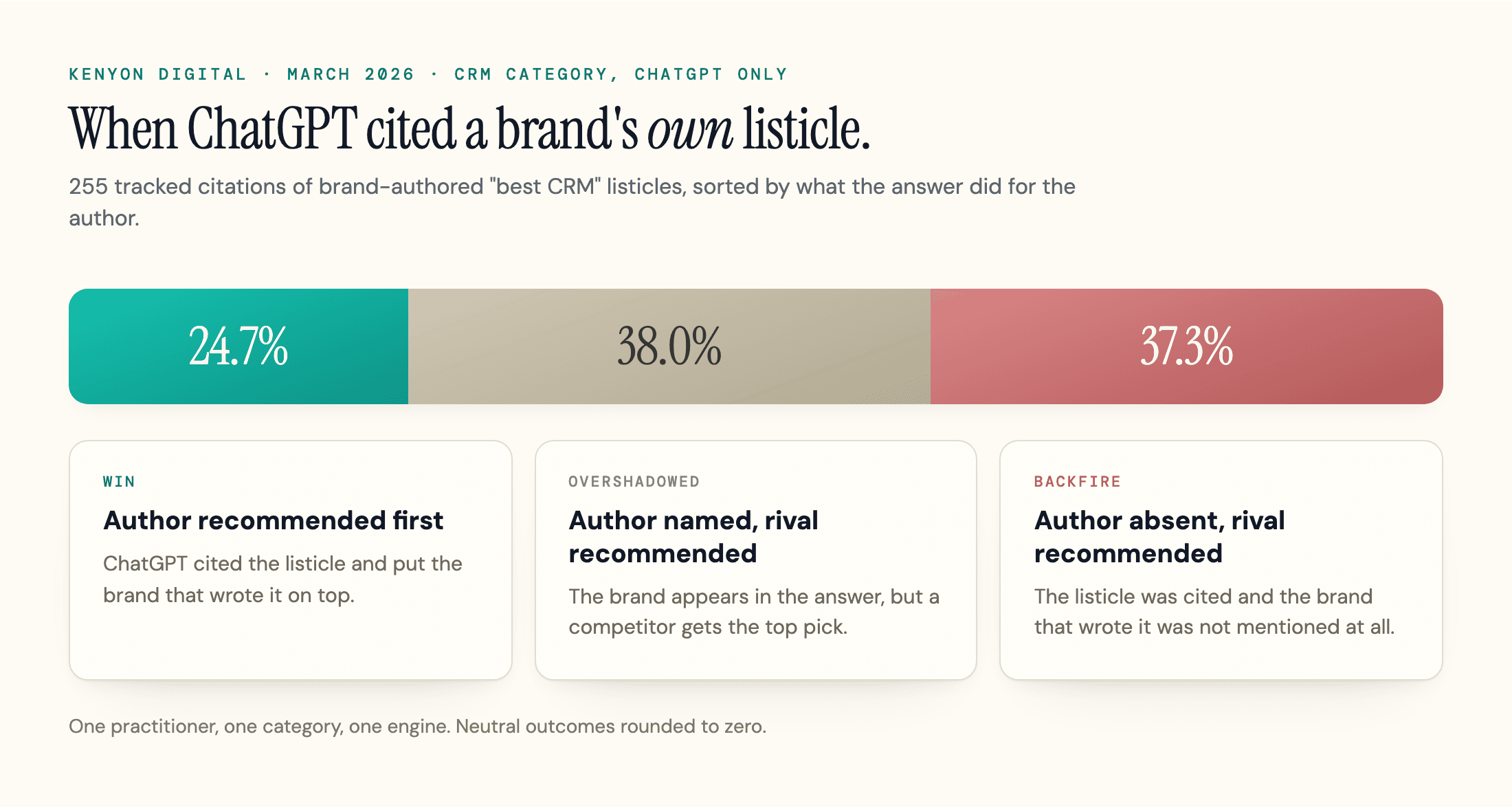
Kenyon's own reading is that the deciding factor was whether ChatGPT already knew the brand rather than how the listicle was written, though the data is correlational. HubSpot appeared in 98% of those responses whichever brand's listicle was cited, and Nutshell in 15%. Our reading is that a listicle can pass credibility to a brand the engine already recognizes, and can hand its research to a rival when it does not. Kenyon's page is one practitioner's test on one engine, so hold it loosely, but it is a good reason not to build your plan on a page where you rank yourself first.
Cited, named and recommended are different outcomes, and your log should record them separately. Our piece on how ChatGPT cites sources separates fetched from cited, and the same care applies to named. A page that gets cited without your brand appearing in the answer can end up doing a competitor's work.
Some seeding guides tell you to break everything into tiny self-contained chunks. Google's own guide for its AI features says there is no requirement to break content into tiny pieces and that you should make pages for your audience. That guide covers Google's systems only, so write for the reader first and let the structure follow.
Whatever you place, keep your entity consistent: describe your brand the same way everywhere, so an engine reading several placements gets one answer.
Step Zero: Can AI Crawlers Reach the Pages You Seed?
A placement that no crawler can fetch does nothing, so check where it can fail: your own pages, and the sites where you place content.
On your own domain, robots.txt is the first suspect. OpenAI's crawler documentation says sites opted out of OAI-SearchBot "will not be shown in ChatGPT search answers, though can still appear as navigational links", while GPTBot is the crawler for training. The page carries no date, so read that as true as of September 2026. A rule written to stop training that also names the search bot takes you out of ChatGPT's search answers.
The same check applies to the host of a placement. If a review platform or publication blocks AI crawlers, what you put there may never be retrieved. We have not tested individual hosts, so read each one's robots.txt before you spend the effort.
geotoolbox's free AI Crawler Checker reads a domain's robots.txt and shows which of 34 AI crawlers it allows or blocks, with the line doing the blocking. It checks permission only and does not see firewall blocks. For those, the free Agent Readiness Scanner requests your site as AI crawlers do, as a simulation, and renders it in a real browser. Neither can tell you whether an engine will cite you.
How to Seed Without Astroturfing
The line is real people and visible affiliation. Real customers write the reviews, real participants join the threads, and anyone reading can see who you are. If you would not be comfortable with a reader and an engine seeing exactly who wrote a placement and why, do not place it. This is not legal advice, and the rules below are US-based.
Reviews and the FTC Rule
The FTC's rule on consumer reviews and testimonials (16 CFR Part 465, announced August 2024) targets:
- reviews that misrepresent who wrote them or what they experienced, including reviewers who do not exist, "such as AI-generated fake reviews"
- paying for reviews conditioned on a positive or negative sentiment
- certain insider reviews that hide the connection
- review suppression and bought fake social indicators
- a review site or listicle a company controls but presents as independent
The FTC can seek civil penalties against knowing violators, up to $53,088 per violation at the 2025 level, and its 2026 notice says those amounts stay unchanged this year. The rule centers on consumer reviews and testimonials, so whether it reaches business-software reviews is a question for counsel.
Endorsements and Agencies
The FTC's Endorsement Guides are interpretive guidance, and they say a material connection the audience would not expect must be disclosed clearly and conspicuously. They also say advertising agencies, public relations firms, review brokers and reputation management companies may be liable for their role in endorsements they know or should know are deceptive. If you seed on a client's behalf, that sentence is about you.
Wikipedia and Paid Editing
The Wikimedia Terms of Use say you must disclose each employer, client, intended beneficiary and affiliation for any contribution you receive or expect compensation for. Our own advice goes further: do not edit your company's page. Propose changes on its talk page, with the same disclosure and sources, and let independent editors decide.
What Google and Practitioners Say
Google is blunt about the shortcut. Its AI optimization guide says seeking inauthentic "mentions" across the web is not as helpful as it might seem, because its ranking systems favor high-quality content and other systems block spam.
Practitioners notice too. A recent r/SEO post said Reddit was starting to shut down "GEO" subreddits that had seen "GEO spam from GEO agencies". Treat that as one poster's account.
How Long Until Seeded Content Shows Up?
We found no benchmark for how long a new placement takes to appear in AI answers. An engine that searches live can only cite a page after it has been crawled or indexed, and how long that takes is unknown. Influence on a model's training waits on a future release.
Noise matters more than speed. Kenyon Digital found that asking ChatGPT the same question five times produced a different top brand for 42% of the queries it tested. A placement can therefore appear in one check and vanish in the next without anything having changed. Judge on repeated runs across a window; as a planning heuristic, not a finding, we would use four to eight weeks, written down before you start.
How to Test Whether Seeding Worked
A before-and-after screenshot proves nothing. Model updates, other marketing and random variation move the same numbers. A control set of prompts helps you separate your effect from changes that hit everything at once.
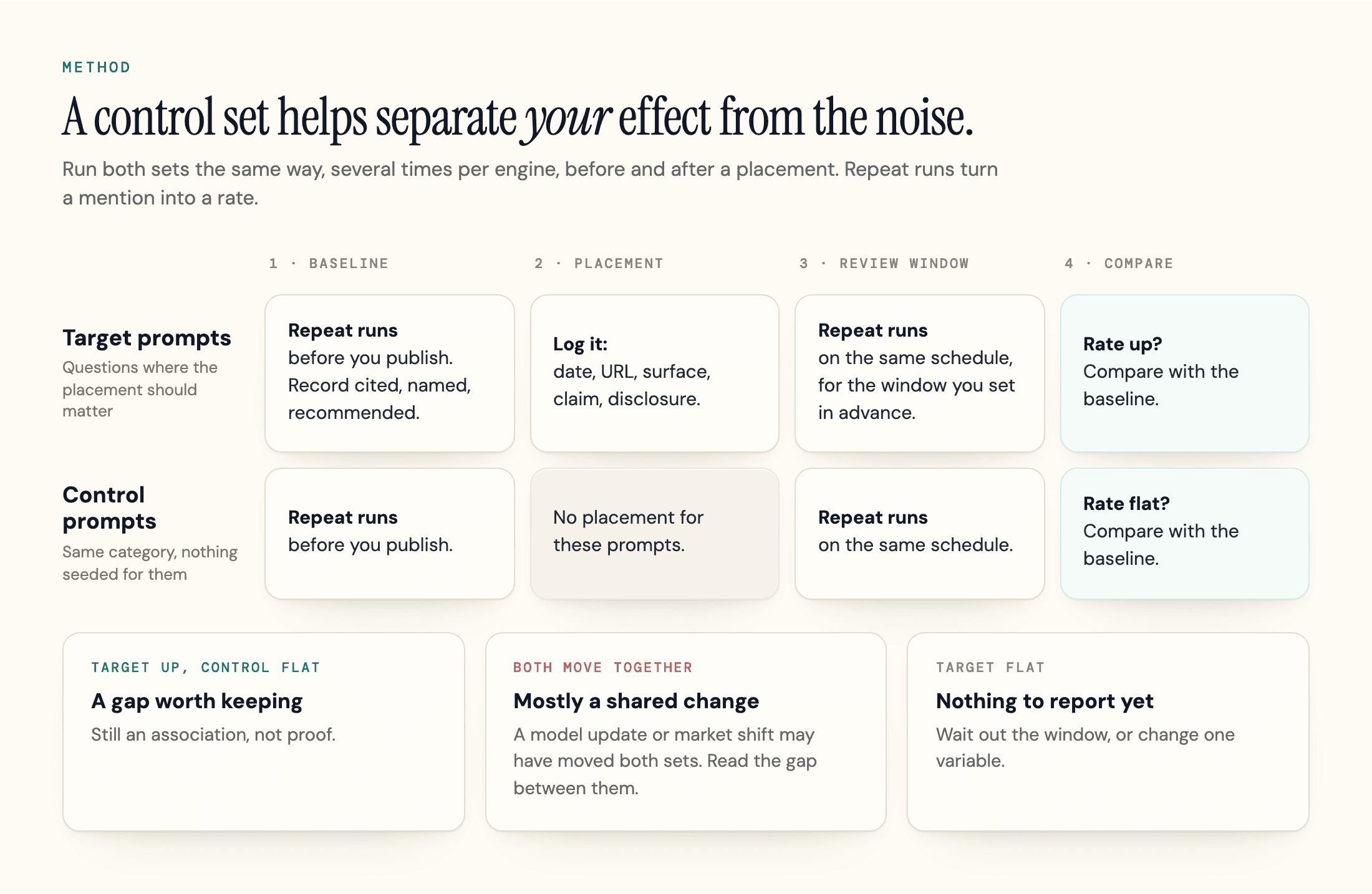
- Log every placement. Record the date, the URL, the surface, the exact claim or brand phrase it carries, and whether your affiliation is disclosed. Without the log you cannot link a movement to an action.
- Build a target set and a control set. Target prompts are the questions where your placement should matter. Control prompts are comparable questions in the same category about things you did not seed. If both sets shift after a model update, most of that shift is shared, so read the gap between them.
- Record a baseline before you publish. Run each prompt several times per engine, since a mention is a rate, not a yes or no, and use a logged-out or fresh session so your own history does not tilt the answer. Our guide to tracking AI brand mentions covers how many runs a number needs.
- Stagger the placements. Change one thing at a time. Delays and overlapping effects still blur attribution, and bundling several placements into one week makes it worse.
- Compare target against control after the window. A rise in the target set with a flat control set is your signal. Log cited, named and recommended as separate columns.
- Read the side channels. Check referral traffic from the surface, a "how did you hear about us" field on your forms, and branded search in Search Console. None of them proves causation alone, so read them together.
The design has limits. Target and control prompts often pull from the same sources, so an effect can leak into the control set. Pick control prompts on different sub-topics and with baseline rates close to your targets, fix the number of runs, and decide in advance how big a gap counts as a signal. Because top brands flip between runs, treat a small sample as exploratory, and even a clean result is an association, not proof.
If you are cited but not named, treat the fix as a hypothesis. Try adding a checkable, brand-attached claim to the page being cited, then see whether your named rate moves in the log.
A spreadsheet is enough to run it. geotoolbox's Domain Overview rolls citations from several AI engines into one view, including which pages get cited and which competitors show up instead of you, and Community Insights lists the Reddit and forum threads those engines cite in your space. Both are included on Plus plans and up, and neither runs the target and control test for you.
When LLM Seeding Is Not Worth It
Skip it while your own pages are unreachable or thin. Placements elsewhere can still get you named, but there is little for anyone to verify or click through to.
Skip it if you cannot disclose your affiliation, or if the only version of the plan requires accounts that pretend to be someone else. And skip it if the prompts you ran show engines citing your competitors' own sites and official docs, because there is then little to seed.
Frequently Asked Questions
What is LLM seeding?
LLM seeding is placing content on the surfaces AI engines retrieve from, such as review sites, communities, comparison articles and Wikipedia, so your brand is named or cited in their answers. It is digital PR and content placement, measured against AI answers instead of rankings.
Does LLM seeding work?
Seer Interactive's data links Trustpilot profiles to higher rates of appearing alongside Trustpilot citations, and Omniscient Digital found most branded-query citations go to reviews and social-proof content. We found no independent controlled test of whether seeding causes it, so measure it yourself with target and control prompts.
Is LLM seeding the same as SEO, GEO or digital PR?
It overlaps with each of them. The tactics resemble digital PR, the groundwork on your own pages resembles SEO, which Google says still applies to its AI features, and the goal is what GEO calls being cited. What differs is the scoreboard: an engine naming or citing you across repeated prompts, not a ranking position.
Is LLM seeding spam?
It becomes spam when the placements are fake or hide who wrote them. Fake reviews, undisclosed paid editing and sock-puppet accounts break platform rules and, for consumer reviews in the US, FTC rules. Real customers, real participation and visible affiliation are the minimum, and relevance, honest claims and each platform's promotion rules still apply.
How do I measure LLM seeding?
Log each placement, then run target and control prompt sets several times per engine before and after, over a window you set in advance. Record cited, named and recommended separately, and fix the run count and the lift that counts as a signal before you look at results.
Start With One Surface
The engines change faster than any guide, so your own dated log is the asset. Start with one surface and let the control set tell you whether it did anything. The 30-day plan in our citation guide covers the on-site half. Before you place anything, geotoolbox's free AI Crawler Checker shows whether your robots.txt lets AI crawlers in.
Sources
- Ahrefs - AI Brand Visibility Correlations (75,000 brands, published December 2025, modified August 2026) -
ahrefs.com/blog/ai-brand-visibility-correlations - Code of Federal Regulations - 16 CFR Part 255, Guides Concerning the Use of Endorsements and Testimonials in Advertising -
ecfr.gov/current/title-16/part-255 - Federal Trade Commission - Federal Trade Commission Announces Final Rule Banning Fake Reviews and Testimonials (August 14, 2024) -
ftc.gov/news-events/news/press-releases/2024/08/federal-trade-commission-announces-final-rule-banning-fake-reviews-testimonials - Federal Trade Commission - FTC Publishes Inflation-Adjusted Civil Penalty Amounts for 2025 (February 11, 2025) -
ftc.gov/news-events/news/press-releases/2025/02/ftc-publishes-inflation-adjusted-civil-penalty-amounts-2025 - Federal Register - Civil Penalty Inflation Adjustments (September 15, 2026) -
federalregister.gov/documents/2026/09/15/2026-18853/civil-penalty-inflation-adjustments - Google Search Central - Optimizing your website for generative AI features on Google Search (last updated July 10, 2026) -
developers.google.com/search/docs/fundamentals/ai-optimization-guide - Kenyon Digital - The Listicle Backfire Study (March 2026) -
kenyondigital.net/listicle-backfire-study - Omniscient Digital - Content Types Cited in LLMs (January 2026, updated June 2026) -
beomniscient.com/blog/content-types-cited-in-llms - OpenAI - Overview of OpenAI Crawlers (undated, read September 30, 2026) -
developers.openai.com/api/docs/bots - OtterlyAI - ChatGPT cut Reddit citations by at least 73% in August 2026 -
otterly.ai/blog/chatgpt-reddit-citations - Reddit r/SEO - post on Reddit shutting down "GEO" subreddits (thread 1tfu6tz) -
reddit.com/r/SEO/comments/1tfu6tz - Seer Interactive - Study of 800K AI Responses: How Review Profiles Shape Brand Presence in AI Search (May 14, 2026) -
seerinteractive.com/insights/study-of-800k-ai-responses-how-reviews-shape-brand-presence-in-ai-search - Semrush - AI Search & SEO Traffic Study (July 21, 2025) -
semrush.com/blog/ai-search-seo-traffic-study - Stacker with Scrunch - How Earned Media Distribution Expands AI Visibility: First Look at Citation Lift (December 2025, updated May 2026) -
stacker.com/blog/how-earned-media-distribution-expands-ai-visibility-first-look-at-citation-lift - Surfer - AI Citation Report (data March to August 2025, updated September 17, 2026) -
surferseo.com/blog/ai-citation-report - Wikimedia Foundation - Terms of Use, Paid Contributions Without Disclosure -
foundation.wikimedia.org/wiki/Policy:Terms_of_Use