
SaaS SEO is how a software company gets found, compared and chosen in Google results and in the AI answers buyers read before they book a demo.
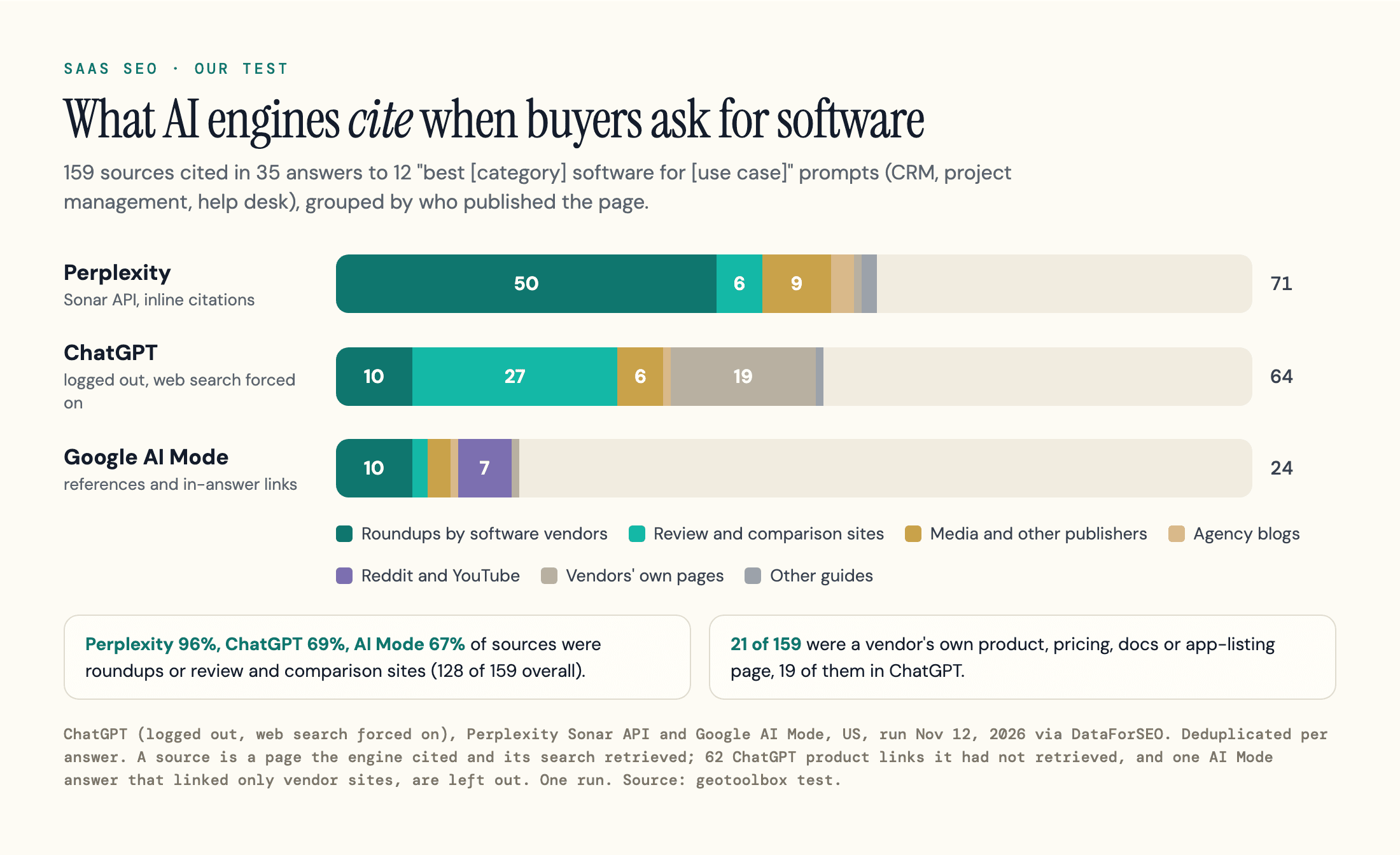
Ask an AI engine for "the best help desk for a small ecommerce store" and the answer is built mostly from other people's pages. In our test of 12 software prompts, roundups and review sites made up 96% of the sources Perplexity cited, 69% for ChatGPT and 67% of the 24 sources Google AI Mode cited.
So a SaaS SEO strategy now covers the pages on your own site that turn decision searches into signups, and the lists about your category that AI engines read.
What SaaS SEO Is in 2026, and What Changed
SaaS SEO is the work of making a software company's site rank in search engines for the searches its buyers run, from the first problem they type into Google to the "[your product] vs [rival]" query a week before they pick a tool, and of turning those visits into trials, demos and paid plans.
It shares its foundations with any other SEO. What sets it apart is the buyer and the product:
- The sale repeats. Revenue is a subscription, so one customer is worth months or years of fees, and a single high-intent page can justify more effort than a blog post that brings in thousands of readers.
- Many buyers compare before they talk to anyone. They read lists, reviews, pricing pages and comparison pages long before a sales call, if there is one.
- The site has page types other businesses don't. Integration pages, docs, templates and public pricing all rank, and all feed a trial.
- Conversion is a signup, not a checkout. You measure free trials, demos and pipeline, which often arrive weeks after the first visit.
That last point is why ecommerce SEO and SaaS SEO look alike from a distance and differ up close: a store sells on the page, a software company sells across a buying cycle.
What AI Search Changed
AI answers now sit on top of the informational layer. When Google shows an AI summary, people click a regular result less often: in Pew Research Center's browsing study of 900 US adults, users clicked a traditional result in 8% of visits when an AI summary appeared and in 15% when none did.
That does not make SaaS SEO obsolete. Google says that the best practices for SEO remain relevant for AI features, with no additional requirements to appear in AI Overviews or AI Mode.
What changes is where the value sits. It moves toward pages with buying intent: "what is a help desk" is the kind of question an AI summary answers on the results page, while "Freshdesk vs Zendesk for a 5-person team" comes from a buyer close to a choice.
Pew's data doesn't split clicks by intent, so track both kinds of query in your own Search Console.
The value also spreads across pages you don't own: AI engines build their answers from many pages at once, splitting one question into several searches (Google calls this query fan-out). Your own site is one of those pages. The lists and reviews written about you are the others.
What AI Engines Cite When Buyers Ask for Software
How We Ran the Test
To see which pages carry a software recommendation, geotoolbox ran a test on November 12, 2026. We wrote 12 neutral prompts of the form "What is the best [category] software for [use case]?" across 3 categories (CRM, project management and help desk, 4 prompts each), with no vendor in the category named.
We sent each one to ChatGPT (logged out, web search forced on), Perplexity (Sonar model with web search) and Google AI Mode from a US location, through DataForSEO. Then we sorted every cited page by who published it and what kind of page it was.
We counted a page as a source when the engine cited it and its own search had retrieved it, so product links ChatGPT added next to its picks without retrieving them were left out.
Our Google AI Mode capture has no retrieval list, so for it we counted its listed references plus 1 roundup linked in its answer text; one AI Mode answer listed no sources and linked only 4 vendor sites, and we left that answer out.
It was one run on one day, in 3 crowded categories, and "Perplexity" here means its Sonar API rather than the consumer app. Prompts worded "best X for Y" may also favor pages titled that way, and other phrasings may pull other sources. Treat the shares as a snapshot.
Roundups Carried the Answers
The result was lopsided. Of the 159 sources cited in the 35 answers that listed any, 128 (81%) were "best X" roundups or review-site pages, and every one of those 35 answers cited at least one:
- 70 were roundups written by a software company, often a rival in the same category ("10 Best Help Desk Software for Ecommerce" on a help desk vendor's blog).
- 35 were review and comparison sites: Capterra, G2 and Software Advice, but mostly small comparison sites.
- 18 came from media and other publishers (PCMag, TechRadar, Forbes and others), and 5 from agency blogs.
Only 21 of the 159 sources were a vendor's own product, pricing, docs or app-listing page, and 19 of those came from ChatGPT.
No vendor's own "[A] vs [B]" page appeared, but our prompts asked for a category, not for alternatives to a named product, so the test says nothing about which pages AI cites for "[rival] alternatives" or "[A] vs [B]" searches.
Each Engine Leaned on a Different Layer
Perplexity leaned hardest on vendor-written roundups: 50 of its 71 sources. ChatGPT's largest group was review and comparison sites (27 of 64), and it cited 19 of the 21 vendor pages. Google AI Mode was the only engine that cited Reddit threads (6) or a YouTube video (1).
Even Google's own AI surfaces draw on different pages: in Ahrefs' study of September 2025 US queries, AI Overviews and AI Mode showed only 13.7% citation overlap, so being cited in one is no guarantee for the other.
ChatGPT also linked the vendors themselves next to the products it recommended. Some of those links pointed at pages its search had retrieved, including 9 vendors' pricing pages and 3 Shopify App Store listings, and we counted those as sources. Another 62, mostly homepages and product pages, were links it had not retrieved, and we left them out.
The live interface can look different from these automated captures. When we ran one of the prompts in a logged-out ChatGPT window, the links under the picks we checked went to roundups and comparison pages, not to the products.
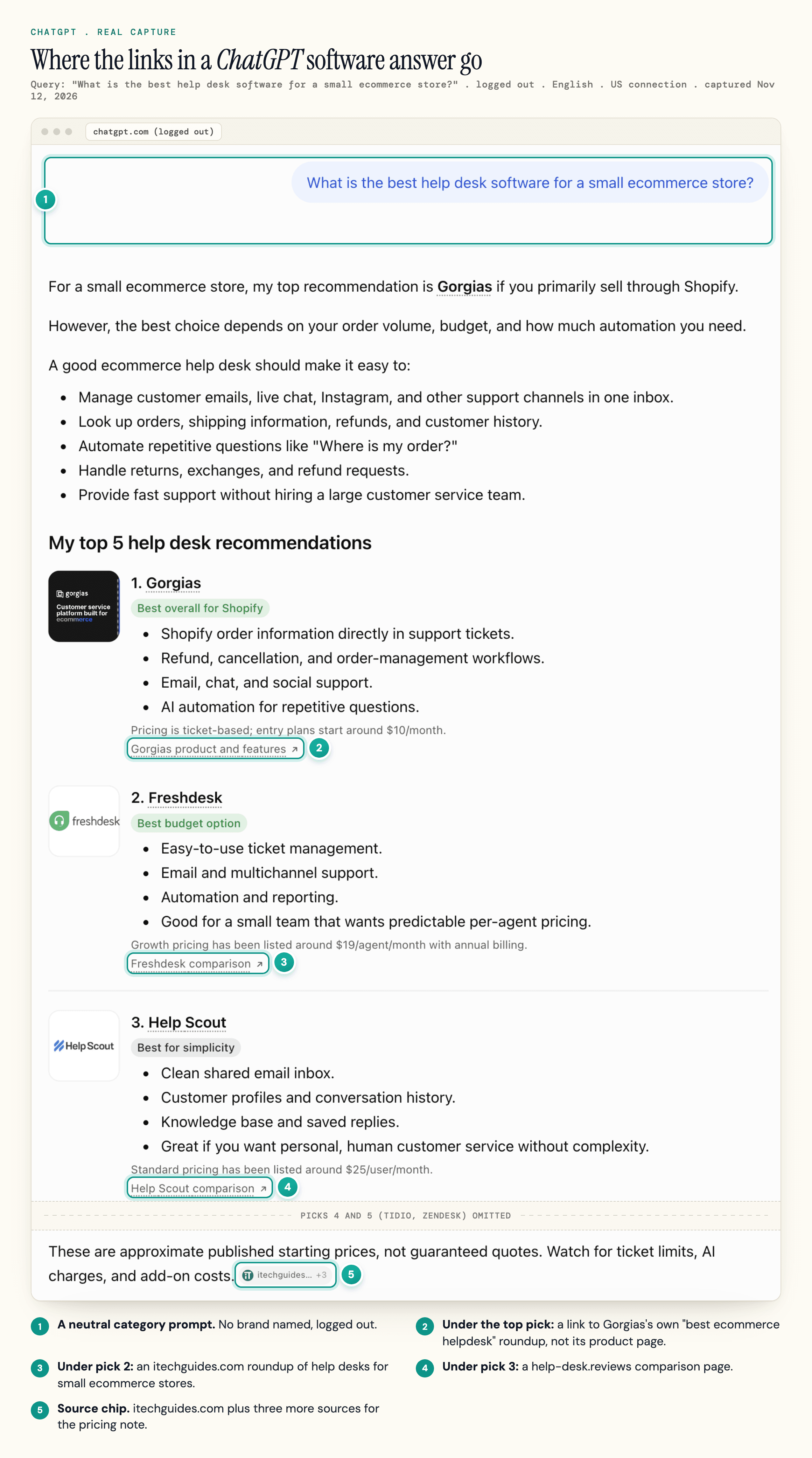
For a SaaS team, ranking your own pages is only half the job; being named, accurately, on those lists is the other half. We cover how ChatGPT picks and sometimes mangles its sources in how ChatGPT cites sources.
Start with Buyer-Intent Keywords Mapped to Page Types
One of the most common SaaS SEO complaints in the 30 founder threads we read on Reddit is a site that gets organic traffic and no signups.
In SEO for SaaS companies, a common cause is a keyword list sorted by volume. High-volume definitions attract students, job seekers and people who aren't buying, while the searches that turn into trials are smaller and closer to a decision.
Prioritize by Conversion, Not Volume
Grow and Convert's analysis of 95 client articles puts numbers on the gap. The agency, which sells this bottom-of-funnel approach, published it in 2023: across 6 months and 4,687 product conversions (trial starts, demo requests and sales form fills), posts targeting alternatives and comparison keywords converted at 8.43% on average, against 2.44% for jobs-to-be-done topics.
In the agency's experience, typical blog posts targeting high-volume keywords convert at 1% or less, and most of its alternatives posts converted under 4%: a few posts about very close rivals pulled the average up.
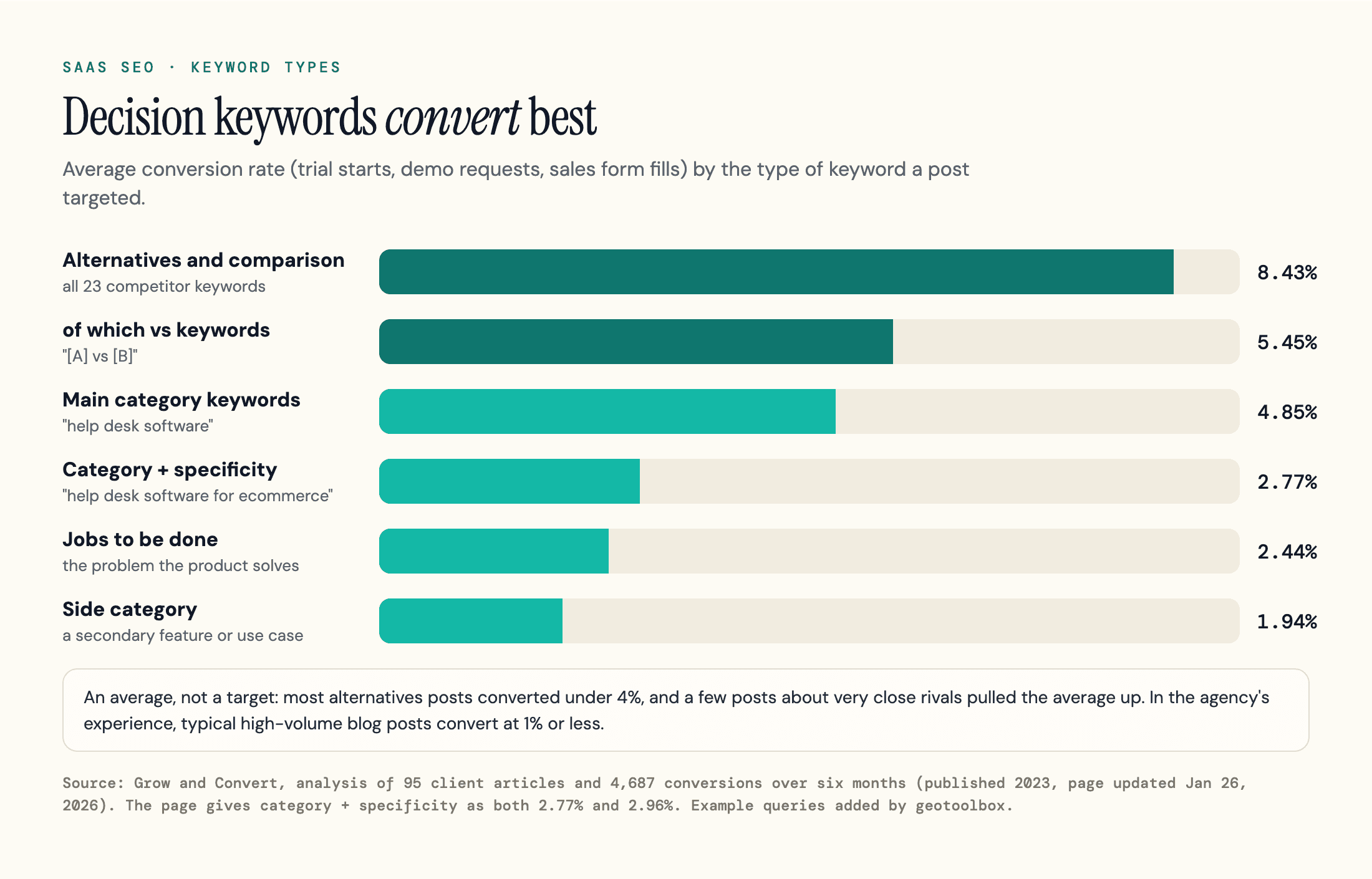
Read those as relative weights, not targets: they come from one agency's client sites and were collected in 2023.
Build the List Backward from the Purchase
Start the keyword research at the bottom of the funnel and work up:
- Start with your customers' words. Sales calls, support tickets and the "why we switched" answers in your reviews show the problems and tools people actually name.
- List the decision searches. "[Competitor] alternatives", "[you] vs [competitor]", "[category] for [industry or role]", "[product] pricing" and "[product] + [tool] integration".
- Add the problem searches you can answer better than anyone. The jobs your product does, written as the question someone types before they know a category exists.
- Assign one primary page to each search intent before you write anything, so a "vs" query gets a real comparison page, on the blog or off it, and not a generic post.
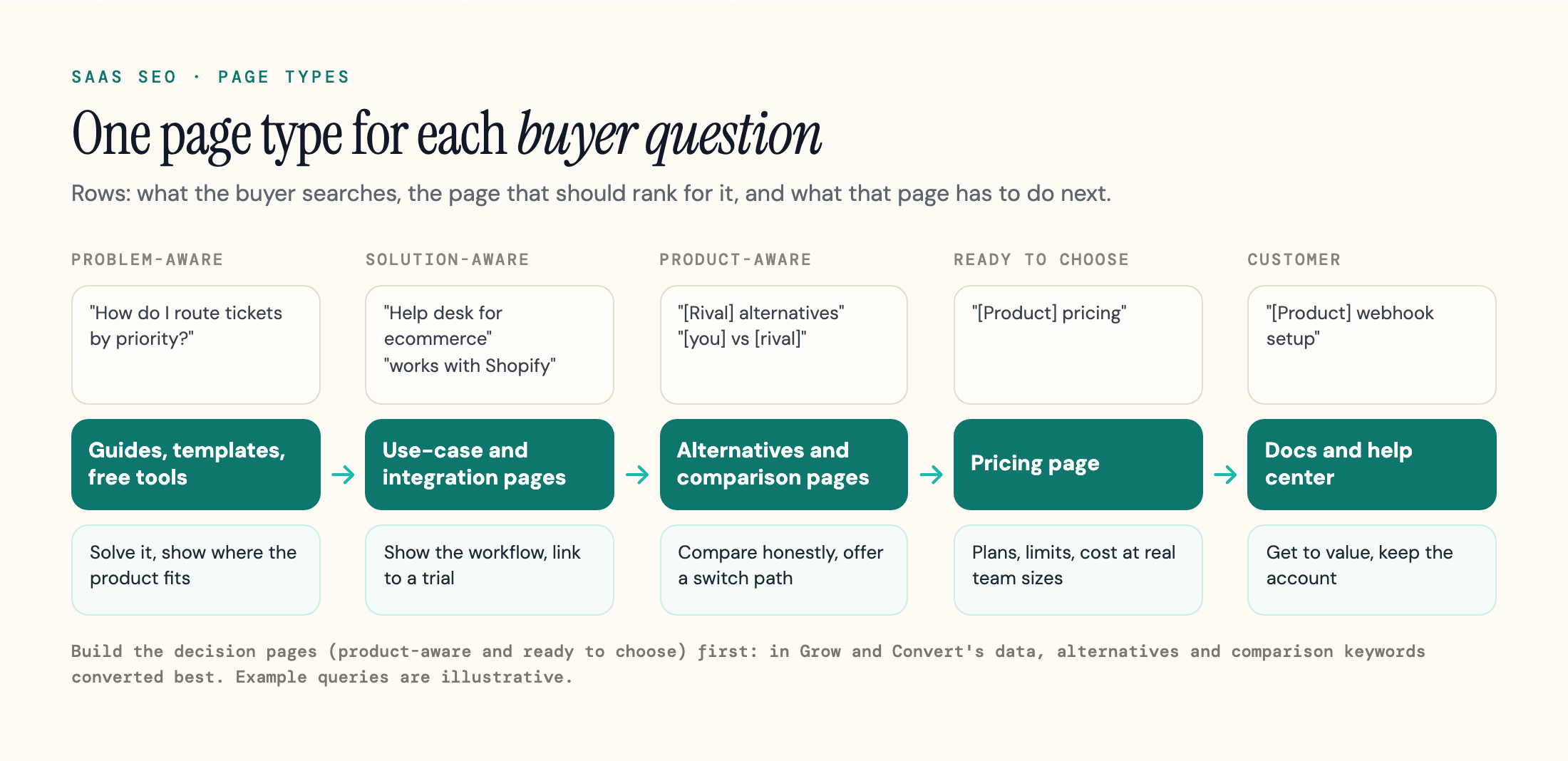
| Buyer stage | Typical search | Page type | What the page should do |
|---|---|---|---|
| Problem-aware | "how to route support tickets by priority" | Guide or template | Solve the problem, show where the product fits |
| Solution-aware | "help desk software for ecommerce" | Use-case or industry page | Show the workflow for that segment, link to trial |
| Solution-aware | "help desk with Shopify integration" | Integration page | Explain what syncs and how it works day to day |
| Product-aware | "[rival] alternatives", "[you] vs [rival]" | Alternatives or comparison page | Compare honestly, say where the rival wins, offer a switch path |
| Ready to choose | "[product] pricing" | Pricing page | Show plans, limits and the cost at real team sizes |
| Customer | "[product] webhook setup" | Docs or help article | Get the user to value, keep them |
Volume still matters for prioritizing within a row. It just shouldn't decide which rows you build first.
Build the Pages That Turn Searches Into Signups
A SaaS site with a busy blog and thin landing pages has the order backward. Work from the purchase out: alternatives, comparison and pricing pages first, then use-case and integration pages, then the guides further up.
Alternatives and Comparison Pages
These pages catch people who already know the category and are choosing. Write one page per serious rival, compare on the criteria buyers actually weigh (price at their team size, the integrations they use, migration effort), and say where the rival is the better pick.
A comparison that only flatters you reads as an ad. Keep the set to the rivals buyers actually weigh you against: hundreds of near-identical "[rival] alternatives" pages run into the scaled-content problem described below.
Keep prices and plan names dated on the page, because rivals change both.
Use-Case and Industry Pages
"[Category] for [segment]" searches are where a general tool has to prove it fits. A good use-case page shows the actual workflow for that segment, with screenshots, the settings that matter and a customer case study.
A page that only swaps the industry name into the same template adds nothing, and many of them together is the pattern Google's spam policies call scaled content abuse: many pages generated for the primary purpose of manipulating search rankings and not helping users, whatever tool produced them.
Building pages from a template at scale is programmatic SEO, and it only works when each page carries information the others don't.
Integration Pages
Buyers search for the tools they already use. One page per integration that matters should explain what data moves, in which direction and what a user does with it, not just show two logos. Zapier is the familiar example: its app directory covers 9,000+ apps, each with its own integrations page.
List the same integration in the partner's marketplace too: when one of our prompts asked for a help desk that integrates with Shopify, ChatGPT cited the vendors' App Store listings.
Pricing Pages
A pricing page ranks for "[product] pricing" and is where many evaluations end. Put the plans, limits and add-ons in crawlable HTML rather than in a script-built table, and answer the questions buyers ask next: seat minimums, annual versus monthly, what the free plan excludes.
ChatGPT cited vendors' pricing pages next to its picks in our test, so a buyer reading an AI answer can land there directly.
Docs, Templates and Free Tools
Public documentation brings in long-tail searches from people already using or evaluating the product, and it answers the setup questions that AI engines get asked about your tool. Templates and free tools work at the top of the funnel: they solve a small problem, earn links and give the visitor a reason to try the product.
Keep one current version of each doc indexed.
Get Into the Lists and Reviews AI Engines Read
In crowded categories like the ones we tested, roundups and review sites supply most of what engines cite for software picks, so they deserve the same attention as your own pages. Treat them as a channel you can audit.
Start by running the prompts your buyers would use, in each engine, and writing down every page cited. Then check each one: are you on it, are your facts right (price, plans, integrations), and is it still maintained? When a maintained list gets your facts wrong, send the author a correction with a source.
Review Platforms
Capterra pages were cited by both ChatGPT and Perplexity in our test, and ChatGPT also cited G2 and Software Advice. Keep your profiles current: categories, pricing, screenshots and integrations, plus reviews from real customers collected steadily rather than in a burst.
The review layer is also consolidating: G2 announced on January 29, 2026 that it would buy Capterra, Software Advice and GetApp from Gartner, completed the deal in early 2026 and now runs them as G2 Digital Markets, so one company now owns 4 well-known software review sites.
Your Own Roundups
Roundups written by software companies, often about their own category, were the largest group in our test, mostly because Perplexity cited so many of them. Being cited is not the same as being picked, though: an engine can read your list and still recommend a rival, which is why our guide to LLM seeding treats self-written lists with caution.
If you publish one, put yourself in it fairly, say that you make one of the tools, compare on stated criteria and update it when rivals change their pricing. We publish lists like this too, and list ourselves last. Keep it to a few lists you can maintain, not dozens.
Community Pages
In our test, only Google AI Mode cited community pages. A separate live capture of one of the prompts shows the same pattern:
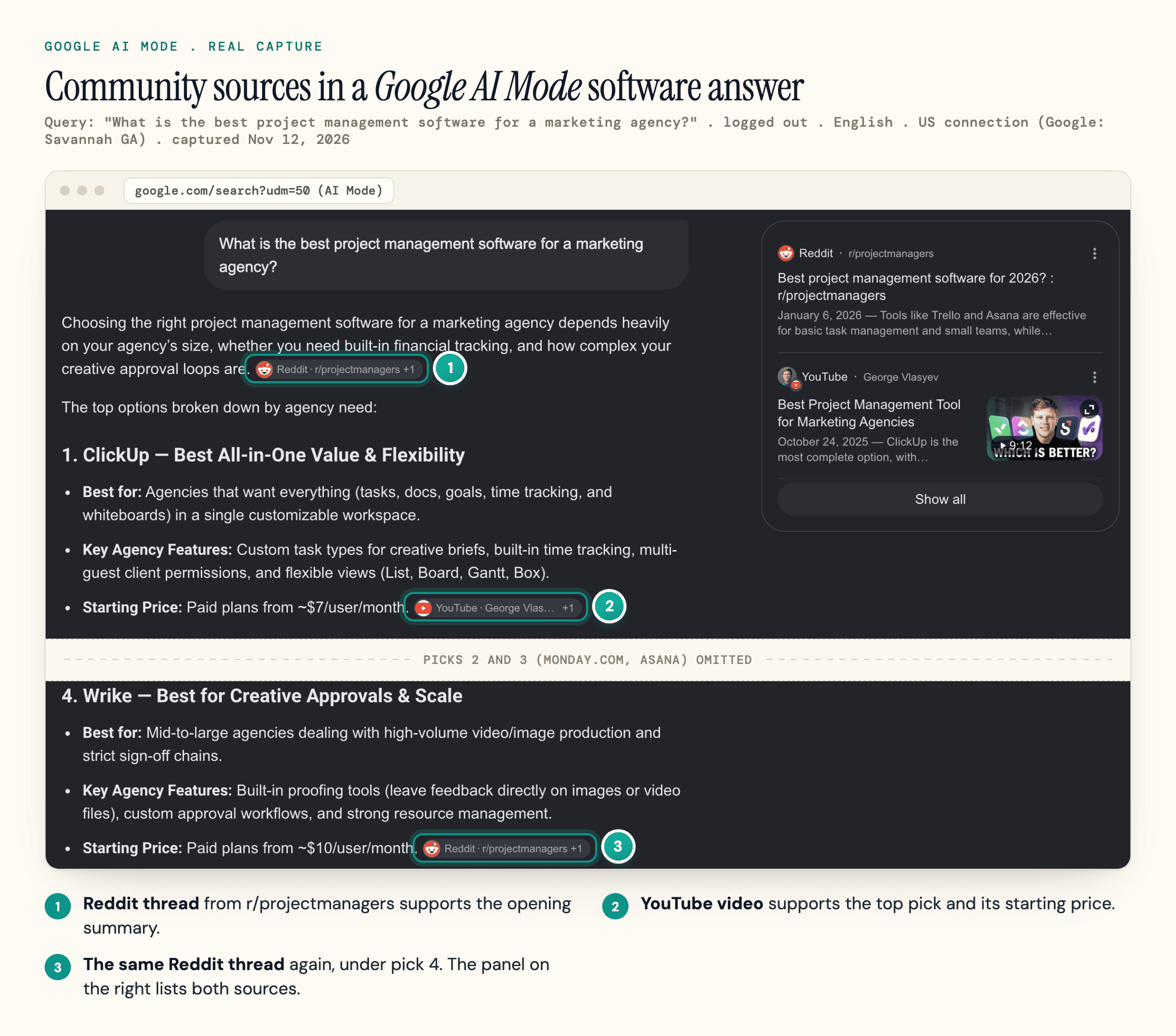
Showing up there means taking part as a person, not as an ad: answer the question asked, say who you work for, and link only when the link is the answer. Subreddit rules and moderators tend to remove anything else.
Technical SEO for SaaS Sites
SaaS sites break in ways other sites don't, because the marketing site, the product, the docs and often a staging copy share one domain. Most SaaS technical SEO work is keeping the app, staging and old documentation versions out of the index, and making sure the pages you want found are readable without JavaScript.
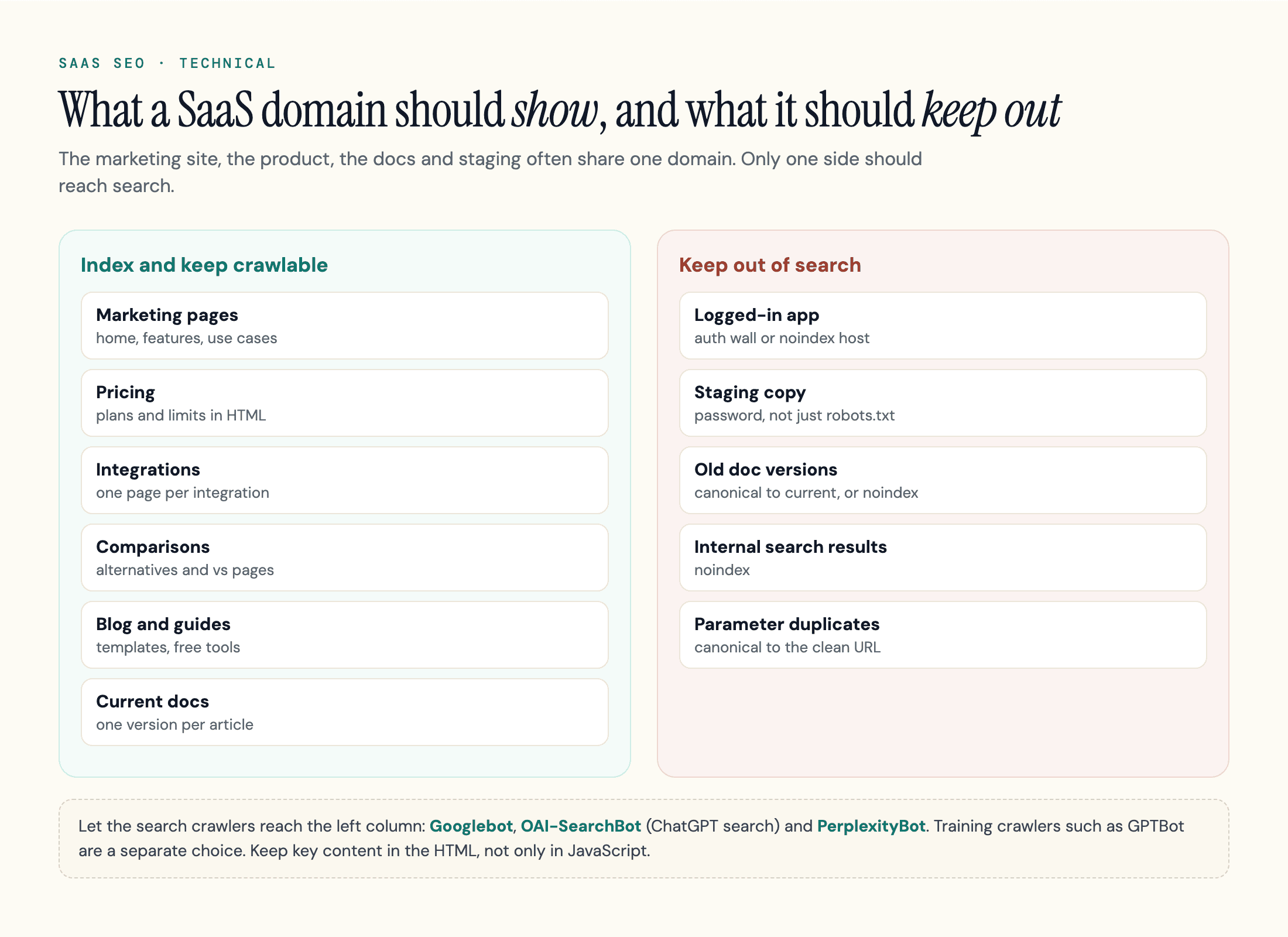
Problems That Recur on SaaS Domains
- The app gets indexed. Logged-in screens, share links and empty workspaces end up in Google. Put the app behind authentication or on its own host with a noindex rule, and keep it out of your sitemap.
- Staging leaks. A public staging copy duplicates the whole site. Protect it with a password, not just a robots.txt line, because a blocked URL can still be indexed if other pages link to it.
- Docs multiply. Version 1, 2 and 3 of the same help article compete with each other. Keep the current version indexable, canonicalize near-identical older copies to it and noindex the rest. A banner on older pages can also send readers to the current one.
- Key content only exists after JavaScript runs. Google renders JavaScript, but in the third-party 2026 server logs we found, ChatGPT-User, Claude-User and PerplexityBot fetched no scripts. Pricing tables, feature lists and docs built client-side can be invisible to them, as our breakdown of JavaScript SEO shows bot by bot, including the newer evidence that OAI-SearchBot renders scripts on some sites.
- Blog or docs on a subdomain or a subfolder? Both setups rank. Pick one, keep it consistent, and link between the docs and the marketing pages.
Let AI Search Crawlers Reach Pricing and Docs
Blocking AI crawlers by accident is easy: a broad bot rule in robots.txt or a firewall setting can shut them out of exactly the pages buyers ask about. The search crawlers and the training crawlers are separate.
OpenAI's documentation says sites that are opted out of OAI-SearchBot will not be shown in ChatGPT search answers, though they can still appear as navigational links. GPTBot is the crawler for model training, and blocking either crawler does not block the other.
Perplexity says PerplexityBot surfaces sites in its search results and is not used to crawl content for AI foundation models.
Decide on training access as a business choice, but keep the search crawlers open on your pricing, docs, integrations and comparison pages.
You don't need special markup for AI answers. Google's AI features page says there's no special schema.org structured data that you need to add to appear in its AI features. Markup that matches the visible text still helps rich results.
Our free AI Crawler Checker shows which AI crawlers your robots.txt allows. For everything else, from crawl budget to Core Web Vitals, see our guide to technical SEO.
Earn Links and Mentions on a New Domain
A new SaaS domain competes against rivals with years of links. You won't close that gap by buying links, which Google's spam policies treat as link spam. Link building for a SaaS company works when you have assets other sites have a reason to cite.
For AI answers, mentions look stronger than links. In Ahrefs' study of 75,000 brands, branded web mentions correlated with visibility in AI Overviews at 0.664, against 0.218 for backlinks. That is a correlation, not proof that mentions cause citations, but it fits our test, where pages written by third parties carried most answers.
The sources that work best for software companies:
- Integration partners. Partner directories, marketplace listings and co-written guides with the tools you integrate with. They are relevant by definition, and both sides gain from the listing.
- Original data. Anonymized benchmarks from your own product, such as a median response time across your customers, get cited by journalists, list authors and AI engines alike, because nobody else has the number.
- Free tools and templates. A calculator or template that solves one problem earns links from the posts that recommend it.
- Digital PR on real news. Funding, a notable customer, a product change that affects a whole category. Pitch the angle, not the press release.
- Unlinked mentions. Search for your brand name without a link and ask the author to add one, especially on lists that already include you.
Measure Signups, Pipeline and AI Referrals
More organic traffic is not proof that a SaaS SEO strategy is working. Measure the searches that turned into leads, trials, demos and revenue, and treat rankings and sessions as early signals that the work is moving.
| Metric | Where to measure it | What it tells you |
|---|---|---|
| Organic signups and demo requests, by landing page type | Analytics conversions grouped by page template | Which page types earn their keep |
| Pipeline and revenue from organic | CRM, using first-touch source and landing page captured at signup | Organic's share of pipeline; divide channel cost by new customers to compare customer acquisition cost (CAC) with paid |
| AI-referred sessions and signups | GA4 AI Assistant channel plus referral sources | A floor for AI traffic, not the full count |
| Self-reported source | A "How did you hear about us?" field on signup | AI and word-of-mouth influence analytics cannot see |
| AI share of answers for your category prompts | The same prompt set, run on a schedule across engines | Whether you are named, and next to whom |
| Rankings and clicks for decision searches | Search Console, filtered to vs, alternatives, pricing and integration queries | Early movement before signups follow |
Count AI Referrals, Knowing What You Miss
AI referrals are the hardest to count. GA4 now has a default AI Assistant channel for visits from sources like ChatGPT, Gemini, Deepseek, Copilot, or Grok, and it excludes Google's AI Overviews and AI Mode, which land in organic search.
Visits often arrive with no referrer when someone copies a link or opens it from an app, so they show up as direct traffic, or the buyer comes back through a branded search a day later. That is why the self-reported field matters: the answer "ChatGPT recommended you" is often the only record of that referral.
AI visibility itself is a sampled share, not a rank. The same prompt gives different answers from run to run, so track a fixed set of prompts over time and compare the share of answers that name you.
Our guide to AI search visibility metrics gives the formulas. To find the lists you are missing from, geotoolbox's Citation Interceptor (Plus plan and up, from $199 a month) pulls the offsite sources AI engines cite for your prompts and shows where your brand is absent.
How Long SaaS SEO Takes
Plan in quarters, not weeks. Fixing a technical block on an established site can move traffic quickly, while new comparison and use-case pages on a young domain need months to rank, and signups follow rankings with the length of your sales cycle on top.
In-House, Agency, and the Mistakes That Cost a Year
In-House or Agency
Who does the work matters less than what gets reported. An in-house marketer knows the product and the customers; an agency brings people who have shipped dozens of comparison pages and link campaigns.
Whoever does it, ask for reports on signups and pipeline by page type, and on the pages shipped, not on traffic and word counts. If you do hire outside help, our buyer's guide to AI SEO agencies lists what to check before you sign (we're listed in it, last).
The Mistakes That Waste the Most Time
- Publishing posts unrelated to what you sell. They rank for questions your product does not answer and build no topical authority around it.
- Starting with the biggest keywords. The high-volume definitions get written first and the decision pages never do.
- Fixing your pages and ignoring the lists. Your pages rank, but the roundups AI engines read still describe last year's pricing, or leave you out.
The lists keep moving after you fix them: a rival reprices, a roundup gets refreshed, an engine starts citing different sources. Start with what you control today. Check that AI crawlers can reach your pricing and docs with our free Agent Readiness Scanner, then rerun your category prompts each month and note whose lists the answers come from.
Frequently Asked Questions
How important is SEO for a SaaS business?
For most SaaS companies it is one of the few channels whose cost does not rise with every visit. A comparison or pricing page that ranks keeps bringing in buyers after it is written, while paid search charges for each click.
How much it matters depends on whether people search for your category: a product that creates a new category needs demand first.
When should an early-stage SaaS start SEO?
Once you can describe who the product is for and which tools it replaces, start with the pages that need no traffic history: pricing, a few comparison pages and a use-case page for each segment you sell to.
Keep a broader content strategy for later, when you know which customer questions lead to signups: blog posts written before positioning settles usually need rewriting.
Is SaaS SEO different from B2B SEO?
They overlap, and B2B SaaS SEO sits where they meet.
Much B2B software is sold as SaaS, and both serve long, researched purchases. SaaS SEO leans on product-specific pages, such as integrations, pricing, docs and comparisons, and on self-serve signups. B2B SEO also covers companies that sell services or physical products, where buying groups and sales calls carry more of the decision.
Sources
- Pew Research Center - Google users are less likely to click on links when an AI summary appears in the results (July 22, 2025) -
pewresearch.org/short-reads/2025/07/22/google-users-are-less-likely-to-click-on-links-when-an-ai-summary-appears-in-the-results - Google Search Central - AI features and your website (updated December 10, 2025) -
developers.google.com/search/docs/appearance/ai-features - Grow and Convert - What's the Average Conversion Rate of Different SEO Keywords? (published 2023, updated January 26, 2026) -
growandconvert.com/conversion-rate-optimization/average-seo-conversion-rate - Google Search Central - Spam policies for Google web search (updated August 28, 2026) -
developers.google.com/search/docs/essentials/spam-policies - G2 - G2 to Acquire Capterra, Software Advice, and GetApp from Gartner (January 29, 2026) -
company.g2.com/news/g2-acquires-capterra-software-advice-getapp - G2 - G2 Expands Buyer Intent Across Four Software Discovery Platforms (June 3, 2026) -
company.g2.com/news/g2-expands-buyer-intent-capabilities - OpenAI Developers - Overview of OpenAI crawlers (accessed November 12, 2026) -
developers.openai.com/api/docs/bots - Ahrefs - An Analysis of AI Overview Brand Visibility Factors (75K Brands Studied) (updated April 27, 2026) -
ahrefs.com/blog/ai-overview-brand-correlation - Ahrefs - Are AI Mode and AI Overviews Just Different Versions of the Same Answer? (730K Responses Studied) (updated June 5, 2026) -
ahrefs.com/blog/ai-overviews-vs-ai-mode - Zapier - App integrations directory (accessed November 12, 2026) -
zapier.com/apps - Perplexity - Perplexity crawlers (accessed November 12, 2026) -
docs.perplexity.ai/docs/resources/perplexity-crawlers - Google Analytics Help - Default channel group (accessed November 12, 2026) -
support.google.com/analytics/answer/9756891 - geotoolbox - Review of 30 Reddit threads on SaaS SEO, plus Hacker News and Indie Hackers posts (read November 12, 2026)
- geotoolbox - AI software citation test, 12 prompts x ChatGPT, Perplexity and Google AI Mode, 35 answers with sources, US (run November 12, 2026, via DataForSEO)