
A B2B SEO strategy works on different terms from consumer SEO: the sale takes months, and several people have to agree on it.
Buyers start their shortlist from what they already know: past purchases, colleagues, peers. Then they check and narrow it in Google results, AI answers, directories and vendors' own pages, mostly before they talk to any vendor.
This guide covers the keyword research, pages, listings, technical basics and pipeline measurement that get you onto that list, with examples from logistics and manufacturing. It also includes our own test at geotoolbox: 60 AI answers to buying questions about logistics providers, to see what each engine cites.
What B2B SEO Is, and What Changed in 2026
B2B SEO is the work of getting a company that sells to other businesses found, and trusted, by the people who will approve the purchase: in Google results, and now in the AI answers those people read before they contact anyone.
The mechanics are the same as any SEO. The buyer is not. A business purchase is made by a group, often called a buying committee, takes months, and starts from search terms so specific that keyword tools often report almost no volume.
How B2B SEO Differs From B2C SEO
| B2B SEO | B2C SEO | |
|---|---|---|
| Who decides | A buying group: users, finance, IT, procurement, an executive sponsor | One person or a household |
| Length of the decision | Months, with several rounds of research | Minutes to days |
| Search volume | Low: the specific terms buyers use often show under 50 a month | Varies widely, often much higher |
| Conversion | A quote request, a spec download, a sales call, a pipeline opportunity | A purchase on the page |
| What persuades | Specs, certifications, case studies, references, price ranges | Price, reviews, convenience |
The group is larger than most marketers plan for. Forrester's State of Business Buying 2026 summary, based on nearly 18,000 business buyers surveyed the year before, counts 13 internal stakeholders and nine external participants influencing a typical purchase.
The decision also starts earlier than the first sales call. In 6sense's 2026 Buyer Experience Report, the average journey lasted 10.3 months with a buying group of 10.2 people, and buyers first contacted a vendor 59.2% of the way through it. The eventual winner was on the shortlist from day one in 91.7% of journeys.
SEO doesn't build that list alone. 6sense finds that most journeys begin "with memory and existing perception", and in 79% of them the buyer's organization already had experience with the winner. Search and AI answers are where the committee checks and narrows the list, and where a less familiar vendor gets a hearing.
AI Answers Joined the Research Layer
The other change is where that checking happens. Business buyers now also ask AI assistants the questions they used to type into Google, then check the answers against sources they trust. AI adds a layer to search, and it changes which of your pages matter.
AI summaries also go with fewer clicks. In a Pew Research Center study of 900 US adults' browsing, people clicked a traditional search result in 8% of visits when Google showed an AI summary such as an AI Overview, against 15% when it did not.
How B2B Buyers Use Search and AI Now
Most business buyers now use AI somewhere in the purchase, but the share depends on who asked and when. Forrester's 2026 report puts AI use at 94% of business buyers and adds the part that matters for SEO: buyers increasingly validate what the AI tells them against trusted external sources.
In 6sense's 2026 survey, LLM use was lower, at 81%, down from 94% a year earlier.
Research habits differ by buyer population:
- Software buyers report more chatbot-first research. In G2's survey of 1,076 B2B software buyers in March 2026, 51% said they start their research with an AI chatbot more often than with Google. That figure covers software buyers only.
- Technical buyers still use search more often than AI. In the 2026 State of Marketing to Engineers report from GlobalSpec and TREW Marketing, 69% of technical buyers use generative AI during the purchasing process, yet 77% still use search engines more often than AI platforms (8% use AI more, 16% both equally).
- AI introduces fewer vendors than you might expect. Only 26% of buyers in 6sense's survey said they use LLMs to discover new vendors. Most solution categories, and many of the vendors in them, were discovered long before the current journey began.
6sense, G2, GlobalSpec and EETech, cited in this guide, all sell to B2B marketers; Forrester is an analyst firm that sells research to the same audience, and Pew is a nonprofit. Read the vendor figures as directional.
Do Roles Research Differently?
Their journeys differ less than the persona slides suggest. 6sense broke its 2026 results out by buying role:
| Buying role | Cycle length (months) | Buying group size | Winner on day-1 shortlist | Requirements set before contact |
|---|---|---|---|---|
| Final decision maker | 9.8 | 9.6 | 92.7% | 85.6% |
| Procurement | 9.8 | 9.6 | 90.3% | 83.2% |
| Champion | 10.2 | 9.9 | 88.5% | 85.1% |
| Influencer | 12.4 | 12.7 | 92.5% | 84.2% |
| Financial ratifier | 11.3 | 11.3 | 93.4% | 84.3% |
| All roles | 10.3 | 10.2 | 91.7% | 84.8% |
Influencers and finance describe longer journeys and bigger groups. In every role, though, the winner was on the first-day list about nine times in ten, and in 84.8% of journeys the requirements were set before anyone talked to sales. 6sense calls the variation modest and says the core mechanics barely move across roles.
Who sits on the committee does change with what you sell. 6sense found IT involved in 69.9% of software purchases but in 36.4% of services and 41.3% of physical-goods purchases, and it advises fitting the proof to the scrutiny each function applies.
What AI Engines Cite When Each Role Asks: Our Test
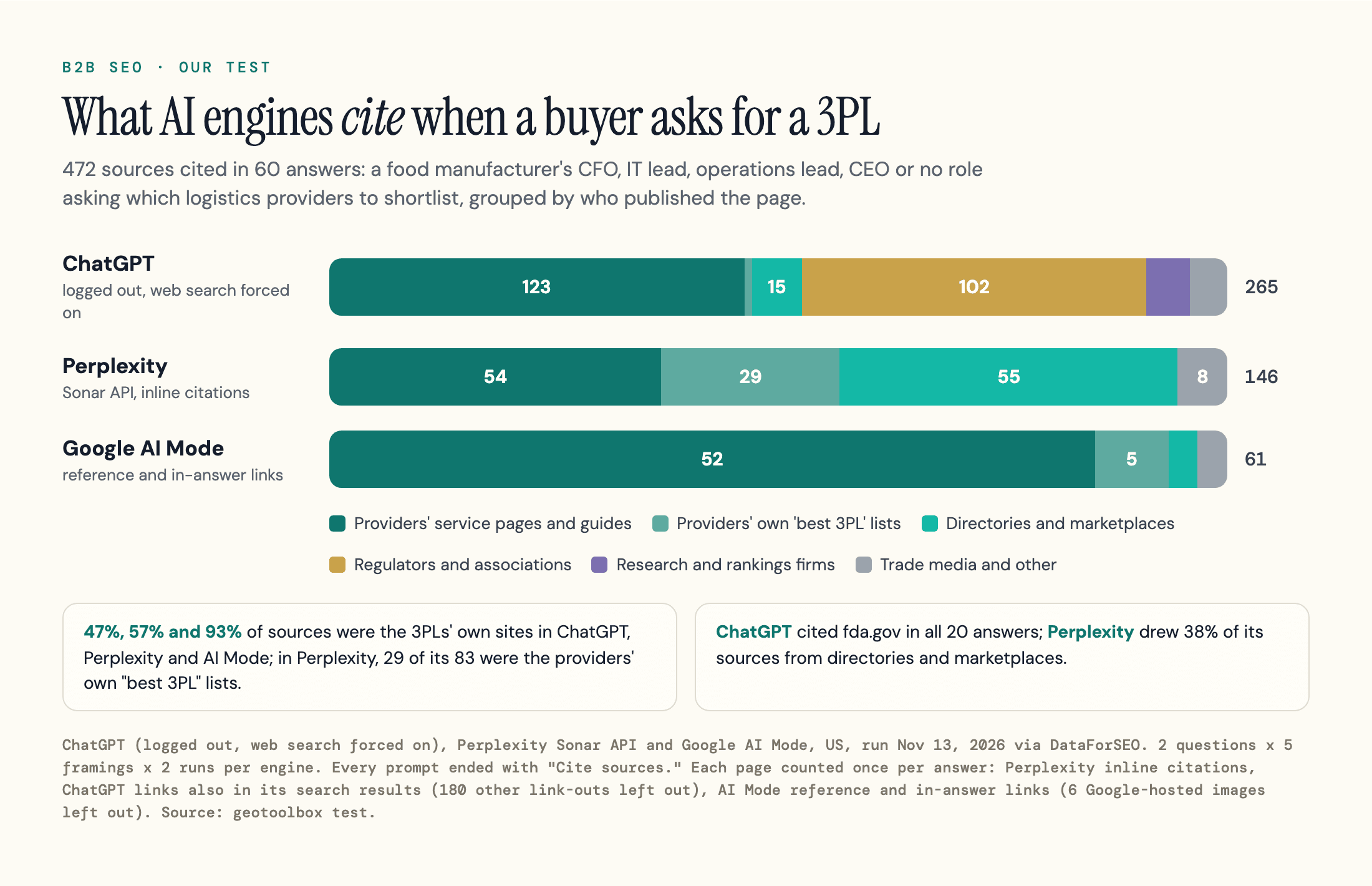
In our test, the 3PLs' own pages were the most-cited source type in all three engines, and only Perplexity's sources clearly changed with the buyer's role.
How We Ran the Test
We asked ChatGPT, Perplexity and Google AI Mode two buying questions about third-party logistics (3PL), a non-software category. The first read: "We need a third-party logistics (3PL) warehousing and fulfillment partner in the US Midwest. Which providers should we shortlist, and how should we evaluate them?"
The second asked which providers to consider for temperature-controlled storage and what to ask them before signing.
Each prompt opened with "We are a 250-person food manufacturer in Ohio", then a role clause such as "and I am the CFO" (or none), and ended with "Cite sources." Only the role clause changed.
The 10 prompts ran twice, back to back, in ChatGPT (logged out, web search forced on), Perplexity (Sonar API) and Google AI Mode, in the US on November 13, 2026: 60 answers.
We counted a page once per answer, and only if the engine cited it: inline-numbered citations for Perplexity, shown links that also appear in the answer's search results for ChatGPT, and reference and in-answer links for AI Mode.
That gave 472 cited sources. Two limits matter. The role exists only in the prompt text, so this is not what a real CFO's ChatGPT shows, and both questions asked which providers to shortlist, which favors providers' pages.
Providers' Pages Led, Including Their Own "Best 3PL" Lists
The 3PLs' own sites were the most-cited source type in every engine: 124 of ChatGPT's 265 sources (47%), 83 of Perplexity's 146 (57%) and 57 of Google AI Mode's 61 (93%). In Perplexity, 29 of those 83 were the providers' own "best 3PL in the Midwest" style roundups; the rest were service pages and buyer guides.
One Cincinnati-based provider was cited 40 times, more than any other provider (only fda.gov was cited more), and 16 of those citations went to its food-grade warehousing pages.
Beyond the providers, each engine read a different layer:
- ChatGPT cited the rules buyers must check. Government, standards-body and industry-association pages made up 38% of its sources: fda.gov appeared in all 20 ChatGPT answers, mostly FSMA food-safety rules such as sanitary transportation, alongside the SQF food safety code. It named providers from rankings too, such as the Global Cold Chain Alliance's Top 25 lists and Armstrong & Associates.
- Perplexity cited directories and matchmaking sites. 55 of its 146 sources (38%) were 3PL directories and marketplaces, and one matchmaking site appeared in 18 of its 20 answers.
- Google AI Mode cited almost only providers. Directories, trade media and other sites together made up 4 of its 61 sources, and it cited no regulator.
In ChatGPT, the Role Moved Sources About as Much as a Rerun
We compared how much the cited domains overlapped between two framings of the same question and between two runs of the same prompt.
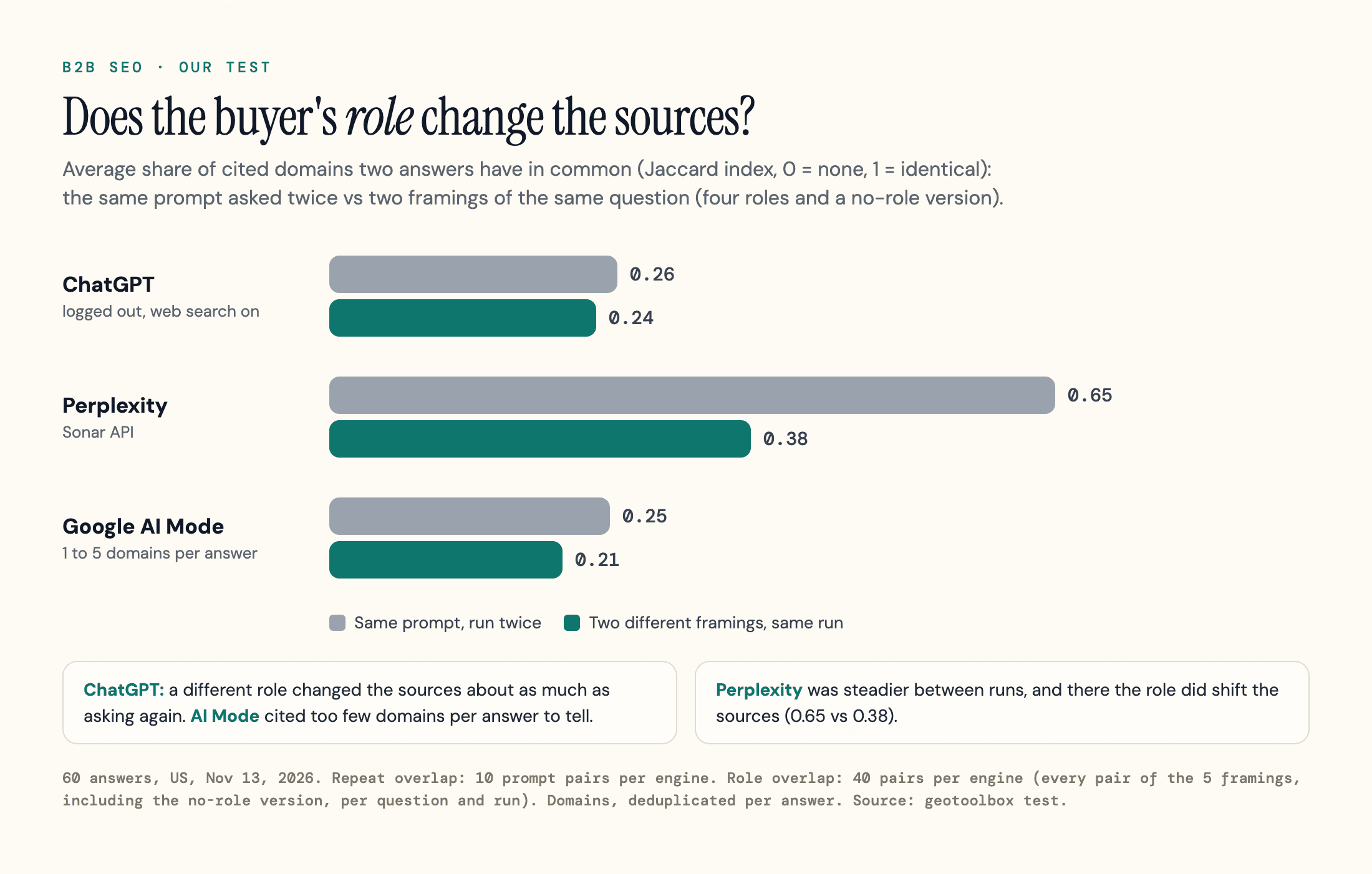
In ChatGPT, changing the role changed the cited domains about as much as asking the same prompt twice. Google AI Mode cited too few domains per answer to tell.
Perplexity was steadier between runs, and there the role did shift its sources: the operations and IT framings drew far more providers' service and facility pages (about 10 each, against 2 for each of the other framings).
The answer text moved most for IT. SOC 2 reports came up in 11 of the 12 IT and security answers and in none of the other 48, and only that framing brought NIST cybersecurity pages into ChatGPT's answers.
For the other roles, the answers covered much the same ground: rates, WMS (warehouse management system) and EDI integration, food-safety certification, capacity.
One category and two questions can't settle page strategy, but nothing here argues for a separate site per role. What changed most with the role was the answers' emphasis, especially for IT. Build pages that answer each role's question precisely, and get listed on the directories, rankings and associations the engines read.
How ChatGPT picks those sources is covered in our guide to ChatGPT citations.
Keyword Research When the Tools Show Zero
Building a B2B SEO strategy runs into a complaint that came up in several of the Reddit threads we read for this guide: every keyword for what we sell shows 0-20 searches a month. That often means the tools can't see the demand, though sometimes the demand really is small.
Keyword tools are coarse at the low end. A term like "food-grade 3PL Ohio" or "cleanroom packaging contract manufacturer" may show zero and still be typed by every buyer who matters to you that year.
Low volume often comes with high intent: ten searches from the right companies can be worth more than ten thousand from people who will never buy.
Size Demand From Your Own Data
Size the keywords you target with evidence from your own business before trusting a volume column:
- Start from sales and support conversations. Pull the exact phrases buyers used on calls, in RFQs (requests for quote) and in emails. Check them in Search Console.
- Read your Search Console queries. Impressions on long, specific queries show demand that keyword tools report as zero. Filter out your brand to see the non-brand trend.
- Check how directories and competitors name the category. If buyers browse a "temperature-controlled warehousing" category on a directory, that wording is a strong candidate for their searches.
- Look for the qualifier. Location, certification, capacity, material or regulation turns a vague term into the one a committee actually types.
- Widen the list last. Google's autocomplete predictions and a keyword export of the competitors who already rank fill in the variants you missed.
Group Keywords by the Question Behind Them
Then group the terms by the question they answer, and note which role asks it:
| Keyword type | 3PL example | Industrial example | Who usually asks |
|---|---|---|---|
| Problem | how to reduce food warehousing costs | why do stainless fittings corrode | Users, champions |
| Category + spec | frozen food 3PL Midwest | 316L sanitary fittings supplier | Users, procurement |
| Credential / compliance | SQF certified warehouse Ohio | ISO 13485 contract manufacturer | Quality, procurement |
| Comparison / alternative | 3PL vs in-house warehouse cost | machined vs cast valve bodies | Finance, executive sponsor |
| Integration / security | 3PL EDI integration with our ERP | supplier portal data security | IT and security |
Problem searches usually come early in the funnel; credential, comparison and integration searches tend to come from buyers near a decision, the bottom of the funnel, though stage depends on context. Group close variants on one page, but give each certification its own page; one comparison page can carry several "vs" variants.
Build Topic Clusters Around Buyer Problems
Problem keywords are where content marketing earns its place in SEO for B2B companies. Write about the adjacent problems your buyers research before they shop, often called shoulder topics, such as cold-chain compliance for a 3PL or corrosion for a fittings maker.
Link those articles to a pillar page on the category and to your service pages, so search engines and readers see one connected topic.
A small firm rarely outranks an industry leader for "3PL", but it can own "SQF certified frozen storage near Columbus", because the leader has no page that specific.
Build the Pages Each Committee Member Needs
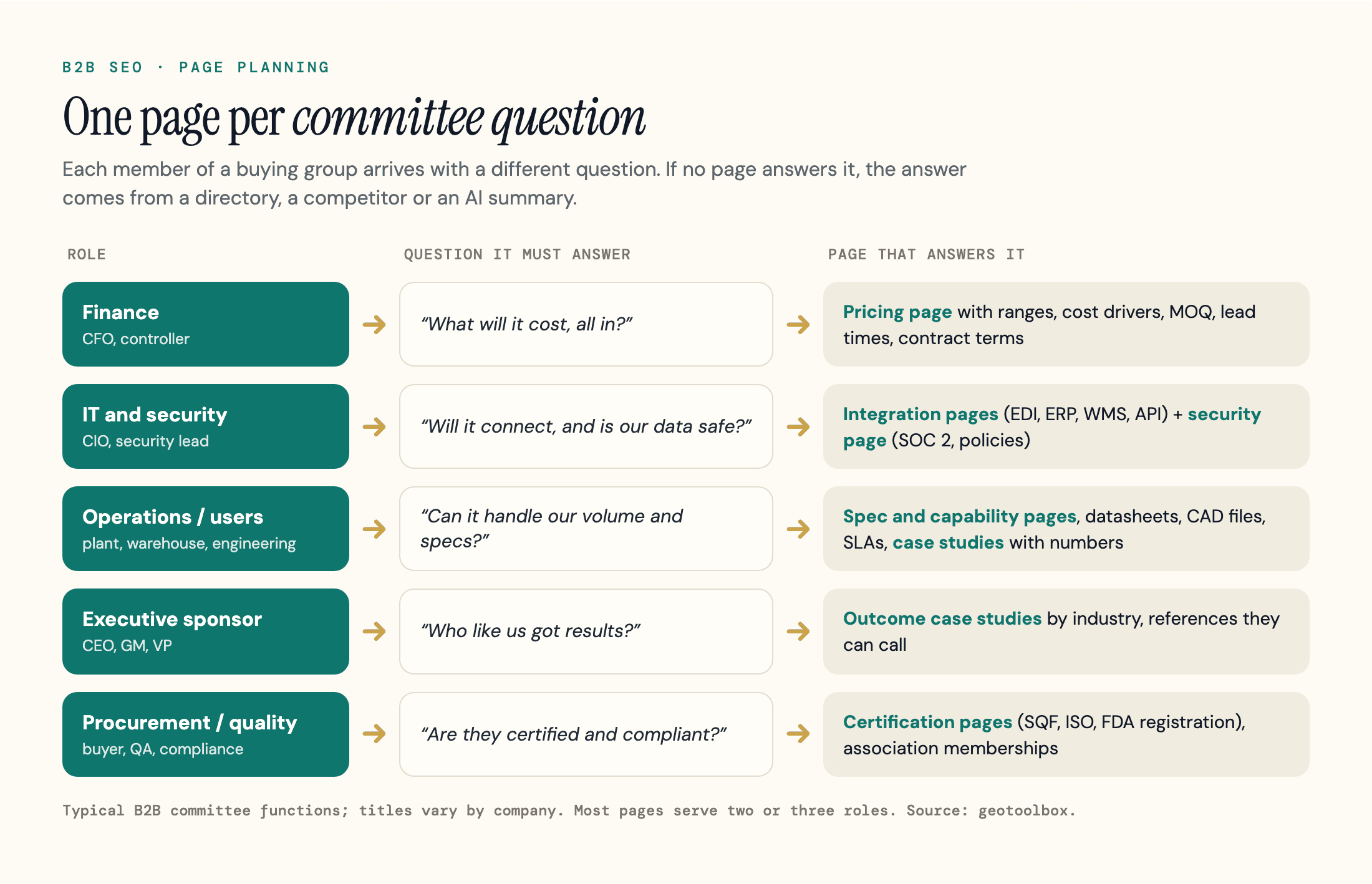
A B2B website with only a homepage, a services page and a blog loses committees mid-journey. Each member arrives with a different question, and if no page answers it, they get the answer from a directory, a competitor or an AI summary of both.
Map every committee role to the question it has to answer and the page that answers it:
Pages for Finance and Procurement
Finance needs a number. "Contact us for pricing" sends the comparison elsewhere. You rarely need a price list; price ranges, the factors that move the price, minimum order quantities, lead times and contract terms are enough to stay on the list.
Procurement and quality need credentials. Give each certification or registration its own page (SQF, ISO, FDA registration, industry associations), written so a buyer can confirm it in one read. Name the rules your certification covers: fda.gov was the single site ChatGPT cited most in our test.
Pages for IT and Security
Integration pages (EDI, ERP, WMS, APIs) and a security page listing the reports and certifications you can share, such as a SOC 2 report, answer the questions that set our test's IT answers apart from the rest.
Pages for Operations, Users and Executive Sponsors
Operations and end users need spec sheets, capacity, service levels and case studies with numbers. For technical buyers, files matter as much as copy.
Sixty-eight percent of the engineers in EETech's June 2026 study of 750 engineers had delayed or reconsidered a vendor because of a poor digital experience. The author singles out datasheets, and one engineer wrote that they don't buy without downloadable CAD models.
The executive sponsor needs outcomes: case studies and industry pages for companies like theirs, with the result in the headline, and references they can call.
Basic on-page SEO still applies: give each of these pages one query group to own. Put that term in the title, the H1 and the URL, and answer the question in the first paragraph; Google builds title links from several sources, including the title element and the main heading.
Then make the next step obvious on each page, a quote request or a spec download, and track which pages produce sales-qualified leads as well as form fills.
Services Firms Have an Extra Problem
Professional services and contract providers sell something the buyer can't inspect in advance, and 6sense finds buyers are less likely to have bought from the contenders before.
Its advice: make the intangible concrete with diagnostic frameworks, outcome evidence and transparency about how the work is delivered. On a website, that means a methodology page, case studies with before-and-after numbers, and named practitioners with real credentials, the experience and expertise behind E-E-A-T.
If you sell software, the page types differ (integrations, alternatives, docs, public pricing); our SaaS SEO guide covers them. If you sell from a catalog, product data and variants come first.
Get Listed Where Buyers and AI Engines Look
Your own pages are only part of the shortlist. The rest is what third parties say about you, and our test showed each AI engine reading a different set of them.
Directories, Marketplaces and Rankings
Every category has its directories: industrial supplier directories, contract manufacturing marketplaces, 3PL matchmaking sites, review sites for professional services. Perplexity leaned on these most. Claim your profile on the ones that rank for your category terms, fill every field (capabilities, certifications, locations, capacity), and keep it consistent with your site.
Rankings work the same way. ChatGPT named providers from published top-25 lists and analyst rankings, so find the lists your category publishes and what it takes to be included.
Associations and Standards Bodies
You can't write the regulators' pages, but you can answer their rules by name on yours, and you can appear in public registries and member lists under the same company name your site uses. Link your site to those records.
Partners, Trade Media and Original Research
6sense describes an "extended buying group" outside the formal committee: analysts, consultants, investors, distributors, resellers and systems integrators who shape the committee's confidence.
Ask the suppliers, distributors and integrators you work with to list you on their partner pages, and offer trade publications data they can quote: digital PR at its simplest. The same mentions earn the backlinks that still carry weight in Google's organic results.
Webinars and guest articles reach the same audiences: co-host a webinar with a partner or an association and publish the recording with a transcript, with the consent of everyone heard or seen in it, or write for the trade titles your buyers read. Don't pay for links that pass ranking credit, and keep keyword anchor text out of the links in your guest articles and press releases: Google's spam policies list both as link spam. A paid placement is fine when its link carries rel="sponsored" or rel="nofollow".
Original data gives others something to cite: G2's 51% figure, from its own buyer survey, came back in all five AI engines we asked while researching this guide. A survey of your customers or a benchmark from your own operations is the smaller-scale version, and it builds the thought leadership committees look for.
LinkedIn, YouTube and Communities
Committees also research on social platforms. In the GlobalSpec and TREW survey, YouTube and LinkedIn again ranked as the social platforms technical buyers find most valuable for work. Short explainer videos and posts from named staff reach people who never type your category into Google.
Keep the Facts Consistent
AI answers stitch facts together from several pages. If your site says three warehouses and a directory says two, the answer may say either. Keep the facts a committee filters on identical across your website and every listing: locations, certifications, capacity, industries served.
This is the B2B form of what we call LLM seeding: placing accurate, consistent information on the pages AI engines already read.
Technical SEO for B2B Sites
Speed and Core Web Vitals still matter, but most B2B technical problems come from how the content is stored.
Don't hide specs behind forms or only in PDFs. Spec sheets, datasheets, certificates and capability statements are what committees and AI engines need to read. A gate adds friction for buyers and blocks crawlers that can't fill in a form.
Google can index PDFs, but a PDF can't carry the structured data Google reads from HTML pages. Publish the facts a buyer filters on as HTML, link the PDF from that page, and keep the gate for deep assets such as a full research report.
Tame large catalogs. Distributors and manufacturers with thousands of SKUs and filter combinations run into crawl waste and duplicate pages. Our technical SEO guide covers faceted navigation, rendering and indexing in depth.
Let AI crawlers in deliberately. Some B2B sites block AI crawlers without meaning to, through a CDN or firewall setting.
Decide which ones you allow (search and answer bots versus training bots) with our AI crawlers guide, then check what each crawler's user agent receives with the free Agent Readiness Scanner, which fetches your pages as six AI crawlers using their user agents (not their IP addresses or verified-bot status).
Mark up the company. Organization data (legal name, locations, contact points) and product data where you sell a defined product can help engines connect your listings to your site.
Cover the basics on every page. Beyond the title, H1 and URL rules above, give each page its own meta description (Google may use it for the snippet), separate the words in URLs with hyphens, serve every page over HTTPS, and show the same content on mobile as on desktop: Google indexes the mobile version.
Measure Pipeline, Not Rankings
Another frequent complaint in those Reddit threads: rankings go up, average position improves, and inquiries stay flat. Rankings, traffic and Domain Authority describe visibility. They don't tell you whether committees put you on the list.
The bigger problem is time. A B2B journey lasts 10.3 months on average in 6sense's numbers, far longer than GA4's attribution window.
The key event lookback window defaults to 90 days for most key events and can only be shortened to 30 or 60. If a buyer first found you through search in January and requested a quote in October, that January visit falls outside the window.
Report on Three Layers
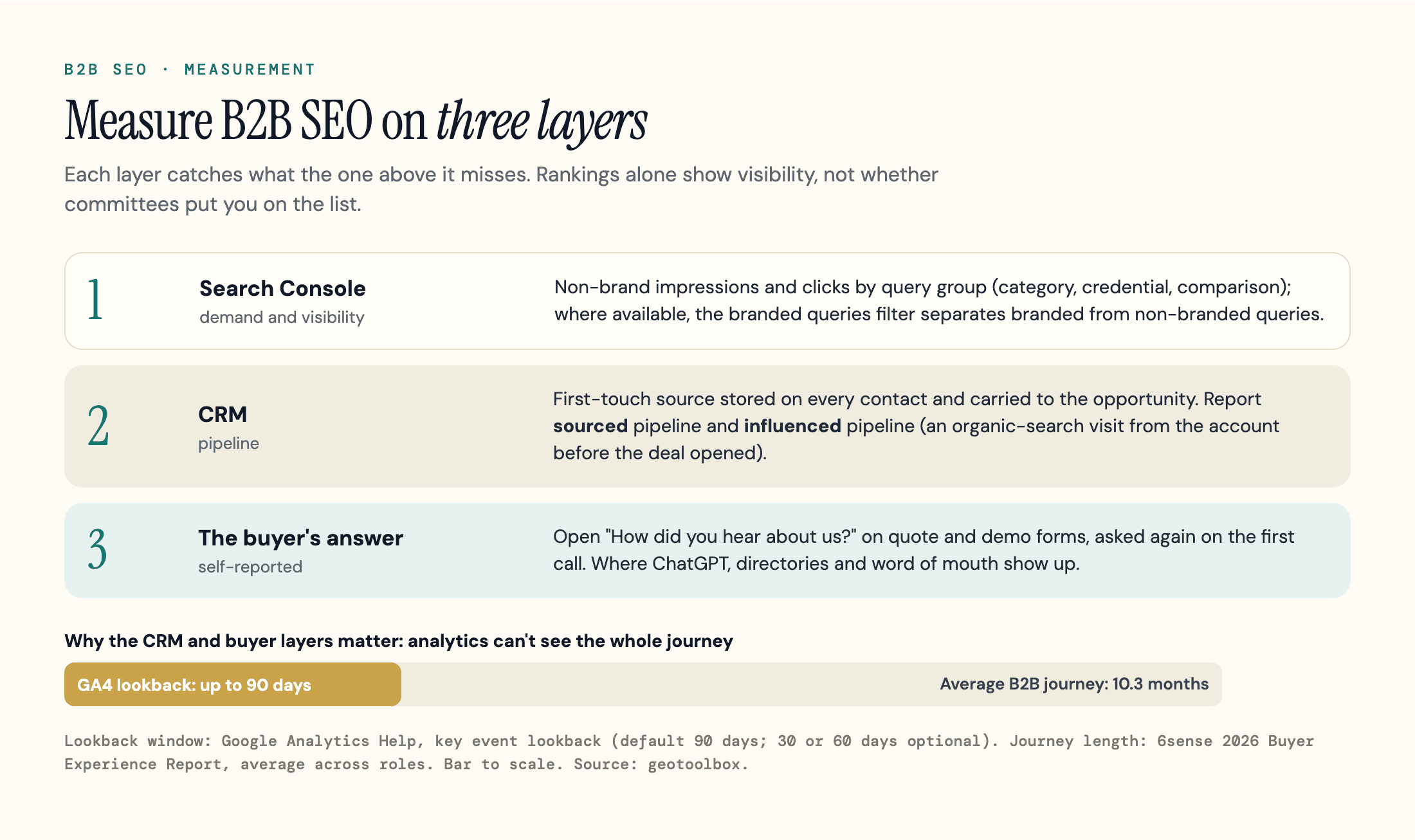
- Search Console: demand and visibility. Track non-brand impressions, clicks and traffic on the query groups that matter (category, credential, comparison). Where it is available for your site, Search Console's branded queries filter separates branded from non-branded queries.
- CRM: sourced and influenced pipeline. Store the first-touch source on every contact and carry it onto the opportunity. Report sourced pipeline (deals whose first touch was organic search) and influenced pipeline (deals where a contact from the account arrived through organic search before the opportunity opened, ideally on key pages such as pricing ranges, certifications or case studies). GA4's attribution paths report gives a rough early read of the same thing.
- The buyer's own answer. Add an open "How did you hear about us?" field to quote and demo forms, and ask again on the first sales call. This is where AI assistants can show up: a buyer may write "ChatGPT", "a Google search" or "a directory" for a visit analytics labeled as direct.
Closed revenue from organic search can lag the first visit by months, which is why opportunities, the influenced number and the buyers' own answers matter in the first year.
Review Pages Ranking 5 to 20 Every Quarter
Rankings still tell you where to work. Once a quarter, filter Search Console's Performance report to a query group that brings pipeline, open the Pages tab with Average position on, and list the pages averaging positions 5 to 20. That range is a working habit, not a Google rule. A query filter leaves out anonymized queries, so check the unfiltered Pages tab too.
These pages already have visibility, so start there before writing new ones: answer the query earlier on the page, add the spec, certification or case study buyers have asked about since, and link to the page from stronger ones. In the same pass, update outdated PDFs such as an old spec sheet or an expired certificate, or remove them and redirect their URLs to the current page.
Track AI Answers Without Overreading Them
Add AI referrals in analytics (visits from chatgpt.com, perplexity.ai and similar) and a fixed set of buyer prompts checked in each engine every month. Our guide on how to measure AI visibility explains the metrics.
Our test also shows why one check proves little: in ChatGPT and Google AI Mode, the same prompt run twice shared only about a quarter of its cited domains. Judge trends across many prompts and repeated runs, and remember that trackers, ours included, measure standardized test conditions rather than each buyer's personalized answers.
Is SEO Worth It for Your B2B Company?
A firm that closes four to six large deals a year often asks whether SEO for B2B can matter at that scale. It usually can: what counts is whether the few committees that will buy this year find you, and believe you, while they check their list.
SEO is a weaker bet when your buyers never research online (a handful of known accounts served through relationships), or when you can't publish the specifics committees need. In those cases, account-based outreach and directory listings may come first.
Mistakes That Cost the First Year
- Chasing high-traffic terms a committee never types, while credential and spec queries go unanswered.
- Gating the spec sheets and certificates that buyers and AI engines need to read.
- Reporting rankings and traffic instead of sourced and influenced pipeline.
In-House or Agency?
A small team can do much of this itself. The knowledge sits in sales calls, quotes and engineering documents, and the most valuable pages are written from those. An agency helps with technical work, scale and link earning.
If you hire one, ask for pipeline reporting from the first proposal. Our list of AI SEO agencies covers firms that report on AI visibility as well as Google (we sell a small GEO service ourselves and list it there, last).
Whichever route you take, check where you stand before you write anything: run the prompts your committee would ask in ChatGPT, Perplexity and Google AI Mode, and note who gets cited.
To track that every week, geotoolbox's AI Visibility Tracker runs your prompts across up to eight AI engines (all eight on the Pro plan), and Domain Overview, on the Plus plan and up, shows the pages each engine cites and the competitors that appear instead of you.
Frequently Asked Questions
Can I do my own SEO for my business?
Yes. In B2B the most useful pages come from knowledge only you have: buyers' questions on sales calls, your specs, certifications and results. Build one page per question, keep your directory listings consistent, and bring in help for technical work or scale.
How long does B2B SEO take to produce leads?
Agencies commonly quote three to six months for ranking movement and six to twelve months for a steady flow of qualified leads. That is a practitioner rule of thumb, not a measured benchmark. Closed revenue from organic search arrives later still, because deals have to run through your sales cycle.
Does SEO work for manufacturers and industrial suppliers?
It does. Engineers and other technical buyers still use search engines more often than AI platforms when they search for information. Publish crawlable spec pages, downloadable CAD files and datasheets, certification pages and application case studies, and list your company in the industrial directories your buyers use.
Sources
- The State Of Business Buying: Risk-Averse Buyers Demand Proof, Not Promises - Forrester (Barbara Winters), 2026 -
forrester.com/blogs/state-of-business-buying-2026/ - B2B Buyer Experience Report: The Secret Life of B2B Buyers - 6sense, 2026 -
6sense.com/buyer-experience-report-2026 - In the Answer Economy, Don't Win the Click - Win the Answer (on the report The Answer Economy: How AI Search Is Rewiring B2B Software Buying) - G2, April 15, 2026 -
company.g2.com/news/g2-research-the-answer-economy - 2026 State of Marketing to Engineers - GlobalSpec and TREW Marketing, March 2026 -
advertising.globalspec.com/wp-content/uploads/2026/03/SMTE-Report_GS2602_FINAL.pdf - What Engineers Actually Do Before They Buy - EETech, June 2026 -
eetech.com/research/what-engineers-actually-do-before-they-buy - Select attribution settings - Google Analytics Help -
support.google.com/analytics/answer/10597962 - Google users are less likely to click on links when an AI summary appears in the results - Pew Research Center, July 22, 2025 -
pewresearch.org/short-reads/2025/07/22/google-users-are-less-likely-to-click-on-links-when-an-ai-summary-appears-in-the-results/ - How Google autocomplete predictions work - Google Search Help -
support.google.com/websearch/answer/7368877 - Influencing your title links in search results - Google Search Central -
developers.google.com/search/docs/appearance/title-link - Spam Policies for Google Web Search - Google Search Central -
developers.google.com/search/docs/essentials/spam-policies - Mobile-first Indexing Best Practices - Google Search Central -
developers.google.com/search/docs/crawling-indexing/mobile/mobile-sites-mobile-first-indexing - AI citation test of 60 answers to 3PL buying questions by role - geotoolbox, November 13, 2026 (method in this article)