
Prompt research is keyword research for AI answers: finding the questions your buyers ask AI assistants, and deciding which ones are worth tracking. No AI platform publishes what people type, so most prompt lists are built from indirect evidence.
A trustworthy prompt list needs evidence that buyers ask each prompt, a check of whether the engine searches the web to answer it, and enough runs to measure it. We tested demand and search with our own Search Console data and a 30-run ChatGPT test, and did the math on runs.
What Is Prompt Research?
Prompt research is the work of finding, choosing and validating the prompts where your brand should show up in AI answers: the questions buyers type into ChatGPT, Gemini, Perplexity, Claude and Google's AI Mode before they pick a vendor. It is the research layer of generative engine optimization and LLM SEO, the same way keyword research is the research layer of SEO: you decide what to measure before you measure it.
The output is a prompt set: a few dozen questions grouped by buyer, buying stage and topic, each backed by evidence that people ask it and that the answer names brands or sources you could appear in.
Most of Google's organic results for "prompt research" mean something else: writing prompts to do academic research with an AI assistant. That is prompt engineering for research tasks, and this page does not cover it.
Prompt Research vs Keyword Research
Keyword research still feeds prompt research. What differs is what you can measure and what you try to win.
| Keyword research | Prompt research | |
|---|---|---|
| Unit | A short query typed into a search box | A full question with context, budget and constraints |
| Demand data | Search volume from Google's ad data, refined by SEO tools | No first-party volume; vendor estimates at the topic level |
| What you win | A ranking position on a results page | A mention, a recommendation or an AI citation inside one answer |
| Stability | Rankings move over days and weeks | Answers change on most runs |
| What you optimize | The page for the query | The pages behind the searches the engine runs for the prompt |
The last row matters most. When an engine searches the web for a prompt, it usually does not search for the prompt as typed. It rewrites it into its own searches, often adding brand names, the year and words like "pricing", a process called query fan-out. The prompt tells you which conversation to watch. The fan-outs show what the engine looked up, and its citations show which pages it used.
Is There Search Volume for AI Prompts?
No AI platform publishes prompt-level search volume. Every "prompt volume" number you see in a tool is an estimate built from a sample or a model, and the useful question is what it can and cannot tell you.
What the platforms share as of November 26, 2026:
- OpenAI. Since November 10, 2026, OpenAI's Business Hub, in beta for businesses that claim their profile, shows mentions, website clicks and "discovery topics", described as "common themes across conversations where their website is cited". It does not share users' conversations, and insights appear only once enough conversations or interactions meet its thresholds.
- Google. The generative AI performance report in Search Console counts impressions from AI Overviews and AI Mode, grouped by page, country, date or device. There is no query dimension. Google's AI features documentation says AI Mode traffic is also counted in the main Performance report under the "Web" search type.
- Microsoft. The AI Performance report in Bing Webmaster Tools lists grounding queries, which Microsoft describes as "the key phrases the AI used when retrieving content" that Copilot, Bing's AI summaries and select partner experiences cited. They are a sample of retrieval phrases, not the prompts users typed.
- Perplexity and Anthropic. We found no comparable prompt or query report for site owners.
AI visibility tools fill the gap with their own datasets. Semrush's documentation describes a "prompt database of 317M+ AI queries" covering Google AI Overviews, AI Mode, Gemini and ChatGPT, and labels its AI Volume figure as an estimate. Profound says its reports start from real user prompts captured from AI platforms. Our own paid tracker checks intent against search-intent data and ranks prompts by estimated AI-search demand. None of these datasets can be audited from outside, ours included.
| Source | What it gives you | What it cannot tell you |
|---|---|---|
| OpenAI Business Hub | Mentions, clicks and themes for your business | The prompts, or demand where you are not yet mentioned |
| Search Console AI report | AI Overviews and AI Mode impressions by page | Which query or prompt produced them |
| Bing AI Performance | A sample of grounding queries behind your citations | The prompt behind each search |
| Vendor prompt databases | Estimated demand by topic, example prompts, intent mix | How the vendor's sample maps to your market |
Use them to rank topics, never to forecast traffic from one exact prompt.
In the 14 Reddit threads we read, a recurring complaint was not knowing where a number comes from. Before you use one, ask the vendor where its prompts come from (a clickstream panel, captured conversations, or Google keyword volume run through a model), how the sample is weighted to your market, and whether it shows absolute numbers at all.
Your Search Console Already Has Prompts in It
The cheapest source is one you already own. Long, conversational queries reach your site through Google every day, and since AI Mode is counted in the Performance report, some are likely AI Mode prompts. Search Console does not label them, so treat that as likely, not proven.
Our numbers for geotoolbox.ai, from the Search Console API: US traffic, August 26 to November 23, 2026.
| Query length | Impressions | Clicks | Share of impressions |
|---|---|---|---|
| All non-anonymized queries | 798,864 | 1,238 | 100% |
| 8 words or more | 110,896 | 37 | 13.9% |
| 8+ words with a question word | 77,384 | 29 | 9.7% |
| 25 words or more | 17,506 | 0 | 2.2% |
Long queries brought 13.9% of impressions and 3% of clicks, a click-through rate of 0.03% against 0.15% for all disclosed queries.
Those shares cover only the queries Google shows: anonymized queries made up 55% of US impressions, and rare long queries are the likeliest to be hidden.
Some do not look human. Across all countries we also found queries shaped like prompt templates: a persona block starting about me: marketing **title:** software marketing team member followed by a question, or a tagged string in the shape <brand>[a brand]</brand> is criticised for <objection>[an objection]</objection>. AI visibility trackers and SEO teams that run prompts through Google's AI Mode or AI Overviews would produce strings like these. We cannot see who sent them, so that is an inference.
To pull your own: in the Performance report, add a Query filter, switch it to "Custom (regex)" and paste the first pattern below.
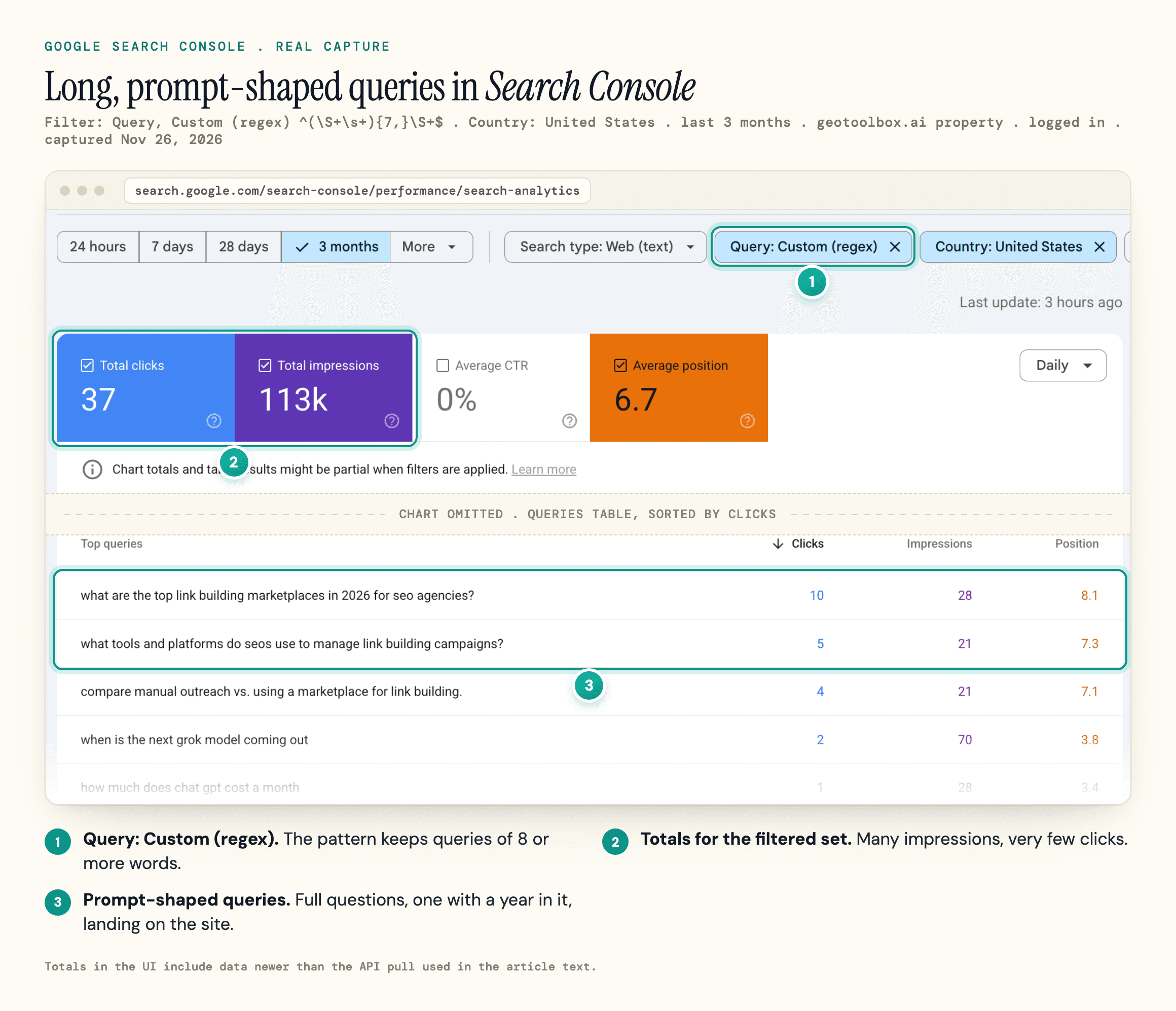
These patterns cover most needs:
^(\S+\s+){7,}\S+$keeps queries of 8 words or more(?i)(^|\s)(who|what|when|where|why|how|which|is|are|can|should|does|do)\skeeps queries with a question word, a rough filter (the UI takes one regex, so our combined row came from the API)
Sort the result by position too. Where you rank past position 10 on a long query, check which page got the impressions before calling it a content gap.
Then clean the export: set aside strings with quotes or OR operators and persona templates for review, and keep questions a buyer would ask. What survives is real wording that reached your site, worth checking against your other sources.
Where to Find Real Prompts
No single source shows what buyers ask AI engines, so draw on several.
| Source | How to mine it | What it proves | Watch out for |
|---|---|---|---|
| Search Console | Regex filter for long and question queries | Real wording already reaching your site | Tool-generated strings with no human behind them |
| Keyword data | Cluster keywords by problem, then rewrite each cluster as a question with constraints | The problem has estimated search demand | Short keywords hide the context |
| Sales calls and support tickets | List objections, comparisons and "does it work with" questions | Buyers ask it right before buying | No volume; customers are not the whole market |
| Community threads | Top threads of the year in 3 to 5 communities, plus a category-term search | Phrasing, and topics too new for keyword tools | Vendor accounts posting as users |
| The engines' own follow-ups | Note the clarifying and related questions your broad prompts get, plus Google's People Also Ask box | The criteria the engine uses to narrow a shortlist | Follow-ups change between runs and accounts |
| Watching buyers use AI | Watch 5 to 10 buyers do the task in their assistant | Real wording, detail and follow-ups | Small samples |
| Vendor prompt databases | Read the example prompts and intent split for your topic | Topic-level demand, estimated | A sampling method you cannot inspect |
Sales conversations are the source most teams skip. A prospect who asks your rep "does it integrate with HubSpot?" has likely asked an assistant too. Write the prompt the way they would, with their company size and stack, and strip customer details before pasting a transcript into an AI tool.
The engines' follow-ups show what the engine treats as a deciding factor. When an assistant answers a broad recommendation prompt by asking about budget, team size or integrations, each of those options is a narrower prompt worth testing. Buyers refine across turns too, so test the narrower follow-ups as prompts of their own, knowing a standalone prompt is not a true second turn.
Turning One Need Into Prompts
Real prompts are long and specific. Seer Interactive watched people use AI assistants across 387 prompts: in its latest study (June 2026) the median prompt ran 20 words, and keyword-style prompts had fallen from 18% to 3% since its first.
So write variants by adding the angles buyers actually mention. Each row below changes the need, so each one can return a different shortlist.
| Angle you add | Example prompt for a real estate CRM |
|---|---|
| Who is asking | "We're a small brokerage with a handful of agents. Which CRM should we use?" |
| The problem first | "Our agents keep losing leads after showings. What CRM would fix that?" |
| Stack or integration | "Which real estate CRM works with Gmail and can text new leads automatically?" |
| Budget | "What is a good real estate CRM for a team on a tight budget?" |
| Comparison | "Follow Up Boss or HubSpot for a small brokerage?" |
| Alternative | "What is a simpler alternative to the CRM our brokerage uses now?" |
Keep only the rows your evidence supports.
Should You Ask ChatGPT to Write the List?
An assistant will happily write 50 plausible prompts from your homepage, none from a buyer. Brainstorm with one, then keep only what a source above backs up.
Exact wording also matters less than it looks. In a study by SparkToro and Gumshoe, 142 people wrote their own prompt for the same need, recommending headphones for a traveling family member (Gumshoe is an AI tracking startup).
The average semantic similarity between any pair of those prompts was 0.081, so almost none were alike. Yet across the 994 answers those prompts produced, Bose, Sony, Sennheiser and Apple showed up 55% to 77% of the time. Wording varied wildly. The leading brands did not.
What Our ChatGPT Test Showed about Wording, Fan-Outs and Search
Most prompt research advice rests on one claim: prompts with the same need trigger similar background searches, so exact wording matters less than intent. None of the guides we compared published a test of it, so we ran a small one.
Method. On November 26, 2026 we sent prompts to ChatGPT's consumer web app through DataForSEO's ChatGPT scraper, from a US location, and logged each answer's fan-out queries, cited sources and brands. The buyer needs: an email tool for a small SaaS, running shoes for knee pain, and a CRM for a small real estate team. Each was written as a keyword-style query, as a plain question, and as a detailed version with context and constraints (the email and shoe prompts add a budget).
Each wording ran twice with web search forced on: 18 runs. Then 12 more prompts ran once each without forcing search.
Rewording Barely Moves the Searches. Constraints Do.
Rewording a question changed the background searches a little more than asking the same question twice. Adding context and constraints changed them far more.
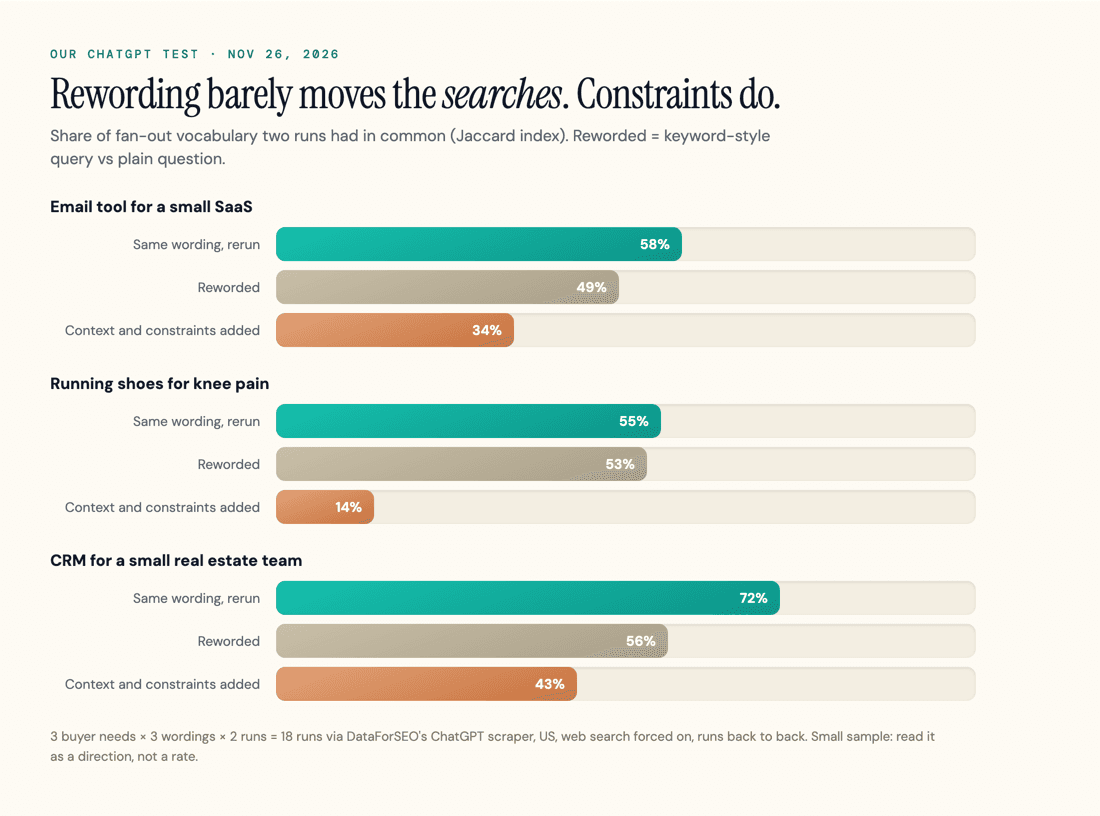
That supports the claim we tested; the detailed prompts are really a different need. They also triggered more searches, 2.8 per run against 1.2 for the keyword-style versions, mostly price checks on named products.
The leading brands moved less than the searches. Brevo, Customer.io and Loops appeared in every email answer, and Follow Up Boss in every CRM answer. The detailed prompts narrowed the shortlists: the detailed CRM answers no longer named Real Geeks, and the shoe prompt with an age, a surface and a $150 cap dropped Hoka.
Cited domains moved the most. Reruns of the same wording shared only 11% to 50% of the domains cited across the pair, depending on the need, which is why one run tells you little.
Fan-Outs Add Years and Name Brands
Across all 18 runs:
- 29 of 33 fan-out queries included 2025 or 2026, although none of the prompts mentioned a year.
- 27 of 33 fan-out queries named at least one brand, and 13 of 18 runs had a brand in the first listed fan-out.
That suggests ChatGPT often had a shortlist in mind before searching. The detailed running-shoe runs searched for Brooks Ghost 17, Saucony Ride 18 and ASICS Gel Cumulus 27, then recommended the newer Ride 19 and Cumulus 28.
One guide advises starting with prompts whose fan-outs are unbranded; in our test only 6 of 33 fan-out queries named no brand from our list.
Only Some Prompts Trigger a Search
Left to decide for itself, ChatGPT searched on none of 4 informational prompts and on all 8 comparison and recommendation prompts, one run each. We counted a search when the answer carried fan-out queries or search results.
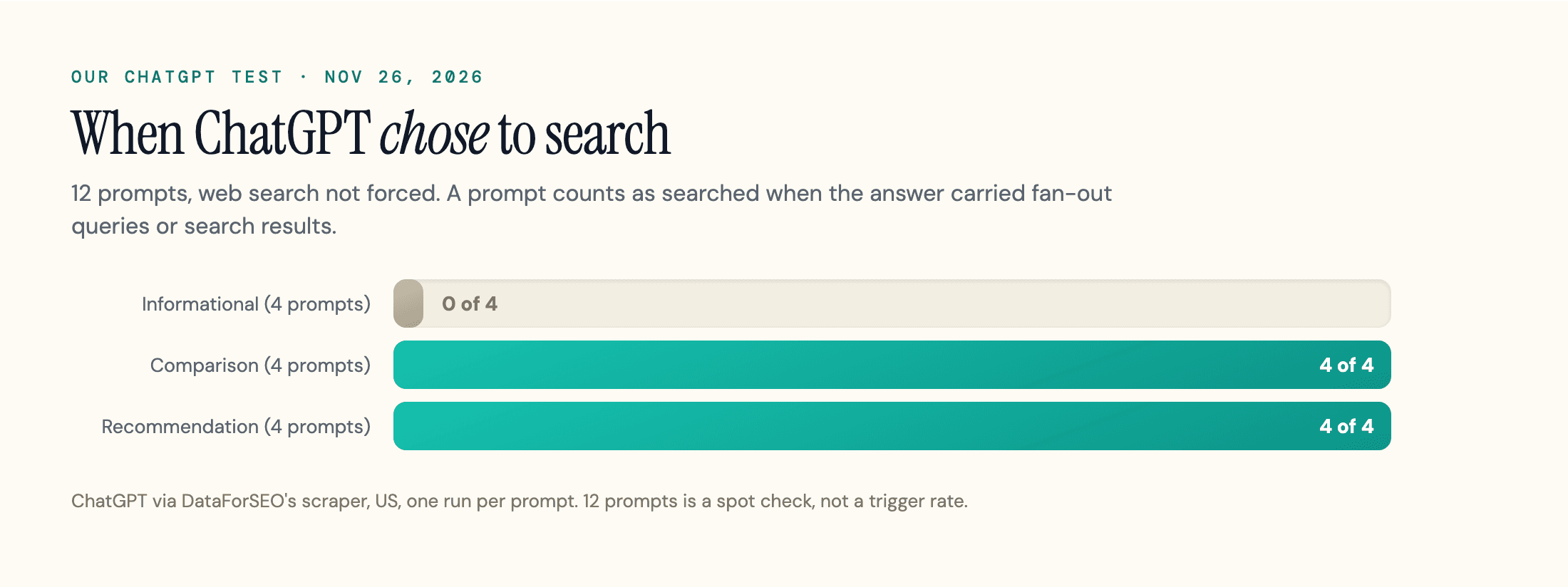
All 8 of those runs had fan-out queries, far above the 14.4% of responses with fan-out queries that Ahrefs found across 66.6 million ChatGPT responses from free, logged-out users in August and September. Ahrefs used broad everyday questions and logged-out sessions, which search less than paid or reasoning models; our prompts were commercial by design. When a run answers from memory, a page you publish cannot reach it through live retrieval.
Ways to see the searches behind answers: Bing's grounding queries (retrieval phrases, Microsoft's engines and select partners), and our query fan-out tool, which shows the searches Gemini grounded its answer in, on your own Gemini API key with billing on.
Caveats. One engine, one location, a scraper rather than a signed-in user, 2 back-to-back runs per wording, and forced search in the wording test. Read these as directions, not rates. We kept all 30 raw API responses.
How to Choose Which Prompts to Track
Every candidate passes the same checks before it is tracked.
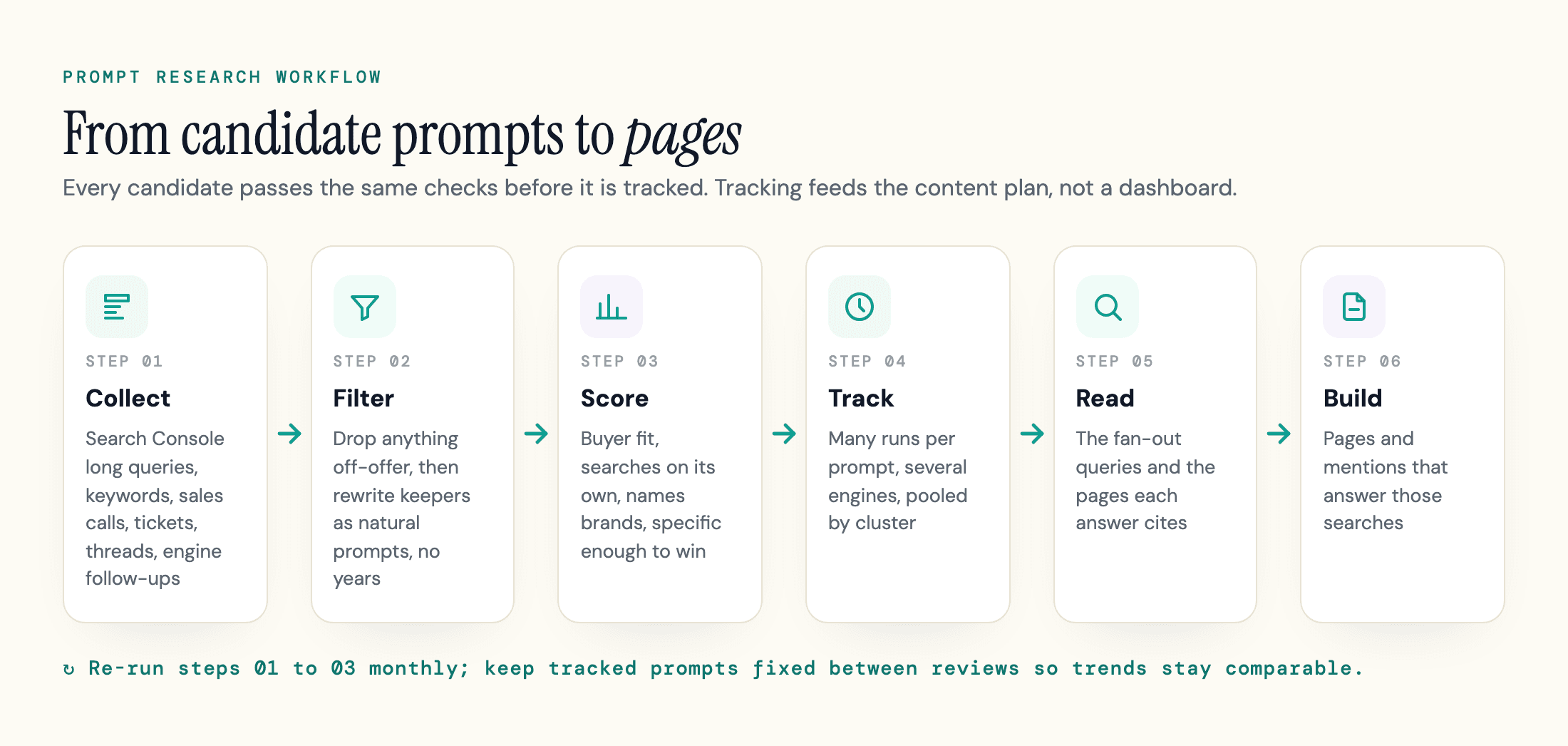
Buyer fit and evidence are pass or fail. The other checks decide where you start.
| Check | How to test it | Keep it when |
|---|---|---|
| 1. Buyer fit | What would a recommendation here be worth? | A lead, trial or sale you can serve |
| 2. Evidence | Trace it to Search Console, keyword data, sales calls, threads, the engines' follow-ups or a vendor database | At least one source shows buyers have the need |
| 3. Searches on its own | Run it a few times without forcing web search and look for fan-outs or search results | It searches, so new content has a way in |
| 4. Names brands | Read the answer | It recommends vendors, and you belong on the list |
| 5. Winnable | Look at the cited pages and the brands named | A page written for it can compete |
Comparison and recommendation prompts were the ones that searched in our test, so most tracked prompts should sit in the middle and bottom of the funnel: "best X for Y", "X vs Y", "alternatives to X", "is X worth it for Y". Track informational prompts in a separate group, so they do not dilute your recommendation numbers.
A few rules keep the set honest:
- No years in evergreen tracked prompts. A prompt with "2026" in it must be replaced in January, and its history restarts at zero. The engine adds the year in its fan-outs anyway.
- No prompts that restate your positioning. A prompt so narrow that only you fit it will show a great AI share of voice from day one, and nobody outside your company types it.
- Branded and unbranded in separate groups. Prompts that name your brand show how engines describe you; unbranded ones show whether they find you. Mixing them inflates the headline number.
- Keep the wording fixed between reviews. Change a tracked prompt and you lose the trend. Add a new one instead.
- Put the place in local prompts. OpenAI's help page on ChatGPT search says ChatGPT can use location information to find local results. A business that sells in specific cities or countries should track prompts that name them, in their language, and run them from those markets.
Once the set is stable, prompt tracking is a separate job, covered in our guide to tracking AI visibility.
How Many Prompts, and How Many Runs per Prompt
What counts is the total number of runs behind a number. An AI answer is a sample, not a ranking, and one sample says very little.
In the same SparkToro and Gumshoe study, 600 volunteers ran 12 prompts through ChatGPT, Claude and Google's AI, 2,961 runs in total. Asked the same prompt over and over, ChatGPT or Google's AI had less than a 1 in 100 chance of listing the same brands in any two of 100 answers, and the same order came up about once in 1,000. How often a brand appeared was far more stable than where.
SparkToro co-founder Rand Fishkin's takeaway: average at least 60 to 100 runs per prompt.
Treat each run as a yes or no for "did the answer mention us", and the uncertainty shrinks in proportion to one over the square root of the number of runs. With 5 runs the margin is roughly 44 points either way; with 30 runs it is about 18.
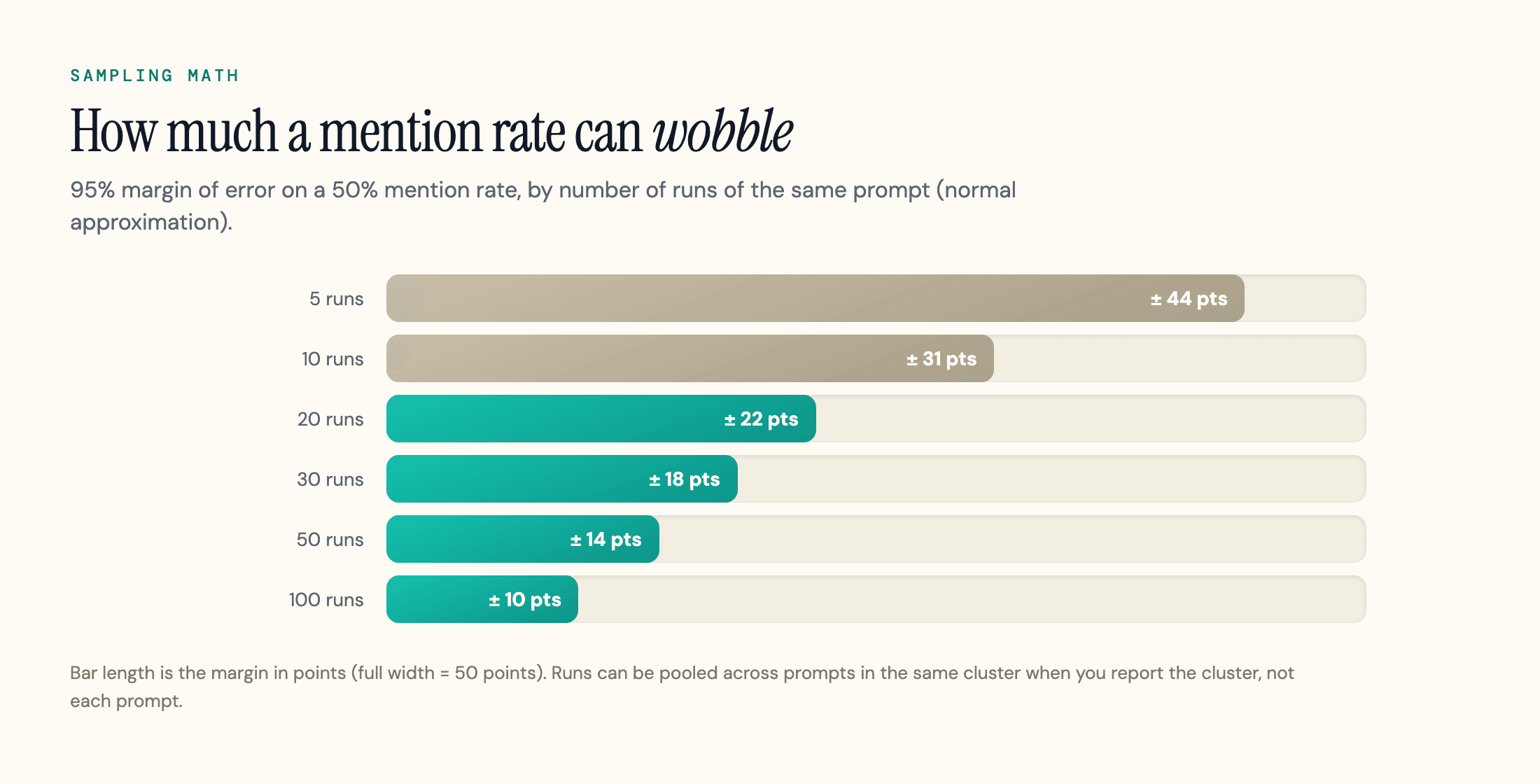
In practice: a brand mentioned in 6 of 10 runs has a plausible true rate anywhere between about 31% and 83% (95% Wilson interval). To tell a move from 30% to 50% apart from noise, with the usual 80% power, you need about 93 runs in each period. No single prompt gets that many runs in a month, even run daily. Topic clusters of prompts can.
| Runs of the same prompt (or cluster) | 95% margin on a 50% mention rate | Good enough for |
|---|---|---|
| 1 to 3 | About 57 points at 3 runs | Reading the answer, not measuring it |
| 10 | 31 points | Flagging prompts where you rarely appear |
| 30 | 18 points | A rough rate per cluster |
| 100 | 10 points | Month-over-month comparisons |
For a cluster rate, the total matters more than the split. Reruns matter when you read prompts one by one; more distinct prompts protect the cluster from one odd wording. Engine updates move every prompt at once, so a cluster shows that something changed, not why. Keep the same prompts and engine settings across periods.
Weekly tracking, ours included, gives about 4 runs per prompt a month. With 5 prompts per need that is about 20 runs per need on each engine, a margin near 22 points: read trends per need over a quarter, not per prompt each week. That is the level where AI search visibility metrics start to mean something.
From Prompt Set to Content Plan
With enough runs per cluster, read the answers for:
- The fan-out themes. The words the searches share across runs show what your pages need to cover; the exact strings change from run to run. If the fan-outs check named products' pricing, your own pricing page has to answer them.
- The AI citations. Read them across many runs, never from one answer. If the cited pages are broad listicles answering a narrow question, a page written for that exact need has an opening.
- The brands named. If competitors appear and you do not, the gap is often off your site, in reviews and directories the model trusts.
Then fix the pages and mentions, rerun the cluster and compare.
If you want a starting list, geotoolbox's free keyword to AI prompts generator turns a keyword into about 15 conversational prompts across 6 intents. An AI model writes them, and a wording rule flags the ones that ask an AI to pick or compare named options. Check the output against your own sources before tracking it. When the set is ready, our AI rank tracking guide shows how to run it across engines over time.
Frequently Asked Questions
Should I check prompts through the API or the ChatGPT app?
Use one method and keep it fixed. Logged-in apps add memory and personalization: OpenAI's help page on ChatGPT search says saved memories can change the search query ChatGPT writes. Logged-out or API runs are more repeatable, but they are not what a signed-in buyer sees.
How often should I refresh a prompt set?
Review candidates monthly and keep the tracked set fixed between reviews. Expect it to age anyway: Seer found prompts getting longer and more personal within a year.
Sources
- OpenAI: Introducing Businesses in ChatGPT (November 10, 2026, updated November 19, 2026) -
openai.com/index/introducing-businesses-chatgpt - Google Search Console Help: Generative AI performance report -
support.google.com/webmasters/answer/16984139 - Google Search Central: AI features and your website -
developers.google.com/search/docs/appearance/ai-features - Semrush Knowledge Base: Prompt Research report -
semrush.com/kb/1597-prompt-research-report - Ahrefs: How ChatGPT Does Query Fan-Out (October 12, 2026, updated October 22, 2026) -
ahrefs.com/blog/query-fan-out-chatgpt - SparkToro: AIs are highly inconsistent when recommending brands or products (January 28, 2026, updated June 28, 2026) -
sparktoro.com/blog/new-research-ais-are-highly-inconsistent-when-recommending-brands-or-products-marketers-should-take-care-when-tracking-ai-visibility - OpenAI Help Center: Searching the web with ChatGPT -
help.openai.com/en/articles/9237897-searching-the-web-with-chatgpt - Microsoft Bing Blogs: Introducing AI Performance in Bing Webmaster Tools Public Preview (February 2026) -
blogs.bing.com/webmaster/2026/2/Introducing-AI-Performance-in-Bing-Webmaster-Tools-Public-Preview - Seer Interactive: Are you picking the prompts for AI tracking without observing real customers? -
seerinteractive.com/insights/are-you-picking-the-prompts-for-ai-tracking-without-observing-real-customers - geotoolbox.ai: ChatGPT prompt test, 30 runs via DataForSEO's ChatGPT scraper, US, November 26, 2026 (raw responses on file)
- geotoolbox.ai: Search Console API pull, US, August 26 to November 23, 2026