
When Alibaba previewed Qwen3.8-Max in July, half the AI assistants we tested did not know it existed, and one that did was already repeating specs Alibaba had never published. Two weeks later the real release landed with a full benchmark table, and on its headline coding benchmark the first independent number came in five points below Alibaba's own. A September snapshot has since scored above it.
This page pins down what is actually known as of October 18, 2026: what the published benchmarks show and where the outside measurements disagree, what the API costs, what the open-weight release did and did not deliver, and why a model most marketers will never touch still shapes what AI tools say about their brands. Every number below is labeled as Alibaba's own or independently measured.
What Is Qwen3.8-Max?
Qwen3.8-Max is Alibaba's current flagship AI model, released on August 3, 2026: a 2.4-trillion-parameter multimodal system with 95 billion parameters active per token, a one-million-token context window, and a price of $2 per million input tokens and $6 per million output. Alibaba's model page lists text, image and video as inputs, with document handling claimed as well, and you call it as qwen3.8-max through Alibaba Cloud Model Studio. Alibaba later shipped an upgraded snapshot, qwen3.8-max-0902 (September 2), at the same price.
Alibaba calls it "the most capable model in the Qwen family to date" and says it improves on Qwen3.7-Max across coding, work, research, and long-horizon tasks. That is a notably quieter claim than the one that trailed the July preview, when Alibaba's internal evaluations had it "second only" to Anthropic's Claude Fable 5. The release post drops that line, and the benchmark table it published instead is the reason why.
One thing to establish before reading those benchmarks, because it decides which rows mean anything. On some rows Alibaba re-ran every model itself: its SWE-bench Pro footnote says all baselines were evaluated on the same corrected benchmark. On its headline row, Terminal-Bench 2.1, it did not. There it ran Qwen under Claude Code and, in its own words, reported "the best published score across harnesses" for everyone else, taking Claude's figures from Artificial Analysis and GPT-5.6 Sol's from OpenAI. A self-run score against other labs' best published scores is not a controlled comparison.
The competitive timing was not subtle. The July preview landed days after Moonshot AI announced Kimi K3, the model Moonshot's own card puts at 2.8T parameters, which had just claimed the "largest ever" headline and then shipped its weights on schedule. Alibaba then promised something it had never done: open weights for a Max-class model, committed for the week of August 10, 2026. It delivered on August 12, inside that week, with a text-only variant under a bespoke license. For a company whose Qwen family built its reputation on open models, what that release does and does not include matters, and we get to it below.
One housekeeping note: Alibaba's Qwen team also has Qwen-Image-3.0. That is a separate image-generation model, despite the similar naming.
Published vs Independently Confirmed: The Spec Reality
The July preview shipped with almost nothing you could check. The August release fixed most of that, and the distinction that still matters is between what Alibaba has now published and what anyone outside Alibaba has confirmed. The table below shows where each spec stands as of October 18, 2026.
| Spec | Status | What we actually know |
|---|---|---|
| 2.4T total parameters, 95B active | Vendor-published | Both figures are now in Alibaba's own release post; the July preview disclosed only the total |
| Sparse MoE architecture | Vendor-published | Confirmed by the 95B-active figure and by the Hugging Face model card, which publishes the architecture (92 layers, 512 experts with 10 routed plus 1 shared, a Gated DeltaNet and Gated Attention hybrid); we found no technical report |
| Multimodal (text, image, video, docs) | Partly published | QwenCloud's model page lists text, image and video as inputs and text as output; document handling is still Alibaba's description rather than a spec |
| 1M-token context window | Vendor-published | No longer community lore: Alibaba's model config sets a 1,000,000-token window, and Model Studio bills against a 0 to 1M tier |
| $2 in / $6 out per 1M tokens | Vendor-published | Listed on Alibaba Cloud Model Studio's pricing page for the international region, the same rate in thinking and non-thinking modes |
| Benchmark scores | Published, and contested | A full table shipped with the release. Some rows re-run every model; the headline Terminal-Bench row imports rivals' best published scores. On that row Artificial Analysis independently measured 81.3% for the launch build and 88.8% for the September 0902 snapshot, where Alibaba reports 86.6 |
| "Second only to Fable 5" | Withdrawn in practice | The August release post does not repeat it, and neither Alibaba's own table nor the independent leaderboard supports it |
| Open-weight release | Delivered August 12, 2026 (partial) | Qwen3.8-2.4T-A95B on Alibaba's official Hugging Face org: text-only, 262,144-token native context (extensible to about 1M), bespoke "Qwen3.8-Max" license, not Apache 2.0 |
The single most useful addition is the active-parameter count. In a mixture-of-experts model only a fraction of the total parameters fire on each token, and that fraction drives compute cost per token while the 2.4T total sets the memory needed just to hold the weights. With 95B active, Qwen3.8-Max activates about 4% of itself per token, which keeps per-token compute far below what the total size suggests and makes a $2 input price economically plausible. In July that number was missing and serving economics were guesswork.
For the generational comparison, Alibaba's table carries a Qwen3.7-Max column on every row: SWE-bench Pro goes 60.6 to 67.7, GPQA Diamond 92.4 to 92.6, and DeepSWE 1.1 jumps 21.6 to 56.6. Treat the Terminal-Bench row differently, because there the 3.7-Max figure is imported from Artificial Analysis while the 3.8-Max figure is Alibaba's own, so 74.5 to 86.6 is not one measurement against another. Measured by Artificial Analysis at both ends, the generational gain on that benchmark was 74.5 to 81.3 for the launch build, and 74.5 to 88.8 for the 0902 snapshot. Separately, the older Qwen3.7 benchmark card reports 80.4% on SWE-bench Verified, a different test from the new table's SWE-bench Pro, so those two coding numbers do not belong on the same axis either.
How Do You Access Qwen3.8-Max?
The ordinary way in is now the API. Qwen3.8-Max is a standard pay-per-token model on Alibaba Cloud Model Studio, called as qwen3.8-max, at $2 per million input tokens and $6 per million output in the international region. That rate is flat across the full million-token context and applies in both thinking and non-thinking modes, with a context-caching discount on repeated input and a one-million-token free allowance to get started. This is the biggest practical change since the July preview, which had no per-token price at all.
The subscription route still exists alongside it. Token Plan sells credit bundles, and Qoder and QoderWork are Alibaba's agentic coding products. Those were the only door during the preview, when a limited-time campaign ran the preview build at 90% off its standard credit consumption; that campaign ended on August 3. Price the API rate first and check any credit promotion live before you count on it.
One caution stands regardless of which door you use. Know who you are contracting with: the international Token Plan checkout names Intelligent Cloud Computing (Singapore) Private Limited as the operator rather than an alibabacloud.com property, and Alibaba's international API is also presented as QwenCloud (qwencloud.com), whose footer names the same entity and which lists qwen3.8-max at the same $2 and $6. That is consistent with Alibaba running international billing through a Singapore entity, but confirm the contracting entity and terms against your own Alibaba Cloud account before entering payment details or API keys.
For developers, the friendliest detail is protocol compatibility: the endpoint speaks both the OpenAI and Anthropic API formats, so it drops into Claude Code, Cursor, OpenCode, and similar tools with a config change. It also exposes a reasoning_effort setting, which is the lever for trading cost against depth. For context on how rivals price this tier, our Kimi API pricing breakdown is the comparison point: $3 per million input tokens and $15 per million output, against Qwen's $2 and $6.
How Does It Compare to Kimi K3 and Fable 5?
It depends on who is holding the stopwatch, and that turns out to be the story.
Start with Alibaba's own table. Against Claude Fable 5 it reports Qwen3.8-Max ahead on Terminal-Bench 2.1, 86.6 to 84.6, and level on GPQA Diamond at 92.6. It also reports Fable 5 comfortably ahead on the harder tests: 80.0 to 67.7 on SWE-bench Pro, and 53.3 to 43.6 on Humanity's Last Exam. Against GPT-5.6 Sol the split runs the other way again, with Qwen behind on Terminal-Bench 2.1 and GPQA Diamond but ahead on SWE-bench Pro, 67.7 to 64.6. Those comparators are the August lineup: Fable 5 and GPT-5.6 Sol have since been superseded by Fable 5.1 and GPT-6.1 Sol.
Then check the same benchmark somewhere Alibaba does not control. Artificial Analysis independently runs Terminal-Bench 2.1 and scored the launch build of Qwen3.8-Max at 81.3% as of August 7, 2026, which put it below Claude Fable 5's 84.6% and Kimi K3's 85.0% on that same leaderboard. Alibaba reported 86.6% for the same model on the same benchmark. Alibaba disclosed the method that produces the gap: it ran Qwen under Claude Code at avg@10 with a five-hour timeout, and for every other model reported the best published score across harnesses. So the two 86.6 and 81.3 figures were the same model on the same benchmark measured by different people under different settings, and a five-point spread there is ordinary rather than scandalous.
That reading did not last. Alibaba's September 2 snapshot, qwen3.8-max-0902, scores 88.8% on the same Artificial Analysis board, which AA now labels Legacy: above Kimi K3 (85.0%), Fable 5 (84.6%) and Alibaba's own 86.6, and below Fable 5.1 (91.4%), GPT-6 Astra (89.9%) and GPT-5.6 Sol (89.5%). The 81.3% figure belongs to the August build, which AA now lists as deprecated.
What it means is narrower, and still worth knowing: the independent ordering on Alibaba's headline benchmark flipped between the August build and the September snapshot, so always check which snapshot a score belongs to.
There is one more outside test, and it predates the release. Trilogy AI's StackPerf run is a blind architecture-analysis benchmark where Qwen3.8-Max-Preview and Kimi K3 each analyzed an identical 269-file codebase under identical limits, with the reports scored blind. Kimi K3 scored 83 out of 100; Qwen3.8-Max-Preview scored 80. Note the build: that was the preview, not the released model, so it describes the July snapshot rather than what ships today. The same run caught a real Qwen strength, 22 gateway requests and 44 tool calls against Kimi's 53, none of Qwen's failed, and the blind review scored its tool use 9 to Kimi's 8.
One thing the coding numbers understate: Alibaba published a second table for multimodal work, and Qwen3.8-Max wins most of it. It leads Fable 5 on MathVision (95.2 to 92.7), LogicVista (91.9 to 85.7), HiPhO (90.0 to 78.6) and most of the vision rows, while the video rows split roughly evenly between them. Those are still vendor-run, and no one has independently checked them, but if you are choosing a model for document, image, or video work rather than for terminal coding, the picture is considerably better than the headline benchmark suggests.
| Model | Parameters | Benchmark position | Pricing per 1M tokens | Weights |
|---|---|---|---|---|
| Qwen3.8-Max | 2.4T total, 95B active (vendor-stated) | Vendor table: 86.6 Terminal-Bench 2.1, 67.7 SWE-bench Pro, 92.6 GPQA. Independently, Artificial Analysis measures 88.8 on Terminal-Bench 2.1 for the 0902 snapshot (81.3 for the August build); AA Intelligence Index 45 for the 0902 API model and 40 for the open 2.4T-A95B text weights (v4.3.2, Oct 2026) | $2 in / $6 out | Open since August 12, 2026 (text-only variant, bespoke "Qwen3.8-Max" license); multimodal version API-only |
| Kimi K3 | 2.8T (claimed) | StackPerf 83/100 (vs the preview build); AA Intelligence Index 44, #4 open-weight; Terminal-Bench 2.1 85.0 (v4.3.2, Oct 2026) | $3 in / $15 out | Published on Hugging Face under a custom Kimi K3 License |
| Qwen3.7-Max (previous flagship) | Undisclosed | Vendor card: GPQA 92.4, SWE-bench Verified 80.4% | $2.50 in / $7.50 out | Closed |
| Claude Fable 5 (launch comparator; Fable 5.1 is current) | Undisclosed | SWE-bench Verified 95% (vendor, Fable 5); AA Intelligence Index 50 (Fable 5) and 53 (Fable 5.1) | $10 in / $50 out | Closed |
| Claude Opus 5.5 | Undisclosed | AA Intelligence Index 58, the top of the index | $4 in / $20 out | Closed |
The benchmark names in that table are not interchangeable. SWE-bench Pro, SWE-bench Verified, and StackPerf are three different tests run by three different parties, so each row only means something on its own terms. Do not compare a score in one row against a score in another.
Early hands-on testing shows what the benchmark cannot. One reviewer who runs the same four build prompts on every flagship found the July preview build one-shotted a full Texas Hold'em simulation in Go, something only Claude Fable 5 and Grok 4.5 had managed on his suite, and produced what he called possibly his best-ever result on a website build. The cost: it was the slowest model he had ever tested, taking 1 hour 20 minutes on the poker task, with long stretches of thinking. His testing predates the August release, so read the slowness as preview-era; the build quality he describes is still the most useful hands-on signal anyone has published.
The gap at the top is still real, and the cleanest like-for-like is Alibaba's own SWE-bench Pro row: Fable 5 at 80.0 against Qwen3.8-Max at 67.7. That row is the most citable of the ones Alibaba published, for two reasons: its footnote says every baseline was re-run on the same corrected benchmark rather than imported, and it is a vendor number that runs against the vendor's own interest. Kimi K3, GLM-5.3, and MiniMax all chased the frontier this year and fell short, and Alibaba's own numbers say it did not close the gap either. The useful reading is narrower than the July headline: Qwen3.8-Max is a strong multimodal model and a competent coding one, priced far below the frontier, and nothing yet published establishes it as the second-best model in the world.
One deployment note for regulated businesses: like the rest of the family, Qwen models carry documented, baked-in guardrails aligned with Chinese content rules on politically sensitive topics. For coding and agent work this rarely surfaces; for content-adjacent or compliance-sensitive workloads, test before you commit. Data residency deserves the same diligence: confirm the service region, retention terms, and contracting entity for the specific product rather than assuming them. If residency is a hard requirement, the clean answer is open weights and self-hosting.
Did the Weights Open?
The open-weight promise was the biggest claim in the release and the one with the weakest track record behind it, and it was ultimately kept, inside the promised week and with caveats. On August 12, 2026, Qwen3.8-2.4T-A95B landed in Alibaba's official Hugging Face organization. The published variant is text-only (the multimodal version stays API-only), its native context stops at 262,144 tokens (extensible to about 1M), and the license is a bespoke "Qwen3.8-Max" license rather than Apache 2.0.
Here is the pattern it broke. Alibaba runs a genuine two-track strategy: the small and mid-size Qwen models ship under Apache 2.0 and dominate the open ecosystem, while the Max-tier flagships stayed closed. Qwen3.7-Max: API-only. Qwen3.6-Max-Preview: API-only. No Max-tier flagship had ever had its weights published, which Alibaba itself acknowledged by calling this "the first time we will open-source the weights of a Qwen-Max-class model." The repository now exists; what remains open is how the bespoke license terms compare to Apache 2.0 in practice.
The competitive read is hard to ignore: Moonshot announced Kimi K3 with a firm weights date of July 27, days before Alibaba's preview, and then met it. The promise kept Alibaba's open-flagship credibility alive through a news cycle it would otherwise have lost, and weight-release promises across the industry have a habit of slipping once headlines move on.
The verification bar is simple, and worth being strict about: an actual repository under Alibaba's own Hugging Face organization containing weights and a license file. Not a blog post, not a tweet, and not a third-party repository that merely carries the name. Repos titled Qwen3.8 have already appeared from unaffiliated accounts, and they are worth understanding because they are the trap. Some are empty placeholders holding a README. Others do contain real weights that are simply not this model: one of the most-downloaded, at roughly 23,000 downloads, ships files named qwen3-4b-thinking-2507, an older and far smaller Qwen wearing the new number. Both kinds carry an Apache 2.0 label that is not Alibaba's terms. Until the real URL exists under Alibaba's own account, treat the release as a roadmap item that can slip. And keep in mind that even a delivered release can be less open than the headline suggests: open weights are not open source, and the license attached will matter as much as the download link.
Can You Actually Run It?
Not this one, and probably not for a long time, even if the weights land tomorrow.
At 2.4 trillion parameters, the arithmetic is brutal. The packed weights alone would occupy roughly 1.2 terabytes at 4-bit quantization, before runtime overhead and caches, and even an extreme 1.5 bits per weight leaves hundreds of gigabytes of raw weights, a point Hacker News commenters worked out within hours of the announcement. Serving it properly means a multi-accelerator cluster; a single Nvidia H200 carries 141 GB, so even an eight-GPU node cannot hold the weights. That math works for inference providers and almost nobody else.
The 95B active-parameter figure changes the cost picture without changing that conclusion. Compute per token is closer to a 95-billion-parameter dense model than to a 2.4-trillion one, which is why a $2 input price is not as implausible as the headline size makes it look, but you still have to hold all 2.4 trillion parameters in memory to serve any of them. Sparse activation makes the model cheap to run at scale, not cheap to own.
The realistic play for anyone who runs models locally has always been to look at the family, not the flagship, and that promise was kept: Qwen3.8-27B shipped on Hugging Face around August 14, 2026, a 27-billion-parameter native vision-language model, under Apache 2.0, that a single well-specified machine can actually run. Where the Max flagship's own multimodal weights stay API-only, this smaller model is both multimodal and genuinely open, which makes it the more useful release of the two for local and self-hosted work. The 2.4T Max model itself, open or not, remains a datacenter artifact.
What AI Engines Say About Qwen3.8-Max
We at geotoolbox ran a four-engine check on July 22, 2026, three days after the preview and two weeks before the model was actually released, asking each assistant what Qwen3.8-Max is. The split was total. What follows is a snapshot of that launch window, not a description of what the engines say today, and the launch window is exactly the interesting part.
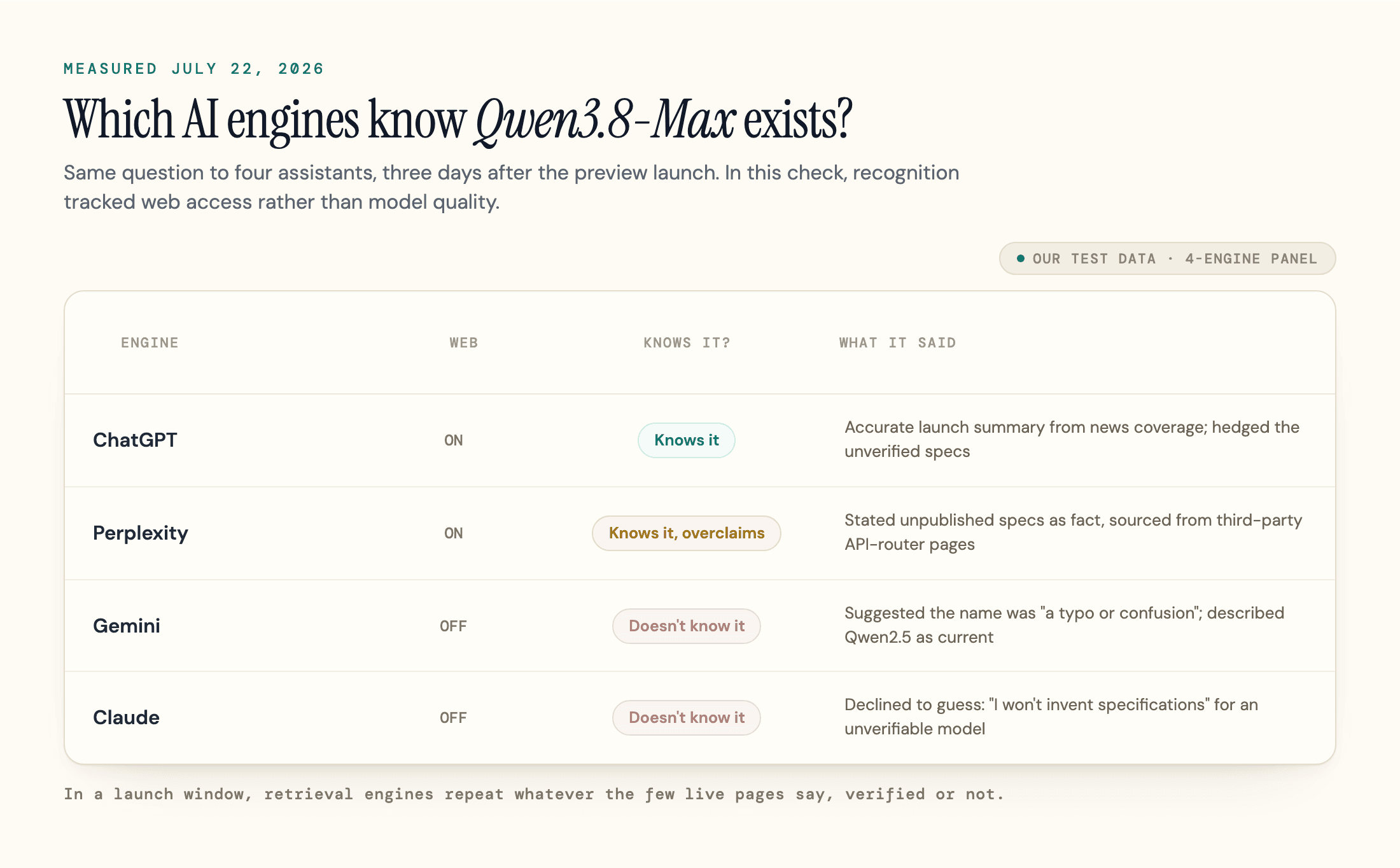
Both web-connected engines recognized the model. ChatGPT with browsing summarized the launch accurately from news coverage and correctly hedged the unverified specs. Perplexity knew it too, but went further than the record supports: it asserted the sparse-MoE architecture and a specific context window as fact, sourcing them from third-party API-router pages rather than anything Alibaba published.
The two engines answering from training data alone were blank. Gemini suggested the name might be "a typo or confusion," guessing we meant a different model entirely, and described Qwen2.5 as current. Claude declined to guess at all, saying it would not invent specifications for a model it could not verify.
The Perplexity result is the one worth dwelling on. For a three-day-old model the blanks are expected behavior; the overclaim is not. In a fresh news window, retrieval-based engines repeat whatever the handful of live pages say, including specs no primary source has confirmed. The unofficial one-million-token context figure it asserted came from an API reseller's page, not from Alibaba. Alibaba's own documentation later confirmed that number, which is the luckiest possible outcome and not the point: at the time it was asserted, nothing supported it, and a guess that happens to be right is still a guess. This is how unverified claims fossilize: the early pages get cited, the citations get repeated, and by the time official documentation lands, the answer engines have weeks of momentum behind whatever the first pages said.
The citation data shows where those answers come from. In DataForSEO's LLM-mention tracking for Qwen topics, the most-cited domains are YouTube, Reddit, Hugging Face, and GitHub, community surfaces rather than Alibaba's own properties. Whoever publishes the clearest early page, accurate or not, tends to become the reference.
What Qwen3.8-Max Means for Your AI Visibility
If you are not shipping AI models, here is why this launch belongs on your radar: every new frontier model is a new surface that describes brands, including yours, to its users.
Qwen matters disproportionately here because of how it spreads. As we covered in our Qwen explainer, it is the most-downloaded open model family of 2026 by Hugging Face's counts, fine-tuned and rebranded inside products that never mention Alibaba. Now that both the Max weights and the smaller, multimodal Qwen3.8-27B have shipped, they will propagate into that same ecosystem, and their answers about your company travel with them, into tools you will never audit.
The launch-window lesson from our four-engine test applies directly to brands. The moment something new is true about your company, a launch, a rename, a pricing change, there is a window where AI engines only know what a few early pages say. Whoever fills that window shapes the answer, and corrections tend to lag well behind the first version. The time to know how AI systems describe your brand is before a wrong version hardens, not after a prospect quotes it back to you.
That check takes minutes. Our free AI readiness scan shows whether AI crawlers can actually reach and read your site, one of the mechanical layers under retrieval-based answers about you, and geotoolbox tracks what the major engines are saying once you are visible. New models will keep launching on someone else's schedule. Your brand's answer should not depend on which one a customer happens to ask.
Frequently Asked Questions
Is Qwen3.8-Max released yet?
Yes. Alibaba released it on August 3, 2026, after showing a preview build on July 19. It is generally available on Alibaba Cloud Model Studio as qwen3.8-max, with published specifications, a benchmark table, and standard per-token pricing. The separate qwen3.8-max-preview build was the July stopgap and is superseded.
Is Qwen3.8-Max free or open source?
The API is paid at $2 per million input tokens and $6 per million output, with a one-million-token free allowance to start. The weights opened on August 12, 2026, the first open Max-tier Qwen ever, but with conditions: the published variant is text-only and ships under a bespoke "Qwen3.8-Max" license rather than Apache 2.0, so it is open-weight, not open source.
Is Qwen3.8-Max better than Kimi K3?
It depends on the build and the benchmark. On Artificial Analysis's Intelligence Index (v4.3.2, October 2026) the 0902 API snapshot scores 45 against Kimi K3's 44, and on its Legacy Terminal-Bench 2.1 board it scores 88.8% against K3's 85.0%; the August build had scored 81.3%. Both now have open weights, but Qwen's are the text-only 2.4T-A95B release (40 on the index); the 0902 snapshot scored here is API-only. Kimi K3 costs $3/$15 against Qwen's $2/$6. Trilogy AI's blind StackPerf run, 83 for Kimi K3 to 80, tested the July preview build. Alibaba's own published table does not compare the two directly.
How can I try Qwen3.8-Max from the US?
Call the API directly on Alibaba Cloud Model Studio at $2 per million input tokens and $6 per million output; the endpoint speaks both the OpenAI and Anthropic formats, so it drops into most existing tooling. Token Plan remains available as a credit-based alternative. The international checkout accepts US customers, so verify the contracting entity against your Alibaba Cloud account first.
Sources
- Qwen3.8-Max: A New Bar for Coding and Cowork (official launch post, specs, benchmark table, open-weights commitment) - Qwen / Alibaba, August 3, 2026 -
qwen.ai/blog?id=qwen3.8 - Alibaba Cloud Model Studio model pricing (official, qwen3.8-max at $2 in / $6 out) - Alibaba Cloud -
alibabacloud.com/help/en/model-studio/model-pricing - Text generation models, Model Studio (official API model id) - Alibaba Cloud -
alibabacloud.com/help/en/model-studio/text-generation - Terminal-Bench v2.1 leaderboard (independent measurement, now labeled Legacy: Qwen3.8-Max 81.3% launch build, 88.8% 0902 snapshot) - Artificial Analysis -
artificialanalysis.ai/evaluations/terminalbench-v2-1 - Qwen3.8-2.4T-A95B model card and license (open-weight release, August 12, 2026) - Qwen (Hugging Face) -
huggingface.co/Qwen/Qwen3.8-2.4T-A95B - Alibaba Previews Qwen3.8-Max, a 2.4 Trillion-Parameter Multimodal Model - MarkTechPost, July 19, 2026 -
marktechpost.com/2026/07/19/alibaba-previews-qwen3-8-max-a-2-4-trillion-parameter-multimodal-model-days-after-moonshots-kimi-k3-open-weight-launch - Alibaba says newest Qwen AI model is second only to Anthropic's Claude Fable 5 - South China Morning Post, July 19, 2026 -
scmp.com/tech/article/3361119/alibaba-says-newest-qwen-ai-model-second-only-anthropics-claude-fable-5 - Qwen3.8-Max-Preview limited-time benefit (official promotion doc, ended August 3) - Qoder Docs, July 2026 -
docs.qoder.com/events/qwen-max-preview - Qwen 3.8 Max Benchmark: How It Compares With Kimi K3 - Trilogy AI, July 2026 -
trilogyai.substack.com/p/qwen-38-max-benchmark-how-it-compares - Qwen3.8-Max Review - thomas-wiegold.com, July 2026 -
thomas-wiegold.com/blog/qwen-3-8-max-review - Qwen 3.8 (discussion thread, 959 points) - Hacker News, July 2026 -
news.ycombinator.com/item?id=48966120