
DeepSeek is the Chinese AI lab whose cheap, open-weight models briefly wiped a record amount off Nvidia's value and made the rest of the industry nervous. If you remember the January 2025 panic and want the plain version of what DeepSeek actually is, who builds it, whether it is safe, and where it stands now, this is it, current as of September 2026. DeepSeek V4 has shipped in full, and its Flash tier has already moved to a new architecture, DeepSeek-V4.1-Flash, on September 10.
That last part matters. Almost every "what is DeepSeek" article you will find was written during the R1 frenzy in early 2025 and stops there. We will cover the parts they miss or get wrong: the current model lineup, the honest story behind the famous "$6 million" price tag, the open weights versus open source distinction, the real shape of the safety and China questions, and what a strong Chinese open model means for whether AI tools mention your brand.
What Is DeepSeek?
DeepSeek is a Chinese AI lab in Hangzhou that builds open-weight large language models, and the chatbot that runs on them. Its best-known models are DeepSeek-R1, a reasoning model, and the DeepSeek-V3 and V4 families for general use. The company was founded and is chiefly funded by High-Flyer, a quantitative hedge fund.
Like Kimi, DeepSeek is really two things, and keeping them straight clears up most of the confusion. There is the hosted product, the free chatbot at chat.deepseek.com and the paid API, which DeepSeek runs on its own servers. And there are the open-weight models underneath, which DeepSeek publishes so anyone can download, run, and adapt them. The model is open; the service around it is DeepSeek's.
That split is the key to almost every question people ask about DeepSeek, because the answers are often different for the hosted app than for the open weights you run yourself. Where DeepSeek earned its reputation is doing frontier-grade reasoning and coding at a fraction of what the closed American models cost, which is exactly why its arrival rattled the market. We break the current numbers down in our DeepSeek pricing guide. Calling it "the cheap Chinese ChatGPT" undersells both what it did and what is genuinely worth questioning about it.
Who Makes DeepSeek? High-Flyer and Liang Wenfeng
DeepSeek comes from an unlikely parent: a hedge fund. It was founded in July 2023 by Liang Wenfeng, who had already co-founded High-Flyer, a Chinese quantitative fund that traded using AI and had stockpiled Nvidia GPUs for years before US export controls tightened. High-Flyer spun its AI research lab out into DeepSeek, and Liang runs both. The lab is based in Hangzhou and stayed deliberately small, with around 160 staff, hiring researchers fresh out of top Chinese universities rather than expensive veterans.
That origin explains a lot about how DeepSeek behaves. It describes itself as research-first and has been in no rush to commercialize, which is part of why it gives so much away for free. The funding has followed the fame: DeepSeek closed its first outside funding round around June 2026 at a reported valuation near $50 billion (about $7.4 billion raised), and within weeks reports pointed to a further round targeting a valuation near $74 billion ahead of a planned IPO. DeepSeek does not confirm figures, so treat any number as reported rather than official.
So yes, DeepSeek is a Chinese company, and that fact sits underneath the safety and data questions we get to below. But it is worth being precise about ownership: DeepSeek is owned by High-Flyer and run by Liang, not by the Chinese state, even though, like any Chinese company, it operates under Chinese law.
The DeepSeek Lineup: R1, V3, and V4
DeepSeek runs two model lines. The V-series (V3, V4) are general-purpose models. The R-series (R1) are reasoning models that work through a problem step by step before answering. The breakout was DeepSeek-R1 in January 2025, which matched OpenAI's o1 on key reasoning and math benchmarks at a tiny fraction of the price. Since then the lineup has moved fast, and this is where stale explainers fall down. Here is where it stands.
| Model (as of September 2026) | Released | What it is |
|---|---|---|
| DeepSeek-V3 | December 2024 | General model: 671B total / 37B active (mixture-of-experts), 128K context |
| DeepSeek-R1 | January 2025 | The reasoning model that started the panic; matched OpenAI o1 on key benchmarks at far lower cost |
| DeepSeek-V3.1 | August 2025 | Hybrid model with both thinking and fast non-thinking modes |
| DeepSeek-V3.2 | December 2025 | More efficient long-context attention |
| DeepSeek-V4-Pro (generally available since August 13, 2026) | April 2026 preview, August 2026 GA | Flagship reasoning/coding model: 1.6T total / 49B active, 1M-token context (384K max output), no vision |
| DeepSeek-V4.1-Flash (replaced V4-Flash outright September 10, 2026) | September 2026 | Fast, cheap tier on a new causal encoder-decoder architecture: 552B + 196B (Engram) / 8B active input, 16B active output, 1M-token context (384K max output), native vision |
A few things to know. Most of these are mixture-of-experts models: they hold a huge number of parameters but only switch on a small slice for any given token, which is the trick behind their low running cost. The big April 2026 jump was the V4 preview, which pushed the context window to one million tokens and split into a fast Flash model and a heavyweight Pro model, both released as open weights under the MIT License. V4 ran as a preview from April 24, and its flagship V4-Pro reached general availability on August 13, 2026. (Oddly, the V4-Pro model card still describes "a preview version of DeepSeek-V4 series," even though the product shipped.)
The Flash tier has moved twice since the April preview: an official release at the end of July, then a full architecture change on September 10, DeepSeek-V4.1-Flash, which added native vision and retired the old Flash build entirely. DeepSeek briefly said it would also route V4-Pro traffic to the new Flash model starting September 14, then reversed that "in response to user demand," so Pro continues as its own separately priced model, and the legacy deepseek-chat and deepseek-reasoner aliases retired on July 24, 2026 (call deepseek-flash and deepseek-v4-pro instead). For the full picture of the shipped models, their benchmarks, pricing, and how they compare, see our DeepSeek V4 guide.
One model people keep asking about is missing: DeepSeek-R2. It was expected in 2025, but as of September 2026 it has not shipped. Reporting points to Liang being unsatisfied with its performance and to hardware snags from a push to train on domestic Huawei chips. Because the lineup moves every couple of months, treat this table as a September 2026 snapshot and check the model card for the version you actually use.
Why DeepSeek Shook the Market, and the $6M Myth
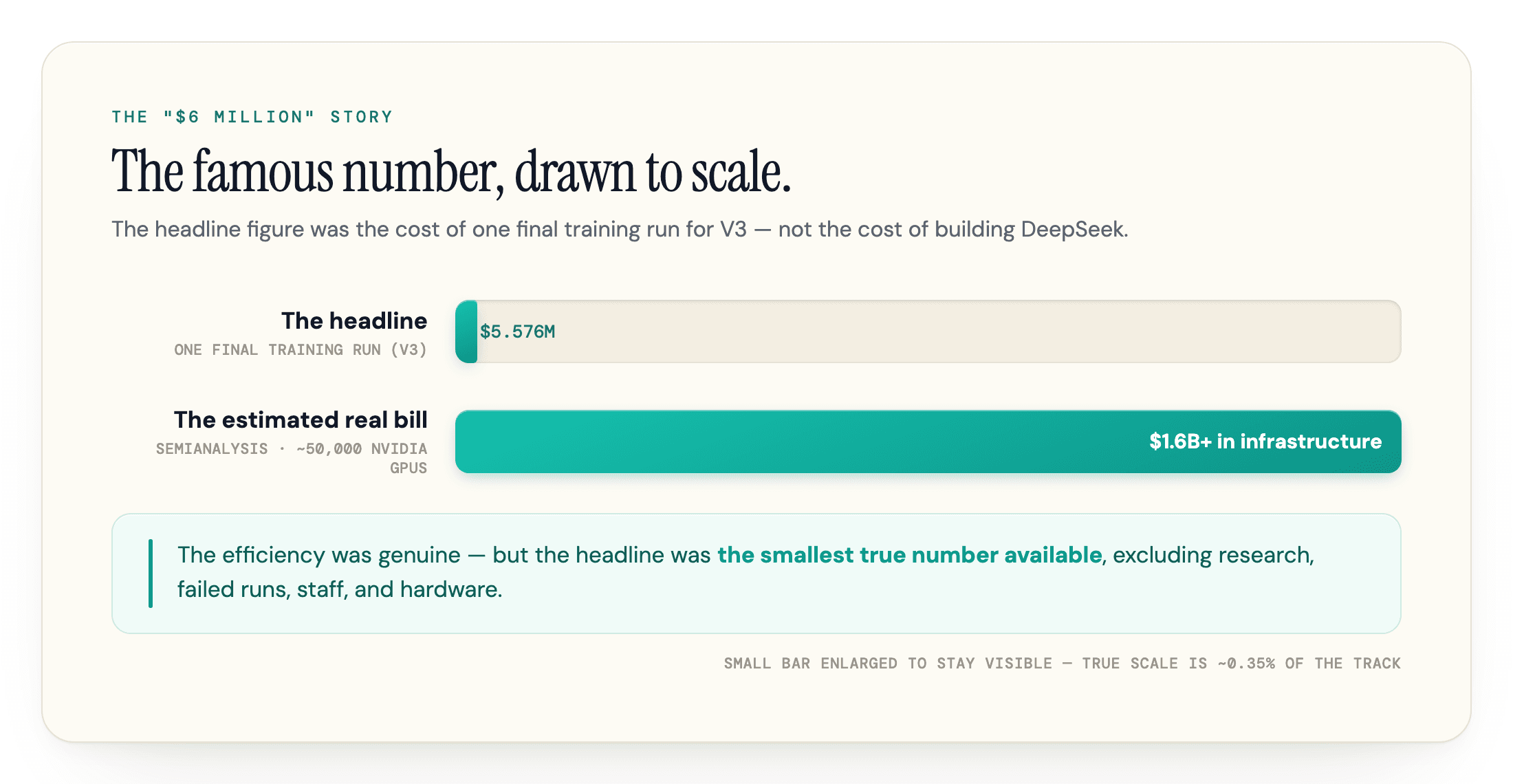
When the DeepSeek app hit number one on the US App Store in late January 2025, the reaction was not really about the chatbot. It was about cost. DeepSeek claimed it had trained a frontier-class model for a few million dollars, which, if true, undercut the assumption that only companies spending billions could compete. Markets took it literally: Nvidia fell about 17% in a day and lost on the order of $600 billion in value, and commentators called it AI's "Sputnik moment."
The efficiency is real. DeepSeek leaned hard on mixture-of-experts design, low-precision math, and clever engineering to train competitive models on the weaker chips it could legally buy. But the famous price tag needs an asterisk. The "$6 million" figure (more precisely $5.576 million) was the cost of one final training run for V3, not the cost of building DeepSeek. It excludes the research, the failed runs, the staff, and the hardware. By SemiAnalysis's estimate, DeepSeek sits on around 50,000 Nvidia GPUs and well over a billion dollars in infrastructure. The breakthrough was genuine; the headline number was the smallest true number available, not the real bill.
There is a second asterisk on how it got so good so cheaply. DeepSeek's own R1 paper describes training on reasoning data generated by other models, and OpenAI accused it of distilling from o1. In February 2026, Anthropic alleged that DeepSeek, along with other Chinese labs, used fake accounts to harvest millions of Claude conversations for the same purpose. None of this is proven in court, and distillation is common across the industry, but it is a fair part of the picture: part of why DeepSeek was cheap is that it could learn from models others paid to build first.
Is DeepSeek Open Source? Open Weights vs Open Source
DeepSeek is described as open source almost everywhere, including by people who should know better, and the label is only half right. DeepSeek's models are open weights, not open source. Since R1, DeepSeek has released its flagship models under the MIT License, one of the most permissive licenses there is, with no strings attached. That is genuinely more open than Kimi, whose modified license adds an attribution requirement. You can download a DeepSeek model, run it, fine-tune it, and ship it commercially.
What you cannot do is rebuild it. Open weights means the finished model files are public. Open source, in the strict sense, would also mean releasing the training data and enough of the recipe to reproduce the model from scratch. DeepSeek publishes detailed papers, more than most, but it does not release its training data, so you can use the model freely without being able to fully audit or recreate how it was made.
That distinction is not pedantic, because it changes what you can actually trust and control. The same wave of open-weight models, DeepSeek, Kimi, Zhipu's GLM, Qwen, Llama, Mistral, and now the US-built Inkling, is reshaping the market precisely because the weights are free to run, even though none of them are open in the way the word implies. If you are weighing DeepSeek against the rest, our guide to how the major Chinese models compare puts them in one table. And it sets up the most practical point about DeepSeek safety: because the weights are public and MIT-licensed, you do not have to use DeepSeek's servers at all, which changes the privacy math entirely.
Is DeepSeek Safe? Privacy, Bans, and the China Question
This is the question DeepSeek gets asked most, and it has more than one honest answer depending on how you use it. Start with content. Like any major model, DeepSeek has guardrails and can still be confidently wrong, so verify what matters. It also follows Chinese content rules: ask the hosted chatbot about Tiananmen Square or Taiwan and it will refuse or echo the official line, and the R1-0528 update was noted for tightening that further. That censorship is heaviest in the hosted app and lighter in the raw open weights you run yourself.
The bigger issue for businesses is data. When you use the free app or the API, your prompts go to DeepSeek's servers in China, which puts them under Chinese jurisdiction and the data-access laws that come with it. That concern is not hypothetical hand-waving: in January 2025, security firm Wiz found a publicly exposed DeepSeek database, unauthenticated and open to the internet, leaking over a million log lines including chat history and API keys. DeepSeek secured it after disclosure, but it was a basic lapse on a service handling sensitive prompts.
That is why DeepSeek has been restricted in many places, and it is worth being precise about what "banned" means. Most actions target the hosted app on official devices, not a blanket consumer ban: the US Navy, Pentagon, NASA, and Congress, plus a growing list of US states (Texas was first, with more than a dozen following), and government bodies in countries including Australia, Taiwan, South Korea, and India have blocked it on their own systems. Italy went further: its privacy regulator ordered DeepSeek blocked over data concerns, and the app was pulled from Italian app stores, while Germany asked Apple and Google to do the same over data-transfer concerns. For most people in most countries DeepSeek is still freely available; the restrictions cluster around governments, sensitive workplaces, and the EU's stricter data rules.
The honest mitigation is the one the open weights make possible. If data residency or censorship is a dealbreaker, you do not have to touch DeepSeek's servers: a team can run the open MIT-licensed weights on its own infrastructure, so prompts never leave the building and the hosted app's behavior does not apply. That shifts the security burden onto you to host it properly, but it is the clearest answer to the China question for sensitive work: self-host rather than send.
DeepSeek vs ChatGPT, Claude, and Kimi
The same category error trips up most comparisons, so fix it first: DeepSeek and Kimi are models you can download and run, while ChatGPT and Claude are mostly products that front closed models you rent (OpenAI's separate gpt-oss models aside). With that straight, here is the practical landscape. For how DeepSeek stacks up against the whole open field, see our best open-source LLMs ranking.
| Tool | What it is | Strongest at | Open weights? | Rough cost |
|---|---|---|---|---|
| DeepSeek (High-Flyer) | Open-weight model + app | Reasoning, coding, math, very low cost | Yes (MIT) | Very low API cost; self-host license is free, hardware isn't |
| ChatGPT (OpenAI) | Product fronting GPT models | General use, images, voice, the widest ecosystem | No (flagship); separate gpt-oss models, yes | Free tier; paid from $20/mo |
| Claude (Anthropic) | Product fronting Claude models | Writing, careful reasoning, long documents | No | Free tier; paid from $20/mo |
| Kimi (Moonshot) | Open-weight model + app (also China) | Agentic multi-step work, coding, long context | Yes (modified MIT) | Low API cost; self-host license is free, hardware isn't |
On capability, the honest read is that DeepSeek competes hardest on reasoning, coding, and price, where R1-class models do work comparable to far pricier American ones. Where the closed products lead is general polish, multimodal range (images, voice), reliability across varied tasks, and ecosystem depth. Independent reviewers also flag weaker safety guardrails on DeepSeek, meaning it is easier to push into answering things the closed models refuse. Against ChatGPT and Claude the trade is cost and openness versus polish and support; against Kimi, DeepSeek is the reasoning-and-cost specialist while Kimi leans more agentic, and both carry the same China-hosting caveats. The distillation questions covered earlier apply here too: part of DeepSeek's value is that it caught up fast and cheap, with help, intended or not, from the models it competes with.
Is DeepSeek Free? Pricing and How to Access It
Yes, DeepSeek is free to use through the web app and mobile apps, no payment required. Where it really stands out is the API, which is priced well below the American labs, and Flash actually got cheaper on September 10. The figures below are the current API rates; they change, so call deepseek-flash and deepseek-v4-pro directly rather than the retired aliases.
| How you use it | Price (as of September 2026) | What you get |
|---|---|---|
| Free chat | $0 | Web and mobile app access, no setup |
| API (V4.1-Flash) | $0.15 in (cache miss) / $0.60 out off-peak, up to $0.30 / $1.20 at peak, per 1M tokens | The cheap, fast workhorse; 1M context, 384K max output, now with native vision |
| API (V4-Pro) | $0.66 in (cache miss) / $1.98 out off-peak, up to $1.32 / $3.96 at peak, per 1M tokens | DeepSeek's highest-capability model for reasoning and agents; 1M context, 384K max output |
| Self-host | Free license; substantial hardware cost | Run the open weights yourself; data stays on your servers |
The peak/off-peak split shown above landed August 16, 2026, replacing the old flat all-day rate. Peak hours run 01:00-04:00 and 06:00-10:00 UTC, Monday through Friday, at exactly double the off-peak rate; weekends and Chinese public holidays bill at the off-peak rate throughout. Then on September 10, 2026, DeepSeek-V4.1-Flash replaced the Flash tier outright at this new, lower price (see the lineup section above for the V4-Pro routing story).
DeepSeek's official pricing page is still the source to check before you build, since these rates have moved three times in 2026. For the fuller cost breakdown, including thinking-mode and cache-hit mechanics, see our DeepSeek pricing guide.
For comparison, those API prices are a small fraction of what the leading closed models charge, which is the whole reason developers reach for DeepSeek on cost-sensitive, high-volume work. Access comes in three main routes: the free web and mobile app, the OpenAI-compatible API for building, and self-hosting the open weights if you want full control. Self-hosting is realistic mainly for companies with serious GPU hardware, since the flagship models are large, but it is the route that sidesteps the China-hosting concern entirely. For everyone else who wants that same distance from DeepSeek's own servers without owning a GPU cluster, a third-party provider that hosts DeepSeek outside China is a practical middle ground on top of the three routes above.
What DeepSeek Means for Your AI Visibility
Step back from the specs and there is a marketing angle hiding in DeepSeek's story, and it is sharper than it looks. Every capable new model is another place a customer might ask "what is the best tool for X" or "is [your company] any good" and act on the answer. DeepSeek is one of those places, and the open-weight twist makes it bigger: because the weights are public, DeepSeek does not only answer inside its own app. It gets hosted, fine-tuned, and embedded into a long tail of downstream products you will never audit one by one.
Researching this piece surfaced a live example of the same problem. On September 19, 2026, we asked three AI models (ChatGPT's GPT-5.6 Luna, Gemini 3.1 Pro, and Perplexity's Sonar Pro, all with web search on) what DeepSeek's current pricing looks like, and all three answered that V4-Pro had been folded into the cheaper V4.1-Flash tier and was now billed at Flash rates. DeepSeek's own pricing page and changelog say otherwise: it floated that plan for September 14, then reversed it, and V4-Pro still has its own separate price. The models can be stale even on their own competitors, days after the correction shipped. That is the whole game in miniature: AI answers are only as current and accurate as the sources they can find, so a clear, up-to-date page is how you get represented correctly instead of through whatever outdated mush a model happens to hold. That is the foundation of generative engine optimization.
In practice it splits into two jobs. First, reachability: every one of these models and the crawlers feeding them has to be able to fetch your site, or you are invisible to the live half of the system. Second, consistency: the brands that get described correctly are the ones whose facts line up across the pages a model is likely to read. Across the sites we scan for AI visibility, the ones that surface well are rarely the ones with the prettiest homepage; they are the ones a model can find, parse, and trust without tripping over contradictions. Our guides on what GEO is and tracking your AI visibility go deeper on both.
The open-model wave does not change the playbook so much as widen the field: there are simply more engines that can mention, or mangle, what you have built. The first move is to check whether they can even read you. Run a free AI Readiness check to see whether the AI crawlers can reach and parse your site, and where the gaps are, before the next model launches and the question gets asked again.
Frequently Asked Questions
Is DeepSeek safe to use?
It depends on how you use it. The models have guardrails like any assistant, but DeepSeek follows Chinese content rules and censors politically sensitive topics, and its safety filters are generally weaker than the closed leaders'. On data, the hosted app and API send your prompts to servers in China, and DeepSeek had a real exposed-database incident in early 2025, so for sensitive work the safer route is to self-host the open weights rather than use the app.
Is DeepSeek free?
Yes. The web and mobile apps are free to use, and the API is among the cheapest of any major model, roughly $0.15 per million cache-miss input tokens off-peak for the V4.1-Flash model as of September 2026 (up to $0.30 during DeepSeek's peak hours; cache hits run far cheaper still). The open weights are also free to download and run under the MIT License if you have the hardware. Prices change, so check the official pricing page.
Is DeepSeek banned in the US?
Not for ordinary consumers. The US bans are targeted: the Navy, Pentagon, NASA, Congress, and a growing list of US states (Texas was the first) have blocked the hosted app on official devices, and other governments abroad have done the same. Italy went further and removed the app from its app stores. But there is no blanket US ban, and most people can still use it freely.
Is DeepSeek really open source?
Not in the strict sense. DeepSeek releases its models as open weights under the permissive MIT License, so you can download, run, and adapt them freely, which is genuinely open. But it does not release its training data or full recipe, so you cannot fully reproduce or audit how the models were built. "Open weights" is the accurate term.
Did DeepSeek really cost $6 million to build?
No. The $6 million figure (about $5.576 million) was the cost of a single final training run for the V3 model, not the cost of the company. It leaves out research, failed runs, staff, and hardware. Independent analysis estimates DeepSeek's real infrastructure at around 50,000 GPUs and well over a billion dollars. The efficiency was real, but the headline number was the smallest true figure available.
Is DeepSeek better than ChatGPT?
It depends on the task. DeepSeek is praised for reasoning, coding, and very low cost, and competes closely with the top models there. ChatGPT is broader and more polished, with images, voice, and a wider ecosystem, and stronger safety guardrails. Many people use both and pick per job.
Sources
- DeepSeek V4 preview announcement - DeepSeek, April 2026 -
api-docs.deepseek.com/news/news260424 - DeepSeek API pricing - DeepSeek (official), verified live September 19, 2026 -
api-docs.deepseek.com/quick_start/pricing - Change Log (V4.1 Flash launch, V4-Pro continuance) - DeepSeek API Docs, verified live September 19, 2026 -
api-docs.deepseek.com/updates - Introducing DeepSeek-V4.1-Flash - DeepSeek, September 10, 2026 -
deepseek.com/en/news/deepseek-v4-1-flash - DeepSeek-V4-Pro model card - DeepSeek (Hugging Face), verified live September 19, 2026 -
huggingface.co/deepseek-ai/DeepSeek-V4-Pro - DeepSeek company overview - Wikipedia -
en.wikipedia.org/wiki/DeepSeek - Wiz Research uncovers exposed DeepSeek database - Wiz, January 2025 -
wiz.io/blog/wiz-research-uncovers-exposed-deepseek-database-leak - DeepSeek may have spent ~$1.6B on buildouts (SemiAnalysis) - Tom's Hardware, 2025 -
tomshardware.com/tech-industry/artificial-intelligence/deepseek-might-not-be-as-disruptive-as-claimed-firm-reportedly-has-50-000-nvidia-gpus-and-spent-usd1-6-billion-on-buildouts - Anthropic accuses Chinese labs of distillation via Claude - Fortune, February 2026 -
fortune.com/2026/02/24/anthropic-china-deepseek-theft-claude-distillation-copyright-national-security - The countries and agencies that have banned DeepSeek - TechCrunch, 2025 -
techcrunch.com/2025/02/03/deepseek-the-countries-and-agencies-that-have-banned-the-ai-companys-tech