
Ask a current AI assistant what Kimi K3 is and it will show you the problem in real time. With web search switched off, Gemini answers "I do not have reliable, verified information about a model called Kimi K3," and Claude says much the same. The model launched on July 16, 2026. The assistants most people rely on have not caught up, and will not for months.
So here is the plain version, current as of July 2026, with the independent benchmark standings updated in September 2026: what Kimi K3 actually is, whether the launch-day hype survives contact with the numbers, what it costs, whether you can run it, and how it stacks up against Kimi K2 and DeepSeek. We will flag which claims are Moonshot's own and which have been checked by someone independent, because on a launch-week model that distinction is most of the story.
What Is Kimi K3?
Kimi K3 is Moonshot AI's 2.8-trillion-parameter open-weight mixture-of-experts model, launched on July 16, 2026, with a one-million-token context window. It is the largest open-weight model any lab has released, and the weights went public on July 27 under Moonshot's own Kimi K3 License. Only a small fraction of those parameters fire on any given token, which is the design trick that makes a model this size runnable at all.
The more useful thing to understand is what Kimi K3 is not. It is not a finished, sign-in-and-chat product that beats everything else, and it is not the budget option Moonshot built its name on. It is a specialist: strong on coding, agent workflows, and long-context tasks, priced and positioned as a frontier model, and noticeably weaker outside that lane. One developer testing it on launch day put it bluntly, calling it "materially worse than GPT-5.6 Sol and Fable 5 for non-coding use cases."
Kimi K3 sits at the top of the same lineup we cover in our Kimi AI explainer, which walks through the K2 family, the open-weights model, and the safety and China questions in more depth. This article is about K3 specifically: the flagship release that pushed Moonshot from "the cheap Chinese open model" into direct frontier competition, and what that shift means once you look past the headline benchmarks.
Who Makes Kimi K3? Moonshot AI and the "DeepSeek Moment"
Kimi K3 comes from Moonshot AI, a Beijing lab founded in 2023 by Yang Zhilin and backed by Alibaba, Tencent, and Meituan. The company has climbed fast: valued near $4 billion at the end of 2025, it raised about $2 billion in May 2026 at a valuation of about $20 billion, and it is reportedly raising again at roughly $30 billion ahead of a Hong Kong listing. That is a steep curve for a lab whose reputation was built almost entirely on giving its models away.
The launch landed as a geopolitical event, not just a product release. Reuters framed K3 as the world's largest open-weight AI system and reported that it arrived weeks after the U.S. government abruptly withdrew Anthropic's Fable and Mythos models over security concerns, and that shares in Chinese rivals Zhipu and MiniMax fell sharply on the news, down 27.7% and 16.5% in Hong Kong. Until K3, Meituan's LongCat-2.0 and DeepSeek's V4-Pro had led the field at around 1.6 trillion parameters. Alibaba answered within days by previewing Qwen3.8-Max, a claimed 2.4-trillion-parameter flagship whose text weights it later opened, on August 12, 2026, under a bespoke license.
The reaction split along a familiar line. The loud version, common on launch day, was that the gap between Chinese and U.S. labs has all but closed. The sober version, which we find more defensible, is that K3 narrows it to under three months on the tasks it is strongest at. Either way, neither settles whether the benchmark wins actually hold up.
Kimi K3 Specs and Architecture
Kimi K3 holds 2.8 trillion parameters in total but activates only 16 of 896 experts for any given token, so the compute cost per token stays far below what the full size suggests. That sparse routing runs on a framework Moonshot calls Stable LatentMoE, which lets the model push that aggressive ratio without the training instability that usually comes with it. Moonshot has published the expert counts but not the active-parameter figure in billions, so treat any exact "active parameters" number you see as an estimate. This routing of tokens through a handful of specialist sub-networks is the same mixture-of-experts pattern we break down in how ChatGPT works.
The headline architecture change is Kimi Delta Attention, a hybrid linear-attention design that, in Moonshot's own Kimi Linear research, decodes up to 6.3 times faster at long context. It is paired with Attention Residuals, which pull information across model depth for a claimed efficiency gain at minimal extra cost, and Gated MLA for sharper attention. Roughly three out of every four attention layers use the cheaper linear form, which is what cuts the memory footprint enough to make a 1M window practical rather than theoretical.
The practical specs matter more than the internals for most readers. Kimi K3 takes text, images, and video as input and returns text, with a context window of 1,048,576 tokens and default output up to 131,072. Reasoning is always on, and the reasoning_effort control now accepts three levels, low, high, and max, defaulting to max; the sampling parameters are locked server-side. At launch only max was available, so early write-ups describe a single-setting model. Put simply: K3 always thinks, and unless you dial the effort down it thinks hard on every request, which shows up in both the speed and the bill.
The Benchmarks, and Which Ones You Can Actually Trust
Here is the part most launch coverage skips. On a launch-week model, nearly every eye-catching number comes from the lab that built it, run under conditions the lab chose. That does not make the numbers wrong, but it does mean you should sort them by who measured them before you draw conclusions.
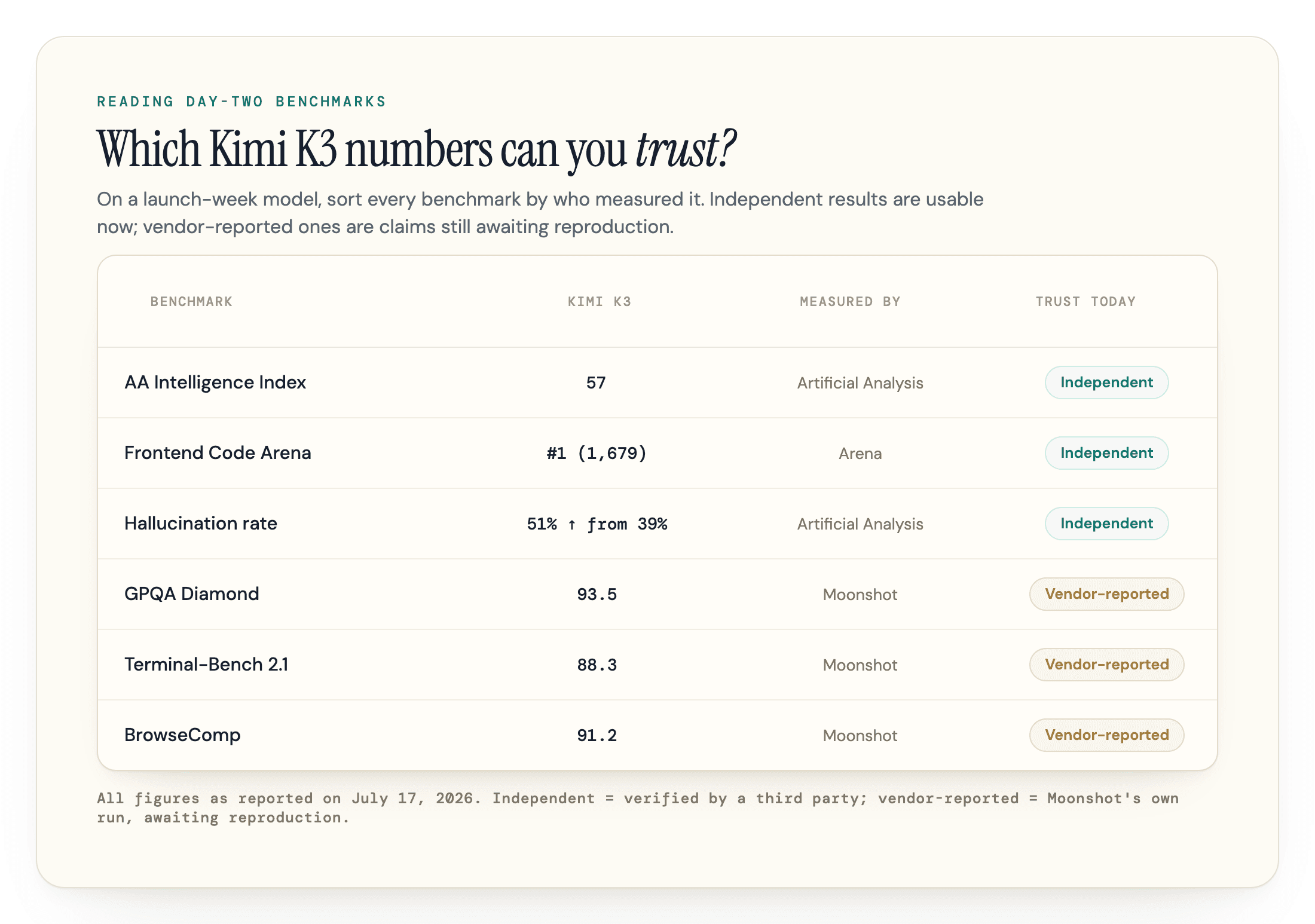
The results worth leaning on today are the independently checked ones. At launch, Artificial Analysis scored K3's overall Intelligence Index at 57 (the figure in the chart above, as reported July 17). The index has since been re-versioned several times, re-weightings of the benchmark suite rather than changes to the model: the August version (v4.1.1) put K3 at 60, tied with GLM-5.3; the September 4, 2026 version (v4.2) put K3 at 50, GLM-5.3 at 49, still the top open-weight model; and on the current v4.3.2 (September 2026, checked September 25) K3 scores 44, now third among open-weight models behind Xiaomi's new MiMo-V2.6-Pro (46) and GLM-5.3 (45), and still behind the closed frontier of Claude Opus 5, Anthropic's newer Claude Fable 5.1, and OpenAI's GPT-6 Astra (released September 3, 2026, superseding GPT-5.6 Sol as the closed flagship). Its long-horizon knowledge-work Elo of 1547 trailed only Fable 5 when measured at launch. Separately, the Frontend Code Arena, a human-preference leaderboard, ranks it first, ahead of Fable 5 and GPT-5.6 Sol, though critics note that leaderboard leans heavily on frontend and 3D-demo tasks, so read it as coding-flavor strength rather than general capability. Read together, those say something specific: K3 was at the frontier on narrow coding and agent tasks at launch, and has since slipped from the open-weight intelligence lead while staying competitive on coding-flavor benchmarks.
Everything else in the headline tables is Moonshot's own reporting, and the caveats are real. The company ran different benchmarks through different agent harnesses (its own Kimi Code, Claude Code, or Codex) at maximum thinking effort, so the comparisons are not strictly apples to apples, and the author of one benchmark Moonshot cited publicly objected that the metric can inflate partial-credit scores. There is also a result the vendor page does not headline: on Artificial Analysis's hallucination test, K3's fabrication rate rose to 51% from the previous model's 39%, even as its accuracy improved. It answers more questions correctly and makes up more of the ones it gets wrong.
| Benchmark | Kimi K3 | Fable 5 | GPT-5.6 Sol | Measured by |
|---|---|---|---|---|
| AA Intelligence Index | 44 (#3 open model, v4.3.2, checked Sept 25 2026) | higher | higher | Independent (Artificial Analysis) |
| Frontend Code Arena | 1,679 (#1) | 1,631 | 1,618 | Independent (Arena) |
| GPQA Diamond | 93.5 | 92.6 | 94.1 | Vendor-reported |
| Terminal-Bench 2.1 | 88.3 | 84.6 | 88.8 | Vendor-reported |
| BrowseComp | 91.2 | 88.0 | 90.4 | Vendor-reported |
| HLE (general reasoning) | 43.5 | 53.3 | 44.5 | Vendor-reported |
| Hallucination rate | 51% (up from 39%) | 54.9% (higher) | n/a | Independent (Artificial Analysis) |
Even Moonshot's own table has K3 trailing Fable 5 on general reasoning, as the HLE row shows, so this is a coding and agent specialist rather than an across-the-board leader. Believe the independent numbers, treat the vendor table as a claim awaiting reproduction, and expect independent coding and reasoning benchmarks to fill in over the coming weeks.
Kimi K3 Pricing: "Open" Does Not Mean Cheap
The biggest surprise of the launch was not a benchmark. It was the price. Kimi K3's API costs $3.00 per million input tokens, $0.30 per million on a cache hit, and $15.00 per million output tokens. Moonshot has since published an official USD rate card confirming those figures; we break down the full lineup, the tier system, and the access routes in our Kimi API pricing guide. If you are weighing the consumer app rather than the API, the subscription tiers and the credit system are covered in our Kimi pricing guide.
Against Moonshot's own history, the jump is stark. That output rate is nearly four times what the K2.7 Code model charged, and the input price is more than three times higher. As one widely shared reaction put it, this is "frontier pricing, from the lab whose entire identity was being the cheap one." The era of a Chinese open model automatically being the budget pick is over.
| Model | Input / 1M | Output / 1M | Cache-hit input | Note |
|---|---|---|---|---|
| Kimi K3 | $3.00 | $15.00 | $0.30 | Frontier tier; nearly 4x the K2 line's output |
| Kimi K2.6 / K2.7 Code | $0.95 | $4.00 | discounted | Still open, far cheaper |
| DeepSeek V4 Pro | $0.66 off-peak / $1.32 peak | $1.98 off-peak / $3.96 peak | ~$0.022 | Frontier-class, a fraction of K3 per token |
Whether $15 hurts depends entirely on your workload. Because K3 reasons on every request and can be verbose, a single task often drags a long thinking trace, retried tool calls, and a growing history through the output meter, so heavy output bills are routine rather than rare. On Artificial Analysis's cost-per-task measure K3 runs about $0.95, under half the $2.03 Claude Opus 5 costs at max effort and close to GPT-5.6 Sol at $1.04, which is reasonable for frontier-grade work. That Sol figure predates OpenAI's August 21, 2026 price cut, so its real cost per task now runs lower than the index shows. But if your goal was to save money by going open, note that DeepSeek V4 Pro completes a comparable task for a small fraction of that. Our DeepSeek pricing breakdown and Claude pricing guide give the fuller comparison.
The 1M Context Is Smaller Than It Looks, Twice Over
The headline context window and the one you can actually reach differ for two separate reasons, and neither is on the spec sheet.
The first is a payload ceiling. Moonshot's own issue tracker carries a reproducible 400 total message size 2100954 exceeds limit 2097152 error: a hard 2 MiB cap on total conversation size. In the reporting user's session that worked out to roughly 770,000 tokens, well short of the advertised 1,048,576. So on text-heavy conversations the byte cap bites before the token limit does.
The second is a paywall. On the Kimi coding plans, 1M context is a tier feature rather than a model property. K3 is not available on the free Adagio or entry Andante tiers, which stay on K2.7; K3 access starts on Moderato (¥99), and the full 1M-token window is exclusive to the top Allegro (¥699) tier. If you are subscribing specifically for the million-token window, check which tier actually grants it before you buy, because the cheapest plan does not give you K3 at all.
The Subscription Burn Rate Is the Part That Surprised People
Per-token pricing is only half the story, and it is not the half that bit early users hardest. The consistent first-week complaint across Kimi's coding plans is that a single task can consume a startling share of a usage window. One user on the $19 plan ran a task he benchmarks every model against and watched it eat almost his entire five-hour allowance, where the same task on a $20 OpenAI plan finished in minutes and barely registered. Another on the same entry tier hit a loop retrying a Docker step and burned through a five-hour window, which was 20% of his weekly quota, on that one failure. A third, on the $99 Kimi Coding plan, reported quota draining at a pace similar to a $200 Anthropic subscription, and notably he liked the model, rating it above Opus 4.8 on quality.
The mechanism is measurable. Artificial Analysis needed 130 million tokens to run K3 through its Intelligence Index against a 63 million average across the field, roughly double. In Simon Willison's test, a single SVG generation returned 16,658 output tokens of which 13,241 were reasoning, costing 25 cents for one image. Several users independently describe the same trace pattern behind it: paragraphs of "wait, actually" as the model backtracks and second-guesses itself on small details.
This is where reasoning_effort stops being a footnote. At launch "max" was the only accepted value, with no cheaper mode to fall back to; Moonshot has since added low and high, but max is still the default, so every request you do not explicitly turn down pays full reasoning tokens at the $15 output rate. Max effort also makes K3 slow enough to break evaluation harnesses: one public comparison had to raise a five-minute per-task timeout to thirty, and one task still took around nine minutes. If cost or latency matters, set the effort level explicitly rather than leaving it at the default.
One more thing worth naming: almost nobody can measure their own burn. The plans report usage as an opaque percentage rather than tokens, which is why some users route their coding subscriptions through a gateway purely to get visibility into what they are actually spending.
Can You Actually Run Kimi K3?
"Open weights" sounds like you can download K3 and run it yourself. The weights are genuinely public now, released on July 27 to Moonshot's Hugging Face repo, and community quantizations for llama.cpp, Ollama, and LM Studio appeared almost immediately. But for almost everyone, downloadable is still not the same as runnable, and the reason is scale.
At 2.8 trillion parameters, the repository is about 1.5TB to download in K3's native 4-bit MXFP4 format, and you need roughly 1.4TB of fast accelerator memory just to load the weights before any conversation. Moonshot recommends serving it on a supernode of 64 or more accelerators; community estimates put the floor around 21 H100-class GPUs, or three server nodes of eight 80GB cards each. A single RTX 4090 or a 512GB Mac Studio does not come close. One tester who did get it onto an M1 MacBook, by streaming individual experts from Hugging Face per token, measured it at roughly one minute per token, which captures the gap between "I can technically load it" and "I can use it."
This is the tension practitioners keep circling: K3 may be legally open while staying operationally closed to anyone without a data center. What open weights buy you here is not laptop inference. The most-upvoted framing in the community is that the real payoff is provider competition: because anyone can host K3, a market of API providers drives the price down, the way many independent hosts already do for models like GLM. Alongside that you get durability (a version cannot be silently retired out from under you) and data residency for teams that self-host. So who self-hosts? Organizations with real GPU infrastructure and a reason to keep data in-house, and even they mostly run it non-interactively. That is the practitioners' fix for the speed problem: point it at an overnight job like "analyze this codebase for vulnerabilities" rather than an interactive chat. A response an hour later is fine there. For everyone else, the practical paths are Moonshot's own platform, a router like OpenRouter, or the free tier in the Kimi consumer app. If you do want to try self-hosting, our guide to running Kimi K3 locally walks through every route, the real hardware, and what each one costs. Note that API credits are billed separately and are not bundled into any Kimi app subscription, so paying for the app does not hand you API access. Our open weights vs open source explainer covers why the distinction matters, and our best open-source LLMs ranking includes a self-host reality check for this class of model.
Kimi K3 vs Kimi K2 vs DeepSeek: Which Should You Use?
The short answer: reach for Kimi K3 only when the job specifically needs what it does best, and keep something cheaper or more reliable for everything else. K3 earns its 3-to-4x premium when you need the long context (bearing in mind the 2 MiB payload cap and the plan tiering above), native vision, or frontier-grade coding and agent performance, and when you can tolerate its speed, which runs a modest 28 to 62 tokens per second with a lot of thinking in between.
For most day-to-day work the math favors its own siblings. Kimi K2.6 and K2.7 Code are far cheaper, fully open, and already strong on coding, so unless a task hits K3's specific strengths, the older models do it for a fraction of the cost. If you are optimizing purely for price per token, DeepSeek V4 is cheaper still. And where the cost of a wrong answer is high, Claude Fable 5 and Opus keep the edge on careful reasoning and verified coding. A fuller side-by-side of the open Chinese models lives in our Chinese AI models comparison.
| Model | Best for | Open weights? | Rough cost | Watch for |
|---|---|---|---|---|
| Kimi K3 | 1M context, vision, frontier coding and agents | Yes (public, custom license) | High ($15 output) | Slow, verbose, needs a GPU cluster to self-host |
| Kimi K2.6 / K2.7 Code | Everyday coding at low cost | Yes | Low | Not frontier-level on the hardest tasks |
| DeepSeek V4 | Cheapest reasoning and coding per token | Yes | Lowest | Same China data questions |
| Claude Fable 5 / Opus | High-stakes reasoning and verified coding | No | Premium | Closed; you rent, not own |
The mature move is to pilot, not switch. Run K3 on one real, measurable task alongside your current model, look at accepted results and how much supervision each needed, and keep whichever leaves less total friction. On launch-day evidence, K3 deserves that pilot for coding, agents, and long-context work. It does not yet justify replacing a model you trust for everything.
What Kimi K3 Means for Your AI Visibility
Come back to where this started. A day after launch, the assistants most people use could not describe Kimi K3 because their training predates it, and they will stay behind for months. That lag is not a Kimi quirk. It is how every model treats anything new, including your business.
If a brand-new, heavily covered AI model is invisible to deployed assistants, then a product launch, a rebrand, or a corrected fact about your company is invisible the same way until training and the live web catch up. That gap is exactly what AI visibility work addresses. And because K3's weights are public, the model gets fine-tuned and embedded into a long tail of downstream tools you will never see individually, each answering questions about your market from whatever it can find about you.
That makes two things the actual levers, and neither is the model. The first is reachability: every one of these systems and the crawlers feeding them has to be able to fetch your site, or you are absent from the live layer that updates faster than training does. The second is consistency, the core of getting cited by AI: the businesses described correctly are the ones whose facts line up across the sources a model reads. In our experience at geotoolbox, the companies that surface well in AI answers are rarely the ones with the prettiest homepage; they are the ones a model can find, parse, and trust without tripping over contradictions.
You cannot control what Kimi K3 or the next open model learns about you. You can control whether it can reach you at all. Run a free AI Readiness check to see whether the AI crawlers can fetch and parse your site, and fix the gaps before the next launch makes the question urgent again.
Frequently Asked Questions
Is Kimi K3 Chinese?
Yes. Kimi K3 is built by Moonshot AI, a Beijing lab founded in 2023 and backed by Alibaba, Tencent, and Meituan. Because it is a Chinese company, the same data-jurisdiction questions that apply to any China-hosted service apply here, which is one reason the open weights matter: teams that need to keep data in their own jurisdiction can self-host rather than send prompts to Moonshot's servers. As with K2, no independent safety evaluation of K3 has landed yet, so treat its alignment and refusal behavior as unverified for now.
Is Kimi K3 open source?
Not quite. K3 is open weights, not open source. Moonshot released the model files on July 27, 2026 under its own Kimi K3 License, which permits commercial use but is not an OSI-approved open-source license: it adds a separate-agreement requirement for very large model-as-a-service operators and a "Kimi K3" display requirement for very large products. The company also does not release the training data or full recipe, and the Kimi app and API stay closed. So you can run and fine-tune the model, but you cannot fully reproduce how it was made.
Is Kimi K3 free?
The model weights are free to download and run (they went public on July 27, 2026), if you have the hardware, but using K3 through the API is not: it is $3 per million input tokens and $15 per million output, nearly four times the older K2 line's output rate. Third-party providers sometimes offer limited free access, and Moonshot's consumer app has a free tier, but there is no permanent free API tier.
Can I run Kimi K3 on my own computer?
Realistically, no. The weights are public now, but at 2.8 trillion parameters K3 is about 1.5TB to download and needs roughly 1.4TB of GPU memory just to load, so Moonshot recommends a supernode of 64 or more accelerators. That is far beyond any consumer machine: a 512GB Mac Studio does not come close, and one tester who forced it onto a MacBook by streaming experts from disk measured minutes per token. Self-hosting is practical only for organizations with serious GPU infrastructure, usually run as overnight batch jobs rather than interactive chat. For everyone else, the hosted API or a provider like OpenRouter is the route. Our how to run Kimi K3 locally guide covers the routes and hardware in full.
Is Kimi K3 better than Claude or GPT?
On narrow coding and agent benchmarks, K3 competes at or near the top, and it ranks first on a human-preference frontend leaderboard. On general intelligence, independent testing now puts it third among open-weight models (behind Xiaomi's MiMo-V2.6-Pro and GLM-5.3 on Artificial Analysis's v4.3.2 Intelligence Index) and behind the closed frontier (Claude Opus 5, Fable 5, GPT-5.6 Sol), and reviewers report it is weaker on non-coding work. It is a strong specialist, not a clear overall winner. Our Kimi K3 vs Claude comparison breaks the head-to-head down by task, cost, and speed.
Does Kimi K3 hallucinate?
Yes, and notably so. On Artificial Analysis's independent testing, K3's hallucination rate rose to 51% from the prior model's 39%, even as its accuracy improved. Higher accuracy came with more confident fabrication, so verify anything that matters before you rely on it.
Sources
- China's Moonshot unveils world's largest open AI model, closing in on US rivals - Reuters, July 2026 -
reuters.com/world/china/chinas-moonshot-unveils-worlds-largest-open-ai-model-closing-us-rivals-2026-07-17 - Kimi K3, and what we can still learn from the pelican benchmark - Simon Willison, July 2026 -
simonwillison.net/2026/Jul/16/kimi-k3 - Kimi K3 - Intelligence, Performance & Price Analysis - Artificial Analysis, July 2026 -
artificialanalysis.ai/models/kimi-k3 - Kimi's open model K3 nears GPT-5.6 Sol and Fable 5 while signaling the end of super cheap Chinese AI - The Decoder, July 2026 -
the-decoder.com/kimis-open-model-k3-nears-gpt-5-6-sol-and-fable-5-while-signaling-the-end-of-super-cheap-chinese-ai - Moonshot AI Releases Kimi K3: A 2.8 Trillion Parameter Open MoE Model - MarkTechPost, July 2026 -
marktechpost.com/2026/07/16/moonshot-ai-releases-kimi-k3-a-2-8-trillion-parameter-open-moe-model-with-kimi-delta-attention-and-1m-context - Kimi K3 - API Pricing & Benchmarks - OpenRouter, July 2026 -
openrouter.ai/moonshotai/kimi-k3 - Kimi Linear: An Expressive, Efficient Attention Architecture - arXiv 2510.26692 -
arxiv.org/abs/2510.26692