
By raw download count, Qwen is the most popular open AI model in the world, and most marketers have never heard of it. Alibaba's open models are downloaded, fine-tuned, and built into other developers' products so widely that Qwen can sit inside tools you would never connect back to a Chinese tech giant. Here is the plain version of what Qwen is, current as of August 2026, who builds it, whether it is safe, and where it stands. And then the part the developer write-ups skip: what the most-deployed open model means for whether AI tools describe your brand correctly.
What Is Qwen?
Qwen is Alibaba Cloud's AI model family, most of it released as open weights and known in China as Tongyi Qianwen. It is not a single model but a whole lineup, with versions for text, code, vision, image generation, and audio. If you have run a local model on your laptop, browsed an "open model" leaderboard, or used an AI tool that swapped in a cheaper engine behind the scenes, there is a good chance Qwen was involved.
Like the other open models, Qwen is really three things, and keeping them straight clears up most of the confusion. There are the open weights, which Alibaba publishes so anyone can download, run, and fine-tune the large language models. There is the hosted product, the free Qwen chatbot and Qwen Studio at qwen.ai, which Alibaba runs on its own servers. And there is the API, which developers call to build on it. The models are mostly open; the service around them is Alibaba's.
The reason most marketers have never heard of Qwen, despite its scale, is that it lives mostly as infrastructure rather than as a consumer brand. It does not have a household name like ChatGPT. It sits underneath things, fine-tuned and rebranded inside other products until the Alibaba name disappears. That ubiquity is the whole story, and it is exactly why Qwen is worth your attention even if you never type a prompt into it.
It's Alibaba's AI, said 'chwen'
Qwen is usually pronounced "chwen." It is the AI model family, not the American football player whose name people misspell into the same search box, and not the accent chair that shares the spelling. When this article says Qwen, it means Alibaba's AI.
Who Makes Qwen? Alibaba and the Tongyi Qianwen Team
Qwen comes from Alibaba Cloud, built by the team behind Tongyi Qianwen, and that pedigree is the first thing that sets it apart. Alibaba launched the first Qwen beta in 2023 and has shipped new models at a relentless pace ever since, eventually spinning the work into a dedicated unit inside the company.
That is a different kind of player from the other Chinese labs you have probably seen in headlines. DeepSeek came out of a quant hedge fund, Kimi from the startup Moonshot, and GLM from Zhipu. Qwen comes from one of the largest technology companies on the planet. It is a Big Tech open-model program, not a scrappy upstart, and that shows in both the breadth of the lineup and the strategy behind it.
The strategy is the familiar one Meta and Google use with their open models: give the models away to win developers, and earn the money on cloud and downstream products. Alibaba leans into that hard. It releases most of the lineup as free downloads, and it also wires Qwen into its own ecosystem, powering features across Alibaba's e-commerce and travel platforms. The free models build the habit; the paid cloud and the flagship API are where Alibaba expects to be repaid.
The Qwen Family: One Name, Dozens of Models
The hardest part of understanding Qwen is that there is no single "Qwen." There are dozens, across several generations and a wall of suffixes: Qwen2.5, Qwen3, Qwen3.5, Qwen3.6, Qwen3.7, Qwen3.8, with labels like Max, Plus, Coder, VL, Image, and Omni appearing across the family, in sizes from under a billion parameters to hundreds of billions. If you have felt lost trying to figure out which Qwen is "the" Qwen, that is the design, not your fault.
The throughline is easy enough. The series ran from the original Qwen in 2023 through Qwen2 and Qwen2.5, then Qwen3 in April 2025, which added a hybrid "thinking" mode that lets the model toggle between fast answers and slower step-by-step reasoning. From there it moved quickly through Qwen3.5, Qwen3.6 and Qwen3.7 to the current flagship, Qwen3.8-Max, released on August 3, 2026. The family is trained for well over 100 languages, which is part of why Qwen is so widely adopted outside the English-speaking world.
Qwen3.8-Max is a 2.4-trillion-parameter multimodal model with 95 billion parameters active per token and a one-million-token context window, first shown as a preview at the World AI Conference in Shanghai on July 19 and released properly two weeks later. Alibaba calls it "the most capable model in the Qwen family to date." It runs through the API as qwen3.8-max at $2 per million input tokens and $6 per million output, and unlike the July preview it comes with a published benchmark table, though a mixed one: Alibaba measured Qwen itself and took several rivals' scores from third parties. The weights, promised for the week of August 10, landed on August 12, 2026 in the official Qwen3.8-2.4T-A95B repository: the first time a Max-tier Qwen has ever been opened. The opening is partial, though: the released variant is text-only, its native context stops at 262,144 tokens (extensible to about a million), and it ships under a bespoke "Qwen3.8-Max" license rather than Apache 2.0.
What really sets Qwen apart from its open rivals is breadth. Where DeepSeek, Kimi, and GLM are essentially text-and-code models, Qwen is a full multimodal family. Here are the main lines as of August 2026.
| Qwen line (as of August 2026) | What it does | Open weights? |
|---|---|---|
| Qwen3.6 (dense + MoE) | General text and reasoning, hybrid thinking; the current open line and the models most people actually run | Yes (Apache 2.0) |
| Qwen3.8-Max | The current flagship, 2.4T parameters with 95B active, 1M context, multimodal | Yes, since August 12, 2026: text-only variant (262,144-token native context), under a bespoke "Qwen3.8-Max" license, not Apache 2.0 |
| Qwen3.7-Max | The previous flagship, 1M context, still on sale; listed higher than 3.8-Max but cheaper while its 50% promotion runs | No (API only) |
| Qwen3.7-Plus | Multimodal mid-tier: image and video understanding, deep reasoning, GUI and agentic work, 1M context | No (API only) |
| Qwen-Coder | Coding and agentic software tasks | Yes (open versions) |
| Qwen-VL | Vision: reads and reasons over images and video | Yes (open versions) |
| Qwen-Image | Image generation and editing | Yes (open versions) |
| Qwen-Omni | Text, image, audio, and video together, with real-time speech; the current commercial builds are qwen3.5-omni-plus and its realtime variant | Mixed (some open, some not) |
Is Qwen Open Source? The Open-vs-Closed Reality
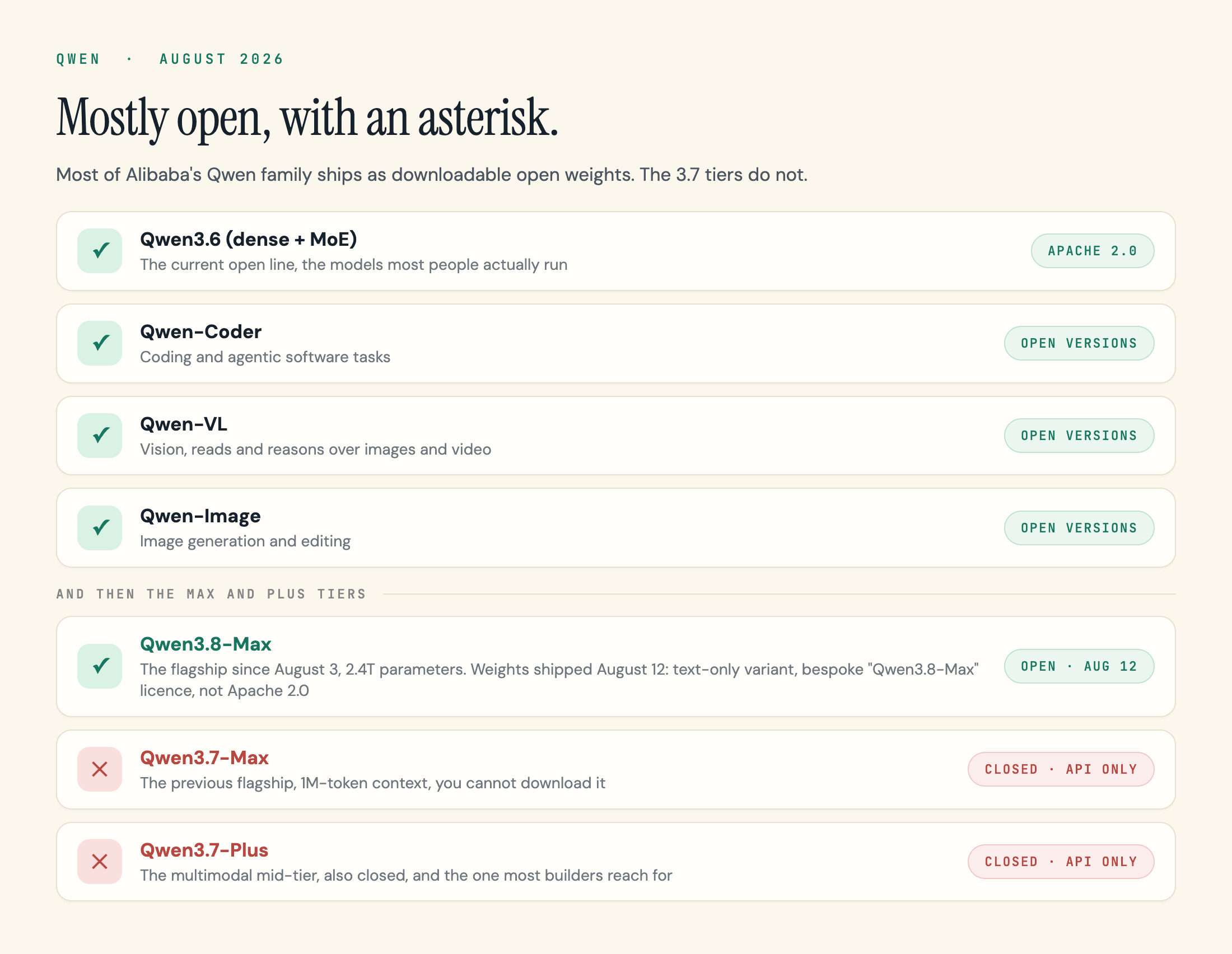
Qwen is the open-model story with an asterisk: most of the family is genuinely open, but the best model in it is not. This trips up a lot of people, and it is worth getting right, because "is Qwen even open source anymore?" has become a real question in the community.
Here is the honest version. Most of the Qwen lineup, the dense models and many of the Mixture-of-Experts models, ships as open weights under the permissive Apache 2.0 license. You can download them, run them on your own hardware, fine-tune them, and use them commercially, subject only to the light conditions of the Apache 2.0 license. That is the part that earned Qwen its reputation. But the flagship "-Max" tier, from Qwen3-Max through Qwen3.7-Max and, until August 12, 2026, the current Qwen3.8-Max, was proprietary: it ran only through Alibaba's API, with no download. Alibaba had followed this pattern since Qwen2, opening most of the lineup while keeping its most capable model closed.
That asterisk grew, then partly receded. The 3.7 generation stayed closed: Qwen3.7-Max in May 2026 and Qwen3.7-Plus in early June, both API-only, and neither ever got weights. Qwen3.8-Max looked set to follow until August 12, 2026, when Alibaba published its weights (text-only, under a bespoke "Qwen3.8-Max" license rather than Apache 2.0): the first open Max-tier Qwen, though the fully multimodal version of the flagship itself remains API-only. A separate, smaller model closed that gap two days later: Qwen3.8-27B, a 27-billion-parameter vision-language model, shipped around August 14, 2026 as open weights under the ordinary Apache 2.0 license, so a genuinely open, genuinely multimodal Qwen now exists, just not at flagship scale. What is still closed is the "-Plus" mid-tier, Qwen3.7-Plus and its successors, the size most builders would actually reach for before jumping to a 2.4T flagship: it stays API-only even now that the flagship has partly opened. The counterweight is that Alibaba has not slowed its open releases elsewhere, shipping Apache 2.0 weights for agent-environment, embedding, and robotics models through June and July 2026, with the most recent uploads to its Hugging Face account dated late July.
The 3.8 launch is where that pattern got tested. Alibaba's release post said it would open-source the Qwen3.8-Max weights in the week of August 10, 2026, the first time a Max-class Qwen would be opened. That was a real break with three years of practice, which is also why it was worth checking rather than assuming, and the check eventually came back in Alibaba's favor: two days past the announced window, the weights landed on August 12, 2026 in Alibaba's official Hugging Face organization. The opening is partial: the published variant is text-only, its native context stops at 262,144 tokens, and the license is a bespoke "Qwen3.8-Max" license rather than the family's usual Apache 2.0. The third-party repositories that carried the Qwen3.8 name before that date held either nothing or older models relabelled with the new number, so only Alibaba's own account settles it.
Licensing adds another layer. Most open models are Apache 2.0 with no conditions, but a few sit under the separate Qwen License, which requires you to request a license from Alibaba once a product passes 100 million monthly active users, and the smallest research variants are non-commercial. And as with every model in this category, open weights are not the same as open source: Alibaba publishes the finished weights, not the training data or the full recipe.
| Tier | Example | Downloadable? | License |
|---|---|---|---|
| Open dense + MoE | Qwen3.6-35B-A3B, Qwen3.6-27B | Yes | Apache 2.0 (no strings) |
| Some larger / older weights | Qwen2-72B | Yes | Qwen License (100M-MAU clause) |
| Small research variants | Qwen2.5-3B | Yes | Qwen Research (non-commercial) |
| Flagship "-Max" | Qwen3.8-Max | Yes (August 12, 2026), text-only | Bespoke "Qwen3.8-Max" license for the weights; the fully multimodal version remains API-only |
| Open multimodal (mid-size) | Qwen3.8-27B | Yes (~August 14, 2026), vision-language | Apache 2.0 (no strings) |
Because so much of Qwen is free and unrestricted, it gets downloaded, fine-tuned, and rebranded into a vast number of community versions, including ones modified to strip out the guardrails. Hold onto that point. It is the part that actually matters for your brand, and we come back to it at the end.
How Good Is Qwen? Qwen3.8-Max and the Honest Picture
As of August 2026 the flagship Qwen3.8-Max is in the frontier conversation on Alibaba's own numbers, but the more useful story is still the open models. The 3.8 release finally came with a benchmark table, which the July preview did not have, and it is worth reading closely rather than as a headline. Alibaba's table puts Qwen3.8-Max at 86.6 on Terminal-Bench 2.1, ahead of Claude Fable 5 at 84.6, and at 92.6 on GPQA Diamond, level with Fable 5. It also shows the model well behind on the harder end: 67.7 against Fable 5's 80.0 on SWE-bench Pro, and 43.6 against 53.3 on Humanity's Last Exam. So it is a good model losing several of the comparisons its own vendor chose to publish, which is already a more honest picture than the "second only to Claude Fable 5" positioning that followed the July preview.
The outside numbers are less flattering still. Artificial Analysis independently runs Terminal-Bench 2.1 and scores Qwen3.8-Max at 81.3%, below Fable 5's 84.6% rather than above it. Alibaba disclosed why the two differ: on that benchmark it ran Qwen itself and reported every rival's best published score from elsewhere, so its table sets a self-run number against other people's. The same caveat applies to its generational claim, where the Qwen3.7-Max figure is imported and the Qwen3.8-Max one is not. Measured by Artificial Analysis at both ends, the jump is 74.5% to 81.3%. That is the whole reason to treat vendor benchmarks as a starting point.
Benchmarks are also the wrong place to look for what this model is actually for. The more telling evidence in Alibaba's launch post is agentic: it says Qwen3.8-Max ran unattended for more than ten days building a working command-line project, accumulating 265 commits and 127 pull requests with no human in the loop, and separately spent about 125 hours reproducing a research paper from nothing but the paper and a set of GPUs before improving on its result. Those are Alibaba's own accounts and nobody has reproduced them. They still describe the thing worth testing: long, unsupervised work rather than single answers.
So the short verdict is that Qwen3.8-Max is a strong multimodal model and a competent coding one at a fraction of frontier pricing, and that nothing published so far makes it the best model in the world.
The result that should actually impress a non-developer is quieter. Qwen's open models, the ones anyone can download for free, routinely punch well above their size, competing with much larger and far more expensive models. That is exactly why developers reach for them as a default, and it is the real Qwen achievement: not that the closed flagship tops a leaderboard for a week, but that the free, downloadable models are good enough to build on.
One honest caveat. On pure English-language tasks the gap between Qwen and the best Western open models like Google's Gemma is narrow and shifts with every release. Qwen's more durable advantage is its broad multilingual coverage, strongest in Chinese and across many non-English languages, which matters more if your audience is global than if it is English-first.
Is Qwen Safe? The China and Alibaba Question
The honest answer turns on the same distinction as every Chinese model, who makes it versus who hosts your data, plus one Alibaba-specific wrinkle. Get the first part straight and most of the worry sorts itself out.
When you use the hosted Qwen app or API, your prompts travel to Alibaba's servers, which puts them under Chinese jurisdiction and the data rules that come with it. Any hosted model means your prompts leave the building, a US provider included; the difference with a Chinese one is whose jurisdiction and policy they land under. For sensitive or proprietary work, that is a real consideration, and it is the same caution we walk through for DeepSeek. The escape hatch is the open weights: because most of the family is downloadable, a team can run Qwen on its own infrastructure, so the prompts never leave the building and Chinese hosting never enters the picture. Self-host rather than send is the clearest answer for sensitive work.
The wrinkle is procurement. Some enterprises, especially in regulated or security-sensitive settings, run a blanket "no Chinese-origin models" policy, and that is a box-checking rule, not a technical one. Self-hosting solves the data-residency problem but may not clear a policy that bars the model by origin regardless of how it is run. If you operate in a regulated or security-sensitive environment, that policy question is often the real blocker, not the engineering. There is also a content angle: the official app follows Chinese content rules on politically sensitive topics, and because the weights are open, the community has even produced "uncensored" forks that strip those guardrails out, which is a reminder of how far beyond Alibaba's control these models travel once released.
How to Access Qwen
There are three ways in, and which one you pick decides the cost and privacy tradeoff. The quickest is the free Qwen chatbot and Qwen Studio at qwen.ai, which need no setup and cover text, images, and more. For building, the API is OpenAI-compatible, so it slots into existing tools by changing little more than an endpoint, and it is priced well below the closed Western frontier. And because most of the family is open, you can skip Alibaba's servers entirely and self-host.
| How you use it | Cost (as of August 2026) | What you get |
|---|---|---|
| Qwen chat / Qwen Studio | Free | Web chat with text and images, no setup, quickest way to try it |
| Standalone API (Qwen3.8-Max) | $2 in / $6 out per 1M tokens | Build the current flagship into your own product |
| Standalone API (Qwen3.7-Max) | $2.50 in / $7.50 out per 1M tokens list, currently on a limited-time 50% discount | The previous flagship, cheaper than the current one while the promotion lasts |
| Self-host (open models) | Free license, your own hardware | Data stays local; runs on anything from a laptop to a server |
The flagship's API pricing on OpenRouter matches Alibaba's own $2 and $6 rates, and the older Qwen3.7-Max sits below that while its 50% promotion runs. Either way it is a fraction of what the top closed models charge. Promotional rates move, so check live before budgeting. The open models live on Hugging Face and Alibaba's ModelScope, and they run through the usual local tools like Ollama and LM Studio, which is how Qwen ended up on so many laptops and phones in the first place.
Qwen vs DeepSeek, Kimi, GLM and Llama
In the crowded open-model field, Qwen's distinction is breadth and reach rather than a single benchmark win. The other open models tend to specialize: DeepSeek is the reasoning-and-cost specialist, Kimi leans agentic with long context, GLM is coding-first, and Meta's Llama is the Western pioneer that kicked off the open-weight wave. Qwen is the one that does a bit of everything, across the most modalities, with the widest deployment. For a full side-by-side of how these stack up on cost, openness, and capability, see our Chinese AI models comparison.
| Model | Maker | Strongest at | Open weights? |
|---|---|---|---|
| Qwen | Alibaba | Breadth (text, vision, image, audio), multilingual, sheer reach | Mostly yes; flagship weights text-only since Aug 12 (bespoke license), multimodal API-only |
| DeepSeek | High-Flyer | Reasoning, math, very low cost | Yes (MIT) |
| Kimi | Moonshot | Agentic work, long context | Yes (modified) |
| GLM | Zhipu | Coding, agents, long-horizon tasks | Yes (custom on 5.3) |
| Llama | Meta | The Western open pioneer, large ecosystem | Yes (Llama license) |
For most teams the practical answer is not to crown one open model but to reach for whichever fits the job, often pairing a cheap open model with a closed frontier model like Claude or GPT for the hardest work. What makes Qwen matter beyond that menu is not where it lands on any one test. It is how many places it has already ended up, and that is the thing with real consequences for your brand.
What Qwen Means for Your Brand's AI Visibility
The question most marketers actually have is whether they need to do something about Qwen. The short answer is no, not directly, and the reason is a distinction worth holding onto. Qwen is infrastructure, not a destination. You do not "optimize for Qwen" the way you optimize a page for Google. Alibaba does run a Qwen chatbot, but in most Western markets your buyers are not researching you there; they are on ChatGPT, Perplexity, Gemini, and Claude. Those products are what you track your visibility in, and a single open model launching changes none of that. It is worth saying plainly, too, that ranking number one on Google does not mean an AI engine will mention you, because that is a separate system with its own logic.
So why does Qwen come up at all? Because of its reach, with one honest qualifier. By mid-August 2026 Alibaba said the Qwen family had passed 3 billion cumulative downloads, making it the most-downloaded open model family in the world, ahead of both Meta and Google. That is Alibaba's own headline, and it is worth an honest qualifier: Hugging Face's own State of Open Models report (August 2026) counts roughly 2 billion Qwen downloads and about 151,000 derivative models, against the 300,000+ Alibaba claims. Whichever count you take, the order of magnitude is the same, and it dwarfs any other open family. Most of those are developers running Qwen for coding, local inference, or backend features that never describe a brand. But some of those deployments do face end users, the chat assistants, support bots, and search wrappers quietly built on Qwen, and their reach is impossible to measure from a download count and impossible to audit. You cannot inspect every product that runs on it, including community forks like "Liberated Qwen," a version stripped of its content guardrails. That is the real point: an open model this widely embedded becomes part of the substrate that describes your brand in places you will never see, not because it is sinister, but because it is everywhere and out of anyone's hands once released.
That ubiquity makes a second problem worth understanding, and it applies to every model, Qwen included. An AI's built-in memory goes stale, and not just on last week's news. To show it, in June 2026 we asked two well-known models, with web search off, about Qwen. GPT-5.5 honestly admitted it was unsure and named the two-year-old "Qwen2-72B" as the flagship. The older GPT-4o confidently answered that the latest Qwen was "Qwen-7B" and that Qwen "is open source and free to use", naming a 2023 model and getting the licensing flatly wrong, since the flagship was closed at the time (and the full multimodal flagship still is API-only). Those are not bleeding-edge misses; they are wrong about Qwen's basic, established state, its current version and whether it is even open.
The lesson is not really about Qwen. For an established brand, the danger is rarely being invisible; it is being described as an outdated version of yourself, an old price, a discontinued product, a name from before your rebrand. If a model can be this wrong about something with hundreds of millions of downloads, it can be wrong about your latest page.
You cannot tune any single model, much less every fork of one. What you can do is make sure every engine and crawler can reach your current pages, and that your facts line up across the sources a model is likely to read. That combination, reachability plus consistency, is the foundation of generative engine optimization, and it is the same mechanism behind AI hallucinations about your company. The pattern we see at geotoolbox is that the businesses surfacing well in AI answers are rarely the ones with the prettiest homepage; they are the ones a model can find, parse, and trust without tripping over a contradiction. Our guides on what GEO is and how AI engines choose their sources go deeper, and since being cited by one engine never guarantees the next, that work pays off across all of them.
Qwen is worth understanding, but the open-model wave it leads does not change your job so much as widen the field: more places an answer about you can appear, more forks running quietly underneath them, and more chances to be described with last year's facts. Qwen is just the clearest case, because it is the one that ended up everywhere. The first move is also the cheapest, and it is the same no matter which model is running underneath: find out whether the AI crawlers can even reach and read your current pages. You can run a free AI Readiness check from geotoolbox to see where those gaps are before the next answer about your brand gets written without you.
Frequently Asked Questions
How do you pronounce Qwen, and is it the football player?
Qwen is usually said "chwen." It is Alibaba's family of AI models, not the American football player whose name gets misspelled into the same search box, and not the furniture that shares the spelling. The AI model is always tied to Alibaba or "Tongyi Qianwen," its Chinese name.
Who makes Qwen, and is it Chinese?
Qwen is made by Alibaba Cloud, the cloud arm of the Chinese technology giant Alibaba, and was first released in 2023 under the name Tongyi Qianwen. Yes, it is a Chinese model, and it operates under Chinese law. That mainly matters for the hosted app and API, which send your prompts to Alibaba's servers; the open models can be self-hosted to avoid that.
Is Qwen open source?
Mostly, with an important exception. Most of the Qwen lineup ships as open weights under the permissive Apache 2.0 license, so you can download, run, and fine-tune those models freely. But the 3.7 generation stayed proprietary and API-only, from the Qwen3.7-Plus mid-tier to Qwen3.7-Max, and the Apache 2.0 line, which had run through Qwen3.6, resumed in August 2026 with Qwen3.8-27B. On August 12, 2026 Alibaba published the Qwen3.8-Max weights, its first open Max-tier model, though the exception is real: the open variant is text-only and ships under a bespoke "Qwen3.8-Max" license rather than Apache 2.0. So "is Qwen open source?" is yes for the models most people run, with special terms on the newest flagship. As with all of these, "open weights" also is not the same as fully open source, since the training data is not released.
Is Qwen safe to use for business?
It depends on how you use it, and on your procurement rules. The hosted app and API route your prompts to servers under Chinese jurisdiction, which is a real consideration for sensitive work; self-hosting the open weights keeps your data in-house. Separately, many enterprises ban Chinese-origin models by policy regardless of how they are run, so the bigger blocker is often that rule rather than the technology.
Is Qwen free, and how much does it cost?
The Qwen chatbot and Qwen Studio are free to use, and the open models are free to download and run under their licenses if you have the hardware. The flagship Qwen3.8-Max runs through a paid API, priced at $2 per million input tokens and $6 per million output on Alibaba Cloud Model Studio's international region as of August 2026, with a context-caching discount and a one-million-token free allowance to start. The older Qwen3.7-Max is listed higher, at $2.50 and $7.50, but Alibaba has been running a standing "limited-time" 50% discount on it, so the previous flagship can work out cheaper than the current one. Check the live number rather than budgeting off any of these. Even at list, all of it is a fraction of what comparable closed Western models charge.
Do I need to track or optimize for Qwen for my brand?
Not directly. Qwen is infrastructure, not a consumer search product, so there is nothing to "optimize for." You track the products your buyers actually use, ChatGPT, Perplexity, Gemini, and Claude, and you keep your brand reachable and consistent across the web so that any engine, including the many downstream tools running on open models like Qwen, can describe you correctly and currently.
Sources
- Qwen - Wikipedia (model family, lineage, licenses, the proprietary-Max split) -
en.wikipedia.org/wiki/Qwen - Alibaba's Qwen passes 3 billion downloads, ahead of Meta and Google - Bloomberg / Fortune, August 2026 -
fortune.com/2026/08/15/alibaba-qwen-open-ai-models-3-billion-downloads-meta-google - Qwen3.7: The Agent Frontier (official benchmark card) - Alibaba Cloud -
alibabacloud.com/blog/qwen3-7-the-agent-frontier_603154 - Qwen3.8-Max: A New Bar for Coding and Cowork (official launch post, specs and open-weights commitment) - Qwen / Alibaba, August 3, 2026 -
qwen.ai/blog?id=qwen3.8 - Model Studio model pricing (official) - Alibaba Cloud -
alibabacloud.com/help/en/model-studio/model-pricing - Terminal-Bench v2.1 leaderboard (independent measurement of Qwen3.8-Max) - Artificial Analysis -
artificialanalysis.ai/evaluations/terminalbench-v2-1 - Qwen3.8-Max API and pricing - OpenRouter -
openrouter.ai/qwen/qwen3.8-max - Qwen (generative AI) - Alibaba Cloud (official) -
alibabacloud.com/en/solutions/generative-ai/qwen - Qwen models - Hugging Face (open weights) -
huggingface.co/Qwen - Tongyi Qianwen License Agreement - QwenLM (the 100M-MAU clause) -
github.com/QwenLM/Qwen/blob/main/Tongyi%20Qianwen%20LICENSE%20AGREEMENT