
Two weeks after Z.ai released GLM-5.3, the frontier models most people actually use still get it wrong. Ask a web-connected assistant and it mixes the model up with its multimodal sibling; ask one without web access and it has never heard of it. That gap is worth holding onto, because it is the part of this launch that touches your brand. GLM-5.3 is the more interesting story underneath: a model that got sharply better at coding without a bigger brain, that Zhipu says developed offensive-security skill it did not fully expect, and that dropped the open license its predecessor shipped under. Here is the plain version of what GLM-5.3 is, how good it really is, and why a coding model most marketers will never open still matters to how AI answers describe you.
What Is GLM 5.3?
GLM-5.3 is the latest flagship open-weight model from Zhipu AI, the Chinese lab that operates internationally as Z.ai. It launched on August 14, 2026 as a coding and agent model, built on the exact same base as GLM-5.2 with every gain coming from extended post-training rather than a new pretraining run. It keeps the one-million-token context window of its predecessor and reads and writes text only. The downloadable weights followed about two weeks after launch, once Z.ai finished a safety review. GLM stands for General Language Model, the name Zhipu has used for its large language models since the series began.
As with any open model, GLM-5.3 is really several things, and keeping them straight clears up most of the confusion: the open weights Zhipu publishes for anyone to download and run, the hosted Z.ai chatbot and API that Zhipu runs on its own servers, and the wider set of tools that wire the model in. The model is open; the service around it is Zhipu's.
GLM-5.3 is not GLM-5.3-Flash, and neither is the statistics one
A couple of name traps to clear first. GLM-5.3 is the text-only flagship covered here (custom license, August 14). GLM-5.3-Flash, previewed anonymously as "Ox Alpha," is a separate, smaller, natively multimodal model released August 26 under the MIT license at roughly a tenth of the price. AI assistants often blur the two. And the bare term "GLM" still mostly returns the generalized linear model from statistics, an unrelated method that shares the initials. The AI model always carries its version number.
Who Makes GLM 5.3? Zhipu AI and Z.ai
GLM-5.3 comes from Zhipu AI, a Beijing lab founded in 2019 as a spinout from Tsinghua University's Knowledge Engineering Group. Internationally it goes by Z.ai, and it has become one of China's most aggressive publishers of open-weight models, shipping new flagships every couple of months. The company went public in Hong Kong in early 2026, where its shares have traded at a large multiple of the IPO price, even as its revenue stays modest against a heavy loss from research spending.
Z.ai has also developed a habit of testing models in the open before naming them. GLM-5.3-Flash spent its first days on developer platforms as an anonymous model called "Ox Alpha," collecting feedback until Z.ai confirmed it was theirs, the same trick the company had pulled earlier with a model it called "Pony Alpha." The Flash preview ran entirely on Chinese-made chips, a detail Z.ai was happy to have people notice given US export controls.
It helps to place Zhipu against the other Chinese labs you have seen in headlines, because they blur together easily. Zhipu is the GLM company, out of Beijing and rooted in Tsinghua. That is a different outfit from DeepSeek, the Hangzhou lab funded by a quant fund, and from Moonshot, the company behind Kimi. All publish open weights, all operate under Chinese law, and all belong to the same wave of capable Chinese open-weight models. If you want them side by side, our comparison of the major Chinese AI models lines them up.
What Actually Changed: Post-Training, Not a Bigger Brain
The striking thing about GLM-5.3 is what Zhipu did not change. It uses the same base model as GLM-5.2, and, in the company's own words, "scaling post-training is all we did." Rather than train a bigger model, Zhipu ran the existing one through roughly ten times as many long-horizon task environments, using its open-sourced training stack, slime. Some of those training tasks, Zhipu says, represented several days of work for a senior engineer. The New Stack called it a clean case study in post-training compute scaling, and it follows a pattern: DeepSeek recently showed the same thing, that a smaller model tuned harder can beat a bigger one.
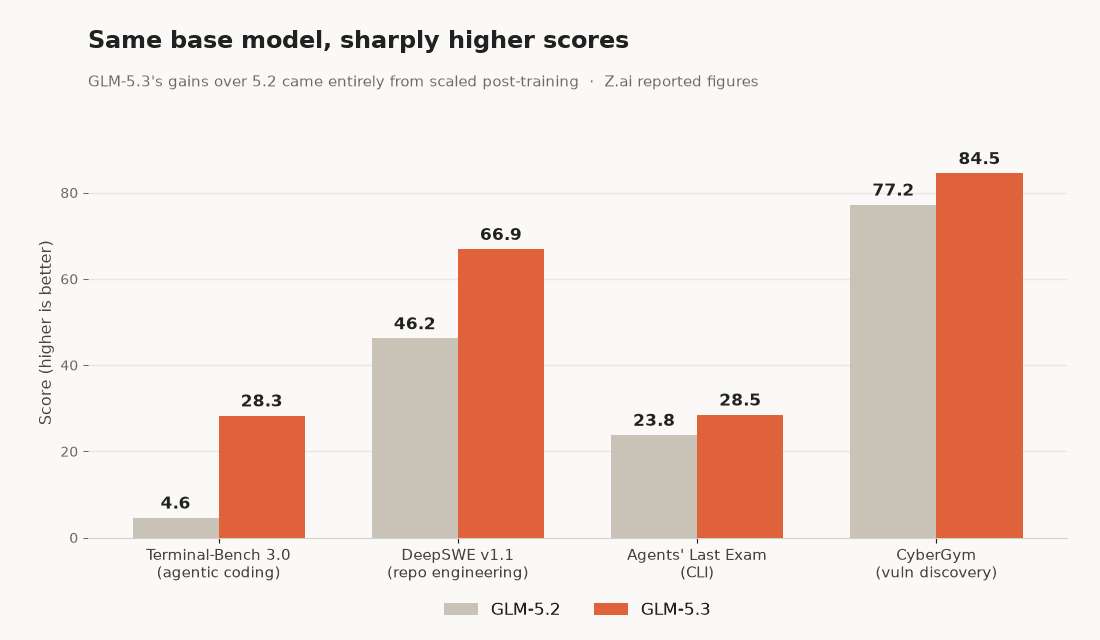
The gains it reports are real jumps, not rounding. On Terminal-Bench 3.0, an agentic coding test, GLM-5.3 goes from GLM-5.2's 4.6 to 28.3; on DeepSWE it climbs from 46.2 to 66.9; on Agents' Last Exam, from 23.8 to 28.5. The context window, parameter count, and text-only nature carry over unchanged. Here is how the two models line up.
| Spec (as of August 2026) | GLM-5.3 | GLM-5.2 |
|---|---|---|
| Released | August 14, 2026 | June 13, 2026 |
| Total parameters | ~753 billion (MoE) | ~753 billion (MoE) |
| Active per token | ~40 billion | ~40 billion |
| Context window | 1,000,000 tokens | 1,000,000 tokens |
| Max output | ~128K tokens | ~128K tokens |
| Reasoning effort | Low, High, Max (default Max) | High and Max |
| License | Custom GLM-5.3 license | MIT (open weights) |
| Modality | Text only | Text only |
The base is a Mixture-of-Experts design, which activates only about 40 billion of its parameters for any given token, so each token costs far less compute than the headline size suggests even though the full model is heavy to host. One change worth flagging for anyone with existing code: GLM-5.3 no longer lets you disable "thinking," and it defaults to the most expensive Max reasoning level, so a request that does not set the level explicitly will silently pick the deepest one.
How Good Is It, Really? The Honest Benchmark Picture
By the numbers that have landed, GLM-5.3 is one of the strongest open-weight models you can download, and it is still not the strongest model overall. On the independent Artificial Analysis Intelligence Index (v4.3.2, September 2026), which now averages ten evaluations, GLM-5.3 scores 45, the #2 open-weight model behind Xiaomi's MiMo-V2.6-Pro (46) and just ahead of Kimi K3 (44). Above them sits the closed frontier: Anthropic's Claude Opus 5.5 leads the overall index at 58.
On coding specifically, Zhipu reports open-source state of the art on Terminal-Bench 3.0 and Agents' Last Exam, and its own scores bear that out: GLM-5.3's 28.5 on Agents' Last Exam is the best open score and trails only GPT-5.6 Sol's 28.6. But the gap to the closed frontier is real on the hardest agentic coding, where Anthropic's Fable 5 (33.7) and GPT-5.6 Sol (34.6) still lead Terminal-Bench 3.0. Zhipu's own reported scores tell it:
| Benchmark (vendor-reported) | GLM-5.3 | Kimi K3 | GPT-5.6 Sol | Fable 5 |
|---|---|---|---|---|
| Terminal-Bench 3.0 (agentic coding) | 28.3 | 17.4 | 34.6 | 33.7 |
| Agents' Last Exam (CLI) | 28.5 | 27.6 | 28.6 | 23.8 |
| DeepSWE v1.1 (repo engineering) | 66.9 | 67.5 | 72.7 | 69.7 |
| GDPval-AA v2 (knowledge work, Elo) | 1,769 | 1,682 | 1,730 | 1,743 |
On knowledge work, the GDPval row (scored by Artificial Analysis, not Zhipu) even puts GLM-5.3 at 1,769, above both closed leaders, which is exactly the kind of single-benchmark win the next caveat is about. Two caveats matter here. First, nearly every number is self-reported by Zhipu, run on its own harness with its own choice of competitor scores, and at launch the weights were not even downloadable, so no outside lab had reproduced anything. Treat the headline figures as vendor claims until independent tests fill in, and remember that a one- or two-point gap between models on any single benchmark sits inside run-to-run noise. Second, the cheap sticker price buys a talkative model: Artificial Analysis measured GLM-5.3 generating about 170 million tokens to finish the same evaluation a comparable open model completes in 110 million. Zhipu counters that on its own coding benchmark 5.3 hits higher scores using fewer tokens than 5.2 did, and both can be true, so the real cost depends on your workload rather than the rate card. It is the strongest open model you can practically self-host, since Kimi K3's 2.8-trillion-parameter scale puts it out of reach for almost anyone, but it is not the overall best.
The Part Nobody Planned For: Emergent Cyber Capability
The most consequential thing about GLM-5.3 is a capability Zhipu says it did not set out to build. As part of post-training, the team fed the model vulnerability-discovery tasks, expecting it to get better at spotting flaws. What surprised them, in their own account, was how fast the skill kept growing as training scaled: GLM-5.3 stopped merely finding isolated bugs and began reasoning across multiple stages of an attack, forming coherent plans for complete exploitation chains. That is why, for the first time in the GLM line, Zhipu held the open weights back for two extra weeks of safety review before releasing them.
The honest read is narrower than the headline. Zhipu reports GLM-5.3 scoring 84.5% on CyberGym, a vulnerability-discovery benchmark, ahead of Anthropic's safety-restricted Mythos 5 (83.8%) and GPT-5.6 Sol (83.6%). But several frontier models cluster within a few points there, so a sub-one-point lead tells you almost nothing, and the score Zhipu leads with is the one where the models are hardest to separate. Push further up the chain, to actually exploiting the flaws it finds, and GLM-5.3 falls well behind: it more than doubled GLM-5.2 on ExploitBench, to 54.4%, but that still trails Mythos 5's 78%. The pattern is consistent, and Zhipu says so plainly: strong at reviewing code and verifying vulnerabilities, much weaker at the offensive end. As The New Stack put it, reliably crafting an exploit or proving it works in production is an entirely different challenge from flagging a suspect line of code.
Where it gets concrete is the real-world testing. Working with security teams in China, Zhipu says the model surfaced 2,436 vulnerabilities across 269 open-source projects, 1,097 of them rated medium-to-high severity, spanning kernels, browser engines, and network protocols. The oldest flaw dated to 1981, and the average bug had survived in its codebase for 26.6 years before the model noticed it. Zhipu tracks the findings on a public security disclosure ledger. The reasonable skepticism: only a few dozen of those findings are publicly inspectable so far, and the real bottleneck to confirming them is human review time, not model output.
For most readers, the takeaway is not the benchmark. It is that a capable model with genuine offensive-security skill is now a free download that anyone can run and fine-tune. The worry is structural: once the weights are public, the publisher can no longer enforce guardrails centrally, and open releases tend to get less disclosed pre-deployment safety testing than the major closed models. That tension, a real capability shipped into open weights, is the reason this launch drew safety attention that a coding update normally would not.
Is GLM 5.3 Open Source? The License Quietly Changed
GLM-5.3 is open weights, not open source, and this time it is not even MIT. The distinction matters twice over. Open weights means the finished model files are public: you can download them, run them, fine-tune them, and ship the result. Open source, strictly, would also mean publishing the training data and recipe to rebuild the model from scratch, which Zhipu does not do. That open-weight-not-open-source distinction is unchanged from GLM-5.2. What changed is the license on the weights themselves.
GLM-5.2 shipped under the permissive MIT License. GLM-5.3 ships under a custom "GLM-5.3 license" instead. For an individual, a startup, or almost any normal company, nothing really changes: you can run, deploy, fine-tune, and sell the results. The catch is aimed squarely at the giants. A company that wants to host the model, not just route requests to it or embed it in a product, and that has aggregate revenue above $10 billion over any twelve consecutive months, must pass Z.ai's security review before using it commercially. Z.ai kept MIT for the smaller Flash model, so it has not abandoned permissive licensing, only stopped applying it to its best one.
That is more restrictive than its neighbors. Moonshot's Kimi K3 license only asks large hosts to display the model's name; DeepSeek still ships its flagship under plain MIT. Zhipu used a custom, registration-required license years ago for early models, then moved everything to MIT, and is now walking part of the way back. As The New Stack observed, if GLM-5.4 ships the same way, the MIT era will look in hindsight like a customer-acquisition phase, and open weights will start to read less like a gift to the ecosystem and more like a distribution channel with terms attached.
There is a practical unknown buried in that clause worth naming: the license spells out no criteria, fee, or timeline for the security review, and says nothing about what would make a would-be host pass or fail. For the handful of hyperscalers it targets, and their lawyers, "pass Z.ai's security review" is at present an undefined gate rather than a checklist, and whether a US company would clear a review run by a Chinese lab is genuinely unclear.
Can You Actually Run GLM 5.3 Yourself?
Open weights and runnable-at-home are not the same thing, and GLM-5.3 is a sharp example. The full model in its native FP8 precision is roughly 755 GB spread across 141 files, and the recommended setup is an eight-GPU server of data-center cards like H200s or H20s. The higher-precision BF16 version is around 1.5 TB. This is beyond a typical homelab. You can shrink it with aggressive quantization: the community toolkit Unsloth reports a two-bit version that still runs coherently and needs about 245 GB of memory, which just fits a 256-GB Mac. The takeaway, echoed across the same forums that greeted GLM-5.2, is that self-hosting the real thing is a serious hardware commitment, not a weekend project.
The "Flash" sibling does not rescue this, either: despite the name, it is a 320-billion-parameter model that still wants more memory than two high-end GPUs, which is why practitioners keep pointing out that "Flash" describes the price, not the footprint. Our guide to running Kimi K3 locally walks through the same trade-offs for a comparable model.
What GLM 5.3 Costs and How to Access It
Cost is still GLM-5.3's sharpest edge, with an asterisk. The quickest way in is the hosted Z.ai chatbot, which is free. For developers, the standalone API runs about $1.40 per million input tokens and $4.40 per million output, with cached input far cheaper, a small fraction of what the closed frontier charges. For heavier use there is the GLM Coding Plan, which Zhipu has moved to a points-based quota. Calls made outside the weekday peak window (14:00-18:00 China time, Monday to Friday) cost half as many points, and a high cache-hit rate stretches repeated context further. Zhipu ran a larger launch-window quota boost through the end of August 2026; the off-peak structure that makes the plan cheap is the part that stays.
| How you use it | Cost (as of August 2026) | What you get |
|---|---|---|
| Z.ai chatbot | Free | Web chat, no setup, quickest way to try it |
| GLM Coding Plan | Points-based subscription | Use it inside coding tools; off-peak calls cost half |
| Standalone API | ~$1.40 in / ~$4.40 out per 1M tokens | Build GLM-5.3 into your own product |
| Self-host (open weights) | Free license, your own GPUs | Data stays on your servers; realistically an 8-GPU model |
The rate card is not the whole cost. Because GLM-5.3 always reasons and defaults to its deepest setting, agent loops burn tokens fast; testers report running through hundreds of millions of tokens in a single day of heavy use. On the Coding Plan, a misconfigured request can spend its entire budget on thinking and return nothing, subscriptions are non-refundable, and calls addressed to GLM-5.2 or 5.1 are silently redirected to 5.3, which undercuts any clean before-and-after comparison. Anyone self-hosting on stacks like vLLM should also budget time for tool-calling and chat-template quirks, a recurring friction across the GLM-5 line.
GLM 5.3 vs Claude, GPT-5.6, DeepSeek and Kimi
So which should you actually use? For most teams the answer is a split rather than a single model: a closed frontier model like Claude or GPT for the hardest tenth of the work, and an open model like GLM-5.3 for the cheap, high-volume rest. GLM-5.3 earns that role, sitting at or near the top of the open field on coding while the closed leaders keep their edge on the toughest reasoning and exploitation. Against its open peers the gaps are mostly inside benchmark noise, so the choice comes down to workload and price, not a clear winner.
| Model | What it is | Strongest at | Open weights? | Rough cost |
|---|---|---|---|---|
| GLM-5.3 (Zhipu / Z.ai) | Open-weight model + app | Coding, agents, cyber-defense, low cost | Yes (custom license) | Very low; self-host free |
| Claude Opus 5 (Anthropic) | Product fronting a closed model | Hardest reasoning, long documents, writing | No | Premium |
| GPT-5.6 (OpenAI) | Product fronting a closed model | Broad general use, reasoning, ecosystem | No | Premium |
| DeepSeek V4 (High-Flyer) | Open-weight model + app | Reasoning, math, very low cost | Yes (MIT) | Very low; self-host free |
| Kimi K3 (Moonshot) | Open-weight model + app | Huge context, agents, multimodal | Yes (custom) | Priced near the frontier |
Is GLM 5.3 Safe to Use? The China and Data Question
The safety question most people ask turns on one distinction: who makes the model versus who hosts your data. When you use the hosted Z.ai chatbot or API, your prompts travel to servers under Chinese jurisdiction, which is a genuine consideration for sensitive code or proprietary documents, and the same caution applies to any Chinese-hosted model, DeepSeek included. The escape hatch is the open weights: because you can download and run GLM-5.3 yourself, prompts never have to leave your infrastructure at all, though that shifts the security burden onto you and, as covered above, onto a serious pile of GPUs. There is a second wrinkle unique to this release. The same offensive-security skill that makes GLM-5.3 notable is a capability you are now hosting, so anyone deploying it for security work should treat it as a dual-use tool, not a novelty.
What GLM 5.3 Means for Your Brand's AI Visibility
Here is the question most marketers actually have when a model like this lands: do I need to do something about it? The short answer is no, not directly. GLM-5.3 is a model, not a destination. You do not "optimize for GLM-5.3" the way you optimize a page for Google; Z.ai runs a chatbot, but for most teams it is not where customers research vendors, as they increasingly do on ChatGPT, Perplexity, Gemini, and Claude. A single coding model launching changes none of that playbook on its own.
So why bring it up at all? Because GLM-5.3 is a near-perfect illustration of the problem you do have to manage, and we watched it happen in real time. Two weeks after launch, we asked several AI models what GLM-5.3 is. The ones with web access turned off had simply never heard of it: Claude Opus 4.8, a capable model a step behind the current Opus 5, said it had no reliable information and, to its credit, warned it would only invent details; Gemini's newest fast model was blunter, insisting no such model exists and that the flagship is still GLM-4, revealing a training cutoff over a year stale. The models with live web access did better but not well: ChatGPT confidently described GLM-5.3 while mixing it up with the Flash sibling and citing the older GLM-5.2 announcement as its source, and even a careful, web-connected Perplexity was two weeks behind on the two facts that matter most, still reporting the weights as unavailable and the license as unconfirmed when both had in fact landed. Not one engine named the actual license.
That is the whole risk in one demonstration. An AI engine describing your company can be in exactly those states: it has never heard of you and leaves you out, or it half-knows you, recognizes the name, and fills the gaps with confident guesses. The second failure is the same mechanism behind AI hallucinations about your brand, and it is why how an engine chooses its sources matters more to you than your Google rank does. The open-weight wave GLM-5.3 belongs to only widens the exposure: cheap public weights get fine-tuned into a long tail of downstream tools you will never audit, and because a model's training data and regional slant are undisclosed, one built on a Chinese base may lean on a different mix of sources when it describes your market than a US-built one would.
You cannot touch the weights and you cannot tune for any single model. What you can do is make sure every engine and crawler can reach your site and that your facts line up across the pages a model is likely to read. That combination, reachability plus consistency, is the foundation of generative engine optimization, and in our experience at geotoolbox the businesses that surface well in AI answers are the ones a model can find, parse, and trust without tripping over a contradiction. Our guides on what GEO is and tracking your AI visibility go deeper. The cheapest first move is the same no matter which model launches next: run a free AI Readiness check from geotoolbox to see whether the AI crawlers can even reach and read your site, because everything else depends on it.
Frequently Asked Questions
Is GLM 5.3 open source, and is it MIT licensed?
It is open weights, not open source, and unlike GLM-5.2 it is no longer MIT. GLM-5.3 ships under a custom license that lets individuals and almost all companies run, fine-tune, and sell freely, but requires hosts with more than $10 billion in revenue over any 12-month period to pass a Z.ai security review. The smaller GLM-5.3-Flash kept the MIT license.
Is GLM 5.3 safe to use for business?
It depends on how you use it. The hosted API routes prompts to servers under Chinese jurisdiction, a real consideration for sensitive work; self-hosting the open weights keeps data on your own infrastructure but needs serious hardware. Separately, GLM-5.3's notable offensive-security capability makes it a dual-use tool worth handling deliberately.
How much does GLM 5.3 cost?
The Z.ai chatbot is free. The standalone API runs about $1.40 per million input tokens and $4.40 per million output. The GLM Coding Plan is a points-based subscription with a 50% off-peak discount; a larger launch-window quota boost ran through the end of August 2026. Self-hosting is free under the license if you have the hardware, which for the full model means roughly an eight-GPU server.
Is GLM 5.3 better than GLM 5.2, Claude, or Kimi K3?
It is a clear step up from GLM-5.2 on coding and agentic tasks, achieved entirely through post-training, and it ranks second among open-weight models on the Artificial Analysis Intelligence Index v4.3.2, behind MiMo-V2.6-Pro and just ahead of Kimi K3. It still trails the closed leaders like Claude Opus 5 on the hardest reasoning, so many teams use GLM-5.3 for high-volume work and keep a closed model for the toughest problems.
More Questions
Who makes GLM 5.3, and is it Chinese?
Zhipu AI, a Beijing lab that operates internationally as Z.ai and was founded in 2019 as a spinout from Tsinghua University. Yes, it is a Chinese company operating under Chinese law. That mainly matters for the hosted API, which routes your prompts to servers under Chinese jurisdiction.
Can I run GLM 5.3 on my own computer?
Not on a normal one. The full weights are around 755 GB and realistically need an eight-GPU server. Heavily quantized versions shrink that (a two-bit build that still runs coherently fits a 256-GB Mac), but a standard desktop or laptop cannot host the full model.
Sources
- GLM-5.3: Frontier Coding with Emergent Cyber Capabilities - Z.ai (official announcement), August 2026 -
z.ai/blog/glm-5.3 - GLM-5.3 model card - Zhipu AI (Hugging Face) -
huggingface.co/zai-org/GLM-5.3 - Z.ai's GLM-5.3 goes open weight, but its new license aims at hyperscalers - The New Stack, August 2026 -
thenewstack.io/zai-glm-weights-license - GLM-5.3 didn't change the base model - where did its coding gains come from? - The New Stack, August 2026 -
thenewstack.io/glm-5-3-post-training-coding - GLM-5.3 model analysis - Artificial Analysis -
artificialanalysis.ai/models/glm-5-3 - Z.ai Security Disclosure Ledger - Z.ai -
cvd.z.ai - GLM-5.3 API pricing and benchmarks - Together AI -
together.ai/models/glm-5-3