
Chinese AI models went from a single viral release to a crowded, credible field in about eighteen months. If you are trying to make sense of DeepSeek, Qwen, GLM, Kimi, and the rest, the noise is the real obstacle: most coverage is either breathless or dismissive, and almost none of it is current, because the labs ship new versions every few weeks. This is a straight comparison of the major Chinese AI models as they stand in September 2026: who makes them, how good they actually are, whether they are safe to use, and what their rise means if you care about being found in AI answers.
The Major Chinese AI Models at a Glance
A year ago, "Chinese AI model" mostly meant DeepSeek. In September 2026 it means a crowded field of labs shipping frontier-grade models, most of them with downloadable open weights, and most of them far cheaper than the closed American systems. The US has since answered with its own open models, Thinking Machines' Inkling and Meta's Apache-licensed Muse Glimmer, but the field below is the one they are chasing. Here is the current lineup, with the version that is actually live as of this writing.
| Model (Sept 2026) | Lab | Open weights? | Context | Best at | Rough API price (input / 1M) |
|---|---|---|---|---|---|
| DeepSeek V4 | DeepSeek (Hangzhou) | Yes | ~1M | Cheap reasoning and coding | ~$0.22 off-peak (Flash) |
| Qwen3.8-Max | Alibaba | Smaller models yes; flagship weights published Aug 12, 2026 (text-only, bespoke license) | 1M | Multilingual, agents, multimodal | $2 |
| GLM-5.3 | Zhipu / Z.ai (Beijing) | Yes | ~1M | Coding and agent work | ~$1.40 |
| Kimi K3 | Moonshot AI | Yes | 1M | Frontier scale, agent swarms | $3 |
| MiniMax M3 | MiniMax | Yes | ~1M | Long context at low cost | ~$0.40 |
| Hunyuan Hy4 Preview | Tencent | Yes | 1M | Long-context agent work, fully permissive license | ~$0.83 |
| Ernie 5.1 | Baidu | Ernie 4.5 family yes | ~128K | Search-grounded, efficient | ~$0.55 |
| Doubao Seed 2.1 Pro | ByteDance | No | ~256K | High-volume production | ~$0.83 |
Prices move almost weekly and depend on tier, so treat them as orders of magnitude rather than quotes. The pattern that holds: the strongest Chinese models cost a fraction of GPT-5 or Claude Opus, and most of them you can download and run yourself.
DeepSeek, Qwen, GLM, and Kimi: The Big Four
Four labs do most of the heavy lifting in this conversation. They are the ones whose names show up in AI Overviews, the ones Western startups quietly build on, and the ones you are actually choosing between when you ask which Chinese model to use.
DeepSeek (V4): The Cost Disruptor
DeepSeek is the lab that started the panic. Its R1 reasoning model in January 2025 matched American frontier systems at a tiny fraction of the cost, became the most-downloaded free app in the US App Store within days, and helped wipe roughly a trillion dollars off US tech stocks in the late-January 2025 selloff. The lab sits in Hangzhou and is funded by the quantitative hedge fund High-Flyer, which is part of why it optimizes so aggressively for cost. Our DeepSeek pricing guide has the current V4 Flash and Pro rates in full.
DeepSeek's current flagship is V4, which TechCrunch reported was previewed in late April 2026, built on the same mixture-of-experts efficiency the lab is known for; its flagship V4-Pro reached general availability on August 13, 2026. It is genuinely good at reasoning and agentic coding, and on price it is close to unbeatable: the Flash tier starts around twenty-two cents per million input tokens off-peak, where Western frontier models charge dollars. On August 16, 2026, DeepSeek replaced its old flat all-day rate with a peak/off-peak split that doubles the price during seven hours a day (peak hours 01:00-04:00 and 06:00-10:00 UTC), but even at peak it stays a fraction of Western pricing. If your question is "which Chinese model gets me the most capability per dollar," DeepSeek is usually the answer, and it is where most DeepSeek-versus-Qwen comparisons land on cost alone.
Alibaba Qwen (Qwen3.8-Max): The Default Base Model
If DeepSeek grabbed the headlines, Qwen quietly became the foundation. Alibaba's Qwen family is the most-downloaded open model line in the world: MIT Technology Review reports it accounted for more than 30 percent of all Hugging Face model downloads in 2024, and by August 2025 Qwen derivatives made up over 40 percent of new language-model variants on Hugging Face, versus about 15 percent for Meta's Llama. Alibaba ships new Qwen models at a relentless pace, several a month.
The practical takeaway is that when a developer anywhere fine-tunes "an open model," it is very often a Qwen underneath. The smaller and mid-size Qwen models ship with open weights under permissive licenses, which is what makes them the default starting point. The catch: Alibaba long treated its very largest models as a closed API rather than an open download, and only partly reversed that in August 2026. Qwen's strengths are breadth: strong multilingual coverage, agentic tool use, and a one-million-token context window. The current flagship, Qwen3.8-Max, was released on August 3, 2026 at 2.4 trillion parameters with 95 billion active, priced at $2 per million input tokens and $6 per million output. Alibaba published its weights on August 12, 2026, the first open Max-tier Qwen, though as a text-only variant under a bespoke "Qwen3.8-Max" license rather than Apache 2.0.
Zhipu GLM (GLM-5.3): The Frontier Challenger
Zhipu's GLM line closed the gap, and its current flagship GLM-5.3 launched August 14, 2026. It comes from Zhipu AI, a Beijing lab spun out of Tsinghua University that operates internationally as Z.ai, and it launched on August 14, 2026 with a one-million-token context window, keeping the same 753B/40B base as GLM-5.2 (all the gains come from post-training). Unlike GLM-5.2's clean MIT terms, GLM-5.3 ships under a custom license: hosts with more than $10B in revenue over any 12-month period must pass a Z.ai security review. On the Artificial Analysis Intelligence Index v4.2 it scores 49, just behind Kimi K3's 50 at the top of the open-weight field, and Reuters reported Z.ai rivals the closed frontier models from OpenAI and Anthropic on coding and agent tasks at a fraction of the cost. Z.ai went public in Hong Kong in January 2026, and investors treated its decision to give the weights away as a strategic win rather than a loss.
What sets GLM apart from DeepSeek is focus. Where DeepSeek optimizes for raw cost, GLM-5.3 is tuned for long-horizon software engineering: full-codebase debugging, autonomous self-correction, and the kind of multi-step agent runs that fall apart on weaker models. If your work is serious coding or agent orchestration and you want open weights, this is the current pick.
Moonshot Kimi (K3 and K2.7-Code): The Agent Specialist
Kimi, from Moonshot AI, is built for agents that run for hours, and its current lineup splits the job by cost. Kimi K3 is the flagship: launched July 16, 2026 at 2.8 trillion parameters with a one-million-token context window, with open weights published July 27, 2026 under a bespoke Kimi K3 License. K2.7-Code, a coding-specialized variant Moonshot shipped in mid-June 2026, is the everyday workhorse most teams should default to: it still ships open weights under the K2 line's modified MIT license and the same agent-swarm orchestration Moonshot is known for, coordinating many sub-agents across long background tasks rather than answering one prompt at a time. An earlier Kimi release landed at roughly one-seventh the price of Claude Opus and quickly became a heavily used model on agent platforms. K3's output price ($15 per million tokens) runs 3.75 times K2.7-Code's ($4), so the practical split is K2.7-Code for routine coding and agent work and K3 for the sessions that specifically need the extra scale, reasoning, or the full context window; our Kimi K3 vs Claude comparison weighs K3 against the Claude lineup task by task. The prior-generation K2.6 is still live on the API at the same $0.95/$4.00 rate as K2.7-Code, but Moonshot's own retirement of the older K2.5 line on August 31, 2026 is a sign of where that generation is headed next. On the consumer side Moonshot sells five subscription tiers metered in credits rather than messages, which we break down in our Kimi pricing guide.
In a head-to-head, comparing Kimi with DeepSeek, or Qwen with Kimi, usually comes down to job shape. DeepSeek is the cheapest generalist, Qwen is the most adaptable base, GLM is the coding frontier, and Kimi is the one you reach for when an agent needs to keep its footing across a very long, multi-step run.
The Next Tier: MiniMax, Tencent Hunyuan, Baidu Ernie, and ByteDance Doubao
Four more labs round out the field and show up constantly in any serious comparison.
MiniMax shipped M3 on June 1, 2026 with open weights. Its hook is architectural: a sparse-attention design that handles a one-million-token context window at far lower compute cost than a standard transformer, which lets it stay cheap while going long. It went public in Hong Kong the same week as Z.ai.
Tencent Hunyuan is the field's quiet permissive-license play. Its current flagship, Hy4 Preview, shipped open weights on August 28, 2026 at 770 billion total parameters (49 billion active) with a one-million-token context window, and unlike GLM-5.3 or Kimi K3, whose flagships both carry custom licenses with revenue or usage conditions, it ships under a plain Apache 2.0 license. On Tencent's own blind-eval benchmark it edges out GLM-5.3 and Kimi K3. Its predecessor, the full Hy3 released July 6, 2026 (also Apache 2.0, not to be confused with the more restrictive April Hy3-Preview), reportedly ranked third by raw token volume on OpenRouter the week of July 27-August 2, 2026, ahead of GLM-5.2 and behind only Xiaomi's MiMo-V2.5 and DeepSeek V4 Flash. Hy3 remains available at roughly a fifth to a fifth-and-a-half of Hy4's price for teams that do not need the newer model's scale.
Baidu Ernie is the veteran. Its current flagship, Ernie 5.1, launched in spring 2026 and reached the top of the Chinese field on the LMArena preference leaderboard while training on a fraction of the usual compute. The genuinely open piece is the older Ernie 4.5 family, which Baidu released under an Apache 2.0 license as a range of mixture-of-experts models you can download and run. Ernie's edge is tight search grounding, which fits Baidu's search-engine roots.
ByteDance Doubao is the odd one out: it is closed. The Doubao Seed 2.1 Pro line is served only through ByteDance's Volcano Engine cloud, and it is built for raw scale, with the family handling well over a hundred trillion token calls a day across ByteDance's apps. It is cheap and reliable for high-volume production, but you cannot download it, and the ByteDance name carries the same political baggage TikTok does in the US.
One scope note before going further: this guide is about text and chat models, the ones you reason, write, and code with. The other place Chinese labs are winning is generative media, where they arguably lead the world. Kuaishou's Kling, MiniMax's Hailuo, ByteDance's Seedance, and Alibaba's Wan top most video-generation rankings. Tencent's Hunyuan brand spans both worlds, it ships the Hy text models covered above and a separate video-generation line, so do not confuse the two when you see "Hunyuan" in a ranking. If your interest is AI video or image generation rather than chat, that is a different shortlist than the one here.
Open Weights vs Open Source: What "Open" Really Means
Almost every article on this topic calls these models "open source," and almost every one is being loose with the term. The distinction matters enough to get right, because it changes what you are actually allowed to do.
Most Chinese models are open weights, not open source. The lab publishes the trained model file so you can download, run, and fine-tune it, but it does not publish the training data or the full training code. So you can use the model freely, but you cannot fully reproduce or audit how it was built. A genuinely open-source AI model would release all three; an open-weights model releases only the weights. It is the difference between being handed a working engine and being handed the engine plus the factory blueprints. For the model-by-model license breakdown, see our guide to open weights vs open source.
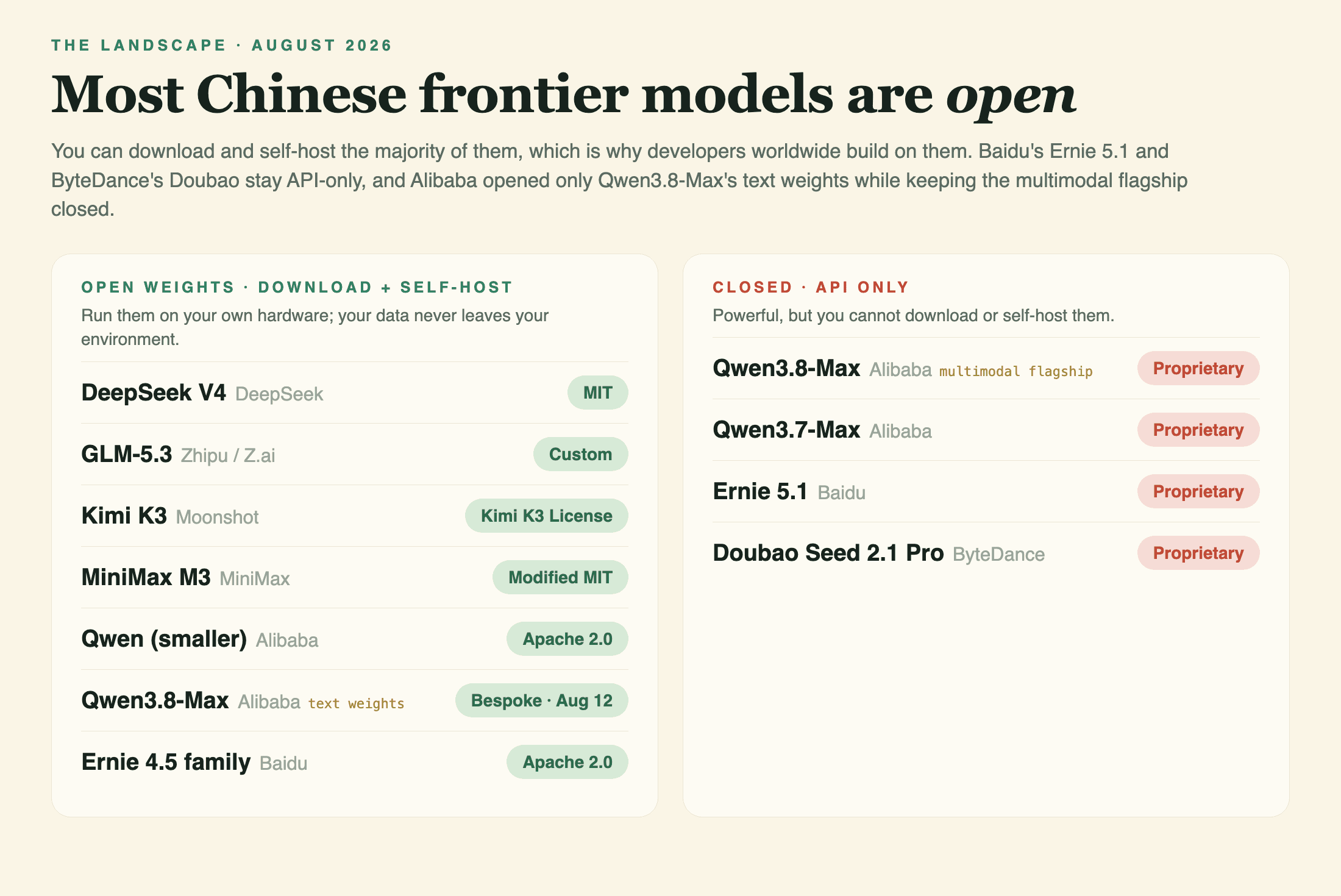
"Open" also does not automatically mean "free for any use." The license attached to the weights decides that, and the licenses vary.
| Model | License | Commercial use | Self-host | What is not released |
|---|---|---|---|---|
| DeepSeek V4 | MIT | Yes | Yes | Training data and code |
| GLM-5.3 | Custom | Yes | Yes | Training data and code |
| Kimi K3 | Kimi K3 License | Yes, with conditions | Yes | Training data and code |
| MiniMax M3 | MiniMax Community License | Yes, with conditions | Yes | Training data and code |
| Hunyuan Hy4 Preview | Apache 2.0 | Yes | Yes | Training data and code |
| Qwen (smaller models) | Apache 2.0 | Yes | Yes | Multimodal flagship weights, training data |
| Ernie 4.5 family | Apache 2.0 | Yes | Yes | Ernie 5.x weights, training data |
| Doubao Seed 2.1 | Proprietary | API only | No | The weights themselves |
The surprise for many people is that the permissive ones are genuinely permissive. MIT and Apache 2.0 are about as open as licenses get, with no user-count caps. That makes DeepSeek, Hunyuan Hy4 Preview, and the open Qwen and Ernie models legally easier to build a commercial product on than Meta's Llama 4, whose license adds a large-user restriction (Meta's smaller, newer Muse Glimmer flips that: it shipped in August 2026 under plain Apache 2.0 with no such cap). GLM is a partial exception now: GLM-5.3's flagship weights carry a custom license with their own revenue-threshold review, closer in spirit to Llama's restriction than to MIT, though the smaller GLM-5.3-Flash kept MIT. The thing to watch is not the openness of the small models but the trend at the top: Baidu's Ernie 5.1 and all of Doubao stay closed, and Alibaba opened only a text-only version of Qwen3.8-Max in August, keeping the multimodal flagship API-only.
Are Chinese AI Models Safe? Privacy, Censorship, and Bans
This is the question that actually stops people, and it deserves a straight answer. There are three real concerns, and for each one the answer depends heavily on how you use the model.
The first is data privacy. When you use a hosted Chinese AI app or its native cloud API, your prompts are processed on servers in China, and China's 2017 National Intelligence Law can compel companies to hand data to the state. That is a genuine problem for regulated work, and it is why many employers already restrict the consumer DeepSeek and Qwen apps. The key distinction is hosting: that risk attaches to the hosted service, not to the open weights. Download the weights and run them on your own hardware or a Western cloud, and your data never leaves your environment. Same model, different data path.
The second is censorship. Hosted Chinese assistants refuse or deflect on politically sensitive topics like Tiananmen, Taiwan, and the Uyghurs, and a September 2025 report from the US government's AI safety body, covered by NBC News, found DeepSeek models showed weakened safety protocols and a measurable lean toward pro-Chinese framing compared with US models. For most marketing or coding work this never comes up, but if you are generating content where political neutrality matters, test for it. Self-hosting an open-weight version reduces but does not fully remove the bias baked in during training.
The third is bans. US federal agencies and several states restrict DeepSeek on government devices, and a few allied countries have moved against the hosted apps. These bans almost always target the hosted service on official devices, not the underlying open weights running in a private deployment. So "is DeepSeek banned" depends entirely on who and where you are.
Restriction is not a one-way street, either. In June 2026 the US itself briefly made Anthropic pull its top Claude models offline (Fable 5 and Mythos 5) to comply with an order restricting foreign access, a restriction lifted on July 1, 2026, but one that, while it lasted, pushed developers in other countries toward exactly these Chinese open-weight models. CrowdStrike has reported that DeepSeek-R1 emits up to 50 percent more insecure code when prompts include politically sensitive triggers, which most analysts read as a training side effect rather than deliberate sabotage. Review the output, and keep these models away from government or safety-critical systems, the same as you would any model you cannot fully audit.
How They Compare to ChatGPT, Claude, and Gemini
Chinese models have closed most of the gap on most tasks, while a real gap remains at the very top. On public benchmarks for coding, math, and reasoning, the best Chinese models now trade blows with GPT-5-class systems, Claude, and Gemini. On cost the gap is wide: the Chinese options routinely run a fraction of the price, DeepSeek's twenty-two cents against dollars for the Western flagships, which is the single biggest reason Western developers reach for them. OpenAI shipped GPT-6 Astra on September 3, 2026, which OpenAI says beats GPT-5.6 Sol and matches or trails Anthropic's Claude Fable 5.1 depending on the benchmark, so the closed frontier kept moving, not standing still, even as the open Chinese field keeps catching up on everything below it.
Two cautions matter. First, a lot of "beats GPT-5" framing comes from the labs themselves, and independent observers still credit US labs with a lead at the frontier, describing the Chinese players as fast, well-funded fast-followers, even as they have drawn level on specific axes like coding and agent benchmarks. Second, benchmarks are easy to over-read. Many leaderboards have thin English-language coverage, and there are ongoing questions about test contamination, so a single eye-catching score is weaker evidence than a consistent pattern across independent evaluations. It is also worth remembering that these labs still train largely on Nvidia hardware and US cloud infrastructure, so "independent Chinese AI" is a simplification.
For practical work, the split is clean. If you want maximum capability and have the budget, the top closed American models still have an edge on the hardest tasks and the smoothest tooling. If you want most of that capability at a tenth of the cost, or you need to run a model in your own environment, the Chinese open models are now a serious answer rather than a curiosity. If you are weighing one against a specific Western system, our Gemini vs ChatGPT comparison lays out the same framework for the closed side.
What the Rise of Chinese AI Means for Your Visibility
Here is the part the benchmark roundups skip, and it is the one that matters if your job is marketing rather than machine learning. Chinese open models are no longer a niche. They grew from essentially zero to around 30 percent of usage on OpenRouter, a major model-routing service, in little over a year, and roughly 80 percent of startups building on open-source stacks now run on them. MIT Technology Review's framing is the right one: these models have become infrastructure for global AI builders. Microsoft, for one, added DeepSeek's R1 to its Azure AI Foundry catalog within days of the model's release.
That changes the visibility picture in two ways. The first is that a growing share of the agents and applications reading your site are powered by these models, so how AI search works increasingly runs through Chinese model weights even on Western products. The second is that the big Chinese assistants, DeepSeek, Kimi, Doubao, Ernie, and Qwen's Tongyi, are their own answer engines with hundreds of millions of users, and almost nobody in Western marketing is thinking about whether they appear there.
In our experience at geotoolbox, the brands that stay visible as the model field splinters are the ones that treat AI reachability and citation as a first-class channel rather than an afterthought. Our AI Crawler Checker covers 34 crawler user-agents, including ByteDance's, so you can at least see which AI systems your robots.txt currently lets in. The open question nobody has answered well yet, ourselves included, is how consistently these Chinese engines cite and link back to the Western sources they draw on, which is exactly the kind of gap worth watching rather than guessing about.
Which Chinese AI Model Should You Use?
There is no single winner, because the right pick depends on the job. Here is the short version. For the global field including Llama, Gemma, and gpt-oss, our best open-source LLMs ranking covers all ten.
| If you want to... | Pick | Why |
|---|---|---|
| Pay as little as possible per token | DeepSeek V4 | Frontier-level output at the lowest price |
| Do serious coding and agent work, open | GLM-5.3 | Tops the Chinese field on coding and long agent runs |
| Run long, multi-step agent jobs | Kimi K2.7-Code (K3 for the hardest sessions) | Built for long context and agent-swarm orchestration; K3 adds scale at 3.75x the output price |
| Fine-tune your own model | Qwen (open sizes) | The most-adopted, best-supported open base |
| Run locally on modest hardware | A small Qwen or DeepSeek | Smaller open variants fit consumer GPUs |
| Avoid China-hosted data entirely | Any open model, self-hosted | Open weights on your infrastructure keep data local |
A practical note on access: you rarely need a Chinese account to use these. The open models are on Hugging Face, and Western-friendly gateways like OpenRouter let you call most of them through one API without touching a native cloud. That avoids a Chinese account and cloud while keeping the price advantage, though a gateway still routes your prompt through a third party, so check its retention terms if data residency matters.
So "which Chinese AI model is best" is the wrong question. The field is good enough now that the better question is which one fits your specific job, budget, and risk tolerance, and the table above is where to start.
The Models Will Keep Changing. Your Visibility Strategy Shouldn't Have To
The specific version numbers in this guide will be stale within months, because that is the pace these labs ship at. What will not change as fast is the underlying shift: capable AI is getting cheaper, more open, and more fragmented across providers, and a rising share of it now runs on Chinese weights.
For anyone whose livelihood depends on being found, that fragmentation is the real story. When a dozen engines, Western and Chinese, can all answer a buyer's question, the brands that win are the ones cited across them, not the ones optimized for a single search box. That is the problem geotoolbox is built for: our Citation Interceptor tracks where you appear, and where you are missing, across ChatGPT, Perplexity, Gemini, Claude, Google AI Overviews, Bing Copilot, and Grok, so you can fix the gaps instead of guessing at them. Start with the engines that already send you buyers, and keep one eye on the Chinese ones coming up fast behind them.
Frequently Asked Questions
What is the best Chinese AI model right now?
There is no single best one. On independent coding and agent leaderboards GLM-5.3 leads the Chinese field, DeepSeek V4 wins on price, Qwen is the most-adopted open base, and Kimi is strongest for long agent runs, K2.7-Code for routine work and K3 when a session specifically needs the extra scale. The right pick depends on whether you care most about cost, coding, fine-tuning, or agent work.
Is DeepSeek banned in the US?
Not for the general public. US federal agencies and several states ban the DeepSeek app on government devices over data-security concerns, and a few other countries have restricted the hosted app. Those bans target the China-hosted service, not the open-weight model, which anyone can still download and run privately.
Are Chinese AI models safe to use, and does my data go to China?
If you use the hosted apps or native cloud APIs, your prompts are processed in China and can be subject to Chinese data laws, which is a real concern for sensitive work. If you self-host the open weights on your own hardware or a Western cloud, your data never reaches China. A gateway like OpenRouter avoids a Chinese account and cloud, though your prompt still passes through a third party, so check its routing and retention terms.
What is the difference between open-weight and open-source?
Open-weight means the lab publishes the trained model so you can download, run, and fine-tune it. Open-source would also include the training data and code needed to rebuild it from scratch. Most of the leading Chinese models, like DeepSeek and GLM, are open-weight but not fully open-source, so you can use them freely without being able to fully audit how they were made.
Can I run Chinese AI models locally or offline?
Yes, for the open-weight ones. Smaller DeepSeek, Qwen, and GLM variants, around 7 to 14 billion parameters and quantized, run on a single 8 to 16 GB consumer GPU through tools like Ollama. The trillion-parameter flagships need multi-GPU or datacenter hardware, though even that ceiling is starting to move: a July 2026 proof-of-concept called Colibri ran GLM-5.2, natively a 1.5 TB model, on a 25 GB consumer machine by streaming its experts from disk, but at roughly 0.05 to 0.1 tokens per second (one token every ten to twenty seconds) it is a glimpse of where local inference is heading, not a daily driver yet. Running locally is the cleanest way to remove the hosted data-residency risk, though training-time bias or refusal behavior can still surface.
Which Chinese AI models do ChatGPT, Gemini, and Perplexity cite?
That is a different question from which models are good. Western answer engines cite sources based on their own retrieval, not on which model a lab built, so being mentioned by ChatGPT or Gemini is about your content earning the citation. The newer wrinkle is that Chinese assistants like DeepSeek and Kimi are their own answer engines, and how they cite Western sources is still an open and largely unmeasured question.
Sources
- DeepSeek previews new AI model that closes the gap with frontier models - TechCrunch -
techcrunch.com/2026/04/24/deepseek-previews-new-ai-model-that-closes-the-gap-with-frontier-models - What's next for Chinese open-source AI - MIT Technology Review -
technologyreview.com/2026/02/12/1132811/whats-next-for-chinese-open-source-ai - More of Silicon Valley is building on free Chinese AI - NBC News -
nbcnews.com/tech/innovation/silicon-valley-building-free-chinese-ai-rcna242430 - After Anthropic shutdown, China's Z.ai closes frontier gap - Reuters -
reuters.com/world/asia-pacific/after-anthropic-shutdown-chinas-zai-closes-frontier-gap-it-plans-dual-listing-2026-06-25 - Hidden vulnerabilities in AI-coded software - CrowdStrike -
crowdstrike.com/en-us/blog/crowdstrike-researchers-identify-hidden-vulnerabilities-ai-coded-software - DeepSeek R1 is now available on Azure AI Foundry - Microsoft Azure -
azure.microsoft.com/en-us/blog/deepseek-r1-is-now-available-on-azure-ai-foundry-and-github - Artificial intelligence industry in China - Wikipedia -
en.wikipedia.org/wiki/Artificial_intelligence_industry_in_China - DeepSeek API documentation - DeepSeek -
api-docs.deepseek.com - Open models on Hugging Face - Hugging Face -
huggingface.co/models - Colibri proof-of-concept runs GLM-5.2's 1.5-TB model on 25GB of RAM - Tom's Hardware, July 2026 -
tomshardware.com/tech-industry/artificial-intelligence/colibri-proof-of-concept-gains-frontier-level-1-5-tb-ai-model-novel-approach-runs-on-only-25gb-of-ram-and-shows-promise-for-local-ai-setups - OpenAI announces rollout of GPT-6 Astra model - CNBC, September 3, 2026 -
cnbc.com/2026/09/03/open-ai-astra-gpt-6-cyber.html - Tencent open-sources Hy4 preview with 770B parameters and a 1M-token context - TechNode, August 28, 2026 -
technode.com/2026/08/28/tencent-open-sources-hy4-preview-with-770b-parameters-and-a-1m-token-context - Meta returns to open source with Muse Glimmer, an Apache 2.0 licensed 30B parameter AI model - VentureBeat, August 10, 2026 -
venturebeat.com/technology/meta-returns-to-open-source-with-muse-glimmer-an-apache-2-0-licensed-30b-parameter-ai-model-optimized-for-agents-available-now