
Meta AI is the assistant that showed up uninvited in your WhatsApp, your Instagram search bar, and that blue-and-pink circle you keep tapping by accident. It answers questions, makes images, and talks back through Ray-Ban glasses, and more than a billion people use it every month, most of them without ever choosing to. If you want the plain version of what Meta AI actually is, what powers it now, where it lives, and whether you can trust it, this is it, current as of September 2026.
Most "what is Meta AI" articles tell you it runs on Llama. As of 2026, that is out of date, and the gap matters. In April 2026 Meta quietly moved its flagship assistant onto a brand-new proprietary model called Muse Spark, its first model built outside the open Llama line. We will cover what Meta AI is, the switch from Llama to Muse, everywhere it runs, how it compares to ChatGPT and Gemini, the privacy questions worth asking, and one thing almost no marketer is tracking: whether your own site shows up when Meta AI answers.
What Is Meta AI?
Meta AI is the free artificial intelligence assistant built by Meta, the company behind Facebook, Instagram, WhatsApp, and Messenger. It is a general-purpose chatbot in the same category as ChatGPT, Google Gemini, and Claude: you ask it questions in plain language and it answers, writes and edits text, generates and edits images, holds voice conversations, and can search the web for current information. What makes it different is not the technology but the distribution. Instead of asking you to visit a separate site, Meta built the assistant directly into apps that billions of people already open every day.
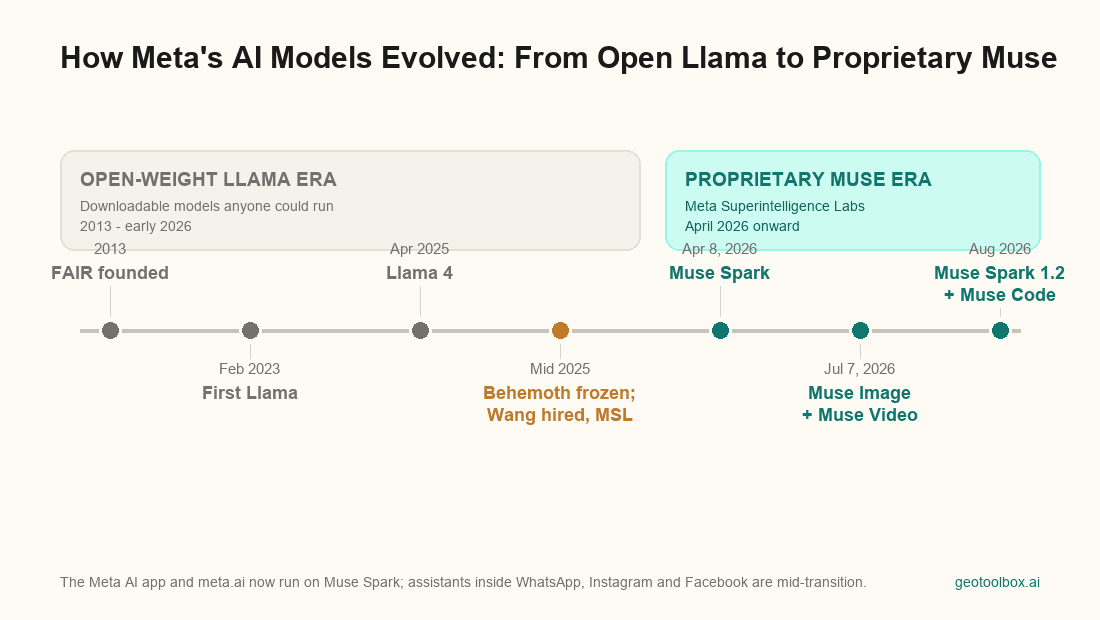
One naming point trips people up. The label "Meta AI" gets used for more than one thing. It is the name of the consumer assistant this article is about, and it is also the older name for Meta's research division, formerly Facebook AI Research (FAIR), founded in 2013, which builds the underlying models. When Wikipedia says "Meta AI is a research division," it means the lab. When the blue circle in WhatsApp says "Meta AI," it means the assistant. This article is about the assistant, and the large language model that runs it.
The assistant is genuinely free. There is no subscription to chat with it, generate images, or use it in the apps. You pay in a different currency, which is your data, and we will get to exactly how in the privacy section below.
Which Model Powers Meta AI? From Llama to Muse Spark
Meta AI used to run on Llama, Meta's family of open-weight models. As of April 2026, the flagship Meta AI app and the meta.ai website run on Muse Spark, a new proprietary model, and this is the single most out-of-date fact in most explainers. If you have read that "Meta AI is powered by Llama 4," that was true through early 2026 and is no longer the whole story.
Here is what happened, and the "why" explains the whole shift. For years Meta's strategy was open source: it released Llama 2, Llama 3, and Llama 4 as downloadable models anyone could run, which made Llama one of the most-used open model lines in the world. Then Llama 4 stumbled. According to CNBC's reporting, the largest planned model, Llama 4 Behemoth, was delayed through 2025 and then frozen, and the disappointment triggered a leadership shake-up. Meta paid roughly $14.3 billion for a 49% stake in Scale AI and hired its chief executive, Alexandr Wang, as Meta's Chief AI Officer to run a new group called Meta Superintelligence Labs, with Shengjia Zhao as chief scientist.
The first product of that group was Muse Spark, released April 8, 2026. Meta describes it as a natively multimodal reasoning model with tool use and multi-agent capabilities, and says it matches its previous model, Llama 4 Maverick, while using over an order of magnitude less compute. Reporters framed the launch as "goodbye Llama," but Meta itself is more careful: its announcement says Muse Spark is "available today at meta.ai and the Meta AI app," and does not claim it has replaced Llama across WhatsApp, Instagram, and Facebook, where the embedded assistants have historically run on Llama. So the accurate statement in 2026 is narrower than the headlines: the standalone Meta AI app and meta.ai run on Muse Spark, while the assistant inside the social apps is mid-transition. Muse Spark is also the anchor of a wider family of models Meta shipped through 2026.
| Model | Released | What it does |
|---|---|---|
| Muse Spark | April 8, 2026 | The reasoning model that powers the Meta AI app and meta.ai; multimodal, tool use, agentic tasks |
| Muse Image + Muse Video | July 7, 2026 | Meta Superintelligence Labs' first media-generation models; Muse Image launched in the Meta AI app and on meta.ai, plus Instagram Stories in the US and WhatsApp in limited countries; Muse Video shipped as a preview |
| Muse Spark 1.2 + Muse Code | Early August 2026 | Muse Spark 1.2, a coding-focused model (an update to Muse Spark 1.1), powering Muse Code, a terminal-based coding agent (beta), and the Meta Model API |
| Muse Spark 1.3 | September 2, 2026 | Meta's most capable model to date; needs roughly 20% fewer tool calls and 25% fewer tokens than 1.2 on comparable tasks; available today in Muse Code and the Meta Model API, and powers the new Muse agent app below |
| Llama 4 (Scout, Maverick) | April 2025 | The prior open-weight line; still available to developers and still powering some in-app assistants |
One nuance keeps the "Meta went closed" reading honest: on August 10, 2026 Meta released Muse Glimmer, a 30-billion-parameter multimodal model with open weights under an Apache 2.0 license on Hugging Face, meant for local and on-device use. So Meta now runs two tracks in parallel: a closed frontier model (Muse Spark) and open weights anyone can run themselves (Glimmer).
Muse Is Not Meta AI: Meta's New Personal Agent App
On September 8, 2026, Meta launched a separate product also called Muse: a personal AI agent app for iOS, Android, the web at muse.ai, and directly inside WhatsApp (AI glasses support is coming later), rolling out in the US only. It is not the Meta AI assistant this article covers; it is a distinct product built to act on your behalf (sending emails, booking travel, working toward longer-term goals) from a dedicated secure virtual machine with its own browser, rather than just answering chat messages.
The Muse app is described by Meta as running on Muse Spark, its most capable model to date (1.3, released 6 days earlier, was the current version at launch). Pricing has three tiers, per Meta's own help center: free with weekly usage caps, Power at $20/month, and Maximum at $100/month.
The naming collision is real and worth flagging if you are searching "Meta AI vs Muse": Meta AI is the free assistant embedded in WhatsApp, Instagram, and the rest of Meta's apps; Muse is a separate, partly-paid agent app that does tasks rather than just answering questions, and can also be reached inside WhatsApp, which is exactly where the confusion starts. Both now run on members of the Muse Spark model family.
Where You Can Use Meta AI
Meta AI's whole strategy is to be everywhere you already are, which is why it seems to appear on your phone without your permission. You do not download Meta AI so much as find it waiting inside apps you installed for other reasons. That is also the answer to the most common question about it, which is "why did this show up on my phone?" It showed up because Meta added it to the app, not because you did anything.
You can reach the assistant on the web, in its own app, inside Meta's social apps, and on its hardware. On the web there is meta.ai, which works in any desktop or mobile browser, alongside the standalone Meta AI app for iOS and Android; these are the surfaces now running on Muse Spark. It is built into WhatsApp (the blue-and-pink circle), Instagram (the search bar and direct messages), Facebook, and Messenger. And it reaches hardware through the Ray-Ban Meta smart glasses, where you talk to it out loud and it can describe what the camera sees. The experience varies by surface: the app and website get the newest features first, the in-app versions are more limited, and availability differs by country.
Meta AI vs ChatGPT vs Gemini: Is It Any Good?
Meta AI is good enough for everyday questions and casual image generation, and its real advantage is convenience rather than raw capability. Because it is already inside the apps you use, it wins on friction: you never have to open anything new. On hard reasoning, long research tasks, and coding, the more focused assistants tend to lead, and Meta says so itself. Its own Muse Spark announcement lists long-horizon agentic systems and coding workflows as areas with current performance gaps. Users also report the two rough edges you would expect from a free, mass-market assistant: it can state wrong facts confidently, and its tone runs noticeably chummier than its rivals.
| Assistant | Underlying model | Best for | Cost | Watch for |
|---|---|---|---|---|
| Meta AI | Muse Spark (app + meta.ai) | Quick answers and images inside apps you already use | Free | Confident errors; data used for ads |
| ChatGPT | GPT-5.x | Reasoning, writing, coding, deep research | Free tier + paid | Paid tiers for best models |
| Gemini | Gemini 3.x | Google-ecosystem tasks, long context, multimodal | Free tier + paid | Tied to Google account and services |
So is Meta AI better than ChatGPT? For most people, the honest answer is that it is the most convenient, not the most capable. If you want a quick answer while messaging a friend or a fast image in a group chat, Meta AI is right there and free. If you are doing serious reasoning, research, or code, ChatGPT and Gemini are still the stronger tools. Many people end up using both, which is exactly what Meta is counting on to keep the assistant in front of a billion users.
Can Your Site Show Up in Meta AI?
Yes, and it is the AI-search surface most marketers overlook. When Meta AI answers a question that needs current information, it searches the web, and Meta runs its own crawler, Meta-ExternalAgent, to index public pages that can be cited or linked in those answers. That means your website is a candidate to appear inside Meta AI responses the same way it can appear in ChatGPT search or Google's AI Overviews. The levers are the same ones that drive AI visibility everywhere: the crawler has to be able to reach your pages, your content has to answer the question cleanly enough to be lifted out, and your facts have to be current.
The scale is what makes ignoring it a mistake. Meta AI crossed a billion monthly active users in May 2025, per Mark Zuckerberg at Meta's shareholder meeting, and it has kept growing since. That is a larger audience than most AI assistants marketers actually optimize for, yet nearly all the attention goes to ChatGPT and Gemini.
There is a second reason this matters, and it is the reason this article exists. AI assistants answer from their training data unless they search, and training data goes stale. When we ran a quick test on August 16, 2026, asking a current version of ChatGPT with web search turned off what powers Meta AI, it confidently answered "the Llama family, currently chiefly Llama 4," months after Muse Spark had shipped. In the AI-visibility work we do, that is the pattern that decides who gets cited: engines fall back on outdated training data, and the pages that get pulled into answers are the current, clearly structured, reachable ones. Being the current source on your own topic is the mechanism, not a bonus.
Privacy and Control: Turning Meta AI Off and What It Does With Your Data
Meta AI is wired into Meta's data machine, so the sensible approach is to use it for low-stakes things and keep private details out of it. Start with the question most people actually have: no, Meta AI does not read your normal WhatsApp messages. One-to-one and group chats stay end-to-end encrypted, and the assistant only sees a message when you deliberately tag @Meta AI or message it directly. The catch is that a message you do send to Meta AI is not private to Meta, and it can be used the way the rest of your AI activity is.
Turning it off is harder than hiding it. WhatsApp is rolling out a "Show Meta AI Button" toggle under Settings that removes the blue circle, but it is phased, is not yet available in the US and much of Asia, and even where it exists it only hides the button rather than uninstalling the feature. Everywhere else you are limited to muting or archiving the chat. Available controls also depend on your country: Meta AI arrived later, and with more restrictions, in the EU than in the US.
On data, a few things are worth knowing. Meta uses public posts, photos, and captions from adult Facebook and Instagram accounts to train its models, and a formal opt-out is largely limited to the EU, UK, and a few other regions. As of December 16, 2025, Meta also began using your AI interactions to shape the content and ads you see in most regions (the EU, UK, and South Korea are excluded under GDPR and similar laws), with some exceptions for sensitive topics. And in 2025, some Meta AI app users published chats to a public "Discover" feed by tapping share without realizing the posts were public, a reminder to treat any chatbot like a semi-public space.
The practical rule is the one that applies to any AI assistant: do not paste passwords, financial details, medical information, or anything you would not want tied to your identity. And if you wear the Ray-Ban glasses, the camera captures the people around you too, which is why some venues have started to restrict them.
The Short Version
Meta AI went from an open-Llama experiment to a proprietary, Muse Spark-powered product with more than a billion monthly users, embedded so deeply in Meta's apps that most people never chose to use it. It is free and convenient, uneven on hard tasks, and quietly busy with your data. For anyone who runs a website, though, the headline is simpler: Meta AI is a search surface with a billion users and its own crawler, and hardly anyone is measuring whether they show up in it.
That last part is worth thirty seconds of your time. You can check whether Meta's crawler can even reach your site with our free AI crawler checker. If Meta-ExternalAgent cannot read your content, you are invisible to a billion-user assistant before the ranking question even starts.
Frequently Asked Questions
Is Meta AI free?
Yes. Chatting with Meta AI, generating images, and using it inside WhatsApp, Instagram, Facebook, and Messenger are all free, with no subscription. The trade-off is data: Meta uses public posts to train its models and, as of late 2025, uses your AI interactions to personalize ads in most regions (the EU, UK, and South Korea are excluded).
What model does Meta AI use now?
As of September 2026, the Meta AI app and the meta.ai website run on Muse Spark, built by Meta Superintelligence Labs, with 1.3 (released September 2, 2026) the most recent version in the Spark line. This replaced Llama on those surfaces. The assistants built into WhatsApp, Instagram, and Facebook have historically run on Llama and are mid-transition. Note this is separate from Muse, the freemium personal-agent app (free tier plus paid plans) Meta launched September 8, 2026, which is also described as running on Muse Spark but is a different product from the Meta AI assistant.
Can I turn off Meta AI?
There is no universal off switch. WhatsApp is rolling out a "Show Meta AI Button" toggle that hides the blue circle, and in most apps you can hide, mute, or archive the Meta AI chat, but you cannot fully remove the feature. Data controls also vary by region: users in the EU and UK generally have stronger opt-out and data rights than those elsewhere.
Is Meta AI safe to use?
It is safe enough for everyday questions, but treat it like any public-facing chatbot. It can state wrong facts confidently, and Meta uses conversation and account data to personalize ads in most regions (the EU, UK, and South Korea are excluded). Do not share passwords, financial details, medical information, or anything sensitive.
Is Meta AI better than ChatGPT?
For convenience, often yes, because it is already inside the apps you use and it is free. For hard reasoning, research, and coding, ChatGPT and Gemini are still stronger. Many people use Meta AI for quick tasks and a dedicated assistant for serious work.
Who makes Meta AI?
Meta AI is built by Meta, the parent company of Facebook and Instagram, through its research arm and its newer Meta Superintelligence Labs. The assistant is simply called "Meta AI," and the models under it are the Llama and, more recently, Muse families.
Sources
- Introducing Muse Spark - AI at Meta, April 8, 2026 -
ai.meta.com/blog/introducing-muse-spark-msl - Meta debuts first major AI model since $14 billion deal to bring in Alexandr Wang - CNBC, April 8, 2026 -
cnbc.com/2026/04/08/meta-debuts-first-major-ai-model-since-14-billion-deal-to-bring-in-alexandr-wang.html - Mark Zuckerberg says Meta AI has 1 billion monthly active users - CNBC, May 28, 2025 -
cnbc.com/2025/05/28/zuckerberg-meta-ai-one-billion-monthly-users.html - Introducing Muse Image and Muse Video - AI at Meta, July 7, 2026 -
ai.meta.com/blog/introducing-muse-image-muse-video-msl - Meta AI - Wikipedia -
en.wikipedia.org/wiki/Meta_AI - Meta Superintelligence Labs - Wikipedia -
en.wikipedia.org/wiki/Meta_Superintelligence_Labs - Introducing Muse: The World's First Personal AI Agent Built for Everyone - Meta, September 8, 2026 -
about.fb.com/news/2026/09/introducing-muse-personal-ai-agent - About Muse subscriptions - Meta Help Center -
meta.com/help/subscriptions/1021145227643680 - Introducing Muse Spark 1.3 - Meta AI Research, September 2, 2026 -
research.meta.ai/blog/introducing-muse-spark-1-3