
Claude AI is the chat assistant made by Anthropic, best known for careful, low-fluff answers and a reputation for handling long documents and code especially well. If you have heard the name next to ChatGPT and Gemini and want the plain version of what it is, who builds it, what it costs, and what it can actually do, this is it, current as of September 2026. We will also cover the parts most explainers skip: the usage limits people complain about, what happens to your data, and the new Fable 5 model that the US government pulled offline within days of launch, then let back a few weeks later.
What Is Claude AI?
Claude is a family of large language models and an AI assistant built on top of them, made by Anthropic. You talk to it the way you would text a sharp colleague: ask a question, paste a document, describe a task, and it answers in natural language. It is the same broad category of tool as ChatGPT and Gemini, not a different species.
You can use Claude free at claude.ai, in the iOS, Android, and desktop apps, or through Anthropic's API, which is how other products plug the same models in behind the scenes (Microsoft's Copilot, for instance, lets you choose Claude as its model). The models are closed and proprietary, so Claude only runs through Anthropic or partners who license it.
Claude works mainly through text. It reads documents and images, writes and analyzes code, and on the mobile app can hold a spoken conversation, but it does not generate images or video the way ChatGPT and Gemini do. Calling it a chatbot undersells it, though. It can work through a long report, keep a multi-step task on track, build small interactive tools in a panel beside the chat, and search the live web when a question needs current facts. The rest of this guide walks through each of those pieces.
Who Makes Claude? Meet Anthropic
Claude comes from Anthropic, an AI lab founded in 2021 by a group of former OpenAI staff, including the siblings Dario Amodei, its CEO, and Daniela Amodei, its president. They left before OpenAI released ChatGPT, in part to put AI safety and interpretability (the study of what is actually happening inside these models) at the center of the work. Anthropic is registered as a public benefit corporation, which means its charter formally weighs public interest alongside profit.
This answers one of the most common questions about Claude: who owns it? Anthropic owns and runs Claude. Amazon is its largest outside investor, with commitments reported in the tens of billions, and Google holds a minority stake, but neither company owns or controls Anthropic, and neither one decides how Claude behaves. The confusion is understandable, because both Amazon and Google also sell access to Claude through their own clouds, but the model is Anthropic's.
That safety-first origin is not just branding. It shapes how Claude is trained, why it sometimes refuses or hedges where other assistants charge ahead, and the unusual situation it found itself in this June, when its most capable model was switched off by a government order. More on both shortly.
How Claude Works, and What Makes It Different
Under the hood, Claude is a transformer that predicts the next chunk of text one piece at a time, trained on a huge amount of writing and code until patterns of grammar, fact, and reasoning settle into its billions of internal numbers. That part is true of ChatGPT and Gemini too, so it is not where Claude stands apart.
The difference is how Anthropic shapes its behavior. Most assistants are tuned mainly with human feedback, where people rate answers and the model learns to prefer the better-rated ones. Anthropic adds a method it calls Constitutional AI: Claude is trained against a written set of principles, Claude's Constitution, and learns to critique and revise its own answers toward being helpful, honest, and harmless. The practical result is the trait people notice first, a model that tends to be careful, explains its reasoning, and pushes back instead of confidently inventing an answer.
Newer Claude models are also hybrid reasoning models. By default they reply right away, but you can switch on extended thinking for hard problems, where the model works through the steps before answering. That trades speed for accuracy on math, analysis, and complex coding.
Want the real mechanism?
This is the short version. If you want the honest, deeper walkthrough, including what researchers found by looking inside the model and why even Claude's own explanation of its reasoning can be a guess, read our companion piece on how Claude works.
The Claude Model Lineup: Haiku, Sonnet, Opus, and Fable
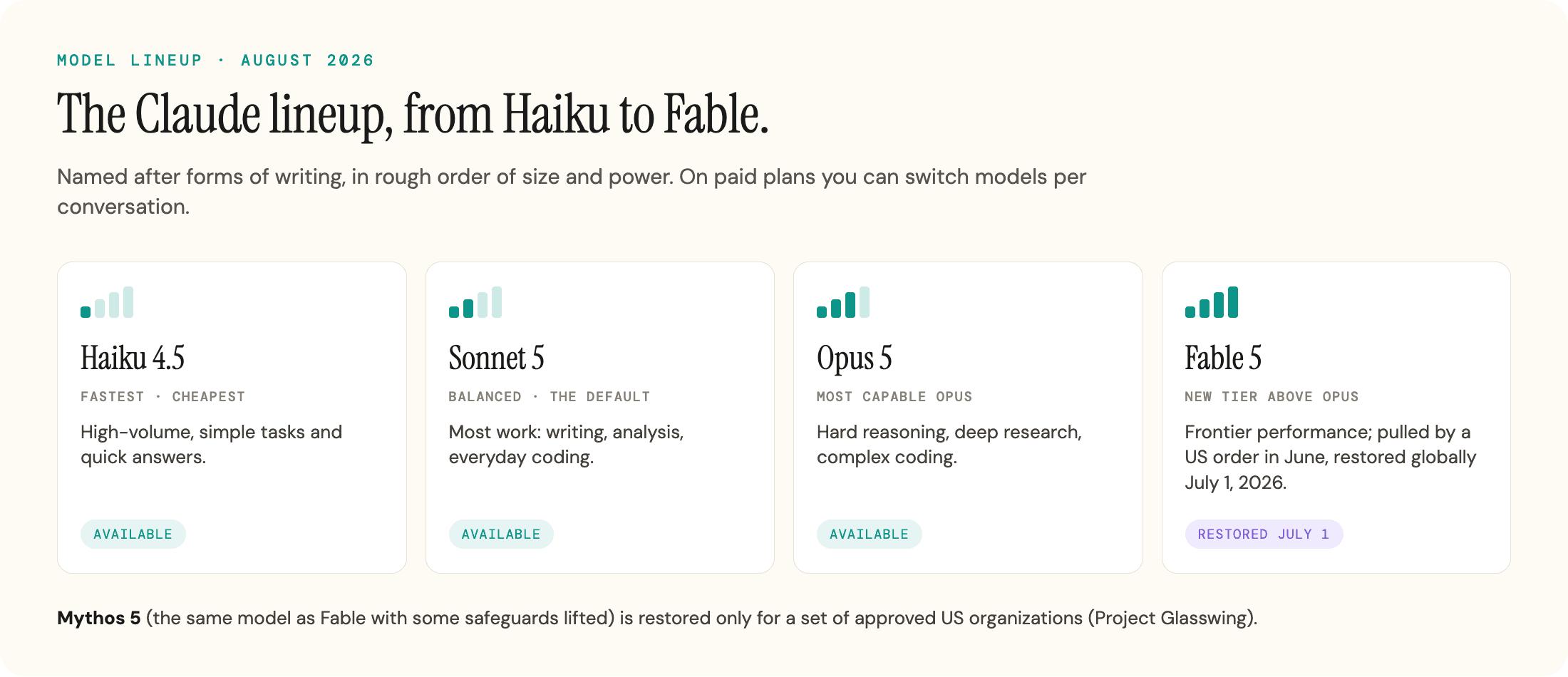
Claude is not one model but a lineup, named after forms of writing in rough order of size and power. Haiku is the short, fast one. Sonnet is the medium, balanced one. Opus is the large, most capable one. In June 2026, Anthropic added a new top tier above Opus, beginning with a model called Fable 5. Anthropic later released its successor, Claude Fable 5.1, on September 1, 2026 at the same $10 and $50 per million input and output tokens, though it works out cheaper in practice: Anthropic cut cache reads by 75%, to $0.25 per million tokens, which it says lowers typical workload costs by around 25% and could save up to around 45% on agentic ones. Here is where things stand.
| Model (September 2026) | Speed and cost | Best for | Status |
|---|---|---|---|
| Claude Haiku 4.5 | Fastest, cheapest | High-volume, simple tasks and quick answers | Available |
| Claude Sonnet 5 | Balanced | The default for most work: writing, analysis, everyday coding | Available (new default, launched June 30, 2026) |
| Claude Opus 5 | Most capable Opus tier, slower, priciest | Hard reasoning, deep research, complex coding | Available (launched July 24, 2026, replacing Opus 4.8 at the same price) |
| Claude Opus 4.8 | Same price as Opus 5 | Hard reasoning, deep research, complex coding | Available as a legacy model |
| Claude Fable 5.1 | The tier above Opus | Frontier performance across benchmarks | Current since September 1, 2026; Fable 5 (restored globally July 1, 2026) is now legacy |
| Claude Mythos 5.1 | Same model as Fable 5.1, some safeguards lifted | Vetted cyberdefenders and life scientists (Cyber and Life Sciences Verification Programs, under Project Glasswing) | Current since September 1, 2026; US organizations only, with Anthropic working to extend access internationally |
Claude Opus 4.8 shipped on May 28, 2026, and was the most advanced model in the classic Opus line until Claude Opus 5 succeeded it on July 24, 2026 at the same price. Fable 5 had arrived earlier, on June 9, 2026, as the first public model in a new, more powerful "Mythos-class" tier that sits above the Opus class. It went dark within days under a US government order and was restored on July 1, 2026 (more on that next).
Which one should you pick? If you are unsure, start with Sonnet, the everyday workhorse. Reach for Haiku when you want speed and low cost on routine tasks, and switch to Opus for genuinely hard problems. On the paid plans you can change models per conversation, so the choice is never permanent. Because version numbers move every few weeks, treat this table as a September 2026 snapshot.
Wait, Didn't Claude Just Get Banned?
Not Claude as a whole, but its two most powerful models. This is the news driving a lot of the "is Claude banned" searches, so here is the short, dated version.
Fable 5 and its less-restricted sibling Mythos 5 went live on June 9, 2026. Three days later, on June 12, the US government issued a national-security export-control directive ordering Anthropic to suspend access to both models for any foreign national, anywhere, including Anthropic's own foreign-national employees. Complying with a rule that broad was all-or-nothing, so Anthropic switched Fable 5 and Mythos 5 off for everyone. Every other Claude model, including Opus 4.8, kept working normally.
The trigger, as reported, was a claimed method of bypassing Fable 5's safety guardrails. Anthropic has said it believed the issue was narrow rather than a universal jailbreak, and outside coverage has questioned the order's footing, with TechCrunch reporting that the ban "was never about an AI jailbreak."
The story has since resolved. On June 30, 2026, the Commerce Department lifted the export controls, and Anthropic redeployed Fable 5 globally on July 1, 2026, including in Europe, the API, and Claude Code. Mythos 5 returned for a set of US organizations following a June 26 government approval, and its successor Mythos 5.1 launched on September 1, 2026 on the same terms: US organizations only, through the Cyber and Life Sciences Verification Programs, while Anthropic works with the US government to extend access to international partners. It moved fast, so treat this as a September 2026 snapshot and check Anthropic's announcements for the current state. For the full breakdown of what Fable 5 and Mythos 5 are and why they were pulled and restored, see our Fable 5 and Mythos 5 explainer.
Is Claude AI Free? Plans and Pricing
So how much does Claude AI cost? Less than you might expect to start, because there is a real free tier. You can sign up at claude.ai with an email and phone number and use Claude on the web and in the apps. The catch is usage: the free plan has the lowest caps, which reset on a rolling basis roughly every five hours.
| Plan | Price (September 2026) | What you get |
|---|---|---|
| Free | $0 | Claude on web and apps, web search, the lowest usage limits |
| Pro | $20/month | Around five times the free usage, access to Opus, Projects, Claude Code |
| Max 5x | $100/month | Five times Pro usage, priority access, higher Claude Code limits |
| Max 20x | $200/month | Twenty times Pro usage, the highest individual limits |
| Team and Enterprise | Per seat or custom | Shared workspaces, admin controls, single sign-on, larger context |
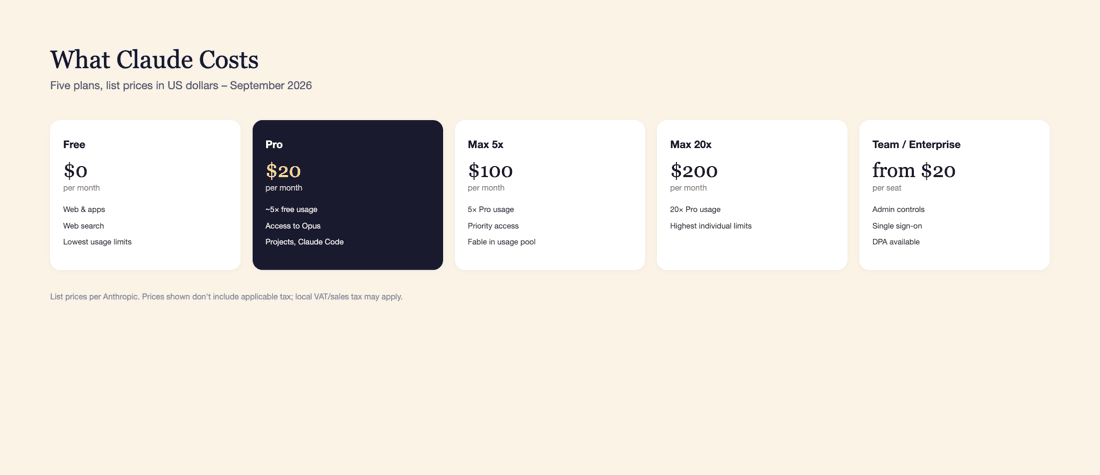
Prices and limits here are a September 2026 snapshot, so check claude.ai for the current numbers. Paid plans give you more usage and fuller access to the most capable Opus model, while the free tier defaults to a fast Sonnet-class model and has the tightest limits. The current Opus and Sonnet models can work with up to a 1-million-token context window, roughly a long book and then some in a single conversation, though how much of that the chat app exposes depends on your plan (Haiku tops out lower, at 200,000 tokens).
Developers pay separately through the API, priced per million tokens of input and output (Sonnet 5 runs $2 in and $10 out, for example; Anthropic announced that rate as introductory but made it permanent through August 2026, now standard, cancelling the planned rise to $3/$15). Is Pro worth it? If you hit the free limits often enough to be interrupted, or you want priority access to Opus, $20 is the usual answer. If you only dip in occasionally, the free tier is genuinely usable.
The Usage Limits Everyone Complains About
If you read about Claude before trying it, the loudest complaint you will find is about running out of usage, sometimes even on a paid plan. This is the part most explainers gloss over, so here is how it actually works.
Claude limits you on a rolling window, commonly described as about five hours, and paid tiers add weekly caps on top. The key thing to understand is that not all messages cost the same. A short question to Haiku barely moves the needle; a long prompt to Opus, especially one carrying a big document, eats far more of your allowance. So two people on the same plan can hit the wall at very different points depending on which model they use and how much they paste in. Limits also tighten during peak hours, when overall demand on Anthropic's systems is highest.
There is a second, quieter limit: the context window. When a single conversation grows past the window your plan allows, the app may start summarizing or dropping the earliest parts to keep going, which is why a very long thread can begin to feel like it is forgetting details from the top.
The practical fix is to match the model to the job. Route routine drafting, summarizing, and quick lookups to Sonnet or Haiku, and save Opus for the genuinely hard problems. Start a fresh chat for a new topic instead of letting one thread run for hours, and you will stretch your allowance a lot further than fighting a single 50-message conversation will.
Does Claude Train on Your Conversations?
The honest answer is "only if you let it," and the default changed in 2025, so it is worth getting right rather than trusting a flat yes or no.
For free, Pro, and Max accounts, Anthropic asks whether you want to share your chats to help improve Claude. If you leave that setting on, your conversations can be used to train future models and are kept for up to five years. If you turn it off, your chats are not used for training and fall under a much shorter retention window of around 30 days. You can change the setting at any time in your privacy controls, and deleting a conversation or your account removes that data from future training.
Business usage is treated differently. Traffic through Claude for Work, Enterprise, Education, and the API is not used to train models by default, which is part of why companies are comfortable putting Claude into their workflows.
So the myth cuts both ways. Claude does not silently hoover up everything you type, and it is also not a guaranteed privacy vault. The control is a toggle, and the sensible move is to open your settings and decide for yourself rather than assume either extreme.
What Can Claude Do, and Do You Need to Code?
Claude's strengths cluster around a few things: writing and editing that reads naturally, working through long documents without losing the thread, structured reasoning, and coding, where it is widely rated near the top. It can also run multi-step tasks fairly autonomously, the "agentic" behavior every AI company is chasing.
Can Claude access the internet? Yes. This is one of the most stubborn outdated beliefs about it. Claude has built-in web search and will pull live pages when a question needs current information, then cite the sources it used. Anthropic also runs a web crawler, ClaudeBot, though that one mainly gathers training data; the live search built into your chat fetches pages in the moment. There is still a knowledge cutoff baked into the model from training, but web search is how Claude reaches past it for anything recent.
A point of confusion worth clearing up: the Claude chat app and Claude Code are two different things. The app at claude.ai is general-purpose and built for everyone, writers, marketers, students, analysts, no coding required. Claude Code is a separate tool for software engineers that runs in a terminal and edits real codebases. If you have read intimidating articles about Claude writing software and wondered whether Claude is "for developers," the answer is that the chatbot most people mean is for everyone; Claude Code is the specialist add-on.
One real limit to keep in mind: Claude reads images and documents, but it does not generate photographic images or video the way ChatGPT and Gemini do. (Anthropic's separate Claude Design preview can build editable layouts like slides and prototypes, but not pixel images.) For a finished illustration you still reach for a dedicated image tool. Claude's lane is text, reasoning, and code, and it is deliberately deep rather than wide.
Claude vs ChatGPT vs Gemini, the Short Version
People rarely evaluate Claude in a vacuum; the real question is usually how it stacks up against ChatGPT and Gemini. The honest answer is that they are close enough that the "best" one depends on the task, not a scoreboard.
| Assistant | Maker | Leans best at |
|---|---|---|
| Claude | Anthropic | Long-document work, natural writing, careful reasoning, coding |
| ChatGPT | OpenAI | Image and video generation, voice, advanced reasoning, custom GPTs, the widest ecosystem |
| Gemini | Native multimodality, long-context retrieval, deep Google Search and Workspace integration |
In plain terms: Claude is known for natural-sounding writing and a careful, low-fluff tone; ChatGPT covers the most ground and is the one to reach for if you also want image generation, voice, and the largest plugin ecosystem; and Gemini's edge is native multimodality and living inside Google's products and index. On most individual tasks the latest models are close, which is why plenty of people keep two open and switch by job. If you are weighing the open-weight challengers too, Kimi K2, DeepSeek, and Zhipu's GLM 5.2 now match the big closed models on some tasks at a fraction of the cost.
We go deep on the head-to-heads elsewhere, including where each one genuinely wins and where the marketing oversells it, in Claude vs ChatGPT, Claude vs Gemini, and Grok vs Claude. If you are choosing one assistant to live in, those comparisons are the place to settle it. For the wider field beyond Claude, our roundup of the best ChatGPT alternatives sorts every major assistant by the job you need it for.
What Claude Means for Your Brand
Here is the part most "what is Claude AI" explainers never reach, and the reason it matters if you run a website or a brand. When Claude searches the web, it does more than answer; like ChatGPT, Gemini, and Google's AI Overviews, it names the sources it leaned on. The result at the top of a search like that is now often an AI summary, not ten blue links.
So a new question sits underneath the old SEO one. When a customer asks Claude "what's the best tool for X" or "is [your company] any good," does your brand come up, and is what Claude says about it correct? Claude draws on two places: what it absorbed during training, and what its web search and crawler pull live. Both are influenced by how clearly and consistently your business is represented across the web.
In our experience at geotoolbox, the brands that show up well in AI answers are rarely the ones with the slickest homepage; they are the ones whose facts are consistent, well-structured, and easy for a model to retrieve and trust. That is a fixable, measurable problem, which is the whole reason we build tooling around it: see what AI assistants actually say about you and where you are missing. Our guides on getting cited in Claude and tracking your AI visibility go deeper.
Understanding what Claude is matters most when you stop asking "what can it do for me" and start asking "what does it already say about me." You can answer that one today. Run a free AI Readiness check to see whether Claude and the other AI engines can find and read your site, and where the gaps are.
Frequently Asked Questions
Is Claude AI free?
Yes. There is a genuine free tier at claude.ai that needs only an email and phone number, no credit card. It has the lowest usage limits, which reset on a rolling basis every few hours. If you hit those limits regularly, Claude Pro is $20 a month for roughly five times the usage and priority access to the top Opus model.
Who owns Claude AI?
Anthropic owns and operates Claude. Amazon is its largest outside investor and Google holds a minority stake, but neither company owns or controls Anthropic, and neither decides how Claude behaves. Anthropic was founded in 2021 by former OpenAI staff, including siblings Dario and Daniela Amodei.
Is Claude better than ChatGPT?
It depends on the task rather than a single winner. Claude is often praised for natural writing, long-document work, and a careful tone; ChatGPT is strong on reasoning, images, voice, and its wider ecosystem; and on most tasks the latest models are close. Many people use both and switch depending on the job.
Is Claude AI safe?
Safety is Anthropic's founding pitch. Claude is trained with Constitutional AI, a written set of principles meant to keep it helpful, honest, and harmless, which is why it tends to refuse clearly harmful requests and hedge when it is unsure. No AI is flawless and Claude can still be wrong, but for everyday use it is as safe as the other major assistants. On data specifically, see the privacy note above and check your settings.
What is the difference between Claude and Claude Code?
The Claude app at claude.ai is the general-purpose assistant most people mean; it needs no coding skills and suits writing, research, and analysis. Claude Code is a separate tool for software engineers that runs in a terminal and edits real codebases. You do not need Claude Code to use Claude.
Is Claude AI banned?
No, everyday Claude works normally. In June 2026 the US government ordered Anthropic to suspend its two most powerful new models, Fable 5 and Mythos 5, for foreign nationals under export-control rules, so Anthropic disabled them for everyone to comply. All other models, including Opus 4.8, stayed available. The export controls were lifted on June 30, 2026, and Anthropic restored Fable 5 globally on July 1, 2026 (with Mythos 5, and now its successor Mythos 5.1, available only to certain US organizations).
More Questions
Can Claude access the internet?
Yes. Claude has built-in web search and will pull live pages when a question needs current information, then cite the sources it used. It still has a training knowledge cutoff, but web search is how it reaches past that for recent facts. The belief that Claude cannot browse the web is out of date.
Does Claude train on my conversations?
Only if you allow it. Free, Pro, and Max accounts have a "help improve Claude" setting; leave it on and your chats can be used for training and kept up to five years, turn it off and they are not used for training and kept around 30 days. Business plans like Enterprise and the API are not used for training by default.
Which Claude model should I use?
Start with Sonnet, the balanced default that handles most work well. Use Haiku when you want speed and low cost on simple, high-volume tasks, and switch to Opus for genuinely hard reasoning, research, or coding. On paid plans you can change the model per conversation.
Sources
- What Is Claude AI? - IBM Think, updated 2026 -
ibm.com/think/topics/claude-ai - Claude's Constitution - Anthropic -
anthropic.com/constitution - Introducing Claude Opus 4.8 - Anthropic, May 2026 -
anthropic.com/news/claude-opus-4-8 - Claude Fable 5 and Claude Mythos 5 - Anthropic, June 2026 -
anthropic.com/news/claude-fable-5-mythos-5 - Statement on the US government directive to suspend access to Fable 5 and Mythos 5 - Anthropic, June 2026 -
anthropic.com/news/fable-mythos-access - Redeploying Fable 5 - Anthropic, July 2026 -
anthropic.com/news/redeploying-fable-5 - Introducing Claude Sonnet 5 - Anthropic, June 2026 -
anthropic.com/news/claude-sonnet-5 - The US government's Anthropic models ban was never about an AI jailbreak - TechCrunch, June 2026 -
techcrunch.com/2026/06/15/the-us-governments-anthropic-models-ban-was-never-about-an-ai-jailbreak - Updates to our Consumer Terms and Privacy Policy - Anthropic, 2025 -
anthropic.com/news/updates-to-our-consumer-terms - What is the Pro plan? - Anthropic Support -
support.claude.com/en/articles/8325606-what-is-the-pro-plan