
Ask which is better, Gemini or ChatGPT, and most answers stall on "it depends." That is true, and useless. So here is the honest version, current as of September 2026: the two are genuinely close, both charge about $20 a month for their main plan, and the right pick changes by the job you need done.
This guide gives you the task-by-task verdict, the current models and prices (the part most comparisons get wrong or leave stale), and one angle most comparisons skip: Google Gemini and ChatGPT cite sources differently, so being visible in one does not mean being visible in the other. That last point matters more than the benchmark scores if people find your brand through AI.
One caveat up front: the model rosters move almost monthly. Everything below is dated. When a launch lands, the names change before the conclusions do.
Gemini vs ChatGPT at a Glance (September 2026)
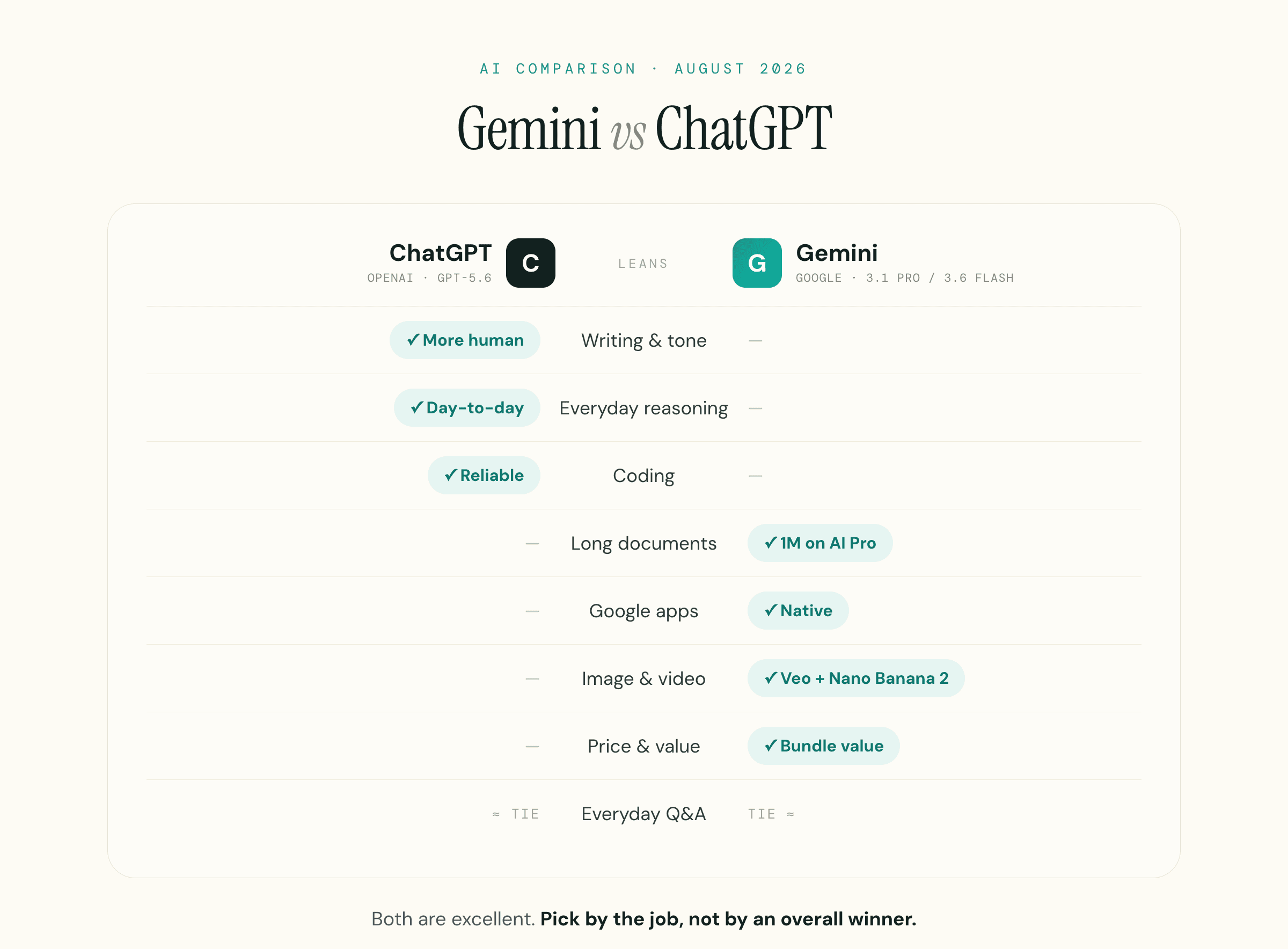
The short answer: pick ChatGPT for writing, day-to-day reasoning, and the bigger third-party ecosystem. Pick Gemini for long documents, Google Workspace integration, video generation, and bundle value. On most everyday questions, you would struggle to tell the two apart.
The model names are the first source of confusion, so start here. OpenAI's current flagship is GPT-6 Astra, released September 3, 2026, priced at $10 and $50 per million tokens. Below it sits the GPT-5.6 generation, generally available since July 9, 2026 across ChatGPT, Codex, and the API, with Sol (working flagship, $4 and $20), Terra (balanced), and Luna (fast) variants. GPT-5.6 superseded GPT-5.5, the prior-generation flagship (until July 2026). Google's lineup, per Google DeepMind, runs on Gemini 3.1 Pro for heavy tasks and, as of September 2, 2026, Gemini 3.8 Flash as the newest fast model, its third Flash release in six weeks (3.7 Flash is now the previous generation), while Gemini 3.5 Pro still has not shipped: Google announced it at I/O on May 19, 2026, but as of September 5, 2026 it remains in partner testing, with no API model ID and no date. If a comparison still cites GPT-5.2 or Gemini 3 Pro as current, it is already out of date.
| ChatGPT (OpenAI) | Gemini (Google) | |
|---|---|---|
| Maker | OpenAI | Google DeepMind |
| Current flagship | GPT-6 Astra (Sept 3, 2026), with GPT-5.6 (Sol / Terra / Luna) below it | Gemini 3.1 Pro (preview); Gemini 3.8 Flash (newest, Sept 2); 3.5 Pro not yet shipped |
| Free model | GPT-5.6 Luna (rolling out; Instant still GPT-5.5) | Gemini 3.6 Flash |
| Main paid plan | Plus, $20/mo | Google AI Pro, $19.99/mo |
| Top tier | Pro 5x $100 / Pro 20x $200 | AI Ultra $99.99 (5x) or $199.99 (20x) |
| Context window | Tiered in-app: 54K instant / 256K reasoning on Plus, up to 128K / 400K on Pro; 1M via API | By plan: 32K free, 128K AI Plus, 1M on AI Pro and Ultra |
| Image / video | ChatGPT Images 2.5 (Sept 8, 2026) / no in-app video (Sora app retired Apr 2026) | Nano Banana 2 (Pro on paid plans) / Veo 3.1 |
| Best at | Writing, reasoning, coding, ecosystem | Long docs, Workspace, video, value |
The rest of this guide works through where those differences actually bite.
Pricing: What You Actually Get Free and Paid
Both companies restructured their plans in 2026, so old price tables mislead. Here is where they stand now.
Start with free, because for many people it is enough. ChatGPT's free tier is mid-transition: OpenAI's help centre said on August 7, 2026 that GPT-5.6 Luna, the fastest and cheapest model in the family, is becoming the default for Free and Go as it rolls out, with GPT-5.5 Instant still behind the Instant setting. Message caps are tight, and neither Free nor Go gets GPT-5.6 Sol; Terra reaches them only inside Codex, never in a standard conversation. Gemini's free tier runs on Gemini 3.6 Flash with a 32K context window. If you mostly need a capable assistant for everyday questions, Gemini's free tier is still the more generous of the two, but not for the reason usually given. It is not the context window; it is model access. Google lets free users reach Flash-Lite, Flash and Pro, capping volume and context rather than model quality, while OpenAI's Free and Go plans get no access to GPT-5.6 Sol at any volume.
The main paid plans are effectively tied on price. ChatGPT Plus is $20 a month and includes GPT-6 Astra and GPT-5.6, Deep Research, and image generation. Google AI Pro is $19.99 a month and, per Google's plan page, bundles expanded Gemini access with 5TB of storage, YouTube Premium Lite, and NotebookLM. Dollar for dollar, Gemini AI Pro packs in more, which is why "Gemini is better value" is the one verdict almost every reviewer agrees on. Our Gemini pricing guide breaks down every tier and the API token costs.
At the top, both run a power tier. ChatGPT Pro is $100 or $200 a month depending on usage limits. Google cut its AI Ultra plan from $249.99 to $199.99 and added a new $99.99 entry tier at I/O 2026, per Google's announcement. Unless you are running heavy professional workloads, you can ignore both top tiers and miss nothing.
| Tier | ChatGPT (OpenAI) | Gemini (Google) |
|---|---|---|
| Free | $0 - GPT-5.6 Luna, limited | $0 - Gemini 3.6 Flash, 32K context |
| Entry | Go, $8/mo | AI Plus, $4.99/mo (400GB) |
| Main | Plus, $20/mo | AI Pro, $19.99/mo (5TB, YouTube Premium Lite) |
| Power | Pro 5x $100 / Pro 20x $200 | AI Ultra $99.99 (5x) or $199.99 (20x) (from 20TB, Deep Think) |
Is $20 a month worth it over free? For most casual users, no. The free tiers cover daily questions, drafting, and light research. Pay when you hit message caps often, need the heaviest models for work, or want the storage and YouTube extras Gemini bundles in. The $100 to $200 top tiers (ChatGPT Pro and Gemini AI Ultra) are aimed at heavy professional and agentic workloads that need the highest reasoning limits. For everyone else, they are not worth it.
Writing and Tone: Which Sounds More Human?
This is the difference people feel first, and it decides more switches than any benchmark. ChatGPT writes like a person. Gemini writes like a competent report. Spend a week in both and you will see it: ChatGPT varies its rhythm, picks up your tone, and reads warm, while Gemini stays precise, structured, and reliably on point, if a little corporate. A common refrain among heavy users is that Gemini feels like a tool and ChatGPT feels like a colleague.
That is a strength for Gemini when you want facts without flourish, like a summary, a spec, or a structured brief. It is a weakness when the writing itself is the product. In hands-on testing, PCMag found that ChatGPT follows complex creative instructions more reliably and adds small touches Gemini skips, while Gemini sometimes turns a poem into prose.
So the "they are basically the same" myth breaks down fastest here. On a one-line factual question, sure. On a 600-word landing page, a brand email, or a short story, the voice gap is obvious, and it usually favors ChatGPT. If you write for a living, that alone may settle it. For a head-to-head against Anthropic's model on tone, see our Claude vs ChatGPT comparison.
Accuracy, Hallucinations, and Sources
"ChatGPT is just more accurate" is a myth worth retiring. Which one is more accurate depends entirely on the question.
For anything recent or checkable, Gemini has a structural edge: it is grounded in Google Search, so on current questions it usually pulls live information and shows its sources. ChatGPT also searches the web, on by default, but it decides per query whether to look things up rather than grounding every answer, which is where it can produce a confident, wrong, well-written answer about something that changed last month. Both models still hallucinate, inventing quotes from documents or misreading an image, so neither earns blind trust on facts that matter.
The practical rule: for live facts, news, and "what does the latest version do," prefer Gemini and click its citations. For reasoning through a problem you can verify yourself, ChatGPT is its equal. Either way, treat both as a fast first draft of the truth, not the truth itself.
This source-grounding gap also explains a deeper split in how each engine decides what to cite, which is where the comparison stops being about chat quality and starts being about whether anyone finds your brand.
Coding: Benchmark Winner vs Day-to-Day
The "Gemini is weaker at coding" line needs nuance. On the public benchmarks the race is mixed and task-specific: Gemini 3.1 Pro leads on some coding and reasoning tests while OpenAI's flagship leads on others, and Gemini is strong at catching logical errors in long files. Yet plenty of developers still reach for ChatGPT. Both things are true.
The split is correctness and scale versus readability and explanation. Gemini tends to be thorough and literal, and its huge context lets it reason over an entire repository at once. ChatGPT tends to write cleaner, more idiomatic code and explain its reasoning step by step, which is why beginners and people learning a new language often prefer it.
Treat the benchmark scores with caution. They are close, contested, drawn from whichever model versions were tested, and they rarely match how a tool feels after a week of real work. The summary: reach for Gemini when you are analyzing a large codebase or chasing the top score on a given test, and for ChatGPT when you want explained, ready-to-paste code or are still learning.
Context Window and Long Documents
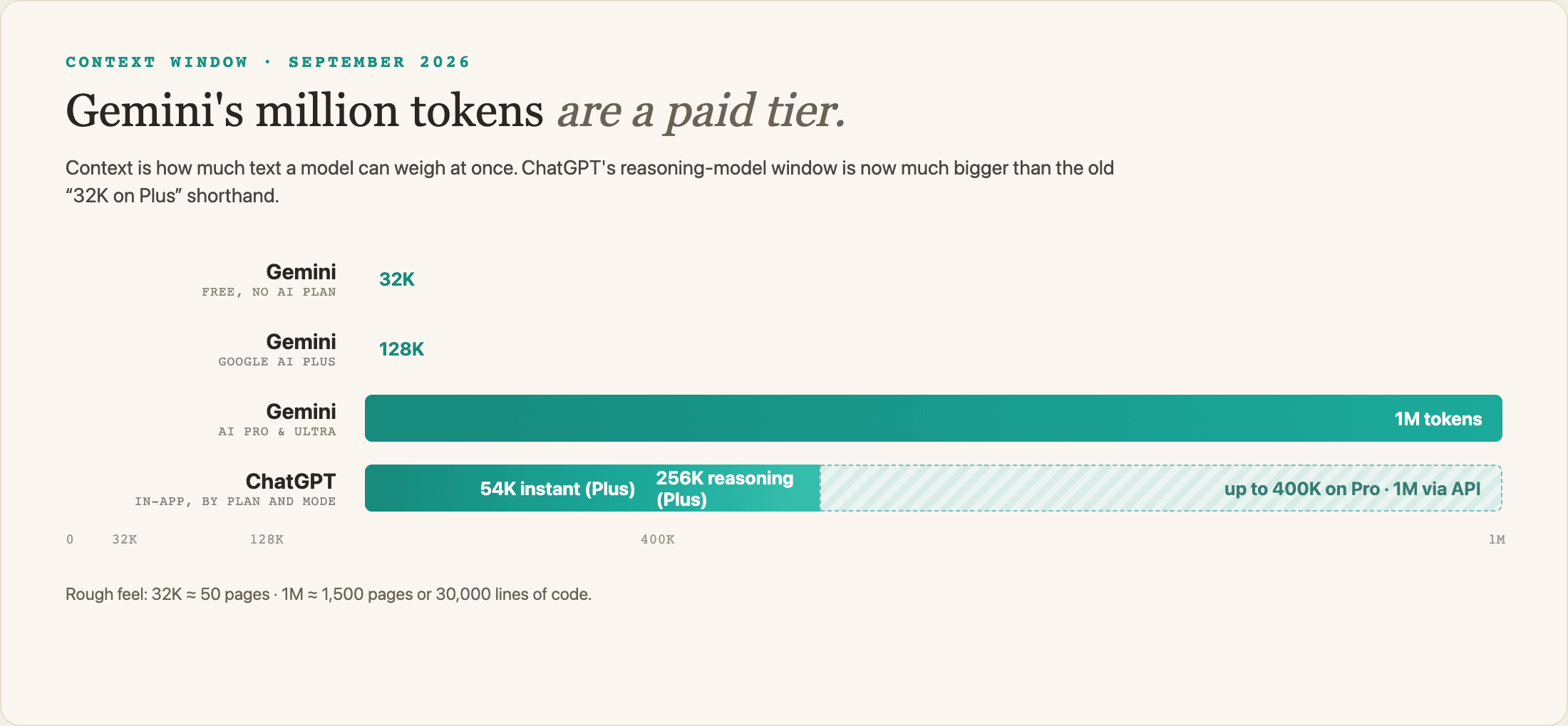
This is where the spec sheets contradict each other, so let us settle it. Gemini's million-token context window is a paid feature, not a free one. Per Google's own limits page, the Gemini app's context window goes by plan: 32K tokens with no AI plan, 128K on Google AI Plus, and 1 million on AI Pro and AI Ultra. For scale, Google reckons 1M tokens at about 1,500 pages of text or 30,000 lines of code; the free tier's 32K is roughly 50 pages. ChatGPT's in-app context, per OpenAI's plan details, is smaller and tiered, and it splits by model mode: on Plus you get a 54K-token window on the instant model and 256K on the reasoning model, rising to 128K and 400K on Pro. The full 1-million figure is reserved for the API, not the chat product most people use.
So the comparisons that print "ChatGPT 128K vs Gemini 1M" still land on the right side of the gap, even if ChatGPT's reasoning window is now larger than that shorthand suggests, and the ones claiming ChatGPT matches Gemini's million are quoting the API. The difference is real, not marketing. If your work means dropping an entire research paper, a long contract, a year of transcripts, or a big codebase into one prompt, Gemini handles it without you chopping the file into pieces. For shorter chats, the gap is invisible and you will never notice it.
Images and Video
On images, the lead has changed hands and is now close. Gemini's default generator is Nano Banana 2 (Gemini 3.1 Flash Image), which replaced Nano Banana Pro in the app in February 2026; Pro survives for AI Pro and Ultra subscribers as a higher-fidelity regenerate option. The Nano Banana line produces more detailed, photorealistic results and its edits hold the original aspect ratio and resolution better, which is why PCMag handed Gemini the image round in a February 2026 test of GPT Image 1.5 against Nano Banana Pro. Both sides have changed models since, so treat that verdict as a direction, not a current head-to-head. ChatGPT's image model is now Images 2.5, released September 8, 2026 to every ChatGPT tier (it succeeds Images 2.0 from April 2026 and adds sharper detail, better reference-photo fidelity, and roughly 50% faster generation). It counters with stronger instruction-following and noticeably better text rendering, so it wins for diagrams, infographics, and anything with words baked into the picture. If you are asking "is Nano Banana still better," the answer is: for photo-style images and clean edits, usually yes; for layouts with text, ChatGPT often wins.
Video tilts the other way, and not by a little. Gemini generates multimodal clips with audio through Veo 3.1 and its Flow filmmaking tools, a full consumer video stack. ChatGPT, meanwhile, has no native in-app video generator at all right now: OpenAI retired the Sora app and website on April 26, 2026 and is shutting down the Sora API on September 24, 2026, so this is a full withdrawal rather than a change of shop window. For video generation, Gemini is the only real choice of the two.
Ecosystem: Google Workspace vs ChatGPT's World
For a lot of people, this section decides everything, model quality aside. Gemini lives inside Google. It drafts in Gmail, edits in Docs, cleans up Sheets, pulls from Drive, and rides along on Android, so if your day already runs on Google apps, it removes the copy-paste shuffle entirely. That convenience is real, and it is the most common reason people switch to it.
ChatGPT plays a wider field. It has the largest third-party ecosystem: Custom GPTs and the GPT Store, the Codex coding tools, the Canvas editor, a built-in browser for agentic tasks, and broad plugin support through the Model Context Protocol. OpenAI retired the standalone Atlas browser on August 9, 2026 and folded its capabilities into ChatGPT itself. If your work spans many non-Google tools, or you want to build custom assistants and automations, ChatGPT bends to more shapes. Gemini's answer to custom GPTs is Gemini Gems, which are simpler but wired straight into Gmail, Docs, and Drive.
Put plainly: Gemini wins if you live in Google Workspace, ChatGPT wins if you live everywhere else. That is often a bigger deciding factor than which model writes a slightly better paragraph.
Privacy and Your Data
Neither is a clear winner here, and the answer is uncomfortable: on their consumer plans, both train on your conversations by default. ChatGPT and Gemini each use your chats to improve their models unless you turn that off in settings, and both let you do so. Google does not train on your Gemini activity inside Workspace apps by default, which is a point in its favor for work accounts.
The under-discussed part is retention. Even with history off, providers keep copies for a window, and Google has said Gemini conversations can be human-reviewed and kept for up to three years, so the safe habit is simple: do not paste anything truly sensitive into either one.
Gemini also drew scrutiny over its deeper Google reach. Reports in late 2025 said Google had switched on Gemini's smart features across Gmail and Chat by default for many US users, prompting a class-action lawsuit, while Google says it did not change those settings and does not train on personal Gmail content. On July 7, 2026 a federal judge dismissed that suit for lack of standing rather than on the merits, granting leave to amend, so it is neither settled nor over. The takeaway holds either way: review the data settings on whichever you choose, because the defaults lean toward collection.
The GEO Angle: How Gemini and ChatGPT Cite Your Brand
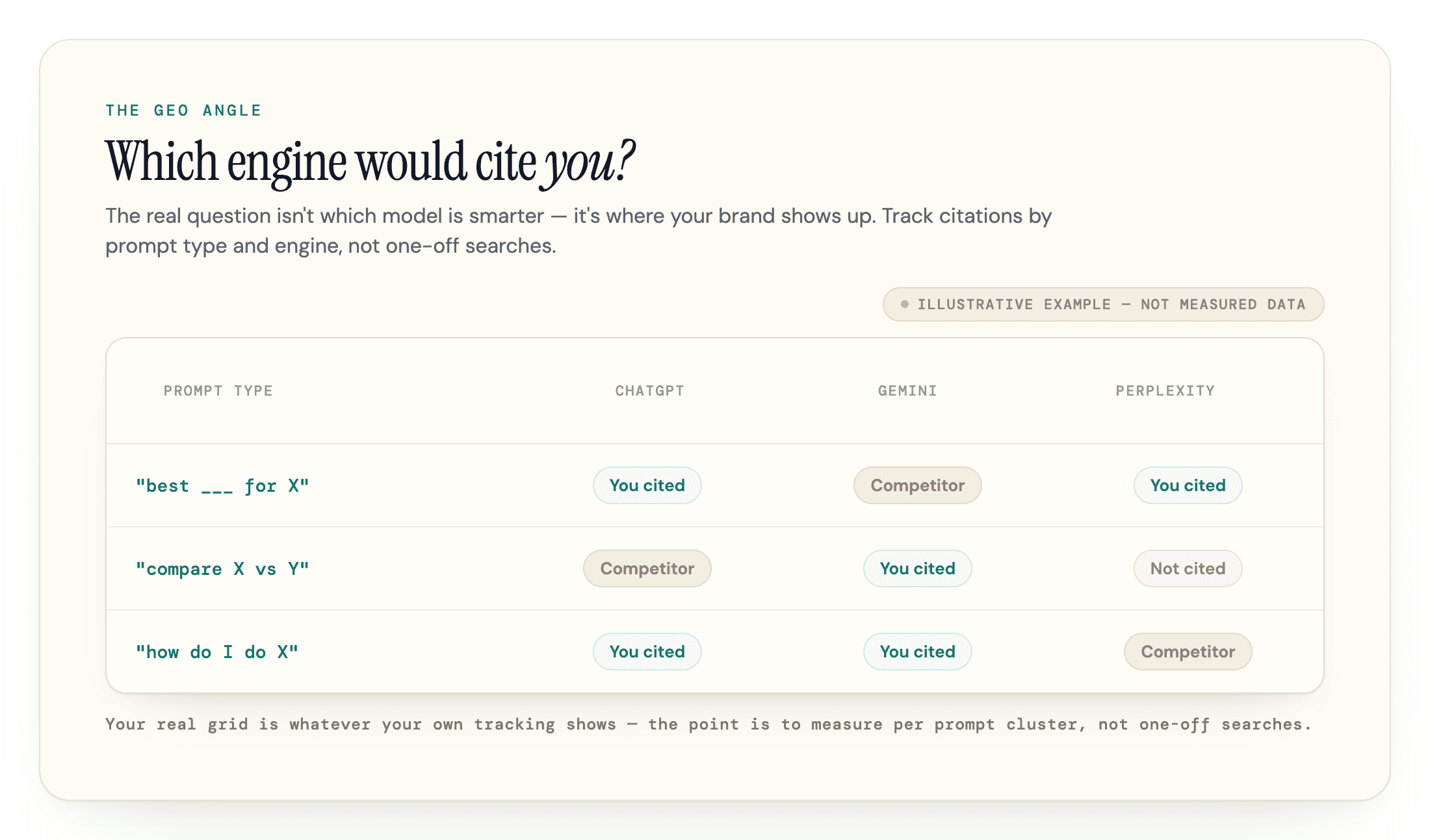
Here is the comparison nobody else runs, and the one that matters most if customers find you through AI: Gemini and ChatGPT do not pull their sources from the same place, so being cited by one is a weak predictor of being cited by the other.
Gemini is grounded in Google's search index. Analysis from Yext, which studied 17.2 million citations across the major engines, found Gemini behaves much like traditional search: it favors official brand websites and established, well-structured sources. ChatGPT's mix shifts more by industry; in some verticals it leans on official brand sites as heavily as Gemini does, in others on third-party reviews and publications. Across all engines, Yext found that verified, directly-distributed brand data (the listings a company controls) made up 54.53% of distinct citation sources, so the brands winning AI mentions tend to own the source of truth, not just the prettiest page.
It splits further by query. On a comparison search like this one, our own citation data shows Google's AI leaning heavily on YouTube and Reddit alongside editorial roundups, a very different recipe from the brand-owned pages Gemini favors elsewhere. In our experience at geotoolbox auditing AI visibility, a brand can be quoted confidently by ChatGPT and be invisible in Gemini for the same question, simply because each engine trusts a different kind of source.
The practical consequence: optimizing for one engine does not carry to the other. You have to know where each one is sourcing your category and earn a place in both. That starts with measuring your AI visibility per engine and watching how Google's AI Overviews cite your space over time.
Which Should You Use? (Decision by Task)
Skip the "it depends" and match the tool to the job. This is the verdict, task by task.
| If your main job is... | Use | Why |
|---|---|---|
| Everyday questions and chat | Either | Genuinely interchangeable; pick by free-tier or ecosystem |
| Writing and creative work | ChatGPT | Warmer voice, follows complex instructions better |
| Day-to-day coding | ChatGPT | Cleaner, better-explained code (huge repos: Gemini) |
| Studying and exam prep | Either | ChatGPT explains step by step; for whole-textbook context Gemini needs AI Pro, not the free tier |
| Long documents and research | Gemini | 1M-token context in the app, on AI Pro and above |
| Google Workspace work | Gemini | Native in Gmail, Docs, Sheets, Drive |
| Image generation | Tie | Gemini for photos and edits; ChatGPT for text and diagrams |
| Video generation | Gemini | Veo 3.1 and Flow; ChatGPT retired its Sora app |
| Current facts and news | Gemini | Google Search grounding with citations |
| Brand AI visibility | Both | Each cites different sources; you need both |
Most experienced users land in the same place: use both. Research and fact-check in Gemini, then draft in ChatGPT because it reads more human. With both free tiers, that hybrid costs nothing, and even paying for one and using the other free is common. If your work lives in Microsoft 365 rather than Google Workspace, the third option is worth a look in Microsoft Copilot vs ChatGPT, and we put Microsoft's assistant against Google's directly in Copilot vs Gemini.
Should you cancel one and switch? Switch to Gemini if you want long-context work, Google integration, or better video, and switch to ChatGPT if you want stronger writing and a broader tool ecosystem. A fair number of people who jump to Gemini for the value drift back to ChatGPT for brainstorming and tone, so try the free tier for a week before you cancel anything.
The One Comparison That Outlives the Model Roster
The version numbers in this guide will be stale within months. What will not change as fast is the deeper split: these two engines reason similarly but source differently, and that decides whether your brand shows up when someone asks an AI about your category.
If people increasingly discover you through Gemini and ChatGPT instead of a blue-link search, the question stops being "which is better" and becomes "which one is recommending me, and which one has never heard of me." Geotoolbox tracks exactly that: which sources ChatGPT, Gemini, and Google AI Overviews cite for your category, and where your brand is missing from them, so you can earn a place in both engines instead of guessing. Start by seeing where you stand across engines before the next model launch resets the board.
Frequently Asked Questions
Is Gemini better than ChatGPT in 2026?
Neither is better overall; it depends on the task. Gemini wins on long-document handling, Google Workspace integration, video generation, and raw value. ChatGPT wins on writing quality, day-to-day coding, and its third-party tool ecosystem. On everyday questions, they are close to interchangeable.
Should I switch from ChatGPT to Gemini?
Switch if you live in Google Workspace, regularly work with very long documents, or want stronger video generation and bundled storage. Many people who switch for the value drift back to ChatGPT for brainstorming and tone, so test Gemini's free tier for a week before canceling anything.
Is the free version of Gemini better than free ChatGPT?
For most people, yes, though not for the reason usually cited. Both free tiers are tightly capped on context: Gemini's free plan gets 32K tokens and ChatGPT's in-app window is comparable. Gemini's edge is model access, since Google lets free users reach its Pro model while ChatGPT's Free and Go plans do not include GPT-5.6 Sol at all.
Which is better for coding, Gemini or ChatGPT?
It is close, and the benchmarks split by test rather than crowning one winner. Gemini 3.1 Pro handles entire codebases thanks to its large context, while ChatGPT tends to write cleaner, better-explained code, which is why many developers and learners prefer it day to day. Use Gemini for big-repository work and ChatGPT for explained, ready-to-use snippets.
Do Gemini and ChatGPT train on my data?
Both train on your conversations by default, and both let you turn that off in settings. Google does not train on Gemini activity inside Workspace apps by default. Either way, avoid pasting sensitive information, since chats can be retained for a period and sometimes reviewed to improve quality.
Can I use both Gemini and ChatGPT together?
Yes, and many people do, using one for grounded research and the other for the final draft. With both free tiers, running them side by side costs nothing.
Sources
- Google DeepMind - Gemini models -
deepmind.google/models/gemini - Google - new Google AI subscriptions (Google One) -
blog.google/products-and-platforms/products/google-one/google-ai-subscriptions - Google One - Google AI plans -
one.google.com/about/google-ai-plans - OpenAI - ChatGPT plans and pricing -
chatgpt.com/pricing - PCMag - ChatGPT vs. Gemini, tested -
pcmag.com/comparisons/chatgpt-vs-gemini-which-ai-chatbot-is-actually-smarter - Yext - how ChatGPT, Perplexity, Gemini, and Claude decide what to cite -
yext.com/blog/how-chatgpt-perplexity-gemini-claude-decide-what-to-cite - National Law Review - lawsuit over Gemini's Gmail/Chat default settings -
natlawreview.com/article/silent-switch-new-lawsuit-alleges-google-uses-gemini-ai-secretly-read-gmail-chat