
If AI engines answer questions in your category, the first thing to learn is whether they can see you at all. An AI visibility audit is the structured check that tells you: whether ChatGPT, Perplexity, Gemini, and Google's AI Overviews can reach, read, and cite your site, and why they do or do not. Run right, it ends in a prioritized fix list, not a vanity score, and it starts with the one layer almost every other audit skips. For the wider context these audits sit inside, how AI search actually looks in 2026, see our state of AI search 2026 field report.
What an AI Visibility Audit Actually Checks
An AI visibility audit is a structured check of whether AI engines can find, read, and cite your brand, and why they do or do not. It is a diagnostic, run once or each quarter, that ends in a prioritized fix list. That makes it different from ongoing AI visibility tracking, which watches a number over time. The audit tells you what to change; tracking tells you whether the change worked. It is also one layer of a full SEO audit, which covers crawling, indexing, rendering and links as well.
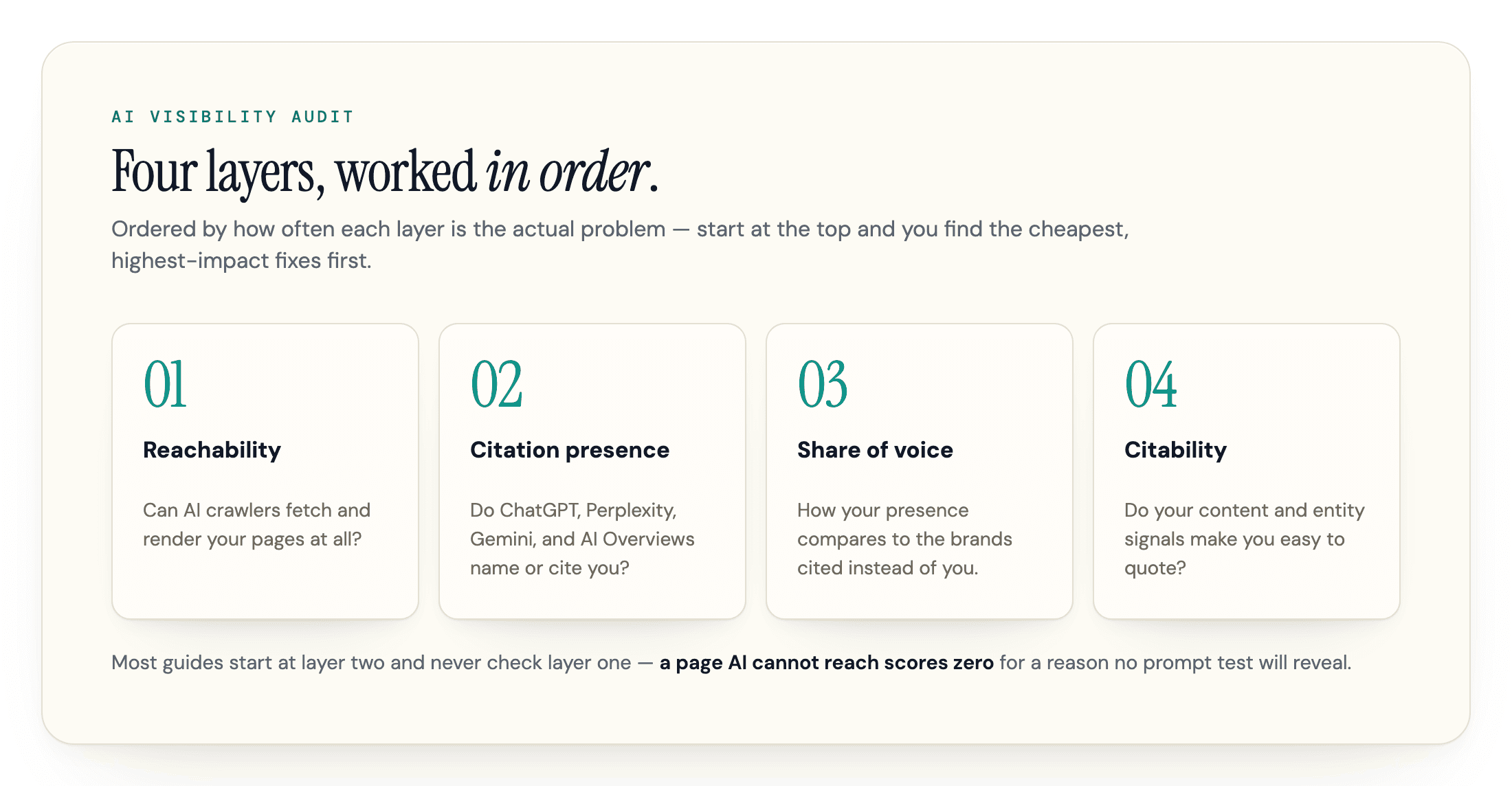
A complete audit covers four layers, in order of how often they are the actual problem:
- Reachability - can AI crawlers fetch and render your pages at all
- Citation presence - do ChatGPT, Perplexity, Gemini, and Google's AI Overviews name or cite you for your target prompts
- Competitor share of voice - how your presence compares to the brands cited instead of you
- Citability - whether your content and entity signals make you easy to quote
Most guides start at layer two and never check layer one. That is the mistake this audit is built to avoid, because a page AI cannot reach scores zero for a reason no prompt test will reveal. Work the layers in order and you find the cheapest, highest-impact fixes first.
Why Audit AI Visibility Separately from Your Rankings
You cannot read your AI visibility off your Google rankings. They are governed by different conditions. Google's own documentation states that to appear in AI features a page must be indexed and eligible to be shown with a snippet, which is its own bar, separate from where you sit in the organic results.
Ranking first earns you nothing automatically in the AI answer, and pages buried on page two sometimes get cited. So rank is not a proxy, and an audit has to test AI presence directly.
The stakes are why this is worth a dedicated audit now rather than a rankings glance. When an AI summary appears, the click often does not follow: Pew Research found (via Search Engine Land), analyzing the browsing data of 900 US adults, that people clicked a traditional result on just 8% of searches with an AI summary, versus 15% without. If half your would-be visitors are reading an answer instead of clicking, whether that answer names you is no longer a side metric.
There is also no industry benchmark for a "good" AI visibility score, despite what the ads claim. The number that means something is your own audit, repeated, against the competitors and prompts you chose. Treat any vendor's universal percentage with suspicion.
Step 1: Can AI Crawlers Even Reach Your Page?
Start here, because it is the most common cause of zero visibility and the cheapest to fix. If an AI engine cannot fetch and render your page, you are not ranked low in its answers, you are absent from the source pool entirely, and no prompt test or content rewrite will change that.
Three things break reachability, and you should check all three.
The first is robots.txt. Each AI crawler is its own user agent, and any of them can be disallowed, often by accident in a blanket rule. OpenAI's documentation confirms that GPTBot and OAI-SearchBot are controlled through robots.txt, and the same is true for Google's crawlers and others. Pull your robots.txt and confirm the agents you want are actually allowed.
Check your robots.txt in seconds
The free AI Crawler Checker tests your robots.txt against all 34 AI crawlers at once and flags the exact blocking line, so you can clear the reachability layer before auditing anything else.
The second is the firewall, and this one is easy to miss because it is invisible in robots.txt. Bot-management and CDN rules can silently return a 403 or a challenge to non-browser traffic while every human sees a normal page. This is no longer an edge case: Cloudflare announced it now blocks AI crawlers by default for new domains, so a brand can be invisible to AI engines because of an infrastructure default it never set.
The third is rendering. If your content only appears after JavaScript the crawler does not execute, the bot indexes an empty shell. In the audits we run, this trio is the most common cause of zero visibility, well ahead of weak content. A fast way to check all three is to fetch your page as each AI crawler and compare what comes back to what a browser sees: geotoolbox's free AI-Readiness Score covers the crawler-access basics and its full Agent Readiness scan (also free) fetches and renders pages the way the crawlers do, while the Content Analyzer adds the per-page render diff and citability grade.
Step 2: Check Whether AI Engines Cite You
With reachability confirmed, test presence directly: ask the engines the questions your buyers ask and record what comes back. This is the spot-check at the heart of the audit.
Build a fixed set of 10 to 20 prompts grounded in real demand, not the ones that flatter you, because the prompt set you choose decides the score you get. Run each prompt across ChatGPT, Perplexity, Gemini, and Google's AI Overviews in a logged-out or incognito session, since signed-in chat history skews answers toward brands you already engage with. For each response, log three things: whether you were mentioned, whether you were cited with a link, and which competitors appeared.
The part most people skip is repetition, and it is the difference between a real reading and a number. AI answers are non-deterministic: a study across five models found accuracy varying by up to 15% between runs, with as much as a 70% gap between best and worst output and no model reproducing identical text. A single check is a coin flip. Run each prompt three to five times and record how often you appear, as a rate, not a yes or no.
That rate, across your prompt set, is your real presence number, and the competitor column is your share of voice. For turning this baseline into an automated, repeated reading over time, an AI rank tracker does the same thing on a schedule, but for the audit, a careful manual pass is enough to see where you stand.
For the Google layer, there is now first-party data to check your prompt runs against. On June 3, 2026, Search Console added Generative AI performance reports that break out impressions from AI Overviews and AI Mode, by page, country, device, and date. They show no clicks or queries yet, and while the rollout started with a subset of properties, Google says it now covers all properties worldwide as of August 31, 2026. They do not replace the prompt work, but they confirm at scale whether Google's AI features are surfacing you at all.
Step 3: Score Citability and Entity Clarity
Once you know where you appear, the last layer explains why. Citability is whether a page makes itself easy to quote, and it comes down to a few concrete things you can check page by page.
Read your most important pages the way a model does. Does the answer to the page's core question sit near the top, in plain language, or is it buried under setup? Are claims specific and backed by named sources, numbers, and dates that a model can lift and attribute? Vague, unsourced prose gives an engine nothing to cite. This is the same on-page work behind getting cited, covered in full in our AI search playbook; in the audit you are just grading it honestly.
Then check entity clarity: whether engines can resolve your brand to one unambiguous thing. Inconsistent names, a thin or missing knowledge-graph presence, and conflicting descriptions across the web all make a model less confident naming you. Our guide to entity SEO covers the fixes; the audit step is confirming the signals are consistent.
One thing not to over-weight: special files and markup. Google states plainly that there are no special schema or AI text files required to appear in AI features. Schema helps machines parse a page, but skip any audit checklist that treats a missing AI-specific file as a top-line failure. It is not the reason you are invisible.
The Credible-Score Test: Avoiding a Vanity Number
Most AI visibility scores you can buy are vanity metrics, and the audit is worthless if it produces one. A number is only as trustworthy as the method behind it, so before you act on any score (your own, a tool's, or ours), run it through three questions.
First, how many runs is it based on? A score from a single pass is noise, for the Step 2 reason. A credible score samples each prompt several times and reports a rate. That applies to geotoolbox's own scores too: a single scan is one sample, which is why we tell users to read the trend.
Second, did it check reachability? A score that tests prompts but never confirms the page is crawlable will report a confident zero for a page that is simply blocked. That is the most misleading failure mode there is: a real-looking number with a mechanical cause hidden underneath.
Third, do you know the prompt set and the competitors? A visibility percentage with no visible prompt list is unfalsifiable. You need to know what was asked to know what the number means.
This is also the answer to a common complaint about these tools, the one where a score drops from 34 to zero overnight with no changes made. That is not a collapse in your visibility; it is the non-determinism showing through a too-thin sample. A good audit does not just hand you a number. It tells you which layer is failing and what to fix.
The AI Visibility Audit Checklist
Here is the whole process as a checklist you can copy and work through. It follows the layer order, so a failure early on stops you wasting time further down.
Reachability (do this first)
- Pull your robots.txt and confirm GPTBot, OAI-SearchBot, Claude-SearchBot, ClaudeBot, and PerplexityBot are allowed where you want them
- Test-fetch key pages as an AI crawler and confirm a 200, not a 403 or a challenge from your firewall or CDN
- Compare the rendered page to the raw HTML and confirm your main content is present without JavaScript (our JavaScript SEO guide walks through the test)
Presence
- Write 10 to 20 buyer-intent prompts grounded in real demand
- Run each across ChatGPT, Perplexity, Gemini, and Google's AI Overviews, in a clean session, three to five times
- Log mention, citation, and competitors for every response, then compute your appearance rate and share of voice
Citability
- Confirm each key page answers its core question near the top, in plain language
- Confirm claims are specific and backed by named sources, numbers, and dates
- Confirm your brand resolves to one consistent entity across the web
Score and prioritize
- Rate each layer pass, partial, or fail, then rank fixes by impact: reachability before citability, citability before entity work
Run it once to set a baseline, then re-run quarterly or after any major site change. The first pass usually surfaces one or two reachability problems that explain most of the gap. Log that baseline in your monthly reporting: the SEO report template has an AI visibility tab for it.
After the Audit: Fix, Then Track
The audit's output is a ranked fix list, and the order is the same one the layers gave you. Clear reachability first, for the reasons Step 1 laid out. Then improve citability on your highest-value pages. Entity work comes last, because it is slower and matters less if the page was never reachable to begin with. Our AI search playbook covers each of those fixes in depth.
A one-time audit sets the baseline, but AI answers drift, so the work does not end there. Once the obvious problems are fixed, switch to ongoing tracking to catch when a citation disappears or a competitor pulls ahead. The traffic side of that is easier to watch now: since May 13, 2026, GA4 assigns visits from assistants such as ChatGPT, Gemini, and Copilot to a native AI Assistants channel automatically, though only from that date forward. Audit to diagnose, track to maintain.
Whether you do this yourself or hire it out is a budget question. The audit above is fully DIY for a focused site; agencies sell the same thing as a packaged engagement, which is worth it when the site is large or the work is continuous. If you are choosing software to help, our rundown of generative engine optimization (GEO) tools compares the options by what they check.
Frequently Asked Questions
What is an AI visibility audit?
A diagnostic you run once or quarterly to find why AI engines do or do not cite you. Budget about half a day for a focused site: an hour on crawler access, an afternoon on prompt runs. The output is a fix list tied to specific pages plus a baseline you re-test against next quarter.
Is there a free AI visibility checker?
Yes, and the free route covers most layers: robots.txt testing (the AI Crawler Checker covers 34 crawlers at no cost), fetch-and-render checks via the free Agent Readiness scan, and manual prompt runs for presence. Citability grading and automated tracking are where paid tools come in.
Do I need an llms.txt file to be visible in AI search?
Not for AI search visibility. Google confirms no special files or schema are required to appear in its AI features, and it does not treat llms.txt as a ranking or citation signal. It is a separate, optional convention for AI agents and browsers (Google added an llms.txt check to Lighthouse's agentic-browsing audits in 2026), so it is fine to add as low-cost infrastructure, just don't expect it to lift your AI citations. Reachability and citability are what move the needle.
Should I run the audit myself or hire an agency?
A focused site can run this in-house with the checklist above in about half a day. Hire it out when the site is large or multilingual, when you need the findings to carry weight with stakeholders, or when the program is continuous. For the full tradeoff, see GEO services vs software.
Where to Start
Work the layers in order and the first one usually pays for the whole audit. Pull your robots.txt, fetch a few key pages as an AI crawler, and confirm they come back fully rendered. Then run ten real buyer prompts across the engines, several times each, and log who gets cited. That is a complete first pass.
The fastest way to clear the layer that traps most sites is to check reachability before anything else. geotoolbox's free AI-Readiness Score flags a crawler block in seconds, and the Content Analyzer fetches your page as the major AI crawlers, flags a render gap, and grades how citable the page is. Start there, then work down the checklist on pages you know the AI can actually see.
Sources
- Non-Determinism of "Deterministic" LLM Settings - Atil et al., arXiv, 2024 -
arxiv.org/abs/2408.04667 - AI features and your website - Google Search Central -
developers.google.com/search/docs/appearance/ai-features - Cloudflare Just Changed How AI Crawlers Scrape the Internet-at-Large - Cloudflare, 2025 -
cloudflare.com/press/press-releases/2025/cloudflare-just-changed-how-ai-crawlers-scrape-the-internet-at-large - Overview of OpenAI Crawlers - OpenAI developer documentation -
developers.openai.com/api/docs/bots - Google's AI Overviews are hurting clicks: Pew study - Pew Research Center, reported by Search Engine Land, 2025 -
searchengineland.com/google-ai-overviews-hurting-clicks-study-459434 - Introducing Search Generative AI performance reports in Search Console - Google Search Central Blog, 2026 -
developers.google.com/search/blog/2026/06/gen-ai-performance-reports - What's new in Google Analytics: AI Assistants channel - Google Analytics Help, 2026 -
support.google.com/analytics/answer/9164320 - llms.txt (Lighthouse agentic-browsing audit) - Chrome / Google, 2026 -
developer.chrome.com/docs/lighthouse/agentic-browsing/llms-txt