
Kimi pricing starts at zero, and there are four paid tiers topping out at $199 a month.
That much is easy. What trips people up is what you are actually buying, because Kimi does not meter its plans in messages or prompts. It meters them in credits, and which model you are talking to decides whether the meter runs at all. Get that wrong, as most guides currently do, and you either overpay for a tier you do not need or budget around limits that no longer exist.
Every Kimi figure below was checked against Kimi's own help center on July 18, 2026, and re-checked on July 20. Competitor prices are current as of the same date.
As of July 20, 2026, all four paid Kimi tiers show "Sold out" and no new subscription can be bought. Moonshot paused new sign-ups on July 19: demand for K3 outran its forecasts and saturated its GPUs. Existing subscribers are unaffected, and Moonshot says places will reopen in batches, with no date given; its plan-adjustment notice still listed new plans as unavailable to buy as of August 2026. It has also announced that the offer will split in two, a Kimi Membership and a separate Kimi Code Membership. The prices below are still the published ones, but for now they describe a product you cannot purchase.
How Much Does Kimi Cost?
Kimi costs nothing on the free Adagio plan. The four paid plans are $19, $39, $99, and $199 a month, and every one of them is about 20% cheaper if you pay annually.
Moonshot names the tiers after musical tempo markings, which is charming and completely unhelpful for working out which one you need. Here is the full ladder, from Kimi's published pricing details:
| Plan | Monthly | Annual (per month) | Annual total | Who it is for |
|---|---|---|---|---|
| Adagio | Free | Free | $0 | Chat and light testing; no K3 |
| Moderato | $19 | $15 | $180 | First tier with K3 access and Agent Swarm |
| Allegretto | $39 | $31 | $372 | First tier with Kimi Claw and the 1M context window |
| Allegro | $99 | $79 | $948 | Volume: 360 credits and 4 concurrent tasks |
| Vivace | $199 | $159 | $1,908 | Maximum quotas and the largest swarm allowance |
A Kimi membership and Kimi's developer API are separate products with separate bills. Paying for Moderato does not buy you API tokens, and topping up an API balance does not give you a single membership feature. If you are building on Kimi rather than chatting with it, our Kimi API pricing breakdown covers the per-token rates instead.
What Each Kimi Plan Actually Includes
Here is the part almost nobody publishes: the numeric allowances behind each tier, which buyers otherwise crowdsource from forum threads.
| Allowance | Adagio (free) | Moderato $19 | Allegretto $39 | Allegro $99 | Vivace $199 |
|---|---|---|---|---|---|
| Agent credits per month | 6 | 60 | 150 | 360 | 720 |
| Concurrent agent tasks | 1 | 2 | 2 | 4 | 4 |
| Agent speed priority | None | 4x | 4x | 4x | 4x |
| Agent Swarm (beta) | None | 25 uses | 50 uses | 120 uses | 240 uses |
| Swarm concurrent subtasks | None | 2 | 4 | 4 | 8 |
| Kimi Code credits | None | 1x | 5x | 15x | 30x |
| Kimi Claw | No | No | Yes | Yes | Yes |
| Professional database calls | 200 | 2,000 | 5,000 | 12,000 | 24,000 |
Verified against Kimi's help center on July 18, 2026. Kimi labels the credit figures "approximate" and "for reference only", so treat them as the vendor's own estimates rather than contractual quotas.
Two rows get misreported constantly. Agent Swarm starts at Moderato, not the higher tiers several guides claim. And swarm subtasks top out at 8 concurrent, not the "300 parallel sub-agents" figure that circulates widely: 300 describes a model capability, not a plan allowance, and repeating it overstates what any subscription grants by nearly forty times.
One caveat on that row, and it comes from Kimi itself: its pricing page advertises 8 concurrent subtasks for Allegro where its help center says 4. Both pages are Moonshot's, and they contradict each other on the same day. We follow the help center, which is the more precise, tabular source, but check this one if that ceiling is what you are buying.
Is Kimi Free? What Adagio Actually Gives You
Yes. Kimi has a genuine free tier called Adagio, and it needs no credit card.
What it gives you is 6 agent credits a month, one agent task at a time, and 200 professional database calls. There is no Agent Swarm, no Kimi Claw, and no speed priority. It also does not include K3: per Moonshot's own Kimi Code changelog, "Moderato members and above can use Kimi K3." Kimi does not publish which model Adagio serves instead. What it does publish is that K2.6 is the one model whose conversations cost no credits. So whether the free tier's chat is metered comes down to which model you are actually served, and Kimi leaves that unstated.
You will also read, on a page Google's AI Overview currently cites and in answers from at least one major AI assistant, that Kimi's free tier gives you 30 to 50 messages a day. It does not. That figure comes from a March 2026 write-up describing an older version of the product, alongside a regional "Pro" plan at $8 to $19 that appears nowhere in Kimi's current tier list.
A daily message cap punishes you for talking to the model a lot; a credit pool does not care how much you chat, only how many heavy agent jobs you run. If you picked a plan based on the message-cap version, you probably picked wrong.
What a Kimi Credit Is, and What Does Not Spend One
A credit is a unit of token consumption, not a unit of work. Kimi's credit rules state that credits are "consumed based on the number of tokens a task processes," so a long document review and a one-line request are not the same purchase, even though both are one task.
Everything on a membership draws from a single shared pool: agent tasks like websites, documents, slides, spreadsheets and deep research, plus Kimi Claw, image generation, and chat with the latest model. Kimi Code is the exception, running on its own separate pool that scales sharply with tier, from 1x at Moderato to 30x at Vivace.
Then there is the exception that changes the upgrade decision, stated in Kimi's membership overview and again in its credit rules: conversations with the K2.6 model do not consume credits.
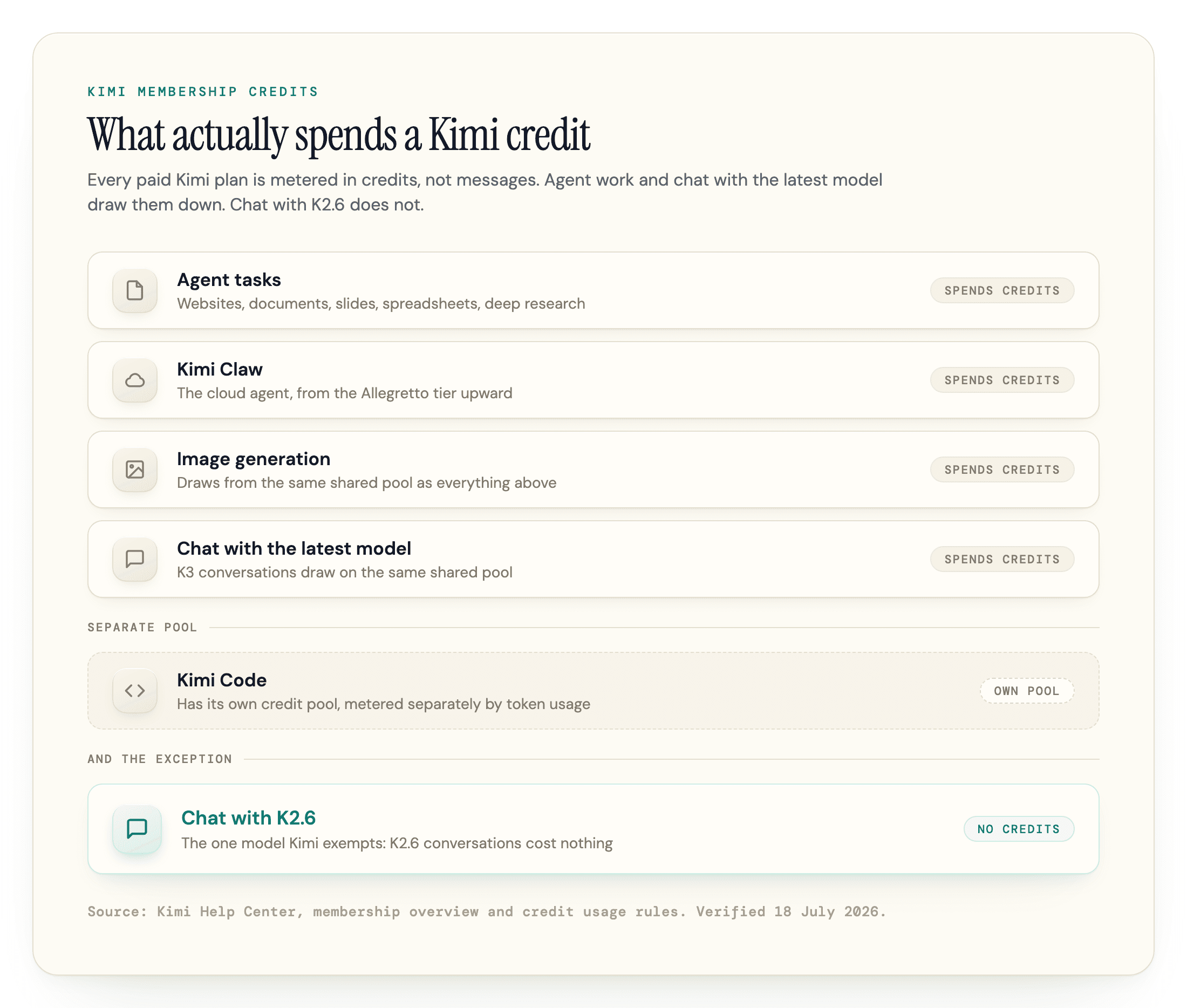
The scope is the whole buying decision. The exemption names K2.6 specifically. Kimi publishes no equivalent for K3, and its credit documentation lists chat with the latest model inside the shared pool. So the free tier's unmetered conversation depends on it serving K2.6, and paying for K3 access is the point at which your chat starts spending credits too.
For the jobs that do spend credits, Kimi offers a rough guide, scoped to free-tier users: a simple slide deck runs about 1% to 2% of your credits, a deep research report 5% to 10%, and a code snippet 0.5% to 2%.
Treat those percentages carefully, because they do not sit easily beside the plan table. Kimi's own footnote defines those credit figures as "the equivalent number of tasks for the same feature", so Adagio's 6 reads as roughly six agent tasks. Yet a deep research report at 5% to 10% of a pool implies ten to twenty of them. Kimi labels the counts "approximate" and "for reference only", which is a fair warning. Do not budget from either figure: run one representative task and watch what it takes out of your balance.
Credits refresh monthly whether you pay monthly or annually, and they land on your subscription anniversary rather than the first of the calendar month. Kimi's own example: subscribe on December 1 at 3:00 PM and they return on January 1 at 3:00 PM.
Nothing rolls over, so there is no banking a quiet month to fund a busy one. Tasks can also hit 5-hour and 7-day concurrency limits shown in the interface. Run out mid-month and the task in flight finishes, but new ones are blocked until the refresh. If a task fails on Kimi's end, the thumbs-down button doubles as a credit refund request.
Monthly vs Annual, and the Downgrade Trap
Annual billing saves you about a fifth, and the rate barely moves between tiers.
| Plan | Monthly | 12 months at monthly | Annual total | You save | Effective discount |
|---|---|---|---|---|---|
| Moderato | $19 | $228 | $180 | $48 | 21.1% |
| Allegretto | $39 | $468 | $372 | $96 | 20.5% |
| Allegro | $99 | $1,188 | $948 | $240 | 20.2% |
| Vivace | $199 | $2,388 | $1,908 | $480 | 20.1% |
That last column is the useful one, and Kimi does not publish it. Work it out from their own figures and the discount is flat at roughly 20% on every tier. Kimi's marketing leads with "save up to $480 a year," which is accurate for Vivace and easy to read as a better deal at the top than it is, because $480 is simply 20% of a bigger number. Several guides report this as "15% to 25%, varies by tier." It does not really vary.
Then there is what happens when you change your mind. Upgrading is painless: immediate, prorated, with the unused portion refunded and a fresh credit allocation that ignores whatever you already burned. Downgrading is not. Per Kimi's plan change rules, downgrades cannot be applied mid-cycle at all: you cancel, keep your tier until it expires, then subscribe lower.
Which is a real argument for starting one tier below what you think you need. Moving up is instant and refunded; moving down costs you the rest of the term. One caveat if you subscribed through the App Store or Google Play: billing changes happen in that store's settings, not on kimi.com, and the cancel and refund rules are the store's rather than Moonshot's.
Is Kimi Cheaper Than ChatGPT or Claude?
At the entry tier, no. Not meaningfully.
Kimi is widely described as the budget option, and on the developer API that reputation was earned. On consumer subscriptions it is not, because the whole market has clustered at the same number.
| Assistant | Free tier | Cheapest paid tier | Main paid tier |
|---|---|---|---|
| Kimi | Adagio: 6 agent credits | Moderato $19 | Moderato $19 |
| ChatGPT | Yes, limited | Plus $20 | Plus $20 |
| Claude | Yes, limited | Pro $20 | Pro $20 |
| Gemini | Yes, limited | Google AI Plus $4.99 | Google AI Pro $19.99 |
| Grok | Yes, limited | SuperGrok Lite $10 | SuperGrok $30 |
A dollar. That is the gap between Kimi's main paid tier and ChatGPT Plus at $20 or Claude Pro at the same price. If you are switching to Kimi to save money on a monthly subscription, you are not saving money. On the API, where the picture changes, our Kimi K3 vs Claude comparison shows K3 winning on cost per task while trailing on speed. Gemini's pricing undercuts everyone with a $4.99 entry plan, Grok's main tier sits highest at $30, and DeepSeek undercuts the lot by giving its app away entirely.
Kimi separates itself elsewhere. Its free tier is genuinely usable rather than a demo, and Moonshot publishes open weights for its K2 and K3 models, with Kimi K3's weights released on July 27, 2026 under a custom Kimi K3 License. That is a self-hosting path neither ChatGPT nor Claude offers, if you have the GPU infrastructure for it.
The "cheap Chinese AI" framing is also under more strain than most guides admit. K3 launched in July 2026 priced at $3 per million input tokens and $15 output on the API, and Artificial Analysis, reviewing it independently, found it expensive for its performance class, against a same-price-tier median nearer $1.75 and $9.00. They also note it is very verbose, which compounds the bill because reasoning tokens are billed as output. That is a frontier price tag from the lab that built its reputation on being the affordable one. DeepSeek and Qwen now sit roughly where Kimi used to, which is the comparison that stings, and we cover that field in Chinese AI models compared.
Which Kimi Plan Should You Buy?
Every tier above Adagio removes one specific constraint, so name the one blocking you. If you cannot, the honest answer is that you do not need to pay yet. One important caveat while the pause holds: this tells you which tier to aim for when sign-ups reopen, not which one to buy today.
Stay on Adagio if you mostly chat and do not need K3. K2.6 conversations do not spend credits, so if that is what you are being served, a paid plan buys you nothing you are short of.
Moderato at $19 is the first tier that changes anything structural. You get 60 agent credits instead of 6, two concurrent tasks, 4x speed priority, Agent Swarm at 25 uses, and access to K3. Worth knowing before you upgrade for the model: K3 chat draws on your credit pool in a way K2.6 chat does not.
Allegretto at $39 adds Kimi Claw and lifts Kimi Code credits from 1x to 5x. Kimi Code's changelog also puts the 1M-token context window here, though the pricing page lists it only on Allegro and Vivace, so check that one before paying if the million tokens is what you are buying. It is also usually the plan people mean when they go looking for a "Kimi Pro" subscription. None of Kimi's five tiers is called Pro.
Allegro at $99 more than doubles your credits, from 150 to 360, and is the first tier to lift concurrency past two.
Vivace at $199 is for maxing everything: 720 credits, 240 swarm uses, 24,000 professional database calls.
So is a Kimi subscription worth it? Yes, when a measured limit is blocking a workflow you repeat, and the cheapest tier that removes that limit is the one to buy. No, if you expect real savings over ChatGPT Plus, because $19 against $20 is a one-dollar difference, and the free tier may already be doing everything you need.
Signing Up, Paying, and Cancelling
Two practical blockers sit before checkout. Registration is region-gated: Kimi accepts phone numbers and email addresses only from supported regions, and rejects VoIP numbers and landlines, so sign-up fails at verification if your number is not on the supported list. Google sign-in and the app's QR code are the alternate routes people reach for, though neither is documented as bypassing the regional restriction.
Payment rails may also be narrower than you expect. Moonshot's developer-platform documentation covers WeChat Pay and Alipay QR top-ups, though that governs API billing rather than membership checkout, and Kimi does not publish an equivalent list for consumer plans. Confirm your card works at checkout before planning around Kimi. Cancellation is in account settings and takes effect at the end of the billing period, or in the app store if you subscribed there.
Why So Many Kimi Prices Online Are Wrong
Most Kimi pricing guides are describing a product that changed underneath them. Kimi has revised its plan structure, its model lineup, and its metering system inside a single year.
The pages Google's AI Overview cites for Kimi's free tier are part of the problem: one of the four is a March 2026 write-up still describing a message-capped free tier that no longer exists.
We tested how far that drift has spread. On July 18, 2026 we put three pricing questions to four models through their APIs with web search enabled, GPT-5.6, Sonar Pro, Gemini 3.5 Flash and Claude Opus 4.8, plus the live ChatGPT web interface, then checked every answer against Kimi's help center. These were single runs, and model answers vary between runs.
Three of the four described Kimi's limits on a daily or weekly cadence rather than the monthly credit pool Kimi operates. Sonar Pro carried a "$9.99 Kimi Pro" tier into its own comparison table, sourced to a third-party listicle. It is the same phantom plan as the "$8 to $19 Pro" above, and no such tier exists. Three repeated the "300 parallel sub-agents" figure against a real ceiling of 8. One, GPT-5.6, did surface the credit exemption and cited Kimi's own help pages for it, though it framed the exemption as covering "its latest models" rather than K2.6 specifically, which is the same mis-scoping this article had to correct. Claude Opus surfaced it too, and was the only one to frame it as a correction to older write-ups, though it got there by way of a third-party site rather than Kimi's documentation.
The live ChatGPT surface was precise on the developer API, citing Moonshot's own docs, and named none of the four paid consumer tiers, collapsing the ladder into "starting at $19 per month" and leaning on a tech news review. The gap is specific to the consumer membership, not a general sourcing failure.
The models are not broken. They are reading whatever they can reach, and here that is mostly aggregator pages carrying last quarter's numbers. It is the same dynamic we track when we measure AI visibility for a brand.
Check the date on any Kimi price, and check the number against Kimi's help center rather than a listicle. If a page still talks about daily message caps, it is describing a product Kimi no longer sells.
One date has now passed: the K2.5 and moonshot-v1 models were retired on August 31, 2026, and calls to them return a 404. (A summer API top-up rebate has since lapsed, and Kimi K3's open weights, once pending, went public on July 27, 2026 under a custom Kimi K3 License.) The K2.6 credit exemption in particular is a vendor policy about a model that is now one generation behind, so re-check it before relying on it.
What This Has to Do with Your Own AI Visibility
Kimi published its prices clearly, on its own site, in a help center any crawler can read. Months later, several of the most-used AI systems still describe those prices incorrectly, invent a tier, or lean on a news site over the source. The vendor did nothing wrong. It got out-published by aggregators, and the models learned the aggregators.
That is the same mechanism that decides how AI answers describe your business. Engines do not verify; they synthesize whatever they can fetch and whatever they absorbed in training. If the accurate version of your pricing is thin on the open web while a stale listing is everywhere, the stale version wins. What decides it is whether a model can reach your page, parse it, and read it without hitting contradictions between sources. That is what generative engine optimization is really about, and at geotoolbox we start with reachability rather than wording, because a page an engine cannot fetch will not be fixed by better copy.
If you have never checked whether the AI crawlers can read your site at all, start there. The free AI Readiness check we built at geotoolbox tells you what they can and cannot fetch, before an engine answers a question about you with somebody else's version of the facts.
Frequently Asked Questions
Is Kimi AI free?
Yes. Kimi's free plan is Adagio, and it needs no credit card: 6 agent credits a month, one agent task at a time, and 200 professional database calls, with no Agent Swarm or Kimi Claw. It does not include K3, and Kimi does not publish which model it serves instead. K2.6 conversations consume no credits, so if that is the model you get, the free tier goes further for chat than for agent work.
How much does a Kimi subscription cost?
Four paid tiers: Moderato at $19 a month, Allegretto at $39, Allegro at $99, and Vivace at $199. Annual billing brings those to $15, $31, $79, and $159 a month, billed as $180, $372, $948, and $1,908 a year. The discount works out at roughly 20% on every tier.
Is a Kimi subscription worth it?
It is worth it when a specific limit blocks something you do repeatedly, and the right plan is the cheapest one that removes that limit. It is not worth buying as a cheaper ChatGPT Plus or Claude Pro, because at $19 against $20 the saving is a dollar. Test on Adagio first.
Does Kimi have a usage limit?
Yes, but not a message limit. Plans are metered by a monthly credit pool that agent tasks, Kimi Claw, image generation and chat with the latest model all draw from, while Kimi Code has a separate pool. Credits refresh on your subscription anniversary and do not roll over. Tasks can also hit 5-hour and 7-day concurrency limits shown in the interface.
Which Kimi plan gives me K3?
Moderato at $19 a month is the first tier with Kimi K3 access, per Moonshot's Kimi Code changelog, which also places the 1M-token context window at Allegretto and above. Kimi's pricing page lists that window only on Allegro and Vivace, so verify it if that is your criterion. Adagio does not include K3, and Kimi does not publish which model it serves instead. Note that K3 chat draws on your credit pool, whereas K2.6 chat does not.
Does a Kimi subscription include API credits?
No. The membership and the developer API are separate products with separate billing. Paying for Moderato does not give you API tokens, and adding funds to an API balance does not grant membership features. If you are building on Kimi rather than using the app, see our Kimi API pricing guide instead.
Sources
- Pricing details (tier prices, annual rates, per-tier allowances) - Moonshot AI, Kimi Help Center, accessed July 18, 2026 -
kimi.com/help/membership/membership-pricing - Membership plans overview (shared credit pool, K2.6 credit exemption) - Moonshot AI, Kimi Help Center, accessed July 18, 2026 -
kimi.com/help/membership/membership-overview - Credit update and usage rules (token metering, refresh, rollover, concurrency limits) - Moonshot AI, Kimi Help Center, accessed July 18, 2026 -
kimi.com/help/membership/update-rules - Membership credit system update (what the shared pool covers, including chat with the latest model) - Moonshot AI, accessed July 18, 2026 -
kimi.com/membership-credits - Public pricing page and subscription status ("Sold out" markers, announced Kimi / Kimi Code split) - Moonshot AI, observed July 20, 2026 -
kimi.com/membership/pricing - Moonshot pauses new Kimi subscriptions as K3 demand outstrips GPU capacity - Reuters, July 20, 2026
- Plan changes (upgrade proration, downgrade restrictions) - Moonshot AI, Kimi Help Center, accessed July 18, 2026 -
kimi.com/help/membership/membership-upgrade-downgrade - Kimi Code changelog, K3 membership availability and the 1M context window - Moonshot AI, accessed July 18, 2026 -
kimi.com/code/docs/en/kimi-code/whats-new.html - Account and payments, developer platform top-up methods - Moonshot AI developer docs, accessed July 18, 2026 -
platform.kimi.ai/docs/guide/account-and-payments - Kimi K3 model analysis (independent pricing and cost-efficiency review) - Artificial Analysis, accessed July 18, 2026 -
artificialanalysis.ai/models/kimi-k3 - Flagship Model Kimi K3 Pricing - Moonshot AI developer docs, accessed July 18, 2026 -
platform.kimi.ai/docs/pricing/chat-k3 - Kimi (chatbot), tier names and K3 launch details - Wikipedia, accessed July 18, 2026 -
en.wikipedia.org/wiki/Kimi_(chatbot) - ChatGPT, Claude, Gemini and Grok subscription prices are stated from each vendor's own published plans and cross-checked against our maintained pricing guides for those products, linked inline, July 2026