
Google Gemini is free to start, and for a lot of people that is the end of the story. If you want more, the paid consumer plans run $4.99 a month for Google AI Plus, $19.99 for Google AI Pro, and $99.99 to $199.99 for Google AI Ultra. Build with the API instead and you pay per token, starting around $0.10 per million.
The catch is that Google reshuffled and repriced these plans more than once in 2026, so a lot of the Gemini pricing guides you will find quote numbers that no longer exist. Below is every current price, reconciled from each vendor's own pricing page, plus the question the numbers exist to answer: which plan, if any, you should actually pay for.
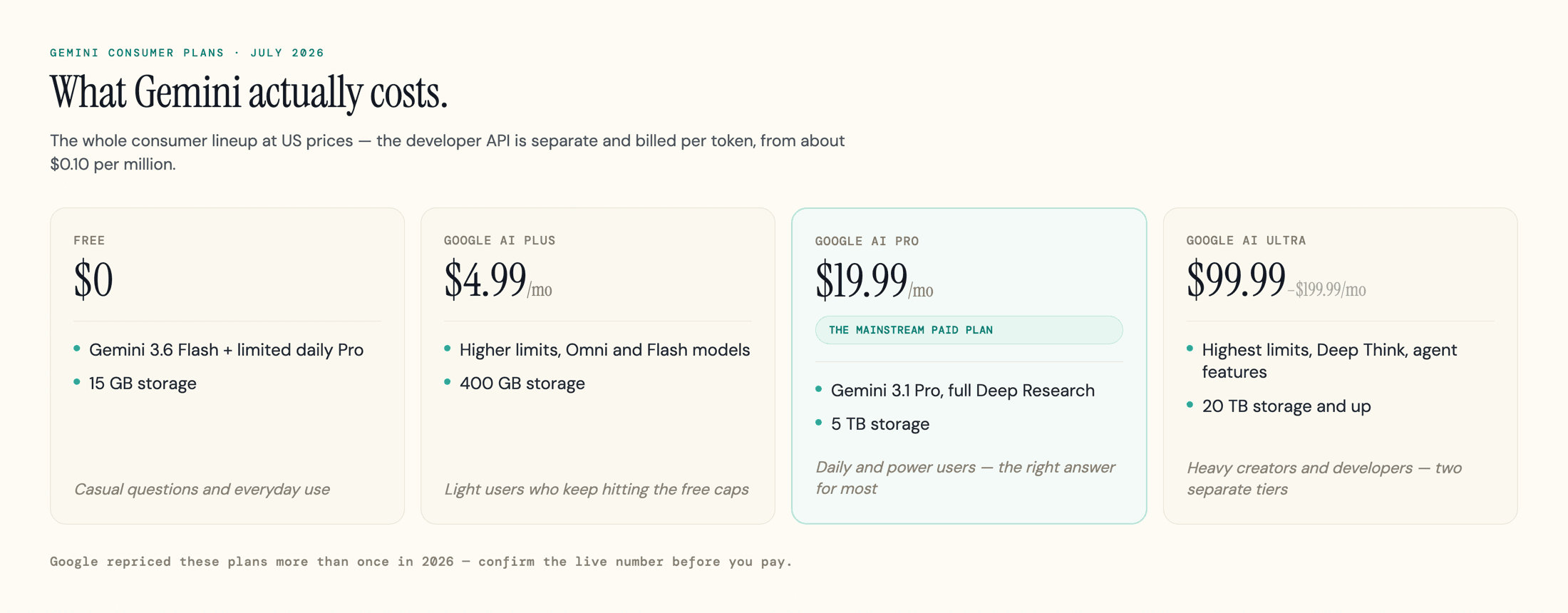
How Much Does Gemini Cost? Every Plan at a Glance
Here is the whole consumer lineup in one place, at US prices as of July 2026.
| Plan | Price (US, per month) | Storage | Key model access | Best for |
|---|---|---|---|---|
| Free | $0 | 15 GB | Gemini 3.6 Flash, limited daily Pro | Casual questions and everyday use |
| Google AI Plus | $4.99 | 400 GB | Higher limits, Gemini Omni and Flash | Light users who want more headroom |
| Google AI Pro | $19.99 | 5 TB | Gemini 3.1 Pro, full Deep Research | Daily and power users (the mainstream paid plan) |
| Google AI Ultra | $99.99 to $199.99 | 20 TB and up | Highest limits, Deep Think, agent features | Heavy creators and developers |
Two things cause most of the confusion.
Gemini is sold two completely different ways. One is the consumer app, where you pay a flat monthly subscription, which is the table above. The other is the developer API, where your software pays per token for whatever it sends and receives, with no subscription at all. Most people reading a pricing page want the first one. If you are wiring Gemini into your own product, skip down to the API pricing. There is also a third path for organizations: Gemini is sold per seat inside Google Workspace business and enterprise plans, which is a separate price book from the consumer tiers here.
The second point: the paid plans are bundled into Google One, the same subscription that sells cloud storage. That is why each tier comes with a big storage allowance attached, and it is also why canceling trips people up. We come back to that at the end. All the consumer plans bill monthly, with no meaningful annual-prepay discount, so the monthly figure is the figure. For the bigger picture of what these models actually are, our guide to what Google Gemini is covers the lineup in plain terms.
Is Gemini Free? What the Free Tier Actually Gives You
Yes. Gemini has a genuinely useful free tier, and for most people it is enough.
On the free plan you get the Gemini app at no cost, with Gemini 3.6 Flash as the default model and a daily allowance of the stronger Pro model for harder questions. You also get image generation, voice mode, 15 GB of shared Google storage, and a small number of Deep Research reports. The honest catch is throttling. Heavy use of the Pro model hits daily caps, and during busy periods the app can quietly drop you from Pro back to Flash.
What "limited Pro access" actually means is the part most pricing guides skip, and it is the number that decides whether you need to pay. Google does not publish an exact figure, and the caps shift, but the pattern users report is a handful of Pro prompts and one or two Deep Research reports a day before you are bumped back to Flash. Ask a few questions a day and you will never hit it. Run document-heavy research all day and you will hit it fast, which is the real signal to consider a paid plan.
The other free-tier ceiling is the one almost every comparison gets wrong: the context window is gated by plan, not shared across them. Per Google's own limits page, the Gemini app gives you 32K tokens with no AI plan, 128K on Google AI Plus, and 1 million on AI Pro and AI Ultra. Google's own yardstick puts 1 million tokens at about 1,500 pages of text; the free tier's 32K is roughly 50. So the headline million-token figure you see quoted for Gemini is a paid feature, and if your reason for considering a paid plan is dropping whole documents into one prompt, that is the number that decides it, not the daily Pro allowance.
There is also a free tier on the developer side. The Gemini API gives you free, rate-limited access to most models through Google AI Studio with no credit card. The trade is that free-tier traffic can be used to improve Google's products, so it is fine for prototyping and wrong for anything confidential. Paid API usage, by contrast, is not used to train Google's models. More on that in the API section below.
Google AI Plus ($4.99 a Month): The Cheap Entry Tier
Google AI Plus is the budget paid plan, and it just got cheaper. In June 2026, Google cut Plus from $7.99 to $4.99 a month and doubled its storage from 200 GB to 400 GB, part of a broader price war among AI subscriptions.
For $4.99 you get roughly double the free-tier usage limits, a 128K context window (up from 32K), access to the Gemini Omni and Flash models, entry-level Deep Research, Omni Flash for video generation, and the 400 GB of storage. It stops short of the top Pro models, which the next tier adds.
Who it is for: light users who keep bumping into the free-tier caps but cannot justify $20 a month. At $4.99 it is one of the cheapest serious AI subscriptions from a major lab, and the storage alone makes it competitive with a plain Google One plan.
Google AI Pro ($19.99 a Month): The Mainstream Plan
If you have heard of "Gemini Advanced," this is its descendant, though the naming took a detour that trips people up at checkout. Gemini Advanced became Google One AI Premium, and Google's own plan page now says the AI Premium plan "has a new name: Google AI Plus" — the $4.99 tier above, with 400 GB of storage. The full-strength tier that most people mean by "Gemini Advanced" is this one, Google AI Pro at $19.99. So if you are following an old guide, check the storage figure and the price rather than the name: 400 GB means you are looking at Plus, 5 TB means Pro.
For that you get access to Gemini 3.1 Pro, the full one-million-token context window, full Deep Research, video generation with Omni Flash, 1,000 Google Flow credits for Google's creative tools, early access to Gemini Spark (the 24/7 agent that takes action on your behalf, in select countries and languages), and roughly four times the free-tier usage limits. Storage jumps to 5 TB, up from the 2 TB it carried earlier in the year at the same price. The plan also brings Gemini into Gmail and Docs, raises the limits in Google's coding tools, and adds the Jules coding agent, an upgraded Gemini Notebook (formerly NotebookLM), and Antigravity, Google's agentic development environment.
The number that matters for comparison: $19.99 lands a cent under ChatGPT Plus at $20, so the two are a direct fight. Which one wins depends on whether you live in Google's apps or OpenAI's, and we break that down in Gemini vs ChatGPT. One thing worth checking before you pay: Google's student offer is live. The US plans page currently offers eligible students Google AI Pro free for a year, including the 5 TB of storage and the higher Gemini limits, with eligibility verified through SheerID at sign-up. Student pricing runs for up to four years and then renews automatically at the standard monthly rate. It is not available on school-issued accounts, and availability is country-scoped — it covers most markets but excludes a handful, Canada among them.
Who it is for: daily users who hit the free caps, anyone who wants Deep Research and Veo without the throttling, and people already paying for 2 TB of Google One who can fold storage and AI into one bill.
Google AI Ultra ($99.99 to $199.99 a Month): The Power Tier
Ultra is where the pricing gets genuinely confusing, because there are now two of them.
At Google I/O in May 2026, Google restructured the top of the lineup. It introduced a new $99.99 Ultra tier aimed at developers and serious creators, and it cut the existing top tier from $249.99 to $199.99. So the two Ultra prices are not a typo. They are two different plans.
Both Ultra tiers share the same headline features: Deep Think, Gemini's hardest reasoning mode, and Project Genie, the interactive-world-model tool, are included on both the $99.99 and the $199.99 plan, not gated to the top tier alone. The $99.99 tier gives you about five times the Pro plan's usage limits, priority access to Antigravity, 20 TB of storage, and a YouTube Premium plan. The $199.99 tier pushes usage limits to roughly twenty times Pro, adds 4K image and video upscaling, up to 25,000 Google Flow credits, and 30 TB of storage.
That earlier $249.99 price is the one that made consumers wince, and the cut plus the new mid-tier is Google's answer to it. Even so, Ultra is a professional tool, and almost nobody needs the $200 plan for everyday use. It is built for people generating video at volume or running heavy agentic workflows. If you are not sure you need it, you do not.
Who it is for: high-volume creators, developers leaning on Antigravity and the agent tooling, and teams that will genuinely use Deep Think and tens of thousands of credits a month.
Gemini API Pricing: Pay-Per-Token by Model
If you are building software on Gemini rather than chatting with it, you do not buy a plan at all. You pay per token, the chunks of text the model reads and writes, billed separately for input and output. You can reach the same models two ways: the Gemini Developer API, which is the simplest path, or Vertex AI on Google Cloud, which carries the same per-token rates but adds enterprise billing, data governance, and SLAs. Here are the current pay-as-you-go rates for the models worth using as of July 2026.
| Model | Input (per 1M tokens) | Output (per 1M tokens) | Notes |
|---|---|---|---|
| Gemini 2.5 Flash-Lite | $0.10 | $0.40 | Cheapest model overall |
| Gemini 3.1 Flash-Lite | $0.25 | $1.50 | Prior-generation budget tier |
| Gemini 2.5 Flash | $0.30 | $2.50 | Fast, multimodal workhorse |
| Gemini 3.5 Flash-Lite | $0.30 | $2.50 | Budget tier (July 2026) |
| Gemini 3 Flash (Preview) | $0.50 | $3.00 | Prior-generation Flash |
| Gemini 3.7 Flash | $0.75 | $3.75 | Promotional rate through Dec 31, 2026 |
| Gemini 3.8 Flash | $0.75 | $3.75 | New default workhorse (Sept 2026); promotional rate through Dec 31, 2026 |
| Gemini 3.6 Flash | $0.75 | $3.75 | Promotional rate through Dec 31, 2026 (then $1.50 / $7.50) |
| Gemini 3.5 Flash | $1.50 | $9.00 | Superseded by newer Flash models |
| Gemini Omni Flash | $1.50 | $9.00 text / $17.50 video | Google's video generation and editing model (about $0.10 per second of 720p); paid tier only |
| Gemini 2.5 Pro | $1.25 / $2.50 | $10.00 / $15.00 | Higher rate for prompts over 200K tokens |
| Gemini 3.1 Pro (Preview) | $2.00 / $4.00 | $12.00 / $18.00 | Top Pro model in the public API, paid only; higher rate over 200K tokens |
A few things to read into that table. Flash-Lite is the floor and Pro is the ceiling, and the gap is wide: Gemini 3.1 Pro costs eight times more per input token than 3.1 Flash-Lite, and the older 2.5 Flash-Lite is cheaper still. For classification, extraction, and routine summarizing, the cheap models are usually fine, and routing simple work to Flash-Lite is where most teams find their savings.
Output costs far more than input, usually four to eight times, so long-winded responses are where bills balloon. The Pro models also carry a context cliff: once a single prompt crosses 200,000 tokens, Gemini 3.1 Pro input roughly doubles to $4.00 and output climbs to $18.00 per million. Retrieval pipelines that stuff large documents into every call can quietly cross that line on every request.
One model to watch: Gemini 3.5 Pro still has not shipped. It has missed several targeted launch dates after Google reportedly rebuilt the base model, and Google has confirmed no release date, no context window, and no pricing for it. It does not appear on the Vertex AI pricing page (renamed the Gemini Enterprise Agent Platform in April 2026) or in the Gemini API model list. Until it lands, 3.1 Pro Preview is the top Pro model in the general API. Two more changes worth flagging if you are pricing this from an older guide: Google shut down Gemini 2.0 Flash and 2.0 Flash-Lite on June 1, 2026, so any table still listing them as live is out of date, and it pulled its newest Pro model out of the free API tier in April, so experimenting with 3.1 Pro now costs money from the first call, though 2.5 Pro still carries a free tier. Most current models share a one-million-token context window, so the differences are about speed, reasoning quality, and price, not how much they can read. Google's developer API pricing page is the source of record and was last updated on September 11, 2026, so check it before you commit a budget. For the developer's full cost reference, the Standard, Batch, Flex, and Priority service tiers, the free-tier and rate-limit ladder, and a worked example of a real API bill, see our Gemini API pricing guide.
The Hidden API Costs: Batch, Caching, Reasoning, and Media
The per-token rates are only half the API bill. Four things move the real number, and only the first two move it down.
Batch mode cuts every paid request in half. If a job does not need an instant answer, like overnight enrichment or bulk generation, sending it through the Batch API gets a flat 50% discount in exchange for up to 24 hours of latency. It is the single biggest saving most teams skip.
Context caching pays off when you reuse the same context. If every call ships the same long system prompt, policy document, or codebase, caching it means you pay roughly 10% of the input rate on the repeats, plus a small hourly storage charge. For chatbots and document tools that reread the same material, the savings are large.
Reasoning tokens are the one that surprises people. Gemini's thinking models bill their internal reasoning as output tokens, even when the visible answer is short. A model with a low headline rate can therefore cost more in practice than one with a higher rate but terser reasoning. When you compare API prices, the sticker rate is a starting point, not the bill.
Then there are the separate meters. Image and video generation are not priced in text tokens at all. Google's image model, the one nicknamed Nano Banana, runs around $0.039 an image, and Veo 3.1 video generation runs from about $0.05 a second on the Lite model up to $0.60 a second for Standard at 4K. Audio is metered too: audio input costs more per token than text, and the Live API voice models bill separately again. Grounding a response in live Google Search is its own line: the Gemini 3 family gets 5,000 grounded prompts a month free and then $14 per thousand, while the 2.5 models get 1,500 free requests a day before the rate rises to $35 per thousand.
A habit worth borrowing from finance teams: track cost per API call, not just total spend. Two identical-looking requests can bill very differently depending on context length and output, and averages hide the few expensive calls driving most of the cost.
Gemini vs ChatGPT vs Claude: Which Is Cheaper?
On the consumer side, Gemini is the price leader. Its $4.99 Plus tier undercuts everyone, and its $19.99 Pro plan matches ChatGPT Plus and Claude Pro, which both sit around $20. If you are choosing purely on price, Gemini wins the entry tier outright.
On the API the picture is more nuanced, and it is where the cheapest sticker price can mislead.
| Provider | Paid consumer plan | Representative API model (input / output per 1M) |
|---|---|---|
| Google Gemini | AI Plus $4.99 / AI Pro $19.99 | Gemini 2.5 Flash, $0.30 / $2.50 |
| OpenAI ChatGPT | ChatGPT Plus about $20 | GPT-5.6 Sol, about $4.00 / $20.00 (promotional to Nov 21, 2026); GPT-6 Astra $10.00 / $50.00 |
| Anthropic Claude | Claude Pro about $20 | Claude Sonnet 5, $2.00 / $10.00 (permanent rate) |
Gemini's Flash models are among the cheapest credible options for high-volume work. Gemini 2.5 Flash at $0.30 input and $2.50 output is a fraction of what the frontier models charge: GPT-5.6 Sol runs about $4.00 and $20.00 (and GPT-6 Astra $10.00 and $50.00), and Claude Sonnet 5 $2.00 and $10.00, its permanent rate (the previously planned rise to $3.00 input was cancelled). The fair fight is Flash against each rival's own cheap tier, but even there Gemini tends to win on price, and at scale that gap is real money.
But remember the reasoning-token tax. All three providers charge for the model's internal thinking on their reasoning tiers, so a head-to-head on base rates can flip once you measure how verbose each model's reasoning actually is on your workload. The honest move is to benchmark your real prompts on two or three models before committing, not to pick the lowest number in a table.
For the full feature-by-feature picture rather than just price, see our comparisons of Gemini vs ChatGPT and Claude vs Gemini.
Which Gemini Plan Should You Actually Pay For?
Most people overbuy. Here is the honest decision, from the bottom up.
Stay free if you ask Gemini a handful of questions a day and rarely run Deep Research. The free tier covers it, and you will know you have outgrown it the day the app starts dropping you to the lighter model mid-task.
Pay $4.99 for Plus if you keep hitting the free caps but do not need the top Pro models, or if the 400 GB of storage alone is worth it next to a plain Google One plan.
Pay $19.99 for Pro if you use Gemini daily for real work, want the full Pro models and uncapped Deep Research, or already pay for Google One storage and can consolidate. This is the right answer for most paying users.
Pay for Ultra only if you generate video at volume, lean on the agent tooling, or will genuinely use Deep Think. The $99.99 tier is the sane entry point; the $199.99 tier is for professionals who can name exactly why they need it.
Use the API instead of a plan if you are building a product. A subscription buys one person a seat in the app; the API meters whatever your software does, and for anything programmatic that is the only model that makes sense.
Two practical traps before you buy. First, because the plans are bundled into Google One, canceling Gemini and canceling your storage are not the same action, and people get billed after they think they quit. Cancel on the platform you subscribed through, whether that is the web, the Play Store, or the App Store, and confirm your Google One storage stays at the level you actually want. And if you start on a free trial, it converts to the full monthly price automatically, so set a reminder before it renews. Second, a paid plan does not buy identical features everywhere. Gemini Spark, the 24/7 agent, is included from Google AI Pro upward but only in select countries and languages, so a buyer outside those markets can pay the same $19.99 or $199.99 for a thinner feature set.
Why Gemini's Price Tag Matters for Your Brand
Here is the part that outlasts any specific price. Whichever tier people pay for, Gemini is no longer just a chatbot they visit. It is the engine behind the AI answers in Google Search. AI Overviews and AI Mode run on Gemini and reach billions of people a month, which means the model is already summarizing your category and naming competitors to searchers who never open the app.
So the more useful budget question is not which plan you buy. It is whether Gemini mentions your brand at all when someone asks it what to use. That is the gap we help businesses close, and it does not come on a pricing tier.
The numbers above will move again, because Google has repriced Gemini repeatedly in 2026 alone, so confirm the current figure on Google's plans page or developer pricing page before you pay. And once you know what Gemini costs, the next question is what it says about you. Our Citation Interceptor maps where Gemini, Google AI Overviews, and the other AI engines cite sources your brand is missing from, so you can see which conversations to get into. You can learn the broader method in our guide to tracking AI visibility.
Frequently Asked Questions
How much does Gemini cost per month?
Gemini is free to start. Paid consumer plans are Google AI Plus at $4.99, Google AI Pro at $19.99, and Google AI Ultra at $99.99 or $199.99 a month, as of July 2026. The developer API is separate and billed per token, starting at $0.10 per million.
Is Gemini free?
Yes. The free tier gives you Gemini 3.6 Flash, a daily allowance of the stronger Pro model, image and voice, and 15 GB of storage, with throttling under heavy use. The API also has a free, rate-limited tier, though free-tier traffic can be used to improve Google's products.
Is Gemini Advanced the same as Google AI Pro?
Roughly, but the naming is messier than a straight rename. "Gemini Advanced" became Google One AI Premium. Google's plan page now states that the AI Premium plan "has a new name: Google AI Plus," which is the $4.99 tier with 400 GB of storage, while Google AI Pro is the $19.99 tier with 5 TB. If an older guide quotes "Gemini Advanced pricing" at around $20 a month, it is describing today's Pro tier. Go by the price and the storage allowance rather than the plan name.
Is Gemini cheaper than ChatGPT or Claude?
On consumer plans, yes. AI Plus at $4.99 undercuts the roughly $20 ChatGPT Plus and Claude Pro tiers, and AI Pro matches them at $19.99. On the API, Gemini's Flash models are among the cheapest, but reasoning-token charges mean you should benchmark your own workload before deciding.
What is the cheapest Gemini API model?
Gemini 2.5 Flash-Lite at $0.10 per million input tokens and $0.40 output. The newest budget tier is 3.5 Flash-Lite (July 2026) at $0.30 and $2.50, though the prior 3.1 Flash-Lite is a touch cheaper at $0.25 and $1.50. Batch mode halves either rate.
How do I cancel Gemini without losing my Google One storage?
Cancel the AI plan from the same platform you subscribed through, then check your Google One tier afterward. Because the AI subscription and storage are bundled, canceling one does not automatically change the other, which is why people get billed after they think they quit.
Sources
- Gemini Developer API pricing - Google AI for Developers -
ai.google.dev/gemini-api/docs/pricing - Google AI plans - Google One -
one.google.com/about/google-ai-plans - Google AI Pro and Ultra subscriptions - Gemini -
gemini.google/subscriptions - Everything new in our Google AI subscriptions, fresh from I/O 2026 - blog.google -
blog.google/products-and-platforms/products/google-one/google-ai-subscriptions - Google AI Plus gets price drop to $4.99 and storage bump - 9to5Google -
9to5google.com/2026/06/08/google-ai-plus-price-drop - Google just fired a warning shot in the AI subscription price wars - TechCrunch -
techcrunch.com/2026/06/09/google-just-fired-a-warning-shot-in-the-ai-subscription-price-wars