
The DeepSeek app is free. That is the whole answer for most people who type "DeepSeek pricing" into Google. You pay nothing to chat with it on the web or in the app, and there is no Plus or Pro subscription to upsell you.
The money question only starts when you move to the API. And there the news is good: DeepSeek is still close to the cheapest frontier-class pricing you can buy, with the current Flash tier, DeepSeek-V4.1-Flash, starting at $0.15 per million input tokens off-peak and V4 Pro at $0.66 input / $1.98 output off-peak, as of September 2026. The catches, and there are two new ones: DeepSeek replaced V4 Flash outright with V4.1 Flash on September 10, 2026, at a lower price than before, and it separately floated then reversed a plan to fold V4 Pro into that same Flash tier, so Pro survives as its own pricier option after all. Its closest open-weight rival on price is Moonshot's Kimi, though the arrival of K3 moved that lineup upmarket; see our Kimi API pricing breakdown and, for the consumer plans, our Kimi pricing guide. The other catch is that many of the pricing guides you will find still quote the April 2026 launch price of $1.74 and $3.48 for V4 Pro, the July flat rate of $0.435 and $0.87, the August 16 peak/off-peak V4 Flash rate of $0.22 and $0.66, or a mix of all three, all now stale. Below is every current price, reconciled and dated, the two things that move your bill most, and whether it is worth paying for. For how DeepSeek's rate sits against every other provider per million tokens, see our AI token cost comparison.
How Much Does DeepSeek Cost? Free App vs Paid API
DeepSeek is sold as two different things, and almost all the confusion comes from mixing them up.
The consumer product is the DeepSeek chat app on the web and phone. It is free, has no subscription tier, and is what most searchers want. The API is a separate, developer-facing service you pay for per token, used to wire DeepSeek into your own apps, agents, or coding tools. Free chat access does not include free API usage.
| What you use | What it costs | Who it is for |
|---|---|---|
| DeepSeek app (web + mobile) | Free, no subscription | Anyone chatting with DeepSeek directly |
| DeepSeek API - V4.1 Flash | From $0.15 / $0.60 per 1M tokens off-peak (up to $0.30 / $1.20 at peak hours) | High-volume apps, chatbots, extraction, most coding, now with native image input |
| DeepSeek API - V4 Pro | $0.66 / $1.98 per 1M tokens off-peak (up to $1.32 / $3.96 at peak hours) | Hard reasoning, complex code, agentic work |
If you just want to use DeepSeek, stop at the free app and skip the rest of this page. If you are building on it, the sections below are where the real cost lives, and it is not the sticker price. For the bigger picture of what the models are and where DeepSeek came from, our guide to what DeepSeek is covers the history and the open-weights story in plain terms.
Is DeepSeek Free? What the App Actually Gives You
Yes. The DeepSeek app is free, with no paid consumer plan at all.
Sign in at chat.deepseek.com or the mobile app and you get the full chat experience, including the V4 model, web search, and file uploads, at no charge. Unlike ChatGPT Plus or Claude Pro at around $20 a month, DeepSeek does not sell a fixed monthly subscription for individual use. The reason is straightforward: the consumer chat is already free, and the API is prepaid per token, so there is nothing to bundle into a monthly plan.
The one limit worth knowing is fair-use throttling. During heavy traffic you may see "Server Busy" messages and slower responses, which is DeepSeek managing load rather than a paywall. There is no per-day message quota the way some rivals cap their free tiers. The other thing to keep in mind: the app accepts image uploads as of September 10, 2026, but it still does not generate images, video, or audio, so if you came looking for a free image generator, this is not it.
DeepSeek API Pricing: V4.1 Flash and V4 Pro
If you are building on DeepSeek, you pay per token, the chunks of text the model reads and writes, billed separately for input and output, and, since August 16, 2026, separately again for peak and off-peak hours. There are two current models, and the lineup is deliberately simple, though the Flash tier changed again on September 10, 2026. Here are the rates from DeepSeek's official API docs.
| Model | Input, cache miss (per 1M) | Input, cache hit (per 1M) | Output (per 1M) | Context |
|---|---|---|---|---|
| deepseek-flash (V4.1 Flash), off-peak | $0.15 | $0.003 | $0.60 | 1M |
| deepseek-flash (V4.1 Flash), peak | $0.30 | $0.006 | $1.20 | 1M |
| deepseek-v4-pro, off-peak | $0.66 | $0.022 | $1.98 | 1M |
| deepseek-v4-pro, peak | $1.32 | $0.044 | $3.96 | 1M |
Peak hours are 01:00-04:00 and 06:00-10:00 UTC, Monday to Friday; every other hour, including weekends, is off-peak. Off-peak rates are exactly half of peak across every column, so the fastest way to estimate your bill is to price it at off-peak and then check what share of your traffic falls in those two UTC windows.
Both models share a one-million-token context window and up to 384K tokens of output, with no separate long-context surcharge, so a huge prompt bills at the same per-token rate as a small one at whatever time of day it runs. Flash is the default workhorse: chat, extraction, classification, summarization, most coding, and, new as of September 10, image input, since V4.1 Flash is DeepSeek's first Flash-tier model with native vision (V4 Pro still has none). V4 Pro is the stronger model for hard reasoning, multi-step analysis, and demanding code, and it now costs roughly 4.4 times Flash on cache-miss input and 3.3 times on output at off-peak rates, a wider gap than before September 10 since Flash got cheaper while Pro held steady.
Naming has two layers now. First, if you have seen deepseek-chat and deepseek-reasoner in older tutorials, those are legacy aliases DeepSeek retired on July 24, 2026, replaced by deepseek-v4-flash and deepseek-v4-pro. Second, deepseek-v4-flash and deepseek-v4-flash-vision-exp were themselves retired on September 10, 2026: DeepSeek's current model is deepseek-flash, and the old names are, in DeepSeek's own wording, "temporarily routed" to V4.1 Flash and billed at its (lower) price, so code you have not touched since August is quietly running a different, cheaper, vision-capable model today. Temporary means don't build on the old name going forward. R1 was DeepSeek's earlier standalone reasoning model, now succeeded by the V4 line's built-in thinking mode.
The cache-hit and cache-miss columns are not a typo. That roughly fifty-fold gap between $0.15 and $0.003 on off-peak Flash input is the single most important thing to understand about DeepSeek pricing, and it is why your real bill rarely matches the number you first read. The next two sections cover why.
Cache-Hit vs Cache-Miss: Why the Sticker Price Isn't Your Bill
DeepSeek charges two different input prices, and which one you get depends on context caching.
Caching is automatic and on by default. When the beginning of your request matches something DeepSeek processed recently (a reused system prompt, a shared set of instructions, a document you keep sending), those matching tokens bill at the cache-hit rate instead of the full input rate. On Flash that drops input from $0.15 to $0.003 per million tokens off-peak (or $0.30 to $0.006 at peak), a 98% reduction either way. On V4 Pro the cache-hit rate cuts input by roughly the same margin, an even bigger discount in absolute dollars since Pro's cache-miss rate is higher to begin with. There is no separate cache-write charge and no hourly storage fee, so caching is pure savings.
The condition is that cache hits need an exact matching prefix. Put your static content, the system prompt and instructions, at the very start of the request, and your variable content at the end. A small change near the front breaks the match and sends those tokens back to the full cache-miss rate. Caching also works on a best-effort basis, so rather than assuming every repeated prompt hits the cache, track the prompt_cache_hit_tokens and prompt_cache_miss_tokens fields DeepSeek returns with each response and tune from there.
This is why quoting "DeepSeek Flash is $0.15" is only half true. A workload that reuses a long system prompt across thousands of calls pays far less than that on input; a workload that sends a fresh prompt every time pays the full rate, and whether that request lands in a peak or off-peak UTC window moves it again. Your architecture and your traffic's time zone, not the price list, decide which bill you get.
Why Your DeepSeek Bill Runs Higher Than the Off-Peak Sticker Price
The other surprises are on the output side and the clock.
Both V4 models run in thinking mode by default. Before it answers, the model generates internal reasoning tokens, and those tokens bill at the output rate even though they are not part of the final answer. So a request that returns a two-line answer can quietly produce thousands of billed reasoning tokens first. If your bill is higher than the sticker price suggested, thinking mode left on for simple tasks is the most common reason. Turning it off for routine work (classification, extraction, short replies) cuts output tokens directly.
Output is also the expensive side of the ledger. On V4 Pro it costs three times the off-peak cache-miss input rate; on Flash the ratio widened to four times since the September 10 cut dropped input further than output. Combined with a 384K maximum output and default thinking, runaway responses are the main way DeepSeek bills get "weird." The peak-hour window adds a third lever: 01:00-04:00 and 06:00-10:00 UTC bill everything, input and output alike, at double the off-peak rate, so a workload that happens to run heavy during those seven hours a day pays noticeably more than the same volume shifted a few hours earlier or later. Cap your output length, ask for concise or structured responses, batch what you can outside peak hours, and reserve the long generations for tasks that genuinely need them.
What DeepSeek Costs Per Month, in Real Dollars
Per-token rates are hard to feel, so here is what typical workloads actually cost on Flash at off-peak rates, the model most production traffic should use, recalculated at the current $0.15 in / $0.60 out rate. Peak-hour traffic runs roughly double every figure here.
| Workload | Rough monthly cost (off-peak) | Model |
|---|---|---|
| Customer support chatbot, ~1,000 conversations | ~$3.00 (under $1.50 with caching) | V4.1 Flash |
| Same chatbot on the stronger model | ~$11.00 | V4 Pro |
| Summarizing 100 PDFs | ~$0.35 | V4.1 Flash |
| 30 articles of content generation | ~$0.07 | V4.1 Flash |
The pattern holds at scale. Light personal use tends to land around $2 to $7 a month off-peak, small production apps around $7 to $35, and heavier production workloads in the low hundreds, more if traffic clusters in the 01:00-04:00 or 06:00-10:00 UTC peak windows. Those are Flash numbers, now somewhere between 9% and 32% cheaper than before September 10 depending on how input-heavy or output-heavy your workload runs (Flash's cache-miss input fell 32%, output fell 9%; most mixed workloads land in the middle of that range). V4 Pro did not move: the same volume there still costs roughly three to four times the Flash figures, not one flat multiple, because Flash's September cut was uneven (input fell more than output), which widened the Pro-to-Flash gap by more on input than on output. New API accounts have often been given a small promotional grant of free tokens to test with, though the amount and expiry change over time, so check your balance on the platform after signing up rather than trusting a fixed figure from a guide.
How DeepSeek Billing Works, and How to Start
The API runs on a prepaid balance, not a subscription or a monthly invoice. You top up a credit balance, and each call draws it down. There is no seat fee and no auto-renewing plan, so your spend is capped at whatever you loaded.
The gotcha that catches people: if the balance hits zero, requests start failing with a 402 Insufficient Balance error even though your API key is still valid and the free app keeps working normally. Topping the balance back up clears it immediately, and unused credit does not expire. It is worth setting a low-balance alert if anything production depends on the API.
One thing that makes DeepSeek easy to adopt is that the API is OpenAI-compatible and Anthropic-compatible. In most existing code you point the base_url at DeepSeek and swap the key rather than rewriting anything, which is a big part of why teams move workloads onto it to cut costs.
Is DeepSeek Cheaper Than ChatGPT, Claude, and Gemini?
On the API, yes, and by a wide margin. That price gap is much of why DeepSeek matters commercially.
| Model | Input (per 1M) | Output (per 1M) |
|---|---|---|
| DeepSeek V4.1 Flash (off-peak) | $0.15 | $0.60 |
| DeepSeek V4 Pro (off-peak) | $0.66 | $1.98 |
| Grok 4.3 | $1.25 | $2.50 |
| Gemini 3.1 Pro | ~$2.00 | ~$12.00 |
| Claude Opus 5.5 | ~$4.00 | ~$20.00 |
| GPT-6 Sol (since Sep 22, 2026) | ~$2.00 | ~$10.00 |
| GPT-5.6 Sol (prior gen, promo to Nov 21, 2026) | ~$4.00 | ~$20.00 |
Against a top-tier model like Claude Opus 5.5, V4 Pro is now roughly 6 times cheaper on input and roughly 10 times cheaper on output at off-peak rates; at peak hours that shrinks further to roughly 3 and 5 times. V4.1 Flash widens the off-peak gap further still, at roughly 27 times cheaper than Opus 5.5 on input and 33 times on output, since it got a price cut of its own on September 10. Opus 5.5's lower $4/$20 list price, set at its September 22 launch, narrowed these gaps from the roughly 7.5x and 13x (V4 Pro) that applied against Opus 5's $5/$25.
These are flagship tiers, which is the honest frame: each rival also runs a budget model, and some dip below DeepSeek Flash: Google's Gemini 2.5 Flash-Lite is $0.10 on input, and OpenAI's GPT-6 Luna ($0.10/$0.50, since September 22) undercuts it on both input and output. Every Western provider also offers a 50% batch discount on bulk jobs that DeepSeek has no answer to. Grok 4.3 in the table is xAI's value model rather than its flagship (the current flagship, Grok 4.7, runs $2/$6, same as the prior Grok 4.6). OpenAI's own true current flagship is GPT-6 Astra at $10/$50, well over double Claude Opus 5.5's $4/$20 (it was exactly double the earlier Opus 5's $5/$25); GPT-6 Sol, in the table, is OpenAI's current mid-tier model at $2/$10 since September 22, 2026, which puts V4 Pro about 5 times cheaper on output; the prior-generation GPT-5.6 Sol stays on a promotional rate (cut from $5/$30 to $4/$20 on August 21, 2026) only through November 21, 2026. Against the top tier of each rival, DeepSeek sits in a dramatically cheaper bracket on both its Flash and Pro tiers.
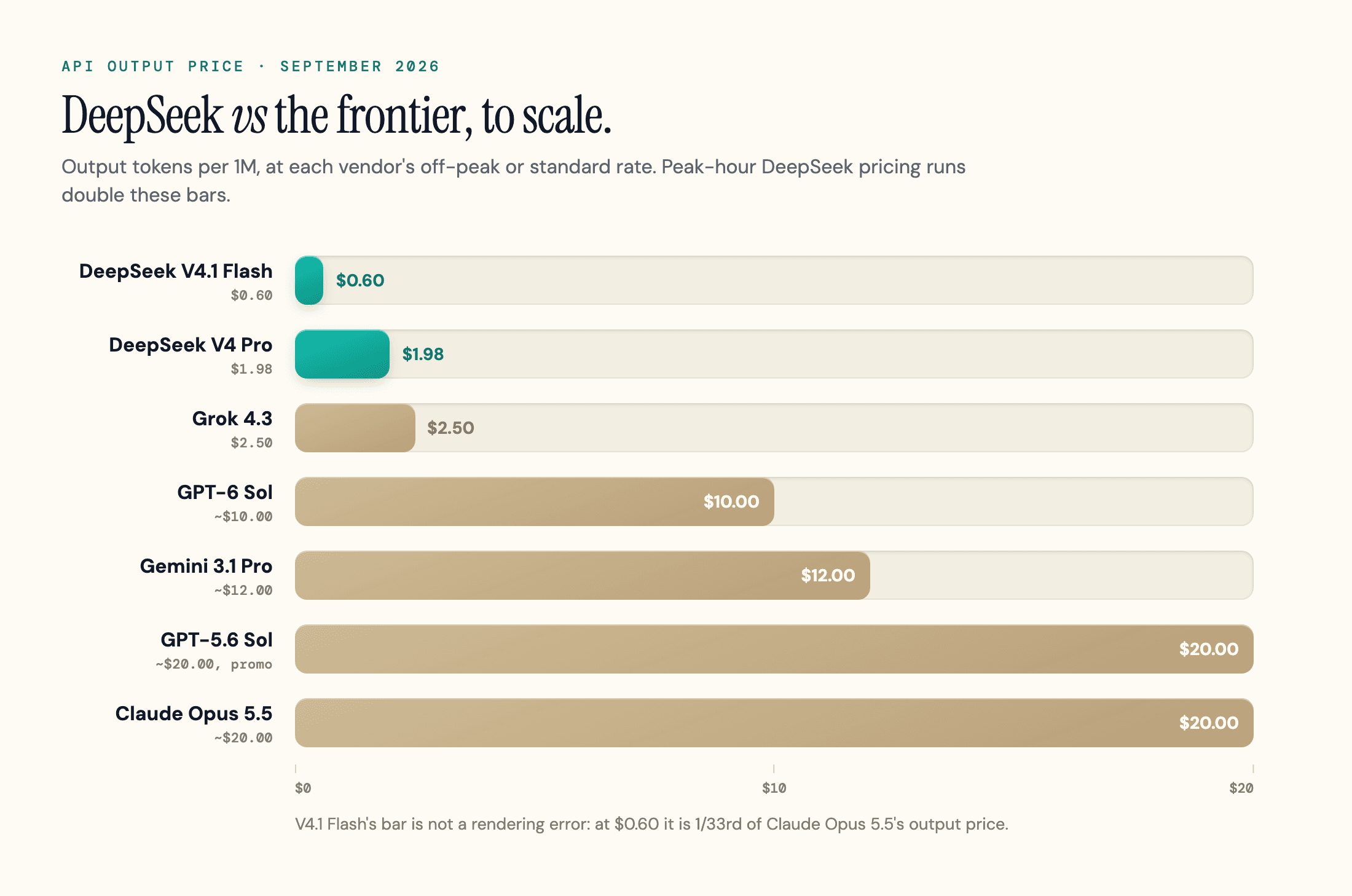
A headline "ten times cheaper" is not your real savings, though. True cost depends on how much output you generate, whether thinking mode is on, whether your traffic falls in DeepSeek's peak window, and how often you hit the cache, and DeepSeek's default thinking mode can erode part of the advantage on output-heavy work. It is also worth weighing the non-price factors, covered below, before switching a production system on price alone. For a feature-level view rather than just the token math, our comparison of Chinese AI models puts DeepSeek next to its closest rivals.
The Stale-Price Trap: Several Different "Current" Prices Are Floating Around
Here is what most DeepSeek pricing guides get wrong right now: there have been three distinct V4 Pro prices and a separate Flash repricing in under five months, and a lot of the web still shows the earlier ones.
V4 Pro launched in April 2026 with a list price of $1.74 per million input tokens and $3.48 output. DeepSeek cut that by about 75% for a flat rate of $0.435 and $0.87 that held through most of the summer. Then, on August 16, 2026, DeepSeek made good on the "significant increase" it had been warning about since July: the flat rate was replaced with the peak/off-peak split above, which puts V4 Pro at $0.66 / $1.98 off-peak and $1.32 / $3.96 at peak hours. A lot of guides, aggregators, and even calculators still quote one of the two earlier numbers. It gets muddier because third-party hosts that resell DeepSeek, listed on marketplaces like OpenRouter, set their own rates, so a figure you find there may not match DeepSeek's own price at all. If you build a budget on the original $1.74 launch price, your cost model now overstates off-peak input cost by roughly 2.6 times and off-peak output cost by roughly 1.8 times, and at peak hours the old $3.48 output figure actually undercounts, since the current peak output rate ($3.96) runs about 14% above it. Even the July flat rate undercounts what you will pay today: roughly 50% low on off-peak input (up to about 200% low at peak input), and 128% low on off-peak output (up to roughly 355% low at peak output). V4 Pro's price has held steady since August 16. DeepSeek's own September 10 release announcement said it was "phasing out V4-Pro," with all deepseek-v4-pro requests set to route to V4.1 Flash starting 04:00 UTC on September 14, 2026. Its API changelog then reversed that, the same day, "in response to user demand," and the live pricing page still lists V4-Pro as its own separately priced model days past that cutover, so Pro survives, for now, at its own, higher price.
Flash moved on a separate track. The August 16 peak/off-peak split also applied to the old V4 Flash, at $0.22 / $0.66 off-peak. That model no longer exists: DeepSeek retired it on September 10, 2026 and replaced it with DeepSeek-V4.1-Flash at a lower price, $0.15 / $0.60 off-peak. So a guide dated anywhere from mid-August to September 9 is quoting a real price for a model that is no longer being served under that name; the old deepseek-v4-flash API id still works, but it now runs V4.1 Flash at the new rate, not the model the guide tested. When you read a DeepSeek price, check the date and the exact model name, and treat any figure that isn't dated after September 10, 2026 as a starting point to verify, not a number to budget on.
One older detail still confuses people: DeepSeek's earlier off-peak discount, the V3-era window that knocked 50 to 75% off during quiet hours, disappeared when V4 launched with flat all-day rates, then reappeared in this new form on August 16 with different hours and a smaller discount (peak is now exactly double off-peak, not the old 2-4x V3 spread). Don't assume the current peak/off-peak windows match the ones from the V3 era; the UTC hours cited above (01:00-04:00 and 06:00-10:00, Monday to Friday) are the current ones as of this pricing page.
Which DeepSeek Option Should You Actually Use?
Short answer to the title question: for API work, yes, it is worth it wherever text-only output and China hosting are acceptable. The rest is picking the right tier.
Use the free app if you want to chat with DeepSeek, run research, or draft text. It costs nothing, needs no subscription, and covers what the large majority of searchers are after.
Use V4.1 Flash on the API for almost everything you build: chatbots, extraction, classification, summarization, most coding, and, new as of September 10, basic image-in tasks. It is cheap enough that at typical volumes the bill is a rounding error, and DeepSeek's own benchmarks claim it now beats V4 Pro on several tasks despite costing a fraction of the price, a claim covered with the appropriate caution in our DeepSeek V4 guide.
Reserve V4 Pro for the work that genuinely needs it, hard reasoning, complex multi-step analysis, and demanding code, where the quality gain is worth the roughly 3 to 4 times higher token cost.
Look elsewhere when price is not the only constraint. V4 Pro is still text-only; V4.1 Flash now accepts images but neither model generates them, so video and audio and image output are out of scope either way. Its models are hosted in China, which matters if you have data-residency, GDPR, or industry compliance requirements, and the pricing docs say nothing about data-processing agreements. For a regulated business, the cheapest token is not automatically the right one.
Why DeepSeek's Price Matters for Your Brand
DeepSeek being this cheap is exactly why it shows up everywhere. It is the default model builders reach for when they want frontier-ish quality at throwaway cost, which means it is quietly powering the chatbots, agents, and search tools that describe your category to buyers.
The more useful question, then: when someone asks an AI assistant what to buy or who to hire, does it mention you? In our tracking of AI answers, assistants routinely name specific vendors in response to buying questions, and the buyer rarely sees why one brand surfaced and another did not. None of that shows up on a pricing page. Our Citation Interceptor maps which sources the AI engines cite when they answer, so you can find the ones shaping the recommendation and get into them. The method is in our guide to tracking AI visibility. If you would rather compare tracking tools first, our roundup of generative engine optimization tools groups them by job, from visibility tracking to free graders.
DeepSeek has changed its API pricing three times already this year: once down, once up, and now down again on Flash while Pro held steady. Confirm the current figure on the official page before you build a budget. Once you know what it costs, the next question is what it tells people about you.
Frequently Asked Questions
Is the DeepSeek app free, or is there a subscription?
The app is free, and there is no paid consumer subscription. You get the full chat experience, including the V4 model, web search, and file uploads, at no charge on the web and mobile app. The only thing you pay for is the API, which is billed per token for developers building their own software.
Why is my DeepSeek API bill higher than the advertised price?
Usually because of thinking mode, which is on by default and bills its reasoning tokens at the output rate, so a short answer can cost far more than it looks. The other reason is caching: the low input price only applies to cache hits, and a prompt that changes every time pays the higher cache-miss rate. Disable thinking for routine tasks and keep your prompt prefixes identical to control both.
What is cache-hit vs cache-miss pricing?
DeepSeek charges two input prices. When the start of your request matches content it processed recently, those tokens bill at the cache-hit rate, which is about 98% cheaper on V4.1 Flash. When the input is new, it bills at the full cache-miss rate. Caching is automatic and free to use, but it only triggers on an exact matching prefix.
Is DeepSeek really cheaper than OpenAI, Claude, and Gemini?
On the API, yes, by a wide margin. V4 Pro is roughly 6 times cheaper than Claude Opus 5.5 on input and roughly 10 times cheaper on output at off-peak rates (about 3x and 5x at peak hours), and V4.1 Flash, repriced lower on September 10, 2026, is cheaper still, roughly 27 times cheaper than Opus 5.5 on input and 33 times on output at off-peak rates. Your real savings depend on how much output you generate, how often you hit the cache, and whether your traffic falls in DeepSeek's peak window, but on raw token price DeepSeek undercuts every Western flagship by a wide margin, though a few rivals' budget tiers get closer on cheap, batchable work.
What happened to R1, V3, and deepseek-chat?
DeepSeek-V4.1-Flash and V4 Pro are the current models. The older deepseek-chat and deepseek-reasoner names were retired on July 24, 2026 in favor of deepseek-v4-flash and deepseek-v4-pro, and now fail outright; before that retirement, deepseek-reasoner mapped to Flash's thinking mode, never to Pro. Of those two July replacement names, only the Flash one changed again: deepseek-v4-flash and the experimental deepseek-v4-flash-vision-exp were folded into the new deepseek-flash (V4.1 Flash) on September 10, 2026, and the old aliases are, for now, still routed to that different, cheaper, vision-capable model, though DeepSeek calls that routing temporary. deepseek-v4-pro was never retired and did not change. R1 was the earlier standalone reasoning model, now succeeded by the V4 line's built-in thinking mode, and V3 has likewise been superseded. For the full model picture, see our DeepSeek V4 guide.
How much does the DeepSeek API cost per month?
For most workloads on Flash, still not much. It moved up on August 16, 2026 when peak/off-peak pricing replaced the old flat rate, then Flash specifically moved back down on September 10, 2026 when V4.1 Flash replaced V4 Flash at a lower rate: a support chatbot handling around 1,000 conversations runs about $3.00 a month at off-peak rates today, and lighter jobs cost pennies. Light personal use lands around $2 to $7 a month off-peak, small production apps around $7 to $35, and the same volume on V4 Pro (unaffected by the September cut) costs roughly three to four times as much; traffic that clusters in the 01:00-04:00 or 06:00-10:00 UTC peak window runs about double.
Does DeepSeek's API now accept images?
Yes, as of September 10, 2026, but only on Flash. DeepSeek-V4.1-Flash is the first DeepSeek Flash-tier model with native vision, accepting image input alongside text. V4 Pro still does not accept images. Before that date, the only DeepSeek model with any image input was an experimental, non-GA build, V4-Flash-Vision-Exp, which has now been retired and folded into V4.1 Flash's native vision support.
Sources
- Models & Pricing - DeepSeek API Docs, verified live September 17, 2026 -
api-docs.deepseek.com/quick_start/pricing - Change Log - DeepSeek API Docs (V4.1 Flash launch, V4 Pro continuance) -
api-docs.deepseek.com/updates - DeepSeek Platform (API access) -
platform.deepseek.com - Claude plans and pricing - Anthropic -
claude.com/pricing - Google AI Pro and Ultra subscriptions - Gemini -
gemini.google/subscriptions - OpenAI API pricing - OpenAI -
developers.openai.com/api/docs/pricing - DeepSeek V4 Pro - API pricing and benchmarks - OpenRouter -
openrouter.ai/deepseek/deepseek-v4-pro