
Kimi AI is the chat assistant and the family of open-weight models built by Moonshot AI, a Beijing company that has become one of the loudest names in open AI. If you have seen "Kimi K2" topping coding leaderboards next to ChatGPT, Claude, and DeepSeek and want the plain version of what it is, who makes it, what it costs, whether it is safe, and what "open" actually means here, this is it, current as of August 2026.
First, the disambiguation, because the name is crowded: this article is about the AI model, not the anime film "Kimi no Na Wa," the manga "Hana-Kimi," or Formula 1 drivers Kimi Räikkönen and Kimi Antonelli. We mean Kimi by Moonshot AI. We will also cover the parts most explainers skip: the open weights versus open source distinction, the data and China questions brands keep asking, and what a strong Chinese open model means for whether AI tools mention your business at all. This guide covers the Kimi family as a whole; for the current flagship specifically, see our Kimi K3 explainer.
What Is Kimi AI?
Kimi is two things under one name: an AI assistant you can chat with at kimi.com, and the family of large language models that power it, now led by Kimi K3, both made by Moonshot AI. You use the assistant the way you use ChatGPT or Claude: ask a question, paste a document, hand it a task, and it answers in natural language. It also reads images, writes and runs code, searches the live web, and runs multi-step agent workflows.
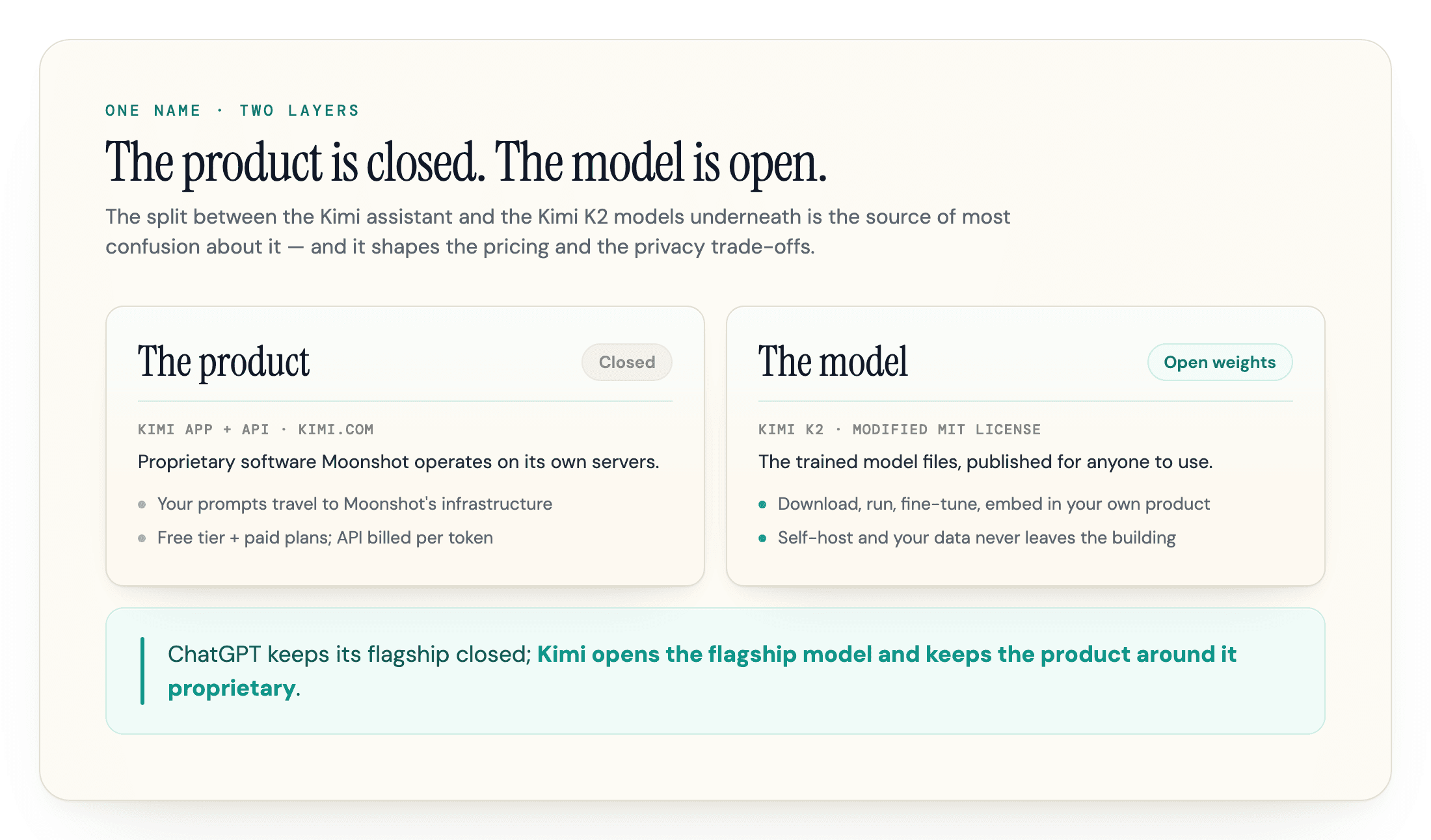
The split between the assistant and the model matters more for Kimi than for most rivals, and it is the source of most confusion about it. The Kimi app and its API are a closed product Moonshot operates. The Kimi models underneath are open weights, which means the trained model files are published for anyone to download, run, and adapt. The flagship models inside ChatGPT stay closed (OpenAI has released separate, smaller open-weight models, but not the ones that power ChatGPT); Kimi opens its flagship model and keeps the product around it proprietary. That single fact shapes the pricing, the privacy trade-offs, and the strategic story we will get to.
Where Kimi earned its reputation is coding and agentic work, tasks where the model plans, calls tools, and works through many steps on its own, at a fraction of what the closed frontier models charge. Calling it "a Chinese ChatGPT" undersells what is interesting about it. The rest of this guide walks through each piece.
Who Makes Kimi? Moonshot AI, Explained
Kimi comes from Moonshot AI, a Beijing startup founded in March 2023 by Yang Zhilin, Zhou Xinyu, and Wu Yuxin, who were schoolmates at Tsinghua University. Yang, the CEO, has said the goal is to build toward artificial general intelligence, with long context, multimodal understanding, and self-improving architecture as the milestones. The company name nods to Pink Floyd's "The Dark Side of the Moon," which is also where the Chinese name, 月之暗面, comes from.
So yes, Kimi is a Chinese company, and that is central to the safety and data questions later. It is one of the better-funded ones. Alibaba put about $800 million into a roughly $1 billion round in February 2024 for a stake of around 36%, Tencent joined later that year, and in May 2026 Moonshot raised about $2 billion at a valuation near $20 billion, according to TechCrunch, on the back of roughly $200 million in annualized revenue. For a two-year-old lab, that is a steep climb, and it is funded largely by the open-weight strategy that put Kimi on the map.
That backing answers a common question: who owns Kimi? Moonshot AI owns and runs it. Alibaba is the largest outside investor, but with a minority stake it does not appear to run Kimi day to day or dictate how it behaves.
The Kimi Model Lineup: K2 to K3
Kimi is not one model but a fast-moving series. The breakout was Kimi K2 in July 2025, a one-trillion-parameter model released as open weights under a modified MIT license, per Moonshot's GitHub repo. It matched or beat much larger closed models on coding benchmarks, and because the weights were free, it spread fast. Since then Moonshot has shipped a new version roughly every couple of months. Here is where things stand.
| Model (as of August 2026) | Released | What changed |
|---|---|---|
| Kimi K2 | July 2025 | The open-weight flagship: 1T total / 32B active parameters, strong coding |
| Kimi K2-Instruct-0905 | September 2025 | Better coding; context window doubled to 256K |
| Kimi K2 Thinking | November 2025 | Reasoning interleaved with tool calls; benchmarked at native INT4 |
| Kimi K2.5 | January 2026 | Vision (images and video) and the first Agent Swarm |
| Kimi K2.6 | April 2026 | Large jump on agentic benchmarks; swarm scaled to 300 sub-agents |
| Kimi K2.7 Code | June 2026 | Coding-specialized; roughly 30% fewer thinking tokens |
| Kimi K3 | July 2026 | New flagship: a jump to 2.8T parameters (16 of 896 experts active) and a 1M-token context, the largest open-weight model at launch |
The big change since the K2 line is Kimi K3, released July 16, 2026, with its weights going public on July 27 under a new custom Kimi K3 License, a step away from the K2 family's Modified MIT terms. It is a step up in scale, a 2.8-trillion-parameter model Moonshot bills as the largest open-weight model yet, and it moved Kimi from the cheap-and-cheerful open option into direct frontier competition on price and positioning. We cover its real specs, which benchmarks to trust, what it costs, and whether you can run it in our Kimi K3 explainer.
Two naming patterns are worth knowing. An "Instruct" model answers right away; a "Thinking" model works through hidden steps before replying, trading speed for accuracy on hard problems. On context length, the original K2 handled 128,000 tokens, doubled to 256,000 in the September Instruct-0905 update and carried into K2 Thinking; every model from K2.5 through K2.7 Code holds that same 256,000-token window, and the jump to a million tokens only arrives with K3.
Kimi K2.5: Vision and the First Agent Swarm
K2.5, released January 27, 2026, is where the K2 model line stopped being text-only. It added a vision encoder Moonshot calls MoonViT, trained on top of the existing K2 base, and it reads video as well as still images. Moonshot's model card reports 76.8% on SWE-bench Verified. It shipped alongside Kimi Code, the company's coding agent for editors like VS Code and Cursor.
The more consequential addition was Agent Swarm. Rather than one model working a task step by step, an orchestrator dispatches sub-agents that run in parallel and report back: up to 100 of them across as many as 1,500 tool calls in K2.5. Moonshot trained the orchestrator with a technique it calls parallel-agent reinforcement learning, freezing the sub-agents and rewarding the orchestrator in stages specifically to stop it collapsing back into doing the whole job itself.
The caveats arrived with the same release. In the most detailed independent review of the model, Hugging Face's Maxime Labonne called it the first open-weight model whose vision "feels genuinely competitive", but measured it burning 89 million output tokens across an evaluation suite where comparable models used a median of 14 million, and watched swarm sub-agents drift into inconsistent definitions of the same shared concept. Cheap per token and cheap per task are not the same claim.
K2.5 is no longer available. Moonshot first closed it to newly registered API users, then retired it on August 31, 2026 along with the older moonshot-v1 family; calls to either now return a 404, and the only replacement Moonshot names is kimi-k3. For routine coding, kimi-k2.7-code is the closer price match, but that is our recommendation rather than Moonshot's.
Kimi K2.6 and K2.7 Code: The Agentic Jump
K2.6 arrived April 20, 2026 with the same network underneath. Its published configuration describes an architecture identical to K2.5's, down to the expert count and the 256,000-token window, so whatever improved came from training rather than a redesign. The improvements also landed unevenly. Coding moved 3.4 points, SWE-bench Verified from 76.8% to 80.2%. The tool-use and agent benchmarks moved much further: Terminal-Bench 2.0 rose almost 16 points, from 50.8% to 66.7%, and three agent-specific suites roughly doubled. Agent Swarm scaled with it, to 300 sub-agents across 4,000 coordinated steps. One caution on that last number, which gets quoted a lot: 300 is a model capability, not something a subscription grants you, and Kimi's own plan table tops out at 8 concurrent swarm subtasks on its most expensive tier.
Artificial Analysis rated K2.6 the leading open-weights model on its intelligence index, fourth overall behind the Anthropic, Google and OpenAI flagships. Its standing criticism was token consumption, which is what K2.7 Code, released June 12, 2026, set out to address: a coding-specialized post-train of the same model that Moonshot says cuts thinking-token use by about 30% on average, and that cannot be run with thinking switched off. Its headline numbers deserve one caveat, though. The benchmarks Moonshot leads with for it, Kimi Code Bench v2 and Program Bench among them, are the company's own suites, and the model has not been submitted to DeepSWE, an independent coding benchmark that spreads models much further apart. As one developer put it to VentureBeat, "every model 'improves' double digits on its own test suite."
The most informative outside test came from researcher Elliot Arledge, who ran K2.7 Code against K2.6 on KernelBench-Hard, a public GPU-kernel optimization benchmark, and published his logs. His verdict was that "K2.7 is more honest but not more capable": on five of six problems the newer model wrote real Triton kernels where K2.6 had wrapped existing libraries, but two of those failed on its own bugs and one score regressed outright. It stopped papering over the hard part without yet doing the hard part better. Treat vendor benchmark wins as claims to verify against your own use, and treat this whole table as an August 2026 snapshot, because the version numbers move every few weeks.
How Kimi K3 Works: The Current Flagship
K3 is the model to understand first now, because it is what Moonshot leads with and what a paid plan points you at. It keeps the mixture-of-experts design the K2 line established but scales it hard: 2.8 trillion parameters in total, with only 16 of 896 experts active per token, so the compute cost per token stays far below what the full size suggests. Moonshot publishes the expert counts but not the active-parameter figure, so treat any exact "active billions" number you see as an estimate.
The bigger change is how K3 handles long inputs. It uses a hybrid linear-attention design Moonshot calls Kimi Delta Attention, with roughly three of every four attention layers running the cheaper linear form. That is what makes a 1,048,576-token context window practical rather than theoretical, and Moonshot's own research reports decoding up to 6.3 times faster at long context. K3 reads text, images, and video and returns text, with default output up to 131,072 tokens.
One quirk matters in daily use: reasoning is always on. You can dial the effort down (the reasoning_effort control accepts low, high, or max, and defaults to max), but you cannot switch thinking off entirely, and the sampling parameters are locked server-side, so at its default K3 thinks hard on every request, which shows up in both speed and cost. The full architecture, the benchmarks worth trusting, and whether you can self-host it are in our Kimi K3 explainer.
How the Kimi Models Work: Mixture of Experts, Built for Agents
Under the hood, Kimi is a transformer that predicts the next chunk of text one piece at a time, the same broad design as ChatGPT and Claude. Where it differs is two deliberate engineering choices that run through the whole family and explain why it is cheap and why it leans agentic.
The first is the mixture-of-experts design. Instead of one dense network where every parameter fires on every word, the Kimi models split into hundreds of specialist sub-networks and route each token to only a few of them. K2 holds a trillion parameters in total but uses only about 32 billion for any given token, and K3 pushes the same idea much further, activating only a sliver of an even larger network at a time. You get the knowledge of a huge model at the running cost of a small one, which is the main reason Kimi's API undercuts the closed frontier so heavily.
The second is the focus on agentic behavior. Moonshot trained Kimi specifically to use tools, call functions, and carry a task across many steps rather than just answer in one shot. That is why its strongest results show up in coding agents and multi-step research, where the model has to decide what to do next, run it, read the result, and adjust. The trade-off is real: a model tuned to think and act in long chains can be slower and more verbose on simple questions, a complaint developers raise often. Practitioners who run it daily report a practical way to blunt that: Kimi tends to spiral into its longest reasoning when a prompt carries contradictory or cluttered instructions, so a short, direct, internally consistent prompt noticeably cuts the wasted thinking.
The architecture itself is not a hidden dial you can game from the outside. It is what decides what Kimi is good at, and it points at the same place ChatGPT and Claude do: clear, well-structured information is what these models reason over best.
Kimi K2 Thinking: The Model That Made the Reputation
Going back a step chronologically: if you have heard one Kimi statistic, it probably came from Kimi K2 Thinking, released November 6, 2025. That is the release that got Kimi taken seriously as a frontier competitor, and its headline numbers are also the most consistently misquoted in the coverage that followed.
What made it different from the Instruct models was that reasoning ran through the tool calls rather than before them. An Instruct model plans, then executes, which means a bad early assumption tends to survive the whole run. K2 Thinking reasons between steps, so it can query something, read the result, revise the plan mid-chain, and continue. Moonshot describes it as holding coherent goal-directed behavior across "200 to 300 sequential tool calls" without human intervention, though it published no harness detail behind that, so read it as a claimed working range rather than a specification.
There is also an unusual engineering choice underneath. Moonshot applied quantization-aware training to the mixture-of-experts weights, so the model runs natively at INT4 precision, and it reports roughly a 2x generation speed-up from that in its own setup. More useful is that it reported every published benchmark at the same INT4 setting. The usual pattern is to benchmark at full precision and then quantize for shipping, which leaves the published scores describing a configuration nobody actually runs; here at least the precision you read about matches the weights you download.
Those benchmark numbers, stated properly, are where most write-ups go wrong. On its Hugging Face model card Moonshot reports 71.3% on SWE-bench Verified, 60.2% on BrowseComp, and, on Humanity's Last Exam, three different figures for three different settings: 23.9% with no tools, 44.9% with tools, and 51.0% in what it calls heavy mode, which rolls out eight parallel attempts and aggregates them. The 44.9% is the figure that travels, almost always without the qualifier. It describes the model wired into a tool stack, not the model alone, and heavy mode is a further step removed again, spending roughly eight rollouts' worth of compute on a single answer.
The economics attracted the same loose treatment. CNBC reported a training cost of roughly $4.6 million from an unnamed source and said plainly that it could not verify the figure; Moonshot's CEO has since said the number is not official, and its researchers have argued the cost is genuinely hard to pin down because so much of it is research and failed experiments. It gets repeated as fact anyway. Artificial Analysis scored K2 Thinking the highest open-weights model on its intelligence index at the time, but also found that running it on Moonshot's faster turbo endpoint made it one of the most expensive models in the whole comparison, because of how many tokens it burned getting there.
One practical note if you go looking for it: Moonshot discontinued the entire kimi-k2 series, K2 Thinking included, on its own API on May 25, 2026, and now directs users to K3. The weights remain openly published and third-party providers still serve them, which is the durability open weights buy you: when a closed model is withdrawn, outside users generally cannot keep running that version at all.
Is Kimi Open Source? Open Weights vs Open Source
This is where Kimi is most often described incorrectly, including by AI assistants asked about it. Kimi K2 is open weights, not open source, and the difference is real. Open weights means Moonshot publishes the finished model files, the billions of trained numbers, so anyone can download them, run them, and fine-tune them. Open source, in the strict sense, would also mean releasing the code and enough detail about the training data and method to rebuild a substantially equivalent model. Moonshot releases the weights but not the training data or the full recipe, so you can use the model freely, but you cannot fully audit or reproduce how it was made.
The license is also not plain MIT. Kimi K2 ships under a modified MIT license, and the modification is a single attribution clause: per the license on Hugging Face, if you deploy Kimi in a product with more than 100 million monthly active users or more than $20 million in monthly revenue, you must display "Kimi K2" prominently in the interface. For almost everyone that clause never triggers, but it means "open" here comes with one string attached. The current flagship changed the terms: K3 ships not under modified MIT but under Moonshot's own Kimi K3 License, which permits commercial use but is not OSI-approved, adding a separate-agreement requirement for very large model-as-a-service operators alongside a similar "Kimi K3" display clause for very large products. The smaller Kimi-VL model uses a standard MIT license with no such clause.
One more layer: the model is open, but the Kimi app and API are not. The product you log into at kimi.com is closed software that Moonshot runs on its own servers. So "Kimi is open source" is true only of the weights, and only loosely. This is the same pattern DeepSeek, Zhipu's GLM, Llama, Qwen, and Mistral follow, a wave of open-weight models that are genuinely free to run but are not open in the way the phrase implies. To see where Kimi lands among them, our Chinese AI models comparison lines them up side by side. The practical upside is that privacy-sensitive teams can self-host the weights instead of sending data to Moonshot, which we come back to next.
Is Kimi AI Safe? Privacy, Data, and the China Question
"Is Kimi safe" actually folds two different questions together, and they have different answers. For everyday content, Kimi has guardrails and, like every assistant, can still be confidently wrong, so verify anything that matters. But its safety tuning looks lighter than the closed leaders'. A preliminary independent safety evaluation of Kimi K2.5 found capability similar to GPT-5.2 and Claude Opus 4.5 but noticeably fewer refusals on dangerous (CBRNE) requests, along with more compliance on disinformation and copyright misuse. As a Chinese model, it also follows Chinese content rules, so on politically sensitive topics it deflects or stays vague where a Western model might engage. None of that makes it unusable, but do not assume its guardrails match the frontier labs'.
The question with more weight for businesses is data. When you use the hosted app or API, your prompts go to Moonshot's servers, and where those servers sit depends on which door you use. The international API is operated by Moonshot AI Pte. Ltd., a Singapore entity, while the consumer service runs under Beijing Moonshot AI Technology Co., Ltd. in China. The underlying concern many security teams raise is that data handled under Chinese jurisdiction can be subject to local data and intelligence laws, which is the same caution applied to any China-hosted service, not a Kimi-specific accusation. There is also a usage term worth reading: Moonshot's API agreement says customer content may be used to develop and improve its services unless you arrange otherwise, with opt-outs reserved for enterprise or separate written agreements. It is worth weighing all of this plainly against your own risk tolerance and what data you would actually be sending.
There is also one reported incident worth knowing. In April 2026 the OECD.AI Incidents Monitor logged a case where Kimi returned another user's resume during a task, a cross-user data exposure. Moonshot characterized it as a model hallucination, while outside observers described it as a data-isolation flaw and reported the exposed details as genuine rather than invented; there is no detailed first-party post-mortem. One reported incident is not a verdict, but it is a fair data point for a privacy review.
The honest mitigation is the one the open weights make possible. If data residency is a dealbreaker, you do not have to use Moonshot's servers at all; a team can run the open Kimi K2 weights on its own infrastructure, so prompts never leave the building. That is the clearest practical answer to the China question: for sensitive workloads, self-host rather than send.
Kimi vs ChatGPT, Claude, and DeepSeek
Before comparing, fix one category error that trips up most write-ups, including AI ones: Kimi K2 and DeepSeek are models you can download and run, while ChatGPT and Claude are products that front closed models you can only rent. A fair comparison either lines the Kimi app up against the ChatGPT and Claude apps, or lines the Kimi K2 model up against the closed models inside them. Here is the practical version.
| Tool | What it is | Strongest at | Open weights? | Rough cost |
|---|---|---|---|---|
| Kimi K2 (Moonshot) | Open-weight model + app | Coding, agentic multi-step work, long context, low cost | Yes (modified MIT) | Low; can self-host free |
| ChatGPT (OpenAI) | Product fronting GPT models | General-purpose use, images, voice, the widest ecosystem | No (flagship); separate gpt-oss models, yes | Free tier; paid from $20/mo |
| Claude (Anthropic) | Product fronting Claude models | Writing, careful reasoning, long documents and code | No | Free tier; paid from $20/mo |
| DeepSeek (DeepSeek) | Open-weight model + app (also China-based) | Reasoning and coding at very low cost | Yes | Low; can self-host free; same China data caveats |
On capability, the honest read is that Kimi competes hardest on coding, agentic tasks, and price, where developers report it doing real work for a fraction of what Claude or ChatGPT cost. Where the closed products still tend to lead is general polish, reliability across varied tasks, multimodal range, and ecosystem depth. Independent reviewers also note Kimi can be slower and noticeably more verbose, answering a simple question with several paragraphs.
Kimi's arrival was called "another DeepSeek moment," and that framing is the real story: a Chinese open model matching far more expensive Western ones no longer shocks anyone, which itself signals how fast the gap is closing. That competitive pressure has an edge to it. In February 2026, Anthropic alleged that several Chinese labs, Moonshot among them, used networks of fake accounts to harvest millions of Claude conversations and distill their capabilities. Anthropic did not sue, Moonshot did not publicly respond, and it remains an unproven accusation, but it is part of the backdrop to how these cheaper, strong models are built. If you are weighing models head to head, our Claude AI explainer covers the other side of that comparison.
Is Kimi Free? Pricing and How to Access It
Yes, Kimi has a real free tier. The plan is called Adagio, it covers the web app and the iOS and Android apps, and it needs no credit card. Above it sit four paid tiers, from Moderato at $19 a month to Vivace at $199, with annual billing taking roughly 20% off at every level. New paid subscriptions are paused as of August 2026 while Moonshot adds capacity; existing subscribers keep their plans.
The important mechanic is that paid plans are metered in credits rather than messages, and conversations with the K2.6 model do not consume credits at all. For the full tier table, what a credit actually buys, how refreshes and downgrades work, and whether paying beats ChatGPT Plus or Claude Pro, see our Kimi pricing breakdown. Developer access is billed separately from the app, and the metered rates and access routes are in our Kimi API pricing guide.
A note on access: signing up from outside China can be fiddly because phone verification does not always work for foreign numbers; logging in with Google or scanning the app's QR code is the usual workaround. And on self-hosting, "free" is the license, not the hardware. Kimi K2 is a one-trillion-parameter model, and running it well takes a multi-GPU server most individuals do not have. The free, run-anywhere option is real for companies with infrastructure; for everyone else, the hosted app or a third-party provider is the practical route. If you just want to try Kimi without committing to a subscription, aggregators like OpenRouter serve the Kimi models, from K2 through K3, on pay-per-use per-token billing, which is what many developers reach for to test a model before paying for any single plan.
What Kimi Means for Your AI Visibility
Step back from the specs and there is a marketing question hiding in all this. Every new strong model is another place where a customer might ask "what is the best tool for X" or "is [your company] any good," and get an answer that shapes a buying decision. Kimi is one more of those places, and the open-weight twist makes it bigger than it looks.
Because Kimi K2's weights are public, the model does not only answer inside Moonshot's own app. It gets hosted, fine-tuned, and embedded into a long tail of downstream products and providers you will never see individually. You cannot audit every deployment that runs on Kimi, DeepSeek, or any other open model. What you can do is influence the input they all share: how clearly and consistently your business is represented across the open web, which is the foundation of generative engine optimization.
That splits into two practical jobs. The first is reachability: every one of these models and the crawlers feeding them has to be able to fetch your site in the first place. Block the AI crawlers, intentionally or not, and you close the live door into every model that fetches the web, even if you cannot undo what they already learned in training. The second is consistency: the brands that get described correctly are the ones whose facts line up across the sites a model is likely to read.
In our experience at geotoolbox, the businesses that surface well in AI answers are rarely the ones with the prettiest homepage; they are the ones a model can find, parse, and trust without tripping over contradictions. That is a measurable problem, which is why we build tooling around it. Our guides on what GEO is and tracking your AI visibility go deeper on both halves.
The open-model wave does not change the playbook so much as raise the stakes: there are simply more engines that can mention, or mangle, what you have built. The first move is to check whether they can even read you. Run a free AI Readiness check to see whether the AI crawlers can reach and parse your site, and where the gaps are, before the next model launches and the question gets asked again.
Frequently Asked Questions
Is Kimi AI a Chinese company?
Yes. Kimi is made by Moonshot AI, a startup based in Beijing and founded in March 2023 by three Tsinghua University classmates. Alibaba is its largest outside investor. As of May 2026 the company was valued at around $20 billion.
Is Kimi AI safe to use?
For everyday content, Kimi has guardrails like any major assistant and, like all of them, can still be wrong, so verify what matters. The bigger consideration is data: prompts sent to the hosted service go to Moonshot's servers (a Singapore entity for the API, a China entity for the consumer app), so they fall under those jurisdictions. For sensitive work, the safest route is to self-host the open weights so your data never leaves your own systems.
Is Kimi AI free?
Yes, there is a genuine free tier called Adagio on the web and in the mobile apps. Paid plans run from $19/mo (Moderato) to $199/mo (Vivace), metered in credits rather than messages, and the open weights are free to run if you have the hardware. New sign-ups are paused as of August 2026 while Moonshot adds capacity. Our Kimi pricing guide covers every tier and what the credits actually buy.
Is Kimi better than ChatGPT and DeepSeek?
It depends on the job. Kimi is praised for coding, agentic multi-step tasks, and very low cost, and it competes closely with DeepSeek, the other major Chinese open-weight model. ChatGPT is broader and more polished across general use, images, and voice. Many people use more than one and pick per task.
Is Kimi really open source?
Not in the strict sense. Kimi K2 is open weights: the trained model is published under a modified MIT license, so you can download, run, and fine-tune it, but Moonshot does not release the training data or full recipe, and the Kimi app and API are closed. The license also asks very large deployments to credit "Kimi K2" in their interface. The current flagship, K3, ships under a separate custom Kimi K3 License, also open weights but not OSI-approved.
Can I run Kimi on my own computer?
The weights are public, but Kimi K2 is a one-trillion-parameter model that needs a multi-GPU server, not a laptop, to run well. Self-hosting is realistic for companies with that infrastructure, mainly for privacy or cost control. For everyone else, the hosted app or a third-party provider is the practical option.
Sources
- Kimi K2 repository (specs and license) - Moonshot AI, 2025 -
github.com/moonshotai/kimi-k2 - Kimi K2-Instruct model card and license - Moonshot AI (Hugging Face) -
huggingface.co/moonshotai/Kimi-K2-Instruct - Kimi K2 Thinking benchmarks, INT4 QAT and tool settings - Moonshot AI (Hugging Face), November 2025 -
huggingface.co/moonshotai/Kimi-K2-Thinking - Kimi K2.5 model card (MoonViT vision encoder, benchmarks, license) - Moonshot AI (Hugging Face), January 2026 -
huggingface.co/moonshotai/Kimi-K2.5 - Kimi K2.6 model card (matched K2.5 vs K2.6 benchmark table) - Moonshot AI (Hugging Face), April 2026 -
huggingface.co/moonshotai/Kimi-K2.6 - Kimi K2.6 announcement (Agent Swarm at 300 sub-agents) - Moonshot AI, April 2026 -
kimi.com/blog/kimi-k2-6 - Kimi K2.7 Code model card (thinking-token reduction, benchmark suites, 256K context) - Moonshot AI (Hugging Face), June 2026 -
huggingface.co/moonshotai/Kimi-K2.7-Code - Kimi K2.7-Code cuts thinking tokens 30%, but practitioners say the benchmarks don't check out (KernelBench-Hard results, DeepSWE submission) - VentureBeat, June 2026 -
venturebeat.com/technology/kimi-k2-7-code-cuts-thinking-tokens-30-practitioners-say-benchmarks-dont-check-out - Model list and deprecation dates (K2 series retired May 25, 2026; K2.5 sunset August 31, 2026) - Moonshot AI developer docs, accessed July 19, 2026 -
platform.kimi.ai/docs/models - Kimi K2 Thinking: everything you need to know (intelligence index, token consumption, endpoint costs) - Artificial Analysis, November 2025 -
artificialanalysis.ai/articles/kimi-k2-thinking-everything-you-need-to-know - Kimi K2.6, the new leading open weights model (hallucination rate, index ranking) - Artificial Analysis, April 2026 -
artificialanalysis.ai/articles/kimi-k2-6-the-new-leading-open-weights-model - Kimi K2.5: still worth it after two weeks? (independent review, token verbosity, swarm drift) - Maxime Labonne, Hugging Face blog, February 2026 -
huggingface.co/blog/mlabonne/kimik25 - Alibaba-backed Moonshot releases Kimi K2 Thinking (reported $4.6M training cost, unverified) - CNBC, November 2025 -
cnbc.com/2025/11/06/alibaba-backed-moonshot-releases-new-ai-model-kimi-k2-thinking.html - Moonshot CEO: reported $4.6M training cost "isn't official" - Yicai Global, November 2025 -
yicaiglobal.com/news/kimi-k2-thinkings-reported-usd46-million-training-cost-isnt-official-moonshot-ceo-says - Moonshot AI company overview - Wikipedia -
en.wikipedia.org/wiki/Moonshot_AI - China's Moonshot AI raises $2B at $20B valuation - TechCrunch, May 2026 -
techcrunch.com/2026/05/07/chinas-moonshot-ai-raises-2b-at-20b-valuation-as-demand-for-open-source-ai-skyrockets - Anthropic accuses Chinese labs of distillation via Claude - Fortune, February 2026 -
fortune.com/2026/02/24/anthropic-china-deepseek-theft-claude-distillation-copyright-national-security - Kimi cross-user data exposure incident - OECD.AI Incidents Monitor, April 2026 -
oecd.ai/en/incidents/2026-04-21-8c79 - An Independent Safety Evaluation of Kimi K2.5 - arXiv, April 2026 -
arxiv.org/abs/2604.03121 - Kimi K2: What's all the fuss and what's it like to use? - Thoughtworks -
thoughtworks.com/en-us/insights/blog/generative-ai/kimi-k2-whats-fuss-whats-like-use