
Claude costs nothing to start and up to $200 a month at the top of the individual plans, and that is before you touch the API. The consumer tiers run Free at $0, Pro at $20, and two Max tiers at $100 and $200. Teams pay per seat: Standard is about $20 to $25 per user, Premium is $100 to $125, and Enterprise runs on a seat fee plus usage. Developers pay the Claude API by the token, on a completely separate bill.
Claude pricing has moved fast in 2026. Anthropic doubled Claude Code's usage limits in May, announced then paused a billing change for automated usage in June, and shipped Claude Sonnet 5 at the end of June. Most pricing guides you will find still quote a model lineup that has already changed. Below is every current price, reconciled from each vendor's own pricing page, plus the question the numbers exist to answer: which plan, if any, you should actually pay for.
One thing to get straight before anything else: a Claude subscription and the Claude API are separate products with separate billing. Paying for one does not give you the other. All prices here are US list prices. For how the Claude API rate compares with every other provider per million tokens, see our AI token cost breakdown.
How Much Does Claude Cost? Every Plan at a Glance
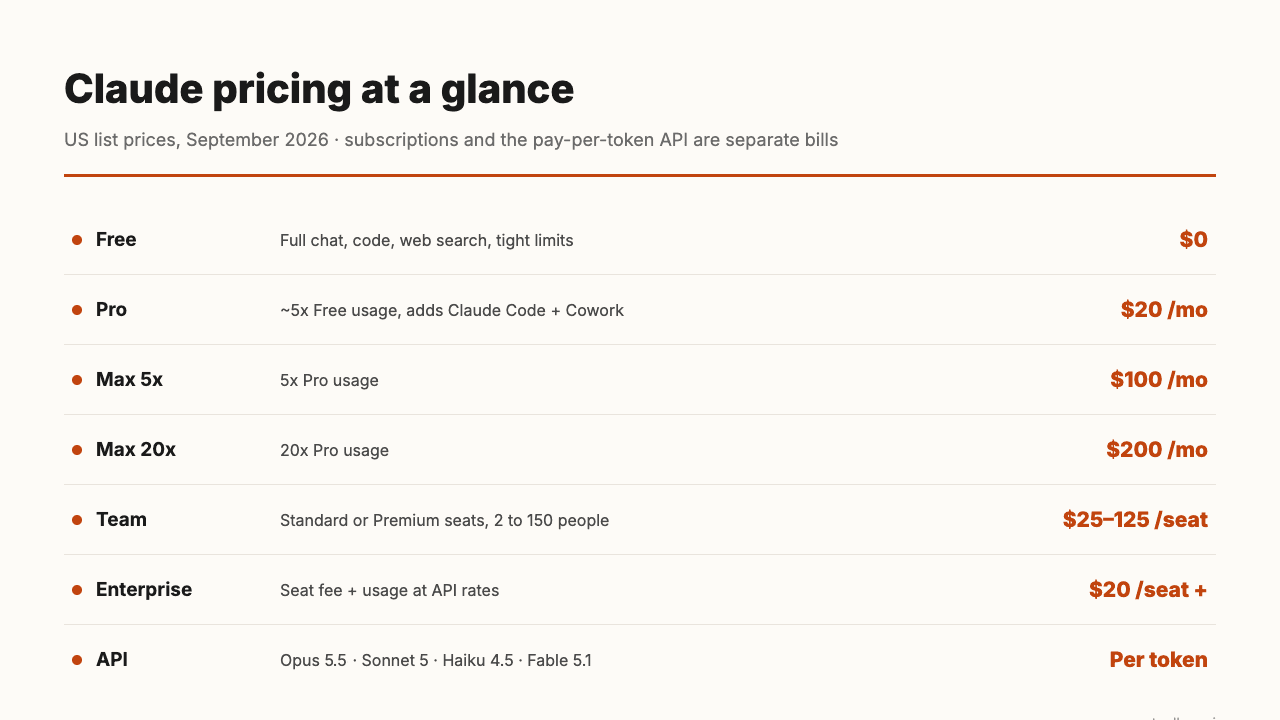
Here is the whole lineup in one place, at US prices from Anthropic as of September 2026.
| Plan | Price (US) | What it is | Best for |
|---|---|---|---|
| Free | $0/mo | Full chat, code generation, web search, tight usage limits | Casual, occasional use |
| Pro | $20/mo ($17/mo annual) | ~5x Free usage, adds Claude Code and Cowork | Most working professionals |
| Max 5x | $100/mo | 5x Pro usage, priority access | Power users who hit Pro limits |
| Max 20x | $200/mo | 20x Pro usage, highest limits | Heavy daily coders and researchers |
| Team Standard | $25/seat (annual $20) | Full features incl. Claude Code, 1.25x Pro usage | Teams of 2 to 150 |
| Team Premium | $125/seat (annual $100) | Same features + Fable 5.1 bundled, 5x Standard usage | Heavy-usage team members |
| Enterprise | $20/seat + usage | Usage billed at API rates, compliance controls | Large or regulated organizations |
| API | Pay per token | Programmatic access to the models, no chat app | Developers and products |
Two things cause most of the confusion. The Max tier is sold as two plans, $100 and $200, that share the same models and differ only in how much you can use them. And the API in that last row is a separate product priced per million tokens, not a monthly subscription. Pro and the Team plans also bundle Anthropic's newer surfaces, Claude Code for the terminal and Claude Cowork for longer agent tasks, which matter more than the headline price once you start using them. If you are new to the platform, our guide to what Claude is covers the models and tools in plain terms.
Is Claude Free? What the $0 Plan Gives You
Yes, and the free tier is a real product, not a locked demo. You get Claude on the web, the desktop apps, and mobile, with code generation, web search, memory across conversations, file creation, and extended thinking for harder problems. No credit card required.
The catch is the usage limit. Free accounts get a small pool of messages that resets on a rolling five-hour window, and the ceiling shows up fast on long or heavy sessions. Anthropic does not publish an exact message count, and it shifts with load, but the pattern is that a serious work session will hit the wall within an hour or two. One feature that is not on Free is Claude Code, the terminal coding tool, which starts on Pro.
For occasional use, drafting, quick questions, or testing what the model can do, Free is genuinely enough. The moment you find yourself waiting out the limit mid-task more than once a day is the signal you have outgrown it. The honest question is not whether Claude is good, it is whether you hit the free wall often enough that removing it is worth about 66 cents a day.
Claude Pro ($20/Month): The Default for Most People
Pro is the plan most people should start with. It runs $20 a month, or $17 a month if you pay annually, which bills as $200 up front. That has held at $20 for a long stretch while the feature set kept growing, which makes it one of the steadier deals in AI subscriptions.
What you get for it: roughly five times the usage of Free, plus the tools that turn Claude from a chat window into a work tool. Pro adds Claude Code in the terminal, Claude Cowork for longer agent-style tasks, unlimited projects to organize your chats and files, Research for multi-step reports, Claude Design, Claude Science, access to more Claude models, and the Microsoft 365 integration. It is the first tier where Claude stops feeling capped.
Is $20 worth it? The useful test is not a general yes or no, it is your own week. Use Pro normally for seven days and count how often you actually hit a limit. If you rarely do, Pro is right and you do not need to spend more. If you hit the wall most days, that is real evidence for a Max tier rather than a hunch. At the same $20, Pro competes head to head with ChatGPT Plus and Gemini's mid plan, so if you are weighing them, our Claude vs ChatGPT breakdown covers where each one pulls ahead.
Claude Max: 5x ($100) vs 20x ($200)
Max is where people overthink the decision, so it helps to know what you are actually buying. Both Max tiers give you the same features as Pro, with one July 2026 exception, the Fable models, which Max bundles into its usage pool while Pro meters them through pay-as-you-go usage credits (covered below). Beyond that, the only difference is how much you can use them. Max 5x, at $100 a month, gives roughly five times Pro's usage. Max 20x, at $200 a month, gives roughly twenty times. Neither one is a smarter Claude. It is simply a bigger bucket.
That reframes the whole choice. You do not upgrade to Max for a feature, you upgrade because you keep running out of Pro. Both tiers add higher output limits, earlier access to new features, and priority access when Claude is under heavy load, but usage capacity is the real product.
The practical advice from people who have paid for all of these is the same every time: start on Pro, and only move up when you can feel the limits getting in your way. Then take the smallest step that fixes it. Most people who hit Pro's ceiling are well served by Max 5x, and only heavy daily users, the kind running long coding sessions or agent workflows, need the 20x tier. There is one wrinkle worth knowing: because usage is per account, some heavy users find two separate Max 5x accounts give them more parallel room than a single Max 20x, though that means juggling two logins. For most people it is not worth the hassle.
Claude's usage limits have moved more than once in 2026, and Anthropic does not publish exact message counts. Treat any specific "X prompts per window" figure you see as an estimate, and check the current allowance on your plan before assuming a tier will cover your volume.
Claude Code Pricing: Is the $20 Tier Worth It?
Claude Code, Anthropic's terminal coding agent, is the single biggest reason people search for Claude pricing, so it deserves a clear answer. The short version: Claude Code is included in Pro at $20, it was not removed, and there is no separate Claude Code subscription. What trips people up is that Claude Code draws from the same usage pool as everything else on your plan, so if you keep hitting the wall, cutting Claude Code's token usage can matter as much as the tier you pay for.
| Plan | Includes Claude Code? | Usage vs Pro | Best for |
|---|---|---|---|
| Free | No | - | Not for coding |
| Pro ($20) | Yes | 1x (baseline) | Light coding, small repos |
| Max 5x ($100) | Yes | 5x | Regular projects |
| Max 20x ($200) | Yes | 20x | Daily heavy coding, agent runs |
| Team Standard ($25/seat) | Yes | 1.25x Pro | Mixed teams |
| Team Premium ($125/seat) | Yes | 5x Standard | Heavy-usage seats |
So why does Claude Code feel expensive? Because coding burns tokens far faster than chatting. A single agent task can read your whole codebase, run tools, and think through several attempts, and all of that comes out of the same five-hour and weekly budget your chats use. On Pro, a real coding session can hit the wall quickly. That is the specific pressure that pushes developers to Max 20x, where the larger bucket is built for daily heavy use.
If your usage is spiky or you are building software rather than coding interactively, there is a third path: skip the subscription and use the API directly, billed per token. One heuristic from teams tracking this closely is that a Max 20x plan tends to beat raw API billing once you pass roughly 70 million tokens a month of typical Sonnet-heavy coding, and the API wins below that or when your usage is uneven. The threshold moves materially once you shift to Opus. One warning that catches people out: if you have ANTHROPIC_API_KEY set in your shell, Claude Code bills at API rates and ignores your subscription entirely.
Claude Team and Enterprise: Per-Seat Pricing
Once you are buying for a group, the plans change shape. Claude Team is built for organizations of 2 to 150 people and requires a minimum of two seats, so the practical entry point is twice the seat price. It comes in two seat types you can mix on the same team.
| Team Standard | Team Premium | Enterprise | |
|---|---|---|---|
| Price | $25/seat (annual $20) | $125/seat (annual $100) | $20/seat + usage |
| Usage per seat | 1.25x Pro | 6.25x Pro (5x Standard) | Negotiated |
| Claude Code and Cowork | Yes | Yes | Yes |
| SSO and admin controls | Yes | Yes | Yes |
| SCIM, audit logs, compliance | No | No | Yes |
The key thing to understand is that the seat types are nearly the same product; the main difference is usage. Standard and Premium seats both include Claude Code, Cowork, and every model, with the Fable models the one exception since July 2026: Premium bundles Fable 5 and Fable 5.1 into the usage pool, while Standard, like Pro, has no Fable allowance at all and meters both at API rates through usage credits. What separates them is how much you get: a Standard seat is about 1.25 times a Pro plan's per-session usage, while a Premium seat is 6.25 times. So the real decision is not who gets the coding tool, it is who needs the headroom. Put light users on Standard, put the people who run Claude Code all day on Premium, and mix the two on one bill. All Team plans keep your content out of model training by default, which is often the real reason a company moves off individual accounts. One thing to know about the limits: they are per seat, not pooled, so a heavy user cannot borrow a colleague's unused capacity.
Enterprise is the tier for larger or regulated organizations. The pricing page lists it as a seat price plus usage billed at API rates, with the real terms set through sales. That structure is newer than it looks. Anthropic moved Enterprise off its old seat-based plans, which charged a flat monthly fee per seat including a usage allowance, onto a single Enterprise seat where the fee buys platform access and nothing else: every token is billed on top at standard API rates. Legacy Standard, Premium, and Chat-only seats are closed to new contracts and convert at renewal, and usage billing cannot be switched off. For a team that was comfortably inside its old allowance, that is the change that moves the bill. What you are paying for beyond that is the governance layer Team does not include: role-based access control, SCIM provisioning, audit logs, a compliance API, custom data retention, IP allowlisting, a HIPAA-ready option, and Claude Security. If regulators rather than budgets are driving the conversation, that is Enterprise territory.
Claude API Pricing: Pay per Token (Sonnet 5 and Fable 5.1 Included)
The API is a different product with a different meter. There is no monthly fee and no message cap. You pay per token, split into input (what you send) and output (what the model returns), priced per million tokens. This is where Anthropic's lineup moves fastest, and where most pricing guides are already out of date: Claude Sonnet 5 launched at the end of June 2026, and few guides have it yet. Here are the current published rates for the models Anthropic recommends today.
| Model | Input (per 1M) | Output (per 1M) | Best for |
|---|---|---|---|
| Haiku 4.5 | $1 | $5 | High-volume, simple tasks |
| Sonnet 5 | $2 | $10 | The production default |
| Opus 5.5 | $4 | $20 | Complex reasoning, agentic coding |
| Opus 5 (prior) | $5 | $25 | Superseded by Opus 5.5 |
| Opus 4.8 (legacy) | $5 | $25 | Same rate; superseded by Opus 5 |
| Fable 5.1 | $10 | $50 | Long-running autonomous agents |
A few things to read into that table. Claude Sonnet 5 runs $2 input and $10 output per million tokens; Anthropic announced that as introductory pricing through August 31, 2026, then made it permanent in August 2026, cancelling the planned rise to $3 and $15. It is the sensible default for most production work. The Opus tier is now led by Claude Opus 5.5, released September 22, 2026 at $4 input and $20 output per million tokens, with cache reads at $0.20, cheaper than the $5 and $25 rate of Opus 5, which it supersedes. Opus 5 remains available as the prior model; it had launched July 24, 2026 at the same $5 and $25 rate as Opus 4.8, which itself remains available as a legacy model. Fable 5.1, at $10 and $50, is Anthropic's premium tier for long-running agent work, having replaced Fable 5 on September 1, 2026 at the same headline price (with a 75% cheaper cache read); on Artificial Analysis's general Intelligence Index (v4.3.2, September 2026), Opus 5.5 now scores higher, 58 to 53. Fable 5.1 is built for long-running autonomous agents, which is why it costs two and a half times as much as Opus 5.5 per token and is overkill for a job that Opus or Sonnet can handle. There is also Claude Mythos 5.1 at the same rate, the same model as Fable 5.1 with more permissive safeguards for vetted organizations, available only through Anthropic's trusted-access programs. Unless you are running long unattended agent workloads, Sonnet 5 or Opus 5.5 is almost always the right call.
One subscription note. Fable 5.1 and Fable 5 are not included across the consumer plans the way Opus 5.5 and Sonnet 5 are. On Max, Team Premium and premium Enterprise seats, both Fable models are a standard part of the plan and you can spend up to 50% of your weekly usage limits on them at no extra cost. On Pro and Team Standard seats they are not in your plan's limits at all: they run on pay-as-you-go usage credits from the first message, billed at the API rates above ($10 / $50). Anthropic did hand eligible Pro and Team Standard subscribers a one-time $100 credit when Fable 5 moved to usage credits in July 2026, but that claim window closed on August 2, 2026, it never covered Fable 5.1, and those credits expire on September 17, 2026. The full story, including why it was briefly pulled and brought back, is in our Claude Fable 5 explainer.
Two nuances hide real money here. First, cheaper per token is not the same as cheaper per task. Sonnet 5's rate sits well below Opus 5.5, so for straightforward work it is the cheaper choice, but it tends to use more reasoning and tool calls on agent workloads, which narrows the gap. On a heavy agent job that burns through enough extra tokens and tool calls, Sonnet 5 can end up costing close to the same job on Opus. Separately, Claude 4.7 and later models, which covers Sonnet 5, Opus 5.5 and Fable 5.1 (not Haiku 4.5), count tokens with an updated tokenizer that produces about 30% more tokens for the same text than Sonnet 4.6 and earlier, so a team moving up from an older Sonnet should budget against its actual token volume, not the per-token rate alone. Two discounts then cut the bill hard: the Batch API takes 50% off both input and output for work that can run asynchronously, and prompt caching drops repeated context to about 10% of the input rate on most models, and lower on the newest ones (Opus 5.5 cache reads are $0.20, 5% of its input rate), savings of 90% or more. Server-side tools bill on top, for example web search at $10 per 1,000 queries, and a fast mode for Opus 5.5 runs at $8 input and $40 output per million (Opus 5 and Opus 4.8's fast mode stayed $10 and $50), double the standard rate, for lower latency (a research preview, on the Anthropic API only).
Subscription vs API: Which Is Cheaper?
The two meters are built for different jobs. A subscription is a flat fee for as much interactive use as your limits allow. The API is metered, so a quiet month is nearly free and a busy one can dwarf any subscription. The rule of thumb is simple: if a human is typing, buy a subscription; if code is calling the model, use the API. For everyday chatting and coding the subscription wins easily, because Anthropic is not charging you per token for it. For a product that processes documents in bulk or runs agents at scale, per-token pricing with batch and caching discounts is the right meter, and no subscription covers programmatic use at scale anyway.
That last point is worth a careful note, because it nearly changed in 2026. Anthropic announced that starting June 15, programmatic usage through the Agent SDK, claude -p, and third-party apps would move out of the shared subscription pool onto a separate monthly credit billed at API rates. Then it paused the change before it took effect. As of now, those surfaces still draw from your Pro, Max, or Team limits exactly as before, there is no separate credit, and Anthropic has said it will give advance notice before any future version. If you build automated workflows on a subscription, this is the line to watch.
The Real Cost Is the Usage Limits
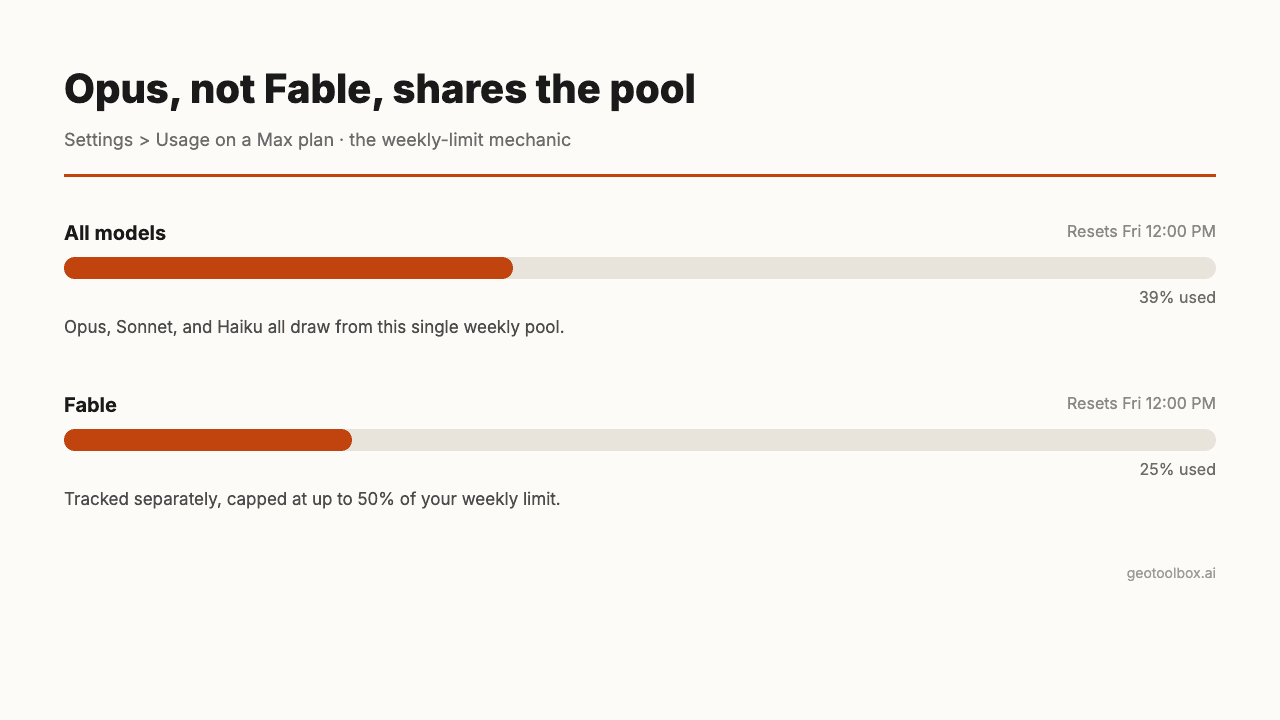
The prices above are the easy part. What actually determines whether a plan works for you is the usage limits, and they are less visible than the sticker price. Claude enforces two at once: a five-hour rolling window and a weekly cap. The weekly one is not published as a hard number, so you cannot plan against an absolute message count — but you are not flying blind either: Settings > Usage shows progress bars for both your five-hour session and your weekly limits, plus the next reset time. And because that budget is shared across chat, Claude Code, and Cowork, a heavy afternoon of coding can lock you out of ordinary chat for the rest of the window.
There is also a quieter limit inside the limit, and it applies to Fable, not Opus. On Max and premium Team/Enterprise seats, Settings > Usage shows two separate weekly bars: "All models" and "Fable." Opus, Sonnet, and Haiku all draw from the same all-models pool; Fable is tracked on its own and capped at up to 50% of your weekly usage limit, so heavy Fable use can exhaust its own bar well before the rest of your plan is touched.
The good news is the direction of travel. In May 2026, Anthropic doubled Claude Code's five-hour limits across Pro, Max, Team and seat-based Enterprise plans, removed the peak-hours reduction on Claude Code for Pro and Max, and raised API rate limits for Opus, on the back of a large compute deal with SpaceX. It did it again in September 2026: alongside the Opus 5.5 launch, Anthropic increased five-hour usage limits on Pro, Max, Team, and seat-based Enterprise plans. In our experience helping teams adopt these tools, the plan people regret is almost never the expensive one. It is the cheap tier bought to save money that ends up capping the work, and Pro subscriptions where nobody ever touches the features that justify the price.
Is Claude Worth It? Claude vs ChatGPT, Gemini, and Grok on Price
On the consumer side, price is rarely the deciding factor, because the whole market has clustered at the same number. Claude Pro, ChatGPT Plus, and Google's mid Gemini plan all sit within a dollar of each other at around $20, and Claude's two Max tiers, $100 and $200, line up against ChatGPT Pro's two tiers at the same two prices. The one that prices differently is Grok, whose main tier sits higher at $30.
| Provider | Main paid plan | Flagship API (input / output per 1M) |
|---|---|---|
| Anthropic Claude | Claude Pro $20 | Opus 5.5, $4 / $20 |
| OpenAI ChatGPT | ChatGPT Plus $20 | GPT-6 Astra, $10 / $50; GPT-6 Sol, $2 / $10 |
| Google Gemini | Google AI Pro about $20 | Gemini 3.1 Pro, about $2 / $12 |
| xAI Grok | SuperGrok $30 | grok-4.7, $2 / $6 (prompts under 200K tokens) |
Because the headline prices match, the choice comes down to what each does best rather than what it costs: Claude's writing and reasoning, ChatGPT's breadth of built-in tools, Gemini's tie-in with Google's apps, Grok's real-time access to X. On the API, Claude is not the cheapest on raw list price, but its prompt caching is more aggressive than most rivals', which changes the real cost for apps that reuse context. Gemini's Flash models undercut it on raw tokens, though the real bill depends on the same hidden meters, as our Gemini API pricing guide breaks down. For the current numbers on the closest rivals, our ChatGPT pricing, Gemini pricing, and Grok pricing guides keep the exact figures current, since those move as often as Claude's do.
Which Claude Plan Should You Actually Pay For?
Most people overbuy. Here is how to decide, from the bottom up.
Stay free if you use Claude occasionally and do not code with it. The free tier covers it, and you will know you have outgrown it the day you keep hitting the limit mid-task.
Pay $20 for Pro if you use Claude for real work most days. This is the right answer for the large majority of paying users, and it stays the answer until you are hitting its limits daily.
Pay $100 for Max 5x once you consistently run out of Pro, and step up to $200 for Max 20x only if you exhaust even that, which really means daily heavy coding or agent runs.
Buy Team the moment more than one person needs shared billing, admin controls, or data kept out of training, and give Premium seats to whoever needs the most usage. Talk to sales about Enterprise when compliance and data residency, not budget, drive the decision.
Use the API instead of a plan if you are building software. And if you are a student, check whether your school has an institutional Education plan before paying out of pocket.
Why Claude's Price Matters for Your Brand
One point here outlasts any specific price, and it is the one that matters if you run a business. Whichever tier people pay for, Claude is not just a tool they visit. It answers questions for millions of people, and increasingly those questions are about what to buy and who to hire. When someone asks Claude to recommend a product in your category, it names some companies and leaves out others.
So the more useful question is not which plan you should buy. It is whether Claude mentions your brand at all when a buyer asks it for a recommendation, and what it says when it does. That visibility does not come on a pricing tier, and it is the gap we help businesses close. Our Citation Interceptor maps where Claude and the other AI engines cite sources your brand is missing from, so you can see which conversations to get into, and you can learn the broader method in our guide to tracking AI visibility. Knowing what you pay to use Claude is half the picture. Whether Claude points buyers to you is the other half, and it is what generative engine optimization exists to solve.
Frequently Asked Questions
How much does Claude cost per month?
Claude is free to start. Paid individual plans are Pro at $20 a month (or $17 billed annually), Max 5x at $100, and Max 20x at $200, as of September 2026. Team seats run $25 for Standard and $125 for Premium, cheaper on annual billing, and the developer API is billed separately per token.
Is Claude Pro worth $20 a month?
For anyone who uses Claude for real work most days, yes. A quick test: use it normally for a week and notice whether the usage limits ever get in your way. If they do, $20 is easily worth it; if they never do, the free tier probably covers you. Pro also adds Claude Code and Cowork, which Free does not have.
What's the difference between Max 5x and Max 20x?
Mostly how much you can use them. Both give the same features as Pro and, unlike Pro, bundle the Fable models into the usage pool rather than metering them through usage credits; Max 5x ($100) is about five times Pro's usage and Max 20x ($200) is about twenty times. Neither is a smarter Claude. Start with 5x if you are hitting Pro's limits and move to 20x only if you exhaust that too.
Is the $20 Claude Code worth it, and did it get removed?
Claude Code is still included in Pro at $20; it was not removed, and there is no separate Claude Code plan. It feels expensive because coding burns your shared usage budget fast, which is what pushes heavy users to Max 20x or to the API. For occasional coding on small projects, the $20 Pro tier is genuinely enough.
Is Claude cheaper than ChatGPT?
At the main tier they match: Claude Pro and ChatGPT Plus are both about $20. On the API it depends on the model. Claude Opus 5.5 runs $4 and $20 per million tokens, the same rate as GPT-5.6 Sol; the prior model, Opus 5, had run higher at $5 and $25. OpenAI has since moved past GPT-5.6 too: GPT-6 Sol ($2 and $10) and GPT-6 Luna ($0.10 and $0.50) undercut both, though GPT-6 Astra remains OpenAI's most capable model and its priciest at $10 and $50. Claude Sonnet 5 at $2 and $10 matches GPT-6 Sol for most production work.
How do Claude's usage limits actually work?
Two limits apply at once: a five-hour rolling window and a weekly cap. Anthropic does not publish exact message counts, though Settings > Usage shows progress bars for your session and weekly limits, and Opus, Sonnet, and Haiku all share one all-models pool. Fable is the exception: on Max and premium Team/Enterprise seats it gets its own weekly bar, capped at up to 50% of your weekly limit, tracked separately from everything else. When you hit a usage limit, switching to a lighter model is a manual step (/model), not an automatic downgrade. (Claude does switch models on its own in one unrelated case — when Fable's safety classifiers block a request, it re-runs it on Opus.) Anthropic doubled Claude Code's five-hour limits in May 2026.
Sources
- Plans & Pricing - Claude by Anthropic -
claude.com/pricing - Choose a Claude plan - Claude Help Center -
support.claude.com/en/articles/11049762-choose-a-claude-plan - Pricing - Claude Platform Docs -
platform.claude.com/docs/en/about-claude/pricing - Introducing Claude Sonnet 5 - Anthropic -
anthropic.com/news/claude-sonnet-5 - Higher usage limits for Claude and a compute deal with SpaceX - Anthropic -
anthropic.com/news/higher-limits-spacex - Claude Opus 5.5 - Anthropic -
anthropic.com/news/claude-opus-5-5 - Artificial Analysis Intelligence Index v4.3.2 - Artificial Analysis, September 2026 -
artificialanalysis.ai/leaderboards/models - Release notes (Grok 4.7) - xAI, September 21, 2026 -
docs.x.ai/developers/release-notes - Use the Claude Agent SDK with your Claude plan - Claude Help Center -
support.claude.com/en/articles/15036540-use-the-claude-agent-sdk-with-your-claude-plan - Claude Code Pricing 2026 - Finout -
finout.io/blog/claude-code-pricing-2026