
Local SEO is how a business gets found by people nearby: in the Google map pack, in the local results under it, and now in the answers ChatGPT and Google AI Mode give when someone asks for the best plumber in town.
At geotoolbox we asked ChatGPT and Google AI Mode for the best plumbers, dentists, roofers and personal injury lawyers in three US cities, 48 answers in all. ChatGPT and AI Mode showed very different sources.
In our test, every AI Mode answer showed Google's own business listings. ChatGPT leaned on best-of lists and industry directories, and linked Yelp pages in a quarter of its answers. Most of the businesses either engine named were missing from the Google Maps top 20 for a similar search.
What Is Local SEO?
Local SEO is the work of getting a business shown when people nearby search for what it sells. It covers the Google Business Profile, the website, reviews and the listings other sites keep about the business.
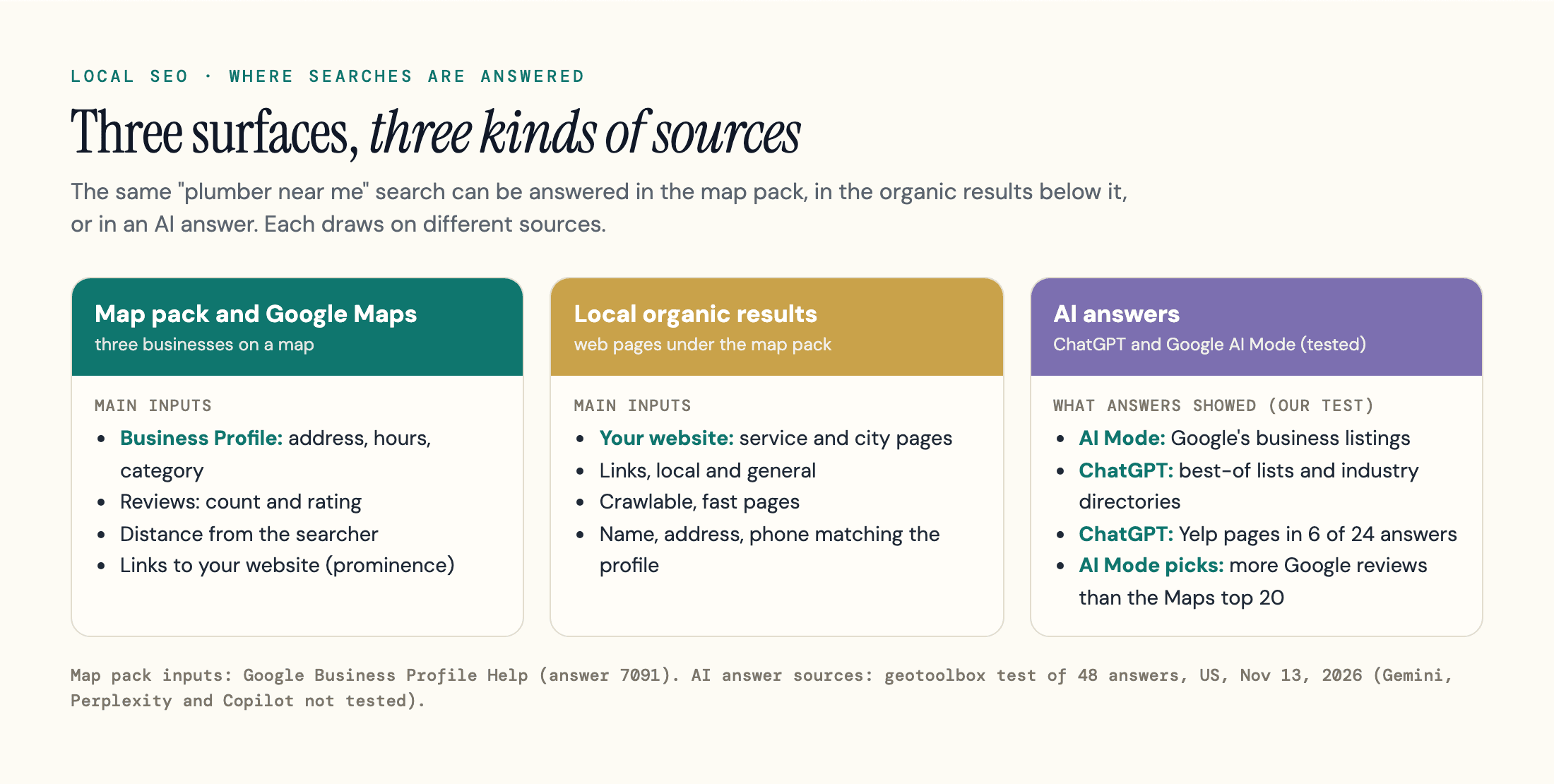
Local searches are answered in three places now: the map pack, the local organic results and AI answers.
The map pack, also called the local pack, is the box of businesses shown with a map in Google Search; Google Maps itself is a related surface. Both run on Google Business Profile data: categories, reviews, hours and the business's location relative to the searcher.
The local organic results under the map pack are ordinary web rankings. Your service pages, location pages and links compete there, so the technical basics still apply.
The third place is the AI answer: ChatGPT, Gemini, Google AI Mode and the AI Overviews at the top of some Google results. Ask ChatGPT or Google AI Mode for the best roofer in Denver and you get a short list of named companies, backed by different sources again. We tested ChatGPT and AI Mode; Gemini, Perplexity and Copilot may lean on other sources.
Local SEO applies to storefronts and to service-area businesses. A storefront serves customers at its address: a dental office, a restaurant, a shop. A service-area business travels to customers, like a plumber or a roofer.
Your website backs up the profile: one page per core service, pages for the areas served when they have real local content, and the same business name, address and phone number as the profile.
How Google Ranks Local Businesses
Google's own help page on improving your local ranking says local results are "mainly based on relevance, distance, and popularity," and describes the third factor, under the heading prominence, as "how well-known a business is."
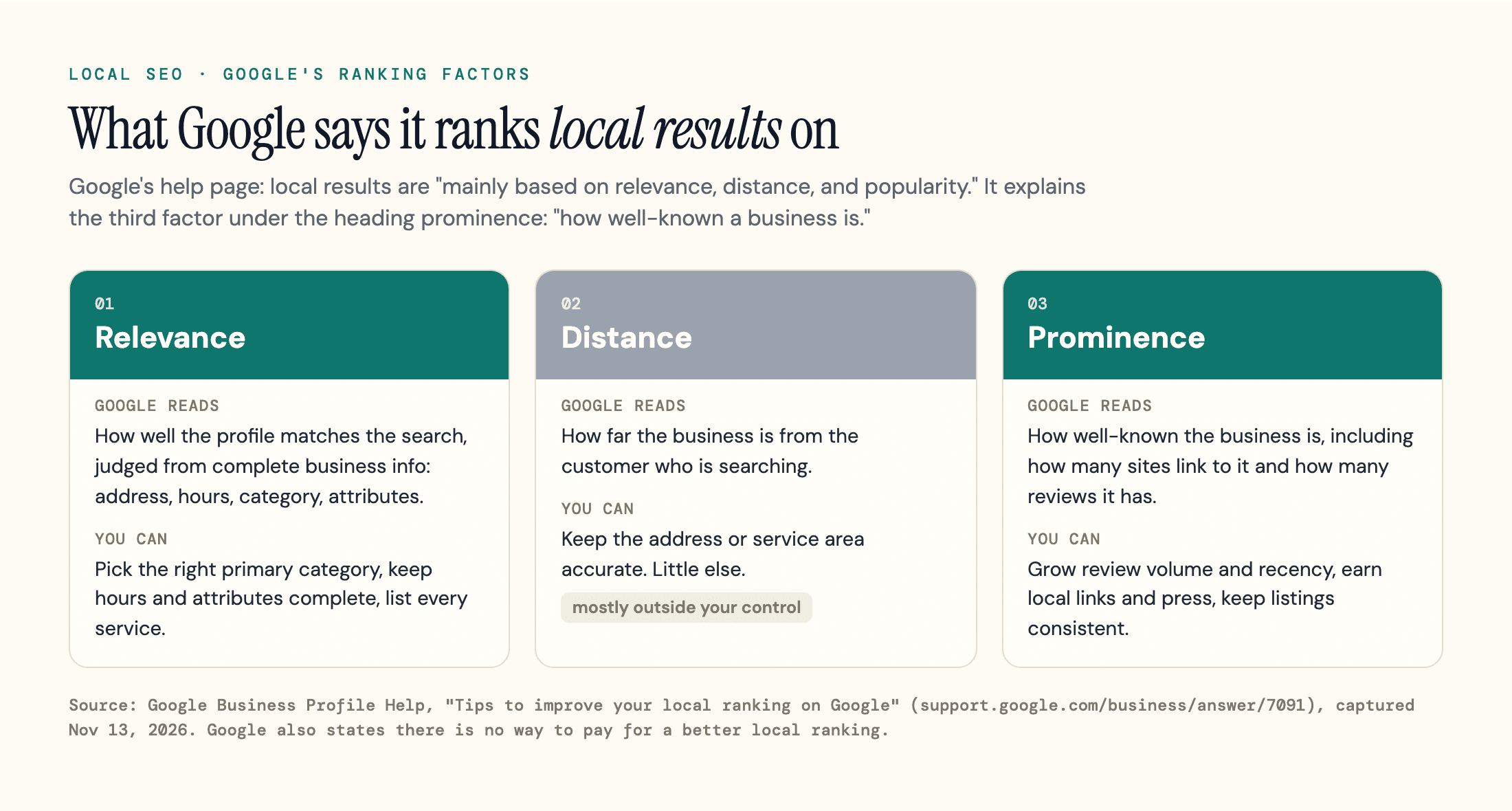
Relevance is how well a profile matches the search. Google asks for "complete and detailed business info" to judge it, and lists your address, hours, category and attributes such as parking.
Distance is how far the business is from the customer who is searching. If a searcher doesn't share a location, Google uses what it knows about where they are. You can't change your distance from a given searcher, which is why a business can rank first on one street and much lower a few miles away.
Prominence is reputation. Google's ranking page counts how many websites link to your business and how many reviews you have, states that "more reviews and positive ratings can help your business's local ranking," and says there's no way to pay for a better local position.
Google doesn't publish weights. The closest thing is the Whitespark Local Search Ranking Factors survey, whose 2026 edition, published November 6, 2025, has local SEO practitioners score 187 factors. Whitespark sells citation and local SEO services, and the survey records practitioners' informed opinion rather than measurement.
Its seven highest-scored map pack factors:
- Primary Business Profile category
- Distance between searcher and business
- Keywords in the business name
- A physical address in the city being searched
- Being open at the time of the search
- High Google ratings
- An address that shows on the profile instead of being hidden
Number 3 is a trap. Google's Business Profile guidelines say "unnecessary information" in a business name isn't permitted and can get a profile suspended.
For 2026, the survey's author reports review and behavioral signals gaining importance, while citations lost about half a percentage point, continuing a decline from earlier editions.
The 2026 edition also scored AI search visibility separately for the first time. Its top AI factor is a business's presence on expert-curated "best of" lists, and the report notes that 3 of the top 5 AI factors are citation factors.
How AI Assistants Pick Local Businesses
AI tools are already a local discovery channel. In the Local Consumer Review Survey 2026 of 1,002 US adults by BrightLocal, which sells local SEO software, use of ChatGPT and other AI tools for local recommendations rose from 6% to 45% in a year.
To see where those recommendations come from, we ran a test on November 13, 2026. We asked "What are the best [service] in [city]?" for plumbers, dentists, roofers and personal injury lawyers in Austin, Columbus and Denver: 12 prompts, each run twice in ChatGPT and twice in Google AI Mode, 48 answers in all.
ChatGPT was queried logged out from the US with web search forced on, and the city was in the prompt. AI Mode's location was set to the city itself.
For a baseline, we pulled the Google Maps top 20 for "[service] in [city]" in each city, ads excluded. We counted every source each answer showed, matched business names to Maps automatically and checked borderline matches by hand.
AI Mode Shows Google's Listings, ChatGPT Shows Lists
In our test, every one of Google AI Mode's 24 answers showed Google's own business listings, while ChatGPT's sources were mostly best-of lists and industry directories.
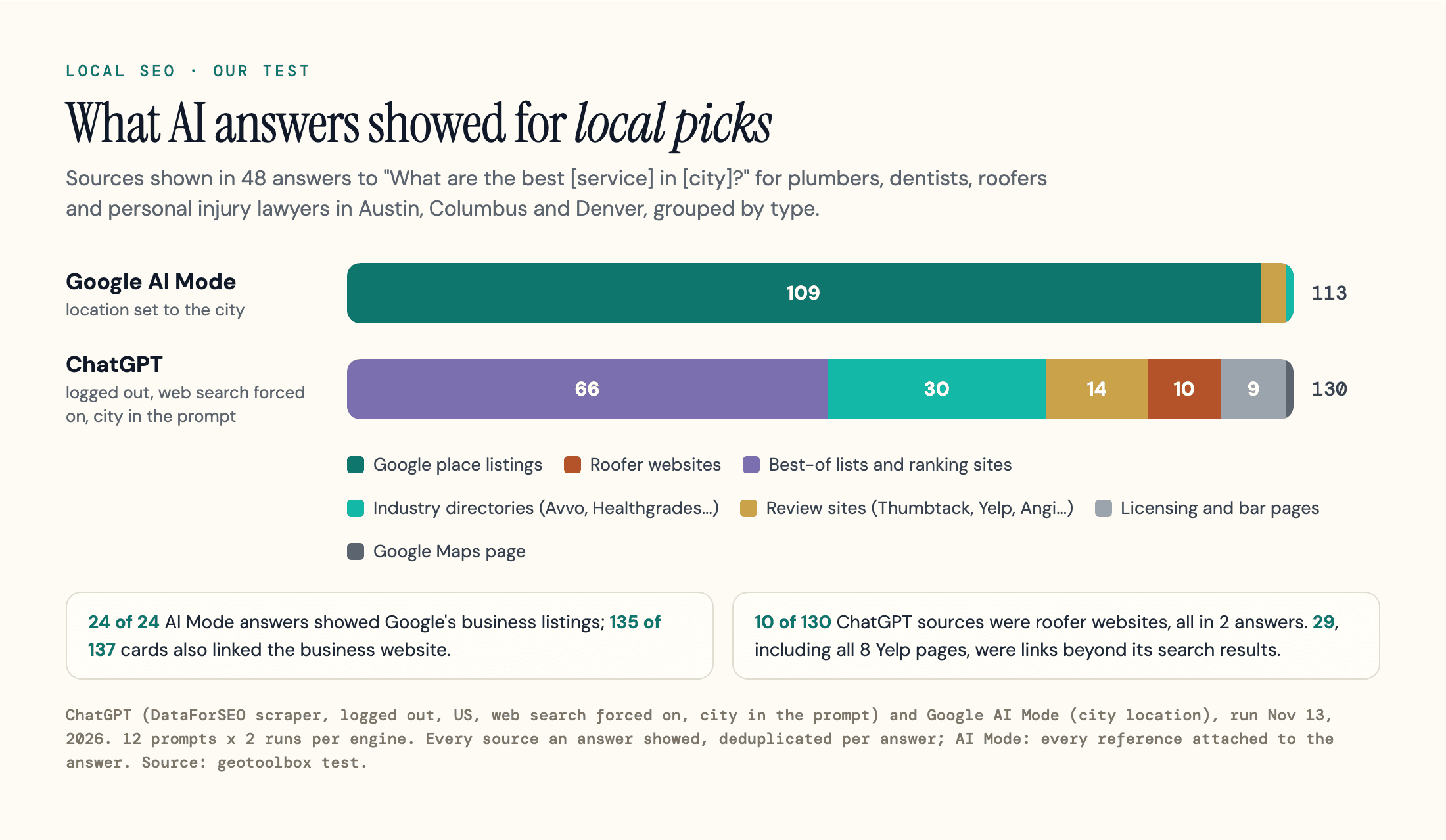
In numbers: 109 of AI Mode's 113 references pointed to Google place listings, the Business Profile data behind each card: name, rating, review count, address. The other 4 were Thumbtack (3) and a lawyer directory (1), and 135 of the 137 cards also linked the business's website.
ChatGPT showed 130 sources across its 24 answers: 66 best-of lists (Expertise.com, city ranking sites), 30 industry directories (Avvo for lawyers, Healthgrades and WebMD for dentists), 14 review sites, 10 roofer websites (one a roofer's own best-of post), 9 state licensing or bar pages and 1 Google Maps page. All 10 roofer sites came from 2 answers.
Of the 130, 101 were pages its search had retrieved; the other 29, including every Yelp page and licensing page, were links added beyond those results.
These are visibility clues, not a full account of what either engine reads. They still point to where to work: an accurate Business Profile for AI Mode, and the lists and directories that cover your trade in your city for ChatGPT.
A larger study agrees on Google and differs on ChatGPT. BrightLocal tracked 1,355 business locations and found Google's AI answers using the Business Profile for virtually every location and Yelp in 80% of ChatGPT's answers; across the engines it tracked, about 93% of the domains cited were business websites.
Prompt design may explain part of the gap, so read our split as what "best [service] in [city]" questions return.
"Best" Answers Differed from the Maps Top 20
Only 33% of the businesses ChatGPT named and 39% of those AI Mode named were in our Google Maps top-20 baseline for the same city and service. Across both runs, ChatGPT named 119 different businesses and 39 of them were in that top 20; AI Mode named 90, and 35 were.
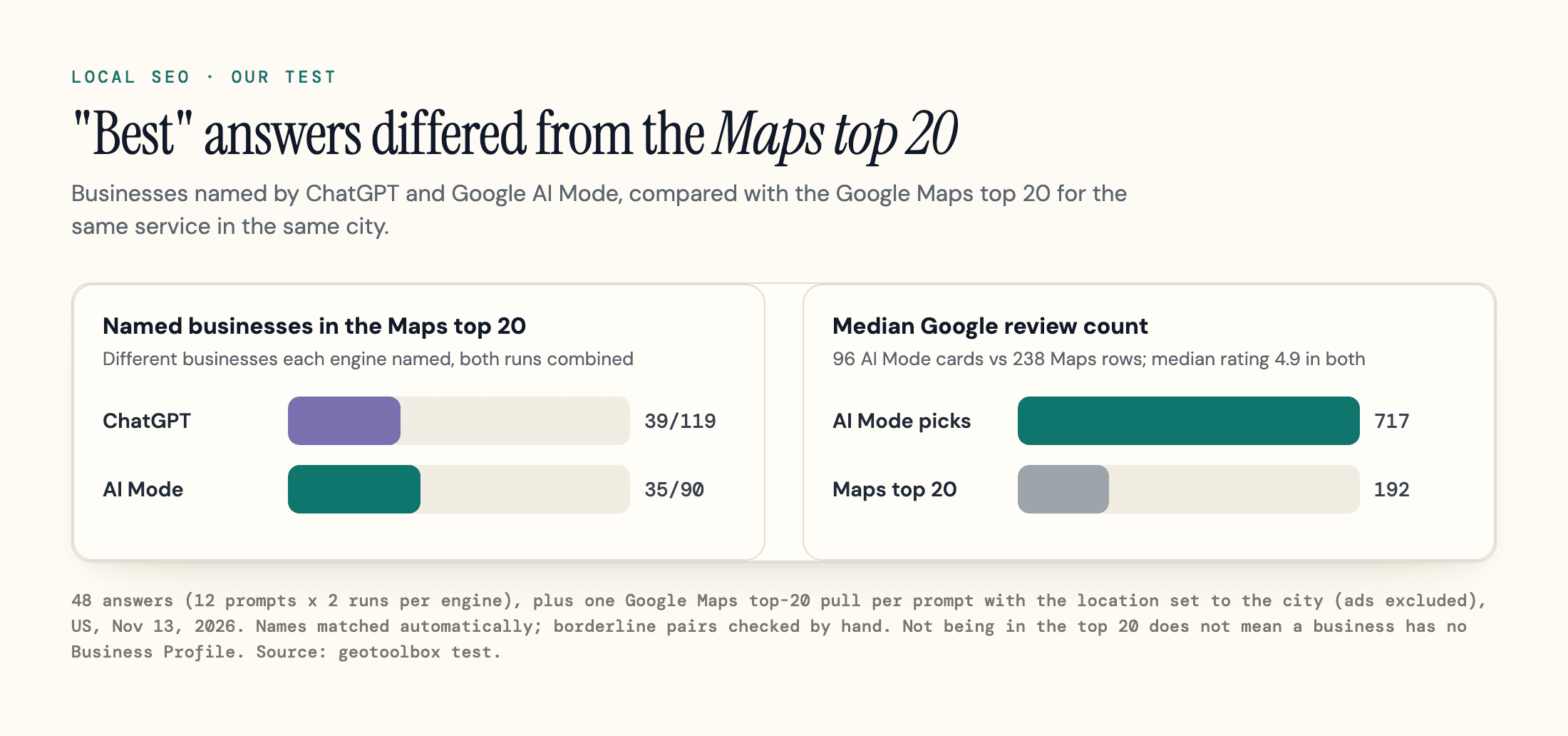
AI Mode's picks carried far more reviews: a median of 717 on Google across its 96 distinct business cards (repeats across runs counted once), against 192 across the 238 Maps rows with review counts (197 for the top 3 alone). The median rating was 4.9 in both groups.
Of the two things we measured, only review count differed, and the test can't show it drove the picks: the Maps baseline was a plain "[service] in [city]" search, not a "best" question.
ChatGPT and AI Mode also disagreed with each other, and neither engine was stable across our 2 runs:
| Measure | ChatGPT | Google AI Mode |
|---|---|---|
| Named in run 1 and again in run 2 | 48 of 91 | 47 of 65 |
| AI Mode picks also named by ChatGPT | - | 40 of 90 |
Where ChatGPT's Business Cards Get Their Numbers
ChatGPT usually shows business cards with a rating and review count. For 23 of the 32 businesses we could match to Google Maps, the card showed fewer than half of Google's reviews, while 8 matched Google's count within 2%.
In 6 of the 24 answers, ChatGPT linked businesses or their ratings to Yelp pages tagged as a Yelp data feed (utm_campaign=yelp_feed). That fits Axios's July 2026 report that Yelp is licensing reviews, ratings, photos and business details to OpenAI for ChatGPT answers. So the card next to your name may carry your Yelp numbers rather than your Google ones.
For more on how the retrieval step works, see how ChatGPT search works and our guide to Google AI Mode SEO.
Set Up Your Google Business Profile to Rank
The profile feeds the map pack and shows up in AI Mode's answers, so it comes first. Most of the work is getting a few fields exactly right.
Primary Category
Pick the primary category that names your core business ("Plumber", not "Water heater installation service"), then add secondary categories only for services you offer. Google's guidelines ask you to "choose the fewest number of categories it takes to describe your overall core business."
Business Name
Use your real-world name, as it appears on your storefront, website and invoices, with no city or service added.
Address or Service Area
A storefront shows its address. A service-area business hides it and lists the areas it serves; Google's guidelines say that area shouldn't extend farther than about 2 hours of driving time from your base, though some businesses can justify more. A hybrid, like an auto shop that also does roadside calls, can show its address and list a service area.
Google's guidelines rule out three kinds of address for a profile:
- a virtual office
- a P.O. box
- a mailbox at a remote location
If you don't operate from an address, don't put a profile there.
Hours, Services and Attributes
Fill in every service with a short description, set holiday hours before holidays, and add the attributes that apply to you (wheelchair access, online appointments, languages spoken). Keep hours accurate, and never claim hours you don't keep.
Photos and Posts
Upload real photos of your work, team, vehicles and premises, and keep adding them. Use profile posts for offers, events and news. Google's ranking page doesn't mention posts, so write them for customers.
Multiple Locations
Give each branch its own profile and its own page on your site, with that branch's hours, services and staff. Google's guidelines say not to "create more than one page for each location of your business," so merge or remove any duplicate profile for the same branch.
Individual practitioners, such as a dentist in a group practice, have separate rules and may get their own profile.
Verification and Suspensions
Verification problems and suspensions came up again and again in the 40 Reddit threads and 4 Google Business Profile Help Community threads we read for this guide. The same triggers repeat, and Google's guidelines rule out most of them:
- a keyword-stuffed business name
- a virtual office, or a coworking desk without signage and staff, as the address
- a service-area business showing a home address
- several profiles for one location
Keep documents that tie the business to the address (utility bills, a business license, photos of signage), and be ready for Google to ask for video verification. A suspended profile can be reinstated through Google's appeal process, so have that evidence ready before you file.
Get More Reviews Without Breaking the Rules
Reviews are the part of prominence you can grow every week.
Customers check how fresh reviews are too. In the BrightLocal survey, 74% of consumers look for reviews written in the last three months, and 32% look for reviews from the last two weeks. A profile with hundreds of reviews and nothing new since spring looks stale.
How to Get More Google Reviews
What works is plain: ask every customer, at the moment the job is done, with a direct link to your review form. Put the link in the invoice email, on the receipt and in a follow-up text. Staff can ask in person, without pressure: Google's policy says businesses shouldn't require or pressure customers to review while on the premises.
Replying to and Reporting Reviews
Reply to reviews, especially the negative ones: a short, specific reply shows the next reader that someone runs the business.
For fake or abusive reviews, flag them from your profile. Google's review reporting page says you can report any review, but only those that break its policies are removed; evaluation typically takes several days, and a rejected report gets one appeal. Google has a separate route for extortion scams that threaten negative reviews.
What Google and the FTC Don't Allow
Two sets of rules apply in the US. Google's Maps content policy bans incentives "such as payment, discounts, free goods and/or services" in exchange for a review, and bans selectively soliciting positive reviews, often called review gating. The FTC's rule on fake reviews, in effect since October 21, 2024, adds civil penalties for knowing violations.
| Practice | Google Maps policy | FTC rule |
|---|---|---|
| Asking every customer for an honest review | Allowed | Allowed |
| Discount or gift in exchange for any review | Not allowed | Not allowed when the reward depends on a positive or negative review |
| Asking only happy customers (review gating) | Not allowed | Not covered by the rule's incentive section, but the FTC says gating can still violate the FTC Act |
| Buying or writing fake reviews | Not allowed | Not allowed, including AI-generated fake reviews |
| Threats or intimidation to get a negative review removed | Not allowed (discouraging or prohibiting negative reviews) | Not allowed |
| Pressuring customers to review on the spot, or telling them what to write | Not allowed | Not addressed directly |
The table settles a disagreement you will meet in other guides. Some still recommend a discount for leaving a review. Google forbids it outright, whatever the review says.
Citations and the Lists AI Answers Read
A local citation is any mention of your business name, address and phone number (NAP) on another site: directories, data aggregators, review platforms, your chamber of commerce, industry associations.
Citations used to be a core map pack lever. NAP consistency still matters for matching: Google, and any AI tool that pulls from these sites, has to tell that "Smith Plumbing LLC, Suite 4" and "Smith Plumbing" are the same company.
Citation tools do this at scale: Whitespark's Local Citation Finder tracks your listings and finds your competitors' citations, and BrightLocal's Citation Builder builds and cleans up listings. Fix the wrong ones and stop there; chasing a hundred low-value directories is unlikely to move rankings. A service-area business that hides a home address shouldn't publish it in listings or markup either.
In the US, start with the listings people and platforms use most:
- Apple Business (formerly Apple Business Connect), where you manage your Apple Maps listing
- Bing Places for Business, for Bing Maps and Bing local results
- Yelp, which ChatGPT linked often in our test
- Facebook and the Better Business Bureau
- Your other social profiles (Instagram, LinkedIn), with the same name, address and phone; the 2026 Whitespark survey added social signals back as a factor group and lists social profiles linked to the Business Profile among its factors
- The main directory for your trade: Avvo or Justia for lawyers, Healthgrades or Zocdoc for dentists and doctors, Angi or Houzz for home services
Then look at the lists ChatGPT showed in our test. Across its 24 answers, the most frequent sources were Avvo (18) and Expertise.com (14), then Yelp (8) and ranking sites for dentists and roofers. Some of these lists build their rankings from Google reviews (FlexiLocal, for one, sorts by rating, then number of reviews), so the review work above feeds them too.
To find yours, ask ChatGPT for the best businesses in your category and city, and open the sources it shows. Some lists are editorial and accept nominations or run review processes. Others are pay-to-play. Check how a list chooses businesses before paying for a spot, and don't buy a badge from a site no AI answer cites.
For more on what makes AI tools cite a page, see our breakdown of ChatGPT citations.
Location Pages, Schema and Local Links
Your website does double duty in local SEO. It ranks on its own in the local organic results, and it confirms what your profile says.
Service Pages and Local Keywords
Start with the local keywords customers type. Google's SEO starter guide tells site owners to "think about the words that a user might search for." Local searches either include a place ("dentist in Columbus") or leave it out ("emergency dentist"). Map each service and area to one page instead of asking the homepage to rank for everything.
Build one page per core service before you build any city pages. "Water heater repair" deserves its own page with prices or price ranges, what the job involves, photos and reviews that mention it.
Give it a title that names the service and the area, such as "Water Heater Repair in Columbus, OH": Google's starter guide says a good title is unique to the page, and the title shapes the link people see in results. Then link each service page to the matching city pages and back, so visitors and crawlers can move between them.
City Pages Without Doorway Spam
Near-identical city pages built to catch searches and funnel visitors to one place risk being treated as doorways: Google's spam policies list doorway abuse as spam, including pages targeted at specific regions or cities that funnel users to one page. A city page earns its place when it has content only that city could have:
- jobs you did there, with photos
- the team or crew that covers it
- local permits, codes or conditions
- reviews from customers in that area
If you can't write that for a town, leave it out and list it in a service-area section instead.
A blog does the same job one level up. Posts that answer questions specific to your area, like frozen pipes in a cold-winter city or roof checks after hail season, give Google and AI tools local material that a national site doesn't have.
Mobile Pages and Maps
Check every page on a phone. Google indexes the mobile version of a site's content, and a visitor standing in a parking lot needs the call button, address and hours without hunting for them. Keep pages fast too; our technical SEO guide covers page speed and Core Web Vitals.
An embedded Google map on your contact or location pages helps with directions, and Google's Maps Embed API adds one with a simple HTTP request. Google's local ranking page doesn't mention map embeds, so treat the map as a convenience for visitors, not a ranking lever.
LocalBusiness Schema
Google's Local Business structured data lets you state your hours, departments, address and other details in a format machines read without guessing. Use the most specific type that fits (Plumber, Dentist, Attorney) and fill in name, address, phone, hours and URL; most SEO plugins can output it.
Google also says it "does not guarantee that features that consume structured data will show up in search results." Local business schema is data hygiene: it makes your NAP, hours and service area unambiguous for Google and other search engines, and it should match your profile exactly. Our guide to schema markup for AI covers the markup itself.
Local Links
Local backlinks help twice: in the map pack through prominence, and for your pages in the local organic search results. The useful ones are earned:
- a sponsorship page from a youth team
- a chamber of commerce membership
- a supplier's "where to buy" page
- a story in the local paper about a job or a hire
Local press can also reach AI answers directly. When we asked for the best dentists in Denver, ChatGPT cited the city magazine 5280's top dentists list.
How to Measure Local SEO
A single "rank" for a local keyword doesn't exist, because of the distance factor above: a report that says "#3 for plumber" describes one point on the map.
Geo-Grid Rank Tracking
A geo-grid tool checks your map pack position from a set of points around your business (a 7x7 or 9x9 grid, for example) and shows where you rank first, where you drop out, and which competitor takes your place. Several local SEO tools sell it, including BrightLocal's Local Search Grid and Whitespark's Local Ranking Grids.
It is also a quick way to read a drop in rankings. If you fell everywhere, check the profile first: a category change, an edit under review, a suspension. If you fell only at the edges, look at competitors nearer those areas.
Local Competitor Checks
Look at the businesses that beat you in the grid and in AI answers: their primary category, how many reviews they have and how fast new ones arrive, and which lists and directories name them. Those are the gaps you can close first.
Business Profile and Analytics
Google's performance report lists the searches people used, views, calls, direction requests, website clicks, messages and bookings. Google notes the totals include Google Ads as well as organic results, so don't read them as organic-only if you run ads.
Tag the website link on your profile with UTM parameters (for example ?utm_source=google&utm_medium=organic&utm_campaign=gbp), so GA4 groups the traffic that came through that link. ChatGPT's business cards can reuse that link: 52 of the 122 card links in our test carried owners' profile tags, so some ChatGPT clicks will land under your profile campaign.
Search Console covers the local organic side: queries with city names, and the pages that rank for them.
AI Answer Checks
Check AI answers the way we did: a fixed list of prompts ("best [service] in [city]", "[service] near [neighborhood]"), the same engines each time, several runs per prompt, and a log of the date, the businesses named and the sources shown. Our reruns showed why one check isn't enough.
| What to track | Where | How often |
|---|---|---|
| Map pack position across your area | Geo-grid rank tracker | Monthly, and after big profile changes |
| Calls, directions, website clicks | Business Profile performance | Monthly |
| Visits and conversions from the profile link | GA4, with UTM tags on the profile link | Monthly |
| Local organic queries and pages | Google Search Console | Monthly |
| Whether AI answers name you, and which sources they show | Fixed prompts in ChatGPT, AI Mode and the assistants your customers use, several runs each | Monthly |
You can run the AI checks by hand, or track brand mentions in AI search with a tool that repeats the prompts for you.
Local SEO Checklist
Work through these in order, or use them as a quick local SEO audit of an existing business.
- Claim and verify your Google Business Profile, with your real business name and no added keywords.
- Set the primary category to your core business, and add only the secondary categories that match services you offer.
- Fill every field: services with descriptions, hours (including holidays), attributes, service areas and real photos.
- Set up a review routine: a direct review link sent after every job, no incentives, and a reply to every review.
- Make your name, address and phone (NAP) match on your website, Apple Business, Bing Places, Yelp, Facebook and your trade's main directory.
- Find the best-of lists and directories that AI answers show for your category and city, and get onto the legitimate ones.
- Build one page per core service, then city pages only where you have local work to show.
- Add LocalBusiness schema that matches your profile exactly.
- Earn a few local backlinks from sponsorships, associations, suppliers and local press.
- Measure monthly: geo-grid positions, profile calls and clicks, UTM-tagged visits, and a fixed set of AI prompts run more than once.
For item 10, the geotoolbox AI visibility tracker runs your prompts on a schedule in ChatGPT, Google AI Mode, Gemini, Perplexity and other engines (which ones depends on the plan) and records the businesses each answer names and the sources it cites.
Each tracked brand scans one market, so put the city in the prompt, as we did for ChatGPT. Our free AI readiness check covers the layer underneath: whether AI crawlers can read the service and city pages you build.
Frequently Asked Questions
How much does local SEO cost?
Doing it yourself costs time and a few tools: the Business Profile and most listings are free, and a geo-grid tracker is a monthly subscription. Agency prices depend on how many locations you have and how competitive your trade is in your city. Ask what the fee covers: profile management, reviews, listings, pages, links and reporting are separate pieces of work.
Can I do local SEO myself?
Yes. Most of the work that moves results is in your hands: the Business Profile, a review routine, consistent listings and real service pages. Owners have an edge here: they have the photos, job details and customer contacts. Bring in help for technical site problems, for many locations, or when a suspended profile needs an appeal.
How long does local SEO take?
There's no fixed timeline. Google's SEO starter guide says some changes "might take effect in a few hours, others could take several months," and suggests waiting a few weeks before judging a change.
Does local SEO work without a storefront?
Yes. Businesses that visit customers can list service areas instead of an address, per Google's Business Profile guidelines. Hiding the address has a cost: the Whitespark survey scores a visible address among its top map pack factors. Your service and city pages do the work farther out.
Sources
- Tips to improve your local ranking on Google - Google Business Profile Help -
support.google.com/business/answer/7091 - Guidelines for representing your business on Google - Google Business Profile Help -
support.google.com/business/answer/3038177 - Prohibited and restricted content (Maps user contributed content policy) - Google -
support.google.com/contributionpolicy/answer/7400114 - Federal Trade Commission Announces Final Rule Banning Fake Reviews and Testimonials - FTC, August 14, 2024 -
ftc.gov/news-events/news/press-releases/2024/08/federal-trade-commission-announces-final-rule-banning-fake-reviews-testimonials - Trade Regulation Rule on the Use of Consumer Reviews and Testimonials - Federal Register, August 22, 2024 -
federalregister.gov/documents/2024/08/22/2024-18519/trade-regulation-rule-on-the-use-of-consumer-reviews-and-testimonials - Local Search Ranking Factors 2026 - Whitespark (Darren Shaw), November 6, 2025 -
whitespark.ca/local-search-ranking-factors/ - Local Consumer Review Survey 2026 - BrightLocal, February 11, 2026 -
brightlocal.com/research/local-consumer-review-survey/ - Exclusive: Yelp partners with ChatGPT to surface reviews - Axios, July 23, 2026 -
axios.com/2026/07/23/yelp-reviews-chatgpt-geo-partnership - Spam policies for Google web search (Doorway abuse) - Google Search Central, last updated August 28, 2026 -
developers.google.com/search/docs/essentials/spam-policies - SEO Starter Guide - Google Search Central, last updated December 10, 2025 -
developers.google.com/search/docs/fundamentals/seo-starter-guide - Mobile site and mobile-first indexing best practices - Google Search Central -
developers.google.com/search/docs/crawling-indexing/mobile/mobile-sites-mobile-first-indexing - Maps Embed API overview - Google for Developers -
developers.google.com/maps/documentation/embed/get-started - Local Business (LocalBusiness) structured data - Google Search Central -
developers.google.com/search/docs/appearance/structured-data/local-business - Business Profile performance metrics - Google Business Profile Help -
support.google.com/business/answer/9918094 - Report inappropriate reviews on your Business Profile - Google Business Profile Help -
support.google.com/business/answer/4596773 - Local AI search sources: where to get listed - BrightLocal, August 26, 2026 -
brightlocal.com/resources/ai-directory-sources/ - Plumbers in Austin, Texas: 42 compared by Google reviews - Flexi Local -
reviews.flexilocal.com/l/us/texas/austin/plumbers - AI local recommendation test: 48 ChatGPT and Google AI Mode answers for 12 "best [service] in [city]" prompts, with a Google Maps top-20 baseline - geotoolbox, November 13, 2026 (method in this article)