
Google AI Mode SEO is a different job from ranking. In the conversational tab, you are not competing for a spot in a list of links, you are trying to be one of the few sources the generated answer cites, and you often cannot see whether you made it. This guide covers how AI Mode picks pages, what actually changes in your SEO, how to measure visibility Search Console barely breaks out, and which levers you genuinely control.
What Google AI Mode Is, and How It Differs from AI Overviews
Google AI Mode is the conversational, Gemini-powered search experience you open as its own tab. Instead of a page of ten blue links, you get a generated answer you can follow up on, with a handful of cited sources attached. It surpassed one billion monthly users a year after launch, per Google at I/O 2026, and it is now free and broadly available rather than the US-only, opt-in Labs experiment it started as.
Most of the confusion here comes from mixing up three names. Search Generative Experience (SGE) was the Labs prototype. Google retired that name and expanded the generative summary experience into what shipped broadly as AI Overviews. AI Mode is the separate, full conversational surface that arrived after. They are related, they share Google's index, but they are not the same product and they do not behave the same way.
The distinction matters for SEO because the two surfaces select and show sources differently.
| AI Overviews | AI Mode | |
|---|---|---|
| Where it lives | A summary box on the normal results page, above the blue links | A separate tab you open; it replaces the results page |
| How it triggers | Auto-injected when Google judges it additive to classic Search | User-initiated; you choose to search in it |
| Interaction | Mostly read-and-scroll; less conversational than AI Mode | Multi-turn conversation with follow-ups |
| Query fan-out | Lighter; a few subtopics | Heavier; many concurrent sub-searches per question |
| SEO goal | Be one of the cited sources in the box | Be a cited source inside the synthesized answer |
If your focus is the summary box on the standard results page, that is a related but separate playbook, covered in how to get cited in Google AI Overviews. This piece is about the conversational tab, where the fan-out runs deeper and measurement gets harder. For a plain-English definition you can point a colleague to, the Google AI Mode explainer covers the basics.
How AI Mode Picks the Pages It Cites
AI Mode does not run your query and rank pages. It takes your question, breaks it into subtopics, and runs many searches at once. Google calls this a query fan-out technique, "issuing multiple related searches concurrently across subtopics and multiple data sources," then it synthesizes one answer and attaches the sources that supported it. It now runs this as an agentic loop rather than a single pass: AI Mode builds a search plan, fires off the sub-queries, evaluates what comes back, and adjusts before it commits to an answer. It is the same fan-out architecture as AI Overviews, with deeper reasoning layered on top, which is why a page has to earn its place against a moving set of sub-questions rather than one fixed query.
Picture a search like "best CRM for a 20-person B2B team with HubSpot integration under $500 a month." AI Mode may quietly fan that into separate searches for CRM options at that team size, HubSpot integrations, pricing tiers, and security requirements. A different page can be pulled in for each strand. Your page gets cited because it answered one of those hidden sub-questions well, not because it held position one for the sentence the user typed. If you want the mechanics in depth, we covered query fan-out separately.
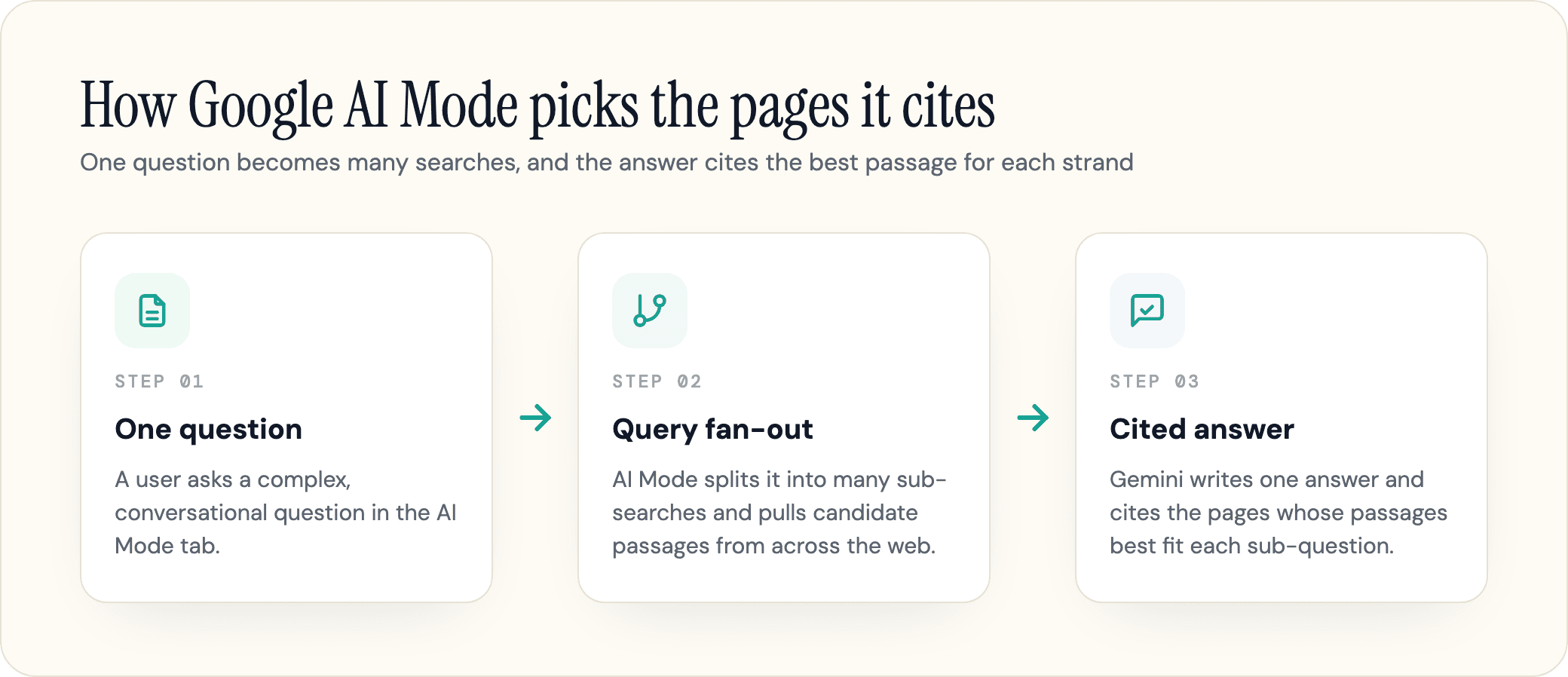
Two consequences follow, and both shape the rest of this guide.
First, treat the passage as the unit of selection. Google documents supporting links and query fan-out rather than a formal passage-ranking rule, but in practice AI Mode lifts the specific chunk that answers a strand. A clear, self-contained passage under a descriptive heading behaves like the thing that gets cited, not the page as a whole.
Second, ranking and citation have come apart. You still need to be indexed and eligible for a snippet, but you do not need to hold position one. Google says AI features surface a "wider and more diverse set of helpful links" than classic search, so a page sitting on page two for the head term can still be cited when its passage best answers a fanned-out strand. That is the most encouraging point for a smaller site. The citation set is also unstable: a Semrush study, reported by iPullRank, found 91% of URLs cited in AI Overviews were dropped at some point, so a page cited today can be gone next week (that figure is from AI Overviews, the closest measured proxy). And Google cites itself heavily, with SE Ranking's analysis of 1.3 million AI Mode citations putting Google.com as the most-cited domain at 17.42%, more than the next several combined. The winnable ground is the specific sub-question, not the head term Google already owns. To understand why a page qualifies at all, it helps to know how AI search works under the hood.
Does AI Mode Need a Different SEO Strategy?
Google's own answer is blunt. Its documentation states there are "no additional requirements to appear in AI Overviews or AI Mode, nor other special optimizations necessary," and that to be eligible a page "must be indexed and eligible to be shown in Google Search with a snippet." AI Mode is not a separate index you submit to. It reads from normal search.
So the honest read is that this is not a new discipline bolted onto SEO. It is SEO, with the prerequisite made non-negotiable and a few emphases shifted. If Google cannot crawl, render, index, and trust your page, it will not become a reliable AI Mode source. There is no shortcut that skips being indexed and genuinely relevant. Anyone selling you a way to "optimize for the AI" that bypasses being indexed and relevant is selling a rebrand. That is the practical answer to the generative engine optimization debate: the label is new, the foundation is not.
What genuinely shifts is narrower, and worth naming so you spend effort in the right place:
- Visibility becomes binary. You are cited or you are not, rather than sitting at position seven where a determined user might still find you.
- Sub-intent coverage matters more than the head keyword, because the fan-out rewards pages that answer the strands around a topic.
- Extractability matters more than it used to, because a passage has to stand on its own to be lifted into an answer.
- Corroboration matters more, because AI Mode leans on sources that agree with each other across the web.
Everything else you already do well, keep doing. The next section turns those four shifts into concrete moves.
How to Optimize for Google AI Mode
Here is the checklist, highest-impact first.
-
Cover the fan-out on one deep page. List the sub-questions a real user would ask around your topic, then answer each one on the same page under its own heading. If a page answers the pricing strand, the integration strand, and the "who is this for" strand, it is eligible for more of the fan-out searches than a thin page that only defines the term. This is coverage on one page, not a doorway page per sub-question.
-
Write answer-first, self-contained passages. Lead each section with the direct answer in a sentence or two, then support it. AI Mode lifts passages, so a chunk that only makes sense after reading the whole article is hard to cite. Descriptive headings that mirror the question help the model match your passage to a strand.
-
Use structured data honestly. Add schema that matches your visible content: Article, FAQPage, Product where it applies. It helps Google parse and trust what a section is, and it is required for some rich results. It is not a citation switch, and Google does not treat it as a ranking factor. We go deeper on where it helps and where it is oversold in schema markup for AI. While you are checking files, skip the effort on speculative ones: Google does not use or document llms.txt for AI Mode, which pulls from the normal search index.
-
Build corroboration and entity signals off-site. AI Mode favors claims that hold up across sources. Consistent brand and author identity, credible mentions on the places these answers already pull from, and a clean entity footprint all raise the odds you are chosen when a strand needs a trusted source. The broader AEO checklist covers the on-page and off-page basics that still underpin all of this.
-
Show real experience. Firsthand tests, original data, named authors, and evidence a competitor cannot copy make a passage harder to replace with a generic one. This is E-E-A-T doing the same job it always did, now as a tiebreaker for citation.
-
For products and local, feed the right graph. AI Mode does not only read the web index. Its fan-out also pulls from the Knowledge Graph, the Shopping Graph, and live sources, so for e-commerce and local queries the real levers are an accurate Merchant Center feed and an up-to-date Google Business Profile, not just blog passages.
In our experience running scans across the geotoolbox engine set, the pages that get pulled into AI Mode answers are rarely the flashiest. They are the ones that answer a narrow question cleanly, in a passage you could lift out and paste into a reply without editing. Write for that.
The Traffic Reality: Impressions Up, Clicks Down
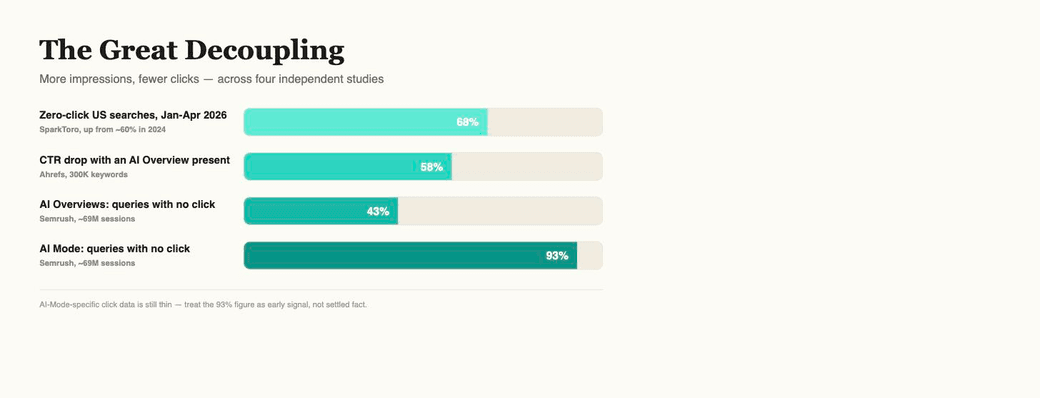
Be honest with yourself and your stakeholders about clicks. The trend is real and it predates AI Mode. In the first four months of 2026, 68.01% of US Google searches ended without a click, up from roughly 60% in 2024, before AI Mode was widespread. AI features push that further. Ahrefs, studying 300,000 keywords, found the presence of an AI Overview correlated with a 58% lower click-through rate for the top-ranking page, up from the 34.5% it measured on the original April 2025 data. BrightEdge's one-year data showed impressions up more than 49% while click-throughs fell about 30%. Inside AI Mode the gap looks sharper still: Semrush, analyzing almost 69 million Google Search sessions, found that 93% of AI Mode queries produced no outbound click, versus about 43% for AI Overviews. One caveat worth stating plainly: AI-Mode-specific click data is still thin, and most of the numbers above come from AI Overviews studies, so treat the AI Mode figures as early signal rather than settled fact. The direction, though, is consistent.
That is the "great decoupling": you are shown more and clicked less. Some of the industry reaction is stark. Speaking to Technology Magazine, Lily Ray of Amsive warned that making AI Mode the default "is going to have a devastating impact on the internet," and Barry Adams of Polemic Digital expects click volume to the web to roughly halve. Google's framing is that the clicks you do get are worth more, with users spending more time on site, and its own executives argue the web is thriving.
You do not have to pick a camp to act on this. The move is to stop grading yourself only on click volume for informational queries and start counting the value AI Mode actually creates: presence in the answer, brand recall, and higher-intent visits. NerdWallet is the case in point. Its monthly unique users fell about 20% year over year while quarterly revenue rose 37% in Q4 2024. That revenue came from other parts of the business, not from AI Mode, but it shows traffic and revenue can move in opposite directions. The point stands only if you can see whether you are in the answer at all, which is where most teams hit a wall.
How to Measure and Track AI Mode Visibility
Start by knowing what Search Console can and cannot tell you, because this is where most of the confusion lives. In the main Performance report, AI Mode and AI Overview activity is folded into the "Web" search type with no filter to isolate it. In June 2026 Google added a separate generative AI performance report, but read the fine print: it reports impressions only, not clicks, and it lumps AI Overviews and AI Mode together into one "generative AI features in Search" bucket you cannot split apart. (AI Overviews appearing in Discover gets its own separate report, not folded into this one.) It also rolled out in phases. So you can increasingly see that you appeared in an AI surface, but not which one, and not what it drove.
Three more things break the old measurement habits:
- There is no fixed top ten to track. AI Mode synthesizes an answer, so traditional rank trackers have nothing to report a position against.
- Answers are personalized and non-deterministic. Two people asking the same question can see different sources, so checking once and seeing yourself proves little.
- Attribution has been shaky. For a stretch in 2025, AI Mode links carried a noreferrer attribute that hid the referrer in analytics; Google said it was unexpected and fixed it, but the episode is a reminder that AI-surface traffic is easy to misread.
So you measure presence, not position, and you measure it across many samples rather than one lucky check. Practically that means tracking whether you are cited for a set of buyer questions, how your share of those answers trends over time, and whether branded search lifts as AI Mode mentions you. Our own writeups on measuring AI visibility, the best AI Mode rank trackers, and AI Overview trackers walk through the free and paid options.
This is the gap geotoolbox was built for. Our scan runs your prompts across eight engines, and Google AI Mode is one of them, so you get a straight read on whether AI Mode cites you or a competitor for the questions your buyers actually ask, tracked across repeated scans so you are reading a trend rather than a single non-deterministic snapshot. Even that is a probe, not any one user's personalized session. It will not give you a clean click number, because no tool honestly can yet. It will tell you whether you are in the answer.
What You Can Actually Control
A lot of anxiety here comes from misunderstanding the levers, so here is what each one actually does.
Googlebot governs whether Google can crawl your site for Search, and since AI Mode reads from the search index, that same crawl access is what makes you eligible for AI features. Two of these are real limits: data-nosnippet hides specific elements, and max-snippet caps snippet length. Be careful with the blunt ones. nosnippet and max-snippet:0 make the page snippet-ineligible, and since AI features require a page to be eligible for a snippet, they effectively remove you from AI Mode citation rather than just trimming it. noindex removes the page from Search entirely.
The most common mistake is reaching for Google-Extended to get out of AI Mode. It does not do that. Google-Extended controls training and grounding in Google's other AI products, not your appearance in AI Overviews or AI Mode, which run on the normal search index through Googlebot. Block Google-Extended and you change what future models train on without opting yourself out of AI Mode or AI Overviews. If you want to understand the wider set of AI crawlers and what each one governs, we keep a running guide to AI crawlers and how to control them.
There is a genuine opt-out, but it is a blunt one. Google began testing its Search Console generative-AI control on June 3, 2026 with a subset of UK properties, started respecting the setting on June 17, 2026 under a binding Competition and Markets Authority conduct requirement, and as of August 31, 2026 has rolled it out to all websites worldwide. Google says the toggle is not used as a ranking signal, and it does not cover the Gemini app. Where it's live, it keeps a site out of AI Overviews and AI Mode, and the tradeoff is total: you forfeit visibility and impressions from those surfaces while staying in classic results. For the vast majority of sites that is the wrong trade, because the traffic is leaving the open web regardless and being absent from the answer does not bring the click back. The better play is to be the source the answer cites.
Frequently Asked Questions
What is the difference between Google AI Mode and AI Overviews?
AI Overviews is the summary box that appears above the blue links on a normal results page. AI Mode is a separate conversational tab that replaces the results page with a generated, multi-turn answer. Both are powered by Gemini and share Google's index, but AI Mode fans a question out into more concurrent searches and is where being a cited source, not a ranked link, is the whole game.
Do I need a different SEO strategy for AI Mode, or is normal SEO enough?
It is mostly the same SEO with the prerequisite made non-negotiable. Google states there are no additional requirements to appear, and a page must simply be indexed and eligible for a snippet. What shifts is emphasis: cover the sub-questions around a topic, write passages that stand on their own, and earn corroboration off-site. There is no path that skips being indexed and relevant.
How do I track whether my site appears in Google AI Mode?
You measure presence across many samples rather than a single position. Search Console now shows generative-AI impressions in a separate report, but it lumps AI Mode in with AI Overviews and shows no clicks, while its main report folds AI activity into the "Web" search type. Use a tool that samples your buyer questions across engines to see whether AI Mode cites you, and watch branded search for lift.
Why did my impressions go up but my clicks go down?
Because AI features show your link more often while answering the question in place, so fewer people click through. BrightEdge measured impressions up roughly 49% and clicks down about 30% across a year of AI Overviews. The fix is not to chase the lost clicks but to value the presence and the higher-intent visits that remain.
Does schema markup or llms.txt help me get cited in AI Mode?
Schema that matches your visible content helps Google parse and trust a section and is needed for some rich results, but it is not a citation switch or a ranking factor. Google does not use llms.txt for AI Mode, which retrieves from the normal search index, so that effort is better spent on indexable, well-structured content.
Why doesn't ranking #1 get me cited in the AI answer?
Because AI Mode selects passages that answer the sub-questions it fanned out, not the single page that ranks first for the typed query. Citation sets are also volatile and self-referential, with one study finding Google.com alone accounts for 17.42% of AI Mode citations. A page can rank first and still be absent from the answer if a narrower passage elsewhere fits a strand better.
Can I opt out of AI Mode, and does blocking Google-Extended stop it?
There is a Search Console control that removes a site from AI Overviews and AI Mode while keeping it in regular Search, and Google says it is not used as a ranking signal. Google began testing it on June 3, 2026 with a subset of UK properties, started respecting the setting on June 17, 2026 under a binding CMA conduct requirement, and by August 31, 2026 had rolled it out to all websites worldwide. But it forfeits all visibility and impressions from those AI surfaces, which is the wrong trade for most sites. Blocking Google-Extended does not opt you out: it governs training in Google's other AI products, while AI Mode appearance runs through Googlebot and the normal index. The searcher-side question, hiding Google's AI answers from your own results, is covered in turning off AI Overviews.
Track Your AI Mode Visibility
The uncomfortable part of AI Mode is how little you can see. You cannot check a rank, clicks are hidden, and the answer changes per person. What you can do is stop guessing. Fix the fundamentals that make a page citable, answer the questions around your topic in chunks that make sense on their own, and then measure presence instead of position.
If you want to know whether Google AI Mode is citing you or your competitor for the questions your buyers ask, run a scan across the eight engines and see where you actually stand. geotoolbox treats AI Mode as one of those engines, so you get a real read on the answer, not a rank you can no longer track.
Sources
- Google Search Central: AI features and your website -
developers.google.com/search/docs/appearance/ai-features - Google: Expanding AI Overviews and introducing AI Mode -
blog.google/products/search/ai-mode-search - Google: A new era for AI Search (I/O 2026) -
blog.google/products-and-platforms/products/search/search-io-2026 - Google Search Central: Generative AI performance reports -
developers.google.com/search/blog/2026/06/gen-ai-performance-reports - SparkToro: In 2026, less than one-third of Google searches still send a click -
sparktoro.com/blog/in-2026-less-than-one-third-of-google-searches-still-send-a-click - Ahrefs: Update: AI Overviews Reduce Clicks by 58% (December 2025 data) -
ahrefs.com/blog/ai-overviews-reduce-clicks-update - BrightEdge: One year of Google AI Overviews -
brightedge.com/news/press-releases/one-year-google-ai-overviews-brightedge-data-reveals-google-search-usage - SE Ranking: Google links in AI Mode answers -
seranking.com/blog/google-links-in-ai-mode-answers - iPullRank: Everything we know about AI Overviews (reporting a Semrush citation-volatility study) -
ipullrank.com/everything-we-know-about-ai-overviews - Semrush: Google AI Mode's Early Adoption and SEO Impact -
semrush.com/blog/google-ai-mode-seo-impact - NerdWallet Q4 and full-year 2024 results -
investors.nerdwallet.com/news-releases/news-release-details/nerdwallet-reports-fourth-quarter-and-full-year-2024-results - Search Engine Land: Google AI Mode traffic untrackable -
searchengineland.com/googles-ai-mode-traffic-untrackable-455883