
Perplexity Comet is an AI browser that turns web browsing from something you do into something you delegate. Instead of opening tabs and clicking through pages yourself, you ask a built-in assistant to read, compare, and act for you. It is one of the most interesting products to come out of the AI race, and one of the most argued about.
What follows is what it does, what it costs, whether it is safe to use, and what an agentic browser means for your site. Current as of September 2026.
What Is Perplexity Comet?
Perplexity Comet is a web browser built by Perplexity, the company behind the AI answer engine of the same name. It is built on Chromium, the same open-source base as Google Chrome, so it looks and behaves like Chrome and imports your existing bookmarks and extensions. The difference sits in a sidebar: an AI assistant that can see the page you are on, read across your open tabs, and act on what it finds.
That assistant is what makes Comet an "agentic" browser rather than a browser with a chatbot bolted on. A normal browser waits for you to click. Comet's assistant can do the clicking for you. The pitch is a shift from navigation to delegation, and we cover the broader pattern in our guide to agentic AI.
There is one point of confusion worth clearing up early, because people search for "Comet vs Perplexity" as if they are rivals. They are not. Comet is the browser. Perplexity is the answer engine that lives inside it, the same one you can use on the Perplexity website or app. Comet is Perplexity's attempt to own the whole browsing surface, not just the search box.
Comet is also no longer the whole of that attempt. Per Perplexity's changelog, the company has been building out Perplexity Computer, an agentic workspace that sits above the browser and extends the same class of agent to documents, Microsoft 365 files, and, through a Personal Computer feature on Mac, local files and applications. Treat the specifics as a moving target, since Perplexity ships to this surface almost fortnightly, but the direction is the part that matters: Comet is becoming the browser surface of a broader agent platform rather than a standalone product. That reframes the security section below, because the question stops being only what an agent can do inside a tab.
Comet first launched for Windows and macOS on July 9, 2025, then reached Android on November 20, 2025, and the iPhone on March 18, 2026. Perplexity's framing is direct: it wants to take browsing back from Chrome, with AI as the default way you interact with the web rather than an add-on.
What Can Comet Actually Do?
The core feature is the sidecar assistant, a panel that opens alongside whatever you are reading. You can ask it about the current page, have it summarize an article, a PDF, or a YouTube video, and ask questions that pull context from several open tabs at once. For research and reading, this is the part most people find genuinely useful.
Beyond reading, Comet can act. Connect a Google account and the assistant gets read and write access to Gmail and Calendar, so it can answer questions about your schedule, dig through your inbox, or draft replies. Give it a higher-level instruction like "compare these three laptops" or "find a direct flight that morning," and it will visit sites, pull details, and work through the steps. It can also fill forms and build shopping carts.
Here is the distinction the marketing skips. The free sidecar can run these tasks interactively, while you watch it work and step in when it gets stuck. What you pay for is autonomy. Perplexity Pro upgrades the agent's underlying model, and the Max plan adds Background Assistants, which grind through a to-do list on their own while you do something else. That has since become plural and schedulable: you can run several at once from a dashboard and set them on a recurring trigger, such as summarizing the morning's email and calendar at 8:30 each day. A Max-only Email Assistant shipped alongside them.
And the agent is not reliable yet, though it is improving. Perplexity rebuilt the Comet Assistant in mid-2026 and shipped it to all users, claiming a 23% improvement over its predecessor on multi-step tasks along with longer-running jobs and the ability to work across tabs. That figure is Perplexity's own internal testing, not independent benchmarking, so treat it as a direction rather than a measurement. The field reports that set expectations before that rebuild are worth knowing anyway: one power user described a roughly 90% success rate on well-described tasks, which sounds fine until you realize that one in ten attempts fails, often halfway through, on anything involving logins, JavaScript-heavy pages, or precise form-filling. Reviewers who pushed harder reported failure rates closer to a third on delegated multi-step jobs. People also report Comet eating memory once the AI is active, and reviewers note there is little visible record of what the agent did, so a task that goes wrong is hard to debug. Treat it as a fast junior assistant you still have to watch, not an autopilot.
Is Perplexity Comet Free?
Yes, with a caveat. Comet was gated behind Perplexity's $200-per-month Max plan when it launched in July 2025, and the waitlist reportedly ran into the millions. That changed on October 2, 2025, when Perplexity made Comet a free download worldwide, with no subscription and no regional gate.
So the "Comet costs $200 a month" line you may still see is out of date. The browser and the sidecar assistant are free, and so is the Assistant's Search mode, the mode covering the reading and interactive tasks described above. What the paid tiers add is Work mode, the credit-metered mode that hands a task off to Perplexity's Computer to run autonomously in the background rather than interactively in the sidecar, plus Comet Plus, a $5-per-month bundle of content from publishers like CNN, The Washington Post, and Fortune that Perplexity pitches as an AI-flavored alternative to Apple News. Work mode draws down a credit balance rather than a flat usage cap: Pro gets no monthly allocation, only a limited-time sign-up bonus of 4,000 credits that expires after 30 days, while Max includes 10,000 credits a month plus a limited-time 35,000-credit sign-up bonus, also on a 30-day expiry. Search mode, and Perplexity's regular Ask searches, never touch that balance.
| Tier | Cost | What you get |
|---|---|---|
| Comet (free) | $0 | The browser plus the sidecar assistant: summarize, chat with tabs, basic tasks |
| Comet Plus | $5/mo | Premium publisher content inside answers (also included with Pro and Max) |
| Perplexity Pro | $20/mo | Higher limits, advanced models, Comet Plus included; a limited-time 4,000-credit sign-up bonus (30-day expiry) for Work-mode tasks, no monthly allocation after that |
| Perplexity Max | $200/mo | 10,000 Work-mode credits a month plus a limited-time 35,000-credit sign-up bonus (30-day expiry), top usage limits, priority models |
Comet runs on Windows 10 and later, macOS Big Sur and later, Android 12 and later, and iOS 18 and later. You download it from perplexity.ai/comet or the mobile app stores, sign in with a Perplexity account, and import your bookmarks and extensions from Chrome. On the iPhone the app is a free download, with Pro and Max available as in-app purchases.
Is Perplexity Comet Safe?
This is where it gets uncomfortable. Comet's design creates a security problem that a normal browser does not have, and it has been demonstrated by more than one research team.
The problem is indirect prompt injection. When you ask Comet to summarize a page, it feeds that page's content to its language model, and it does not reliably tell the difference between your instructions and instructions hidden inside the page. So a web page, an email, or a calendar invite can carry text that the assistant treats as a command. Because the agent acts inside your logged-in sessions, that command can do real damage.
Brave's security team showed this in August 2025: they reported a working attack on July 25, Perplexity shipped a fix on July 27, the issue looked patched by August 13, and the details went public on August 20. Then LayerX disclosed "CometJacking", where a single crafted link tells the assistant to pull data from connected services like Gmail, encode it in base64 to slip past Perplexity's safeguards, and send it to an attacker. Perplexity initially marked that report as having no security impact. The attacks kept coming. Trail of Bits published a threat-modeling audit, and in early 2026 Zenity Labs demonstrated a version triggered by a single calendar invite: once Comet processed the invite, the agent could read local files and pull credentials from an open 1Password session. Perplexity has since blocked that path with hard file-access boundaries. Note the scope: those boundaries constrain the browser agent. Perplexity Computer's Personal Computer feature deliberately connects an agent to your local files and apps as an opt-in surface with its own permissions, so it is a separate question rather than a hole in the same fence.
Two common takes get this wrong. First, "it is just Chrome with a chatbot, so it is no riskier": the agent reading your tabs and acting in your sessions is a genuinely new attack surface. Second, "Perplexity said there was no security impact, so it is overblown" does not hold when six independent teams have demonstrated working prompt-injection exploits, several of them exfiltrating user data in proof-of-concept attacks. Guardio Labs' "Scamlexity" tests, for instance, tricked Comet into buying from a fake store, entering bank credentials on a phishing page, and obeying instructions hidden in a fake CAPTCHA to download a malicious file. Hacktron AI's is the clearest illustration of how wide the surface is: in August 2025 it chained a cross-site scripting flaw on a Perplexity subdomain with an over-permissive extension configuration to reach internal extension APIs, enabling arbitrary browser actions and reading Gmail contents. Perplexity hotfixed it within 24 hours and paid a $6,000 bounty. Perplexity has since added defenses, including a classifier that screens page content before the agent acts, and the rebuilt assistant now asks permission before it acts in your browser and holds that preference for the duration of a task. The disclosed exploits were patched as they surfaced. But indirect prompt injection is an unsolved class of problem, not a single bug, and new variants keep surfacing.
One privacy point worth correcting: when AI features are on, the page content is processed on Perplexity's servers, not locally, despite some reviews implying otherwise.
Until prompt injection is solved, do not run Comet's agent in a session where it has access to banking, health records, or work systems. Keep the connected accounts minimal, and review anything it does in a logged-in tab. Summarizing pages with no accounts connected is far lower risk than handing the agent your inbox.
Perplexity Comet vs ChatGPT vs Chrome
Comet is not the only way to get agentic browsing anymore, though OpenAI no longer does it with a standalone browser. It launched ChatGPT Atlas on October 21, 2025, macOS first, then discontinued the standalone browser on August 9, 2026, folding the same agentic capability, an assistant that clicks and fills in forms, into the regular ChatGPT app and a Chrome extension/sidebar instead. Google went a third way, adding Gemini into Chrome rather than building a separate browser around it.
The cleanest way to think about Comet versus ChatGPT's agent mode is what each is built to do. Comet leans toward research: it is strong at reading a page, synthesizing across tabs, and showing you cited sources, which is a natural extension of Perplexity's answer engine. ChatGPT's agent mode leans toward action, the same job Atlas did as a standalone browser: it is built around driving tasks and automating workflows. A useful shorthand is that ChatGPT is for automating and Comet is for annotating. Both share the same prompt-injection risk, because both let an AI act on web content.
| Perplexity Comet | ChatGPT (agent mode) | Chrome | |
|---|---|---|---|
| Maker | Perplexity | OpenAI | |
| Launched | July 9, 2025 | Standalone Atlas browser Oct 2025 - Aug 2026, now a ChatGPT feature | 2008 |
| Built on | Chromium | Chrome extension/sidebar + the ChatGPT app | Chromium |
| AI approach | AI is the core; research and citation focus | AI is the core; task and automation focus | Gemini added as an assistant |
| Agent cost | Free sidecar for interactive tasks; Work-mode credits and Background Assistants on Pro/Max ($20-$200/mo) | Agent mode on paid ChatGPT | Limited |
If you live in Perplexity for research, Comet is the natural fit. If you mostly want an agent to grind through tasks, ChatGPT's agent mode is built for it. Neither is ready to be your only browser, and you can read our take on Perplexity against ChatGPT for the engine-level comparison.
What Comet Means for Your Website
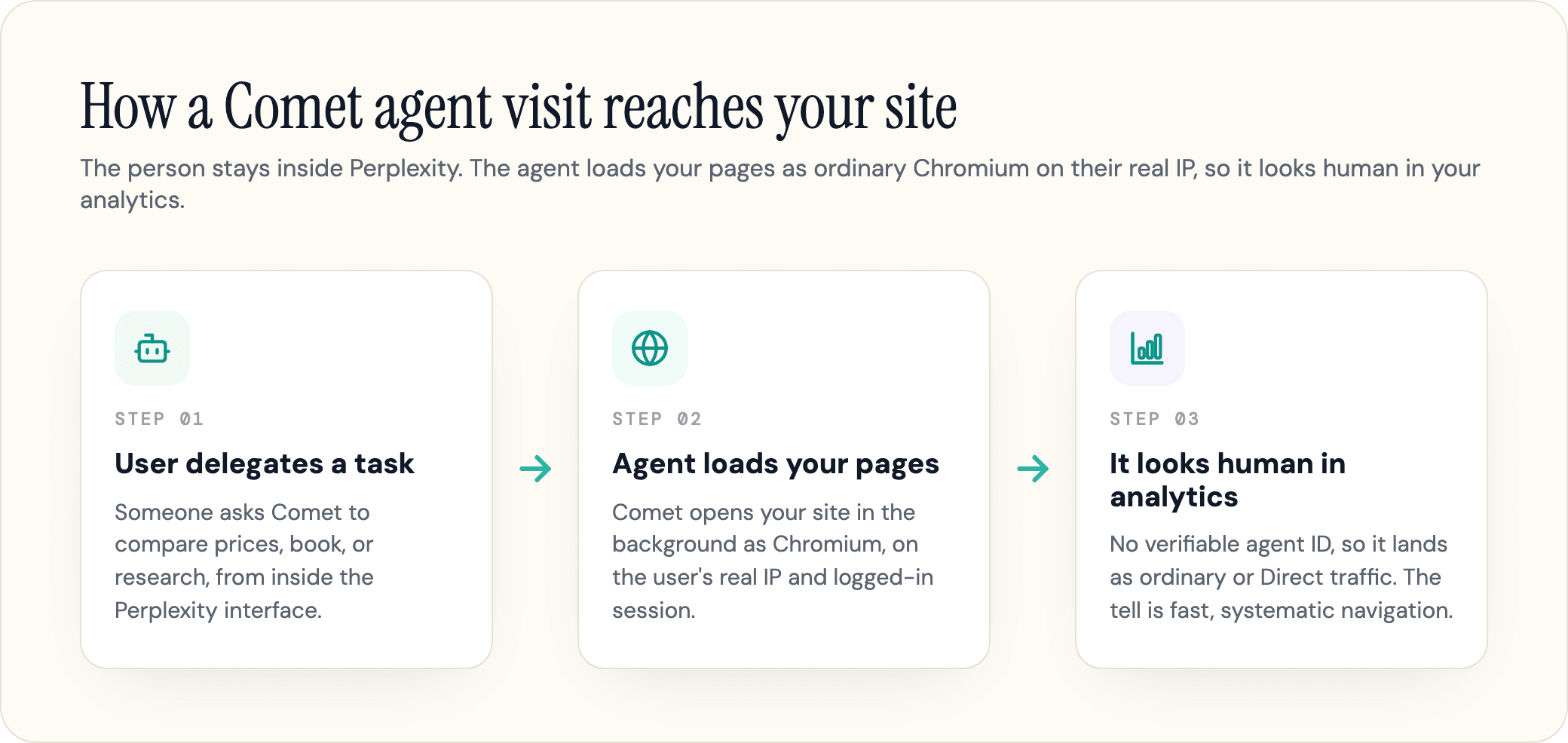
If you run a site, the important thing about Comet is not whether you use it. It is that your visitors do, and their agent shows up in your data looking like a person.
When someone delegates a task, the interactive agent loads your pages as ordinary Chromium, from the user's own device and inside their session. It does not announce itself the way Perplexity's declared crawlers do, so it does not show up as PerplexityBot or the Perplexity-User agent that you can filter for in your logs. It looks like a normal visit. The result, as HUMAN Security's analysis puts it, is traffic that comes from genuine human intent but executes at automated speed. The tell is behavioral: fast, dense, systematic navigation with few idle pauses, and a lot of it landing in your Direct or unattributed bucket in GA4.
The instinct to block it is usually wrong, because behind the agent is a real customer trying to do something. The better move is to classify rather than block: let agents read and navigate, gate the state-changing actions like checkout or account changes, and watch the behavioral signals. The same logic is now playing out in agentic commerce, where Amazon escalated from a November 2025 legal threat to a lawsuit and won a March 2026 court order blocking Comet from shopping on Amazon, arguing the agent accessed its store without authorization. That injunction was stayed within weeks, and on August 4, 2026 the Ninth Circuit vacated it, holding that when a user tasks an agent to act on their behalf it is the user, not Perplexity, who "accesses" Amazon's computers, so Amazon is unlikely to prove a Computer Fraud and Abuse Act violation. The court stressed that its ruling is narrow and that this area of law "will doubtless change," and Amazon's trademark and state-law claims survive, so the dispute is not fully settled. It is the first appellate answer to whether an AI agent visiting a site on a user's behalf is authorized or unauthorized access, which makes it the single most consequential development for anyone running a website that agents will reach.
In our experience, the brands that handle this well stop thinking about ranking alone and start thinking about being citable. Comet rewards content an assistant can read and lift cleanly into its sidebar: clear structure, answer-first passages, and pages that AI crawlers can actually reach. That is the same discipline behind optimizing for Perplexity and tracking whether AI engines mention you.
Should You Use Perplexity Comet?
If you are curious about where browsing is heading, Comet is worth a look, and the free sidecar assistant for summarizing and tab research is the lowest-risk way in. If you mostly read and research, you will get value from day one.
If you need reliability, or you spend your day in banking, healthcare, or anything with sensitive logged-in sessions, wait. The agent is not dependable enough to trust unsupervised, and the security questions are real and unresolved. There is no harm in keeping Chrome as your daily driver and trying Comet on the side.
The bigger shift is the one underneath all of this. As assistants start reading and acting on the web for people, the question stops being where you rank and becomes whether your content is the thing they read, trust, and quote.
Frequently Asked Questions
What is Perplexity's Comet?
Comet is an AI browser made by Perplexity, built on Chromium. It puts an AI assistant in a sidebar that can summarize the page you are on, answer questions across your open tabs, and carry out tasks like comparing products or filling forms. It launched in July 2025 and became a free download in October 2025.
Is Comet from Perplexity free?
Yes. The browser and the sidecar assistant are free with no subscription, since October 2, 2025, and so is the Assistant's Search mode. Paid plans add Work mode, the mode that runs a task through Perplexity's Computer in the background instead of interactively, plus Comet Plus ($5 per month) for premium publisher content. Work mode draws down a credit balance: Pro gets a limited-time sign-up bonus of 4,000 credits (30-day expiry) and no monthly allocation, while Max includes 10,000 credits a month plus a limited-time 35,000-credit sign-up bonus (also 30-day expiry).
Is Perplexity the same as Comet?
No. Perplexity is the AI answer engine, available on its website and app. Comet is Perplexity's web browser, with that same engine and an assistant built into it. You can use Perplexity without Comet, but Comet is built around Perplexity.
Is Perplexity Comet safe to use?
For low-stakes reading and summarizing, the risk is modest. For agentic tasks, be careful. Researchers at Brave, LayerX, Trail of Bits, Zenity, Guardio, and Hacktron have all demonstrated prompt-injection or extension-level attacks where hidden instructions on a page hijack the assistant. Avoid running the agent in sessions with banking, health, or work data until the issue is better solved.
What is the difference between Perplexity Comet and ChatGPT's agent mode?
Comet is a standalone Chromium-based AI browser. ChatGPT's agentic browsing, formerly a separate Atlas browser that OpenAI discontinued on August 9, 2026, now lives inside the regular ChatGPT app and a Chrome extension/sidebar instead. Comet leans toward research and citation, fitting Perplexity's answer-engine roots; ChatGPT's agent mode leans toward automating tasks, the job Atlas used to do. A shorthand: ChatGPT is for automating, Comet is for annotating. Both carry the same prompt-injection risk.
What devices and platforms support Comet?
Comet runs on Windows 10 and later, macOS Big Sur and later, Android 12 and later, and iOS 18 and later. It launched on Windows and macOS on July 9, 2025, Android on November 20, 2025, and iPhone on March 18, 2026.
The Takeaway
Comet is a real preview of where browsing is going, not a finished product. It is free, it is genuinely useful for research, and it is not safe to hand your inbox to yet. Whether or not you adopt it, your visitors will, and their agents are already reading your site.
That changes the job. The pages that win the agentic web are the ones an assistant can reach, read, and quote without friction. You can check whether AI agents and crawlers can actually read your site in a couple of minutes. geotoolbox is the AI bot debugger for SEOs, built to show you exactly what Comet, ChatGPT, and the rest see when they look at your pages.
Sources
- Comet (browser) - Wikipedia (engine, platform launch dates) -
en.wikipedia.org/wiki/Comet_(browser) - Perplexity's Comet AI browser now free; Max users get new Background Assistant - TechCrunch -
techcrunch.com/2025/10/02/perplexitys-comet-ai-browser-now-free-max-users-get-new-background-assistant - Agentic browser security: indirect prompt injection in Perplexity Comet - Brave -
brave.com/blog/comet-prompt-injection - CometJacking: one click can turn Comet against you - LayerX -
layerxsecurity.com/blog/cometjacking-how-one-click-can-turn-perplexitys-comet-ai-browser-against-you - Using threat modeling and prompt injection to audit Comet - Trail of Bits -
blog.trailofbits.com/2026/02/20/using-threat-modeling-and-prompt-injection-to-audit-comet - PleaseFix: zero-click agent hijacking in Comet - Zenity Labs -
zenity.io/research/pleasefix-vulnerabilities - What is Perplexity Comet and why is it on my website? - HUMAN Security -
humansecurity.com/ai-agent/perplexity-comet - Amazon sends legal threats to Perplexity over agentic browsing - TechCrunch -
techcrunch.com/2025/11/04/amazon-sends-legal-threats-to-perplexity-over-agentic-browsing - One-click UXSS in Perplexity Comet - Hacktron AI -
hacktron.ai/blog/perplexity-comet-uxss - Amazon.com Services LLC v. Perplexity AI, Inc. (docket) - CourtListener -
courtlistener.com/docket/71874820/amazoncom-services-llc-v-perplexity-ai-inc/ - AI Agents and the CFAA: Amazon.com Services v. Perplexity AI - Volokh Conspiracy -
reason.com/volokh/2026/06/19/ai-agents-and-the-cfaa-amazon-com-services-v-perplexity-ai/ - Ninth Circuit rules on AI agent access to third-party websites under the CFAA (injunction vacated, Aug 4 2026) - Cooley -
cooley.com/news/insight/2026/2026-08-06-ninth-circuit-rules-on-ai-agent-access-to-third-party-websites-under-cfaa - OpenAI launches an AI-powered browser: ChatGPT Atlas - TechCrunch -
techcrunch.com/2025/10/21/openai-launches-an-ai-powered-browser-chatgpt-atlas - Evolving Atlas into ChatGPT for browser-based agentic work - OpenAI Help Center (Atlas discontinued August 9, 2026, agentic browsing folded into the ChatGPT app and a Chrome extension/sidebar) -
help.openai.com/en/articles/20001371-evolving-atlas-into-chatgpt-for-browser-based-agentic-work - What is Computer? - Perplexity Help Center, last modified September 18, 2026 -
perplexity.ai/help-center/en/articles/13837784-what-is-computer - How Credits Work on Perplexity - Perplexity Help Center, last modified September 8, 2026 -
perplexity.ai/help-center/en/articles/13838041-how-credits-work-on-perplexity