
Perplexity is the AI that answers your question with a written, cited answer instead of a list of links. It is the tool people increasingly open before Google when they want a fast, sourced answer rather than ten tabs to read through, and it is often the top pick among the best AI search engines for cited research.
Most "what is Perplexity" explainers stop at "it is an AI search engine." That is true and not very useful. This covers what actually matters: who builds it, what it costs, whether you can trust it, and what it means for whether AI mentions your brand, current as of September 2026.
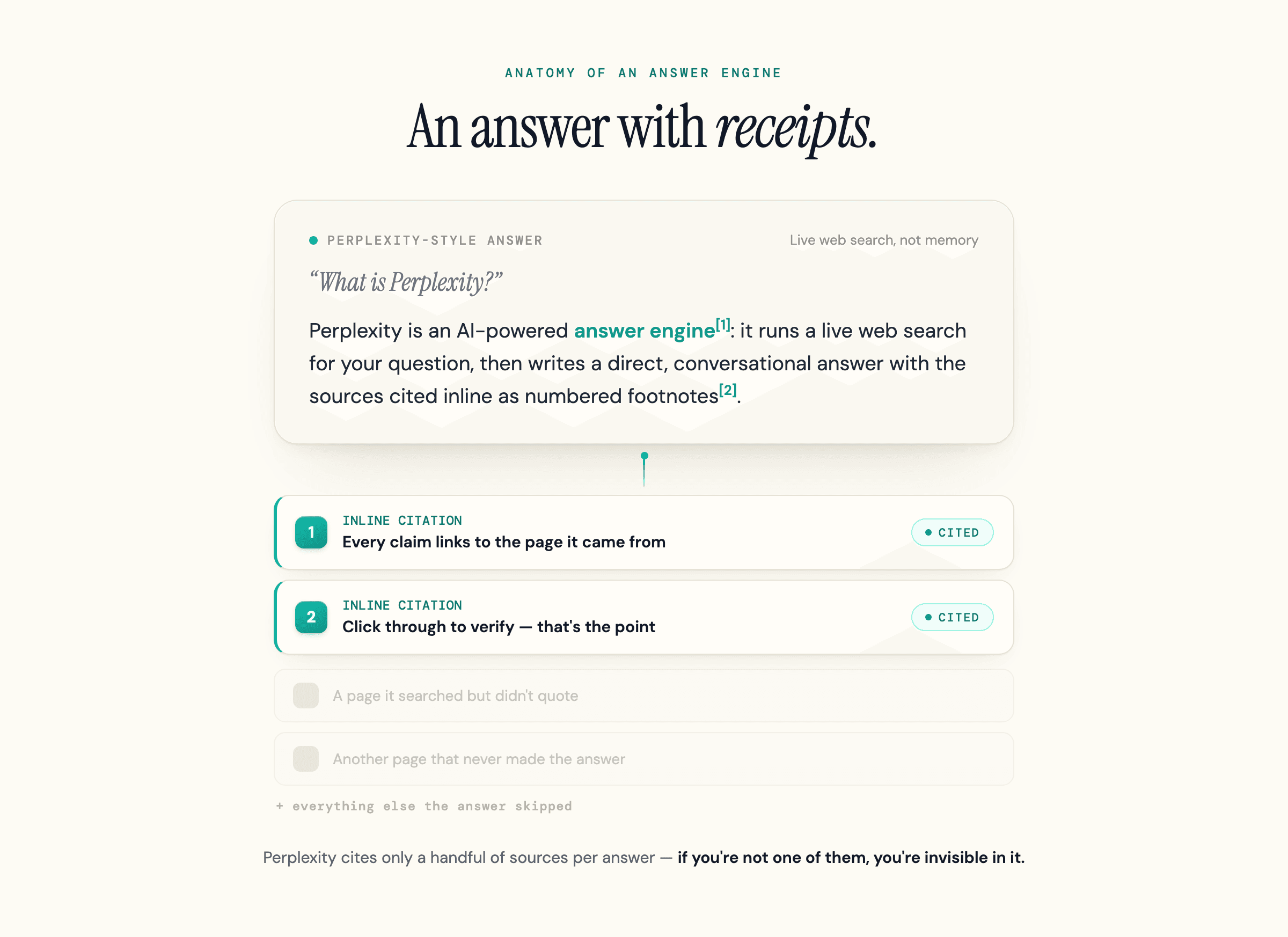
What Is Perplexity?
Perplexity is an AI-powered answer engine: it runs a live web search for almost any question, then uses a large language model to write a direct, conversational answer with the sources cited inline as numbered footnotes. You ask in plain language, and instead of blue links you get a short written answer with clickable citations under each claim.
That makes it a different kind of tool from the two things people confuse it with. A traditional search engine hands you a ranked list of links and leaves the reading to you. A general chatbot like ChatGPT writes from what its model learned during training, which can be out of date and has no sources attached. Perplexity sits in between: it behaves like a research librarian that goes and finds current pages, then summarizes them and shows you where each line came from. It is built around its citations, which is the single most important thing to understand about it.
| Search engine (Google) | Chatbot (ChatGPT) | Answer engine (Perplexity) | |
|---|---|---|---|
| What you get | A ranked list of links | A written answer from training data | A written answer from live sources |
| Sources shown | The links are the result | Often none by default | Inline citations on each claim |
| Freshness | Mixed; can rank old pages | Limited by training cutoff | Live web search on most queries |
| Best at | Navigation, shopping, maps | Writing, brainstorming, code | Research and fact-finding with sources |
Perplexity is what you reach for when you want a sourced answer to a real question, fast. It is one of the clearest examples of an answer engine, the category that is reshaping how people find information online.
Perplexity the Product vs Perplexity the Metric
One quick source of confusion worth clearing up. In machine learning, "perplexity" is a long-standing metric that measures how well a language model predicts text: lower perplexity means the model is less "surprised" by the next word, so a lower score is better.
The company named itself after that concept, but the product and the metric are separate things. If you came here looking for the statistics term, that is the other one. For the rest of this article, Perplexity means the answer engine.
Who Owns Perplexity, and Is It Legit?
Perplexity AI, Inc. is an independent, privately held US company based in San Francisco, founded in August 2022 by Aravind Srinivas (CEO), Denis Yarats (CTO), Johnny Ho, and Andy Konwinski. The founders came out of AI research and engineering roles at places like OpenAI, Google DeepMind, Meta, and Databricks. It is not owned by Google, Microsoft, or OpenAI, and despite a common assumption, it is not a Chinese app.
It is also well funded by names you will recognize. According to its Wikipedia profile, investors include Nvidia, Jeff Bezos, Databricks, SoftBank, and NEA, and in December 2025 Cristiano Ronaldo took a stake and a brand partnership. The valuation has climbed fast: past $1 billion in April 2024, to $14 billion by mid-2025, and $20 billion in a September 2025 round. Figures of $21 to $23 billion for early 2026 circulate in private-market databases, but they disagree with each other and no dated primary source confirms them. So the "is this a sketchy startup" worry is misplaced, and yes, Jeff Bezos really did invest.
The scale is real too. At Bloomberg's Tech Summit in 2025, Srinivas said Perplexity handled 780 million queries in May 2025, growing more than 20% month over month. Its reach jumped further when India's Airtel handed free Perplexity Pro to its 360 million customers in mid-2025, one of several moves that pushed adoption well beyond the US.
Can you buy Perplexity stock? Not directly. Perplexity is privately held, so there is no public ticker to buy on a stock exchange. The only ways to hold a position are private or secondary markets that most people cannot easily access, or buying shares of its public investors. If you see a "Perplexity stock" listing, treat it with suspicion, because the company itself is not publicly traded.
How Perplexity Works
Under the hood, Perplexity is a retrieval-augmented answer engine. When you ask a question, it reads your query, runs a live web search, pulls the most relevant passages from the pages it finds, and then hands those to a language model that writes the answer and attaches a citation to each claim. That pattern of fetching real sources first and generating the answer second is called retrieval-augmented generation, and it is why the answers come with footnotes instead of arriving from nowhere. If you want the longer version, we wrote a full breakdown of how AI search works.
Two design choices shape the experience. The first is model choice. Perplexity is not locked to a single model. It builds its own Sonar 2 model, and on the paid tiers it lets you pick the engine that writes the answer. As of September 2026 that list runs well beyond the big three: OpenAI's GPT-5.6, Anthropic's Claude Sonnet 5 and Opus 5, Google's Gemini 3.7 Flash, xAI's Grok 4.6, Moonshot's Kimi K3, Z.ai's GLM 5.3, and NVIDIA's Nemotron 3 Ultra. This is the part people get wrong most often: Perplexity is not built by OpenAI and is not "ChatGPT with sources." It is its own product that can route your question to several different models.
The second is modes. Rather than one search box, Perplexity now documents a mode selector: Search for a quick cited answer, Deep Research for a long report, Learn Mode for studying a topic, Model Council to put the same question to several models at once, plus Comet and Computer. Organisation accounts add a "Choose sources" picker for switching between the open web and internal files. Matching the mode to the job is how you get a research-grade answer instead of a generic one.
What Perplexity Can Do
Perplexity started as a search box and has turned into a small family of products in 2026. You can use it free on the web at perplexity.ai, in the iOS and Android apps, or inside its own browser. The core is still the answer engine, but the surfaces around it are where the recent action is.
The everyday workhorse is search with Pro Search and Deep Research. A normal query returns a quick cited answer; Pro Search asks clarifying questions and digs deeper, and Deep Research runs many searches in a row and writes up a longer report. Pages lets you turn a research thread into a clean, shareable article. There are also Shopping and Finance surfaces that pull live product and market data into the answer. Image generation is available on the paid tiers, but treat it as a convenience rather than a reason to pick Perplexity over a dedicated image tool.
The bigger 2026 story is the move beyond a website. Comet is Perplexity's own web browser, built on Chromium and launched in July 2025, then opened up as a free download in October 2025. It puts an AI assistant inside the browser that can summarize the page you are on, compare what is across your open tabs, and carry out multi-step tasks like filling forms or drafting an email. Alongside it, Perplexity Assistant and Computer push into agentic territory. Perplexity's own framing is the clearest: "Perplexity answers your questions. Computer does your work." Computer launched in February 2026 as a cloud agent that researches, writes documents, builds apps and manages email across hundreds of connectors like Gmail, Slack and Notion, running tasks in the background on a schedule. It reached Windows in July 2026 and, in August 2026, a fully on-device version. It is available on any paid plan and metered in credits rather than seats.
In practice, Perplexity's durable edge is the cited, live answer and the browser-and-agent push around it. The image generation and creative features are competitive but not clearly ahead of the rest of the field. Reach for Perplexity when you want a sourced answer or want the web acted on, not because any single creative feature is best in class.
Is Perplexity Free? Pricing Explained
Yes, Perplexity has a genuinely usable free tier, and the paid tiers mostly buy you higher limits and model choice. For a lot of people the free plan is enough.
| Tier | Reported price (2026) | What you get |
|---|---|---|
| Free | $0 | Unlimited quick searches and citations, plus a small daily allotment of Pro searches. No model picker, no Labs. |
| Pro | ~$20 / month or ~$200 / year | Unlimited Pro searches, model choice, more Deep Research, larger file uploads, image generation |
| Max | ~$200 / month | The highest limits, the newest features, and the most agent and Computer usage |
| Comet Plus | ~$5 / month | Premium publisher content in Comet; included at no extra cost in Pro and Max |
| Education Pro | ~$10 / month | Everything in Pro, for students and educators who verify through SheerID |
| Enterprise | $40 / seat / month or $400 / seat / year | Team controls, internal document search, security and data-handling guarantees |
| Enterprise Max | Custom | The top business tier: highest model access, video generation, SCIM, audit logs, configurable retention |
A caveat: the exact free-plan caps move around, so the daily Pro-search number you read today may be different next month. Check the current limits in the app rather than trusting any single article.
Is Pro worth $20 a month?
Run the free plan hard for a week. If you keep bumping into the daily Pro-search limit, the upgrade pays for itself. If you do not, stay free. One honest caveat from regular users: switching the underlying model on Pro changes the answer less than you would expect for most everyday questions, so do not upgrade only for the model picker. For a full plan-by-plan breakdown, see our Perplexity pricing guide.
Perplexity vs ChatGPT
They overlap on a lot, so the real question is which one fits a given job, not which is "better." The cleanest way to think about it: Perplexity searches and cites, ChatGPT thinks and creates.
| Factor | Perplexity | ChatGPT |
|---|---|---|
| Default behavior | Live web search with citations on every answer | Writes from training data; browses when asked |
| Sources | Shown inline by default | Not always shown |
| Best at | Research, fact-finding, current events | Writing, brainstorming, coding, long-form |
| Weak spot | Less suited to creative or extended back-and-forth | Can sound confident without showing its sources |
In practice many people run both: use Perplexity to gather sourced facts, then move to ChatGPT to draft and polish. If you already pay for ChatGPT, you do not strictly need Perplexity, but you give up the cited, current answers that are its whole point. We go deeper on the trade-offs in our ChatGPT vs Perplexity comparison. And if you want to know whether Perplexity cites your own site, our best Perplexity rank trackers guide compares the tools that measure it.
Is Perplexity Accurate and Safe? The Honest Picture
This is where a straight answer matters more than the marketing. Three things are worth knowing.
Accuracy: citations are a trust signal, not a guarantee. Because every claim has a source attached, it is tempting to assume Perplexity is always right. It is not. Like any model, it can still hallucinate, and the citation format can actually mask that. A known failure mode is a real link attached to a claim the source never actually made, which reads as verified but is not. The lawsuit from Dow Jones and the New York Post even alleged that Perplexity attributed made-up quotes to their articles. The takeaway is simple: the citations make verification easy, so use them. Click through on anything that matters, especially on long Deep Research reports.
Privacy: assume the consumer app trains on your data unless you turn that off. On the Free, Pro and Max plans, your queries can be used to improve the models by default: the "AI data retention" toggle under Settings then Preferences is on unless you turn it off, and opting out applies only to data collected after that date, since already-collected training data cannot be removed. Enterprise data is never used for training. The practical rule is the one that applies to every consumer AI tool: do not paste anything confidential or regulated into it, and check the enterprise or API terms separately if you need stronger guarantees. Training policies shift often, so confirm the current setting in your account rather than trusting any single write-up.
Reputation: the scraping controversy is real, and the list of publishers suing keeps growing. Perplexity has spent two years fighting over how it gathers content. The New York Times sued it for copyright infringement in December 2025, escalating from an earlier cease-and-desist, and CNN sued in May 2026 over roughly 17,000 copied stories. Dow Jones, the New York Post, the BBC, several Japanese newspapers, Encyclopaedia Britannica and Merriam-Webster, the Chicago Tribune, and Reddit have all sued or threatened to. None of these copyright cases has yet reached a trial or a settlement. In one case Perplexity has scored an appellate win. Amazon sued to stop Perplexity's agent from shopping on its site for users, and in August 2026 the Ninth Circuit vacated the preliminary injunction, holding that when you task an agent it is you, not Perplexity, who "accessed" Amazon's computers. The case itself continues, but it is the first federal appellate ruling on whether AI agents may act on a platform on a user's behalf, and it is the legal ground under the whole agentic push. Most pointedly, in August 2025 Cloudflare reported that Perplexity used undeclared "stealth" crawlers that ignored robots.txt and impersonated a normal browser to get around blocks, and de-listed it as a verified bot. Perplexity has disputed the framing; The Verge keeps a running account of the controversies. In February 2026 the company dropped advertising and moved to a subscription-first model, telling the Financial Times it wanted to protect trust in the answer engine: "The challenge with ads is that a user would just start doubting everything." None of this makes Perplexity unusable, but it is why some organizations keep it off their approved-tools list, and it is the backdrop to the part that matters most for site owners.
What Perplexity Means for Your Brand's Visibility
When someone asks Perplexity about your category, it cites only a handful of sources, and if you are not one of them, you are invisible in that answer. This is the shift that matters. The goal is no longer just to rank first on Google; it is to be one of the few sources the answer engine quotes. That discipline has a name, answer engine optimization, and it sits inside the broader practice of generative engine optimization.
The good news is that Perplexity is unusually transparent about it. Because it shows its citations, you can ask it your own buyer's questions, read exactly which pages it pulled, and reverse-engineer the gap. That makes it the most measurable of the AI engines to optimize for, which is the whole premise of our guide to getting cited in Perplexity.
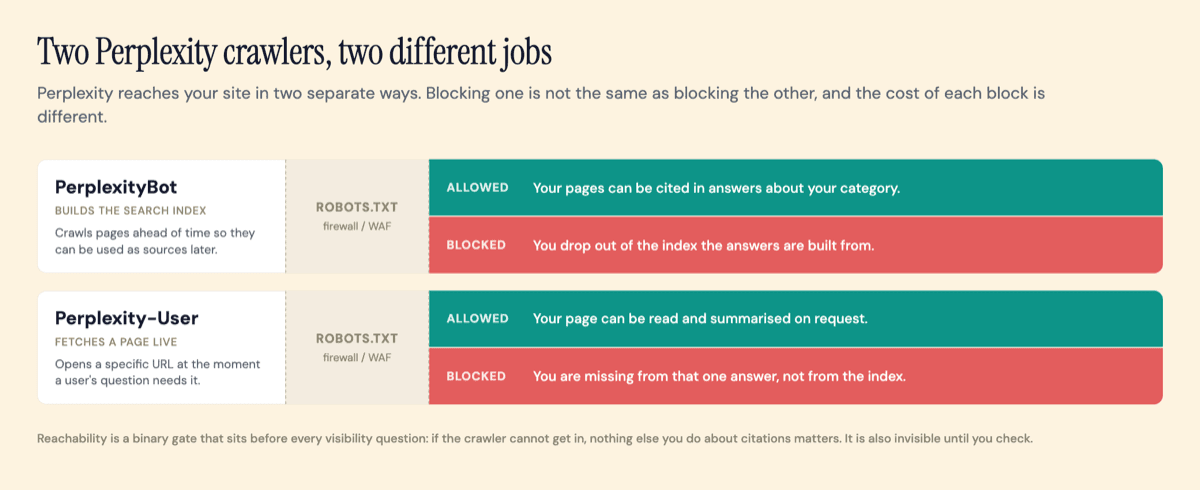
Before any of that, there is a binary gate: reachability. Perplexity uses two crawlers, PerplexityBot for its search index and Perplexity-User for live fetches, and if a robots.txt or firewall rule blocks PerplexityBot, you drop out of the index it builds answers from. In our experience auditing brands across engines, this is the most common and most fixable reason a brand is missing from Perplexity answers, and it is invisible until you check. The citations themselves are the scoreboard, which is why we track AI visibility per engine rather than as one blended number.
The open question for most businesses is the one you cannot answer by reading about Perplexity: what is it actually telling people about you, and where is it getting that from? geotoolbox tracks brand mentions and citations across the major AI engines, Perplexity included, and our free AI Crawler Checker confirms in seconds whether PerplexityBot can even reach your pages. Start there, then see what AI is citing about your brand and close the gaps you find.
Frequently Asked Questions
What is the difference between Perplexity and ChatGPT?
Perplexity is an answer engine built around live web search, so it cites its sources by default and is strongest for research and current facts. ChatGPT is built around generating text from its training, so it is stronger for writing, brainstorming, and coding. Many people use both: Perplexity to gather sourced facts, ChatGPT to draft.
Is Perplexity AI free, and is Pro worth $20 a month?
Yes, Perplexity has a free tier with unlimited basic searches and a small daily allotment of Pro searches. Pro costs about $20 a month and lifts those limits, adds model choice, and gives you more Deep Research. It is worth it if you regularly hit the free daily cap; if you do not, the free plan is fine.
Does Perplexity have its own AI model, or does it use ChatGPT?
Both. Perplexity builds its own Sonar 2 model and also lets paid users pick frontier models to write the answer, from OpenAI, Anthropic, Google, xAI, NVIDIA, Moonshot and Z.ai. It is an independent company, not owned by or built on OpenAI, so it is not "ChatGPT with sources."
Can Perplexity replace Google Search?
For research, comparison, and "explain this to me" questions, many people already use it instead of Google because it hands back a sourced answer rather than a list of links. For navigation, local results, maps, and shopping, Google still wins. In practice it complements Google more than it replaces it.
Is Perplexity accurate, and can I trust its citations?
It is accurate often enough to be useful, but it can still get things wrong, and a citation is not a guarantee. The cited source sometimes does not actually support the claim attached to it. Treat Perplexity as a fast first draft of the truth, and verify anything important before you rely on it.
Who owns Perplexity, and can I buy its stock?
Perplexity AI, Inc. is a private US company founded in 2022 by Aravind Srinivas and three co-founders, backed by investors including Nvidia and Jeff Bezos. Because it is private, there is no public stock to buy; any listing claiming to be "Perplexity stock" is not the company itself.
Sources
- Perplexity AI - Wikipedia (founders, funding, products, controversies) -
en.wikipedia.org/wiki/Perplexity_AI - Perplexity received 780 million queries last month, CEO says - TechCrunch, June 2025 -
techcrunch.com/2025/06/05/perplexity-received-780-million-queries-last-month-ceo-says - Airtel partners with Perplexity to power 360 million customers with Perplexity Pro - Airtel, July 2025 -
airtel.in/press-release/07-2025/airtel-partners-with-perplexity-powers-every-single-of-its-360mn-customers-with-perplexity-pro - The New York Times sues Perplexity over copyright - CNBC, December 2025 -
cnbc.com/2025/12/05/the-new-york-times-perplexity-copyright.html - CNN sues Perplexity over alleged AI copyright theft - NPR, May 2026 -
npr.org/2026/05/28/g-s1-124680/cnn-sues-ai-company-perplexity-alleging-it-violates-copyright-protections - Reddit sues Perplexity over scraped user data - CNBC, October 2025 -
cnbc.com/2025/10/23/reddit-user-data-battle-ai-industry-sues-perplexity-scraping-posts-openai-chatgpt-google-gemini-lawsuit.html - Perplexity is using stealth, undeclared crawlers to evade no-crawl directives - Cloudflare, August 2025 -
blog.cloudflare.com/perplexity-is-using-stealth-undeclared-crawlers-to-evade-website-no-crawl-directives - Perplexity AI: the answer engine with a lot of question marks - The Verge -
theverge.com/24187792/perplexity-ai-news-updates - Ninth Circuit rules on AI agent access to third-party websites under the CFAA - Cooley, August 2026 -
cooley.com/news/insight/2026/2026-08-06-ninth-circuit-rules-on-ai-agent-access-to-third-party-websites-under-cfaa - Perplexity abandons AI advertising strategy over trust worries - MacRumors, February 2026 -
macrumors.com/2026/02/18/perplexity-abandons-ai-advertising - Perplexity AI valued at $20 billion in latest funding round - Reuters, September 2025 -
tech.yahoo.com/ai/articles/perplexity-finalizes-20-billion-valuation-232758661.html - Paying in local currency - Perplexity Help Center (last modified September 2026) -
perplexity.ai/help-center/en/articles/13182759-paying-in-local-currency - What advanced AI models are included in my subscription - Perplexity Help Center (September 2026) -
perplexity.ai/help-center/en/articles/10354919-what-advanced-ai-models-are-included-in-my-subscription - Data collection at Perplexity - Perplexity Help Center -
perplexity.ai/help-center/en/articles/11564572-data-collection-at-perplexity - What is Computer - Perplexity Help Center -
perplexity.ai/help-center/en/articles/13837784-what-is-computer