
Perplexity has six plans: a free tier, Pro at $20 a month, Max at $200, a $10 student plan, and two enterprise tiers. Most people only ever need the free plan or Pro. The hard part is not the headline prices, it is what changed underneath them in 2026: a credit system, an agent called Perplexity Computer, and quietly tightened limits.
Here is what each plan costs, what you get for it, and who should pay for which, as at the update date on this page.
Perplexity Pricing at a Glance
| Plan | Price | Best for | Headline of what you get |
|---|---|---|---|
| Free | $0 | Casual lookups | The default Sonar model with citations, around three Pro Searches a day |
| Pro | $20/mo or $200/yr | Daily research | Model switching, near-unlimited Pro Search, file uploads, image generation, Comet Plus, Computer access |
| Max | $200/mo or $2,000/yr | Heavy agent and automation users | Everything in Pro plus 10,000 monthly Computer credits, Model Council, unlimited research |
| Education Pro | $10/mo | Verified students and educators | The Pro plan at half price, verified through SheerID |
| Enterprise Pro | $40/seat/mo or $400/yr | Teams | Pro plus SSO, admin controls, internal knowledge search, no training on your data |
| Enterprise Max | $325/seat/mo (or custom) | Large orgs running agents | Enterprise Pro plus 15,000 monthly credits and the highest limits |
One caveat on the numbers. The source of truth is Perplexity's own plans page, but it sits behind a bot wall, and the third-party guides that rank for "perplexity pricing" disagree with each other on the fine print: daily search caps, whether the API credit still ships, whether Enterprise Max is a fixed price or custom. Every number above is cross-checked against Perplexity's live plans page and multiple current sources, and where they genuinely conflict, this guide flags the conflict instead of presenting one figure as settled.
The short version: the free plan is better than most people expect, Pro is the best value in the lineup if you do real research more than a couple of times a week, and Max is a niche tool for people running automated agent work, not a "better answers" upgrade.
Is Perplexity Free? What You Get Without Paying
Yes, and the free plan is genuinely usable. You get unlimited basic searches on Perplexity's own Sonar model, every answer comes with citations, and you get a small daily allowance of Pro Searches, the deeper multi-step searches that read several sources before answering. Perplexity's own help center now lists three a day, though some older guides still say five. Either way, it resets daily and it is enough for occasional use.
What you give up on free is real but specific. You cannot switch models, so you are stuck with Perplexity's fast default rather than picking GPT, Claude, or Gemini for a given task. Image generation is off. File uploads are limited. Deep Research, the long report-style mode, is capped to roughly one run a month. And you do not get access to Perplexity Computer, the agent layer that the paid plans are now built around.
For someone who asks Perplexity a handful of questions a week, the free plan covers it. The moment you start leaning on it for work, you will hit the Pro Search ceiling and the single-model limit fast, and that is the upgrade Perplexity is counting on.
Perplexity Pro ($20/Month): What You Actually Get
Pro is $20 a month, or $200 a year if you pay annually, which works out to about $16.67 a month. It is the plan most paying users are on, and the jump from free is the biggest value-per-dollar step in the lineup.
The headline upgrade is model switching. On Pro you choose which frontier model answers a given question, drawing from the current OpenAI, Anthropic Claude, and Google Gemini releases plus Perplexity's own Sonar. The exact model names move almost monthly, so treat any specific version you read as a snapshot rather than a contract. You also get near-unlimited Pro Search, Deep Research at a much higher allowance (commonly cited at around 20 runs a day), the Labs report-builder, large file uploads, AI image generation, and access to premium data sources like financial and academic databases.
Two things matter more than the feature list. First, Pro includes access to Perplexity Computer plus a one-time bundle of around 4,000 Computer credits, not a monthly refill. That distinction trips people up, and the next section explains why. Second, Pro has historically included a small monthly credit toward Perplexity's developer API, though some 2026 reporting says consumer plans no longer bundle it, so confirm it at signup rather than counting on it.
The word "unlimited" comes with asterisks now. Through 2026 Perplexity quietly tightened limits on its most demanding features. Users reported hitting weekly caps on the heaviest models after as few as three to five queries a day, file-upload caps triggering after two uploads, and per-response token limits cut from 200 to 100. Perplexity said the changes mostly affected accounts tied to promotional codes, citing fraud and resale. Two things are worth knowing before you pay anyway: the heaviest models are rationed more tightly than "unlimited" suggests, and some users report being quietly served Perplexity's cheaper fallback model without choosing it. Pro is still a high-ceiling plan for almost anyone, but check that you are getting the model you picked.
If you are deciding between monthly and annual, the annual plan saves you about $40 a year. Given how fast Perplexity changes its plans, paying monthly for the first couple of months and switching to annual once you know you will keep it is the lower-risk play.
Perplexity Max ($200/Month): Who It's Really For
Max is $200 a month, or $2,000 a year. It is ten times the price of Pro, and the instinct is to assume that buys ten times better answers. For everyday questions, it does not. Max mostly buys scale and automation.
What you get over Pro is volume. Max includes 10,000 Perplexity Computer credits a month (plus a one-time bonus when you upgrade), unlimited Labs and Research, priority access to the newest models, enhanced media generation, and Model Council, a feature that runs the same question through several models at once and synthesizes the answers. The base models that answer your Pro queries also answer your Max queries, so for a normal single-model question the answer quality is the same. Max's one genuine quality lever is Model Council on hard problems; the rest of the gap is how much agent and research work you can throw at it before you hit a wall.
The hidden detail that makes Max make sense for the right person is the spending cap. Every Max account has a monthly credit spending limit, defaulting to $200 and adjustable up to $2,000. When you hit it, running tasks pause. That tells you exactly who Max is for: someone whose agent workflows would otherwise blow through credits, who wants a predictable ceiling on heavy automated use.
For everyone else, Max is the wrong plan. If your day is asking questions and reading cited answers, you are unlikely to use enough of what it offers to justify it, and Pro gives you the same model quality for a tenth of the cost.
The Credit System Explained (Perplexity Computer)
This is the part most pricing guides skate over, and the part that surprises people when their first bill arrives. In early 2026 Perplexity launched Perplexity Computer, an agent that orchestrates around 19 different models to carry out multi-step jobs on your behalf, the kind of "go do this whole task" work we cover in our guide to agentic AI. Computer does not run on your normal search allowance. It runs on credits.
A credit is metered agent compute. Browsing a page, filling a form, running a step in a workflow, all of it draws down a credit balance. The problem is that Perplexity does not publish a clear "this action costs this many credits" table, so the meter is hard to predict. One user reported a single 40-minute task burning roughly 23,000 credits, more than a Max plan's entire monthly allowance. Worse, a task that fails partway still consumes the credits it used, and they are not automatically refunded.
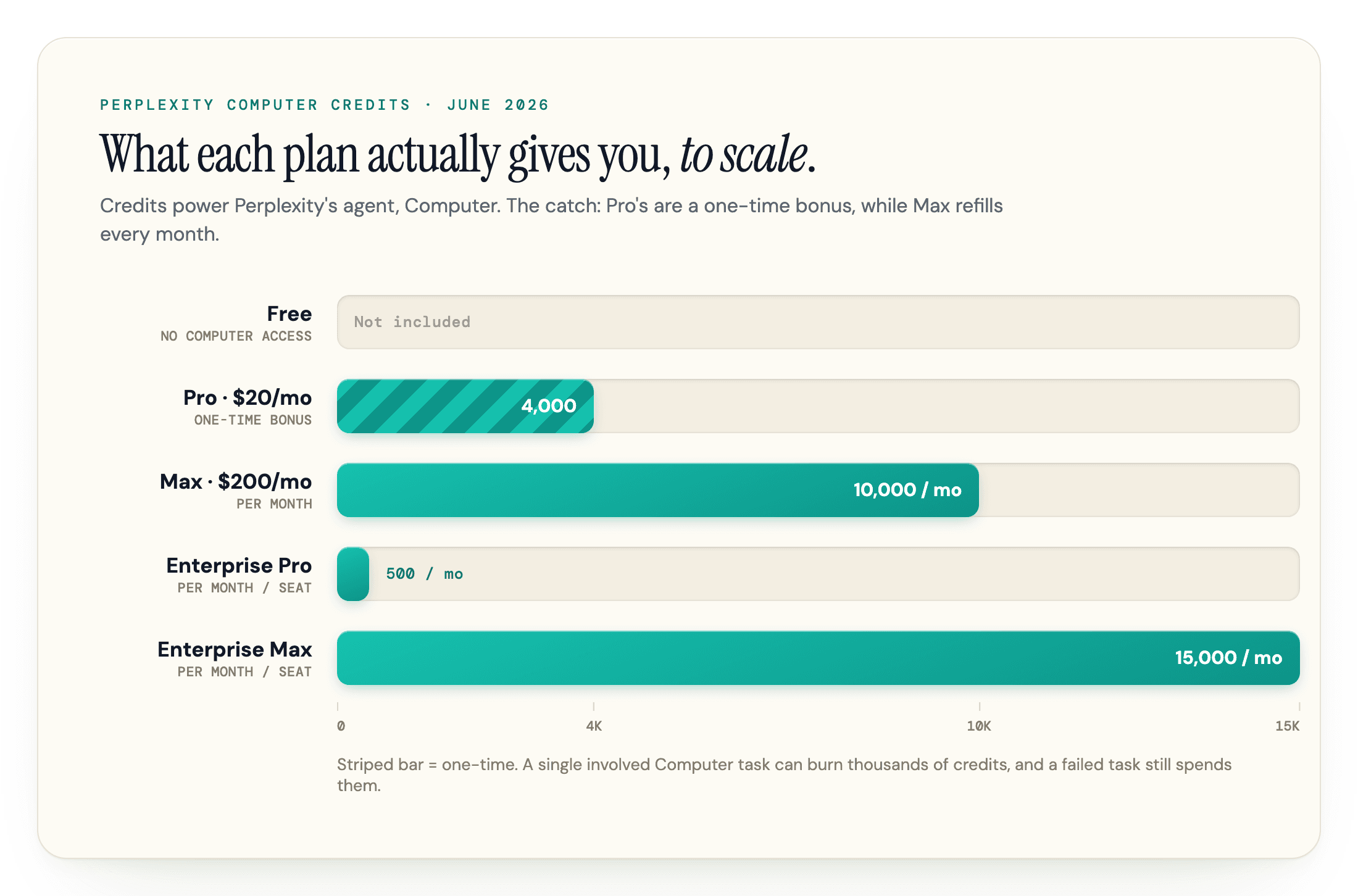
Here is how the allowances stack up in practice:
| Plan | Computer credits | What that signals |
|---|---|---|
| Free | None | No Computer access |
| Pro | ~4,000, one-time bonus | Enough to try it, not to live on it |
| Max | 10,000 per month | Built for ongoing agent use |
| Enterprise Pro | ~500 per month per seat | Light, shared team use |
| Enterprise Max | 15,000 per month per seat | Heavy team automation |
Once Pro's bonus credits are gone, serious Computer use means moving to Max or buying more. That is not an accident of plan design. When the Financial Times reported that Perplexity's annual recurring revenue jumped past $450 million in early 2026, it tied the surge directly to the shift toward AI agents and usage-based pricing. The credit economy is the business model, which is exactly why it pays to understand the meter before you switch it on.
Student, Education and Free-Pro Deals: What's Real in 2026
Search "how to get Perplexity Pro for free" and you will find a graveyard of expired offers presented as if they still work. Here is what is actually live versus dead as of mid-2026.
The reliable discount is Education Pro at $10 a month, the full Pro plan at half price for students and educators who verify through SheerID. It has dipped to around $5 during promotional windows. Perplexity has also run a referral program giving verified students free months that stack, reported as valid through May 31, 2026, so by now treat it as expired unless Perplexity has renewed it. Separately, US government and military workers with a qualifying email address have been offered a free year of Pro at various points.
The carrier and fintech deals are where people get burned. The widely shared PayPal and Venmo free-Pro offers expired on December 31, 2025. The Airtel promotion in India ran out in January 2026. New regional partnerships appear and lapse constantly, so by the time a "free Perplexity Pro" post is circulating, the window has often already closed.
Before you sign up through any third-party "free Pro" link, check the expiry date and whether it is region-locked. Several 2026 offers advertised as no-card trials later required a card and auto-renewed. If a deal asks for payment details for something billed as free, treat that as the catch.
Enterprise Pro vs Enterprise Max ($40 vs $325 per Seat)
For teams, Perplexity sells two tiers. Enterprise Pro is $40 per seat per month, or $400 a year per seat. On top of everything in individual Pro, it adds single sign-on, SCIM provisioning, role-based admin controls, SOC 2 Type II compliance, and Internal Knowledge Search, which lets a team query an uploaded shared file repository. Crucially, company data on enterprise plans is not used to train Perplexity's models. Each seat comes with a modest monthly Computer credit allowance, commonly cited around 500.
Enterprise Max is the heavy tier at $325 per seat per month, or $3,250 a year, though the most recent guides note it can also be quoted as custom pricing for the largest deployments. It raises every limit and bumps each seat to roughly 15,000 Computer credits a month, aimed at teams running real agent workloads rather than just team search. Verified educational institutions have also been offered Enterprise Pro at a reduced per-seat rate.
For most teams, Enterprise Pro is the sensible default. Enterprise Max only earns its price when seats are genuinely running automated Computer tasks at volume.
Perplexity API and Sonar Pricing (For Developers)
If you are building on Perplexity rather than chatting with it, the Sonar API is billed separately from any consumer subscription, on tokens plus a per-request search fee.
| Model | Input / output (per 1M tokens) | Notes |
|---|---|---|
| Sonar | $1 / $1 | Lightweight search-grounded answers |
| Sonar Pro | $3 / $15 | Deeper, multi-step search |
| Sonar Reasoning Pro | $2 / $8 | Reasoning over search results |
| Sonar Deep Research | $2 / $8 | Plus citation, reasoning, and search-query fees |
On top of tokens, each model charges a per-1,000-request fee that scales with how much search context you pull, roughly $5 to $14 for the standard models and up to about $22 for the agentic Pro Search mode. The exact figures move, so price a real workload against the live docs before you commit. This is a developer concern, not a consumer one, and it is separate from the credits that power Perplexity Computer inside the app.
Perplexity vs ChatGPT Plus, Claude Pro and Gemini: Do You Need to Pay?
At $20 a month, Perplexity Pro sits in the same price bracket as the other major AI subscriptions, and the most common real question is not "is Pro good" but "do I need it if I already pay for one of these."
| Plan | Price | Best at |
|---|---|---|
| Perplexity Pro | $20/mo | Live, cited web research across multiple models in one place |
| ChatGPT Plus | $20/mo | General assistant work, writing, coding, image and voice |
| Claude Pro | $20/mo | Long-document reasoning and careful writing |
| Google AI Pro | ~$20/mo | Gemini tied into Google Search, Workspace, and Android |
Perplexity's distinct edge is answer-engine search: every response is grounded in live sources you can click, and you can pick the model behind it. If your day is research where the citation matters, that is worth paying for on its own, and it is a different job from a general chatbot. We go deeper on the head-to-head in Perplexity vs ChatGPT.
The real answer to "do I need both" is usually no. If you already pay for ChatGPT Plus or Claude Pro mainly to chat, write, or code, Perplexity overlaps enough that a second $20 is hard to justify, and the free Perplexity plan covers the occasional cited lookup. If cited, multi-model research is the core of your work, Perplexity earns its place even alongside another subscription. The same logic applies if you are weighing Gemini's plans: pick the tool whose main job matches yours, and resist paying twice for the overlap.
Is Perplexity Pro Worth It? An Honest Verdict
For the right user, Pro at $20 is one of the easier yes calls in AI subscriptions. For the wrong one, it is $240 a year you will barely touch. It comes down to one thing: how often you do cited research.
Pro is worth it if you run real research more than a couple of times a week. Marketers, analysts, researchers, journalists, consultants, and students who need answers with sources they can check get the most out of it: live web results, real citations, and the freedom to pick the best model for a task, all in one place. If you qualify for the $10 student rate or a free year, the math gets even easier.
It is not worth it if your AI use is casual, if your work is mostly creative writing or coding where a general assistant fits better, or if you already pay for ChatGPT Plus or Claude Pro and do not specifically need cited search. The free plan handles light use well enough that paying adds little.
On Max, the verdict is narrower. In our experience, Max only makes sense for a small group: people running automated agent workflows or Model Council comparisons at volume who want a predictable spending ceiling. For everyone else it is paying ten times the price for capacity you will not use, with no gain in answer quality. If you are asking whether you need Max, you almost certainly do not.
Where Perplexity's Paid Plans Fall Short
Paying Perplexity does not buy you out of its real weaknesses, and a pricing guide that skips them is not worth much.
The biggest one is that price does not buy accuracy. A Tow Center study covered by the Columbia Journalism Review found AI search tools got citations wrong in over 60% of news queries, with Perplexity around 37%, and notably the paid variants were not reliably cleaner than the free ones. The failure mode is the dangerous kind: a real URL attached to a claim the source never made. Pro and Max give you more searches and better models, not freedom from confident, well-cited errors. You still have to verify.
The credit system is the second issue. Because per-task credit costs are not published, Max users have been genuinely surprised by how fast credits vanish, and a failed task still burns them with no refund. Third, several users report billing friction: auto-renewal is the default, the annual refund window is short, and deleting your account does not cancel your subscription. None of this makes Perplexity a bad product. It makes it one you should sign up for with eyes open, especially before stepping up to Max.
How to Cancel Perplexity and Whether You Get a Refund
Cancelling is simple once you know it will not happen by itself. On the web, open Settings, find Subscription under Perplexity Pro, click Manage Subscription, then Cancel. If you subscribed through the iPhone or Android app, you have to cancel in the App Store or Google Play instead, because the app store owns that billing. Cancelling stops the next renewal and you keep Pro until the end of the period you already paid for. One trap to avoid: deleting your Perplexity account does not cancel the subscription, so people who just remove the app keep getting charged.
Refunds are harder. Perplexity generally does not refund unused time, though consumer law widens the window in some regions: monthly plans are often refundable within about 24 hours and annual plans within about 72 hours, while EU, UK, and Turkey customers get 14 days. If support stonewalls a charge you believe is wrong, a card-issuer chargeback is the realistic fallback. The cleaner habit is the one from earlier: stay monthly until you are sure, and only move to annual once you know you will keep it.
Getting Cited by Perplexity Is the Other Half of the Equation
Everything above is about what you pay Perplexity. If you run a brand or publish content, there is a more valuable question hiding underneath it: when Perplexity answers questions about your market, does it cite you?
That is a different game from a subscription. Perplexity sends referral traffic and visibility to the sources it cites in answers, and it has even started paying some of them through Comet Plus, a publisher program that shares revenue on an 80/20 split favoring publishers. Being in the cited set is the visibility play, and it is one you earn through how your content is structured and sourced, not through a $20 plan. We break down the tactics in our guide to getting cited in Perplexity.
This is what we built geotoolbox for. Our Citation Interceptor finds the offsite sources that Perplexity and the other answer engines cite in your space where your brand is missing, grades each one by how strong the evidence is, and ranks them by how often you are left out. Paying for Pro makes you a better Perplexity user. Getting cited gives Perplexity a reason to surface you. If you are spending on AI subscriptions anyway, the second one is where the return is.
Frequently Asked Questions
Is Perplexity cheaper than ChatGPT?
They cost the same at the entry tier: both Perplexity Pro and ChatGPT Plus are $20 a month. Perplexity is cheaper for students at $10, and it has a free plan that is more research-capable than ChatGPT's free tier for cited search. At the top end, Perplexity Max and ChatGPT's $200 tier are also matched. Price is rarely the deciding factor between them; the job you need done is.
Is a Perplexity subscription worth it?
For people who do cited research regularly, yes, Pro at $20 is strong value. For casual users, the free plan is enough, and for anyone already paying for another AI assistant they mainly chat with, a second subscription is hard to justify. Match the plan to how often you actually need sourced answers.
How much does Perplexity Pro cost?
Perplexity Pro is $20 a month, or $200 a year if you pay annually (about $16.67 a month). Verified students and educators pay $10 through Education Pro. There is no permanent free trial of Pro, though Perplexity has run short trials and free-month promotions at various points, so the practical way to test it is to pay for one month and cancel if it is not for you.
Why is Perplexity so expensive?
Among the individual plans, only Max is expensive, at $200 a month, and it is priced for heavy agent and automation use rather than ordinary search (enterprise seats run higher still, up to $325). The cost reflects Perplexity routing your queries to frontier models it licenses from OpenAI, Anthropic, and Google, plus the credit-metered compute behind Perplexity Computer. For normal use, the $20 Pro plan, or free, is the relevant price.
Can I get Perplexity Pro for free?
Sometimes, legitimately. Verified students and educators get Pro for $10 through SheerID, and free-month referral and government-email offers have run during 2026. Be skeptical of carrier and fintech "free Pro" deals shared online, though: the major PayPal and Venmo offers expired at the end of 2025, and many circulating links are out of date or region-locked.
Why is Perplexity being sued?
The lawsuits are about how Perplexity gathers and uses content, not about its pricing. Several news publishers have sued it for copyright infringement: News Corp's Dow Jones and the New York Post filed first, in October 2024, the New York Times followed in December 2025 after an earlier cease-and-desist, and CNN sued in May 2026. Perplexity disputes the claims, and the cases are still working through the courts. It is worth knowing as context, but it does not change what your subscription costs or what the plans include.
More Questions
What is the downside of Perplexity?
Paying does not eliminate inaccuracy. Independent testing found Perplexity, like all AI search tools, still misattributes sources a meaningful share of the time, sometimes pairing a real link with a claim it does not support. The credit system is also hard to predict, and some users report billing and cancellation friction. Treat it as a fast research aid you still fact-check, not an oracle.
Is Perplexity Max worth $200 a month?
For almost everyone, no. Max does not produce better answers than Pro; it produces more capacity, more Computer credits, and Model Council comparisons. It is worth it only if you run automated agent workflows or high-volume research and want a predictable spending ceiling. If you are unsure whether you need it, you do not.
Sources
- Perplexity Sonar API pricing (docs.perplexity.ai)
- Perplexity's Comet browser is now free for everyone (The Verge)
- Comet free, Max gets the Background Assistant (TechCrunch)
- AI Search Has a Citation Problem (Columbia Journalism Review, Tow Center)
- AI search engines are confidently wrong (Fortune)
- Perplexity ARR tops $450M after pricing shift (Financial Times via Yahoo Finance)
- The New York Times sues Perplexity over copyright (CNBC)
- CNN sues Perplexity over alleged AI copyright theft (CNN Business)