
Perplexity is the purest answer engine of the big ones. If you want the background on the product itself, start with what Perplexity is; this guide is about getting cited in it. It does not pretend to be a chatbot that occasionally searches; most Perplexity search answers are built around live or indexed sources and show citations inline. That makes Perplexity SEO unusually tractable, because the engine shows the sources it cites, giving you a useful but imperfect view of what it used.
Four things are genuinely different about optimizing for Perplexity: the way it picks sources, the two Perplexity user agents that affect visibility and control, the Related Questions surface, and a Publishers Program that can actually pay you when you are cited.
Why Perplexity SEO Is Different
Perplexity is citation-first and recency-heavy. Where a traditional search engine ranks links and a general chatbot leans on training data, Perplexity runs a live retrieval for almost every query and footnotes the sources it used. Answer engines are no longer a niche: Pew Research found 44% of US adults had used ChatGPT, per a survey published June 2026, up from 34% a year earlier, and Perplexity itself handled 780 million queries in May 2025, per CEO Aravind Srinivas, as users shift toward asking an engine instead of scanning a list of links. Two consequences follow that change your strategy.
| Perplexity | ||
|---|---|---|
| Output | Ranked list of links | Written answer with inline citations |
| Source freshness | Mixed; can rank old pages | Strong recency weighting via a live index |
| What wins | Authority + links + relevance | Extractable, current, well-sourced content |
| Visibility signal | Position | Whether you are in the citations |
First, recency matters more than on Google. In observed AI-citation studies and Geotoolbox scans, fresher pages can beat older authoritative pages, especially on fast-moving topics. Second, because Perplexity shows its citations, you can see precisely who it cites for your target questions and reverse-engineer the gap, which is harder on engines that hide their sources.
Allow PerplexityBot, and Know the Two Agents
Perplexity uses two separate user agents, and the distinction matters for both visibility and control. Perplexity's bot documentation is explicit about it.
| Agent | What it does | Respects robots.txt? |
|---|---|---|
| PerplexityBot | Crawls to surface and link your site in Perplexity search results. Not used to train foundation models. | Yes |
| Perplexity-User | Fetches a specific page live when a user's question requires it. | Generally no (Perplexity says user-initiated fetches generally ignore robots.txt) |
The practical takeaway is simple: allow PerplexityBot. Perplexity itself recommends it, and blocking PerplexityBot removes you from the index it uses to build answers. Some sites block it by reflex along with AI training crawlers, not realizing it governs search visibility, not training. Note also that because Perplexity-User fetches are user-initiated, a robots.txt block will generally not stop them, so do not rely on robots.txt to keep your content out of a user's direct query.
If you are not sure whether PerplexityBot can currently reach your pages, that is the first thing to check, the same reachability gate that applies to generative engine optimization on any engine.
What Perplexity Cites
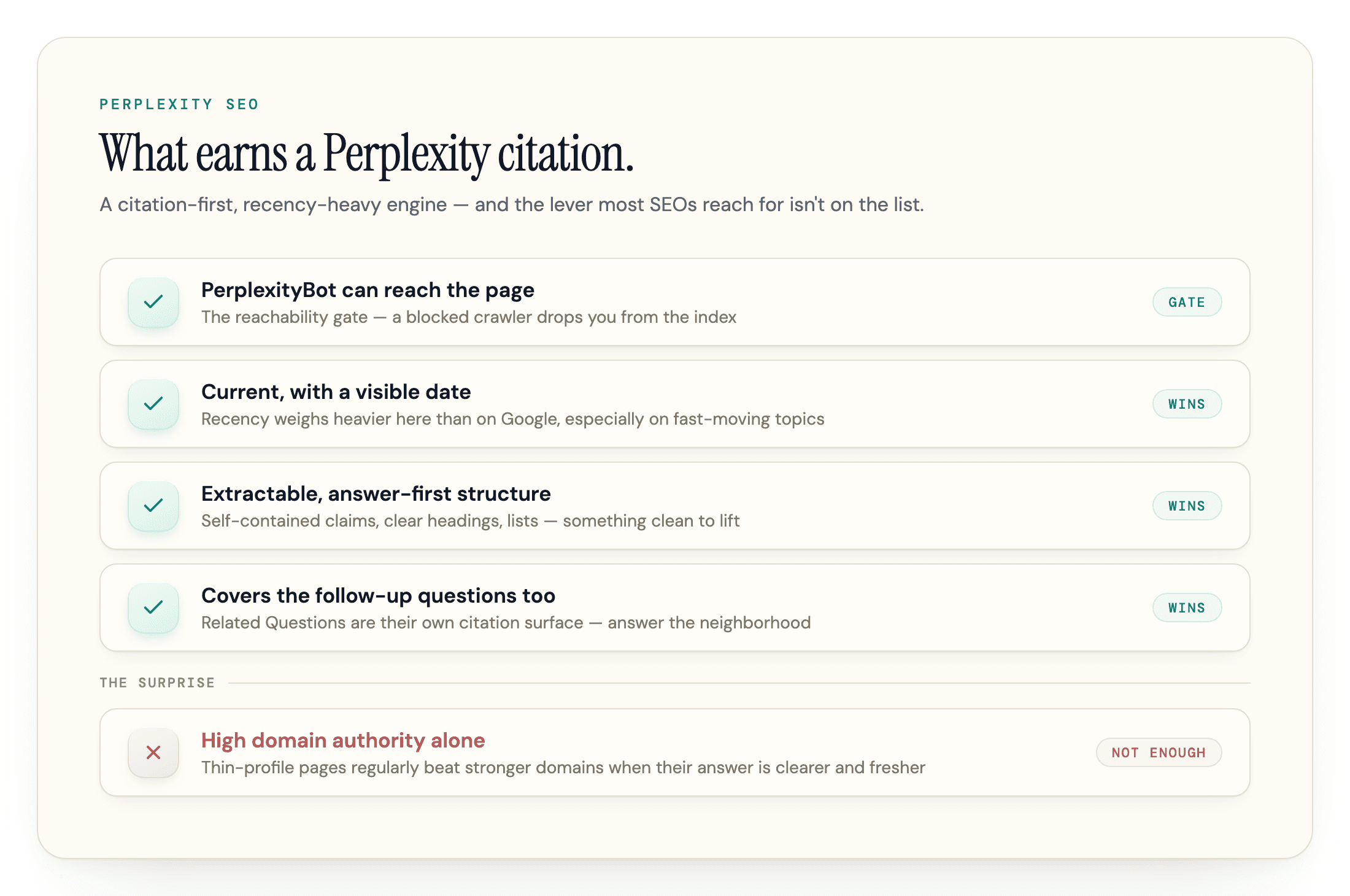
Three things decide whether Perplexity pulls you into an answer.
Recency. Perplexity leans on a live index and visibly favors current content. Keep important pages updated, show the date, and refresh material on fast-moving topics. In observed AI-citation studies and Geotoolbox scans, fresher pages can beat older authoritative pages, especially on fast-moving topics.
Extractable structure. Lead with the answer, keep claims self-contained, use clear headings and lists. Aggarwal et al.'s GEO study (KDD 2024) found those tactics improved visibility in their benchmark by up to 40% — a study-scoped result, not a guaranteed Perplexity lift — and Perplexity, being citation-driven, rewards extractable structure. See the GEO paper. The passage-level craft of writing pages LLMs cite is what makes a claim liftable.
Not domain authority. This is the surprise for SEOs. Perplexity frequently cites pages with thin backlink profiles. It is the pattern we consistently see in the scans we run at Geotoolbox: reference, community, and niche pages get pulled in over high-authority marketing blogs. A strong Google domain rating does not guarantee Perplexity citations; in our scans, clear, current, on-topic pages can beat stronger domains. Perplexity publishes no authority-based ranking guidance; the only optimization lever its own docs spell out is reachability via PerplexityBot.
Optimize for Related Questions
Perplexity does not stop at the first answer. It suggests follow-up questions beneath each response, and those Related Questions are their own visibility surface. A user who asks one question often clicks two or three suggested follow-ups, and each is a fresh chance to be cited.
The way to win them is to cover the adjacent questions on the same page or cluster. If your page answers the main query but ignores the obvious next questions, a competitor that covers the whole neighborhood gets cited on the follow-ups. Map the questions around your topic, answer each one cleanly under its own heading, and you become the source Perplexity reaches for across the whole thread, not just the opening query.
Here is a concrete way to harvest them:
- Ask Perplexity your head question, then write down every Related Question it suggests beneath the answer.
- Click into two or three of those and record the follow-ups they generate in turn, since the suggestions branch. Within a few minutes you have a tree of ten to twenty real questions Perplexity actually serves on your topic, not a keyword tool's guesses.
- Compare that tree against your existing page. For each question you do not already answer cleanly, add a short, self-contained section under its own H2 or H3 that leads with the answer in the first sentence.
- Group tightly related follow-ups onto one page; split genuinely separate intents into their own cluster pages that link to each other.
The goal is that whichever node of the tree a user lands on, your content is the cleanest extractable answer in view.
The Publishers Program: Getting Paid When You're Cited
Perplexity is one of the few engines that will share revenue with the sources it cites. Its Publishers Program, launched in July 2024, states that when Perplexity earns revenue from an interaction where a publisher's content is referenced, that publisher earns a share. The newer Comet Plus arrangement extends payouts to human visits, search citations, and agent actions.
For most sites this is not an immediate lever, since the program favors established publishers, but it signals where the model is heading: citations as a paid relationship, not just free exposure. If you publish at real scale, it is worth tracking eligibility. For everyone else, the takeaway is that being consistently cited has compounding value here, and the incentives reward exactly the kind of trustworthy, well-sourced content the rest of this guide pushes toward.
How to Measure Perplexity Visibility
Because Perplexity shows its sources, measurement is more direct than on other engines. Two caveats before you start: answers vary from run to run and by user context, so sample each prompt a few times before concluding you have won or lost a citation, and none of this guarantees one; Perplexity has not published how it picks among eligible sources.
- Run your questions and read the citations. Ask Perplexity your ten core questions and record whether you are cited and who is cited instead. The visible source list is your competitive map.
- Watch referral traffic. Filter analytics for the perplexity.ai referrer. Perplexity sends more click-through than some engines because users follow citations. For scale, Statcounter put Perplexity at 7.73% of worldwide AI chatbot referrals in April 2026, third behind ChatGPT and Google Gemini.
- Track the trend. Re-run the prompts monthly. A monitoring view that tracks your AI visibility over time turns those checks into a baseline you can act on.
A Worked Example: Reading the Citations to Find the Gap
Say you sell project-management software and ask Perplexity "what is the best free project management tool for small teams." The answer cites a Reddit thread, a software-comparison roundup, and two vendor pages that are not yours. Open each citation and read what Perplexity actually lifted. The Reddit thread surfaces because it answers a sharper question, free for teams under five people, with named tools and prices in plain text. The roundup wins because it has a scannable comparison table with one row per tool. The vendor pages that beat you lead with a one-sentence definition and a free-tier limit stated up front.
Now the gap is concrete, not abstract. Your own page may bury the free-tier details three paragraphs down, lack a comparison table, and never address the "under five people" cut that the cited sources answer head-on. The fix writes itself: add a one-line answer at the top, a comparison table Perplexity can extract, an explicit free-tier section, and a short answer to the team-size question. Then re-run the prompt in a week and check whether you have entered the citation list. Because Perplexity shows its sources, every answer you are missing from is a labeled to-do list rather than a guess.
Pay attention to which sentence each citation footnote attaches to as well, since Perplexity links claims to visible citations, which is a useful clue about which source may be supporting which claim. If a competitor's page earns the citation on the exact line that states the pricing, and a forum post earns the citation on the line about team-size limits, that gives you a practical map of the gaps to close.
The lesson is that you do not have to beat any single page on everything. You have to own one clean, current, extractable claim that the engine currently borrows from someone else, then repeat that for each footnote you want to displace. Keep a simple log of the questions, the current cited sources, and the specific claim each one wins, and the work turns into a ranked queue instead of a vague content project.
The Source Types Perplexity Reaches For
Beyond your own pages, it helps to know the kinds of sources Perplexity pulls into answers, because being present in them is part of the work. In the pattern we see in our own tracking, it draws heavily on a few categories: reference pages, community discussion (Reddit and forums where real questions get answered), video, and comparison or listicle content. That is consistent with how AI engines cite generally: they reward sources that are structured, current, and corroborated rather than simply high-authority. One caveat on the community pillar: Reddit sued Perplexity in October 2025 over scraped data, and unlike Google or OpenAI, Perplexity holds no Reddit licensing deal, so how heavily Reddit features in its answers may shift while the case plays out. Our Reddit SEO guide covers how to take part in Reddit without breaking its rules, and our guide to placing content in those sources covers how to test the result.
The practical move is to make sure your brand shows up accurately in those places, not just on your own domain. A clear answer on your site, echoed in a community thread and a credible roundup, is far more citable than the same claim sitting only on your homepage. Participate where you have genuine standing, though; manufactured or purely promotional threads get removed by moderators and can hurt the brand more than the missing citation did.
Perplexity Pages and Owned Surfaces
Perplexity is not only an engine that cites other people's pages. It also hosts content directly, and those owned surfaces are worth understanding because they sit inside the product rather than competing for a citation slot.
Perplexity Pages lets you turn a research thread into a published, shareable article that lives on Perplexity's own domain. For a brand, this is a different lever than optimizing your site to get cited. A well-built Page on a topic you have genuine expertise in can rank inside Perplexity, be surfaced for related queries, and carry your framing of a subject in your own words, with your sources attached. It will not replace your site, but it is a low-cost way to plant a structured, well-sourced answer on a high-authority surface that the engine already trusts.
Perplexity's shopping and merchant integrations work the same way. As it layers in shopping and agentic actions, the data it reads about your product (pricing, availability, specifications, structured merchant feeds) becomes part of what it can cite and act on. The takeaway is the same one that runs through this guide: make the canonical, structured version of your answer easy to find and easy to extract. The difference with owned surfaces is that some of that canonical content can live on Perplexity itself, not only on pages you hope it crawls. Treat a Page or a clean merchant feed as another citable copy of your answer, kept consistent with what is on your domain so the engine sees corroboration rather than contradiction.
Common Reasons You're Not Cited in Perplexity
When a brand is missing from Perplexity answers, it is usually one of these:
- PerplexityBot is blocked. A robots.txt or WAF rule keeps the crawler out of the index. Fix this first; nothing downstream matters until it is resolved.
- The content is stale. A substantive refresh with a visible date can help, but re-test citations because Perplexity has not published how it weights freshness.
- The answer is not extractable. The page may be thorough but buries its answer, leaving nothing clean to lift and cite.
- You cover the head question but not the follow-ups. A competitor that answers the whole question neighborhood gets the Related Questions citations you miss.
- No corroboration, and over-reliance on authority. The claim exists only on your own site, so there is nothing to cross-check, and as noted above a strong backlink profile alone does not win the citation.
Work the list in order. The first is technical and binary; the rest are content, freshness, and authority.
Frequently Asked Questions
Do you need backlinks to rank in Perplexity?
Less than on Google. Backlinks still feed the corroboration engines look for, but a thin-profile page with a current, extractable answer regularly wins the citation. Spend the marginal hour on the answer, not the link.
Does Perplexity favor fresh content?
Fresher content correlates with stronger citations, especially on fast-moving topics. A substantive refresh with a visible date can help; Perplexity has not published how it weights freshness, so re-test after refreshing rather than treating it as a guaranteed lever.
How is Perplexity SEO different from Google SEO?
Google ranks links; Perplexity writes an answer and cites a few sources. That shifts the goal from position to citation, raises the weight on freshness and extractable structure, and lowers the weight on raw domain authority. The fundamentals overlap, but the emphasis differs.
Can you get paid when Perplexity cites you?
Sometimes. Perplexity's Publishers Program shares revenue with referenced publishers, and Comet Plus extends payouts to visits, citations, and agent actions. It mainly benefits established publishers today, but it is a real mechanism.
How do you rank on Perplexity specifically?
Allow PerplexityBot, keep content current and answer-first, cover the related follow-up questions, and earn consistent mentions so the engine trusts repeating you. Then track which questions cite you and close the gaps.
Is optimizing for Perplexity different from ChatGPT?
The core overlaps, but each engine sources differently. See our guides on getting cited in ChatGPT search and getting cited in Gemini for those engines' specifics, ChatGPT vs Perplexity for how their retrieval and citations differ, and the how to optimize for AI search playbook for the engine-agnostic workflow.
Start with Reachability
Everything above assumes one thing: PerplexityBot can actually reach your pages. If it is blocked, your pages drop out of the index Perplexity builds answers from; a user can still pull a page in with a direct request, but you stop appearing in everyday answers.
Geotoolbox's free AI Crawler Checker shows whether your robots.txt allows the major AI crawlers, PerplexityBot included (a WAF block needs a server-side check), and the Content Analyzer grades how citable your page is. Confirm the gate is open, make your pages the current, well-sourced answer to the questions you want, and you give Perplexity's citation-first model its best reason to pick you.
Sources
- PerplexityBot and Perplexity-User documentation - Perplexity -
docs.perplexity.ai/guides/bots - Introducing the Perplexity Publishers Program - Perplexity -
perplexity.ai/hub/blog/introducing-the-perplexity-publishers-program - Introducing Comet Plus - Perplexity -
perplexity.ai/hub/blog/introducing-comet-plus - GEO: Generative Engine Optimization - Aggarwal et al., KDD 2024 -
arxiv.org/abs/2311.09735 - Americans and AI 2026: Chatbots, Smart Devices and Views on Impact (44% of US adults have used ChatGPT) - Pew Research Center, June 2026 -
pewresearch.org/internet/2026/06/17/americans-and-ai-2026-chatbots-smart-devices-and-views-on-impact - Perplexity received 780 million queries last month, CEO says - TechCrunch, June 2025 -
techcrunch.com/2025/06/05/perplexity-received-780-million-queries-last-month-ceo-says - ChatGPT falls to all-time low as AI chatbot referral market continues to fragment - Statcounter, May 2026 -
gs.statcounter.com/press/chatgpt-falls-to-all-time-low-as-ai-chatbot-referral-market-continues-to-fragment - Reddit accuses Perplexity of stealing user posts - CNBC, October 2025 -
cnbc.com/2025/10/23/reddit-user-data-battle-ai-industry-sues-perplexity-scraping-posts-openai-chatgpt-google-gemini-lawsuit.html