
Copilot SEO is not a separate discipline so much as your existing SEO aimed at a different target: getting your brand named when someone asks Microsoft Copilot a question, instead of just ranking a link they may never click. Most guides skip the one fact that makes it work. Copilot does not run its own index of the web. It grounds its answers on the Bing index, the same one behind your Bing rankings, and that single detail tells you almost everything about how to show up. Get a few mechanics right and you feed Copilot's consumer surfaces at once, from the answer box in Bing to the assistant in Windows and Edge. Below are the specifics, current as of July 2026.
What "Copilot SEO" Really Means
Search "copilot seo" and most of the results are about using Copilot to write your meta descriptions or do keyword research. This guide is the other job: being the source Copilot names when it answers someone's question.
That job is worth doing on its own because Copilot is not one product, and several of its surfaces can name you or skip you:
- Copilot Search, the AI answer experience in Bing and at copilot.microsoft.com, where a question returns a written answer with cited links
- Copilot in Windows and Edge, the same assistant built into the operating system and browser
- Microsoft 365 Copilot, the work assistant inside Word, Outlook, and Teams, which can also pull live web sources into an answer
These grew out of what used to be Bing Chat, which Microsoft rebranded as Copilot in late 2023. The naming churn is part of why people are unsure what "optimizing for Copilot" even means. The consumer surfaces (Copilot Search, Windows, and Edge) share one web-retrieval foundation, so the work below feeds all of them at once. Microsoft 365 Copilot can also pull in web sources, but only when an admin turns web search on, and it leans mostly on your internal work data, so public SEO touches just its web layer. Optimizing for the consumer surfaces is mostly your existing SEO and answer engine optimization aimed at a new target: the answer, not the blue link.
How Microsoft Copilot Picks Its Sources
When Copilot answers a question that needs current facts, it runs a web search and writes its answer from the results. It does not pull from a separate "Copilot index" you can submit to. Microsoft is direct about this in its Bing Webmaster Guidelines, which state that "Bing and Copilot search experiences rely on the same core crawling, indexing, and ranking foundation as traditional search." The Bing index is the pool. Everything else is downstream of being in it.
The retrieval itself is more specific than "Copilot reads the web." Microsoft's documentation on how web search works in Copilot describes the flow: Copilot rewrites your prompt into a short Bing search query, runs it, and draws candidate sources from that Bing result set. It then writes an answer from the most relevant of those results and cites the pages it used. You can see the machinery yourself: the sources button under a Copilot answer reveals the exact search query it generated and the pages it drew on.
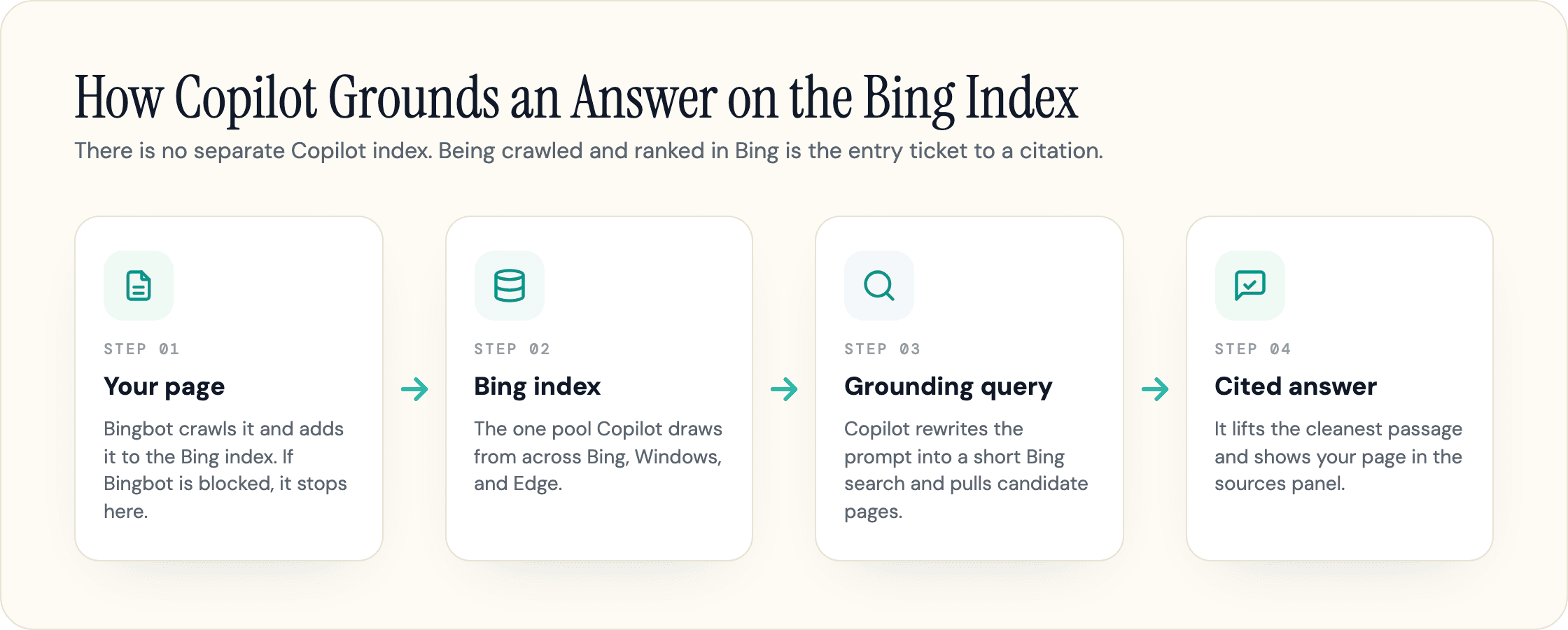
This is grounding: the answer is anchored to live retrieved pages instead of the model's memory alone. This means two things, and they shape everything else in this guide. First, if a page is not in the Bing index, no amount of content quality makes it a candidate. Second, Copilot works at the passage level, not the whole page. It builds the answer from the part of your page that best fits the rewritten query, the same way the rest of AI search works, so a self-contained answer it can quote cleanly beats the same point buried in a long page. Two things have to be true to get cited: you are in the index, and your answer is the cleanest passage for that query.
Why Bing Is the Entry Ticket (and Why That's Good News)
The single biggest move for Copilot visibility is getting your pages indexed and ranking in Bing. Most SEOs underweight Bing because it carries a small slice of raw search traffic, and that instinct is now backwards. Bing is no longer just a search engine with a few percent of the market. It is the index behind Copilot's answers in Bing, Windows, and Edge. That makes Bing work an AI distribution play now, not just a traffic one.
The reach also runs past Microsoft's own products. In one small test of ChatGPT Agent sessions, Search Engine Land's Jes Scholz found the agent leaned on the Bing Search API in the large majority of cases. That is ChatGPT, not Copilot, and too small a sample to bank on, but it points at something structural: the Bing index quietly feeds more AI surfaces than its brand suggests, so the work compounds.
There is a second reason to like this surface. It is easier to break into than Google. Copilot leans on Bing's ranking signals, which reward clear, well-structured pages, and it competes a much smaller field than Google's. SEOs report new and even pre-launch sites racking up thousands of Copilot citations while they are nowhere in Google. Those figures are self-reported anecdotes rather than measured data, but the pattern is consistent and it matches what we see: structure and index presence beat raw domain authority here in a way they no longer do on Google.
Copilot is also stingy with slots. Practitioners who watch it closely put the count at roughly three sources per answer, far fewer than ChatGPT's longer source lists, so the bar per slot is higher. Fewer slots and lower competition cut in opposite directions, and the net is favorable: you are competing a smaller field for a smaller number of spots, where being a clean, well-ranked Bing result is often enough to land one.
Step 1: Get Into the Bing Index
Everything starts with Bing being able to crawl, index, and rank your pages. If Bingbot cannot reach a page, Copilot cannot cite it, full stop. So the first pass is plumbing, and it is usually a quick win because most sites have never been tuned for Bing at all.
Three steps cover the index foundation:
- Verify your site in Bing Webmaster Tools. You can import your site and sitemaps directly from Google Search Console, so this takes minutes. It also gives you the reporting you will need later to measure citations.
- Submit your XML sitemap and use IndexNow. IndexNow, which Microsoft supports and the Bing guidelines tell you to use, pings Bing the moment a page is published or updated, so new content becomes eligible for Copilot in hours instead of waiting on a crawl.
- Clear the crawl blockers. Confirm that no robots.txt rule,
noindextag, login wall, or firewall is blocking Bingbot. Aggressive Cloudflare or WAF rules that lump Bingbot in with scrapers are a common, silent cause of AI invisibility.
The crawler question trips people up, because the AI era added a pile of new bots and the advice to "block AI crawlers" is everywhere. Keep two categories separate. Bingbot is the crawler that builds the index Copilot answers from, so blocking it removes you from Copilot. Bots like GPTBot or the training crawlers are a different decision about whether your content trains a model, and blocking them does not affect Copilot citations one way or the other. The mistake that costs you is blocking the wrong one. Confirm Bingbot has a clear path in your robots.txt and in Bing Webmaster Tools first, since that is the crawler Copilot depends on. Then sort out the AI bots: our free AI Crawler Checker fetches your robots.txt server-side and shows which of 34 AI crawlers, including a Microsoft AI crawler, you are allowing or blocking, so the block-all-or-allow decision is a deliberate one. For the wider picture of who reaches your site, see our guide to AI crawlers.
Step 2: Structure Pages So Copilot Can Lift Them
Ranking in Bing gets you into the candidate pool. Structure decides whether you get lifted out of it. This is the gap that frustrates people whose pages rank fine yet never get named: the answer is there, but it is buried where Copilot cannot cleanly extract it. Position qualifies you; an extractable passage wins the slot. Ranking number one is not even required, since the pages an AI answer cites do not always match the top organic results.
Microsoft publishes its own short list of what makes content easy to ground. The Bing Webmaster Guidelines tell you to state facts explicitly, use clear and consistent names for entities, keep a single topic per URL, and put the key information near the top of the page. Read those as instructions, not platitudes. They translate into a handful of habits:
- Lead each section with the answer. State the fact in a self-contained sentence in the first line or two, then add the detail. Copilot lifts a clean claim it can quote in one line over the same point spread across three paragraphs.
- Chunk by question. Give each distinct question its own heading and a standalone answer beneath it, so a passage makes sense lifted out of the page. Phrasing the heading as the question users actually ask helps the match.
- Keep the answer in the HTML. If your key facts load through client-side JavaScript, a crawler or grounding fetch can hit a near-empty shell. Server-rendered, text-first pages extract cleanly.
- Write with conviction. Independent research by Kevin Indig found that cited passages were nearly twice as likely to use definitive language as uncited ones, and that 44% of citations came from the first third of the page. That study measured ChatGPT citations, so treat it as a general AI-citation pattern rather than a Copilot-specific rule, but it lines up with Bing's own advice to put your clearest, most committed sentences up top.
Schema markup is worth adding, with a realistic expectation of what it does. Structured data like FAQPage, HowTo, and Article helps Copilot parse your entities and pull the right snippet, but it is an extraction aid, not a citation trigger. It makes a good passage easier to lift; it does not make a weak page get chosen. In the scans we run at geotoolbox, the pages that win citations are almost always the ones that answer a single question cleanly near the top, with schema as a supporting layer rather than the cause. If you want a second read on how liftable a given page is, our Content Analyzer grades a URL on the same signals, and the broader workflow lives in how to optimize for AI search.
Why Copilot Picks One Source Over Another
Indexing and structure get you into the running. When Copilot has several pages that could answer a query and room for only about three, a few softer signals decide who it names. They are worth knowing, because this is the gap behind the most common complaint: my coverage is fine, so why does Copilot keep naming a competitor?
Freshness tends to count for more on Bing than on Google, so a current, honestly dated page beats a stale one on questions that move. Authority still matters: a clear author, real credentials, and citing your own sources all help Copilot trust the page. And because the answer is assembled from what several sources agree on, being named accurately across reputable sites, profiles, and communities counts as much as your own page. Copilot also leans toward recognized entities, which is why consistent naming and a strong entity profile, with sameAs links to places like LinkedIn, help it connect a mention to you. None of this overrides being in the index, but it often decides the last open slot.
Step 3: Control How Copilot Cites You
Microsoft gives you direct controls over whether and how Copilot can cite a page, and almost no one uses them. These are the same robots and meta directives you already know, but the Bing Webmaster Guidelines now document exactly what each one does to Copilot specifically. They cut both ways: most pages want to be fully citable, but a paywalled article, a pricing page, or a competitor-bait comparison might not.
| Directive | Effect on Copilot citation | When to use it |
|---|---|---|
| Default (no directive) | The page is fully eligible to be grounded, quoted, and cited | Almost everything you publish and want found |
| NOARCHIVE | Prevents the content from being used in Copilot responses and grounding results entirely | Pages you never want Copilot to lift from |
| NOCACHE | Limits Copilot to using only the URL, title, and snippet, not the full page | Gated or sensitive pages you still want surfaced as a link |
| NOSNIPPET / data-nosnippet | Removes the snippet, which can limit Copilot citation quality for the marked content | Specific paragraphs you do not want quoted (wrap with data-nosnippet) |
| data-snippet | Marks the exact text you prefer Bing to display or cite | Steering Copilot toward your cleanest answer passage |
The practical move is the last row. Most pages should stay on the default and let Copilot quote freely, but the data-snippet attribute lets you specify the text you would rather it use, which helps when your best answer is not the first thing on the page. It is Bing-documented, though how strongly it steers Copilot in practice is not something Microsoft quantifies, so treat it as a nudge, not a guarantee. Reserve NOARCHIVE and NOCACHE for the handful of URLs where being quoted in full works against you. A blanket NOARCHIVE applied site-wide by a cautious developer quietly removes you from Copilot answers you would have wanted to win.
Step 4: Measure Your Copilot Citations
Copilot is the most measurable AI engine to optimize for, because it is the only one with a first-party citation report. In February 2026, Microsoft launched the AI Performance report in Bing Webmaster Tools as a public preview. It shows when your site is cited across Microsoft Copilot, AI-generated summaries in Bing, and select partner integrations, reported through metrics like Total Citations, Average Cited Pages, visibility trends, and page-level citation activity. Google Search Console still has no equivalent, which is the quiet reason Copilot is the easiest AI surface to optimize with feedback rather than guesswork.
The most useful field is grounding queries: a sample of the key phrases the AI used to retrieve your cited pages, aggregated across Copilot, Bing's AI summaries, and partner surfaces. Treat them as retrieval-intent clues rather than a complete log of exact Copilot searches, and they still close the loop. Instead of guessing which questions to write for, you mine that list for the ones you answer thinly or not at all, write the clean passage, and optimize against real retrieval behavior rather than a keyword tool. A June 2026 update added intent labels and topic groupings on those queries plus Citation Share and Compare views, so you can also watch how your presence moves against other cited sources over time.
Two honest caveats. The report is a preview, so expect the metrics and categories to keep changing. And citation data is not traffic data. Most AI clicks arrive with no referrer, so Copilot sessions are nearly invisible in GA4, which is exactly why the citation report matters more than your analytics here. Microsoft Clarity can surface some of that referral behavior, but treat it as a separate, smaller signal from the citation counts, which measure visibility rather than clicks. The discipline is the same one we build into our tools: sample the questions that matter, log who gets cited, and close the gaps one passage at a time. geotoolbox's Citation Interceptor tracks brand citations in Bing Copilot alongside the other major engines, and the Domain Overview turns those repeated checks into a visibility baseline over time. If you are weighing which tool to use for this, our best Copilot rank trackers guide compares the options.
What a Copilot Citation Is Actually Worth
Set expectations before you celebrate a big citation number, because the metric that looks most impressive is the one that converts least. SEOs watching the new report routinely see huge citation counts paired with almost no sessions, on the order of a tenth of a percent of citations turning into a click. Those are practitioner-reported figures, not vendor data, but the dynamic is real: most people read the Copilot answer and never click through, so a citation is a brand impression far more often than it is a visit.
That reframes the win. A Copilot citation is worth what a recommendation is worth: your name shows up at the moment someone is deciding, which drives the branded searches and direct visits that follow even when the answer itself gets no click. Plan for presence in the answer, not a flood of referral traffic, and value a citation the way you would value being named in an analyst's shortlist rather than a paid click.
It also pays to stay honest about the ceiling. Microsoft is explicit that good optimization makes a page eligible for grounding and citation but does not guarantee it. There is no published "Copilot ranking algorithm" to reverse-engineer and no setting that forces a citation. You are improving your odds across many answers, not buying a slot, which is exactly why the measure-and-iterate loop matters more here than any single tactic.
Copilot vs the Other AI Engines
Copilot's defining trait is that it rides the Bing index, which makes Bing SEO the lever and gives you a first-party report no other engine offers. The other major engines retrieve differently and reward slightly different work, so it helps to see where Copilot sits.
| Engine | What it grounds on | Crawler to allow | First-party citation report? |
|---|---|---|---|
| Microsoft Copilot | The Bing index | Bingbot | Yes, Bing Webmaster Tools AI Performance |
| ChatGPT | Its own search index plus Bing for some retrieval | OAI-SearchBot | No |
| Google Gemini | The Google Search index | Googlebot | No dedicated citation report |
| Perplexity | Its own index plus partner search APIs | PerplexityBot | No |
| Claude | Web search (via Brave) | Claude-User | No |
The fundamentals travel. A reachable, indexed, answer-first page is a citation candidate on all five engines, so the same GEO work covers Copilot too. What is unique to Copilot is the upside: the Bing index reaches more places than its traffic share implies, and it is the one engine that reports back which of your URLs get cited across its AI surfaces.
What Doesn't Move Copilot Citations
A few tactics get sold as Copilot requirements that do nothing, and they are worth naming so you can spend the time elsewhere.
Microsoft Ads. Paying for Bing ads does not buy or boost organic Copilot citations. The two systems are separate, and there is no documented path from ad spend to a grounded citation.
GitHub Copilot tweaks. GitHub Copilot is a coding assistant. It is a different product that shares the brand, and nothing you do for it affects whether Microsoft Copilot cites your website.
Keyword stuffing. Copilot lifts passages that read as clear, credible answers. Repeating a phrase to hit a density target makes a passage harder to lift, not easier, and Bing's quality systems discount it.
An llms.txt file. There is no evidence Copilot reads llms.txt, and Microsoft does not list it as a grounding input. Treat it as unproven rather than a requirement, and put the effort into being in the Bing index with extractable answers instead.
Frequently Asked Questions
Does Microsoft Copilot use Bing to find sources?
Yes. Copilot grounds its web answers on the Bing index, and Microsoft's own guidelines state that Bing and Copilot search rely on the same crawling, indexing, and ranking foundation as traditional search. When Copilot needs current facts, it rewrites your prompt into a Bing query, pulls candidate pages from the results, and cites the passages it uses.
Is Copilot SEO the same as Bing SEO?
It is built on Bing SEO but adds a second layer. Ranking in Bing gets your page into Copilot's candidate pool, which is the prerequisite. Getting cited then depends on structure: answer-first passages, self-contained sections, and clear writing Copilot can lift cleanly. So strong Bing SEO is necessary, and extractable content is what turns a ranking page into a cited one.
How do I check if Copilot is citing my website?
Use the AI Performance report in Bing Webmaster Tools, which launched in public preview in February 2026. It shows your total citations across Microsoft Copilot and Bing AI answers, which pages get cited, and a sample of the grounding queries the AI used to retrieve them. It is currently the only first-party AI-citation report any major engine offers.
How long until Copilot cites a new page?
It depends on how fast Bing indexes the page. Submitting it through Bing Webmaster Tools and pinging IndexNow can make a new page eligible within hours rather than waiting on a normal crawl. Citation is never guaranteed, but faster indexing is the fastest route to becoming a candidate.
Does blocking Bingbot block Copilot?
Yes. Bingbot builds the index Copilot answers from, so if your robots.txt, firewall, or WAF blocks Bingbot, your pages cannot be cited in Copilot. This is different from blocking AI training crawlers like GPTBot, which has no effect on Copilot citations either way.
Does schema markup get me cited in Copilot?
It helps extraction, not selection. Schema like FAQPage, HowTo, and Article makes it easier for Copilot to parse your entities and pull the right snippet, but it does not make a weak page get chosen. Add it as a supporting layer on top of clear, answer-first content, not as a citation trigger on its own.
Start with the Bing Index
That is the whole job: get into the Bing index, then be the cleanest answer Copilot can lift. Do those two things and Copilot citations follow the rest of your AI visibility work, with the bonus that this is the one engine that reports back exactly which pages it cites.
Start at the gate the other guides skip. geotoolbox's free AI Crawler Checker shows which AI crawlers your robots.txt is letting in or shutting out, the Content Analyzer grades how liftable a page is once it is reachable, and the Citation Interceptor tracks when Bing Copilot starts naming you. Open the door, make your best pages the clearest current answer, and give Copilot its best reason to pick you.
Sources
- Bing Webmaster Guidelines - Microsoft Bing (Copilot grounding, citation directives, and content rules) -
bing.com/webmasters/help/webmaster-guidelines-30fba23a - Introducing AI Performance in Bing Webmaster Tools (Public Preview) - Bing Webmaster Blog, February 2026 -
blogs.bing.com/webmaster/February-2026/Introducing-AI-Performance-in-Bing-Webmaster-Tools-Public-Preview - Bringing the best of AI search to Copilot - Microsoft Copilot Blog, November 2025 -
microsoft.com/en-us/microsoft-copilot/blog/2025/11/07/bringing-the-best-of-ai-search-to-copilot - How web search works in Microsoft 365 Copilot - Microsoft Support -
support.microsoft.com/en-US/Microsoft-365-Copilot/how-web-search-works-in-microsoft-365-copilot-chat-and-agents - IndexNow - IndexNow protocol (supported by Microsoft Bing) -
indexnow.org - The Science of How AI Pays Attention - Kevin Indig, Growth Memo, February 2026 -
growth-memo.com/p/the-science-of-how-ai-pays-attention - Insights from 100 conversations with ChatGPT Agent mode - Jes Scholz, Search Engine Land, October 2025 -
searchengineland.com/insights-chatgpt-agent-mode-463127