
Plenty of Semrush reviews are feature tours written from a quick trial. This one is written from the paid account we use for client work every day, checked against Google Search Console on three real sites, and updated for what Semrush became in 2026: an Adobe-owned platform selling AI visibility alongside classic SEO. Two things to know before reading: Semrush links here are affiliate links, and we build an AI visibility tool of our own, which makes part of what we review below a competing product.
Semrush Review: The Short Answer
Semrush is the strongest all-in-one SEO platform you can buy in 2026, and the most annoying one to pay for. Verdict: 4.25/5, docked mostly for the billing traps and seat math rather than the product.
The core toolkit earns its reputation. Keyword Magic is the best keyword research tool we have used, the paid-search intelligence has no real equivalent in Ahrefs, and the reporting features are what justify the invoice for agencies.
The hard part is everything around the product. The price on the website is not the price you end up paying once seats and add-ons stack up. The AI Visibility Toolkit's advertised $99 a month carries a "billed annually" line on the tab the pricing page opens to, but the monthly tab offers the same $99 with no annual discount at all. And billing and cancellation dominate the community complaints we monitored, ahead of any product flaw.
Here is the short version:
Buy it if you run an agency or an in-house team that will use three or more of its toolkits, you need PPC competitive data, or you want AI search visibility and classic SEO in one subscription.
Skip it if you are a solo operator with one small site. You would be paying for dozens of tools to use five, and the cheaper tiers fence off the features that make the price defensible.
Every number below is either a figure from our own dashboards checked against Search Console, or a price verified on Semrush's own pages this week. We label which is which.
How We Tested It
This review is based on the Semrush account we pay for and use daily, not a trial spun up for a screenshot.
We ran Semrush against three sites we have full data access to: our own site (a small, young domain), a mid-size manufacturer site, and a large marketplace in the high five figures of monthly clicks (the latter two are client sites, anonymized). For each one we compared Semrush's numbers with Google Search Console, with Ahrefs (which we also pay for), and, for the AI-citation check, with Bing Webmaster Tools. We pulled the same dashboards twice, twelve days apart, to see how the numbers move.
That methodology matters because it separates two questions reviews usually blur: what Semrush can do, and whether its numbers are right. A feature tour cannot answer the second question. Ground truth can.
We published the first round of that data in our Semrush vs Ahrefs comparison in July. This review extends it with the full 2026 pricing picture, the AI Visibility Toolkit, and the buying decisions the comparison did not cover.
What Semrush Is Best At
Strip away the marketing and Semrush is really three exceptional products wearing one login.
Keyword Magic and Keyword Research
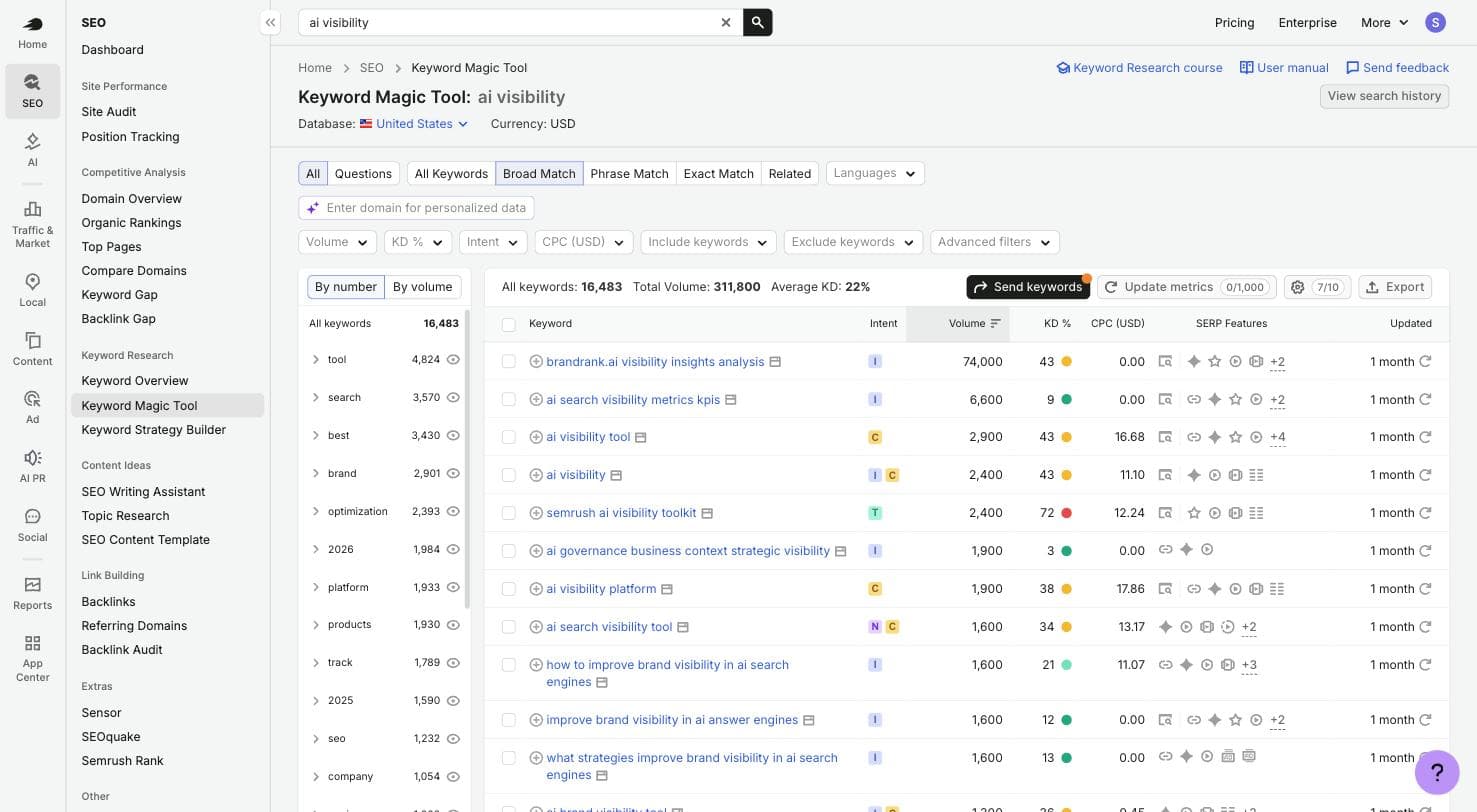
The Keyword Magic Tool is the closest thing to a consensus in SEO tooling: even the community threads that trash Semrush's billing concede this one. Type a seed term and it returns keyword variations grouped into semantic clusters, with intent labels, difficulty scores, CPC, and SERP feature flags attached to each row.
Two things make it better than the equivalents. The clustering does hours of manual sorting for you, and the personalized difficulty option estimates how hard a keyword would be for your domain rather than in the abstract.
We use it weekly for keyword research on client campaigns, and in that use the variation coverage runs broader than what Ahrefs returns for the same seeds, which matches the database gap both vendors advertise. We have not run a formal seed-by-seed count, so read that as working impression rather than a measured result.
Competitive and PPC Intelligence
This is the moat. Organic Research shows a competitor's ranking pages and estimated traffic split, the Keyword Gap and Backlink Gap tools map exactly where rivals rank and earn links that you do not, and Advertising Research exposes their paid keywords, ad copy history, and where the budget goes. Ahrefs carries some paid-search data too, but nowhere near this depth: no ad copy history, no comparable spend view. Standalone PPC spy tools cost real money on their own.
If you sell to clients, Advertising Research alone can carry a pitch meeting. It's the feature we point to when someone asks why the subscription survives our annual tool cull.
Site Audit and Agency Reporting
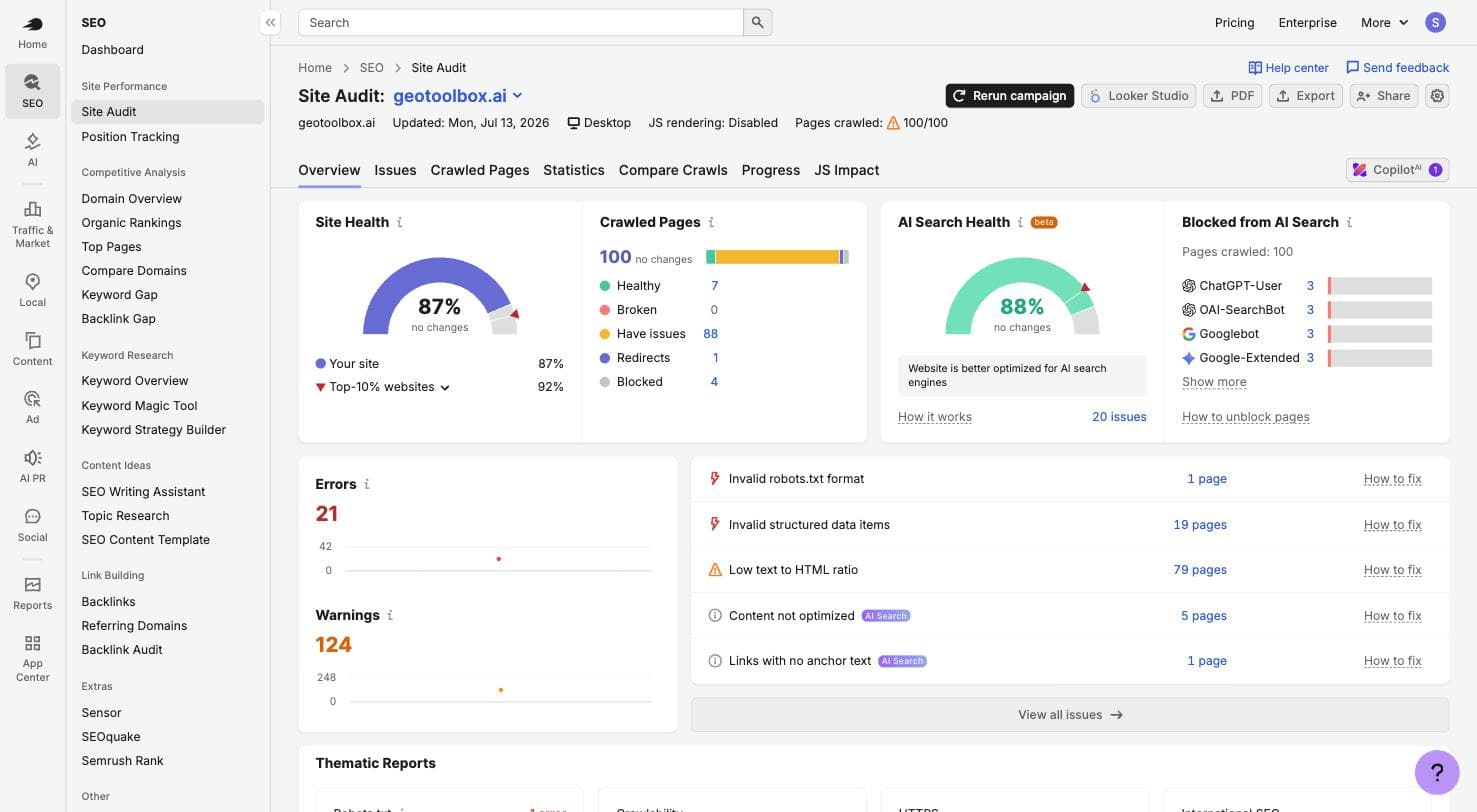
Site Audit's crawl budget scales with plan tier and, more usefully, it ranks what it finds by impact instead of dumping an error list. Each issue carries a plain-language explanation of why it matters and how to fix it.
For agencies, the white-label scheduled PDF reports are the quiet workhorse (note that on current plans some branding and scheduling options sit in a low-cost reports add-on, $10 to $20 a month, rather than the base tier). Several agency owners in the communities we monitor describe reporting, not research, as the thing that justifies the price, and our experience matches: client-ready reports on a schedule remove a real block of monthly labor.
The backlink audit with its built-in disavow workflow rounds this out. Ahrefs will show you the links and can export a disavow file, but deliberately leaves the toxicity judgment to you; Semrush scores them and walks you through acting on the score. If you do penalty-recovery work that workflow is genuinely useful, though most sites without a manual action never need to disavow anything.
One caveat the community repeats, and our own comparison confirms: SEOs who run Semrush often still pay for Ahrefs specifically for link data. The index refreshes slower, and noisy lost-link alerts are the recurring complaint. If backlink data is your primary job, this is not your primary tool.
The rest is a mixed bag. Position Tracking is solid (daily, down to zip code level, now including AI surfaces we cover below). The content tools, SEO Writing Assistant included, are useful on Guru and up. The social media toolkit is an afterthought, and nothing we would pay separately for.
The learning curve is real, and it belongs next to the price. The interface has dozens of sections, and community threads about switching tools consistently describe weeks, not days, to feel fluent. Budget onboarding time like you budget the subscription.
Accuracy: What Our Three Sites Show
Reviews disagree wildly about Semrush's data accuracy. One popular review measured its own site and found Semrush underestimating traffic by 43 percent. Another says the accuracy "resembles Google Search Console closely." Each ran a single site, which is exactly why they disagree.
We compared Semrush's organic traffic estimates with Google Search Console clicks and Ahrefs estimates on three sites of very different sizes. Same week, same pull, checked again twelve days later, and the re-pull is a finding on its own: the models move. Over those twelve days Semrush's estimated traffic for our small site went from about 1,000 to 1,700 while Ahrefs revised its own estimate from about 1,500 down to 375, swings we documented pull by pull in the comparison piece. The table below uses the later pull for everything.
| Site | Semrush est. monthly organic | Ahrefs est. monthly organic | GSC clicks (30 days) |
|---|---|---|---|
| Small site (our own, a few months old) | ~1,700 | ~375 | 382 |
| Mid-size site (manufacturer) | ~5,100 | ~2,700 | 3,703 |
| Large site (marketplace) | ~397,300 | ~316,000 | 83,499 |
TESTED, August 2026: tool figures are each dashboard's headline estimate for the site's primary market: worldwide for our half-French small site, the US database for the two US-centric client sites, and worldwide throughout for Ahrefs. GSC counts Google web clicks over the trailing 30 days, unfiltered. Full methodology in the comparison piece.
Three patterns worth your attention.
The error is large, and it is never the same size twice. Semrush read high on all three of our sites, but by anywhere from more than a third over to nearly five times over, so no fixed discount you apply to the dashboard number will correct it. Ahrefs happened to land within seven clicks of the Search Console number on our small site, a coincidence you should not extrapolate: it undershot the mid-size site by about a quarter and ran nearly four times over on the marketplace.
Published tests point the other way too: one reviewer measured a 43 percent underestimate. A reviewer testing one site can conclude almost anything, in good faith.
Estimates and clicks measure different things, but the gap is still the point. Tool estimates model visits from ranking positions and clickstream panels; Search Console counts actual Google clicks. Some divergence is structural. What matters for a buyer is that the site-level number on the dashboard is a modeled figure that can be off by hundreds of percent, and other reviewers have caught it missing low by nearly half. Nothing in the interface warns you either way.
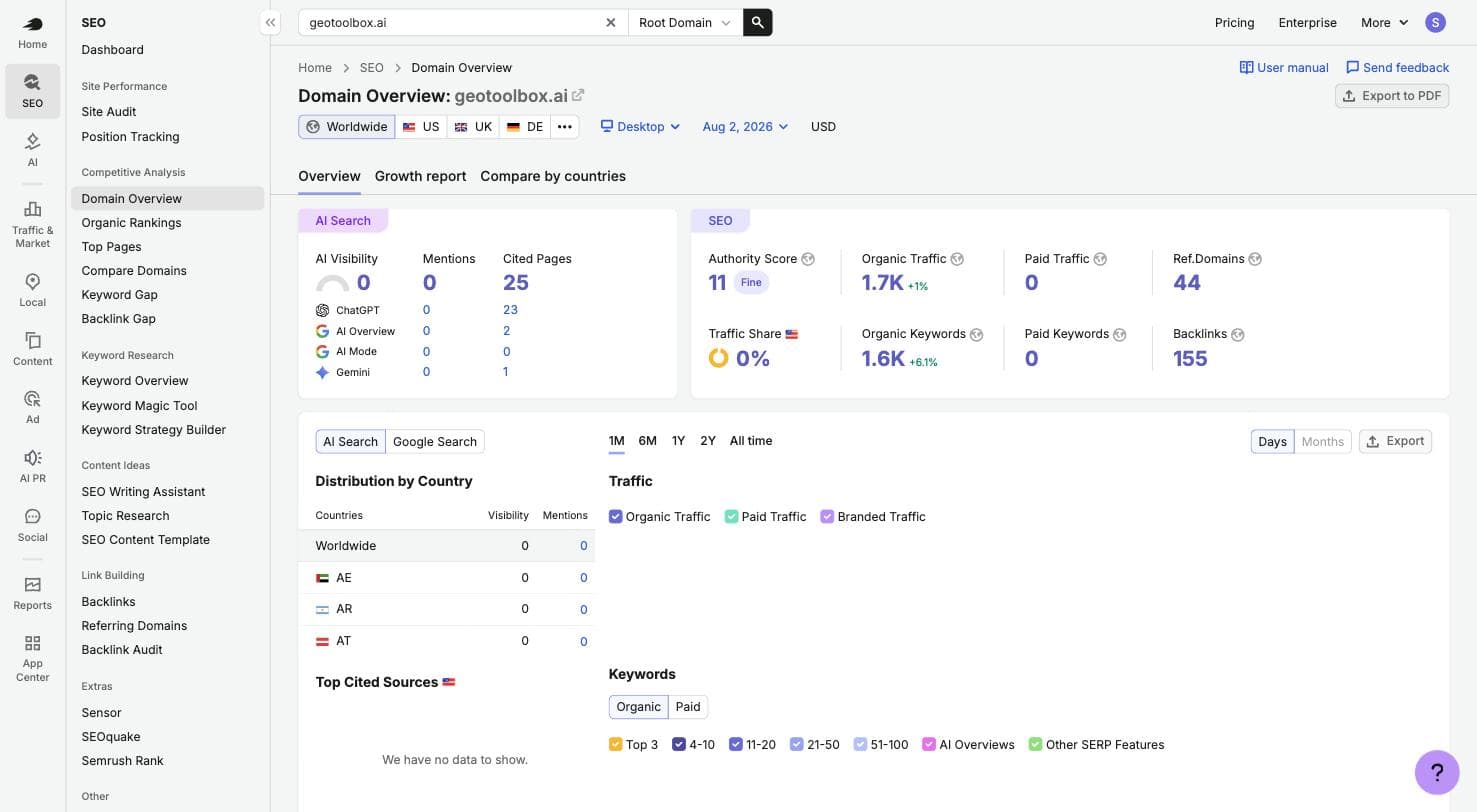
Keyword counts are definitions, not measurements. Semrush credited our small site with about 1,500 ranking keywords worldwide on the August 1 pull (1.6K a day later, as the screenshot above shows); Ahrefs counted 42 in its default view. Neither is lying. They count different positions, databases, and thresholds. Comparing your keyword count in one tool against a competitor's count in another is meaningless.
Our working rule after running both tools side by side: use Semrush for relative comparisons (you against competitors, measured in the same index) and Search Console for the truth about your own Google clicks. That caveat is about precision, not coverage. Semrush sees more of the query space than anything else we run, which is exactly why the relative comparisons are worth having. The 7-day free trial is enough time to run this same Search Console comparison on your own site before any invoice lands.
The AI Visibility Toolkit, Reviewed by People Who Build One
Semrush's 2026 repositioning is built around one idea: a unified AI visibility and SEO platform. The app's left rail now has a full AI Visibility section, and the Domain Overview carries an AI Search panel next to the classic organic data. We build AI visibility tooling at geotoolbox ourselves. That makes this section a review of a competing product, as disclosed above, and it also means we can judge it as practitioners.
The documented feature set is substantial. Per Semrush's own documentation, the AI Visibility Toolkit tracks your brand across ChatGPT, Google AI Overviews, Google AI Mode, Gemini, and Perplexity. It produces a Visibility Score (an index of your brand's mentions against the median of your top competitors), Share of Voice against named rivals, Prompt Research to find the questions people ask AI engines, and cited-source breakdowns showing which pages earn the citations. Daily Prompt Tracking, 25 custom prompts on the standalone toolkit's base tier, lets you benchmark competitors and watch shifts over time.
On our own account we opened the Visibility Overview, Prompt Research, and the citation reports; we did not stress-test the Visibility Score or Share of Voice methodology.
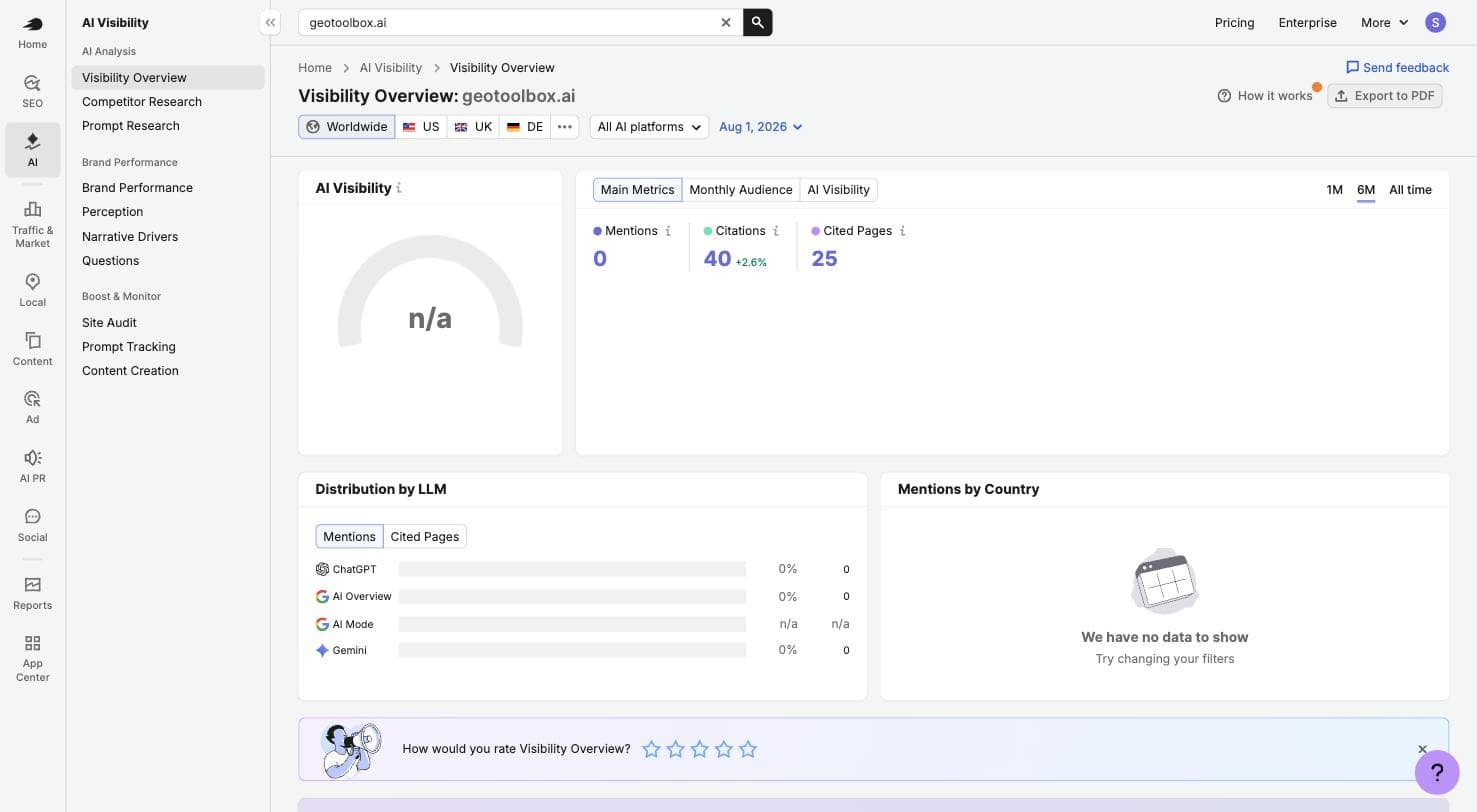
One clarification to the review ecosystem: several popular reviews claim Perplexity is not covered. Semrush's documentation says otherwise, and the confusion is understandable, because the Distribution by LLM panel inside our dashboard currently lists only ChatGPT, AI Overviews, AI Mode, and Gemini. We could not confirm Perplexity data on our own account, whether because our domain has no Perplexity citations yet or because the panel lags the docs. What is actually absent from the self-serve tiers: Claude, Grok, MS Copilot, and DeepSeek. Semrush's Enterprise pricing page sets it out in a comparison table: the AI Visibility Toolkit gets "ChatGPT, Google AI Overviews, Google AI Mode, Perplexity, and Gemini" with 25 to 200 prompts, while Enterprise's AI Optimization adds MS Copilot, Grok, Claude, and Deepseek on top, with unlimited prompts.
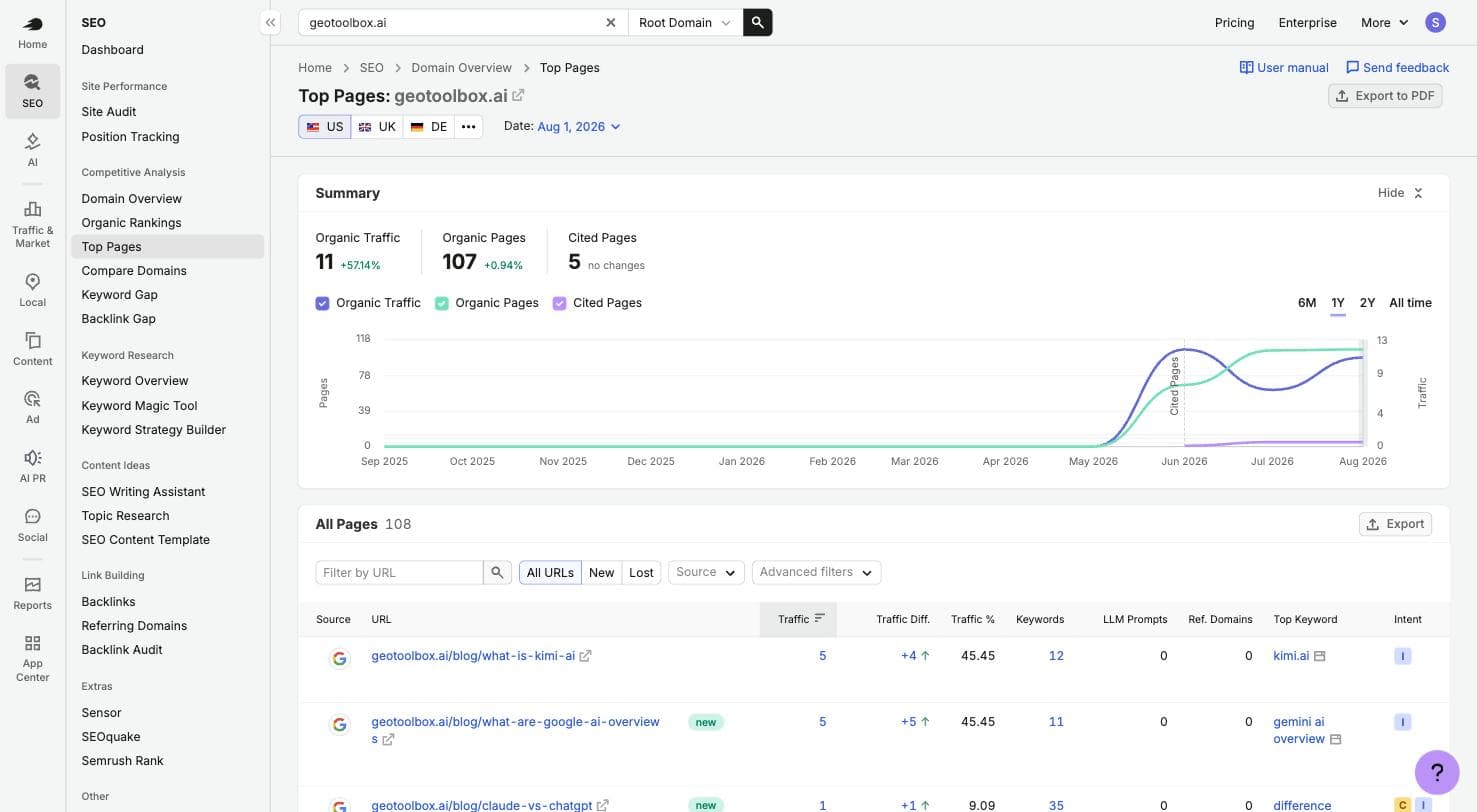
TESTED, August 2026: the toolkit logged 40 AI citations across 25 cited pages for our site on August 2, up from 39 the day before (the dashboard's +2.6 percent badge) and from 31 citations across 19 cited pages in July. Directionally that matches the growth we see in our own logs. The absolute numbers do not: Bing Webmaster Tools reported 15.3K AI citations for the same domain over three months. The figures are not comparable: different periods, different surfaces, different definitions of a citation, and neither validates the other.
Also worth reporting: on our domain the headline Visibility Score returned n/a and brand Mentions sat at zero across three of the four engines in the panel; the fourth, AI Mode, returned n/a, which is not the same claim as a zero. Only the citations counter produced data. On a domain our size the flagship score has nothing to chew on yet, which is itself a finding about who the toolkit is for.
That is the right frame for this entire category, ours included: AI visibility numbers are modeled samples, not ground truth. Our own tracker samples a fixed prompt set on a fixed cadence and misses everything outside it; Semrush's samples differently and misses differently. AI answers are volatile and personalized, no vendor sees every response, and our data study on AI search found the engines disagree with each other about who deserves a citation in the first place. Treat the scores as competitive direction, never as a count of anything. A tool that shows you trending up against named competitors on tracked prompts is useful. A tool that claims to measure your total AI presence is overpromising, whoever sells it.
Where does that leave the toolkit? If you already live in Semrush, it is the most convenient way to get systematic AI tracking next to your SEO data. Pair it with first-party evidence (your logs, Bing Webmaster Tools, and a crawler-access check like our free AI readiness scan) and you have a defensible AI visibility practice.
Semrush Pricing in 2026: What You'll Actually Pay
Semrush pricing got more complicated in 2026. There are now two front doors: the classic SEO plans, and the Semrush One bundles that fold the AI Visibility Toolkit into one subscription. All figures below are from Semrush's pricing pages and its own Semrush One documentation, re-checked on August 7, 2026.
| Plan | Monthly billing | Annual billing (per month) | Limits |
|---|---|---|---|
| Pro (classic) — now sold as "SEO" | $139 | $117.33 | 5 projects, 500 tracked keywords |
| Guru (classic) — off public pricing, see note | $249.95 | $208.33 | 15 projects, 1,500 keywords, content tools |
| Business (classic) — off public pricing, see note | $499.95 | $416.66 | 40 projects, 5,000 keywords, API |
| One Starter | $199 | $165.17 | 5 sites, 500 keywords, 50 AI prompts daily |
| One Pro+ | $299 | $248.17 | 15 sites, 1,500 keywords, 100 AI prompts |
| One Advanced | $549 | $455.67 | 40 sites, 5,000 keywords, 200 AI prompts |
Each Semrush One tier inherits the features of its classic sibling (Starter maps to Pro, Pro+ to Guru, Advanced to Business) and adds the AI Visibility Toolkit on top. The 7-day free trial covers SEO, Starter and Pro+ — but not Advanced, whose only buttons are "Subscribe" and "try custom plan." The most expensive self-serve plan is the one you cannot try first.
One restructuring note, and it changed between our first check and this update: the public pricing page, now titled "SEO & AI Search Plans and Pricing," shows exactly four plans — a single "SEO" plan next to the three One bundles. That "SEO" plan is the classic Pro renamed, and very slightly repriced: $139 flat, down from Pro's $139.95. Guru and Business no longer appear on any public pricing page we could reach: they remain documented in Semrush's knowledge base and active for existing subscribers, but a new buyer today is being steered to the entry SEO plan or the bundles. If your budget was built around Guru, price the equivalent One tier instead.
One more scope note before the catches: the classic plans are not entirely AI-blind. Semrush's own documentation shows they include sample-level AI citation and mention data, plus the AI Search Health score in Site Audit. What they cannot do is track prompts, which is the thing the toolkit actually sells.
Now the parts the pricing page does not put in the headline.
The $99 AI toolkit gains nothing from paying annually. The AI Visibility Toolkit standalone is $99 per month per domain, and the toolkit page opens on its Annually tab, where the fine print reads "billed annually." Switch the toggle to Monthly and the price is identical, $99, with that line gone and a different checkout offer behind the button. So unlike the SEO plans, where paying for a year takes $139 down to $117.33, committing twelve months to the toolkit buys you no discount whatsoever. We checked this at a signed-in checkout, not just on the pricing page: the monthly offer bills every 1 month, the annual one every 12, and the per-month figure is identical. What the toolkit genuinely lacks is a way to try it: per Semrush's own knowledge base there is no free trial of it at all, so the first $99 is a purchase, not a test.
Every plan includes one seat. Additional users start at $45 per month each and scale up by plan. The $45 is a floor, not a rate: Semrush prices extra users at $45 on SEO and Starter, $80 on Pro+, and $100 on Advanced. A five-person team on Pro+ is not paying $299 a month, it is paying $299 plus four seats at $80, or $619 before a single add-on.
One more line the pricing page does not show: an extra seat does not inherit everything. Semrush documents that the Traffic & Market Toolkit, App Center, and the AI Visibility Toolkit must each be bought again per additional user — $99 a user for AI Visibility, $289 for Traffic & Market. On a One plan, the second person who needs the AI reports costs you the seat and the toolkit.
The add-on stack is where budgets die. Local SEO, Traffic & Market Analytics, the Content Toolkit, Advertising, Social, and AI PR are all separately priced add-ons, several of them billed per user. The community's word for this is nickel-and-diming, and it's the most consistent pricing complaint we found. Price the tools you expect to open weekly before you commit.
The upgrade math favors One for a single-user account. On monthly billing, Guru plus the $99 toolkit is about $349 against One Pro+'s $299, and both routes advertise a month-to-month option. Run it all-annual and the shape is the same: $307.33 against $248.17. Run the arithmetic and it is plain enough: an annual One Pro+ costs essentially the same as a monthly Guru (accepting the 12-month commitment annual billing implies), with quadruple the standalone toolkit's prompt allowance (100 on Pro+ versus 25) included. Semrush's Semrush One documentation sets out the tiers; the comparison is ours. With Guru now pulled from the public pricing page, the bundle is the default route for new buyers anyway. Teams should still price their exact seat and domain count before switching, because per-user costs stack differently across the two routes.
What is a prompt, in practice? One tracked prompt is one question checked daily across the covered AI engines. Fifty prompts on One Starter sounds like a lot until you split it: ten brand and product queries plus eight competitors at five prompts each exhausts it exactly. Agencies should budget prompts like they budget tracked keywords: they run out, and Semrush's docs price the refill at $60 a month for another 50, which is the add-on pattern again.
The free trial runs seven days as standard per Semrush's own site (partner links sometimes extend it to 14; the length shown at your checkout is the one to calendar), and it requires a credit card. Given how Semrush handles cancellation, that matters more than usual.
The Complaints Worth Taking Seriously
Semrush holds a 4.4 rating from 4,024 reviews on G2 and a 1.7 from 1,354 on Trustpilot, as rendered in Google's review snippets the day we checked. That split is not a contradiction. G2 reviews mostly discuss the product; Trustpilot's recent reviews mostly describe billing disputes. Both are telling you something true.
Cancellation is the big one. Submitting the cancellation form is not the end of the process. Semrush's own help documentation states that after the form you receive a confirmation email whose link is valid for 24 hours, and "you must click this link to finalize your request." Miss that window and the subscription keeps renewing.
Communities treat missed confirmations as a recurring trap. In the late-2025 through mid-2026 threads we monitored across r/SEO and adjacent subreddits, cancellation and renewal complaints were the most common Semrush topic, and one long-running worth-it thread has proven durable enough to rank on page one for "semrush review" (US results, August 2026).
The Better Business Bureau profile shows a D- rating, which BBB ties to 53 unanswered complaints, and the recent complaints on the profile center on trial charges and refused refunds. The refund fine print explains some of that heat: Semrush's refund policy is a one-time, 7-day money-back guarantee that applies only to annual-or-longer commitments. Month-to-month subscriptions are not refundable at all, so the people angriest in those threads are often outside a window that never applied to them.
If you start the trial: calendar the trial end date, cancel a few days early if you are not converting, and complete the confirmation email the same day it arrives. None of this is hard, but nobody at Semrush will do it for you.
Support has thinned, by community account. Reports of template responses and slow escalation recur across 2025 and 2026 threads, usually attached to billing cases rather than product questions. Our own support contacts have been fine for product issues, so we mark this one community-reported rather than tested.
Then there is Adobe. Adobe completed its acquisition of Semrush on April 28, 2026, an all-cash deal announced at $1.9 billion, and Semrush now sits in Adobe's Customer Experience Orchestration business. Practitioner sentiment in the threads we monitored skews strongly negative, with three recurring fears: enterprise-oriented pricing, slower product velocity, and the fate of self-service accounts inside a company built on suite deals.
What has changed so far, from inside a paying account: nothing we can observe. Headline prices on the plans we hold did not move at the close (though Semrush restructured its packaging during 2026, as covered above), the product kept shipping (the AI Visibility rebrand landed post-announcement), and Adobe publicly committed to continued investment. The fears are about trajectory, not the present. We wouldn't cancel over the logo, but we also wouldn't sign a multi-year commitment on the assumption that pre-acquisition pricing survives the integration.
In the threads we read, the complaints clustered on billing rather than the product itself, and data-quality complaints were rare (though our own accuracy testing above suggests the estimates deserve more scrutiny than the community gives them). People complain about paying for Semrush, rarely about using it.
Who Should Buy It (And Who Shouldn't)
Agencies and client-facing teams
Yes. The combination of breadth, PPC intelligence, and white-label reporting is unmatched among the tools we have run, and per-client project workflows are what the platform is built around. Budget for seats honestly and the invoice still beats stitching four tools together. Start the trial on your busiest client account.
In-house teams at mid-size companies
Yes, with the seat math done first. If two or more people live in SEO data weekly and you touch paid search at all, Semrush earns its slot. If your whole SEO program is one person maintaining rankings, a cheaper tier of a simpler tool covers most of what you need.
Solo operators and small sites
Usually no. This is where the community's "not worth it yet" consensus is right. The free plan covers ten reports a day, enough to check an idea, and it costs nothing to keep around while you grow into the paid tiers. Past that, tools like SE Ranking or Mangools cover keyword research and tracking at a fraction of the price (our Semrush alternatives guide picks the best by job), and free SEO tools cover audits and basics. Come back to Semrush when clients or scale arrive.
AI-visibility-first buyers
Check the bundle before the standalone. If AI search tracking is your primary goal, One Starter at $199 is the cheapest full Semrush package with AI tracking included, and the standalone $99 toolkit only wins if you need nothing from the SEO side. It advertises a monthly option, but there is no trial and no annual discount, so the first $99 is a purchase. We compared the wider field in our AI visibility tools roundup if Semrush is not a foregone conclusion. That field includes our own geotoolbox — from $99 a month with a 7-day trial, reaching eight engines on higher tiers, including Claude, Copilot, and Grok — three engines the self-serve toolkit does not cover — reviewed in that roundup with the same disclosure made there.
Is Semrush Worth It in 2026?
For agencies and teams that will use its breadth: yes, clearly. It is the strongest all-in-one we have paid for, and nothing else we have used combines organic, paid, and AI search data this deeply in one subscription. For everyone else it is a utilization question, not a quality question: count the toolkits you would open in a normal week. At three or more, buy it; at one, do not; at two, let the trial decide.
The thing that would change this verdict is Adobe. If the next renewal cycle arrives with enterprise pricing and a thinner self-service tier, the math above stops holding, and we will update this review to say so.
If you are ready to test it, start the 7-day Semrush free trial and run it on your own data, or compare the Semrush One bundles if AI visibility is part of the plan. Run it against your Search Console the way we did. Separately, if you want the AI-search side checked without a subscription, our free AI readiness scan takes about a minute.
Whichever way you decide, set that cancellation reminder first.
Frequently Asked Questions
What is Semrush?
Semrush is an all-in-one digital marketing platform covering keyword research, competitor analysis, site audits, rank tracking, PPC research, and, since 2025, AI search visibility tracking. It has been owned by Adobe since April 2026 and sits alongside Ahrefs as one of the two dominant paid SEO suites.
Is Semrush worth the money?
For agencies and teams using three or more of its toolkits, yes. The breadth, PPC data, and reporting justify the price. For solo operators with one small site, usually not: cheaper tools cover the basics, and Semrush's per-seat and per-add-on pricing punishes light use. The 7-day free trial is the cheapest way to settle it on your own data.
How much does Semrush cost per month?
The entry SEO plan (the classic Pro, now sold as "SEO") runs $139 monthly. The Semrush One bundles, which add the AI Visibility Toolkit, cost $199, $299, and $549. Annual billing cuts up to 17 percent; the entry plan drops to $117.33 a month. Guru ($249.95) and Business ($499.95) still exist for current subscribers but no longer appear on the public pricing page. Extra user seats start at $45 per month, and most specialty toolkits are separately priced add-ons.
How do I cancel a Semrush subscription?
Submit the cancellation form from your subscription settings, then click the link in the confirmation email Semrush sends; per Semrush's help docs the link is valid for 24 hours and the cancellation is not final until you click it. Cancel a few days before renewal and complete the confirmation the same day.
How accurate is Semrush's traffic data?
Treat it as directional. Across our three test sites, Semrush overestimated every time, from more than a third over Google Search Console clicks to nearly five times over, while published single-site tests have measured meaningful underestimates too. Use it to compare competitors within the same index, and use Search Console for the truth about your own Google clicks.
Does Semrush track AI search visibility?
Yes. Semrush documents AI Visibility Toolkit coverage of ChatGPT, Google AI Overviews, AI Mode, Gemini, and Perplexity, with a Visibility Score, Share of Voice, Prompt Research, and daily prompt tracking; on our own account the dashboard showed data for the first four. It costs $99 per month per domain, the same figure on either billing term and with no free trial, or comes bundled in Semrush One plans.
Is Semrush better than Ahrefs?
For breadth, yes; for backlink data, no. Semrush covers more surface (PPC intelligence, content tools, AI visibility) and sees more of the query space, while Ahrefs refreshes link data faster and ran closer to Search Console in our three-site accuracy test. Many teams run both; if you must pick one, choose by your primary job. The full head-to-head data is in our Semrush vs Ahrefs comparison.
Is there a free version of Semrush?
Yes, with real limits: one demo project and ten report requests per day. It works for checking a domain or a keyword occasionally. The free trial of the paid plans requires a credit card, so set a reminder before it converts.
Sources
- Semrush pricing page - Semrush, checked August 2026 -
semrush.com/pricing/ - AI Visibility Toolkit pricing - Semrush, checked August 2026 -
semrush.com/pricing/ai/ - What is Semrush One? - Semrush Knowledge Base, checked September 2026 -
semrush.com/kb/1608-semrush-one - Adding users to your account (per-toolkit seat pricing) - Semrush Knowledge Base, checked September 2026 -
semrush.com/kb/677 - AI Visibility platform coverage - Semrush Knowledge Base, checked August 2026 -
semrush.com/kb/1626 - Prompt Tracking limits - Semrush Knowledge Base, checked August 2026 -
semrush.com/kb/1493 - Cancelling your account - Semrush Knowledge Base, checked August 2026 -
semrush.com/kb/252-cancelling-your-account - Cancellation and refund policy - Semrush, checked August 2026 -
semrush.com/refund - SEO & AI Search plans and pricing (replaced the SEO Classic plans page) - Semrush, checked August 7, 2026 -
semrush.com/pricing/seo-ai-search/ - Enterprise plans (AI Visibility toolkit vs AI Optimization LLM-coverage table) - Semrush, checked August 7, 2026 -
semrush.com/pricing/enterprise/ - How Accurate Is Semrush (Detailed Tests & Analysis) - Akshay Hallur, BloggingX -
bloggingx.com/how-accurate-is-semrush/ - Adobe to acquire Semrush (deal terms) - Adobe Newsroom, November 19, 2025 -
news.adobe.com/news/2025/11/adobe-to-acquire-semrush - Adobe completes Semrush acquisition - Adobe Newsroom, April 28, 2026 -
news.adobe.com/news/2026/04/adobe-completes-semrush-acquisition - Semrush reviews - Trustpilot, checked August 2026 -
trustpilot.com/review/semrush.com - Semrush reviews - G2, checked August 2026 -
g2.com/products/semrush/reviews - Semrush, Inc. profile - Better Business Bureau, checked August 2026 -
bbb.org/us/ma/boston/profile/marketing-software/semrush-inc-0021-553725 - SEM Rush: Is it worth it? - r/SEO, Reddit -
reddit.com/r/SEO/comments/jc6llk/sem_rush_is_it_worth_it/