
Anyone researching the state of AI search in 2026 runs into the same problem: the major studies stopped agreeing with each other. One report says AI traffic is a rounding error; another calls it the highest-intent channel you have. One says brand visibility in AI answers is stable; another says it changes every time you regenerate. And half the industry quietly suspects the whole thing is snake oil, SEO rebranded with a new invoice attached.
This is a field report. We reconciled the major 2026 datasets, kept every number attributed and dated, and flagged where the evidence is thin or single-source.
AI Search Fragmented Across Eight Engines
AI search in 2026 is no longer Google plus ChatGPT. Answers now come from eight conversational engines: ChatGPT, Gemini, Perplexity, Claude, Microsoft Copilot, Grok, DeepSeek and Google's AI Mode, plus Google's AI Overviews as a separate SERP surface. Optimizing for one engine now leaves most of your visibility on the table. If you are choosing which of these to use yourself, our guide to the best AI search engines ranks them by what each does well.
The scale shifted first. ChatGPT reported roughly 900 million weekly active users in February 2026 and was tracking toward a billion by May. Google used I/O 2026 to frame the shift as a new era for AI search, and reported that AI Mode passed one billion monthly users, while AI Overviews reached around two billion people a month as of its mid-2025 earnings. Those two companies alone put AI-generated answers in front of most of the searching internet.
Then the field widened. Grok ships inside X. Microsoft Copilot sits in Windows and Edge. DeepSeek, the fastest-rising challenger, has pulled significant usage outside the US. Each engine retrieves, grounds, and cites differently, which is why how AI search works mechanically matters more than it did a year ago. Citation behavior alone varies wildly: Semrush's 2026 AI Visibility Index, built on 126 million US prompts, found ChatGPT cites around 15 sources per response while Gemini cites about 3.
| Engine / surface | Maker | Web grounding | Est. reach | Share of AI referrals | Avg. citations per answer |
|---|---|---|---|---|---|
| ChatGPT | OpenAI | Yes (built-in search) | ~900M weekly users (Feb 2026, company-reported) | 62.6% to 80%+, panel-dependent (see the contradiction matrix below) | ~15 (Semrush) |
| Gemini | Yes (Google index) | Not disclosed | ~10.6% of B2B AI referrals (Goodie, Mar-Apr 2026) | ~3 (Semrush) | |
| Perplexity | Perplexity AI | Yes (own index) | Not disclosed | ~7.3% of B2B AI referrals (Goodie) | Not measured |
| Claude | Anthropic | Yes (web search) | Not disclosed | ~18.5% of B2B AI referrals, #2 (Goodie) | Not measured |
| Microsoft Copilot | Microsoft | Yes (Bing) | Not disclosed | Inside the ~1% outside the Big Four (est.) | Not measured |
| Grok | xAI | Yes (X + web) | Not disclosed | Inside the ~1% outside the Big Four (est.) | Not measured |
| DeepSeek | DeepSeek | Yes | Not disclosed; rising, strongest outside the US | Inside the ~1% outside the Big Four (est.) | Not measured |
| Google AI Mode | Yes (Google index) | 1B+ monthly users (I/O 2026) | Bundled into google.com referrals in most analytics | Varies | |
| Google AI Overviews (SERP surface) | Yes (Google index) | ~2B monthly users (Google, mid-2025) | Shows on roughly half of US searches | Varies |
The Big Four AI Referral Engines
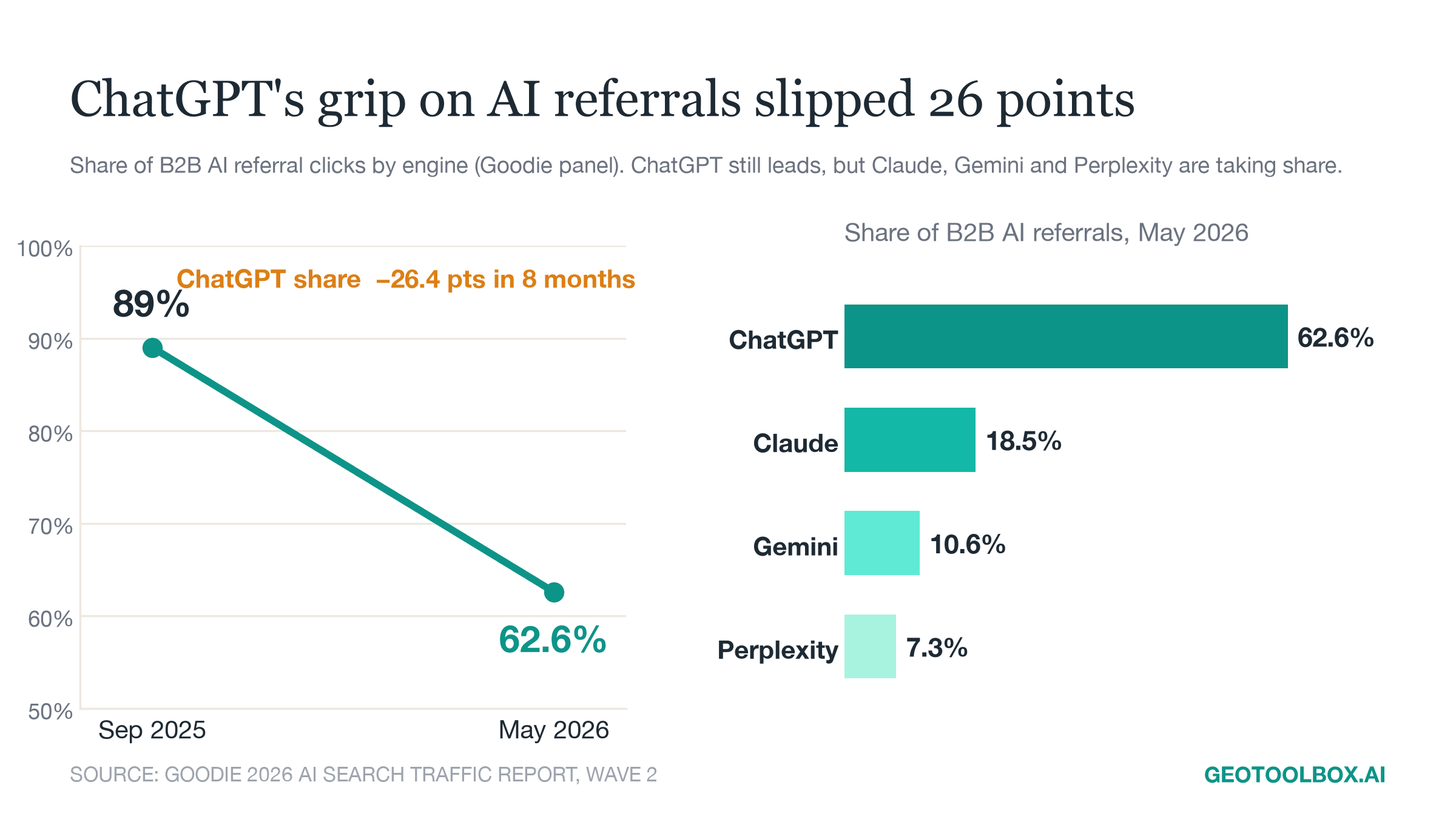
Reach and referrals are different things. When Goodie's 2026 AI search traffic report measured which engines actually send B2B visitors, four platforms, ChatGPT, Claude, Gemini, and Perplexity, carried about 99% of all AI referral clicks. Everything else is measurement noise for now. If you can only track a handful of engines, these four plus Google's AI surfaces cover nearly all of the traffic that leaves an AI answer.
Google's Two AI Surfaces: AI Overviews and AI Mode
Google now runs two distinct AI surfaces, and they behave differently. AI Overviews are AI-generated summaries injected into the classic SERP, so they compete with your blue link on the same page. AI Mode is a full conversational surface, closer to ChatGPT than to a results page, and ranking inside Google AI Mode follows chat-style retrieval, not position tracking. Treat them as two separate surfaces with separate playbooks.
GEO, AEO and LLMO Are One Discipline, and No, SEO Isn't Dead
GEO, AEO, LLMO and "AI SEO" describe the same job under different labels: getting cited when an AI engine answers instead of listing links. Roughly 80% of it is durable SEO. Crawlability, clear structure, real expertise. The other 20%, citation over ranking, third-party authority, per-engine behavior, is what's genuinely new.
The acronym sprawl is doing real damage, mostly by convincing people there are four new disciplines to learn. There aren't. The practitioner consensus across the industry press puts the overlap with classic SEO around 80%, and an informal DataForSEO content-analysis scan we ran in July 2026 put sentiment on the term "generative engine optimization" around 28% negative, so the skepticism you feel is widely shared. It's also partly earned: plenty of vendors renamed their SEO deck and doubled the price.
What Each Acronym Actually Optimizes For
The labels differ by what they emphasize, while the underlying work stays the same. Generative engine optimization (GEO) targets generative engines as a class. Answer engine optimization (AEO) frames the goal as the answer box. LLMO frames it as the model layer. All three converge on one outcome: your brand mentioned and your pages cited in generated answers. If you want the full taxonomy argument, we've mapped GEO vs AEO vs SEO side by side. Either way, you do the work and the label sorts itself out.
Is SEO Dead? No, the Fundamentals Still Gate Everything
Every AI engine that grounds its answers starts from a retrieval layer, and most retrieval layers start from a search index. A page that can't be crawled, doesn't get indexed, or reads as untrustworthy fails in AI search for exactly the same reasons it fails in classic search. What changed is the payout structure: ranking used to be the finish line, and now it's the qualifying round. If the practical question is how to divide effort between the two, our GEO vs SEO deep-dive covers the budget split and when SEO still wins.
AI Overviews Now Appear on Roughly Half of Google Searches
In 2026 AI Overviews appear on roughly half of US Google searches, and when one shows, clicks to the top result fall sharply. But the story isn't a straight line down: click-through partially rebounded in early 2026, and branded queries can gain clicks, which is why both panic and complacency miss the mark.
The prevalence numbers first. BrightEdge tracked AI Overviews on about 48% of Google searches in early 2026, and Semrush and BrightEdge tracker data both put the figure near half of US queries. The ramp was steep: Semrush measured AI Overviews on 13.1% of searches in March 2025, roughly half of them within a year. If your pages answer informational queries, the question is no longer whether an AI Overview sits above you. It's what the zero-click search dynamic does to your clicks when it does.
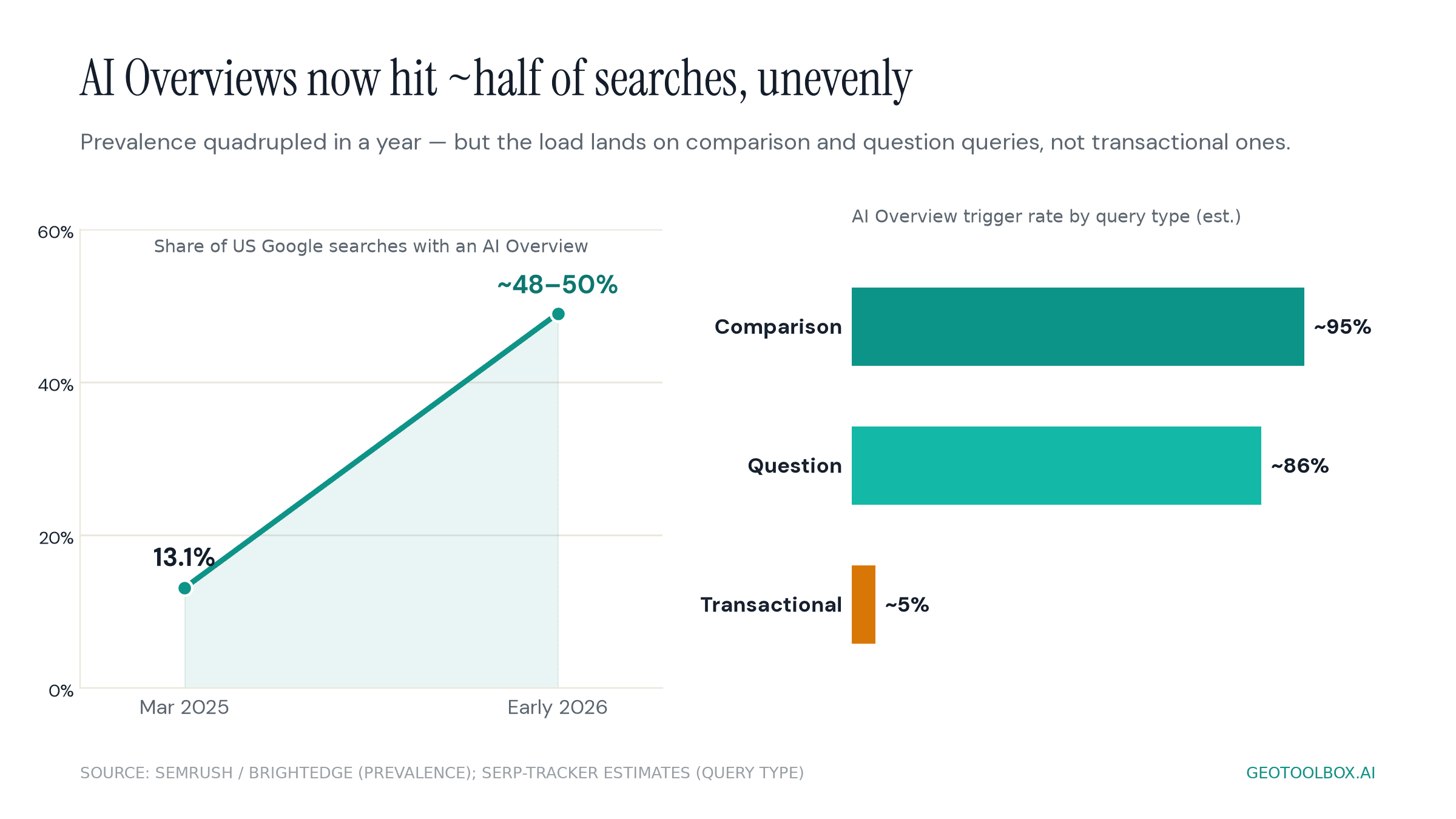
The concentration matters as much as the average. Third-party SERP trackers put the AI Overview trigger rate near 95% for comparison queries and around 86% for question-form queries, against roughly 5% for transactional ones (these query-type splits are tracker estimates, not first-party figures). Informational content absorbs almost all of the impact; product and checkout pages barely feel it.
| Metric | 2025 | 2026 | Source |
|---|---|---|---|
| AI Overview prevalence | 13.1% of searches (Mar 2025) | ~48-50% of US searches | Semrush / BrightEdge trackers |
| Top-ranking page CTR when an AIO shows | ~34.5% lower (2025 estimate) | ~58% lower (Feb 2026, 300K keywords) | Ahrefs |
| Users clicking any result, with vs without AI summary | 8% vs 15% (Jul 2025) | No published re-run yet | Pew Research Center |
| Clicks on links inside the AI Overview | ~1% of visits (Jul 2025) | No published re-run yet | Pew Research Center |
| AIO organic CTR, longitudinal | ~1.3% at the Dec 2025 low | ~2.4% (Feb 2026) | Seer Interactive |
How AI Overviews Cut Clicks (and by How Much)
The most credible click-impact data comes from outside the SEO industry. Pew Research Center analyzed 68,879 real Google searches and found users clicked a traditional result 8% of the time when an AI summary appeared versus 15% without one, a 47% relative drop. Only about 1% of visits produced a click on a link inside the summary, and about 26% of these page visits ended without any further click.
Ahrefs' February 2026 study across 300,000 keywords found the top-ranking page loses about 58% of its expected CTR when an AI Overview is present, up from its 34.5% estimate a year earlier. One caution before you extrapolate: that 58% is the hit to the top-ranking page on affected queries, not a 58% loss of sitewide traffic. Most sites have a mix of query types, and the transactional end of that mix is barely touched. If you want the tactical response, we've covered how to get cited in AI Overviews separately.
The 2026 CTR Rebound Almost No One Is Reporting
The decline isn't monotonic, which is the part most coverage misses. Seer Interactive's longitudinal study, covering 2.43 billion impressions across 53 brands, found organic CTR on AIO-affected queries bottomed near 1.3% in December 2025 and recovered to roughly 2.4% by February 2026. A separate Amsive study of 700,000 keywords found branded queries with an AI Overview gaining about 18% CTR. These are two studies, and we'd treat them as an emerging signal rather than settled fact, but they're the strongest evidence yet that "AI Overviews killed clicks" was a 2025 snapshot, and the picture is already shifting. Watching your own affected queries in an AI Overview tracker beats arguing about whose average applies to you.
Citations Are Decoupling From Google Rankings
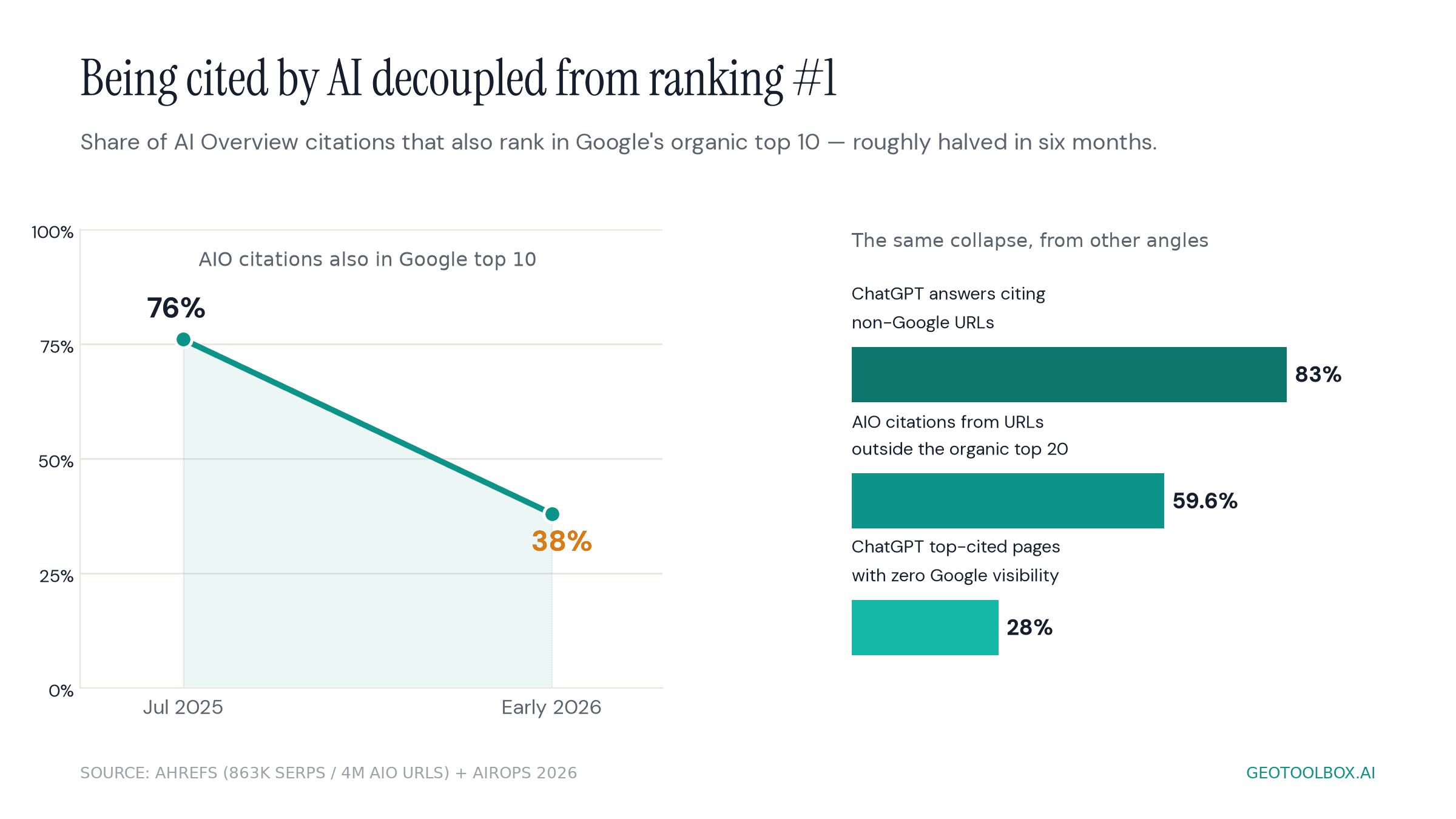
The link between ranking in Google's top 10 and being cited by AI has collapsed. In mid-2025 about three-quarters of AI Overview citations also ranked in Google's top 10; by early 2026 only about 38% did. AI engines increasingly pull from pages that don't rank at all, so a page can be cited without ranking, and vice versa.
The canonical dataset here is Ahrefs' study of 863,000 SERPs and 4 million AI Overview URLs: in July 2025, roughly 76% of AI Overview citations also appeared in the organic top 10. By early 2026, that overlap had fallen to about 38%. Half the relationship, gone in months.
Other datasets frame the same collapse from the opposite end. AirOps' 2026 State of AI Search, the analysis Kevin Indig worked on, found 59.6% of AI Overview citations come from URLs that don't rank in the organic top 20 at all. Off Google's surfaces the decoupling is starker: Ahrefs found 83% of ChatGPT's answers cite URLs that don't appear in Google's results for the same query, and 28% of ChatGPT's most-cited pages have zero Google organic visibility whatsoever. eMarketer's read is more aggressive still, putting fewer than 10% of sources cited by ChatGPT, Gemini and Microsoft Copilot inside Google's top 10 for the matching query.
Being cited is associated with more clicks, too. Seer's impression-level data shows brands cited inside an AI Overview earn about 120% more clicks per impression than non-cited brands on the same SERP. An AI citation increasingly correlates with getting the click, rather than replacing it.
| Measure | Value | Date | Source |
|---|---|---|---|
| AI Overview citations also ranking in Google's top 10 | ~76% falling to ~38% | Jul 2025 to early 2026 | Ahrefs (863K SERPs) |
| AIO citations from URLs outside the organic top 20 | 59.6% | 2026 | AirOps / Kevin Indig |
| ChatGPT answers citing URLs absent from Google's results | 83% | 2026 | Ahrefs |
| ChatGPT's most-cited pages with zero Google organic visibility | 28% | 2026 | Ahrefs |
| Extra organic clicks for brands cited inside an AIO | ~+120% more clicks per impression | 2025-2026 | Seer Interactive (2.43B impressions) |
Why Classic Rank Tracking Now Misses Your AI Visibility
A rank tracker answers "where do I appear in an ordered list." AI visibility is a different question: "am I retrieved, mentioned, and linked when an engine composes an answer." With 38% overlap and falling, position data now predicts a minority of your AI citations, and it says nothing about ChatGPT, Claude or Perplexity, where how ChatGPT picks its citations has little to do with your Google position. You need a second instrument. We cover what that looks like in the measurement section below.
Query Fan-Out: How One Question Becomes Many
The mechanism behind the decoupling is retrieval design. When you ask an AI engine one question, it typically decomposes it into several sub-queries, retrieves candidates for each, then synthesizes an answer from the union. This is query fan-out, and it means your page can be selected for a sub-query that never appears in any rank tracker. A page that answers one narrow facet precisely can out-cite a page that ranks #1 for the head term.
What the Studies Agree On, and Where They Flatly Contradict Each Other
The 2026 reports don't agree. ChatGPT's referral share is quoted at both 62.6% and 80%+, AI's traffic share at both 0.1% and a few percent, brand visibility as both "highly unstable" and "durable." Most of these aren't errors. They're the same metric measured on different panels, dates, or brand tiers. Here's how they reconcile.
Five Points Most of the Studies Converge On
Strip away the headline fights and the studies converge on five points. First, fragmentation is real: no single engine covers your AI visibility anymore. Second, third-party pages beat owned pages as citation sources, by a wide margin (quantified in the next section). Third, community and UGC platforms form a trust layer engines lean on heavily. Fourth, the zero-click backdrop persists: most AI answers end without any click. Fifth, freshness matters more than it did in classic search; stale pages lose citations measurably faster than stale rankings ever decayed.
Those fights sit on top of that shared floor, and most of these disagreements become clearer once you check the methodology.
The Five Numbers They Fight Over (and the Honest Answer to Each)
| Metric | Source A | Source B | Why they differ | The reconciled read |
|---|---|---|---|---|
| ChatGPT's share of AI referrals | 80%+ and rising (Ahrefs, Nov 2025) | 62.6%, down from 89% eight months earlier (Goodie, May 2026) | Different panels, six months apart | Both were right at their timestamp. It's a trend: Claude (18.5%) and Gemini are taking share, and the fresher B2B panel catches the decline |
| Rank-citation overlap | 76% falling to 38% of AIO citations in the top 10 (Ahrefs) | 59.6% of AIO citations outside the top 20 (AirOps) | Same collapse, framed from opposite ends | The rank-citation link is breaking, whichever end you measure from |
| AI's share of total traffic | ~0.1% of web referrals (Ahrefs, broad web) | low single digits of B2B inbound (Goodie, B2B panel) | A broad-web average vs a B2B SaaS panel; an order-of-magnitude-plus spread | Report a range, 0.1% to a few percent by vertical, and remember both undercount dark AI traffic hiding in Direct |
| Brand visibility stability | Only 30% of brands stay visible answer-to-answer; 20% across 5 runs (AirOps) | The "Universal 36" held top-100 visibility on all four platforms every single month (Semrush) | A brand-tier artifact: one measures everyone, one measures the elite | Stability is earned at the very top. For everyone else, visibility is volatile run-to-run |
| Mentions vs citations | Mention/citation overlap as low as 30% on Gemini (Semrush/AirOps) | Brands earning both are ~40% likelier to stay visible (AirOps) | Not a contradiction; two different signals | A mention is your name in the answer, a citation is a linked source. Track both |
Walk through the logic once and the pattern generalizes. When two AI-search numbers disagree, check the panel (broad web vs B2B), the date (this field moves quarterly), and the brand tier (elite brands behave differently from everyone else) before assuming either study botched it. The mention-citation distinction matters most in practice: a brand mention without a link and a linked citation without your name are different assets, they correlate weakly, and your AI share of voice depends on both.
In our experience running visibility scans across engines, the run-to-run swing AirOps describes is exactly what makes a single manual prompt-check misleading; the same brand can appear in one answer and vanish from the next regeneration.
Third-Party Sources Drive Most AI Citations, Not Your Own Site
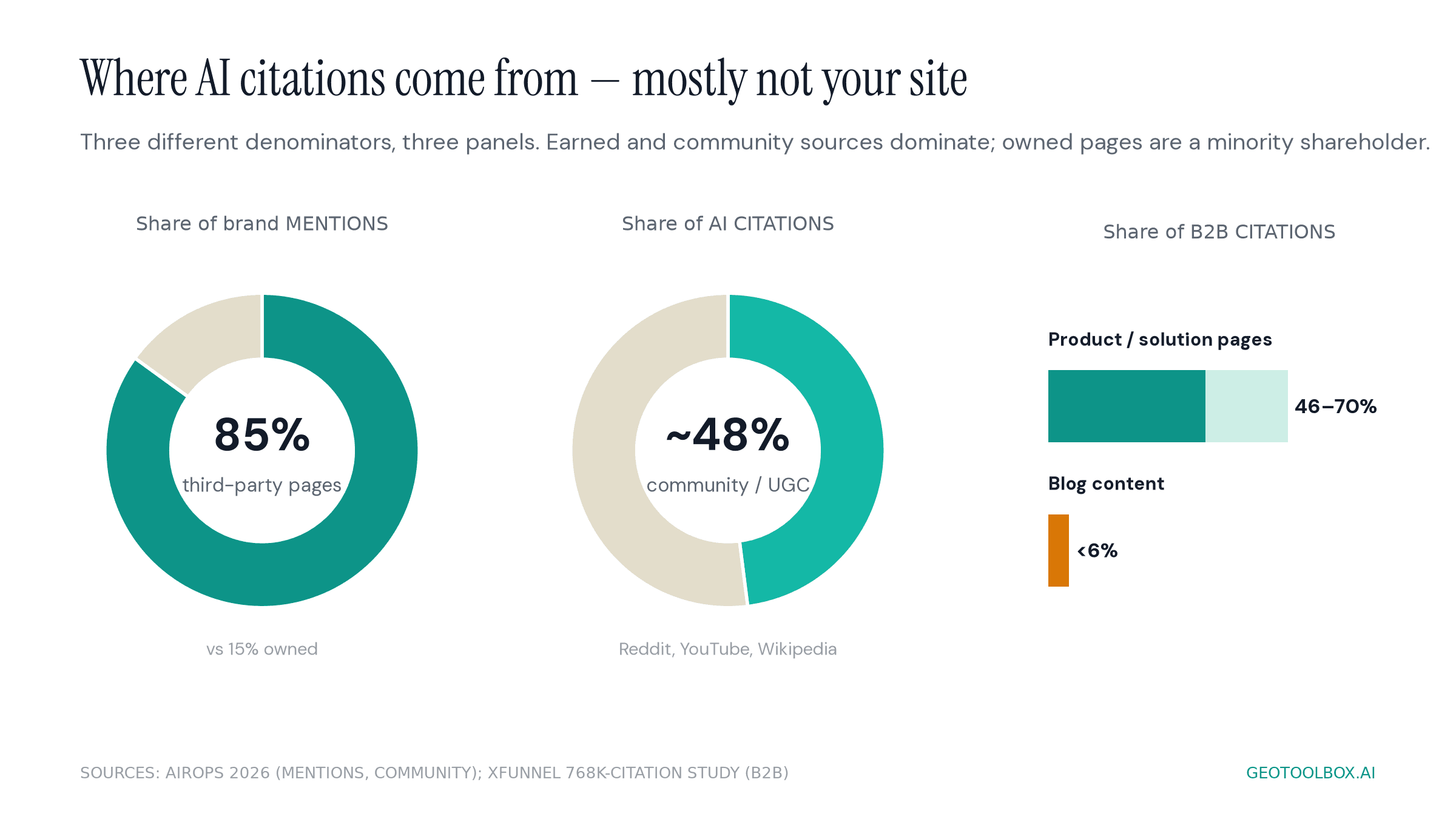
The biggest lever in AI visibility usually isn't your own site. Roughly 85% of brand mentions in AI answers come from third-party pages, and community platforms like Reddit, YouTube and Wikipedia supply nearly half of all citations. A weaker competitor often gets cited because it's talked about in the places engines trust.
These figures come from AirOps' 2026 dataset, a single source, so treat them as directional: about 85% of brand mentions in AI answers originate from third-party pages, making a brand roughly 6.5 times more likely to be mentioned via someone else's content than its own, and around 48% of AI citations trace to user-generated and community sources. Your domain is a minority shareholder in your own AI visibility.
| Source type | Share of citations / mentions | Best-fit surface | What it means for you |
|---|---|---|---|
| Third-party pages (all) | ~85% of brand mentions (AirOps) | All engines | Earned coverage outweighs owned content for visibility |
| Community / UGC platforms | ~48% of AI citations (AirOps) | ChatGPT, Perplexity, AI Overviews | Genuine community presence is a real citation channel |
| YouTube | Among the most-cited domains in AI answers; AirOps ranks it #2 in Gemini and Perplexity (AirOps) | AI Overviews, Gemini | Frequently cited even where no page ranks |
| Review platforms (G2, Trustpilot, Capterra) | ~3x citation probability when present (SE Ranking, estimate) | ChatGPT, Perplexity | The highest-impact earned lever for commercial queries |
| Owned product / solution pages | 46-70% of B2B citations (XFunnel 768K-citation study, verify before betting on it) | B2B commercial queries | Product pages out-cite blogs on money queries |
| Owned blog content | Under 6% of B2B citations (same analysis) | Informational queries | Blogs earn topical presence, not commercial citations |
Reddit, YouTube and Wikipedia Are the Trust Layer
High-trust community platforms appear to function as a trust signal in the citation mix. YouTube is among the most-cited domains in AI answers, with AirOps ranking it #2 in Gemini and Perplexity, so video content gets cited even without a ranking page. Reddit citations concentrate on category-level queries, around 88% of them by AirOps' count, which is exactly where buyers ask "what's the best X." You can't spam your way into this layer; engines and communities both punish it. You can earn it the way E-E-A-T for AI search describes: real participation, real reviews, real expertise attached to a real entity.
Review Platforms and Product Pages: The Two Highest-Impact Levers
If you need movement this quarter, two levers stand out. Presence on major review platforms correlates with roughly triple the citation probability for commercial queries (an SE Ranking estimate we'd verify before budgeting against). And in B2B, XFunnel's 768,000-citation study found product and solution pages earning 46-70% of AI citations while blog content took under 6%, a ratio worth checking against your own citation mix even if the exact split needs independent confirmation. Both levers reward the same thing: being a clearly defined entity engines can resolve, which is the case for investing in entity SEO before another content sprint.
AI Traffic Is Tiny, Converts Better, and Is Partly Invisible
AI referral traffic is still a sliver, somewhere between about 0.1% of broad-web referrals and low single digits of B2B inbound depending on the panel, but it converts far better than classic organic and engages longer, and a chunk of it hides in your Direct channel. The volume argument understates it, and standard analytics undercount it.
The honest volume number is the range from the contradiction matrix: about 0.1% of broad-web referrals (Ahrefs) up to low single digits of B2B inbound (Goodie). Nobody serious claims AI referrals rival organic search on volume in mid-2026. The case rests on quality and trajectory instead, and in some verticals the trajectory is steep: Adobe's data, surfaced in Semrush's index, tracked AI traffic to US retail sites up 1,324% and travel sites up 2,215% between October 2024 and May 2026.
Small Volume, High Intent: the Conversion and Engagement Case
Ahrefs published a first-party figure worth pausing on: AI search visitors converted about 23 times better than traditional organic visitors, with AI referrals driving 12% of signups from 0.5% of traffic. Treat the 23x as a SaaS-shaped outlier, not your forecast; one panel suggests the advantage is smaller, in the low single-digit multiples. Even the conservative end changes the math on "ignore it, it's 0.1%." Engagement points the same way: Goodie's panel has AI visitors staying about 30% longer than Google organic visitors.
Efficiency also differs sharply by engine, which is why a single "AI traffic" line in your analytics is already too coarse:
| Engine | Share of AI visits (Goodie B2B panel) | Share of B2B AI referrals | Efficiency read |
|---|---|---|---|
| ChatGPT | Majority of AI visits (est.) | 62.6% | The volume engine; share falling from 89% in 8 months |
| Claude | 1.29% | 18.5% | ~14x over-indexed: tiny usage, outsized referrals |
| Perplexity | 1.85% | 7.3% | ~4x over-indexed; search-native users click sources |
| Gemini | 29.0% | 10.6% | Under-indexed: high usage, answers rarely send clicks |
Dark AI Traffic: Why GA4 Undercounts It
Some AI surfaces strip or mangle referrer data, and clicks from apps, copied links, and certain in-answer clicks land in your analytics as Direct. Goodie estimates around 5% of "Direct" traffic is actually misattributed AI traffic; that's an estimate, not a measurement, but the mechanism is uncontested. The practical takeaway: if you evaluate AI search on your GA4 referral report alone, you're grading it on partial evidence. Separating real Direct from dark AI requires the kind of instrumentation we walk through in how to track AI visibility, plus the answer-side measurement the next section covers.
45% of Teams Still Can't Measure Their AI Visibility (Here's How to Start)
Most teams are flying blind: 45% of marketing leaders say they can't accurately measure brand visibility in AI answers, and only 9% have full tracking in place. You can fix that without an enterprise contract. Track four things across a fixed prompt set, repeated: share of voice, citation rate, mention rate, and answer position.
Those two numbers come from Semrush's 2026 AI Visibility Index, and they describe a strange market: nearly every team we talk to is being asked about AI visibility, and almost none can produce a trend line for it. The real 2026 crisis is the measurement gap. You can't prioritize levers you can't score.
The Four AI-Visibility Metrics Worth Tracking
Four metrics cover the job. Share of voice: of all brand appearances across your prompt set, what fraction are you versus competitors (definition at share of voice). Citation rate: how often your URLs appear as linked sources. Mention rate: how often your brand is named, linked or not. Answer position: whether you lead the answer or trail it. Mentions and citations overlap as little as 30% on Gemini, so tracking one and assuming the other is how teams end up with a misleading AI visibility score.
How to Check Whether ChatGPT, Perplexity and Gemini Cite You (Step by Step)
- Build a fixed prompt set: 10-20 real buyer questions in your category, phrased the way customers ask them, not the way you'd search them.
- Run each prompt across the engines that matter to you. Don't eyeball one engine and extrapolate; citation behavior differs per engine.
- Record mention vs citation vs position, for your brand and 2-3 competitors, in a spreadsheet with dates.
- Repeat on a schedule, weekly or biweekly. Answers drift run-to-run, so a single snapshot is noise; the trend is the signal.
- Cross-check reachability: confirm AI crawlers can fetch your pages with the free AI Crawler Checker. An engine can't cite what it can't read.
Manually, that's a few hours per wave and it gets skipped the third week. This is the job we built geotoolbox for: it runs your prompt set across the eight engines we track, a different eight from the industry landscape above: ChatGPT, Perplexity, Gemini, Claude, Google AI Overviews, Google AI Mode, Microsoft Copilot, and Grok, and records mentions, citations and position over time. We count Google's AI Overviews and AI Mode as two of our tracked eight, and DeepSeek, the rising engine from the landscape above, is next on our roster rather than live today. Whether you automate it or run it by hand, the schema is the same, and a structured AI visibility audit is the right first wave.
| Metric | What it tells you | Free way to check | When to upgrade to a tool |
|---|---|---|---|
| Reachability | Whether AI crawlers can fetch your pages at all | Check robots.txt and server logs, or run a free crawler-access checker | When you need per-bot monitoring across many pages |
| Share of voice | Your slice of brand appearances vs competitors | Manual prompt set, tally appearances per brand | When competitors or prompt count outgrow a spreadsheet |
| Citation rate | How often your URLs are linked as sources | Run prompts, log every linked URL | When you need per-engine, per-page trend lines |
| Mention rate | How often you're named, with or without a link | Same prompt log, separate column | When run-to-run variance drowns your manual sample |
| Answer position | Whether you lead the answer or appear as an afterthought | Note first-mention position per answer | When you track more than a handful of prompts weekly |
Why Self-Prompting Once Is Misleading
The AirOps stability data is the reason step 4 exists: only 30% of brands stay visible from one answer to the next regeneration, and just 20% hold visibility across five runs of the same prompt. LLMs sample their outputs, so two identical prompts produce different answers by design; why AI answers vary covers the mechanics. The operational consequence: your CEO asking ChatGPT once and reporting "we're not in AI" (or "we are, ship it") is not a measurement. Repetition is what separates signal from sampling noise, the same way a single rank check never was a rank report. If you want position-style tracking across engines, that's what an AI rank tracker does with prompts instead of keywords.
Domain Authority Barely Predicts AI Citations, and It Depends on the Engine
Domain authority is a weak predictor of AI citations, but how weak depends on the engine. Pure LLM engines like ChatGPT and Perplexity show almost no correlation between authority metrics and citations. Google's AI Overviews still lean on classic rankings. Branded mentions, not backlinks, track AI visibility most closely.
The starkest number comes from Surfer's June 2026 analysis of 5 million citations: the Spearman correlation between domain authority or PageRank-style metrics and AI citations came out near zero, from about -0.07 to +0.01 depending on the metric. Statistically, no relationship. Before you delete your link-building budget, read that by engine. AI Overviews are grounded in Google's ranked index, so ranking still buys citation probability there (recall the 38% of AIO citations that still overlap the top 10). ChatGPT and Perplexity aren't grounded in Google's index, which is where the correlation flatlines.
What does correlate? Ahrefs ran the comparison directly: branded web mentions correlate with AI Overview visibility at 0.664, far above backlinks at 0.218 or domain rating at 0.326. The market is unevenly claimed too: 26% of brands have zero AI Overview mentions at all, while the top 50 brands soak up 28.9% of all AIO citations, leaving the space concentrated at the top and wide open through the middle where most sites compete.
Why ChatGPT and Perplexity Ignore Your Authority Score
LLM-native engines select passages, not domains. What retrieval rewards is extractability (can a self-contained passage answer the sub-query), entity clarity (does the engine know who you are, which is knowledge graph territory), and freshness. None of those inherit from domain authority. This is also why the two engines diverge in whom they cite for identical prompts; we've documented the behavioral split in ChatGPT vs Perplexity.
Why Google AI Overviews Still Reward Ranking
AI Overviews are generated on top of Google's live index and its ranking signals, so classic position still buys probability there, falling probability (recall the 76%-to-38% overlap collapse), but real. Practically: traditional ranking and link-authority signals keep paying on Google's AI surfaces but contribute less on ChatGPT or Perplexity, even though SEO fundamentals like crawlability and structure still matter everywhere. Budget accordingly instead of arguing about whether "authority matters" in the abstract, since it depends on the engine.
What Actually Moves AI Citations in 2026 (and What's Folklore)
Four levers have real evidence behind them: branded third-party mentions, freshness, answer-first structure, and cited evidence (sources, stats, and quotations). Two popular ones mostly don't move citations: llms.txt and schema-as-a-silver-bullet. Here's each lever, the study behind it, and how strongly it correlates, so you can spend effort where it pays.
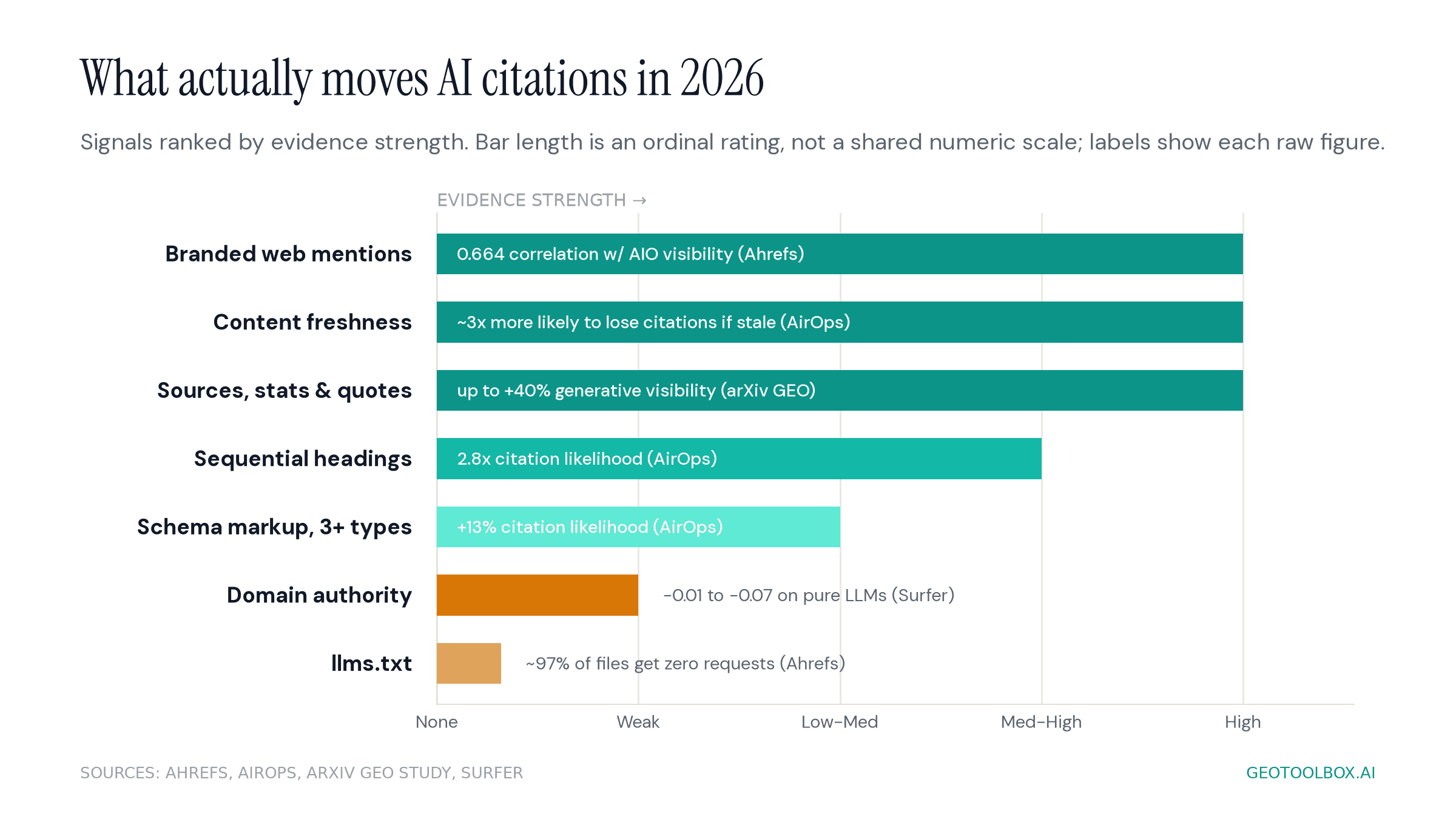
| Signal | What the data shows | Strength | Do this |
|---|---|---|---|
| Branded web mentions | 0.664 correlation with AIO visibility (Ahrefs) | High | Earn third-party and community coverage before more owned content |
| Content freshness | Pages not updated quarterly are ~3x likelier to lose citations; 83% of commercial citations from pages updated within a year (AirOps) | High | Put update cycles on your cited pages, with dated changes |
| Sources, stats and quotations | Up to +40% generative visibility vs unoptimized content (arXiv GEO study) | High | Cite primary data inline; add expert quotes with attribution |
| Sequential heading structure | 2.8x citation likelihood; 87% of cited pages use a single H1 (AirOps) | Medium-high | One H1, logical H2/H3 order, answer-first sections |
| Schema markup, 3+ types | +13% citation likelihood; ~61% of cited pages use 3+ types (AirOps) | Low-medium | Implement it, then stop expecting miracles from it |
| Domain authority | near zero, from about -0.07 to +0.01 depending on the metric on pure LLMs (Surfer); engine-specific on AIO | Weak / engine-specific | Stop reporting DR as an AI-visibility KPI |
| llms.txt | ~97% of files receive zero requests (Ahrefs); Google doesn't support it | No measured effect | Fine to ship, don't count it as work done |
The Four Levers with Real Evidence
Freshness has the scariest numbers: AirOps found pages not updated quarterly are about three times more likely to lose their AI citations, over 70% of AI-cited pages were updated within the last 12 months, and 83% of citations on commercial queries come from pages updated within a year. Structure is next: sequential, logical heading hierarchy correlates with 2.8 times higher citation likelihood, 68.7% of ChatGPT-cited pages use a clean hierarchy, and 87% carry a single H1. Branded web mentions (the 0.664 correlation) you've already seen. And the original GEO research from Princeton-affiliated authors showed that adding cited sources, statistics, and quotations lifts generative-engine visibility up to 40% versus unoptimized content, the finding the entire discipline is named after. The working checklist version of all four lives in how to optimize for AI search.
Does llms.txt Work? Barely, in 2026
The proposal is appealing and the adoption data isn't. Ahrefs analyzed server logs across roughly 137,000 domains and found about 97% of published llms.txt files received zero requests, from bots or humans. Google's search advocates have said plainly that Google doesn't use it. We keep a live status check in does llms.txt work, because this could change, but in mid-2026 llms.txt rarely does anything measurable. Ship it in an afternoon if you like; just don't report it as AI optimization.
Schema Helps a Little
Schema earned a middle verdict: pages with three or more schema types show about 13% higher citation likelihood, and 61% of cited pages use three-plus types. That's a real and modest effect, worth implementing but not a strategy on its own. The right frame for schema markup in 2026: it's connective tissue that helps engines resolve entities and structure, and the specific types worth shipping are in our guide to schema markup for AI search. If a vendor pitches schema as the AI-visibility silver bullet, that 13% lift is the number to hold them to.
The Small-Site Playbook: You Over-Index on AI Traffic
If you run a small site, the data leans your way: small sites earn a higher share of AI traffic than giant ones, and AI engines routinely cite low-authority pages over big brands. You don't need a big budget. You need three moves: be reachable, be talked about, be extractable.
Why Small Sites Over-Index on AI Traffic
Ahrefs' traffic data shows sites under 10,000 monthly visits drawing about 0.3% of their traffic from AI, three times the ~0.1% share that sites with over a million visits see. Add the citation math from earlier: authority barely predicts citations on LLM engines, 26% of brands have zero AI Overview presence, and query fan-out selects precise passages over powerful domains. Classic search compounded advantages for incumbents; AI retrieval, at least in 2026, levels part of that slope. There's a geographic edge too: AI Overviews trigger most often in Indonesia, the Philippines and Mexico, so sites serving those markets may find extra opportunity there, though it needs local query and language validation.
The First Three Moves That Aren't Hype
Move one: confirm you're reachable. A surprising number of sites block GPTBot, PerplexityBot or ClaudeBot by accident, via CDN defaults or a copy-pasted robots.txt. Our guide to AI crawlers lists every bot that matters and what to allow, and the free AI Readiness check grades your site's crawlability, structure and machine-readability in one pass.
Move two: earn third-party mentions where your buyers already talk. One genuine Reddit thread, one review-platform profile with real reviews, one YouTube walkthrough. That's the 85%-third-party lever scaled to a small team.
Move three: restructure one flagship page answer-first. Single H1, question-shaped H2s, a 40-60 word direct answer under each, updated date. That's the 2.8x structure lever applied where it counts. Measure before and after; if you'd rather compare tooling first, we've reviewed the current field in the best generative engine optimization tools.
Run the reachability check before anything else. Every other lever in this article assumes engines can fetch your pages; a blocked crawler silently zeroes out the rest of the playbook.
Where This Leaves You
The 2026 studies disagree on the decimals and agree on the direction: AI visibility is decoupling from rankings, migrating off your own domain, and concentrating in engines that don't behave alike. Every contradiction in the data resolves to a panel, a date, or a brand tier, which means the next contradictory headline you read probably isn't wrong either. It's just partial.
The one thing you can act on today is measurement, because you can't fix what you can't see, and 45% of your peers can't see it. If you'd rather not spend Friday afternoons re-running prompts by hand, geotoolbox's domain overview runs a fixed prompt set across ChatGPT, Perplexity, Gemini, Claude, Google's AI surfaces, Microsoft Copilot and Grok, and turns mentions, citations and answer position into the trend line this article keeps asking you for.
Frequently Asked Questions
How much of my traffic drop is from AI Overviews vs a Google core update?
Separate the timelines first: match your drop's start date against AI Overview rollout dates for your query types and against Google's confirmed core-update dates. Then check GSC: impressions holding while clicks fall points to AI Overviews; both falling together points to a ranking loss. Informational pages lose most to AI Overviews, transactional pages least.
How do I check if ChatGPT, Perplexity or Gemini is citing my website?
Build a fixed set of 10-20 real buyer questions, run each across the engines, and record whether you're mentioned, cited as a linked source, and where in the answer you appear. Repeat weekly, because answers change run to run. A single manual check is sampling noise rather than a measurement.
Is AI search traffic worth optimizing for if it's only 0.1% of my traffic?
For most sites, yes. The 0.1% to a few percent share undercounts reality because part of AI traffic hides in your Direct channel, and the visitors it does send convert several times better than classic organic. Small sites also earn roughly triple the AI-traffic share of large ones, so the smaller you are, the stronger the case.
What's the difference between a mention and a citation in AI search?
A mention is your brand named inside the answer text; a citation is your URL linked as a source. They correlate weakly, with overlap as low as 30% on Gemini, and brands earning both are about 40% likelier to stay visible. Track them as two separate metrics.
Is AEO the same as GEO, and which should I be doing?
Same discipline, different labels. GEO emphasizes generative engines, AEO emphasizes answers, LLMO emphasizes models, and all three optimize for the same outcome: being mentioned and cited in generated answers. Pick whichever term your team likes and do the work; about 80% of it is durable SEO either way.
Does llms.txt actually do anything yet?
Not measurably. Around 97% of published llms.txt files receive zero requests according to Ahrefs' log analysis, and Google has said it doesn't use the file. It costs little to publish and may age well, but in 2026 it belongs at the bottom of the list, after reachability, structure and third-party presence.
Why does a weaker competitor get cited by AI when I don't?
Usually because citation doesn't follow authority. The likeliest causes, in order: they're discussed more on third-party and community platforms, their pages answer questions in extractable answer-first passages, their entity is clearer to the engines, and their content is fresher. Domain strength correlates near zero with citations on ChatGPT and Perplexity, so "we're the bigger brand" doesn't enter the equation.
Sources and Methodology
We reconciled the major public 2026 AI-search datasets. Figures are attributed inline to their source and dated where the source provides a date, and single-source or unverified figures are flagged in the text.
- Ahrefs, AI Overview citations and the rank-citation link (76% to 38% overlap, 58% CTR, 83% non-Google): ahrefs.com/blog/ai-overview-citations-top-10 -
ahrefs.com/blog/ai-overview-citations-top-10 - Ahrefs, AI SEO statistics (the 0.664 branded-mention correlation, 23x conversion, 97% zero-request llms.txt, small-site AI-traffic share, and other cited Ahrefs figures span this and the study above): ahrefs.com/blog/ai-seo-statistics -
ahrefs.com/blog/ai-seo-statistics - Google, I/O 2026 announcement (AI Mode at 1B+ monthly users): blog.google -
blog.google/products-and-platforms/products/search/search-io-2026 - Pew Research Center, AI summaries and click behavior: pewresearch.org -
pewresearch.org/short-reads/2025/07/22/google-users-are-less-likely-to-click-on-links-when-an-ai-summary-appears-in-the-results - AirOps, The 2026 State of AI Search: airops.com/report/the-2026-state-of-ai-search -
airops.com/report/the-2026-state-of-ai-search - Goodie, 2026 AI Search Traffic Report: higoodie.com/blog/ai-search-traffic-report-2026 -
higoodie.com/blog/ai-search-traffic-report-2026 - Semrush, 2026 AI Visibility Index: ai-visibility-index.semrush.com -
ai-visibility-index.semrush.com - Amsive, AI Overviews click-study: amsive.com -
amsive.com/insights/seo/google-ai-overviews-new-research-reveals-how-to-navigate-click-drop-off - Seer Interactive, AIO impact on Google CTR (2026 update): seerinteractive.com -
seerinteractive.com/insights/aio-impact-on-google-ctr-2026-update - Aggarwal et al., GEO: Generative Engine Optimization (arXiv): arxiv.org/abs/2311.09735 -
arxiv.org/abs/2311.09735 - Surfer, domain-authority vs AI-citation correlation study (5M citations, June 2026)
- XFunnel, B2B AI-citation study (768K citations, 2026)
- SE Ranking, review-platform AI-citation study (2026)
- eMarketer, generative engine optimization research (2026)
- BrightEdge, AI Overview prevalence tracker (2026)
- Adobe, retail and travel AI-traffic growth data (Oct 2024 to May 2026), surfaced via the Semrush AI Visibility Index
- Sentiment on "generative engine optimization" (~28% negative) is an informal DataForSEO content-analysis scan the author ran in July 2026, not a formal study